×
Request Free Sample ×

Kindly complete the form below to receive a free sample of this Report

* Please use a valid business email

Leading companies partner with us for data-driven Insights

clients tt-cursor
Hero Background
English
Chinese
French
Japanese
Korean
German
Spanish

Solar Hybrid Inverter Market Share

ID: MRFR/EnP/6980-HCR
111 Pages
Priya Nagrale
February 2026

Solar Hybrid Inverter Market Size, Share & Growth Analysis Report by Product (Single-Phase Hybrid, Three-Phase Hybrid), By Grid Type (On Grid, Off Grid), End-User (Commercial, Residential and Others), Sales Channel (Direct, Distributor), By Application (Energy Generation, Solar Energy Storage, Others) And By Region (North America, Europe, Asia-Pacific, And Rest Of The World) - Growth & Industry Forecast to 2035

Share:
Download PDF ×

We do not share your information with anyone. However, we may send you emails based on your report interest from time to time. You may contact us at any time to opt-out.

Solar Hybrid Inverter Market Infographic
Purchase Options

Market Share

Solar Hybrid Inverter Market Share Analysis

In the quickly advancing Solar Hybrid Inverter market, organizations send different techniques to lay out and improve their market share situating. Mechanical advancement is a key driver, with organizations zeroing in on creating progressed solar hybrid inverters that coordinate flawlessly with sustainable power sources. Developments like bidirectional abilities, hybrid energy stockpiling similarity, and network tied functionalities add to the separation of items, drawing in clients looking for flexible and proficient answers for solar energy usage. The premium evaluating procedures might be utilized by organizations stressing predominant highlights like higher effectiveness, high level checking abilities, or upgraded toughness. The picked evaluating technique lines up with the organization's general market situating and target client inclinations. Continual development permits organizations to work on the proficiency of inverters, improve similarity with different energy stockpiling arrangements, and coordinate smart highlights for remote observing and control. Progresses in power hardware and programming add to the improvement of solar hybrid inverters that satiate the developing needs of the environmentally friendly power market. Organizations that underscore eco-accommodating practices, like utilizing recyclable materials, decreasing energy utilization during activity, and guaranteeing item recyclability, resound with earth cognizant clients. Furthermore, the improvement of solar hybrid inverters that add to in general energy effectiveness and diminish reliance on customary power sources upgrades an organization's standing and market situating. Besides, offering complete after-deals administrations, including establishment backing and maintenance, improves an organization's standing for unwavering quality and client care. The mixture of smart advancements, for example, IoT-empowered observing and control frameworks, permits organizations to offer astute inverters that can upgrade energy use, give constant information bits of knowledge, and work with far off administration. These smart elements line up with the developing interest for interconnected and carefully empowered energy arrangements.
Author
Priya Nagrale
Senior Research Analyst

With an experience of over five years in market research industry (Chemicals & Materials domain), I gather and analyze market data from diverse sources to produce results, which are then presented back to a client. Also, provide recommendations based on the findings. As a Senior Research Analyst, I perform quality checks (QC) for market estimations, QC for reports, and handle queries and work extensively on client customizations. Also, handle the responsibilities of client proposals, report planning, report finalization, and execution

Leave a Comment

FAQs

What is the projected market valuation of the Solar Hybrid Inverter Market by 2035?

<p>The Solar Hybrid Inverter Market is projected to reach a valuation of 24.75 USD Billion by 2035.</p>

What was the market valuation of the Solar Hybrid Inverter Market in 2024?

<p>In 2024, the overall market valuation was 9.69 USD Billion.</p>

What is the expected CAGR for the Solar Hybrid Inverter Market during the forecast period 2025 - 2035?

<p>The expected CAGR for the Solar Hybrid Inverter Market during the forecast period 2025 - 2035 is 8.9%.</p>

Which application segment is projected to have the highest valuation by 2035?

<p>The Utility application segment is projected to reach a valuation of 7.5 USD Billion by 2035.</p>

What are the projected valuations for the Residential segment by 2035?

<p>The Residential segment is projected to reach a valuation of 6.25 USD Billion by 2035.</p>

Which technology type is expected to dominate the market by 2035?

<p>The Grid-tied technology type is expected to dominate the market, projected to reach 9.75 USD Billion by 2035.</p>

What is the projected valuation for the Off-grid segment by 2035?

The Off-grid segment is projected to reach a valuation of 3.63 USD Billion by 2035.

Who are the key players in the Solar Hybrid Inverter Market?

Key players in the market include SMA Solar Technology AG, Fronius International GmbH, and SolarEdge Technologies Inc.

What is the projected valuation for the Battery component type by 2035?

The Battery component type is projected to reach a valuation of 5.78 USD Billion by 2035.

What is the expected valuation for the Agricultural Sector end user by 2035?

The Agricultural Sector end user is expected to reach a valuation of 1.5 USD Billion by 2035.

Market Summary

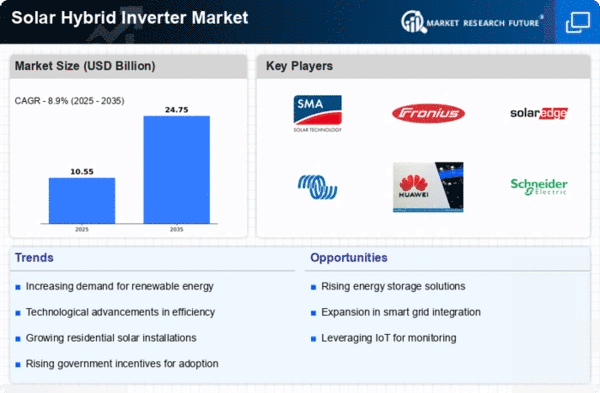
As per MRFR analysis, the Solar Hybrid Inverter Market Size was estimated at 9.69 USD Billion in 2024. The Solar Hybrid Inverter industry is projected to grow from 10.55 USD Billion in 2025 to 24.75 USD Billion by 2035, exhibiting a compound annual growth rate (CAGR) of 8.9% during the forecast period 2025 - 2035.

Key Market Trends & Highlights

The Solar Hybrid Inverter Market is experiencing robust growth driven by technological advancements and increasing consumer demand.

  • North America remains the largest market for solar hybrid inverters, reflecting a strong adoption of renewable energy solutions. The Asia-Pacific region is identified as the fastest-growing market, propelled by rising energy needs and supportive government policies. The residential segment continues to dominate the market, while the commercial segment is witnessing rapid growth due to increasing energy efficiency initiatives. Rising energy costs and government incentives are key drivers fueling the expansion of the solar hybrid inverter market.

Market Size & Forecast

2024 Market Size 9.69 (USD Billion)
2035 Market Size 24.75 (USD Billion)
CAGR (2025 - 2035) 8.9%
Largest Regional Market Share in 2024 Asia-Pacific

Major Players

SMA Solar Technology AG (DE), Fronius International GmbH (AT), SolarEdge Technologies Inc (IL), Victron Energy (NL), Huawei Technologies Co., Ltd. (CN), Schneider Electric SE (FR), Tigo Energy, Inc. (US), Enphase Energy, Inc. (US), Goodwe Power Supply Technology Co., Ltd. (CN)

Market Trends

The Solar Hybrid Inverter Market is currently experiencing a notable transformation, driven by the increasing demand for renewable energy solutions and the growing emphasis on energy efficiency. This market encompasses inverters that combine solar energy with other power sources, such as grid electricity or diesel generators, thereby enhancing reliability and flexibility in energy supply. As consumers and businesses alike seek to reduce their carbon footprints, the adoption of solar hybrid inverters appears to be gaining momentum. Furthermore, advancements in technology are likely to play a pivotal role in shaping the future landscape of this market, as innovations lead to improved performance and cost-effectiveness. In addition, the regulatory environment is evolving, with governments worldwide implementing policies that promote the use of renewable energy technologies. This trend suggests a supportive framework for the Solar Hybrid Inverter Market, potentially encouraging investments and fostering growth. As awareness of climate change and sustainability issues continues to rise, the market may witness an influx of new players and products, further diversifying the offerings available to consumers. Overall, the Solar Hybrid Inverter Market seems poised for substantial growth, driven by technological advancements and a favorable regulatory climate.

Technological Advancements

The Solar Hybrid Inverter Market is witnessing rapid technological advancements that enhance efficiency and performance. Innovations in inverter design and energy management systems are likely to improve energy conversion rates and reduce operational costs. These developments may also facilitate better integration with smart home technologies, making solar hybrid systems more attractive to consumers.

Regulatory Support

Government policies and incentives are playing a crucial role in the expansion of the Solar Hybrid Inverter Market. Various regions are implementing supportive regulations that encourage the adoption of renewable energy solutions. This regulatory backing could lead to increased investments in solar hybrid technologies, fostering market growth.

Consumer Awareness and Demand

There is a growing awareness among consumers regarding the benefits of renewable energy, which is driving demand for solar hybrid inverters. As individuals and businesses seek sustainable energy solutions, the market is likely to see an increase in the adoption of these systems. This trend suggests a shift towards more environmentally friendly energy practices.

Solar Hybrid Inverter Market Market Drivers

Rising Electricity Costs

The increasing cost of electricity is a significant driver for the Global Solar Hybrid Inverter Market Industry. As traditional energy prices continue to rise, consumers are seeking alternative energy solutions to mitigate their electricity expenses. Solar hybrid inverters provide a viable option by enabling users to generate their own electricity, thus reducing dependence on grid power. This trend is particularly evident in regions where electricity prices are soaring, prompting homeowners and businesses to invest in solar energy systems. The potential for long-term savings on energy bills is likely to propel market growth in the coming years.

Market Growth Projections

The Global Solar Hybrid Inverter Market Industry is projected to grow significantly, with estimates indicating a rise from 9.69 USD Billion in 2024 to 24.8 USD Billion by 2035. This growth reflects a compound annual growth rate (CAGR) of 8.9% from 2025 to 2035, highlighting the increasing adoption of solar hybrid inverters across various sectors. The market dynamics suggest a robust expansion driven by technological advancements, government incentives, and rising consumer awareness regarding renewable energy solutions. Such projections indicate a promising future for the solar hybrid inverter market, positioning it as a key player in the global energy landscape.

Growing Environmental Awareness

Growing environmental awareness among consumers is a pivotal factor influencing the Global Solar Hybrid Inverter Market Industry. As individuals and organizations become more conscious of their carbon footprints, there is an increasing preference for sustainable energy solutions. Solar hybrid inverters, which facilitate the use of renewable energy, align with this shift towards eco-friendly practices. This heightened awareness is driving demand for solar energy systems, as consumers seek to contribute to environmental conservation. The market's growth trajectory appears promising, as more people recognize the benefits of adopting solar technology in their daily lives.

Government Incentives and Subsidies

Government incentives and subsidies play a crucial role in the expansion of the Global Solar Hybrid Inverter Market Industry. Many countries are offering financial support to encourage the installation of solar energy systems, including tax credits, grants, and rebates. These initiatives lower the initial investment barrier for consumers and businesses, making solar hybrid inverters more accessible. As a result, the market is expected to witness substantial growth, with a projected CAGR of 8.9% from 2025 to 2035. Such supportive policies not only stimulate demand but also contribute to the overall transition towards sustainable energy solutions.

Increasing Demand for Renewable Energy

The Global Solar Hybrid Inverter Market Industry is experiencing a surge in demand driven by the global shift towards renewable energy sources. Governments worldwide are implementing policies and incentives to promote solar energy adoption, which is reflected in the projected market growth from 9.69 USD Billion in 2024 to 24.8 USD Billion by 2035. This transition is not only environmentally motivated but also economically beneficial, as solar hybrid inverters enhance energy efficiency and reduce reliance on fossil fuels. The increasing awareness of climate change and the need for sustainable energy solutions further bolster this trend, indicating a robust future for the solar hybrid inverter market.

Technological Advancements in Inverter Design

Technological innovations are significantly shaping the Global Solar Hybrid Inverter Market Industry. The development of advanced inverter technologies, such as multi-mode operation and smart grid integration, enhances the efficiency and reliability of solar energy systems. These advancements allow for better energy management, optimizing the use of solar power and reducing energy costs for consumers. As inverter technology continues to evolve, it is likely to attract more investments and drive market growth. The integration of artificial intelligence and machine learning in inverter systems may further improve performance, suggesting a promising trajectory for the industry.

Market Segment Insights

By Application: Residential (Largest) vs. Commercial (Fastest-Growing)

The Solar Hybrid Inverter Market showcases a diverse application spectrum, with the Residential segment holding the largest share. Homeowners are increasingly adopting solar hybrid inverters due to rising energy costs and a growing emphasis on sustainability. This segment benefits from government incentives and the increasing installation of solar panels, making it a preferred choice for energy independence. Meanwhile, the Commercial segment, albeit smaller in share, is emerging as the fastest-growing area. Businesses are recognizing the financial and environmental benefits of integrating solar hybrid solutions to reduce operational costs and transition to greener practices. Growth trends indicate that the Residential application will continue to thrive, driven by technological advancements that enhance efficiency and performance. Additionally, the influx of smart home technologies promotes the integration of solar hybrid inverters, offering users better control over energy consumption. In contrast, the Commercial sector is expanding rapidly as organizations seek to meet sustainability goals and comply with stricter regulations. Fleet management and large-scale solar deployments are increasingly becoming common, propelling the demand for these versatile inverters in the commercial landscape.

Residential (Dominant) vs. Commercial (Emerging)

The Residential segment is characterized by its strong market position, driven by the increasing installation of solar energy systems in homes. As homeowners seek to reduce electricity bills and reliance on the grid, this segment effectively meets the demand for sustainable energy solutions. Enhanced features such as energy storage capabilities, manageability through mobile applications, and integration with home energy management systems bolster the attractiveness of these products. On the other hand, the Commercial segment, while classified as emerging, shows remarkable promise for growth. Commercial enterprises are investing in solar hybrid inverters as they become more environmentally conscious, looking to lower their carbon footprint. The need for reliable power solutions and the benefits of cost savings from energy efficiency make this segment a focal point for manufacturers and investors in the solar hybrid inverter industry.

By Technology Type: Grid-tied (Largest) vs. Off-grid (Fastest-Growing)

<p>In the Solar Hybrid Inverter Market, the technology type segment is diverse, encompassing Grid-tied, Off-grid, Hybrid, Battery-based, and Microgrid systems. Grid-tied inverters currently dominate the market, offering seamless integration with the existing electrical grid and providing reliability and cost-effectiveness. Off-grid systems are rapidly gaining traction, catering to the increasing demand for energy independence and sustainability in regions without grid access. The diversity in technology types helps address various consumer needs, with each segment presenting unique advantages.</p>

<p>Grid-tied (Dominant) vs. Off-grid (Emerging)</p>

<p>Grid-tied solar hybrid inverters stand as the dominant technology type, primarily designed to work in conjunction with the electrical grid. These systems allow users to harness solar energy efficiently while benefiting from grid electricity during low solar production periods. Conversely, Off-grid systems represent the emerging trend, gaining popularity particularly in remote areas where conventional power supply is unreliable. These inverters facilitate complete energy autonomy, utilizing battery storage to ensure a consistent power supply. Both segments serve significant yet distinct consumer bases, with grid-tied systems being more common for urban installations, while off-grid solutions cater to rural or isolated applications.</p>

By Power Rating: 5 kW to 10 kW (Largest) vs. Above 20 kW (Fastest-Growing)

<p>The Solar Hybrid Inverter Market demonstrates a varied distribution of power rating segments, with the 5 kW to 10 kW range commanding the largest market share. This segment has gained ground due to increasing residential and small commercial installations. Meanwhile, the above 20 kW segment is emerging rapidly, driven by the demand for renewable energy solutions in larger industrial applications and utility-scale projects. The growth trends indicate a clear shift towards higher power ratings as governments and businesses adopt more intensive solar energy strategies. This transition is supported by advancements in inverter technology and initiatives aimed at enhancing energy efficiency. Moreover, the rising adoption of hybrid systems that integrate battery storage with traditional solar setups is further propelling the above 20 kW segment, marking it as the fastest-growing category within the market.</p>

<p>5 kW to 10 kW (Dominant) vs. Above 20 kW (Emerging)</p>

<p>The 5 kW to 10 kW power rating segment is considered dominant due to its widespread application in residential and small commercial settings, where it effectively balances energy demand and supply. Features such as user-friendly interfaces and compatibility with various energy sources contribute to its appeal. In contrast, the above 20 kW segment is seen as emerging, primarily driven by large-scale solar installations in industrial environments. These inverters often incorporate advanced features like grid management and smart technology, allowing for efficient energy distribution and enhanced performance in demanding applications.</p>

By End User: Homeowners (Largest) vs. Businesses (Fastest-Growing)

<p>In the Solar Hybrid Inverter Market, the end-user segment is primarily dominated by homeowners, who constitute the largest share due to the increasing shift toward energy independence and sustainability. This segment benefits from various government incentives and solar programs, making it an appealing option for residential solar solutions. On the other hand, businesses are emerging as the fastest-growing segment, motivated by the need for reliable and cost-effective energy solutions. They recognize the long-term savings associated with solar hybrid inverters as key to their operational efficiency.</p>

<p>Homeowners (Dominant) vs. Businesses (Emerging)</p>

<p>Homeowners represent the dominant force in the Solar Hybrid Inverter Market, characterized by a strong preference for energy solutions that allow for autonomy and sustainability. This segment is further propelled by the social trend towards environmentally friendly practices and government support through incentives. In contrast, businesses are quickly becoming an emerging segment, drawn by the advantages of reduced operational costs and increased reliability. This growth is largely driven by rising energy costs and the need for backup power solutions that offer both efficiency and sustainability, indicating a shift in energy consumption trends in favor of commercial solar solutions.</p>

By Component Type: Inverter (Largest) vs. Battery (Fastest-Growing)

<p>The Solar Hybrid Inverter Market is segmented into five primary component types: inverter, battery, charge controller, monitoring system, and switchgear. Among these, inverters hold the largest market share due to their critical role in converting solar energy into usable electricity. This segment is a cornerstone of solar hybrid systems, allowing for seamless integration of energy from various sources. Batteries, on the other hand, represent the fastest-growing segment as they are increasingly essential for energy storage and management, enabling users to maximize their solar energy usage during peak demand periods.</p>

<p>Battery (Dominant) vs. Monitoring System (Emerging)</p>

<p>The battery segment is currently regarded as a dominant force within the Solar Hybrid Inverter Market, driven by advancements in energy storage technologies and escalating demand for renewable energy solutions. Batteries offer enhanced capabilities for energy management, enabling consumers to utilize stored energy effectively, which aligns with the growing trend for sustainable living. In contrast, the monitoring system segment is emerging as an important player, providing critical insights into energy consumption and system performance. It enables users to optimize their energy usage, which is increasingly sought after in modern energy management strategies, thus presenting a significant growth opportunity in the market.</p>

Get more detailed insights about Solar Hybrid Inverter Market Research Report - Global Forecast till 2035

Regional Insights

North America : Growing Adoption of Renewables

The North American solar hybrid inverter market is poised for significant growth, driven by increasing demand for renewable energy solutions and supportive government policies. With a market size of $1.94 billion, the region is witnessing a surge in residential and commercial solar installations. Regulatory incentives, such as tax credits and rebates, are further catalyzing this growth, making solar energy more accessible to consumers. Leading countries like the USA and Canada are at the forefront of this transition, with major players such as Enphase Energy, Tigo Energy, and Schneider Electric actively contributing to market expansion. The competitive landscape is characterized by innovation and technological advancements, ensuring that North America remains a key player in The Solar Hybrid Inverter.

Europe : Innovative Energy Solutions Hub

Europe is emerging as a powerhouse in the solar hybrid inverter market, with a market size of €2.31 billion. The region's commitment to sustainability and stringent environmental regulations are driving the adoption of solar technologies. Countries like Germany, France, and the Netherlands are leading the charge, supported by government initiatives aimed at reducing carbon emissions and promoting renewable energy sources. The competitive landscape is robust, featuring key players such as SMA Solar Technology and Fronius International. These companies are leveraging innovative technologies to enhance efficiency and reliability in solar hybrid inverters. The European market is characterized by a strong emphasis on research and development, ensuring that it remains at the forefront of solar energy solutions.

Asia-Pacific : Emerging Powerhouse in Solar

The Asia-Pacific region is the largest market for solar hybrid inverters, boasting a market size of $5.0 billion. This growth is fueled by rapid urbanization, increasing energy demands, and government initiatives promoting renewable energy. Countries like China, India, and Japan are leading the way, with substantial investments in solar infrastructure and technology, making the region a global leader in solar energy production. The competitive landscape is vibrant, with major players such as Huawei Technologies and Goodwe Power Supply Technology driving innovation. The presence of these key players, along with favorable regulatory frameworks, positions Asia-Pacific as a critical player in The Solar Hybrid Inverter, ensuring continued growth and development in the sector.

Middle East and Africa : Resource-Rich Frontier for Solar

The Middle East and Africa region is emerging as a significant player in the solar hybrid inverter market, with a market size of $0.44 billion. The region's abundant solar resources and increasing energy needs are driving investments in renewable energy solutions. Governments are implementing policies to diversify energy sources and reduce reliance on fossil fuels, creating a favorable environment for solar energy adoption. Countries like South Africa and the UAE are leading the charge, with initiatives aimed at expanding solar capacity. The competitive landscape is evolving, with both local and international players entering the market. This growth is supported by strategic partnerships and investments in technology, positioning the region for future advancements in solar energy.

Key Players and Competitive Insights

The Solar Hybrid Inverter Market is currently characterized by a dynamic competitive landscape, driven by increasing demand for renewable energy solutions and advancements in inverter technology. Key players such as SMA Solar Technology AG (DE), SolarEdge Technologies Inc (IL), and Huawei Technologies Co., Ltd. (CN) are strategically positioned to leverage these trends. SMA Solar Technology AG (DE) focuses on innovation and product diversification, while SolarEdge Technologies Inc (IL) emphasizes digital transformation and smart energy management solutions. Huawei Technologies Co., Ltd. (CN) is expanding its footprint through strategic partnerships and technological advancements, collectively shaping a competitive environment that prioritizes efficiency and sustainability.In terms of business tactics, companies are increasingly localizing manufacturing to reduce costs and enhance supply chain resilience. The market appears moderately fragmented, with several key players exerting influence through innovative product offerings and strategic collaborations. This competitive structure allows for a diverse range of solutions, catering to various customer needs and preferences.
In November SMA Solar Technology AG (DE) announced a partnership with a leading energy provider to develop a new line of hybrid inverters tailored for residential applications. This strategic move is likely to enhance SMA's market presence and address the growing demand for efficient home energy solutions. The collaboration underscores the importance of partnerships in driving innovation and expanding product offerings in the sector.
In October SolarEdge Technologies Inc (IL) launched a new AI-driven monitoring platform designed to optimize energy consumption and enhance system performance. This initiative reflects the company's commitment to integrating advanced technologies into its product suite, potentially setting a new standard for energy management in the hybrid inverter market. The focus on AI integration may provide SolarEdge with a competitive edge in an increasingly tech-driven landscape.
In September Huawei Technologies Co., Ltd. (CN) unveiled its latest generation of hybrid inverters, featuring enhanced efficiency and smart grid capabilities. This product launch is indicative of Huawei's strategy to lead in technological innovation, positioning the company favorably against competitors. The emphasis on smart grid technology aligns with global trends towards more interconnected and efficient energy systems.
As of December the competitive trends in the Solar Hybrid Inverter Market are increasingly defined by digitalization, sustainability, and the integration of AI technologies. Strategic alliances are playing a crucial role in shaping the current landscape, enabling companies to pool resources and expertise. Looking ahead, competitive differentiation is likely to evolve from traditional price-based competition to a focus on innovation, technological advancements, and supply chain reliability, as companies strive to meet the growing expectations of environmentally conscious consumers.

Key Companies in the Solar Hybrid Inverter Market include

Industry Developments

The year 2023 will see Ningbo Deye Inverter Technology Co., Ltd. as a major manufacturer of intelligent hybrid inverters meant to seamlessly link into battery storage systems and smart grids. The advanced inverters assist in improved energy efficiency and flexibility in power management thus catering to the changing requirements of modern energy solutions.

Sungrow introduced its latest SH8.ORS and SHIORS single-phase hybrid inverters for homes at All Energy Australia 2023 in October 2023. The advantages of this system are capable of seamless transition within 10ms for uninterrupted power supply, improved performance and reliability through upgrading the design, as well as a digital energy management platform (iSolarCloud) on which smart energy management is made possible.

GoodWe launched a high-capacity ET Series three-phase hybrid for residential and small C&I applications in October 2022. Powerful energy backup, peak shaving, and intelligent load management provide other benefits with respect to this series of inverters for increased energy autonomy and reduced energy costs. The intention behind this is to provide reliable and flexible energy solutions for various rooftop installations by increasing the range of its products to serve larger residential and small commercial/industrial projects.

According to IEA forecast published in 2022, global renewable capacity is set to soar by nearly 2 400 GW (nearly three-quarters) between 2022 and 2027

In 2021, Tesla (TSLA) launched a solar power inverter that complemented its home solar lineup alongside Powerwall. It is what the Tesla Solar Inverter does converting DC electricity generated by sunlight into AC for use in households. The inverter has strong safety features and an easy installation process with compatibility on both Solar Roof and standard solar panels because it leverages Tesla’s expertise in power electronics.

Governments worldwide have been implementing policies and incentives aimed at promoting the adoption of solar power like the Solar Investment Tax Credit (ITC) being used within the United States, which provides a 26% tax credit for solar installations until 2022.

Ingeteam developer of electric power conversion equipment, released the INGECON SUN storage 1 play TLM hybrid inverter in the year 2020. This new product is highly adaptable, with one battery input and two other PV panel inputs. Each PV input has its own maximum power point tracking mechanism. The solar hybrid inverter has a flexible application allowing easy setup and firmware updates via PC, tablet or smartphone. Additionally, the lead-acid batteries and lithium-ion used by most of the major storage systems in the market are compatible with this type of storage system.

This will drive market growth during the forecast period.

In July 2018, Schneider Electric, an energy management specialist and automation leader, secured a patent for its new smart charge technology- the Conext SW inverter. It initiates automatic battery charging and monitors excess power flow.

Future Outlook

Solar Hybrid Inverter Market Future Outlook

The future of the Solar Hybrid Inverter Market is set for rapid expansion as energy independence becomes a global priority. Driven by the integration of advanced battery storage and smart grid technology, the market will benefit from rising demand for resilient, self-sufficient power solutions in residential sectors.

New opportunities lie in:

  • <p>Expansion into emerging markets with tailored financing solutions. Development of smart grid integration technologies for enhanced efficiency. Partnerships with electric vehicle manufacturers for dual-use applications.</p>

The Solar Hybrid Inverter market reveals that by 2035 this market is expected to be robust, reflecting substantial growth and innovation.

Market Segmentation

Solar Hybrid Inverter Market End Use Outlook

  • Energy Management
  • Backup Power
  • Renewable Integration
  • Load Shifting
  • Demand Response

Solar Hybrid Inverter Market Technology Outlook

  • Grid-tied
  • Off-grid
  • Hybrid
  • Battery Storage
  • Smart Inverter

Solar Hybrid Inverter Market Application Outlook

  • Residential
  • Commercial
  • Industrial
  • Utility
  • Off-grid

Report Scope

MARKET SIZE 2024 9.69(USD Billion)
MARKET SIZE 2025 10.55(USD Billion)
MARKET SIZE 2035 24.75(USD Billion)
COMPOUND ANNUAL GROWTH RATE (CAGR) 8.9% (2025 - 2035)
REPORT COVERAGE Revenue Forecast, Competitive Landscape, Growth Factors, and Trends
BASE YEAR 2024
Market Forecast Period 2025 - 2035
Historical Data 2019 - 2024
Market Forecast Units USD Billion
Key Companies Profiled SMA Solar Technology AG (DE), Fronius International GmbH (AT), SolarEdge Technologies Inc (IL), Victron Energy (NL), Huawei Technologies Co., Ltd. (CN), Schneider Electric SE (FR), Tigo Energy, Inc. (US), Enphase Energy, Inc. (US), Goodwe Power Supply Technology Co., Ltd. (CN)
Segments Covered Application, Technology, End Use
Key Market Opportunities Growing demand for renewable energy solutions drives innovation in the Solar Hybrid Inverter Market.
Key Market Dynamics Rising demand for renewable energy drives innovation and competition in the Solar Hybrid Inverter Market.
Countries Covered North America, Europe, APAC, South America, MEA

FAQs

What is the projected market valuation of the Solar Hybrid Inverter Market by 2035?

<p>The Solar Hybrid Inverter Market is projected to reach a valuation of 24.75 USD Billion by 2035.</p>

What was the market valuation of the Solar Hybrid Inverter Market in 2024?

<p>In 2024, the overall market valuation was 9.69 USD Billion.</p>

What is the expected CAGR for the Solar Hybrid Inverter Market during the forecast period 2025 - 2035?

<p>The expected CAGR for the Solar Hybrid Inverter Market during the forecast period 2025 - 2035 is 8.9%.</p>

Which application segment is projected to have the highest valuation by 2035?

<p>The Utility application segment is projected to reach a valuation of 7.5 USD Billion by 2035.</p>

What are the projected valuations for the Residential segment by 2035?

<p>The Residential segment is projected to reach a valuation of 6.25 USD Billion by 2035.</p>

Which technology type is expected to dominate the market by 2035?

<p>The Grid-tied technology type is expected to dominate the market, projected to reach 9.75 USD Billion by 2035.</p>

What is the projected valuation for the Off-grid segment by 2035?

The Off-grid segment is projected to reach a valuation of 3.63 USD Billion by 2035.

Who are the key players in the Solar Hybrid Inverter Market?

Key players in the market include SMA Solar Technology AG, Fronius International GmbH, and SolarEdge Technologies Inc.

What is the projected valuation for the Battery component type by 2035?

The Battery component type is projected to reach a valuation of 5.78 USD Billion by 2035.

What is the expected valuation for the Agricultural Sector end user by 2035?

The Agricultural Sector end user is expected to reach a valuation of 1.5 USD Billion by 2035.

  1. SECTION I: EXECUTIVE SUMMARY AND KEY HIGHLIGHTS
    1. | 1.1 EXECUTIVE SUMMARY
    2. | | 1.1.1 Market Overview
    3. | | 1.1.2 Key Findings
    4. | | 1.1.3 Market Segmentation
    5. | | 1.1.4 Competitive Landscape
    6. | | 1.1.5 Challenges and Opportunities
    7. | | 1.1.6 Future Outlook
  2. SECTION II: SCOPING, METHODOLOGY AND MARKET STRUCTURE
    1. | 2.1 MARKET INTRODUCTION
    2. | | 2.1.1 Definition
    3. | | 2.1.2 Scope of the study
    4. | | | 2.1.2.1 Research Objective
    5. | | | 2.1.2.2 Assumption
    6. | | | 2.1.2.3 Limitations
    7. | 2.2 RESEARCH METHODOLOGY
    8. | | 2.2.1 Overview
    9. | | 2.2.2 Data Mining
    10. | | 2.2.3 Secondary Research
    11. | | 2.2.4 Primary Research
    12. | | | 2.2.4.1 Primary Interviews and Information Gathering Process
    13. | | | 2.2.4.2 Breakdown of Primary Respondents
    14. | | 2.2.5 Forecasting Model
    15. | | 2.2.6 Market Size Estimation
    16. | | | 2.2.6.1 Bottom-Up Approach
    17. | | | 2.2.6.2 Top-Down Approach
    18. | | 2.2.7 Data Triangulation
    19. | | 2.2.8 Validation
  3. SECTION III: QUALITATIVE ANALYSIS
    1. | 3.1 MARKET DYNAMICS
    2. | | 3.1.1 Overview
    3. | | 3.1.2 Drivers
    4. | | 3.1.3 Restraints
    5. | | 3.1.4 Opportunities
    6. | 3.2 MARKET FACTOR ANALYSIS
    7. | | 3.2.1 Value chain Analysis
    8. | | 3.2.2 Porter's Five Forces Analysis
    9. | | | 3.2.2.1 Bargaining Power of Suppliers
    10. | | | 3.2.2.2 Bargaining Power of Buyers
    11. | | | 3.2.2.3 Threat of New Entrants
    12. | | | 3.2.2.4 Threat of Substitutes
    13. | | | 3.2.2.5 Intensity of Rivalry
    14. | | 3.2.3 COVID-19 Impact Analysis
    15. | | | 3.2.3.1 Market Impact Analysis
    16. | | | 3.2.3.2 Regional Impact
    17. | | | 3.2.3.3 Opportunity and Threat Analysis
  4. SECTION IV: QUANTITATIVE ANALYSIS
    1. | 4.1 Energy & Power, BY Application (USD Billion)
    2. | | 4.1.1 Residential
    3. | | 4.1.2 Commercial
    4. | | 4.1.3 Industrial
    5. | | 4.1.4 Utility
    6. | | 4.1.5 Off-grid
    7. | 4.2 Energy & Power, BY Technology Type (USD Billion)
    8. | | 4.2.1 Grid-tied
    9. | | 4.2.2 Off-grid
    10. | | 4.2.3 Hybrid
    11. | | 4.2.4 Battery-based
    12. | | 4.2.5 Microgrid
    13. | 4.3 Energy & Power, BY Power Rating (USD Billion)
    14. | | 4.3.1 Below 1 kW
    15. | | 4.3.2 1 kW to 5 kW
    16. | | 4.3.3 5 kW to 10 kW
    17. | | 4.3.4 10 kW to 20 kW
    18. | | 4.3.5 Above 20 kW
    19. | 4.4 Energy & Power, BY End User (USD Billion)
    20. | | 4.4.1 Homeowners
    21. | | 4.4.2 Businesses
    22. | | 4.4.3 Government
    23. | | 4.4.4 Non-profit Organizations
    24. | | 4.4.5 Agricultural Sector
    25. | 4.5 Energy & Power, BY Component Type (USD Billion)
    26. | | 4.5.1 Inverter
    27. | | 4.5.2 Battery
    28. | | 4.5.3 Charge Controller
    29. | | 4.5.4 Monitoring System
    30. | | 4.5.5 Switchgear
    31. | 4.6 Energy & Power, BY Region (USD Billion)
    32. | | 4.6.1 North America
    33. | | | 4.6.1.1 US
    34. | | | 4.6.1.2 Canada
    35. | | 4.6.2 Europe
    36. | | | 4.6.2.1 Germany
    37. | | | 4.6.2.2 UK
    38. | | | 4.6.2.3 France
    39. | | | 4.6.2.4 Russia
    40. | | | 4.6.2.5 Italy
    41. | | | 4.6.2.6 Spain
    42. | | | 4.6.2.7 Rest of Europe
    43. | | 4.6.3 APAC
    44. | | | 4.6.3.1 China
    45. | | | 4.6.3.2 India
    46. | | | 4.6.3.3 Japan
    47. | | | 4.6.3.4 South Korea
    48. | | | 4.6.3.5 Malaysia
    49. | | | 4.6.3.6 Thailand
    50. | | | 4.6.3.7 Indonesia
    51. | | | 4.6.3.8 Rest of APAC
    52. | | 4.6.4 South America
    53. | | | 4.6.4.1 Brazil
    54. | | | 4.6.4.2 Mexico
    55. | | | 4.6.4.3 Argentina
    56. | | | 4.6.4.4 Rest of South America
    57. | | 4.6.5 MEA
    58. | | | 4.6.5.1 GCC Countries
    59. | | | 4.6.5.2 South Africa
    60. | | | 4.6.5.3 Rest of MEA
  5. SECTION V: COMPETITIVE ANALYSIS
    1. | 5.1 Competitive Landscape
    2. | | 5.1.1 Overview
    3. | | 5.1.2 Competitive Analysis
    4. | | 5.1.3 Market share Analysis
    5. | | 5.1.4 Major Growth Strategy in the Energy & Power
    6. | | 5.1.5 Competitive Benchmarking
    7. | | 5.1.6 Leading Players in Terms of Number of Developments in the Energy & Power
    8. | | 5.1.7 Key developments and growth strategies
    9. | | | 5.1.7.1 New Product Launch/Service Deployment
    10. | | | 5.1.7.2 Merger & Acquisitions
    11. | | | 5.1.7.3 Joint Ventures
    12. | | 5.1.8 Major Players Financial Matrix
    13. | | | 5.1.8.1 Sales and Operating Income
    14. | | | 5.1.8.2 Major Players R&D Expenditure. 2023
    15. | 5.2 Company Profiles
    16. | | 5.2.1 SMA Solar Technology AG (DE)
    17. | | | 5.2.1.1 Financial Overview
    18. | | | 5.2.1.2 Products Offered
    19. | | | 5.2.1.3 Key Developments
    20. | | | 5.2.1.4 SWOT Analysis
    21. | | | 5.2.1.5 Key Strategies
    22. | | 5.2.2 Fronius International GmbH (AT)
    23. | | | 5.2.2.1 Financial Overview
    24. | | | 5.2.2.2 Products Offered
    25. | | | 5.2.2.3 Key Developments
    26. | | | 5.2.2.4 SWOT Analysis
    27. | | | 5.2.2.5 Key Strategies
    28. | | 5.2.3 SolarEdge Technologies Inc. (IL)
    29. | | | 5.2.3.1 Financial Overview
    30. | | | 5.2.3.2 Products Offered
    31. | | | 5.2.3.3 Key Developments
    32. | | | 5.2.3.4 SWOT Analysis
    33. | | | 5.2.3.5 Key Strategies
    34. | | 5.2.4 Victron Energy B.V. (NL)
    35. | | | 5.2.4.1 Financial Overview
    36. | | | 5.2.4.2 Products Offered
    37. | | | 5.2.4.3 Key Developments
    38. | | | 5.2.4.4 SWOT Analysis
    39. | | | 5.2.4.5 Key Strategies
    40. | | 5.2.5 Huawei Technologies Co., Ltd. (CN)
    41. | | | 5.2.5.1 Financial Overview
    42. | | | 5.2.5.2 Products Offered
    43. | | | 5.2.5.3 Key Developments
    44. | | | 5.2.5.4 SWOT Analysis
    45. | | | 5.2.5.5 Key Strategies
    46. | | 5.2.6 Schneider Electric SE (FR)
    47. | | | 5.2.6.1 Financial Overview
    48. | | | 5.2.6.2 Products Offered
    49. | | | 5.2.6.3 Key Developments
    50. | | | 5.2.6.4 SWOT Analysis
    51. | | | 5.2.6.5 Key Strategies
    52. | | 5.2.7 OutBack Power Technologies (US)
    53. | | | 5.2.7.1 Financial Overview
    54. | | | 5.2.7.2 Products Offered
    55. | | | 5.2.7.3 Key Developments
    56. | | | 5.2.7.4 SWOT Analysis
    57. | | | 5.2.7.5 Key Strategies
    58. | | 5.2.8 Enphase Energy Inc. (US)
    59. | | | 5.2.8.1 Financial Overview
    60. | | | 5.2.8.2 Products Offered
    61. | | | 5.2.8.3 Key Developments
    62. | | | 5.2.8.4 SWOT Analysis
    63. | | | 5.2.8.5 Key Strategies
    64. | | 5.2.9 Tigo Energy, Inc. (US)
    65. | | | 5.2.9.1 Financial Overview
    66. | | | 5.2.9.2 Products Offered
    67. | | | 5.2.9.3 Key Developments
    68. | | | 5.2.9.4 SWOT Analysis
    69. | | | 5.2.9.5 Key Strategies
    70. | 5.3 Appendix
    71. | | 5.3.1 References
    72. | | 5.3.2 Related Reports
  6. LIST OF FIGURES
    1. | 6.1 MARKET SYNOPSIS
    2. | 6.2 NORTH AMERICA MARKET ANALYSIS
    3. | 6.3 US MARKET ANALYSIS BY APPLICATION
    4. | 6.4 US MARKET ANALYSIS BY TECHNOLOGY TYPE
    5. | 6.5 US MARKET ANALYSIS BY POWER RATING
    6. | 6.6 US MARKET ANALYSIS BY END USER
    7. | 6.7 US MARKET ANALYSIS BY COMPONENT TYPE
    8. | 6.8 CANADA MARKET ANALYSIS BY APPLICATION
    9. | 6.9 CANADA MARKET ANALYSIS BY TECHNOLOGY TYPE
    10. | 6.10 CANADA MARKET ANALYSIS BY POWER RATING
    11. | 6.11 CANADA MARKET ANALYSIS BY END USER
    12. | 6.12 CANADA MARKET ANALYSIS BY COMPONENT TYPE
    13. | 6.13 EUROPE MARKET ANALYSIS
    14. | 6.14 GERMANY MARKET ANALYSIS BY APPLICATION
    15. | 6.15 GERMANY MARKET ANALYSIS BY TECHNOLOGY TYPE
    16. | 6.16 GERMANY MARKET ANALYSIS BY POWER RATING
    17. | 6.17 GERMANY MARKET ANALYSIS BY END USER
    18. | 6.18 GERMANY MARKET ANALYSIS BY COMPONENT TYPE
    19. | 6.19 UK MARKET ANALYSIS BY APPLICATION
    20. | 6.20 UK MARKET ANALYSIS BY TECHNOLOGY TYPE
    21. | 6.21 UK MARKET ANALYSIS BY POWER RATING
    22. | 6.22 UK MARKET ANALYSIS BY END USER
    23. | 6.23 UK MARKET ANALYSIS BY COMPONENT TYPE
    24. | 6.24 FRANCE MARKET ANALYSIS BY APPLICATION
    25. | 6.25 FRANCE MARKET ANALYSIS BY TECHNOLOGY TYPE
    26. | 6.26 FRANCE MARKET ANALYSIS BY POWER RATING
    27. | 6.27 FRANCE MARKET ANALYSIS BY END USER
    28. | 6.28 FRANCE MARKET ANALYSIS BY COMPONENT TYPE
    29. | 6.29 RUSSIA MARKET ANALYSIS BY APPLICATION
    30. | 6.30 RUSSIA MARKET ANALYSIS BY TECHNOLOGY TYPE
    31. | 6.31 RUSSIA MARKET ANALYSIS BY POWER RATING
    32. | 6.32 RUSSIA MARKET ANALYSIS BY END USER
    33. | 6.33 RUSSIA MARKET ANALYSIS BY COMPONENT TYPE
    34. | 6.34 ITALY MARKET ANALYSIS BY APPLICATION
    35. | 6.35 ITALY MARKET ANALYSIS BY TECHNOLOGY TYPE
    36. | 6.36 ITALY MARKET ANALYSIS BY POWER RATING
    37. | 6.37 ITALY MARKET ANALYSIS BY END USER
    38. | 6.38 ITALY MARKET ANALYSIS BY COMPONENT TYPE
    39. | 6.39 SPAIN MARKET ANALYSIS BY APPLICATION
    40. | 6.40 SPAIN MARKET ANALYSIS BY TECHNOLOGY TYPE
    41. | 6.41 SPAIN MARKET ANALYSIS BY POWER RATING
    42. | 6.42 SPAIN MARKET ANALYSIS BY END USER
    43. | 6.43 SPAIN MARKET ANALYSIS BY COMPONENT TYPE
    44. | 6.44 REST OF EUROPE MARKET ANALYSIS BY APPLICATION
    45. | 6.45 REST OF EUROPE MARKET ANALYSIS BY TECHNOLOGY TYPE
    46. | 6.46 REST OF EUROPE MARKET ANALYSIS BY POWER RATING
    47. | 6.47 REST OF EUROPE MARKET ANALYSIS BY END USER
    48. | 6.48 REST OF EUROPE MARKET ANALYSIS BY COMPONENT TYPE
    49. | 6.49 APAC MARKET ANALYSIS
    50. | 6.50 CHINA MARKET ANALYSIS BY APPLICATION
    51. | 6.51 CHINA MARKET ANALYSIS BY TECHNOLOGY TYPE
    52. | 6.52 CHINA MARKET ANALYSIS BY POWER RATING
    53. | 6.53 CHINA MARKET ANALYSIS BY END USER
    54. | 6.54 CHINA MARKET ANALYSIS BY COMPONENT TYPE
    55. | 6.55 INDIA MARKET ANALYSIS BY APPLICATION
    56. | 6.56 INDIA MARKET ANALYSIS BY TECHNOLOGY TYPE
    57. | 6.57 INDIA MARKET ANALYSIS BY POWER RATING
    58. | 6.58 INDIA MARKET ANALYSIS BY END USER
    59. | 6.59 INDIA MARKET ANALYSIS BY COMPONENT TYPE
    60. | 6.60 JAPAN MARKET ANALYSIS BY APPLICATION
    61. | 6.61 JAPAN MARKET ANALYSIS BY TECHNOLOGY TYPE
    62. | 6.62 JAPAN MARKET ANALYSIS BY POWER RATING
    63. | 6.63 JAPAN MARKET ANALYSIS BY END USER
    64. | 6.64 JAPAN MARKET ANALYSIS BY COMPONENT TYPE
    65. | 6.65 SOUTH KOREA MARKET ANALYSIS BY APPLICATION
    66. | 6.66 SOUTH KOREA MARKET ANALYSIS BY TECHNOLOGY TYPE
    67. | 6.67 SOUTH KOREA MARKET ANALYSIS BY POWER RATING
    68. | 6.68 SOUTH KOREA MARKET ANALYSIS BY END USER
    69. | 6.69 SOUTH KOREA MARKET ANALYSIS BY COMPONENT TYPE
    70. | 6.70 MALAYSIA MARKET ANALYSIS BY APPLICATION
    71. | 6.71 MALAYSIA MARKET ANALYSIS BY TECHNOLOGY TYPE
    72. | 6.72 MALAYSIA MARKET ANALYSIS BY POWER RATING
    73. | 6.73 MALAYSIA MARKET ANALYSIS BY END USER
    74. | 6.74 MALAYSIA MARKET ANALYSIS BY COMPONENT TYPE
    75. | 6.75 THAILAND MARKET ANALYSIS BY APPLICATION
    76. | 6.76 THAILAND MARKET ANALYSIS BY TECHNOLOGY TYPE
    77. | 6.77 THAILAND MARKET ANALYSIS BY POWER RATING
    78. | 6.78 THAILAND MARKET ANALYSIS BY END USER
    79. | 6.79 THAILAND MARKET ANALYSIS BY COMPONENT TYPE
    80. | 6.80 INDONESIA MARKET ANALYSIS BY APPLICATION
    81. | 6.81 INDONESIA MARKET ANALYSIS BY TECHNOLOGY TYPE
    82. | 6.82 INDONESIA MARKET ANALYSIS BY POWER RATING
    83. | 6.83 INDONESIA MARKET ANALYSIS BY END USER
    84. | 6.84 INDONESIA MARKET ANALYSIS BY COMPONENT TYPE
    85. | 6.85 REST OF APAC MARKET ANALYSIS BY APPLICATION
    86. | 6.86 REST OF APAC MARKET ANALYSIS BY TECHNOLOGY TYPE
    87. | 6.87 REST OF APAC MARKET ANALYSIS BY POWER RATING
    88. | 6.88 REST OF APAC MARKET ANALYSIS BY END USER
    89. | 6.89 REST OF APAC MARKET ANALYSIS BY COMPONENT TYPE
    90. | 6.90 SOUTH AMERICA MARKET ANALYSIS
    91. | 6.91 BRAZIL MARKET ANALYSIS BY APPLICATION
    92. | 6.92 BRAZIL MARKET ANALYSIS BY TECHNOLOGY TYPE
    93. | 6.93 BRAZIL MARKET ANALYSIS BY POWER RATING
    94. | 6.94 BRAZIL MARKET ANALYSIS BY END USER
    95. | 6.95 BRAZIL MARKET ANALYSIS BY COMPONENT TYPE
    96. | 6.96 MEXICO MARKET ANALYSIS BY APPLICATION
    97. | 6.97 MEXICO MARKET ANALYSIS BY TECHNOLOGY TYPE
    98. | 6.98 MEXICO MARKET ANALYSIS BY POWER RATING
    99. | 6.99 MEXICO MARKET ANALYSIS BY END USER
    100. | 6.100 MEXICO MARKET ANALYSIS BY COMPONENT TYPE
    101. | 6.101 ARGENTINA MARKET ANALYSIS BY APPLICATION
    102. | 6.102 ARGENTINA MARKET ANALYSIS BY TECHNOLOGY TYPE
    103. | 6.103 ARGENTINA MARKET ANALYSIS BY POWER RATING
    104. | 6.104 ARGENTINA MARKET ANALYSIS BY END USER
    105. | 6.105 ARGENTINA MARKET ANALYSIS BY COMPONENT TYPE
    106. | 6.106 REST OF SOUTH AMERICA MARKET ANALYSIS BY APPLICATION
    107. | 6.107 REST OF SOUTH AMERICA MARKET ANALYSIS BY TECHNOLOGY TYPE
    108. | 6.108 REST OF SOUTH AMERICA MARKET ANALYSIS BY POWER RATING
    109. | 6.109 REST OF SOUTH AMERICA MARKET ANALYSIS BY END USER
    110. | 6.110 REST OF SOUTH AMERICA MARKET ANALYSIS BY COMPONENT TYPE
    111. | 6.111 MEA MARKET ANALYSIS
    112. | 6.112 GCC COUNTRIES MARKET ANALYSIS BY APPLICATION
    113. | 6.113 GCC COUNTRIES MARKET ANALYSIS BY TECHNOLOGY TYPE
    114. | 6.114 GCC COUNTRIES MARKET ANALYSIS BY POWER RATING
    115. | 6.115 GCC COUNTRIES MARKET ANALYSIS BY END USER
    116. | 6.116 GCC COUNTRIES MARKET ANALYSIS BY COMPONENT TYPE
    117. | 6.117 SOUTH AFRICA MARKET ANALYSIS BY APPLICATION
    118. | 6.118 SOUTH AFRICA MARKET ANALYSIS BY TECHNOLOGY TYPE
    119. | 6.119 SOUTH AFRICA MARKET ANALYSIS BY POWER RATING
    120. | 6.120 SOUTH AFRICA MARKET ANALYSIS BY END USER
    121. | 6.121 SOUTH AFRICA MARKET ANALYSIS BY COMPONENT TYPE
    122. | 6.122 REST OF MEA MARKET ANALYSIS BY APPLICATION
    123. | 6.123 REST OF MEA MARKET ANALYSIS BY TECHNOLOGY TYPE
    124. | 6.124 REST OF MEA MARKET ANALYSIS BY POWER RATING
    125. | 6.125 REST OF MEA MARKET ANALYSIS BY END USER
    126. | 6.126 REST OF MEA MARKET ANALYSIS BY COMPONENT TYPE
    127. | 6.127 KEY BUYING CRITERIA OF ENERGY & POWER
    128. | 6.128 RESEARCH PROCESS OF MRFR
    129. | 6.129 DRO ANALYSIS OF ENERGY & POWER
    130. | 6.130 DRIVERS IMPACT ANALYSIS: ENERGY & POWER
    131. | 6.131 RESTRAINTS IMPACT ANALYSIS: ENERGY & POWER
    132. | 6.132 SUPPLY / VALUE CHAIN: ENERGY & POWER
    133. | 6.133 ENERGY & POWER, BY APPLICATION, 2024 (% SHARE)
    134. | 6.134 ENERGY & POWER, BY APPLICATION, 2024 TO 2035 (USD Billion)
    135. | 6.135 ENERGY & POWER, BY TECHNOLOGY TYPE, 2024 (% SHARE)
    136. | 6.136 ENERGY & POWER, BY TECHNOLOGY TYPE, 2024 TO 2035 (USD Billion)
    137. | 6.137 ENERGY & POWER, BY POWER RATING, 2024 (% SHARE)
    138. | 6.138 ENERGY & POWER, BY POWER RATING, 2024 TO 2035 (USD Billion)
    139. | 6.139 ENERGY & POWER, BY END USER, 2024 (% SHARE)
    140. | 6.140 ENERGY & POWER, BY END USER, 2024 TO 2035 (USD Billion)
    141. | 6.141 ENERGY & POWER, BY COMPONENT TYPE, 2024 (% SHARE)
    142. | 6.142 ENERGY & POWER, BY COMPONENT TYPE, 2024 TO 2035 (USD Billion)
    143. | 6.143 BENCHMARKING OF MAJOR COMPETITORS
  7. LIST OF TABLES
    1. | 7.1 LIST OF ASSUMPTIONS
    2. | | 7.1.1
    3. | 7.2 North America MARKET SIZE ESTIMATES; FORECAST
    4. | | 7.2.1 BY APPLICATION, 2025-2035 (USD Billion)
    5. | | 7.2.2 BY TECHNOLOGY TYPE, 2025-2035 (USD Billion)
    6. | | 7.2.3 BY POWER RATING, 2025-2035 (USD Billion)
    7. | | 7.2.4 BY END USER, 2025-2035 (USD Billion)
    8. | | 7.2.5 BY COMPONENT TYPE, 2025-2035 (USD Billion)
    9. | 7.3 US MARKET SIZE ESTIMATES; FORECAST
    10. | | 7.3.1 BY APPLICATION, 2025-2035 (USD Billion)
    11. | | 7.3.2 BY TECHNOLOGY TYPE, 2025-2035 (USD Billion)
    12. | | 7.3.3 BY POWER RATING, 2025-2035 (USD Billion)
    13. | | 7.3.4 BY END USER, 2025-2035 (USD Billion)
    14. | | 7.3.5 BY COMPONENT TYPE, 2025-2035 (USD Billion)
    15. | 7.4 Canada MARKET SIZE ESTIMATES; FORECAST
    16. | | 7.4.1 BY APPLICATION, 2025-2035 (USD Billion)
    17. | | 7.4.2 BY TECHNOLOGY TYPE, 2025-2035 (USD Billion)
    18. | | 7.4.3 BY POWER RATING, 2025-2035 (USD Billion)
    19. | | 7.4.4 BY END USER, 2025-2035 (USD Billion)
    20. | | 7.4.5 BY COMPONENT TYPE, 2025-2035 (USD Billion)
    21. | 7.5 Europe MARKET SIZE ESTIMATES; FORECAST
    22. | | 7.5.1 BY APPLICATION, 2025-2035 (USD Billion)
    23. | | 7.5.2 BY TECHNOLOGY TYPE, 2025-2035 (USD Billion)
    24. | | 7.5.3 BY POWER RATING, 2025-2035 (USD Billion)
    25. | | 7.5.4 BY END USER, 2025-2035 (USD Billion)
    26. | | 7.5.5 BY COMPONENT TYPE, 2025-2035 (USD Billion)
    27. | 7.6 Germany MARKET SIZE ESTIMATES; FORECAST
    28. | | 7.6.1 BY APPLICATION, 2025-2035 (USD Billion)
    29. | | 7.6.2 BY TECHNOLOGY TYPE, 2025-2035 (USD Billion)
    30. | | 7.6.3 BY POWER RATING, 2025-2035 (USD Billion)
    31. | | 7.6.4 BY END USER, 2025-2035 (USD Billion)
    32. | | 7.6.5 BY COMPONENT TYPE, 2025-2035 (USD Billion)
    33. | 7.7 UK MARKET SIZE ESTIMATES; FORECAST
    34. | | 7.7.1 BY APPLICATION, 2025-2035 (USD Billion)
    35. | | 7.7.2 BY TECHNOLOGY TYPE, 2025-2035 (USD Billion)
    36. | | 7.7.3 BY POWER RATING, 2025-2035 (USD Billion)
    37. | | 7.7.4 BY END USER, 2025-2035 (USD Billion)
    38. | | 7.7.5 BY COMPONENT TYPE, 2025-2035 (USD Billion)
    39. | 7.8 France MARKET SIZE ESTIMATES; FORECAST
    40. | | 7.8.1 BY APPLICATION, 2025-2035 (USD Billion)
    41. | | 7.8.2 BY TECHNOLOGY TYPE, 2025-2035 (USD Billion)
    42. | | 7.8.3 BY POWER RATING, 2025-2035 (USD Billion)
    43. | | 7.8.4 BY END USER, 2025-2035 (USD Billion)
    44. | | 7.8.5 BY COMPONENT TYPE, 2025-2035 (USD Billion)
    45. | 7.9 Russia MARKET SIZE ESTIMATES; FORECAST
    46. | | 7.9.1 BY APPLICATION, 2025-2035 (USD Billion)
    47. | | 7.9.2 BY TECHNOLOGY TYPE, 2025-2035 (USD Billion)
    48. | | 7.9.3 BY POWER RATING, 2025-2035 (USD Billion)
    49. | | 7.9.4 BY END USER, 2025-2035 (USD Billion)
    50. | | 7.9.5 BY COMPONENT TYPE, 2025-2035 (USD Billion)
    51. | 7.10 Italy MARKET SIZE ESTIMATES; FORECAST
    52. | | 7.10.1 BY APPLICATION, 2025-2035 (USD Billion)
    53. | | 7.10.2 BY TECHNOLOGY TYPE, 2025-2035 (USD Billion)
    54. | | 7.10.3 BY POWER RATING, 2025-2035 (USD Billion)
    55. | | 7.10.4 BY END USER, 2025-2035 (USD Billion)
    56. | | 7.10.5 BY COMPONENT TYPE, 2025-2035 (USD Billion)
    57. | 7.11 Spain MARKET SIZE ESTIMATES; FORECAST
    58. | | 7.11.1 BY APPLICATION, 2025-2035 (USD Billion)
    59. | | 7.11.2 BY TECHNOLOGY TYPE, 2025-2035 (USD Billion)
    60. | | 7.11.3 BY POWER RATING, 2025-2035 (USD Billion)
    61. | | 7.11.4 BY END USER, 2025-2035 (USD Billion)
    62. | | 7.11.5 BY COMPONENT TYPE, 2025-2035 (USD Billion)
    63. | 7.12 Rest of Europe MARKET SIZE ESTIMATES; FORECAST
    64. | | 7.12.1 BY APPLICATION, 2025-2035 (USD Billion)
    65. | | 7.12.2 BY TECHNOLOGY TYPE, 2025-2035 (USD Billion)
    66. | | 7.12.3 BY POWER RATING, 2025-2035 (USD Billion)
    67. | | 7.12.4 BY END USER, 2025-2035 (USD Billion)
    68. | | 7.12.5 BY COMPONENT TYPE, 2025-2035 (USD Billion)
    69. | 7.13 APAC MARKET SIZE ESTIMATES; FORECAST
    70. | | 7.13.1 BY APPLICATION, 2025-2035 (USD Billion)
    71. | | 7.13.2 BY TECHNOLOGY TYPE, 2025-2035 (USD Billion)
    72. | | 7.13.3 BY POWER RATING, 2025-2035 (USD Billion)
    73. | | 7.13.4 BY END USER, 2025-2035 (USD Billion)
    74. | | 7.13.5 BY COMPONENT TYPE, 2025-2035 (USD Billion)
    75. | 7.14 China MARKET SIZE ESTIMATES; FORECAST
    76. | | 7.14.1 BY APPLICATION, 2025-2035 (USD Billion)
    77. | | 7.14.2 BY TECHNOLOGY TYPE, 2025-2035 (USD Billion)
    78. | | 7.14.3 BY POWER RATING, 2025-2035 (USD Billion)
    79. | | 7.14.4 BY END USER, 2025-2035 (USD Billion)
    80. | | 7.14.5 BY COMPONENT TYPE, 2025-2035 (USD Billion)
    81. | 7.15 India MARKET SIZE ESTIMATES; FORECAST
    82. | | 7.15.1 BY APPLICATION, 2025-2035 (USD Billion)
    83. | | 7.15.2 BY TECHNOLOGY TYPE, 2025-2035 (USD Billion)
    84. | | 7.15.3 BY POWER RATING, 2025-2035 (USD Billion)
    85. | | 7.15.4 BY END USER, 2025-2035 (USD Billion)
    86. | | 7.15.5 BY COMPONENT TYPE, 2025-2035 (USD Billion)
    87. | 7.16 Japan MARKET SIZE ESTIMATES; FORECAST
    88. | | 7.16.1 BY APPLICATION, 2025-2035 (USD Billion)
    89. | | 7.16.2 BY TECHNOLOGY TYPE, 2025-2035 (USD Billion)
    90. | | 7.16.3 BY POWER RATING, 2025-2035 (USD Billion)
    91. | | 7.16.4 BY END USER, 2025-2035 (USD Billion)
    92. | | 7.16.5 BY COMPONENT TYPE, 2025-2035 (USD Billion)
    93. | 7.17 South Korea MARKET SIZE ESTIMATES; FORECAST
    94. | | 7.17.1 BY APPLICATION, 2025-2035 (USD Billion)
    95. | | 7.17.2 BY TECHNOLOGY TYPE, 2025-2035 (USD Billion)
    96. | | 7.17.3 BY POWER RATING, 2025-2035 (USD Billion)
    97. | | 7.17.4 BY END USER, 2025-2035 (USD Billion)
    98. | | 7.17.5 BY COMPONENT TYPE, 2025-2035 (USD Billion)
    99. | 7.18 Malaysia MARKET SIZE ESTIMATES; FORECAST
    100. | | 7.18.1 BY APPLICATION, 2025-2035 (USD Billion)
    101. | | 7.18.2 BY TECHNOLOGY TYPE, 2025-2035 (USD Billion)
    102. | | 7.18.3 BY POWER RATING, 2025-2035 (USD Billion)
    103. | | 7.18.4 BY END USER, 2025-2035 (USD Billion)
    104. | | 7.18.5 BY COMPONENT TYPE, 2025-2035 (USD Billion)
    105. | 7.19 Thailand MARKET SIZE ESTIMATES; FORECAST
    106. | | 7.19.1 BY APPLICATION, 2025-2035 (USD Billion)
    107. | | 7.19.2 BY TECHNOLOGY TYPE, 2025-2035 (USD Billion)
    108. | | 7.19.3 BY POWER RATING, 2025-2035 (USD Billion)
    109. | | 7.19.4 BY END USER, 2025-2035 (USD Billion)
    110. | | 7.19.5 BY COMPONENT TYPE, 2025-2035 (USD Billion)
    111. | 7.20 Indonesia MARKET SIZE ESTIMATES; FORECAST
    112. | | 7.20.1 BY APPLICATION, 2025-2035 (USD Billion)
    113. | | 7.20.2 BY TECHNOLOGY TYPE, 2025-2035 (USD Billion)
    114. | | 7.20.3 BY POWER RATING, 2025-2035 (USD Billion)
    115. | | 7.20.4 BY END USER, 2025-2035 (USD Billion)
    116. | | 7.20.5 BY COMPONENT TYPE, 2025-2035 (USD Billion)
    117. | 7.21 Rest of APAC MARKET SIZE ESTIMATES; FORECAST
    118. | | 7.21.1 BY APPLICATION, 2025-2035 (USD Billion)
    119. | | 7.21.2 BY TECHNOLOGY TYPE, 2025-2035 (USD Billion)
    120. | | 7.21.3 BY POWER RATING, 2025-2035 (USD Billion)
    121. | | 7.21.4 BY END USER, 2025-2035 (USD Billion)
    122. | | 7.21.5 BY COMPONENT TYPE, 2025-2035 (USD Billion)
    123. | 7.22 South America MARKET SIZE ESTIMATES; FORECAST
    124. | | 7.22.1 BY APPLICATION, 2025-2035 (USD Billion)
    125. | | 7.22.2 BY TECHNOLOGY TYPE, 2025-2035 (USD Billion)
    126. | | 7.22.3 BY POWER RATING, 2025-2035 (USD Billion)
    127. | | 7.22.4 BY END USER, 2025-2035 (USD Billion)
    128. | | 7.22.5 BY COMPONENT TYPE, 2025-2035 (USD Billion)
    129. | 7.23 Brazil MARKET SIZE ESTIMATES; FORECAST
    130. | | 7.23.1 BY APPLICATION, 2025-2035 (USD Billion)
    131. | | 7.23.2 BY TECHNOLOGY TYPE, 2025-2035 (USD Billion)
    132. | | 7.23.3 BY POWER RATING, 2025-2035 (USD Billion)
    133. | | 7.23.4 BY END USER, 2025-2035 (USD Billion)
    134. | | 7.23.5 BY COMPONENT TYPE, 2025-2035 (USD Billion)
    135. | 7.24 Mexico MARKET SIZE ESTIMATES; FORECAST
    136. | | 7.24.1 BY APPLICATION, 2025-2035 (USD Billion)
    137. | | 7.24.2 BY TECHNOLOGY TYPE, 2025-2035 (USD Billion)
    138. | | 7.24.3 BY POWER RATING, 2025-2035 (USD Billion)
    139. | | 7.24.4 BY END USER, 2025-2035 (USD Billion)
    140. | | 7.24.5 BY COMPONENT TYPE, 2025-2035 (USD Billion)
    141. | 7.25 Argentina MARKET SIZE ESTIMATES; FORECAST
    142. | | 7.25.1 BY APPLICATION, 2025-2035 (USD Billion)
    143. | | 7.25.2 BY TECHNOLOGY TYPE, 2025-2035 (USD Billion)
    144. | | 7.25.3 BY POWER RATING, 2025-2035 (USD Billion)
    145. | | 7.25.4 BY END USER, 2025-2035 (USD Billion)
    146. | | 7.25.5 BY COMPONENT TYPE, 2025-2035 (USD Billion)
    147. | 7.26 Rest of South America MARKET SIZE ESTIMATES; FORECAST
    148. | | 7.26.1 BY APPLICATION, 2025-2035 (USD Billion)
    149. | | 7.26.2 BY TECHNOLOGY TYPE, 2025-2035 (USD Billion)
    150. | | 7.26.3 BY POWER RATING, 2025-2035 (USD Billion)
    151. | | 7.26.4 BY END USER, 2025-2035 (USD Billion)
    152. | | 7.26.5 BY COMPONENT TYPE, 2025-2035 (USD Billion)
    153. | 7.27 MEA MARKET SIZE ESTIMATES; FORECAST
    154. | | 7.27.1 BY APPLICATION, 2025-2035 (USD Billion)
    155. | | 7.27.2 BY TECHNOLOGY TYPE, 2025-2035 (USD Billion)
    156. | | 7.27.3 BY POWER RATING, 2025-2035 (USD Billion)
    157. | | 7.27.4 BY END USER, 2025-2035 (USD Billion)
    158. | | 7.27.5 BY COMPONENT TYPE, 2025-2035 (USD Billion)
    159. | 7.28 GCC Countries MARKET SIZE ESTIMATES; FORECAST
    160. | | 7.28.1 BY APPLICATION, 2025-2035 (USD Billion)
    161. | | 7.28.2 BY TECHNOLOGY TYPE, 2025-2035 (USD Billion)
    162. | | 7.28.3 BY POWER RATING, 2025-2035 (USD Billion)
    163. | | 7.28.4 BY END USER, 2025-2035 (USD Billion)
    164. | | 7.28.5 BY COMPONENT TYPE, 2025-2035 (USD Billion)
    165. | 7.29 South Africa MARKET SIZE ESTIMATES; FORECAST
    166. | | 7.29.1 BY APPLICATION, 2025-2035 (USD Billion)
    167. | | 7.29.2 BY TECHNOLOGY TYPE, 2025-2035 (USD Billion)
    168. | | 7.29.3 BY POWER RATING, 2025-2035 (USD Billion)
    169. | | 7.29.4 BY END USER, 2025-2035 (USD Billion)
    170. | | 7.29.5 BY COMPONENT TYPE, 2025-2035 (USD Billion)
    171. | 7.30 Rest of MEA MARKET SIZE ESTIMATES; FORECAST
    172. | | 7.30.1 BY APPLICATION, 2025-2035 (USD Billion)
    173. | | 7.30.2 BY TECHNOLOGY TYPE, 2025-2035 (USD Billion)
    174. | | 7.30.3 BY POWER RATING, 2025-2035 (USD Billion)
    175. | | 7.30.4 BY END USER, 2025-2035 (USD Billion)
    176. | | 7.30.5 BY COMPONENT TYPE, 2025-2035 (USD Billion)
    177. | 7.31 PRODUCT LAUNCH/PRODUCT DEVELOPMENT/APPROVAL
    178. | | 7.31.1
    179. | 7.32 ACQUISITION/PARTNERSHIP
    180. | | 7.32.1

Energy & Power Market Segmentation

Energy & Power By Application (USD Billion, 2025-2035)

  • Residential
  • Commercial
  • Industrial
  • Utility
  • Off-grid

Energy & Power By Technology Type (USD Billion, 2025-2035)

  • Grid-tied
  • Off-grid
  • Hybrid
  • Battery-based
  • Microgrid

Energy & Power By Power Rating (USD Billion, 2025-2035)

  • Below 1 kW
  • 1 kW to 5 kW
  • 5 kW to 10 kW
  • 10 kW to 20 kW
  • Above 20 kW

Energy & Power By End User (USD Billion, 2025-2035)

  • Homeowners
  • Businesses
  • Government
  • Non-profit Organizations
  • Agricultural Sector

Energy & Power By Component Type (USD Billion, 2025-2035)

  • Inverter
  • Battery
  • Charge Controller
  • Monitoring System
  • Switchgear
Infographic

Free Sample Request

Kindly complete the form below to receive a free sample of this Report

Get Free Sample

Customer Strories

Compare Licence

×
Features License Type
Single User Multiuser License Enterprise User
Price $4,950 $5,950 $7,250
Maximum User Access Limit 1 User Upto 10 Users Unrestricted Access Throughout the Organization
Free Customization
Direct Access to Analyst
Deliverable Format
Platform Access
Discount on Next Purchase 10% 15% 15%
Printable Versions