×
Request Free Sample ×

Kindly complete the form below to receive a free sample of this Report

* Please use a valid business email

Leading companies partner with us for data-driven Insights

clients tt-cursor
Hero Background

Soft Tissue Allograft Market

ID: MRFR/HC/23031-HCR
128 Pages
Rahul Gotadki
February 2026

Soft Tissue Allograft Market Size, Growth Research Report By Allograft Type (Musculoskeletal Allografts, Vascular Allografts, Cardiovascular Allografts, Integumentary Allografts, Others), By Application (Musculoskeletal Repair and Reconstruction, Vascular Surgery, Cardiothoracic Surgery, Plastic and Reconstructive Surgery, Dental Surgery, Other Medical Applications), By Processing Technique (Fresh Frozen, Irradiated, Dehydrated, Sterilized, Others), By Donor Type (Living Donor, Deceased Donor) - Competitor Industry Analysis and Trends Forecast Till 2035

Share:
Download PDF ×

We do not share your information with anyone. However, we may send you emails based on your report interest from time to time. You may contact us at any time to opt-out.

Soft Tissue Allograft Market Infographic
Purchase Options

Soft Tissue Allograft Market Summary

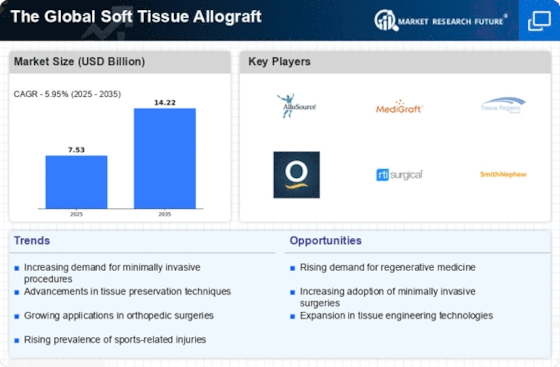
As per MRFR analysis, the Soft Tissue Allograft Market Size was estimated at 7.53 USD Billion in 2024. The Soft Tissue Allograft industry is projected to grow from 7.98 USD Billion in 2025 to 14.22 USD Billion by 2035, exhibiting a compound annual growth rate (CAGR) of 5.95 during the forecast period 2025 - 2035.

Key Market Trends & Highlights

The Soft Tissue Allograft Market is poised for substantial growth driven by technological advancements and increasing demand for minimally invasive procedures.

  • Technological advancements in tissue processing are enhancing the efficacy and safety of soft tissue allografts.
  • The rising demand for minimally invasive procedures is propelling the adoption of soft tissue allografts in surgical practices.
  • North America remains the largest market, while the Asia-Pacific region is emerging as the fastest-growing market for soft tissue allografts.
  • Key market drivers include the increasing incidence of sports injuries and advancements in surgical techniques, which are fueling market expansion.

Market Size & Forecast

2024 Market Size 7.53 (USD Billion)
2035 Market Size 14.22 (USD Billion)
CAGR (2025 - 2035) 5.95%

Major Players

AlloSource (US), MediGraft (US), Tissue Regenix (GB), Organogenesis (US), RTI Surgical (US), Smith & Nephew (GB), LifeNet Health (US), Bone Bank Allografts (US), Cure Medical (US)

Our Impact
Enabled $4.3B Revenue Impact for Fortune 500 and Leading Multinationals
Partnering with 2000+ Global Organizations Each Year
30K+ Citations by Top-Tier Firms in the Industry

Soft Tissue Allograft Market Trends

The Soft Tissue Allograft Market is currently experiencing a notable evolution, driven by advancements in surgical techniques and an increasing demand for minimally invasive procedures. This market encompasses a variety of allograft products, including skin, tendons, ligaments, and fascia, which are utilized in diverse applications such as orthopedic, dental, and reconstructive surgeries. The growing awareness of the benefits associated with allografts, such as reduced recovery times and improved patient outcomes, appears to be influencing healthcare providers' preferences. Furthermore, the integration of innovative technologies in tissue preservation and processing is likely enhancing the quality and safety of allograft products, thereby fostering market growth. In addition, the Soft Tissue Allograft Market is witnessing a shift towards personalized medicine, where tailored solutions are becoming increasingly relevant. This trend is characterized by the customization of allograft products to meet the specific needs of individual patients, which may lead to improved surgical results. Regulatory bodies are also playing a crucial role in ensuring the safety and efficacy of allografts, which could further bolster market confidence. Overall, the Soft Tissue Allograft Market seems poised for continued expansion, driven by technological advancements and a growing emphasis on patient-centered care.

Technological Advancements in Tissue Processing

Recent innovations in tissue processing techniques are enhancing the quality and safety of soft tissue allografts. These advancements may lead to improved preservation methods, which could extend the shelf life of allografts and ensure better outcomes for patients.

Rising Demand for Minimally Invasive Procedures

The increasing preference for minimally invasive surgical techniques is influencing the Soft Tissue Allograft Market. As healthcare providers seek to reduce patient recovery times and improve surgical outcomes, the demand for allografts in various applications is likely to rise.

Focus on Personalized Medicine

The trend towards personalized medicine is becoming more pronounced within the Soft Tissue Allograft Market. Customization of allograft products to cater to individual patient needs may enhance surgical success rates and overall patient satisfaction.

Soft Tissue Allograft Market Drivers

Growing Geriatric Population

The growing geriatric population is a significant factor influencing the Soft Tissue Allograft Market. As individuals age, they become more susceptible to degenerative conditions and injuries that require surgical intervention. Soft tissue allografts are often utilized in orthopedic surgeries, particularly for repairing damaged ligaments and tendons. With the elderly population projected to increase substantially in the coming years, the demand for effective treatment options, including soft tissue allografts, is likely to rise. This demographic shift presents a substantial opportunity for the Soft Tissue Allograft Market, as healthcare systems adapt to meet the needs of an aging population seeking improved quality of life through advanced medical solutions.

Advancements in Surgical Techniques

Advancements in surgical techniques are transforming the landscape of the Soft Tissue Allograft Market. Innovations such as arthroscopy and minimally invasive surgery have enhanced the ability to perform complex procedures with reduced recovery times. These techniques often utilize soft tissue allografts to repair damaged tissues, leading to better patient outcomes. The integration of technology in surgical procedures has also improved precision and reduced complications. As healthcare providers increasingly adopt these advanced techniques, the demand for soft tissue allografts is expected to rise. This shift not only benefits patients but also drives growth within the Soft Tissue Allograft Market, as more surgeons recognize the advantages of using allografts in their practices.

Rising Awareness of Tissue Donation

Rising awareness of tissue donation is positively impacting the Soft Tissue Allograft Market. Educational campaigns and initiatives aimed at promoting the benefits of tissue donation have led to an increase in donor registrations. This heightened awareness not only supports the availability of soft tissue allografts but also encourages patients to consider these options for their surgical needs. As more individuals understand the life-saving potential of donated tissues, the supply of allografts is expected to grow, thereby enhancing the Soft Tissue Allograft Market. This trend reflects a broader societal shift towards valuing organ and tissue donation, which is crucial for meeting the increasing demand for allografts in various medical procedures.

Expansion of Healthcare Infrastructure

The expansion of healthcare infrastructure is a critical driver for the Soft Tissue Allograft Market. As healthcare facilities grow and improve, access to advanced surgical procedures increases, leading to a higher demand for soft tissue allografts. New hospitals and surgical centers are being established, particularly in emerging markets, which enhances the availability of specialized treatments. This expansion is accompanied by investments in medical technology and training for healthcare professionals, further supporting the use of soft tissue allografts in surgical practices. As healthcare systems evolve to meet the needs of diverse populations, the Soft Tissue Allograft Market is poised for growth, driven by improved access to quality care and innovative treatment options.

Increasing Incidence of Sports Injuries

The rising incidence of sports injuries is a notable driver for the Soft Tissue Allograft Market. As more individuals engage in competitive sports and physical activities, the demand for effective treatment options increases. Soft tissue injuries, including ligament tears and muscle strains, are prevalent among athletes. According to recent data, sports injuries account for a significant percentage of emergency room visits, highlighting the need for advanced treatment solutions. Soft tissue allografts provide a viable option for reconstructive surgeries, enabling quicker recovery and improved outcomes. This trend is likely to continue, as the popularity of sports and fitness activities grows, thereby propelling the Soft Tissue Allograft Market forward.


Market Segment Insights

By Application: Orthopedic Surgery (Largest) vs. Dental Surgery (Fastest-Growing)

The Soft Tissue Allograft Market exhibits varied market share distribution among its application segments, with Orthopedic Surgery commanding the largest share. This segment leverages the increasing need for advanced surgical solutions to address complex orthopedic issues. In contrast, Dental Surgery is rapidly gaining traction as a result of heightened awareness regarding oral health and advancements in dental procedures, driving its share upwards significantly. As market dynamics continue to evolve, the growth trends highlight a robust demand for orthopedic solutions due to an aging population and increasing instances of sports-related injuries. Simultaneously, Dental Surgery is on an upward trajectory fueled by innovative technologies, patient preferences for minimally invasive surgeries, and a greater emphasis on aesthetic outcomes. These factors collectively shape the competitive landscape of the Soft Tissue Allograft Market.

Orthopedic Surgery (Dominant) vs. Dental Surgery (Emerging)

Orthopedic Surgery remains the dominant application segment in the Soft Tissue Allograft Market, characterized by its strong demand and established usage in various surgical procedures such as joint reconstruction and ligament repair. The increasing prevalence of orthopedic conditions necessitates the continual use of soft tissue allografts, enhancing the effectiveness of surgeries and improving patient outcomes. In contrast, Dental Surgery is emerging as a promising segment, driven by advancements in dental technologies and rising patient expectations for cosmetic enhancements. This segment focuses on utilizing soft tissue allografts for procedures like gum grafting and implant placements, appealing to a broader patient demographic. The shift towards more sophisticated and less invasive techniques in Dental Surgery signifies its potential for substantial growth in coming years.

By Type of Allograft: Tendon Allograft (Largest) vs. Ligament Allograft (Fastest-Growing)

The Soft Tissue Allograft Market is segmented into various types of allografts, including Tendon, Ligament, Skin, Cartilage, and Bone Allografts. Among these, Tendon Allografts hold the largest market share due to their extensive use in orthopedic procedures and sports medicine. Ligament Allografts, by contrast, are gaining traction with a rapidly growing demand driven by advances in surgical techniques and an increase in sports-related injuries.

Tendon Allograft (Dominant) vs. Ligament Allograft (Emerging)

Tendon Allografts are widely recognized for their dominant position in the Soft Tissue Allograft Market, primarily utilized in reconstructive surgeries, providing essential support in tendon repair and replacement. Their reliability in enhancing healing processes and improving patient outcomes has solidified their role as a preferred option among surgeons. On the other hand, Ligament Allografts are emerging as a pivotal component of the market, especially with the rising incidence of ligament injuries in athletes and active individuals. Innovations in minimally invasive procedures and technological advancements in composite grafting are propelling the Ligament Allograft sector, attracting heightened interest from both medical professionals and patients, further expanding their market presence.

By End Use: Hospitals (Largest) vs. Ambulatory Surgical Centers (Fastest-Growing)

In the Soft Tissue Allograft Market, hospitals account for the largest share, driven by their capacity to handle complex surgical procedures and a high volume of patients requiring allograft solutions. Ambulatory surgical centers are emerging as a significant player, offering a quicker and cost-effective alternative for outpatient surgeries, which has increased their market share considerably. Specialty clinics, rehabilitation centers, and research institutions also play vital roles, but their shares remain smaller compared to the leading segments.

Hospitals (Dominant) vs. Ambulatory Surgical Centers (Emerging)

Hospitals are positioned dominantly in the Soft Tissue Allograft Market, leveraging their comprehensive surgical services and established protocols for allograft utilization. Their ability to conduct intricate surgeries enhances the demand for allografts, ensuring they remain a primary source for tissue transplantation. On the other hand, ambulatory surgical centers are rapidly emerging as vital components of the healthcare ecosystem, providing prompt and efficient surgical care. Their growth is fueled by the shift towards outpatient procedures, lower costs, and increased patient convenience, making them a competitive alternative, especially for less complex surgeries that also require soft tissue grafts.

Get more detailed insights about Soft Tissue Allograft Market

Regional Insights

North America : Market Leader in Allografts

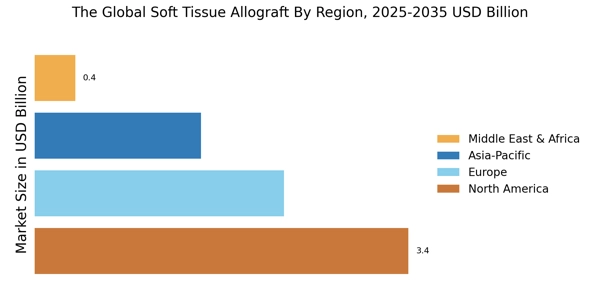
North America continues to lead the Soft Tissue Allograft Market, holding a significant market share of $3.77B in 2024. The growth is driven by increasing surgical procedures, advancements in regenerative medicine, and supportive regulatory frameworks. The demand for allografts is further fueled by rising incidences of sports injuries and orthopedic surgeries, alongside a growing awareness of the benefits of tissue donation. The competitive landscape in North America is robust, featuring key players such as AlloSource, Organogenesis, and LifeNet Health. The U.S. is the primary market, supported by a well-established healthcare infrastructure and a high prevalence of chronic diseases. The presence of leading companies enhances innovation and product availability, ensuring that the region remains at the forefront of the allograft market.

Europe : Emerging Market Potential

Europe's Soft Tissue Allograft Market is valued at $2.0B, reflecting a growing demand driven by an aging population and increasing surgical interventions. Regulatory support from the European Medicines Agency (EMA) has facilitated market entry for innovative allograft products. The region is witnessing a shift towards minimally invasive procedures, which is expected to further boost market growth as healthcare providers seek efficient solutions to meet patient needs. Leading countries in this market include Germany, France, and the UK, where healthcare systems are increasingly adopting advanced allograft technologies. Key players such as Tissue Regenix and Smith & Nephew are actively expanding their product offerings. The competitive landscape is characterized by strategic partnerships and collaborations aimed at enhancing product efficacy and market reach, positioning Europe as a significant player in The Soft Tissue Allograft.

Asia-Pacific : Rapidly Growing Market

The Asia-Pacific region is emerging as a significant player in the Soft Tissue Allograft Market, valued at $1.5B. The growth is driven by increasing healthcare expenditure, rising awareness of tissue donation, and a growing number of surgical procedures. Countries like China and India are witnessing rapid advancements in healthcare infrastructure, which is expected to further enhance the demand for allografts in the coming years. The competitive landscape is evolving, with local and international players vying for market share. Key companies such as RTI Surgical and Cure Medical are expanding their presence in the region. The increasing prevalence of chronic diseases and sports injuries is propelling the demand for allografts, making Asia-Pacific a focal point for future market growth.

Middle East and Africa : Emerging Market Opportunities

The Middle East and Africa (MEA) region represents a nascent but growing market for Soft Tissue Allografts, currently valued at $0.26B. The growth is primarily driven by increasing healthcare investments and a rising number of surgical procedures. Governments are focusing on improving healthcare infrastructure, which is expected to enhance the availability of allograft products. Additionally, awareness campaigns regarding tissue donation are gaining traction, contributing to market growth. Countries like South Africa and the UAE are leading the way in adopting advanced medical technologies, including allografts. The competitive landscape is characterized by a mix of local and international players, with companies exploring partnerships to enhance their market presence. As healthcare systems evolve, the MEA region is poised for significant growth in the allograft sector.

Soft Tissue Allograft Market Regional Image

Key Players and Competitive Insights

The Soft Tissue Allograft Market is characterized by a dynamic competitive landscape, driven by increasing demand for advanced surgical solutions and a growing emphasis on regenerative medicine. Key players such as AlloSource (US), Organogenesis (US), and Smith & Nephew (GB) are strategically positioning themselves through innovation and partnerships. AlloSource (US) focuses on enhancing its product portfolio with cutting-edge technologies, while Organogenesis (US) emphasizes its commitment to regenerative medicine through strategic collaborations. Smith & Nephew (GB) is leveraging its The Soft Tissue Allograft share, indicating a trend towards consolidation and strategic alliances among major players.

In terms of business tactics, companies are increasingly localizing manufacturing to reduce lead times and optimize supply chains. The market appears moderately fragmented, with several players vying for market share. However, the collective influence of key players is shaping a more concentrated environment, as companies seek to differentiate themselves through unique offerings and enhanced service capabilities.

In January 2026, AlloSource (US) announced a partnership with a leading research institution to develop next-generation allograft solutions. This collaboration is expected to enhance AlloSource's R&D capabilities, allowing for the introduction of innovative products that meet evolving clinical needs. Such strategic moves are likely to bolster the company's competitive edge in a rapidly evolving market.

In December 2025, Organogenesis (US) launched a new line of allografts specifically designed for orthopedic applications. This product introduction not only diversifies their portfolio but also positions them to capture a larger share of the orthopedic market, which is experiencing significant growth. The strategic importance of this launch lies in its potential to address unmet clinical needs and enhance patient outcomes, thereby reinforcing Organogenesis's market position.

In November 2025, Smith & Nephew (GB) expanded its distribution network in Asia-Pacific, aiming to tap into emerging markets with high growth potential. This strategic expansion is indicative of the company's focus on global market penetration and reflects a broader trend of companies seeking to capitalize on regional growth opportunities. By enhancing its distribution capabilities, Smith & Nephew is likely to improve its competitive positioning in the region.

As of February 2026, current trends in the Soft Tissue Allograft Market include a strong emphasis on digitalization, sustainability, and the integration of AI technologies. Strategic alliances are increasingly shaping the competitive landscape, as companies recognize the value of collaboration in driving innovation. Looking ahead, competitive differentiation is expected to evolve, with a shift from price-based competition to a focus on technological advancements, product innovation, and supply chain reliability. This transition underscores the importance of agility and responsiveness in meeting the demands of a rapidly changing market.

Key Companies in the Soft Tissue Allograft Market include

Industry Developments

The increasing prevalence of musculoskeletal disorders and the rising demand for minimally invasive surgeries are major factors driving market growth.

Additionally, advancements in tissue engineering and the development of novel allograft products are expected to contribute to the market's expansion.

Key industry players are focusing on strategic collaborations and acquisitions to strengthen their market position. Recent news developments include the acquisition of AlloSource by Medtronic in 2023, expanding Medtronic's portfolio of biologics and surgical technologies.

Future Outlook

Soft Tissue Allograft Market Future Outlook

The Soft Tissue Allograft Market is projected to grow at a 5.95% CAGR from 2024 to 2035, driven by technological advancements, increasing surgical procedures, and rising demand for minimally invasive treatments.

New opportunities lie in:

  • Expansion of regenerative medicine applications in orthopedics
  • Development of customized allograft solutions for specific patient needs
  • Strategic partnerships with surgical centers for enhanced distribution channels

By 2035, the Soft Tissue Allograft Market is expected to achieve substantial growth and innovation.

Market Segmentation

Soft Tissue Allograft Market End Use Outlook

  • Hospitals
  • Ambulatory Surgical Centers
  • Specialty Clinics
  • Rehabilitation Centers
  • Research Institutions

Soft Tissue Allograft Market Application Outlook

  • Orthopedic Surgery
  • Dental Surgery
  • Wound Care
  • Reconstructive Surgery
  • Sports Medicine

Soft Tissue Allograft Market Type of Allograft Outlook

  • Tendon Allograft
  • Ligament Allograft
  • Skin Allograft
  • Cartilage Allograft
  • Bone Allograft

Report Scope

MARKET SIZE 20247.53(USD Billion)
MARKET SIZE 20257.98(USD Billion)
MARKET SIZE 203514.22(USD Billion)
COMPOUND ANNUAL GROWTH RATE (CAGR)5.95% (2024 - 2035)
REPORT COVERAGERevenue Forecast, Competitive Landscape, Growth Factors, and Trends
BASE YEAR2024
Market Forecast Period2025 - 2035
Historical Data2019 - 2024
Market Forecast UnitsUSD Billion
Key Companies ProfiledAlloSource (US), MediGraft (US), Tissue Regenix (GB), Organogenesis (US), RTI Surgical (US), Smith & Nephew (GB), LifeNet Health (US), Bone Bank Allografts (US), Cure Medical (US)
Segments CoveredApplication, Type of Allograft, End Use
Key Market OpportunitiesAdvancements in regenerative medicine enhance demand for innovative solutions in the Soft Tissue Allograft Market.
Key Market DynamicsRising demand for minimally invasive procedures drives innovation and competition in the Soft Tissue Allograft Market.
Countries CoveredNorth America, Europe, APAC, South America, MEA
Leave a Comment

FAQs

What is the projected market valuation of The Global Soft Tissue Allograft by 2035?

The projected market valuation for The Global Soft Tissue Allograft is 14.22 USD Billion by 2035.

What was the market valuation of The Global Soft Tissue Allograft in 2024?

The overall market valuation was 7.53 USD Billion in 2024.

What is the expected CAGR for The Global Soft Tissue Allograft during the forecast period 2025 - 2035?

The expected CAGR for The Global Soft Tissue Allograft during the forecast period 2025 - 2035 is 5.95%.

Which companies are considered key players in The Global Soft Tissue Allograft?

Key players in the market include AlloSource, MediGraft, Tissue Regenix, Organogenesis, RTI Surgical, Smith & Nephew, LifeNet Health, and Cure Medical.

What segment of The Global Soft Tissue Allograft had the highest valuation in 2024?

In 2024, the Musculoskeletal Allografts segment had the highest valuation at 2.26 USD Billion.

What is the projected valuation for the Vascular Allografts segment by 2035?

The projected valuation for the Vascular Allografts segment is 2.8 USD Billion by 2035.

How does the valuation of Deceased Donor allografts compare to Living Donor allografts in 2024?

In 2024, the valuation for Living Donor allografts was 3.77 USD Billion, slightly higher than the 3.76 USD Billion for Deceased Donor allografts.

What processing technique segment is expected to show significant growth by 2035?

The Fresh Frozen processing technique segment is expected to grow to 3.0 USD Billion by 2035.

Which sterilization method segment had a valuation of 2.0 USD Billion in 2024?

The Ethylene Oxide Sterilization method segment had a valuation of 2.0 USD Billion in 2024.

What application segment is projected to reach 2.25 USD Billion by 2035?

The Vascular Surgery application segment is projected to reach 2.25 USD Billion by 2035.

Download Free Sample

Kindly complete the form below to receive a free sample of this Report

Compare Licence

×
Features License Type
Single User Multiuser License Enterprise User
Price $4,950 $5,950 $7,250
Maximum User Access Limit 1 User Upto 10 Users Unrestricted Access Throughout the Organization
Free Customization
Direct Access to Analyst
Deliverable Format
Platform Access
Discount on Next Purchase 10% 15% 15%
Printable Versions