×
Request Free Sample ×

Kindly complete the form below to receive a free sample of this Report

* Please use a valid business email

Leading companies partner with us for data-driven Insights

clients tt-cursor
Hero Background
English
Chinese
French
Japanese
Korean
German
Spanish

Soft Drink Market Share

ID: MRFR/FnB/10084-HCR
128 Pages
Sakshi Gupta
February 2026

Soft Drink Market Size, Share, Industry Trend & Analysis Research Report By Product Type (Carbonated Soft Drinks, Non-Carbonated Soft Drinks, Juices, Sports Drinks, Energy Drinks), By Flavor (Cola, Fruit, Citrus, Herbal, Mixed Flavors), By Packaging Type (Cans, Bottles, Pouches, Tetra Packs, Bulk Packaging), By Distribution Channel (Supermarkets, Convenience Stores, Online Retail, Restaurants, Vending Machines) and By Regional (North America, Europe, South America, Asia Pacific, Middle East and Africa)- Forecast to 2035

Share:
Download PDF ×

We do not share your information with anyone. However, we may send you emails based on your report interest from time to time. You may contact us at any time to opt-out.

Soft Drink Market Infographic
Purchase Options

Market Share

Soft Drink Market Share Analysis

Digital platforms` convenience enabled the most significant change in the underlying market structure of consumer purchases that, in combination with other factors, changed the way we get goods including soft drinks. In the era of e-commerce wave, soft drinks market has been transformed, and so the previous experience of consumers in accessing their favorite products has been totally renewed by providing a user-friendly platform. The core of e-commerce here is the fact that the products can be easily ordered just using dedicated websites or mobile applications totally implying that the customers have discovered a new way of doing things if they now want to order for their favorite soft drinks when they are away from home. The fact of convenience is made even more realistic when it comes to the convenience of receiving those drinks at your doorstep, meaning that you don't need to go to the store in person. The digital change is a reflection of the symbiosis in the ability of technology and the consumer behavior. This relationship sustains with the e-commerce being the platform for … The soft drinks industry is likely to maintain a continuous growth rate due to the accessibility offered by the Internet, hence making e-commerce more convenient and easier. Pricing Strategies, as well as pricing policies, play a pivotal role in the spotting of place for Soft Drink Market. Many companies among brands use something called the tiered pricing structure that is employed to nail different consumers. Competition could motivate some to counter price bids, or anchoring price, to beat critical consumers, while others present themselves as the better deal or the premium alternative that emphasizes quality and their superiority. Strategic pricing therefore increases the market share for a brand and also affects product’s perception in the mind of customer Innovation in the field of packaging is one more of the essential elements of a successful marketing strategy of a product. Businesses will shift to sustainable and environmentally friendly packaging formulations to remain competitive among today’s ecologically aware consumers. Moreover, the convenience and easy usage of canned beverages in smaller packages or with bottles that can be resealed to be later used again satisfy the changing lifestyles of consumers, make the drink brand more popular, and let it take a share of the market by answering various consumer requirements. A vital notion consumption of health and wellness is the place of adaptability while occupying the market share.
Author
Sakshi Gupta
Team Lead - Research

Currently a Team Lead in consumer goods, FMCG, and F&B, she translates rigorous research into decisive strategy. She develops GTM roadmaps, pricing architectures, and competitive benchmarks for companies across Europe, the US, and APAC. She synthesize insights, align cross-functional teams, and drive execution from brief to measurable outcomes. She leads end-to-end engagements with crisp analysis, compelling storytelling, and a strong command of Power BI, Tableau, SQL, and advanced research platforms.

Leave a Comment

FAQs

What is the current valuation of The Global Soft Drink in 2025?

<p>The Global Soft Drink is valued at approximately 1.47 USD Billion in 2024.</p>

What is the projected market valuation for The Global Soft Drink by 2035?

The market is expected to reach a valuation of 2.52 USD Billion by 2035.

What is the expected CAGR for The Global Soft Drink during the forecast period 2025 - 2035?

The expected CAGR for The Global Soft Drink during the forecast period 2025 - 2035 is 5.02%.

Who are the key players in The Global Soft Drink?

Key players include Coca-Cola, PepsiCo, Nestle, Dr Pepper Snapple Group, and Monster Beverage Corporation.

Which segment of The Global Soft Drink had the highest valuation in 2024?

In 2024, Carbonated Soft Drinks had the highest valuation at approximately 0.6 USD Billion.

What is the projected valuation for Non-Carbonated Soft Drinks by 2035?

The projected valuation for Non-Carbonated Soft Drinks is expected to reach around 0.6 USD Billion by 2035.

How do the valuations of different packaging types compare in The Global Soft Drink?

In 2024, Bottles were valued at 0.5 USD Billion, while Cans were valued at 0.35 USD Billion.

What distribution channel is projected to have the highest growth in The Global Soft Drink?

Supermarkets are projected to grow significantly, with a valuation expected to reach 1.05 USD Billion by 2035.

Which flavor segment is anticipated to see the most growth by 2035?

The Fruit flavor segment is anticipated to grow, with a projected valuation of 0.7 USD Billion by 2035.

What are the expected trends in energy drink consumption within The Global Soft Drink?

Energy Drinks are projected to increase in valuation, reaching approximately 0.2 USD Billion by 2035.

Market Summary

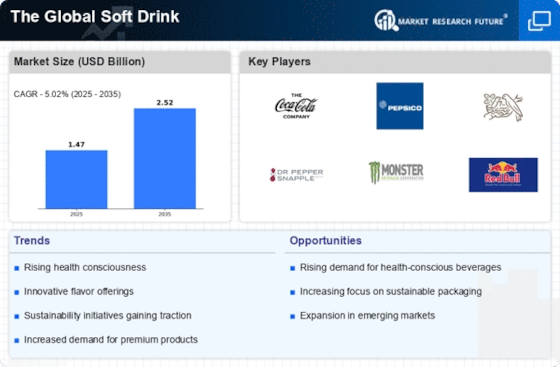
As per Market Research Future analysis, The Global Soft Drink Market Size was estimated at 1.47 USD Billion in 2024. The soft drink industry is projected to grow from 1.544 USD Billion in 2025 to 2.52 USD Billion by 2035, exhibiting a compound annual growth rate (CAGR) of 5.02% during the forecast period 2025 - 2035

Key Market Trends & Highlights

The Global Soft Drink Market is experiencing a dynamic shift towards health-conscious and sustainable choices.

  • North America remains the largest market for soft drinks, driven by a strong demand for carbonated soft drinks. Asia-Pacific is the fastest-growing region, with energy drinks gaining popularity among younger consumers. The cola segment continues to dominate, while fruit-flavored beverages are emerging as the fastest-growing category. Health and wellness trends, along with sustainability initiatives, are key drivers influencing consumer preferences in the market.

Market Size & Forecast

2024 Market Size 1.47 (USD Billion)
2035 Market Size 2.52 (USD Billion)
CAGR (2025 - 2035) 5.02%
Largest Regional Market Share in 2024 Asia Pacific

Major Players

Coca-Cola (US), PepsiCo (US), Nestle (CH), Dr Pepper Snapple Group (US), Monster Beverage Corporation (US), Red Bull GmbH (AT), Britvic (GB), Keurig Dr Pepper (US), Fanta (US), Schweppes (GB)

Market Trends

The Global Soft Drink Market is currently experiencing a dynamic transformation, driven by evolving consumer preferences and increasing health consciousness shaping overall soft drink market trends. As individuals become more aware of the implications of sugar consumption, there is a noticeable shift towards healthier alternatives. This trend is reflected in the rising popularity of low-calorie and sugar-free beverages, which cater to a demographic that prioritizes wellness. Additionally, the market is witnessing a surge in demand for functional drinks that offer added benefits, such as enhanced hydration and nutritional value within the global soft drinks market.

Moreover, the influence of sustainability is becoming increasingly prominent within The Global Soft Drink Market. Consumers are gravitating towards brands that demonstrate a commitment to environmental responsibility, prompting companies to adopt eco-friendly packaging and sustainable sourcing practices. This shift not only aligns with consumer values but also positions brands favorably in a competitive landscape. As the market continues to evolve, it appears that innovation and adaptability will be crucial for companies aiming to thrive in this ever-changing environment and maintain their soft drinks market share.

Health-Conscious Choices

There is a growing inclination among consumers towards beverages that are perceived as healthier. This trend encompasses a rise in demand for low-calorie, sugar-free, and organic options, reflecting a broader societal shift towards wellness and influencing emerging soft drink market trends.

Sustainability Initiatives

Brands are increasingly focusing on sustainable practices, including eco-friendly packaging and responsible sourcing. This trend resonates with environmentally conscious consumers, influencing purchasing decisions and brand loyalty within the soft drinks market.

Functional Beverages

The market is seeing a notable increase in the popularity of functional drinks that provide additional health benefits. These beverages often include ingredients aimed at enhancing hydration, energy, or overall well-being, which continues to shape global soft drink market trends.

Soft Drink Market Market Drivers

Health and Wellness Trends

The Global Soft Drink Industry is increasingly influenced by health and wellness trends. As consumers become more health-conscious, there is a noticeable shift towards beverages that offer functional benefits. This includes drinks fortified with vitamins, minerals, and probiotics. In 2025, the market for health-oriented soft drinks is expected to grow significantly, with a projected value of around 150 billion USD. Brands are responding by reformulating existing products to reduce sugar content and eliminate artificial ingredients. This shift not only caters to the demand for healthier options but also aligns with regulatory pressures aimed at reducing sugar consumption. Consequently, companies that adapt to these trends are likely to capture a larger share of the market.

Innovative Flavor Profiles

The Global Soft Drink Industry is witnessing a surge in demand for innovative flavor profiles. Consumers are increasingly seeking unique and exotic flavors that deviate from traditional offerings. This trend is driven by a desire for novel experiences and the influence of social media, where unique beverages gain popularity rapidly. In 2025, the market for flavored soft drinks is projected to reach approximately 200 billion USD, indicating a robust growth trajectory. Companies are investing in research and development to create flavors that appeal to diverse consumer preferences, including tropical fruits, herbal infusions, and even savory notes. This diversification not only attracts new customers but also encourages brand loyalty, as consumers are more likely to return for distinctive taste experiences.

Emerging Markets and Urbanization

The Global Soft Drink Industry is experiencing growth driven by emerging markets and urbanization. As urban populations expand, there is an increasing demand for convenient and accessible beverage options. In 2025, the market in regions such as Asia-Pacific and Latin America is projected to grow at a compound annual growth rate of over 6%. This growth is fueled by rising disposable incomes and changing lifestyles, where soft drinks are becoming a staple in daily consumption. Companies are strategically targeting these regions with tailored marketing campaigns and localized product offerings to cater to diverse tastes and preferences. This focus on emerging markets presents significant opportunities for expansion and revenue generation.

Digital Marketing and E-Commerce Growth

The Global Soft Drink Industry is undergoing a transformation due to the rise of digital marketing and e-commerce. As consumers increasingly turn to online platforms for shopping, brands are adapting their strategies to engage with customers through digital channels. In 2025, e-commerce sales in the beverage sector are expected to account for over 20% of total sales, reflecting a shift in consumer purchasing behavior. Companies are leveraging social media, influencer partnerships, and targeted advertising to reach a broader audience. This digital engagement not only enhances brand visibility but also facilitates direct-to-consumer sales, allowing companies to build stronger relationships with their customers. The integration of technology in marketing strategies is likely to play a crucial role in shaping the future of the soft drink market.

Sustainability and Eco-Friendly Packaging

The Global Soft Drink Industry is increasingly prioritizing sustainability and eco-friendly packaging solutions. As environmental concerns gain prominence, consumers are more inclined to support brands that demonstrate a commitment to sustainability. In 2025, it is estimated that the market for sustainable packaging in the beverage sector will exceed 50 billion USD. Companies are exploring alternatives to traditional plastic, such as biodegradable materials and recyclable packaging. This shift not only addresses consumer preferences but also aligns with global initiatives aimed at reducing plastic waste. Brands that successfully implement sustainable practices are likely to enhance their reputation and attract environmentally conscious consumers, thereby gaining a competitive edge in the market.

Market Segment Insights

By Type: Carbonated Soft Drinks (Largest) vs. Energy Drinks (Fastest-Growing)

In The Global Soft Drink Market, carbonated soft drinks dominate with the largest share, representing a significant portion of the overall consumer preference and global soft drinks market share. These drinks continue to be the go-to choice for many, driven by their effervescence and variety of flavors. However, energy drinks are capturing attention rapidly, appealing to a younger demographic seeking functional beverages that provide an energy boost. Their unique positioning allows them to carve a niche within the competitive landscape.

carbonated soft drinks (Dominant) vs. energy drinks (Emerging)

carbonated soft drinks remain the dominant segment in The Global Soft Drink Market, characterized by an extensive range of flavors and strong brand loyalty. Consumers enjoy the fizzy experience and variety, which appeals to a wide audience across age groups. In contrast, energy drinks are emerging rapidly, fueled by trends focusing on fitness and performance enhancement. These drinks, often marketed towards younger consumers and athletes, are formulated to deliver energy and enhance focus, positioning them as an essential companion for active lifestyles. As health-consciousness grows among consumers, Energy Drinks are innovating with natural ingredients and reduced sugar content, catering to evolving preferences.

By Flavor: Cola (Largest) vs. Fruit (Fastest-Growing)

In The Global Soft Drink Market, the flavor segment is highly diverse, featuring cola, fruit, citrus, herbal, and mixed flavors. Cola remains the largest segment, maintaining a significant market share due to its established brand loyalty and historical popularity. On the other hand, fruit flavors have emerged as a favorite among consumers seeking more refreshing and healthier alternatives, leading to a substantial increase in their market presence.

Cola (Dominant) vs. Fruit (Emerging)

Cola has long been the dominant flavor in the soft drink sector, attributable to iconic brands that resonate with global consumers. Its robust marketing strategies and strong retail presence ensure a widespread availability that keeps cola at the forefront of the flavor segment. Conversely, fruit flavors are quickly emerging, appealing particularly to health-conscious individuals. With increasing consumer demand for natural ingredients and lower sugar options, brands are innovating their fruit offerings to include exotic and blended options, making this segment one of the most dynamic in the market.

By Packaging Type: Cans (Largest) vs. Bottles (Fastest-Growing)

In The Global Soft Drink Market, the packaging landscape is diverse, with cans dominating the market share due to their convenience, lightweight nature, and recyclable properties. Cans have captured a significant portion of consumer preference, particularly in the on-the-go consumption segment. Bottles, while slightly behind in market share, are gaining momentum by adapting to consumer demand for larger sizes and eco-friendly materials, indicating a shift in consumer preferences that favors sustainability and practicality in beverage packaging.

Cans (Dominant) vs. Bottles (Emerging)

Cans and bottles represent two crucial segments within The Global Soft Drink Market. Cans are recognized for their durability and ability to maintain carbonation, making them a popular choice for carbonated soft drinks. Their lightweight design enhances their transportability, thus boosting sales in retail and vending. Bottles, especially plastic variants, are emerging as environmentally friendly options with growing demand for recycling and reuse. As consumers become increasingly health-conscious, bottles also appeal through innovation, such as the introduction of new sizes and packaging that emphasize convenience. Both segments show promise but are driven by different consumer preferences.

By Distribution Channel: Supermarkets (Largest) vs. Online Retail (Fastest-Growing)

In The Global Soft Drink Market, supermarkets hold a dominating position, accounting for a significant share of total distribution channels. They offer vast product varieties and competitive pricing, making them the preferred shopping destination for consumers seeking soft drinks. Convenience stores also play a crucial role, providing quick access to soft drinks and often capitalizing on impulsive purchases, yet they trail behind the bigger supermarket chains in market share.

Supermarkets (Dominant) vs. Online Retail (Emerging)

Supermarkets are the dominant distribution channel in The Global Soft Drink Market, leveraging their wide range of products and established customer base to maintain their position. Their ability to offer discounts and promotions attracts bulk purchases, catering to family buying habits. Conversely, online retail channels are emerging rapidly, driven by changing consumer preferences favoring convenience and home delivery. E-commerce platforms are gaining traction, as they facilitate easy access to a wide variety of soft drink brands, often accompanied by attractive online-only discounts, making them an increasingly popular choice among tech-savvy consumers.

Get more detailed insights about Soft Drink Market Research Report — Global Forecast till 2035

Regional Insights

The North America region holds a significant share, valued at 137.0 USD Billion in 2024, showcasing consumer preferences for flavored and healthier options contributing to its market leadership. Europe follows, with a valuation of 110.0 USD Billion, driven by high demand for innovative beverage products and sugar alternatives. The APAC region dominates with a substantial valuation of 175.0 USD Billion, reflecting the growing urban population and increasing disposable income which fuel demand.South America, valued at 45.23 USD Billion in 2024, continues to expand with a rising middle-class segment favoring carbonated drinks.

Lastly, the Middle East and Africa (MEA) contribute 25.0 USD Billion, showing potential for growth with evolving beverage trends amid a young population. Each region plays a vital role in shaping the Global Soft Drink Market segmentation strategy, driven by unique consumer trends and market dynamics. Understanding these factors is essential for manufacturers aiming to capitalize on opportunities across these diverse markets.

Key Players and Competitive Insights

The Global Soft Drink Market is characterized by fierce competition and a dynamic landscape where consumer preferences are rapidly evolving. This market encompasses a wide range of beverages, including carbonated soft drinks, juices, bottled water, and alternative health drinks. The competitive insights reveal that companies are focusing on innovation, marketing strategies, and product diversification to capture a larger share of the market. Moreover, the industry has seen a growing trend driven by health-conscious consumers, leading manufacturers to explore natural ingredients, low-calorie options, and environmentally sustainable packaging solutions. As brands strive to differentiate themselves, mergers, acquisitions, and collaborations have become common strategies to enhance market presence and expand product offerings globally.Kraft Heinz has established a robust presence in the Global Soft Drink Market by leveraging its extensive portfolio of well-known brands and innovative products. The company's strengths lie in its ability to offer a diverse range of beverages, including flavored waters, sauces, and ready-to-drink options that appeal to a wide array of consumer tastes. Kraft Heinz emphasizes quality and value, catering to budget-conscious shoppers while also focusing on premium offerings to attract higher-end consumers. Its global distribution network further enhances its market reach, allowing the company to penetrate various regions effectively. By investing in marketing campaigns that resonate with local cultures and preferences, Kraft Heinz efficiently maintains its competitive edge in the global landscape of soft drinks.Danone has carved out a significant role in the Global Soft Drink Market through its focus on health-oriented products and sustainable practices. Known for its yogurt and dairy products, the company has expanded its range of beverages to include bottled water and plant-based drinks, responding to the demand for healthier options. Danone's strength lies in its commitment to environmental sustainability and social responsibility, which has enhanced its brand loyalty among environmentally-conscious consumers. The company's strategic mergers and acquisitions have allowed it to diversify its product offerings and bolster its market presence. With its strong emphasis on innovation and health, Danone continues to develop new formulations that cater to evolving consumer preferences, positioning itself as a leader in the competitive soft drink segment on a global scale.

Key Companies in the Soft Drink Market include

Industry Developments

The Global Soft Drink Market has seen significant developments recently, characterized by rising consumer demand for healthier beverage options. Major players like CocaCola and PepsiCo are adapting to this shift by expanding their portfolios to include low-sugar and functional drinks. In September 2023, announced a strategic initiative to enhance its beverage offerings with a focus on sustainability, aiming for recyclable packaging across all products by 2025. Kraft Heinz has also been active, unveiling new organic juice lines in August 2023 to cater to health-conscious consumers.

Moreover, in July 2023, CocaCola completed the acquisition of a regional beverage company to bolster its market presence in emerging markets. This acquisition aims to leverage local distribution networks and consumer insights. Market valuation for companies such as Red Bull and Monster Beverage has been on the rise, attributed to their innovative marketing strategies and product diversification. The overall trend indicates a robust growth trajectory in the Global Soft Drink Market, fueled by evolving consumer preferences and strategic adaptations by leading brands.

Recent years have seen intensified competition, with companies striving to innovate and meet the demands of a more health-oriented global consumer base.

Future Outlook

Soft Drink Market Future Outlook

The Global Soft Drink Market is projected to grow at a 5.02% CAGR from 2025 to 2035, driven by health-conscious trends, innovative flavors, and sustainable packaging solutions.

New opportunities lie in:

  • <p>Expansion of low-sugar beverage lines to meet health trends. Investment in eco-friendly packaging technologies for sustainability. Development of personalized beverage options using AI-driven consumer insights.</p>

By 2035, the market is expected to be robust, reflecting evolving consumer preferences and innovative strategies.

Market Segmentation

Soft Drink Market Type Outlook

  • Carbonated Soft Drinks
  • Non-Carbonated Soft Drinks
  • Juices
  • Sports Drinks
  • Energy Drinks

Soft Drink Market Flavor Outlook

  • Cola
  • Fruit
  • Citrus
  • Herbal
  • Mixed Flavors

Soft Drink Market Packaging Type Outlook

  • Cans
  • Bottles
  • Pouches
  • Tetra Packs
  • Bulk Packaging

Soft Drink Market Distribution Channel Outlook

  • Supermarkets
  • Convenience Stores
  • Online Retail
  • Restaurants
  • Vending Machines

Report Scope

MARKET SIZE 2024 1.47(USD Billion)
MARKET SIZE 2025 1.544(USD Billion)
MARKET SIZE 2035 2.52(USD Billion)
COMPOUND ANNUAL GROWTH RATE (CAGR) 5.02% (2025 - 2035)
REPORT COVERAGE Revenue Forecast, Competitive Landscape, Growth Factors, and Trends
BASE YEAR 2024
Market Forecast Period 2025 - 2035
Historical Data 2019 - 2024
Market Forecast Units USD Billion
Key Companies Profiled Coca-Cola (US), PepsiCo (US), Nestle (CH), Dr Pepper Snapple Group (US), Monster Beverage Corporation (US), Red Bull GmbH (AT), Britvic (GB), Keurig Dr Pepper (US), Fanta (US), Schweppes (GB)
Segments Covered Product Type, Flavor, Packaging Type, Distribution Channel, Regional
Key Market Opportunities Growing demand for healthier beverage options drives innovation in The Global Soft Drink.
Key Market Dynamics Shifting consumer preferences towards healthier options drive innovation and competition in the soft drink market.
Countries Covered North America, Europe, APAC, South America, MEA

FAQs

What is the current valuation of The Global Soft Drink in 2025?

<p>The Global Soft Drink is valued at approximately 1.47 USD Billion in 2024.</p>

What is the projected market valuation for The Global Soft Drink by 2035?

The market is expected to reach a valuation of 2.52 USD Billion by 2035.

What is the expected CAGR for The Global Soft Drink during the forecast period 2025 - 2035?

The expected CAGR for The Global Soft Drink during the forecast period 2025 - 2035 is 5.02%.

Who are the key players in The Global Soft Drink?

Key players include Coca-Cola, PepsiCo, Nestle, Dr Pepper Snapple Group, and Monster Beverage Corporation.

Which segment of The Global Soft Drink had the highest valuation in 2024?

In 2024, Carbonated Soft Drinks had the highest valuation at approximately 0.6 USD Billion.

What is the projected valuation for Non-Carbonated Soft Drinks by 2035?

The projected valuation for Non-Carbonated Soft Drinks is expected to reach around 0.6 USD Billion by 2035.

How do the valuations of different packaging types compare in The Global Soft Drink?

In 2024, Bottles were valued at 0.5 USD Billion, while Cans were valued at 0.35 USD Billion.

What distribution channel is projected to have the highest growth in The Global Soft Drink?

Supermarkets are projected to grow significantly, with a valuation expected to reach 1.05 USD Billion by 2035.

Which flavor segment is anticipated to see the most growth by 2035?

The Fruit flavor segment is anticipated to grow, with a projected valuation of 0.7 USD Billion by 2035.

What are the expected trends in energy drink consumption within The Global Soft Drink?

Energy Drinks are projected to increase in valuation, reaching approximately 0.2 USD Billion by 2035.

  1. SECTION I: EXECUTIVE SUMMARY AND KEY HIGHLIGHTS |
    1. EXECUTIVE SUMMARY | |
      1. Market Overview | |
      2. Key Findings | |
      3. Market Segmentation | |
      4. Competitive Landscape | |
      5. Challenges and Opportunities | |
      6. Future Outlook 2
  2. SECTION II: SCOPING, METHODOLOGY AND MARKET STRUCTURE |
    1. MARKET INTRODUCTION | |
      1. Definition | |
      2. Scope of the study | | |
    2. RESEARCH METHODOLOGY | |
      1. Overview | |
      2. Data Mining | |
      3. Secondary Research | |
      4. Primary Research | | |
      5. Forecasting Model | |
      6. Market Size Estimation | | |
      7. Data Triangulation | |
      8. Validation 3
  3. SECTION III: QUALITATIVE ANALYSIS |
    1. MARKET DYNAMICS | |
      1. Overview | |
      2. Drivers | |
      3. Restraints | |
      4. Opportunities |
    2. MARKET FACTOR ANALYSIS | |
      1. Value chain Analysis | |
      2. Porter's Five Forces Analysis | | |
      3. COVID-19 Impact Analysis | | |
  4. SECTION IV: QUANTITATIVE ANALYSIS |
    1. Food, Beverages & Nutrition, BY Type (USD Billion) | |
      1. Carbonated Soft Drinks | |
      2. Non-Carbonated Soft Drinks | |
      3. Juices | |
      4. Sports Drinks | |
      5. Energy Drinks |
    2. Food, Beverages & Nutrition, BY Flavor (USD Billion) | |
      1. Cola | |
      2. Fruit | |
      3. Citrus | |
      4. Herbal | |
      5. Mixed Flavors |
    3. Food, Beverages & Nutrition, BY Packaging Type (USD Billion) | |
      1. Cans | |
      2. Bottles | |
      3. Pouches | |
      4. Tetra Packs | |
      5. Bulk Packaging |
    4. Food, Beverages & Nutrition, BY Distribution Channel (USD Billion) | |
      1. Supermarkets | |
      2. Convenience Stores | |
      3. Online Retail | |
      4. Restaurants | |
      5. Vending Machines |
    5. Food, Beverages & Nutrition, BY Region (USD Billion) | |
      1. North America | | |
      2. Europe | | |
      3. APAC | | |
      4. South America | | |
      5. MEA | | |
  5. SECTION V: COMPETITIVE ANALYSIS |
    1. Competitive Landscape | |
      1. Overview | |
      2. Competitive Analysis | |
      3. Market share Analysis | |
      4. Major Growth Strategy in the Food, Beverages & Nutrition | |
      5. Competitive Benchmarking | |
      6. Leading Players in Terms of Number of Developments in the Food, Beverages & Nutrition | |
      7. Key developments and growth strategies | | |
      8. Major Players Financial Matrix | | |
    2. Company Profiles | |
      1. Coca-Cola (US) | | |
      2. PepsiCo (US) | | |
      3. Nestle (CH) | | |
      4. Dr Pepper Snapple Group (US) | | |
      5. Monster Beverage Corporation (US) | | |
      6. Red Bull GmbH (AT) | | |
      7. Britvic (GB) | | |
      8. Keurig Dr Pepper (US) | | |
      9. Fanta (US) | | |
      10. Schweppes (GB) | | |
    3. Appendix | |
      1. References | |
      2. Related Reports 6 LIST OF FIGURES |
    4. MARKET SYNOPSIS |
    5. NORTH AMERICA MARKET ANALYSIS |
    6. US MARKET ANALYSIS BY TYPE |
    7. US MARKET ANALYSIS BY FLAVOR |
    8. US MARKET ANALYSIS BY PACKAGING TYPE |
    9. US MARKET ANALYSIS BY DISTRIBUTION CHANNEL |
    10. CANADA MARKET ANALYSIS BY TYPE |
    11. CANADA MARKET ANALYSIS BY FLAVOR |
    12. CANADA MARKET ANALYSIS BY PACKAGING TYPE |
    13. CANADA MARKET ANALYSIS BY DISTRIBUTION CHANNEL |
    14. EUROPE MARKET ANALYSIS |
    15. GERMANY MARKET ANALYSIS BY TYPE |
    16. GERMANY MARKET ANALYSIS BY FLAVOR |
    17. GERMANY MARKET ANALYSIS BY PACKAGING TYPE |
    18. GERMANY MARKET ANALYSIS BY DISTRIBUTION CHANNEL |
    19. UK MARKET ANALYSIS BY TYPE |
    20. UK MARKET ANALYSIS BY FLAVOR |
    21. UK MARKET ANALYSIS BY PACKAGING TYPE |
    22. UK MARKET ANALYSIS BY DISTRIBUTION CHANNEL |
    23. FRANCE MARKET ANALYSIS BY TYPE |
    24. FRANCE MARKET ANALYSIS BY FLAVOR |
    25. FRANCE MARKET ANALYSIS BY PACKAGING TYPE |
    26. FRANCE MARKET ANALYSIS BY DISTRIBUTION CHANNEL |
    27. RUSSIA MARKET ANALYSIS BY TYPE |
    28. RUSSIA MARKET ANALYSIS BY FLAVOR |
    29. RUSSIA MARKET ANALYSIS BY PACKAGING TYPE |
    30. RUSSIA MARKET ANALYSIS BY DISTRIBUTION CHANNEL |
    31. ITALY MARKET ANALYSIS BY TYPE |
    32. ITALY MARKET ANALYSIS BY FLAVOR |
    33. ITALY MARKET ANALYSIS BY PACKAGING TYPE |
    34. ITALY MARKET ANALYSIS BY DISTRIBUTION CHANNEL |
    35. SPAIN MARKET ANALYSIS BY TYPE |
    36. SPAIN MARKET ANALYSIS BY FLAVOR |
    37. SPAIN MARKET ANALYSIS BY PACKAGING TYPE |
    38. SPAIN MARKET ANALYSIS BY DISTRIBUTION CHANNEL |
    39. REST OF EUROPE MARKET ANALYSIS BY TYPE |
    40. REST OF EUROPE MARKET ANALYSIS BY FLAVOR |
    41. REST OF EUROPE MARKET ANALYSIS BY PACKAGING TYPE |
    42. REST OF EUROPE MARKET ANALYSIS BY DISTRIBUTION CHANNEL |
    43. APAC MARKET ANALYSIS |
    44. CHINA MARKET ANALYSIS BY TYPE |
    45. CHINA MARKET ANALYSIS BY FLAVOR |
    46. CHINA MARKET ANALYSIS BY PACKAGING TYPE |
    47. CHINA MARKET ANALYSIS BY DISTRIBUTION CHANNEL |
    48. INDIA MARKET ANALYSIS BY TYPE |
    49. INDIA MARKET ANALYSIS BY FLAVOR |
    50. INDIA MARKET ANALYSIS BY PACKAGING TYPE |
    51. INDIA MARKET ANALYSIS BY DISTRIBUTION CHANNEL |
    52. JAPAN MARKET ANALYSIS BY TYPE |
    53. JAPAN MARKET ANALYSIS BY FLAVOR |
    54. JAPAN MARKET ANALYSIS BY PACKAGING TYPE |
    55. JAPAN MARKET ANALYSIS BY DISTRIBUTION CHANNEL |
    56. SOUTH KOREA MARKET ANALYSIS BY TYPE |
    57. SOUTH KOREA MARKET ANALYSIS BY FLAVOR |
    58. SOUTH KOREA MARKET ANALYSIS BY PACKAGING TYPE |
    59. SOUTH KOREA MARKET ANALYSIS BY DISTRIBUTION CHANNEL |
    60. MALAYSIA MARKET ANALYSIS BY TYPE |
    61. MALAYSIA MARKET ANALYSIS BY FLAVOR |
    62. MALAYSIA MARKET ANALYSIS BY PACKAGING TYPE |
    63. MALAYSIA MARKET ANALYSIS BY DISTRIBUTION CHANNEL |
    64. THAILAND MARKET ANALYSIS BY TYPE |
    65. THAILAND MARKET ANALYSIS BY FLAVOR |
    66. THAILAND MARKET ANALYSIS BY PACKAGING TYPE |
    67. THAILAND MARKET ANALYSIS BY DISTRIBUTION CHANNEL |
    68. INDONESIA MARKET ANALYSIS BY TYPE |
    69. INDONESIA MARKET ANALYSIS BY FLAVOR |
    70. INDONESIA MARKET ANALYSIS BY PACKAGING TYPE |
    71. INDONESIA MARKET ANALYSIS BY DISTRIBUTION CHANNEL |
    72. REST OF APAC MARKET ANALYSIS BY TYPE |
    73. REST OF APAC MARKET ANALYSIS BY FLAVOR |
    74. REST OF APAC MARKET ANALYSIS BY PACKAGING TYPE |
    75. REST OF APAC MARKET ANALYSIS BY DISTRIBUTION CHANNEL |
    76. SOUTH AMERICA MARKET ANALYSIS |
    77. BRAZIL MARKET ANALYSIS BY TYPE |
    78. BRAZIL MARKET ANALYSIS BY FLAVOR |
    79. BRAZIL MARKET ANALYSIS BY PACKAGING TYPE |
    80. BRAZIL MARKET ANALYSIS BY DISTRIBUTION CHANNEL |
    81. MEXICO MARKET ANALYSIS BY TYPE |
    82. MEXICO MARKET ANALYSIS BY FLAVOR |
    83. MEXICO MARKET ANALYSIS BY PACKAGING TYPE |
    84. MEXICO MARKET ANALYSIS BY DISTRIBUTION CHANNEL |
    85. ARGENTINA MARKET ANALYSIS BY TYPE |
    86. ARGENTINA MARKET ANALYSIS BY FLAVOR |
    87. ARGENTINA MARKET ANALYSIS BY PACKAGING TYPE |
    88. ARGENTINA MARKET ANALYSIS BY DISTRIBUTION CHANNEL |
    89. REST OF SOUTH AMERICA MARKET ANALYSIS BY TYPE |
    90. REST OF SOUTH AMERICA MARKET ANALYSIS BY FLAVOR |
    91. REST OF SOUTH AMERICA MARKET ANALYSIS BY PACKAGING TYPE |
    92. REST OF SOUTH AMERICA MARKET ANALYSIS BY DISTRIBUTION CHANNEL |
    93. MEA MARKET ANALYSIS |
    94. GCC COUNTRIES MARKET ANALYSIS BY TYPE |
    95. GCC COUNTRIES MARKET ANALYSIS BY FLAVOR |
    96. GCC COUNTRIES MARKET ANALYSIS BY PACKAGING TYPE |
    97. GCC COUNTRIES MARKET ANALYSIS BY DISTRIBUTION CHANNEL |
    98. SOUTH AFRICA MARKET ANALYSIS BY TYPE |
    99. SOUTH AFRICA MARKET ANALYSIS BY FLAVOR |
    100. SOUTH AFRICA MARKET ANALYSIS BY PACKAGING TYPE |
    101. SOUTH AFRICA MARKET ANALYSIS BY DISTRIBUTION CHANNEL |
    102. REST OF MEA MARKET ANALYSIS BY TYPE |
    103. REST OF MEA MARKET ANALYSIS BY FLAVOR |
    104. REST OF MEA MARKET ANALYSIS BY PACKAGING TYPE |
    105. REST OF MEA MARKET ANALYSIS BY DISTRIBUTION CHANNEL |
    106. KEY BUYING CRITERIA OF FOOD, BEVERAGES & NUTRITION |
    107. RESEARCH PROCESS OF MRFR |
    108. DRO ANALYSIS OF FOOD, BEVERAGES & NUTRITION |
    109. DRIVERS IMPACT ANALYSIS: FOOD, BEVERAGES & NUTRITION |
    110. RESTRAINTS IMPACT ANALYSIS: FOOD, BEVERAGES & NUTRITION |
    111. SUPPLY / VALUE CHAIN: FOOD, BEVERAGES & NUTRITION |
    112. FOOD, BEVERAGES & NUTRITION, BY TYPE, 2024 (% SHARE) |
    113. FOOD, BEVERAGES & NUTRITION, BY TYPE, 2024 TO 2035 (USD Billion) |
    114. FOOD, BEVERAGES & NUTRITION, BY FLAVOR, 2024 (% SHARE) |
    115. FOOD, BEVERAGES & NUTRITION, BY FLAVOR, 2024 TO 2035 (USD Billion) |
    116. FOOD, BEVERAGES & NUTRITION, BY PACKAGING TYPE, 2024 (% SHARE) |
    117. FOOD, BEVERAGES & NUTRITION, BY PACKAGING TYPE, 2024 TO 2035 (USD Billion) |
    118. FOOD, BEVERAGES & NUTRITION, BY DISTRIBUTION CHANNEL, 2024 (% SHARE) |
    119. FOOD, BEVERAGES & NUTRITION, BY DISTRIBUTION CHANNEL, 2024 TO 2035 (USD Billion) |
    120. BENCHMARKING OF MAJOR COMPETITORS 7 LIST OF TABLES |
    121. LIST OF ASSUMPTIONS | |
      1. |
    122. North America MARKET SIZE ESTIMATES; FORECAST | |
      1. BY TYPE, 2025-2035 (USD Billion) | |
      2. BY FLAVOR, 2025-2035 (USD Billion) | |
      3. BY PACKAGING TYPE, 2025-2035 (USD Billion) | |
      4. BY DISTRIBUTION CHANNEL, 2025-2035 (USD Billion) |
    123. US MARKET SIZE ESTIMATES; FORECAST | |
      1. BY TYPE, 2025-2035 (USD Billion) | |
      2. BY FLAVOR, 2025-2035 (USD Billion) | |
      3. BY PACKAGING TYPE, 2025-2035 (USD Billion) | |
      4. BY DISTRIBUTION CHANNEL, 2025-2035 (USD Billion) |
    124. Canada MARKET SIZE ESTIMATES; FORECAST | |
      1. BY TYPE, 2025-2035 (USD Billion) | |
      2. BY FLAVOR, 2025-2035 (USD Billion) | |
      3. BY PACKAGING TYPE, 2025-2035 (USD Billion) | |
      4. BY DISTRIBUTION CHANNEL, 2025-2035 (USD Billion) |
    125. Europe MARKET SIZE ESTIMATES; FORECAST | |
      1. BY TYPE, 2025-2035 (USD Billion) | |
      2. BY FLAVOR, 2025-2035 (USD Billion) | |
      3. BY PACKAGING TYPE, 2025-2035 (USD Billion) | |
      4. BY DISTRIBUTION CHANNEL, 2025-2035 (USD Billion) |
    126. Germany MARKET SIZE ESTIMATES; FORECAST | |
      1. BY TYPE, 2025-2035 (USD Billion) | |
      2. BY FLAVOR, 2025-2035 (USD Billion) | |
      3. BY PACKAGING TYPE, 2025-2035 (USD Billion) | |
      4. BY DISTRIBUTION CHANNEL, 2025-2035 (USD Billion) |
    127. UK MARKET SIZE ESTIMATES; FORECAST | |
      1. BY TYPE, 2025-2035 (USD Billion) | |
      2. BY FLAVOR, 2025-2035 (USD Billion) | |
      3. BY PACKAGING TYPE, 2025-2035 (USD Billion) | |
      4. BY DISTRIBUTION CHANNEL, 2025-2035 (USD Billion) |
    128. France MARKET SIZE ESTIMATES; FORECAST | |
      1. BY TYPE, 2025-2035 (USD Billion) | |
      2. BY FLAVOR, 2025-2035 (USD Billion) | |
      3. BY PACKAGING TYPE, 2025-2035 (USD Billion) | |
      4. BY DISTRIBUTION CHANNEL, 2025-2035 (USD Billion) |
    129. Russia MARKET SIZE ESTIMATES; FORECAST | |
      1. BY TYPE, 2025-2035 (USD Billion) | |
      2. BY FLAVOR, 2025-2035 (USD Billion) | |
      3. BY PACKAGING TYPE, 2025-2035 (USD Billion) | |
      4. BY DISTRIBUTION CHANNEL, 2025-2035 (USD Billion) |
    130. Italy MARKET SIZE ESTIMATES; FORECAST | |
      1. BY TYPE, 2025-2035 (USD Billion) | |
      2. BY FLAVOR, 2025-2035 (USD Billion) | |
      3. BY PACKAGING TYPE, 2025-2035 (USD Billion) | |
      4. BY DISTRIBUTION CHANNEL, 2025-2035 (USD Billion) |
    131. Spain MARKET SIZE ESTIMATES; FORECAST | |
      1. BY TYPE, 2025-2035 (USD Billion) | |
      2. BY FLAVOR, 2025-2035 (USD Billion) | |
      3. BY PACKAGING TYPE, 2025-2035 (USD Billion) | |
      4. BY DISTRIBUTION CHANNEL, 2025-2035 (USD Billion) |
    132. Rest of Europe MARKET SIZE ESTIMATES; FORECAST | |
      1. BY TYPE, 2025-2035 (USD Billion) | |
      2. BY FLAVOR, 2025-2035 (USD Billion) | |
      3. BY PACKAGING TYPE, 2025-2035 (USD Billion) | |
      4. BY DISTRIBUTION CHANNEL, 2025-2035 (USD Billion) |
    133. APAC MARKET SIZE ESTIMATES; FORECAST | |
      1. BY TYPE, 2025-2035 (USD Billion) | |
      2. BY FLAVOR, 2025-2035 (USD Billion) | |
      3. BY PACKAGING TYPE, 2025-2035 (USD Billion) | |
      4. BY DISTRIBUTION CHANNEL, 2025-2035 (USD Billion) |
    134. China MARKET SIZE ESTIMATES; FORECAST | |
      1. BY TYPE, 2025-2035 (USD Billion) | |
      2. BY FLAVOR, 2025-2035 (USD Billion) | |
      3. BY PACKAGING TYPE, 2025-2035 (USD Billion) | |
      4. BY DISTRIBUTION CHANNEL, 2025-2035 (USD Billion) |
    135. India MARKET SIZE ESTIMATES; FORECAST | |
      1. BY TYPE, 2025-2035 (USD Billion) | |
      2. BY FLAVOR, 2025-2035 (USD Billion) | |
      3. BY PACKAGING TYPE, 2025-2035 (USD Billion) | |
      4. BY DISTRIBUTION CHANNEL, 2025-2035 (USD Billion) |
    136. Japan MARKET SIZE ESTIMATES; FORECAST | |
      1. BY TYPE, 2025-2035 (USD Billion) | |
      2. BY FLAVOR, 2025-2035 (USD Billion) | |
      3. BY PACKAGING TYPE, 2025-2035 (USD Billion) | |
      4. BY DISTRIBUTION CHANNEL, 2025-2035 (USD Billion) |
    137. South Korea MARKET SIZE ESTIMATES; FORECAST | |
      1. BY TYPE, 2025-2035 (USD Billion) | |
      2. BY FLAVOR, 2025-2035 (USD Billion) | |
      3. BY PACKAGING TYPE, 2025-2035 (USD Billion) | |
      4. BY DISTRIBUTION CHANNEL, 2025-2035 (USD Billion) |
    138. Malaysia MARKET SIZE ESTIMATES; FORECAST | |
      1. BY TYPE, 2025-2035 (USD Billion) | |
      2. BY FLAVOR, 2025-2035 (USD Billion) | |
      3. BY PACKAGING TYPE, 2025-2035 (USD Billion) | |
      4. BY DISTRIBUTION CHANNEL, 2025-2035 (USD Billion) |
    139. Thailand MARKET SIZE ESTIMATES; FORECAST | |
      1. BY TYPE, 2025-2035 (USD Billion) | |
      2. BY FLAVOR, 2025-2035 (USD Billion) | |
      3. BY PACKAGING TYPE, 2025-2035 (USD Billion) | |
      4. BY DISTRIBUTION CHANNEL, 2025-2035 (USD Billion) |
    140. Indonesia MARKET SIZE ESTIMATES; FORECAST | |
      1. BY TYPE, 2025-2035 (USD Billion) | |
      2. BY FLAVOR, 2025-2035 (USD Billion) | |
      3. BY PACKAGING TYPE, 2025-2035 (USD Billion) | |
      4. BY DISTRIBUTION CHANNEL, 2025-2035 (USD Billion) |
    141. Rest of APAC MARKET SIZE ESTIMATES; FORECAST | |
      1. BY TYPE, 2025-2035 (USD Billion) | |
      2. BY FLAVOR, 2025-2035 (USD Billion) | |
      3. BY PACKAGING TYPE, 2025-2035 (USD Billion) | |
      4. BY DISTRIBUTION CHANNEL, 2025-2035 (USD Billion) |
    142. South America MARKET SIZE ESTIMATES; FORECAST | |
      1. BY TYPE, 2025-2035 (USD Billion) | |
      2. BY FLAVOR, 2025-2035 (USD Billion) | |
      3. BY PACKAGING TYPE, 2025-2035 (USD Billion) | |
      4. BY DISTRIBUTION CHANNEL, 2025-2035 (USD Billion) |
    143. Brazil MARKET SIZE ESTIMATES; FORECAST | |
      1. BY TYPE, 2025-2035 (USD Billion) | |
      2. BY FLAVOR, 2025-2035 (USD Billion) | |
      3. BY PACKAGING TYPE, 2025-2035 (USD Billion) | |
      4. BY DISTRIBUTION CHANNEL, 2025-2035 (USD Billion) |
    144. Mexico MARKET SIZE ESTIMATES; FORECAST | |
      1. BY TYPE, 2025-2035 (USD Billion) | |
      2. BY FLAVOR, 2025-2035 (USD Billion) | |
      3. BY PACKAGING TYPE, 2025-2035 (USD Billion) | |
      4. BY DISTRIBUTION CHANNEL, 2025-2035 (USD Billion) |
    145. Argentina MARKET SIZE ESTIMATES; FORECAST | |
      1. BY TYPE, 2025-2035 (USD Billion) | |
      2. BY FLAVOR, 2025-2035 (USD Billion) | |
      3. BY PACKAGING TYPE, 2025-2035 (USD Billion) | |
      4. BY DISTRIBUTION CHANNEL, 2025-2035 (USD Billion) |
    146. Rest of South America MARKET SIZE ESTIMATES; FORECAST | |
      1. BY TYPE, 2025-2035 (USD Billion) | |
      2. BY FLAVOR, 2025-2035 (USD Billion) | |
      3. BY PACKAGING TYPE, 2025-2035 (USD Billion) | |
      4. BY DISTRIBUTION CHANNEL, 2025-2035 (USD Billion) |
    147. MEA MARKET SIZE ESTIMATES; FORECAST | |
      1. BY TYPE, 2025-2035 (USD Billion) | |
      2. BY FLAVOR, 2025-2035 (USD Billion) | |
      3. BY PACKAGING TYPE, 2025-2035 (USD Billion) | |
      4. BY DISTRIBUTION CHANNEL, 2025-2035 (USD Billion) |
    148. GCC Countries MARKET SIZE ESTIMATES; FORECAST | |
      1. BY TYPE, 2025-2035 (USD Billion) | |
      2. BY FLAVOR, 2025-2035 (USD Billion) | |
      3. BY PACKAGING TYPE, 2025-2035 (USD Billion) | |
      4. BY DISTRIBUTION CHANNEL, 2025-2035 (USD Billion) |
    149. South Africa MARKET SIZE ESTIMATES; FORECAST | |
      1. BY TYPE, 2025-2035 (USD Billion) | |
      2. BY FLAVOR, 2025-2035 (USD Billion) | |
      3. BY PACKAGING TYPE, 2025-2035 (USD Billion) | |
      4. BY DISTRIBUTION CHANNEL, 2025-2035 (USD Billion) |
    150. Rest of MEA MARKET SIZE ESTIMATES; FORECAST | |
      1. BY TYPE, 2025-2035 (USD Billion) | |
      2. BY FLAVOR, 2025-2035 (USD Billion) | |
      3. BY PACKAGING TYPE, 2025-2035 (USD Billion) | |
      4. BY DISTRIBUTION CHANNEL, 2025-2035 (USD Billion) |
    151. PRODUCT LAUNCH/PRODUCT DEVELOPMENT/APPROVAL | |
      1. |
    152. ACQUISITION/PARTNERSHIP | |

Food, Beverages & Nutrition Market Segmentation

Food, Beverages & Nutrition By Type (USD Billion, 2025-2035)

  • Carbonated Soft Drinks
  • Non-Carbonated Soft Drinks
  • Juices
  • Sports Drinks
  • Energy Drinks

Food, Beverages & Nutrition By Flavor (USD Billion, 2025-2035)

  • Cola
  • Fruit
  • Citrus
  • Herbal
  • Mixed Flavors

Food, Beverages & Nutrition By Packaging Type (USD Billion, 2025-2035)

  • Cans
  • Bottles
  • Pouches
  • Tetra Packs
  • Bulk Packaging

Food, Beverages & Nutrition By Distribution Channel (USD Billion, 2025-2035)

  • Supermarkets
  • Convenience Stores
  • Online Retail
  • Restaurants
  • Vending Machines
Infographic

Free Sample Request

Kindly complete the form below to receive a free sample of this Report

Get Free Sample

Customer Strories

Compare Licence

×
Features License Type
Single User Multiuser License Enterprise User
Price $4,950 $5,950 $7,250
Maximum User Access Limit 1 User Upto 10 Users Unrestricted Access Throughout the Organization
Free Customization
Direct Access to Analyst
Deliverable Format
Platform Access
Discount on Next Purchase 10% 15% 15%
Printable Versions