×
Request Free Sample ×

Kindly complete the form below to receive a free sample of this Report

* Please use a valid business email

Leading companies partner with us for data-driven Insights

clients tt-cursor
Hero Background
English
Chinese
French
Japanese
Korean
German
Spanish

Sodium Hyaluronate Eye Drops Market Share

ID: MRFR/HC/10746-HCR
135 Pages
Rahul Gotadki
October 2025

Sodium Hyaluronate Eye Drops Market Research Report: Information by Type (0.001, 0.0015, 0.003 and Others), by Applications (Dry Eye, Rewetting and Others) and By Region (North America, Europe, Asia-Pacific, And Rest of the World) –Market Forecast Till 2035.

Share:
Download PDF ×

We do not share your information with anyone. However, we may send you emails based on your report interest from time to time. You may contact us at any time to opt-out.

Sodium Hyaluronate Eye Drops Market Infographic
Purchase Options

Market Share

Sodium Hyaluronate Eye Drops Market Share Analysis

The Sodium Hyaluronate Eye Drops market has witnessed significant growth in recent years, fueled by the rising prevalence of eye-related disorders and an aging population. As competition intensifies, companies are adopting various market share positioning strategies to gain a competitive edge. Companies choose this strategy in the effort to promote their products in such a manner that they can easily distinguish their product in the market. This consists in a series of unique vials that are created per condition eye or the fromulation that carry superior features. Through uniqueness, companies intend to gain more market share by providing the right value proposition. While the psychological context is the backbone to which you would design your marketing strategy, it is also equally important to understand the varying needs of different demographic segments. Certain manufacturers are specially modifying their Sodium Hyaluronate Eye Drops to meet the needs of certain age groups or custom tailor them to specific demographic, because usually the consumes don’t have the same preferences and requirements within a group. A correct pricing being an undisputed aspect of market positioning, comes next. Some of the companies use price competition strategy to draw budget-friendly customers, while others focus their products as luxury offering producing high-quality formula. Channels for distribution are positioned strategically as key players for market share. Companies, that are following the pharmacies, optometrists, and online networks are trying to have a strategic effort for a greater accessibility. Effective distribution channels are a major contributor to wider marketing reach and enable customers’ access to them easily. The stage of building competent brand image is critical for segmentation strategy. The Companies put the marketing campaigns in order to advertise the products and encourage the benefits of their Sodium Hyaluronate Eye Drops. Effective branding generates good feedback, thereby making customers to be sure about the products; hence they are likely to be loyal to the brand, contributing to the rise in market shares. Continuous innovation is a main strategy for renovation of products and entry into the market. invest in research and development as this help companies stay in the lead by coming up with new and improved versions all the time. Advantage New and older products which are made with the latest technology attract both old and new customers. Educating consumers about the benefits of Sodium Hyaluronate Eye Drops is a strategic approach. Companies are engaging in educational initiatives, providing information about eye health, the importance of hydration, and the specific advantages of their products. Informed consumers are more likely to make confident purchasing decisions. As the Sodium Hyaluronate Eye Drops market expands globally, companies are strategically entering new markets to capture a larger share. Adapting products to meet regional needs and preferences allows companies to penetrate diverse markets and increase their overall market presence.

Author
Rahul Gotadki
Assistant Manager

He holds an experience of about 7+ years in Market Research and Business Consulting, working under the spectrum of Life Sciences and Healthcare domains. Rahul conceptualizes and implements a scalable business strategy and provides strategic leadership to the clients. His expertise lies in market estimation, competitive intelligence, pipeline analysis, customer assessment, etc. In addition to the above, his other responsibility includes strategic tracking of high growth markets & advising clients on the potential areas of focus they could direct their business initiatives

Leave a Comment

FAQs

What is the projected growth of the Sodium Hyaluronate Eye Drops market?

The Sodium Hyaluronate Eye Drops market is the expected increase in total market value of 0.65 USD billion over a defined forecast period 2025–2035. It is driven by factors such as demand trends, technological advances, regulatory changes, and geographic expansion.

What is the size of the Sodium Hyaluronate Eye Drops market?

Sodium Hyaluronate Eye Drops market size was valued at approximately 0.31 billion USD in 2024. This figure will reach 0.65 billion USD covering all regions (America, Europe, Asia, MEA and ROW), focusing its segments / services / distribution channels till 2035.

What is the CAGR of the Sodium Hyaluronate Eye Drops market?

Sodium Hyaluronate Eye Drops market is expected to grow at a CAGR of 6.92% between 2025 and 2035.

How much will the Sodium Hyaluronate Eye Drops market be worth by 2035?

Sodium Hyaluronate Eye Drops market is expected to be worth of 0.65 billion USD, reflecting growth driven by usage, technology and global demands by the end of 2035.

How will the Sodium Hyaluronate Eye Drops market perform over the next 10 years?

Over the next 10 years the Sodium Hyaluronate Eye Drops market is expected to shift from usd billion 0.31 to 0.65 billion USD, led by adoption of advanced tech, demographic trends, regulatory approvals, with potential headwinds from 2025 to 2035.

Which region held the largest market share in the Sodium hyaluronate eye drops market?

North America had the largest share in the global market

Market Summary

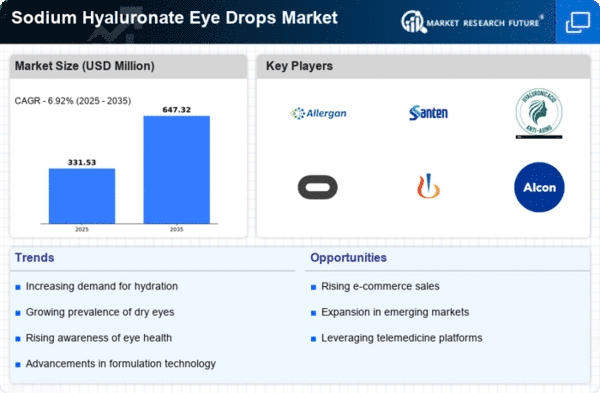
As per MRFR analysis, the Sodium Hyaluronate Eye Drops Market Size was estimated at 310.07 USD Million in 2024. The Sodium Hyaluronate Eye Drops industry is projected to grow from 331.53 in 2025 to 647.32 by 2035, exhibiting a compound annual growth rate (CAGR) of 6.92 during the forecast period 2025 - 2035.

Key Market Trends & Highlights

The Sodium Hyaluronate Eye Drops Market is experiencing robust growth driven by evolving consumer preferences and technological advancements.

  • The demand for natural ingredients in eye care products is on the rise, reflecting a broader trend towards holistic health. Technological advancements in formulation are enhancing product efficacy, particularly in the dry eye treatment segment. North America remains the largest market, while the Asia-Pacific region is emerging as the fastest-growing area for sodium hyaluronate eye drops. The increasing prevalence of eye disorders and the rising awareness of eye health are key drivers propelling market growth.

Market Size & Forecast

2024 Market Size 310.07 (USD Million)
2035 Market Size 647.32 (USD Million)
CAGR (2025 - 2035) 6.92%
Largest Regional Market Share in 2024 North America

Major Players

Allergan (US), <a href="https://www.santen.com/asia/therapeutic-areas/dryeye/hyalein-hialid">Santen </a>(JP), Bausch + Lomb (US), Hyaluronic Acid (US), Oculus (DE), Novartis (CH), Alcon (CH), Eyevance Pharmaceuticals (US), Hyaluronic Acid (US)

Market Trends

The Sodium Hyaluronate Eye Drops Market is currently experiencing a notable evolution, driven by increasing awareness regarding eye health and the rising prevalence of dry eye conditions. This market appears to be expanding as consumers seek effective solutions for ocular discomfort. The formulation of sodium hyaluronate, known for its hydrating properties, is gaining traction among both healthcare professionals and patients. Furthermore, the growing geriatric population, which is more susceptible to eye-related ailments, seems to be a significant factor influencing market dynamics. As a result, manufacturers are likely focusing on developing innovative products that cater to this demographic's needs. In addition, the Sodium Hyaluronate Eye Drops Market is witnessing a shift towards more natural and preservative-free formulations. This trend indicates a consumer preference for products that minimize potential side effects and enhance comfort. The rise of e-commerce platforms is also reshaping distribution channels, making these eye drops more accessible to a broader audience. Overall, the market appears poised for continued growth, with advancements in technology and formulation likely to play a crucial role in shaping its future landscape.

Growing Demand for Natural Ingredients

There is an increasing consumer preference for eye drop formulations that utilize natural ingredients. This trend suggests that patients are becoming more conscious of the components in their eye care products, leading to a rise in demand for sodium hyaluronate eye drops that are free from preservatives and synthetic additives.

Technological Advancements in Product Development

Innovations in manufacturing processes and formulation techniques are likely enhancing the efficacy and comfort of sodium hyaluronate eye drops. These advancements may result in products that offer longer-lasting hydration and improved delivery mechanisms, thereby attracting more users.

Expansion of Online Retail Channels

The growth of e-commerce is transforming how sodium hyaluronate eye drops are marketed and sold. Online platforms are providing consumers with greater access to a variety of products, which may lead to increased sales and brand visibility in the market.

Sodium Hyaluronate Eye Drops Market Market Drivers

Growing Awareness of Eye Health

Awareness regarding eye health is becoming increasingly prominent, contributing to the expansion of the Global Sodium Hyaluronate Eye Drops Market Industry. Educational campaigns and initiatives by health organizations are fostering a better understanding of eye care, particularly among older adults. This heightened awareness is likely to drive demand for sodium hyaluronate eye drops, as consumers seek effective remedies for dry eyes and other related conditions. As a result, the market is projected to grow at a compound annual growth rate of 7.0% from 2025 to 2035, indicating a sustained interest in maintaining eye health and preventing disorders.

Increasing Prevalence of Eye Disorders

The Global Sodium Hyaluronate Eye Drops Market Industry is experiencing growth due to the rising prevalence of eye disorders such as dry eye syndrome and age-related macular degeneration. As populations age, the incidence of these conditions increases, leading to a higher demand for effective treatment options. For instance, it is estimated that by 2024, the market will reach 0.31 USD Billion, reflecting the urgent need for innovative solutions. This trend is likely to continue, as the World Health Organization indicates that the number of individuals affected by vision impairment is projected to rise significantly in the coming years.

Rising Demand for Over-the-Counter Products

The increasing demand for over-the-counter (OTC) eye care products is significantly influencing the Global Sodium Hyaluronate Eye Drops Market Industry. Consumers are increasingly opting for accessible solutions to manage eye discomfort without the need for prescriptions. This trend is particularly evident in the growing popularity of sodium hyaluronate eye drops, which are recognized for their effectiveness in alleviating dry eye symptoms. As the market evolves, it is anticipated that the availability of these products will expand, further driving growth. The convenience of OTC options aligns with consumer preferences for self-care, potentially leading to sustained market expansion in the coming years.

Technological Advancements in Ophthalmic Solutions

Technological advancements in ophthalmic solutions are playing a pivotal role in shaping the Global Sodium Hyaluronate Eye Drops Market Industry. Innovations in formulation and delivery methods are enhancing the efficacy and comfort of eye drops, making them more appealing to consumers. For example, the development of preservative-free formulations is addressing concerns related to irritation and side effects. This trend is expected to contribute to the market's growth, with projections indicating a rise to 0.65 USD Billion by 2035. As manufacturers continue to invest in research and development, the market is likely to witness a surge in novel products that cater to diverse consumer needs.

Market Segment Insights

By Application: Dry Eye Treatment (Largest) vs. Post-Surgical Care (Fastest-Growing)

The Sodium Hyaluronate Eye Drops Market exhibits a diverse application landscape, with Dry Eye Treatment reigning as the largest segment. This application accounts for a significant share, as dry eye syndrome affects millions globally, driving demand for effective relief solutions. Following closely, Post-Surgical Care has emerged as a rapidly evolving segment, fueled by an increased number of surgical procedures and an emphasis on patient recovery and comfort.

Dry Eye Treatment (Dominant) vs. Post-Surgical Care (Emerging)

Dry Eye Treatment stands as the dominant application in the Sodium Hyaluronate Eye Drops Market, thanks to its essential role in alleviating the discomfort caused by dry eye syndrome, which has become prevalent due to various lifestyle factors. The extensive penetration of these drops in consumer health routines solidifies their market presence. In contrast, Post-Surgical Care is identified as an emerging segment, driven by the rise in ocular surgeries and the heightened focus on minimizing postoperative complications. This segment caters to a niche market that emphasizes the importance of providing adequate hydration and lubrication to promote healing, illustrating a trend toward increased specialized eye care solutions.

By Formulation Type: Preservative-Free (Largest) vs. Gel Formulation (Fastest-Growing)

The Sodium Hyaluronate Eye Drops Market is witnessing a significant shift in formulation preferences. The Preservative-Free segment currently holds the largest market share, catering to consumers seeking gentler, more natural solutions for eye care. Conversely, the Gel Formulation segment is on the rise, attracting attention with innovative products designed for prolonged moisture retention and comfort, appealing particularly to users with moderate to severe dry eye symptoms. Growth trends indicate a robust demand for Preservative-Free formulations due to increasing consumer awareness of the side effects associated with preservatives in eye drops. On the other hand, Gel Formulation is capturing the market’s attention as manufacturers focus on developing enhanced delivery systems. Technological advancements and marketing strategies emphasizing comfort and effectiveness are driving this growth, making Gel the fastest-growing formulation type in the sector.

Preservative-Free (Dominant) vs. Gel Formulation (Emerging)

The Preservative-Free formulation segment stands out as the dominant choice in the Sodium Hyaluronate Eye Drops Market, appealing to a broad consumer base that prioritizes safety and comfort. This formulation minimizes the risk of irritation and hypersensitivity reactions, making it particularly suitable for long-term use in sensitive eyes. Additionally, the absence of preservatives allows for a more natural experience, which resonates well with health-conscious consumers. In contrast, Gel Formulation is emerging as a strong competitor, notably for its ability to provide extended moisture and relief for patients with chronic dry eyes. These formulations often contain a higher viscosity, which enhances contact time with the ocular surface, creating a barrier against dryness. As manufacturers innovate and refine gel-based options, its market appeal continues to grow, attracting an increasingly diverse audience seeking effective eye care solutions.

By Distribution Channel: Pharmacies (Largest) vs. Online Retail (Fastest-Growing)

The Sodium Hyaluronate Eye Drops Market is predominantly driven by pharmacies, which hold a significant market share due to their widespread accessibility and trust among consumers. Pharmacies serve as the primary outlet for consumers seeking high-quality eye care products, benefiting from established customer relationships and service excellence. This channel is crucial for reaching a large demographic that prefers in-person consultations and immediate product availability. On the other hand, online retail is emerging as the fastest-growing channel, reflecting a shift in consumer behavior towards convenience and digital shopping. The rise of e-commerce has allowed customers to purchase Sodium Hyaluronate Eye Drops from the comfort of their homes, driving market growth. This segment is fueled by increasing online healthcare awareness, competitive pricing, and extensive product availability, appealing particularly to younger consumers and those in remote areas.

Pharmacies: (Dominant) vs. Online Retail (Emerging)

Pharmacies dominate the Sodium Hyaluronate Eye Drops market as they provide a trusted platform for consumers to purchase essential eye care solutions. Their strength lies in personal interaction and professional guidance from pharmacists, which instills confidence in users regarding product efficacy. Pharmacies benefit from established networks and customer loyalty, making them the go-to source for routine eye care. In contrast, online retail is rapidly emerging, driven by user-friendly interfaces and broader product selections. This segment appeals largely to tech-savvy consumers who value the convenience of home delivery and the ability to compare products easily. Online retail is expected to grow significantly, supported by improved logistics, aggressive marketing strategies, and increasing consumer trust in online transactions.

By End User: Individuals (Largest) vs. Healthcare Professionals (Fastest-Growing)

In the Sodium Hyaluronate Eye Drops Market, the distribution among end user segments showcases a significant proportion of consumption by Individuals, who represent the largest segment. Their need for over-the-counter solutions for dry eyes drives demand and solidifies their position. In contrast, Healthcare Professionals, including optometrists and ophthalmologists, exhibit a rapidly growing share, attributed to increasing patient referrals and the enhanced focus on eye care practices. This indicates a shift towards more professional endorsement and usage of Sodium Hyaluronate for therapeutic purposes among medical practitioners. The growth trends within this segment are substantially influenced by rising awareness about eye health and the effectiveness of Sodium Hyaluronate in providing relief from dry eye symptoms. The surge in prescriptions from Healthcare Professionals correlates with new clinical findings underscoring the efficacy of these eye drops in various conditions. Furthermore, the growing aging population and the prevalence of eye-related ailments have contributed to the demand from both Individuals and Healthcare Professionals, making this segment highly dynamic and promising for future development.

Individuals (Dominant) vs. Healthcare Professionals (Emerging)

The Individuals segment in the Sodium Hyaluronate Eye Drops Market is characterized by a broad consumer base seeking accessible solutions for dry eye symptoms. This group primarily utilizes over-the-counter products that provide quick relief and convenience. In contrast, the Healthcare Professionals segment is emerging strongly, demonstrating an increasing reliance on Sodium Hyaluronate for therapeutic applications. This segment, which includes optometrists and ophthalmologists, prioritizes evidence-based recommendations for their patients and often engages in repeated dispensing based on effectiveness. The recognition of Sodium Hyaluronate as a robust option for eye comfort enhances its prescription appeal, creating a balance between self-care from Individuals and informed choices by Healthcare Professionals.

Get more detailed insights about Sodium Hyaluronate Eye Drops Market Research Report 2035

Regional Insights

North America : Market Leader in Eye Care

North America is poised to maintain its leadership in the Sodium Hyaluronate Eye Drops market, holding a significant market size of $155.0M as of December 2025. The region's growth is driven by increasing prevalence of dry eye conditions, heightened awareness of eye health, and advancements in product formulations. Regulatory support from agencies like the FDA further catalyzes market expansion, ensuring safety and efficacy in eye care products. The competitive landscape is robust, featuring key players such as Allergan, Bausch + Lomb, and Alcon, which dominate the market with innovative solutions. The U.S. remains the largest contributor, supported by a strong healthcare infrastructure and consumer demand for effective eye care solutions. The presence of established companies fosters a dynamic environment for new entrants, enhancing competition and innovation.

Europe : Emerging Market with Growth Potential

Europe's Sodium Hyaluronate Eye Drops market is valued at $85.0M, reflecting a growing demand driven by an aging population and increasing incidence of ocular disorders. Regulatory frameworks, such as the European Medicines Agency guidelines, promote the development of safe and effective eye care products. The region's focus on research and development further supports market growth, with innovations in formulations and delivery methods. Leading countries like Germany, France, and the UK are at the forefront, with a competitive landscape featuring companies such as Santen and Novartis. The presence of established pharmaceutical firms enhances market dynamics, while collaborations and partnerships are common to leverage technological advancements. The European market is characterized by a mix of local and international players, fostering a diverse product offering.

Asia-Pacific : Rapidly Growing Eye Care Sector

The Asia-Pacific region, with a market size of $55.0M, is witnessing rapid growth in the Sodium Hyaluronate Eye Drops market. Factors such as rising disposable incomes, increasing awareness of eye health, and a growing elderly population contribute to this trend. Regulatory bodies in countries like Japan and Australia are enhancing guidelines to ensure product safety, which is crucial for market expansion. Key players such as Santen and local manufacturers are increasingly investing in R&D to cater to the unique needs of the region. Countries like Japan and China are leading the market, supported by a strong healthcare system and increasing consumer demand for effective eye care solutions. The competitive landscape is evolving, with both multinational and regional players vying for market share, driving innovation and accessibility.

Middle East and Africa : Niche Market with Growth Opportunities

The Middle East and Africa region, with a market size of $15.07M, presents a niche yet growing market for Sodium Hyaluronate Eye Drops. The growth is driven by increasing awareness of eye health and rising incidences of dry eye syndrome. Regulatory bodies are beginning to establish frameworks to ensure product safety and efficacy, which is essential for market development. Countries like South Africa and the UAE are emerging as key players in the market, with local manufacturers and international companies exploring opportunities. The competitive landscape is characterized by a mix of established brands and new entrants, fostering innovation. As healthcare infrastructure improves, the demand for effective eye care solutions is expected to rise, creating opportunities for growth in this region.

Key Players and Competitive Insights

The Sodium Hyaluronate Eye Drops Market is characterized by a dynamic competitive landscape, driven by increasing consumer awareness regarding eye health and the rising prevalence of dry eye syndrome. Major players such as Allergan (US), Santen (JP), and Bausch + Lomb (US) are strategically positioned to leverage innovation and expand their market presence. Allergan (US) focuses on enhancing its product portfolio through research and development, while Santen (JP) emphasizes partnerships with healthcare providers to improve patient access to its offerings. Bausch + Lomb (US) is actively pursuing mergers and acquisitions to bolster its market share, indicating a trend towards consolidation in the industry. Collectively, these strategies contribute to a competitive environment that is increasingly centered on innovation and strategic partnerships.
Key business tactics within the Sodium Hyaluronate Eye Drops Market include localizing manufacturing and optimizing supply chains to enhance efficiency and reduce costs. The market structure appears moderately fragmented, with several key players exerting influence over various segments. This fragmentation allows for niche players to thrive, while larger companies capitalize on economies of scale. The collective influence of these key players shapes market dynamics, as they compete not only on product efficacy but also on brand loyalty and distribution networks.
In November 2025, Allergan (US) announced the launch of a new line of preservative-free Sodium Hyaluronate Eye Drops, aimed at providing relief for patients with severe dry eye conditions. This strategic move underscores Allergan's commitment to innovation and patient-centric solutions, potentially enhancing its competitive edge in a market that increasingly values product safety and efficacy. The introduction of preservative-free options may attract a broader consumer base, particularly among those sensitive to preservatives in eye care products.
In October 2025, Santen (JP) entered into a strategic partnership with a leading telehealth provider to facilitate remote consultations for patients suffering from dry eye syndrome. This collaboration is indicative of a growing trend towards digital health solutions, allowing Santen to expand its reach and improve patient engagement. By integrating telehealth services, Santen positions itself as a forward-thinking player in the market, likely enhancing its brand reputation and customer loyalty.
In September 2025, Bausch + Lomb (US) completed the acquisition of a smaller competitor specializing in innovative eye care technologies. This acquisition is expected to enhance Bausch + Lomb's product offerings and accelerate its entry into emerging markets. The strategic importance of this move lies in the potential for increased market share and the ability to leverage new technologies to meet evolving consumer demands.
As of December 2025, current competitive trends in the Sodium Hyaluronate Eye Drops Market are increasingly defined by digitalization, sustainability, and the integration of artificial intelligence (AI) in product development and customer engagement. Strategic alliances are shaping the landscape, as companies seek to combine resources and expertise to drive innovation. Looking ahead, competitive differentiation is likely to evolve from traditional price-based competition towards a focus on technological advancements, product innovation, and supply chain reliability. This shift suggests that companies that prioritize these areas may gain a substantial advantage in an increasingly competitive market.

Key Companies in the Sodium Hyaluronate Eye Drops Market include

Industry Developments

April 2022: Bobbi Brown & Jones Road launched "WTF" foundation formulated with jojoba oil, vitamin E, and sodium hyaluronate (a humectant that attracts moisture when applied to the skin)

February 2023: Santen Pharmaceutical announced that China's National Medical Products Administration accepted its application to market STN1011101, a preservative-free combination eye drop for treating open-angle glaucoma and ocular hypertension.

Future Outlook

Sodium Hyaluronate Eye Drops Market Future Outlook

The Sodium Hyaluronate Eye Drops Market is projected to grow at a 6.92% CAGR from 2025 to 2035, driven by increasing prevalence of dry eye conditions and rising consumer awareness.

New opportunities lie in:

  • Expansion into emerging markets with tailored marketing strategies.
  • Development of preservative-free formulations to attract health-conscious consumers.
  • Partnerships with ophthalmology clinics for direct distribution channels.

By 2035, the market is expected to solidify its position as a leader in ocular health solutions.

Market Segmentation

Sodium Hyaluronate Eye Drops Market End User Outlook

  • Individuals
  • Healthcare Professionals
  • Optometrists
  • Ophthalmologists
  • Pharmaceutical Companies

Sodium Hyaluronate Eye Drops Market Application Outlook

  • Dry Eye Treatment
  • Post-Surgical Care
  • Contact Lens Comfort
  • Ocular Surface Disease
  • Allergy Relief

Sodium Hyaluronate Eye Drops Market Formulation Type Outlook

  • Preservative-Free
  • With Preservatives
  • Gel Formulation
  • Liquid Formulation
  • Sustained Release

Sodium Hyaluronate Eye Drops Market Distribution Channel Outlook

  • Pharmacies
  • Online Retail
  • Hospitals
  • Optometry Clinics
  • Specialty Stores

Report Scope

MARKET SIZE 2024 310.07(USD Million)
MARKET SIZE 2025 331.53(USD Million)
MARKET SIZE 2035 647.32(USD Million)
COMPOUND ANNUAL GROWTH RATE (CAGR) 6.92% (2025 - 2035)
REPORT COVERAGE Revenue Forecast, Competitive Landscape, Growth Factors, and Trends
BASE YEAR 2024
Market Forecast Period 2025 - 2035
Historical Data 2019 - 2024
Market Forecast Units USD Million
Key Companies Profiled Allergan (US), Santen (JP), Bausch + Lomb (US), Hyaluronic Acid (US), Oculus (DE), Novartis (CH), Alcon (CH), Eyevance Pharmaceuticals (US), Hyaluronic Acid (US)
Segments Covered Application, Formulation Type, Distribution Channel, End User
Key Market Opportunities Growing demand for dry eye relief drives innovation in Sodium Hyaluronate Eye Drops Market formulations.
Key Market Dynamics Rising consumer demand for dry eye relief drives innovation and competition in the Sodium Hyaluronate Eye Drops market.
Countries Covered North America, Europe, APAC, South America, MEA

FAQs

What is the projected growth of the Sodium Hyaluronate Eye Drops market?

The Sodium Hyaluronate Eye Drops market is the expected increase in total market value of 0.65 USD billion over a defined forecast period 2025–2035. It is driven by factors such as demand trends, technological advances, regulatory changes, and geographic expansion.

What is the size of the Sodium Hyaluronate Eye Drops market?

Sodium Hyaluronate Eye Drops market size was valued at approximately 0.31 billion USD in 2024. This figure will reach 0.65 billion USD covering all regions (America, Europe, Asia, MEA and ROW), focusing its segments / services / distribution channels till 2035.

What is the CAGR of the Sodium Hyaluronate Eye Drops market?

Sodium Hyaluronate Eye Drops market is expected to grow at a CAGR of 6.92% between 2025 and 2035.

How much will the Sodium Hyaluronate Eye Drops market be worth by 2035?

Sodium Hyaluronate Eye Drops market is expected to be worth of 0.65 billion USD, reflecting growth driven by usage, technology and global demands by the end of 2035.

How will the Sodium Hyaluronate Eye Drops market perform over the next 10 years?

Over the next 10 years the Sodium Hyaluronate Eye Drops market is expected to shift from usd billion 0.31 to 0.65 billion USD, led by adoption of advanced tech, demographic trends, regulatory approvals, with potential headwinds from 2025 to 2035.

Which region held the largest market share in the Sodium hyaluronate eye drops market?

North America had the largest share in the global market

  1. SECTION I: EXECUTIVE SUMMARY AND KEY HIGHLIGHTS
    1. | 1.1 EXECUTIVE SUMMARY
    2. | 1.1.1 Market Overview
    3. | 1.1.2 Key Findings
    4. | 1.1.3 Market Segmentation
    5. | 1.1.4 Competitive Landscape
    6. | 1.1.5 Challenges and Opportunities
    7. | 1.1.6 Future Outlook
  2. SECTION II: SCOPING, METHODOLOGY AND MARKET STRUCTURE
    1. | 2.1 MARKET INTRODUCTION
    2. | 2.1.1 Definition
    3. | 2.1.2 Scope of the study
    4. |-- 2.1.2.1 Research Objective
    5. |-- 2.1.2.2 Assumption
    6. |-- 2.1.2.3 Limitations
    7. | 2.2 RESEARCH METHODOLOGY
    8. | 2.2.1 Overview
    9. | 2.2.2 Data Mining
    10. | 2.2.3 Secondary Research
    11. | 2.2.4 Primary Research
    12. |-- 2.2.4.1 Primary Interviews and Information Gathering Process
    13. |-- 2.2.4.2 Breakdown of Primary Respondents
    14. | 2.2.5 Forecasting Model
    15. | 2.2.6 Market Size Estimation
    16. |-- 2.2.6.1 Bottom-Up Approach
    17. |-- 2.2.6.2 Top-Down Approach
    18. | 2.2.7 Data Triangulation
    19. | 2.2.8 Validation
  3. SECTION III: QUALITATIVE ANALYSIS
    1. | 3.1 MARKET DYNAMICS
    2. | 3.1.1 Overview
    3. | 3.1.2 Drivers
    4. | 3.1.3 Restraints
    5. | 3.1.4 Opportunities
    6. | 3.2 MARKET FACTOR ANALYSIS
    7. | 3.2.1 Value chain Analysis
    8. | 3.2.2 Porter's Five Forces Analysis
    9. |-- 3.2.2.1 Bargaining Power of Suppliers
    10. |-- 3.2.2.2 Bargaining Power of Buyers
    11. |-- 3.2.2.3 Threat of New Entrants
    12. |-- 3.2.2.4 Threat of Substitutes
    13. |-- 3.2.2.5 Intensity of Rivalry
    14. | 3.2.3 COVID-19 Impact Analysis
    15. |-- 3.2.3.1 Market Impact Analysis
    16. |-- 3.2.3.2 Regional Impact
    17. |-- 3.2.3.3 Opportunity and Threat Analysis
  4. SECTION IV: QUANTITATIVE ANALYSIS
    1. | 4.1 Healthcare, BY Application (USD Million)
    2. | 4.1.1 Dry Eye Treatment
    3. | 4.1.2 Post-Surgical Care
    4. | 4.1.3 Contact Lens Comfort
    5. | 4.1.4 Ocular Surface Disease
    6. | 4.1.5 Allergy Relief
    7. | 4.2 Healthcare, BY Formulation Type (USD Million)
    8. | 4.2.1 Preservative-Free
    9. | 4.2.2 With Preservatives
    10. | 4.2.3 Gel Formulation
    11. | 4.2.4 Liquid Formulation
    12. | 4.2.5 Sustained Release
    13. | 4.3 Healthcare, BY Distribution Channel (USD Million)
    14. | 4.3.1 Pharmacies
    15. | 4.3.2 Online Retail
    16. | 4.3.3 Hospitals
    17. | 4.3.4 Optometry Clinics
    18. | 4.3.5 Specialty Stores
    19. | 4.4 Healthcare, BY End User (USD Million)
    20. | 4.4.1 Individuals
    21. | 4.4.2 Healthcare Professionals
    22. | 4.4.3 Optometrists
    23. | 4.4.4 Ophthalmologists
    24. | 4.4.5 Pharmaceutical Companies
    25. | 4.5 Healthcare, BY Region (USD Million)
    26. | 4.5.1 North America
    27. |-- 4.5.1.1 US
    28. |-- 4.5.1.2 Canada
    29. | 4.5.2 Europe
    30. |-- 4.5.2.1 Germany
    31. |-- 4.5.2.2 UK
    32. |-- 4.5.2.3 France
    33. |-- 4.5.2.4 Russia
    34. |-- 4.5.2.5 Italy
    35. |-- 4.5.2.6 Spain
    36. |-- 4.5.2.7 Rest of Europe
    37. | 4.5.3 APAC
    38. |-- 4.5.3.1 China
    39. |-- 4.5.3.2 India
    40. |-- 4.5.3.3 Japan
    41. |-- 4.5.3.4 South Korea
    42. |-- 4.5.3.5 Malaysia
    43. |-- 4.5.3.6 Thailand
    44. |-- 4.5.3.7 Indonesia
    45. |-- 4.5.3.8 Rest of APAC
    46. | 4.5.4 South America
    47. |-- 4.5.4.1 Brazil
    48. |-- 4.5.4.2 Mexico
    49. |-- 4.5.4.3 Argentina
    50. |-- 4.5.4.4 Rest of South America
    51. | 4.5.5 MEA
    52. |-- 4.5.5.1 GCC Countries
    53. |-- 4.5.5.2 South Africa
    54. |-- 4.5.5.3 Rest of MEA
  5. SECTION V: COMPETITIVE ANALYSIS
    1. | 5.1 Competitive Landscape
    2. | 5.1.1 Overview
    3. | 5.1.2 Competitive Analysis
    4. | 5.1.3 Market share Analysis
    5. | 5.1.4 Major Growth Strategy in the Healthcare
    6. | 5.1.5 Competitive Benchmarking
    7. | 5.1.6 Leading Players in Terms of Number of Developments in the Healthcare
    8. | 5.1.7 Key developments and growth strategies
    9. |-- 5.1.7.1 New Product Launch/Service Deployment
    10. |-- 5.1.7.2 Merger & Acquisitions
    11. |-- 5.1.7.3 Joint Ventures
    12. | 5.1.8 Major Players Financial Matrix
    13. |-- 5.1.8.1 Sales and Operating Income
    14. |-- 5.1.8.2 Major Players R&D Expenditure. 2023
    15. | 5.2 Company Profiles
    16. | 5.2.1 Allergan (US)
    17. |-- 5.2.1.1 Financial Overview
    18. |-- 5.2.1.2 Products Offered
    19. |-- 5.2.1.3 Key Developments
    20. |-- 5.2.1.4 SWOT Analysis
    21. |-- 5.2.1.5 Key Strategies
    22. | 5.2.2 Santen (JP)
    23. |-- 5.2.2.1 Financial Overview
    24. |-- 5.2.2.2 Products Offered
    25. |-- 5.2.2.3 Key Developments
    26. |-- 5.2.2.4 SWOT Analysis
    27. |-- 5.2.2.5 Key Strategies
    28. | 5.2.3 Bausch + Lomb (US)
    29. |-- 5.2.3.1 Financial Overview
    30. |-- 5.2.3.2 Products Offered
    31. |-- 5.2.3.3 Key Developments
    32. |-- 5.2.3.4 SWOT Analysis
    33. |-- 5.2.3.5 Key Strategies
    34. | 5.2.4 Hyaluronic Acid (US)
    35. |-- 5.2.4.1 Financial Overview
    36. |-- 5.2.4.2 Products Offered
    37. |-- 5.2.4.3 Key Developments
    38. |-- 5.2.4.4 SWOT Analysis
    39. |-- 5.2.4.5 Key Strategies
    40. | 5.2.5 Oculus (DE)
    41. |-- 5.2.5.1 Financial Overview
    42. |-- 5.2.5.2 Products Offered
    43. |-- 5.2.5.3 Key Developments
    44. |-- 5.2.5.4 SWOT Analysis
    45. |-- 5.2.5.5 Key Strategies
    46. | 5.2.6 Novartis (CH)
    47. |-- 5.2.6.1 Financial Overview
    48. |-- 5.2.6.2 Products Offered
    49. |-- 5.2.6.3 Key Developments
    50. |-- 5.2.6.4 SWOT Analysis
    51. |-- 5.2.6.5 Key Strategies
    52. | 5.2.7 Alcon (CH)
    53. |-- 5.2.7.1 Financial Overview
    54. |-- 5.2.7.2 Products Offered
    55. |-- 5.2.7.3 Key Developments
    56. |-- 5.2.7.4 SWOT Analysis
    57. |-- 5.2.7.5 Key Strategies
    58. | 5.2.8 Eyevance Pharmaceuticals (US)
    59. |-- 5.2.8.1 Financial Overview
    60. |-- 5.2.8.2 Products Offered
    61. |-- 5.2.8.3 Key Developments
    62. |-- 5.2.8.4 SWOT Analysis
    63. |-- 5.2.8.5 Key Strategies
    64. | 5.2.9 Hyaluronic Acid (US)
    65. |-- 5.2.9.1 Financial Overview
    66. |-- 5.2.9.2 Products Offered
    67. |-- 5.2.9.3 Key Developments
    68. |-- 5.2.9.4 SWOT Analysis
    69. |-- 5.2.9.5 Key Strategies
    70. | 5.3 Appendix
    71. | 5.3.1 References
    72. | 5.3.2 Related Reports

Healthcare Market Segmentation

Healthcare By Application (USD Million, 2025-2035)

  • Dry Eye Treatment
  • Post-Surgical Care
  • Contact Lens Comfort
  • Ocular Surface Disease
  • Allergy Relief

Healthcare By Formulation Type (USD Million, 2025-2035)

  • Preservative-Free
  • With Preservatives
  • Gel Formulation
  • Liquid Formulation
  • Sustained Release

Healthcare By Distribution Channel (USD Million, 2025-2035)

  • Pharmacies
  • Online Retail
  • Hospitals
  • Optometry Clinics
  • Specialty Stores

Healthcare By End User (USD Million, 2025-2035)

  • Individuals
  • Healthcare Professionals
  • Optometrists
  • Ophthalmologists
  • Pharmaceutical Companies
Infographic

Free Sample Request

Kindly complete the form below to receive a free sample of this Report

Get Free Sample

Customer Strories

Compare Licence

×
Features License Type
Single User Multiuser License Enterprise User
Price $4,950 $5,950 $7,250
Maximum User Access Limit 1 User Upto 10 Users Unrestricted Access Throughout the Organization
Free Customization
Direct Access to Analyst
Deliverable Format
Platform Access
Discount on Next Purchase 10% 15% 15%
Printable Versions