Request Free Sample ×

Kindly complete the form below to receive a free sample of this Report

* Please use a valid business email

Leading companies partner with us for data-driven Insights

clients tt-cursor
Hero Background
English
Chinese
French
Japanese
Korean
German
Spanish

Socks Market Trends

ID: MRFR/CG/10453-CR
167 Pages
Snehal Singh
July 2023

Socks Market Size, Share, Industry Trend & Analysis Research Report Information by Product Type (Athletic Socks, Specialty Socks, Trouser Socks, Casual Socks, Multiple Toe Socks, and Others), Material (Polyester, Cotton, Wool, and Nylon), End User (Men, Women, and Children), Distribution Channel (Supermarkets & Hypermarkets, Convenience Stores, Specialty Stores, and Online), And by Region (North America, Europe, Asia-Pacific, Latin America, and Middle East & Africa) - Forecast Till 2035

Share:
Download PDF ×

We do not share your information with anyone. However, we may send you emails based on your report interest from time to time. You may contact us at any time to opt-out.

Socks Market Infographic
Purchase Options

Market Trends

Introduction

In 2023, the Socks Market is experiencing a significant transformation in the wake of several macroeconomic factors. Materials and manufacturing processes are increasingly enhancing the performance and sustainability of products, and responding to the growing demand for eco-friendly products. Meanwhile, changes in the behavior of consumers, such as the rise of athleisure and the emphasis on comfort, are reshaping the product portfolio and marketing strategies. The regulatory frameworks relating to the conditions of work and the environment are also affecting the industry’s business practices. These are the trends that companies must understand in order to align their product development and marketing strategies with the expectations of consumers and the regulatory framework, and to ensure their competitiveness in a rapidly changing market.

Top Trends

  1. Sustainability and Eco-Friendly Materials
    The demand for sustainable socks is growing. Brands like Adidas are leading the way, making socks out of recycled materials. A survey showed that 66% of consumers prefer brands that are socially responsible. This is leading producers to invest in more sustainable manufacturing methods, which could transform the supply chain. Biodegradable materials and circular economy practices may be on the horizon.
  2. Smart Socks Technology
    Wearable health sensors are gaining ground, and a number of companies, including Under Armour, have already introduced performance-tracking smart socks. The research suggests that the market for wearable devices will continue to grow, and that the market for socks will be affected. This trend could result in the sock manufacturers forming alliances with technology companies, which would then enhance the socks’ functionality. This could include a fitness app, a personal health tracker and even health insights.
  3. Athleisure and Fashion-Forward Designs
    Sporty lines like those from Nike and the like continue to dominate the market. The popularity of athleisurewear is said to have had a major influence on the popularity of fashionable and practical socks. The trend has also made it possible for sportswear companies to work with fashion designers, thus expanding their markets. More limited-edition lines and collaborations with fashion influencers are expected to be forthcoming.
  4. Increased Focus on Comfort and Performance
    Thorlo focuses on cushioning and moisture transport. It is found from consumer feedback that 7 out of 10 people buy socks for comfort. This trend has led to the sock industry enhancing product features and thereby increasing production costs. The future may bring about a development of socks designed for particular activities, such as running or hiking.
  5. Customization and Personalization
    The same thing is happening with socks. There are a growing number of companies offering to make custom-designed socks for individual preferences. A survey has found that half of consumers are willing to pay more for a product that has been made to their own specifications. This trend is encouraging companies to invest in on-demand production technology, which could cut production costs. Artificial intelligence-based design tools could help consumers create their own unique sock styles.
  6. Health and Wellness Integration
    A sock designed for a specific purpose, such as compression socks, is on the rise. One of the companies that has mastered this niche is Balega. The research shows that the global market for compression socks is growing, which reflects the growing health consciousness of consumers. This trend has prompted the brands to diversify their products, which may lead to an increase in market competition. In the future, there may be a possibility of collaborating with medical professionals to promote these products.
  7. Subscription Services and Direct-to-Consumer Models
    Subscriptions to socks are changing the way we shop. Brands offer monthly deliveries. Data shows that in the last few years, the number of subscriptions has increased by 200%. This trend is causing brands to increase customer loyalty through personalisation. Subscriptions can be offered on different levels with exclusive benefits for members.
  8. Global Expansion and Emerging Markets
    Brands are increasingly concentrating on emerging markets, with companies like Hanesbrands expanding their distribution in Asia. The demand for good socks in these countries is rising, according to market research. This development is causing brands to adapt their marketing to the preferences of the local population. Localized product ranges and regional retailing may be in the offing.
  9. Innovative Marketing Strategies
    It is therefore essential to use creative means of communication. Brands are deploying social media influencers to reach younger audiences. A survey has shown that 70% of millennials are influenced in their purchasing decisions by social media. This trend is driving brands to invest in digital marketing, which can increase brand visibility. Future developments may include augmented reality experiences for virtual fittings.
  10. Enhanced Durability and Performance Features
    Drymax is a brand that emphasizes the properties of its products and the strength of its materials. According to a study, 80% of consumers consider the quality of the product as an important purchase criteria. This trend encourages innovation in material science and, possibly, increases production costs. The next step could be the introduction of a guarantee or a period of use.

Conclusion: Navigating the Competitive Socks Landscape

In 2023, the sock market will be extremely competitive and very fragmented, with both established and new players vying for consumer attention. The growing preference for sustainable and innovative products will force the suppliers to change their strategies. Brands will build on their established brand equity and will use automation and artificial intelligence to increase operational efficiency and improve customer engagement. Meanwhile, newcomers will bet on agility and sustainability to gain a foothold in the crowded marketplace. These new capabilities in artificial intelligence, automation, agility and sustainability will be the key to leadership and will force the suppliers to rethink their strategic positioning in order to remain relevant and competitive.


Author
Snehal Singh
Assistant Manager - Research

High acumen in analyzing complex macro & micro markets with more than 6 years of work experience in the field of market research. By implementing her analytical skills in forecasting and estimation into market research reports, she has expertise in Packaging, Construction, and Equipment domains. She handles a team size of 20-25 resources and ensures smooth running of the projects, associated marketing activities, and client servicing.

Leave a Comment

FAQs

What is the current valuation of the Socks Market as of 2024?

<p>The Socks Market was valued at approximately 14197.76 USD Million in 2024.</p>

What is the projected market size for the Socks Market in 2035?

<p>The Socks Market is projected to reach approximately 27119.88 USD Million by 2035.</p>

What is the expected CAGR for the Socks Market during the forecast period 2025 - 2035?

<p>The expected CAGR for the Socks Market during the forecast period 2025 - 2035 is 6.06%.</p>

Which product type segment has the highest valuation in the Socks Market?

<p>Casual Socks had the highest valuation, ranging from 3500.0 to 7000.0 USD Million.</p>

How do athletic socks perform in terms of market valuation?

<p>Athletic Socks are valued between 3000.0 and 6000.0 USD Million, indicating a robust segment.</p>

What materials dominate the Socks Market?

<p>Cotton leads the material segment with a valuation between 4000.0 and 8000.0 USD Million.</p>

Which demographic segment shows the highest market potential in the Socks Market?

<p>The Women demographic segment shows the highest potential, valued between 6000.0 and 12000.0 USD Million.</p>

What distribution channel is expected to perform best in the Socks Market?

<p>Supermarkets & Hypermarkets are projected to perform best, with a valuation between 5000.0 and 10000.0 USD Million.</p>

Who are the key players in the Socks Market?

<p>Key players include Nike, Adidas, Puma, Hanesbrands, Burlington, Gold Toe, Bombas, Stance, and Falke.</p>

What trends are influencing the growth of the Socks Market?

<p>Trends such as increased demand for specialty and athletic socks are likely influencing market growth.</p>

Market Summary

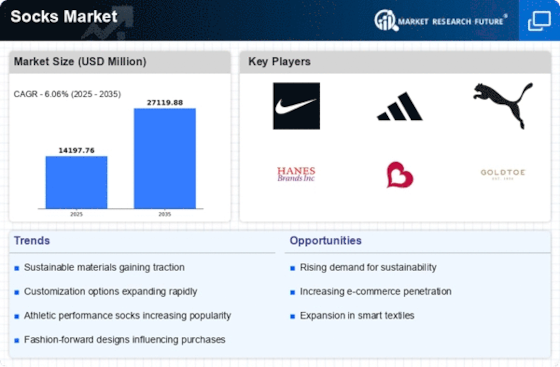
As per Market Research Future analysis, the Socks Market Size was estimated at 14197.76 USD Million in 2024. The Socks industry is projected to grow from USD 15058.15 Million in 2025 to USD 27119.88 Million by 2035, exhibiting a compound annual growth rate (CAGR) of 6.06% during the forecast period 2025 - 2035

Key Market Trends & Highlights

The Socks Market is experiencing a dynamic shift towards sustainability and innovation.

  • The North American market remains the largest, driven by a strong demand for athletic socks. Asia-Pacific is emerging as the fastest-growing region, fueled by increasing disposable incomes and changing lifestyles. Athletic socks dominate the market, while specialty socks are witnessing rapid growth due to evolving consumer preferences. Technological advancements in manufacturing and a rising focus on sustainability are key drivers propelling market expansion.

Market Size & Forecast

2024 Market Size 14197.76 (USD Million)
2035 Market Size 27119.88 (USD Million)
CAGR (2025 - 2035) 6.06%
Largest Regional Market Share in 2024 Asia Pacific

Major Players

Nike (US), <a href="https://www.adidas.de/">Adidas (DE)</a>, Puma (DE), <a href="https://www.hanes.com/">Hanesbrands (US)</a>, Burlington (US), <a href="https://www.goldtoe.com/">Gold Toe (US)</a>, Bombas (US), Stance (US), Falke (DE)

Market Trends

The Socks Market is currently experiencing a dynamic evolution, driven by various factors that influence consumer preferences and purchasing behaviors. The increasing emphasis on sustainability has led to a growing demand for eco-friendly materials and production processes. Consumers are becoming more conscious of their environmental impact, prompting brands to innovate and offer products that align with these values. Additionally, the rise of athleisure and casual wear has transformed the way socks are perceived, with functionality and style becoming equally important. This shift is evident in the diversification of designs, colors, and patterns available in the market, catering to a broader audience. Moreover, the Socks Market is witnessing a surge in online retailing, as digital platforms provide convenience and accessibility for consumers. The proliferation of e-commerce has enabled brands to reach a global audience, enhancing competition and driving innovation. Social media also plays a crucial role in shaping trends, as influencers and fashion icons promote various styles, further influencing consumer choices. As the market continues to evolve, it appears that adaptability and responsiveness to consumer demands will be key for brands aiming to thrive in this competitive landscape.

Sustainability Focus

There is a notable shift towards sustainable practices within the Socks Market. Brands are increasingly adopting eco-friendly materials and ethical production methods to meet the rising consumer demand for environmentally responsible products. This trend reflects a broader societal movement towards sustainability, influencing purchasing decisions.

Athleisure Influence

The popularity of athleisure wear is reshaping the Socks Market, as consumers seek products that blend comfort with style. This trend emphasizes the importance of functionality, with socks designed for both athletic performance and everyday wear. The fusion of fashion and practicality is becoming a defining characteristic of modern sock offerings.

E-commerce Growth

The expansion of e-commerce is significantly impacting the Socks Market, providing consumers with greater access to a diverse range of products. Online shopping platforms facilitate convenience and allow brands to reach wider audiences. This trend is likely to continue, as digital retailing becomes increasingly integral to consumer purchasing habits.

Socks Market Market Drivers

Fashion Trends and Personalization

Fashion trends play a pivotal role in shaping the Socks Market. The increasing popularity of unique and personalized sock designs is driving consumer interest. Brands are now offering customizable options, allowing consumers to select colors, patterns, and even add personal messages. This trend aligns with the broader movement towards individuality in fashion, where consumers seek to express their personal style. Market data indicates that the demand for novelty socks has surged, with sales increasing by approximately 15% over the past year. This growth suggests that consumers are willing to invest in socks that reflect their personality, thereby creating opportunities for brands to innovate and differentiate themselves in the competitive Socks Market.

Rising Health and Wellness Awareness

The growing emphasis on health and wellness is significantly influencing the Socks Market. Consumers are increasingly seeking products that promote comfort and support, particularly in footwear. This trend is evident in the rising demand for compression socks, which are designed to improve circulation and reduce fatigue. According to recent data, the market for compression socks is projected to grow at a compound annual growth rate of over 6% in the coming years. Additionally, the awareness of foot health is prompting consumers to invest in high-quality socks that provide adequate cushioning and support. This shift in consumer behavior is likely to drive innovation and diversification within the Socks Market, as brands strive to meet the evolving needs of health-conscious individuals.

Sustainability and Eco-Friendly Products

Sustainability is becoming a crucial driver in the Socks Market as consumers increasingly prioritize eco-friendly products. Brands are responding by incorporating sustainable materials such as organic cotton, bamboo, and recycled fibers into their sock production. This shift not only appeals to environmentally conscious consumers but also aligns with global efforts to reduce waste and promote sustainable practices. Recent studies indicate that the market for sustainable socks is expected to grow significantly, with a projected increase of over 20% in the next five years. As a result, companies that adopt sustainable practices may gain a competitive edge, attracting a loyal customer base that values ethical consumption in the Socks Market.

E-commerce Expansion and Digital Marketing

The rise of e-commerce is reshaping the Socks Market, providing brands with new avenues to reach consumers. Online shopping has become increasingly popular, with many consumers preferring the convenience of purchasing socks from the comfort of their homes. This trend is supported by data showing that online sales of apparel, including socks, have seen a substantial increase, accounting for nearly 30% of total sales in the sector. Additionally, digital marketing strategies are evolving, with brands leveraging social media platforms to engage with consumers and promote their products. This shift towards e-commerce and digital marketing is likely to enhance brand visibility and accessibility, ultimately driving growth in the Socks Market.

Technological Advancements in Manufacturing

The Sock Market is experiencing a transformation due to technological advancements in manufacturing processes. Innovations such as 3D knitting and automated production lines are enhancing efficiency and reducing costs. These technologies allow for the creation of customized socks that cater to specific consumer preferences, thereby increasing market appeal. Furthermore, the integration of smart textiles into sock production is gaining traction, with features such as moisture-wicking and temperature regulation. This trend is likely to attract health-conscious consumers and athletes, potentially expanding the market. As a result, manufacturers are investing in research and development to stay competitive, which may lead to a more dynamic and responsive Socks Market.

Market Segment Insights

By Product Type: Athletic Socks (Largest) vs. Specialty Socks (Fastest-Growing)

<p>The socks market is currently dominated by athletic socks, which hold the largest share among product types due to their widespread usage in sports and fitness activities. This segment appeals to health-conscious consumers and athletes alike, leading to a stable demand. Following closely are specialty socks, which, though smaller in market share, have been gaining traction due to increasing consumer interest in innovative sock designs that cater to specific needs, such as moisture-wicking and arch support. Growth trends indicate that the athletic socks segment continues to benefit from the growing popularity of sports and outdoor activities, which fuels demand for performance-oriented wearables. On the other hand, the specialty socks segment is expected to experience rapid growth as consumers increasingly favor functionality and unique designs. The focus on comfort and health benefits is driving innovation in sock technology, with brands developing socks tailored for specific activities or health conditions, thus attracting a new segment of shoppers.</p>

<p>Athletic Socks (Dominant) vs. Specialty Socks (Emerging)</p>

<p>Athletic socks represent a dominant force in the socks market, characterized by their emphasis on performance enhancement, comfort, and durability. They are designed to accommodate various sports activities, featuring technologies like moisture management, cushioning, and anatomical fit. This segment's popularity is fuelled by the rise of fitness culture and a growing awareness of health and wellness, leading to consistent consumer investment in quality athletic wear. In contrast, specialty socks are emerging as a vital niche within the market, catering to specific demographic and functional needs. These socks often incorporate advanced materials and designs tailored for specific conditions, such as diabetic or compression socks. The increasing consumer desire for versatility in footwear, combined with health benefits associated with specialty socks, positions this segment for significant growth in the coming years.</p>

By Material: Cotton (Largest) vs. Polyester (Fastest-Growing)

In the Socks Market, the material segment is characterized by a diverse distribution among key players, with cotton serving as the largest segment due to its softness, breathability, and comfort. On the other hand, polyester is emerging robustly, catering to a more active demographic and offering moisture-wicking and enhanced durability. This leads to a shifting focus toward synthetic materials while traditional natural fibers maintain a steady presence in consumer preferences. Moreover, the growth trends in this segment are substantially driven by evolving fashion trends and the increasing demand for functional socks. As consumers prioritize performance alongside comfort, polyester is witnessing rapid growth due to its lightweight nature and performance characteristics. This trend is supported by its application in sports and outdoor activities, making it particularly appealing to younger demographics who value both style and functionality.

Cotton (Dominant) vs. Nylon (Emerging)

Cotton remains the dominant material in the Socks Market, renowned for its natural properties that provide comfort, breathability, and moisture management. Its wide acceptance across various demographics, including casual and formal sock lines, underpins its strong market position. Conversely, nylon represents an emerging material, gaining traction due to its exceptional strength, elasticity, and resistance to wear. This quality makes nylon-sock blends increasingly popular among consumers seeking durability for everyday wear and specific applications like athletic socks. The shift towards nylon is also propelled by ongoing innovations in fabric technology, enhancing the performance attributes of socks, thus attracting performance-driven consumers.

By End User: Men (Largest) vs. Women (Fastest-Growing)

In the Socks Market, the distribution among end users reveals that men constitute the largest segment, driven by consistent demand for dress, casual, and athletic socks. Men's preferences for various styles have established a steady market base that holds a significant share. On the other hand, women's segment has been observing rapid growth owing to the increasing fashion consciousness among women, who seek a wide variety of styles, colors, and patterns, providing a robust incremental market potential.

Men (Dominant) vs. Women (Emerging)

Men's socks dominate the market as the traditional choice for various settings, including work and leisure, characterized by durability and functionality. Styles often include athletic, dress, and casual options that align with their lifestyle demands. Meanwhile, the women's socks segment is emerging as a key growth area, fueled by vibrant designs and the trend toward personalized fashion. Women seek unique sock options that offer both comfort and aesthetic appeal, leading to diverse product offerings that cater to their evolving preferences. As retailers focus more on this emerging segment, introducing fashion-centric collections, it could potentially reshape the market dynamics.

By Distribution Channel: Supermarkets & Hypermarkets (Largest) vs. Online (Fastest-Growing)

In the Socks Market, the distribution channel plays a crucial role in shaping consumer purchasing decisions. Supermarkets and hypermarkets dominate this segment, leveraging their extensive reach and variety that appeals to a broad customer base. Convenience stores and specialty stores also contribute significantly, but they cater to more niche markets. Online retail is gaining traction, especially among younger demographics who value convenience and a wider selection.

Supermarkets &amp; Hypermarkets (Dominant) vs. Online (Emerging)

Supermarkets and hypermarkets are well-established distribution channels in the Socks Market, offering a diverse range of brands and styles under one roof. They benefit from high foot traffic and provide consumers the convenience of quick purchases. In contrast, online distribution is rapidly emerging, driven by advancements in e-commerce and shifts in consumer behavior. Online platforms allow for detailed product comparisons and a broader inventory than physical stores, making them an attractive option for tech-savvy shoppers. These channels appeal particularly to the millennial and Gen Z populations, who prioritize efficiency and variety in their shopping experiences.

Get more detailed insights about Socks Market Research Report—Global Forecast till 2035

Regional Insights

North America : Market Leader in Innovation

The North American socks market is driven by a growing demand for athletic and casual socks, fueled by the increasing popularity of fitness and outdoor activities. The region holds the largest market share at approximately 40%, with the U.S. being the primary contributor. Regulatory support for textile manufacturing and sustainability initiatives further catalyze growth, encouraging brands to innovate and expand their product lines. Key players like Nike, Hanesbrands, and Bombas dominate the competitive landscape, focusing on quality and performance. The U.S. market is characterized by a diverse range of offerings, from performance socks to fashion-oriented designs. Canada also plays a significant role, holding around 15% of the market share, with a growing emphasis on eco-friendly products and local manufacturing.

Europe : Emerging Trends in Sustainability

Europe's socks market is witnessing a shift towards sustainable and eco-friendly products, driven by increasing consumer awareness and regulatory frameworks promoting sustainability. The region holds the second-largest market share at approximately 30%, with Germany and the UK leading the charge. Regulatory initiatives, such as the EU's Green Deal, are encouraging brands to adopt sustainable practices, thus enhancing market growth. Germany is home to key players like Adidas and Falke, while the UK market is characterized by a mix of established brands and innovative startups. The competitive landscape is vibrant, with a focus on quality, design, and sustainability. The presence of major retailers and e-commerce platforms further supports market expansion, catering to diverse consumer preferences and trends.

Asia-Pacific : Rapid Growth in Emerging Markets

The Asia-Pacific socks market is experiencing rapid growth, driven by rising disposable incomes and changing fashion trends. The region is projected to hold a market share of approximately 25%, with China and India being the largest contributors. The increasing urbanization and a growing middle class are significant demand drivers, alongside a shift towards online shopping and brand consciousness among consumers. China leads the market with a strong presence of both local and international brands, while India is emerging as a key player with a focus on affordable and stylish options. The competitive landscape is marked by a mix of established brands and new entrants, with companies like Puma and local manufacturers vying for market share. The region's diverse consumer base presents opportunities for innovation and tailored offerings.

Middle East and Africa : Untapped Potential in the Market

The Middle East and Africa (MEA) socks market is gradually expanding, driven by increasing urbanization and a growing youth population. The region holds a smaller market share of around 5%, but there is significant potential for growth as consumer preferences shift towards branded and quality products. Regulatory support for textile manufacturing is also emerging, encouraging local production and reducing reliance on imports. Countries like South Africa and the UAE are leading the market, with a rising demand for both athletic and casual socks. The competitive landscape is evolving, with local brands gaining traction alongside international players. The focus on quality and design is becoming increasingly important, as consumers seek products that reflect their lifestyle and preferences.

Key Players and Competitive Insights

The Socks is currently characterized by a dynamic competitive landscape, driven by innovation, sustainability, and digital transformation. Major players such as Nike (US), Adidas (DE), and Hanesbrands (US) are actively shaping the market through strategic initiatives that emphasize product differentiation and consumer engagement. Nike (US) continues to leverage its strong brand equity by focusing on performance-oriented socks, while Adidas (DE) emphasizes sustainability in its product lines, appealing to environmentally conscious consumers. Hanesbrands (US), on the other hand, is enhancing its market presence through strategic acquisitions and expanding its product offerings to include more diverse styles and materials, thereby catering to a broader audience. Collectively, these strategies contribute to a competitive environment that is increasingly focused on innovation and consumer preferences.

In terms of business tactics, companies are increasingly localizing manufacturing and optimizing supply chains to enhance efficiency and responsiveness to market demands. The Socks Market appears moderately fragmented, with a mix of established brands and emerging players. This structure allows for a variety of competitive strategies, as key players like Puma (DE) and Bombas (US) adopt unique approaches to capture market share. Puma (DE) is focusing on collaborations with fashion designers to create limited-edition collections, while Bombas (US) emphasizes its social mission of donating a pair of socks for every pair sold, which resonates well with socially conscious consumers.

In August 2025, Nike (US) announced the launch of its new line of eco-friendly socks made from recycled materials, reflecting a growing trend towards sustainability in the apparel industry. This strategic move not only aligns with consumer preferences for environmentally responsible products but also positions Nike (US) as a leader in sustainable innovation within the socks segment. The introduction of these products is likely to enhance brand loyalty and attract a new demographic of eco-conscious consumers.

In September 2025, Adidas (DE) unveiled a partnership with a leading technology firm to integrate smart textiles into its sock offerings. This collaboration aims to develop socks that monitor foot health and performance metrics, appealing to athletes and fitness enthusiasts. The strategic importance of this initiative lies in its potential to differentiate Adidas (DE) in a crowded market, as it combines technology with traditional sock manufacturing, thereby enhancing the overall consumer experience.

In October 2025, Hanesbrands (US) reported a significant investment in its digital marketing strategy, focusing on personalized consumer experiences through data analytics. This move is indicative of a broader trend where brands are leveraging technology to create tailored marketing campaigns that resonate with individual consumer preferences. By enhancing its digital presence, Hanesbrands (US) aims to strengthen customer engagement and drive sales growth in an increasingly competitive landscape.

As of October 2025, the Socks Market is witnessing trends that emphasize digitalization, sustainability, and technological integration. Strategic alliances are becoming increasingly important, as companies collaborate to enhance product offerings and market reach. The competitive differentiation is likely to evolve from traditional price-based competition to a focus on innovation, technology, and supply chain reliability. This shift suggests that companies that prioritize these aspects will be better positioned to thrive in the future.

Key Companies in the Socks Market include

Industry Developments

May 2022: Adidas AG announced the long-term partnership with Foot Locker Inc., this partnership has been made to broaden the company’s selection of footwear and apparel for the sport and sneaker communities.

June 11, 2024: With a fresh 2024 reissue of the original Speedcat, PUMA is vying for first place. Originally designed for the fastest sport on the planet, the PUMA Speedcat has left a legendary mark on the F1TM world. PUMA is now reintroducing the sneaker that has been worn by Grand Prix winners.

June 5, 2024: PUMA and Noah continue their partnership, honoring the unwavering desire for sportsmanship and the individual victories that define great athletes. The partnership is inspired by the idea that style is an extension of winning spirit.

Future Outlook

Socks Market Future Outlook

The Socks Market is projected to grow at a 6.06% CAGR from 2025 to 2035, driven by increasing consumer demand for comfort, sustainability, and innovative designs.

New opportunities lie in:

  • <p>Expansion into eco-friendly materials for sustainable product lines. Development of smart socks with integrated health monitoring technology. Partnerships with fashion brands for exclusive sock collections.</p>

By 2035, the socks market is expected to achieve robust growth, reflecting evolving consumer preferences and innovative product offerings.

Market Segmentation

Socks Market End User Outlook

  • Men
  • Women
  • Children

Socks Market Material Outlook

  • Polyester
  • Cotton
  • Wool
  • Nylon

Socks Market Product Type Outlook

  • Athletic Socks
  • Specialty Socks
  • Trouser Socks
  • Casual Socks
  • Multiple Toe Socks
  • Others

Socks Market Distribution Channel Outlook

  • Supermarkets & Hypermarkets
  • Convenience Stores
  • Specialty Stores
  • Online

Report Scope

MARKET SIZE 2024 14197.76(USD Million)
MARKET SIZE 2025 15058.15(USD Million)
MARKET SIZE 2035 27119.88(USD Million)
COMPOUND ANNUAL GROWTH RATE (CAGR) 6.06% (2025 - 2035)
REPORT COVERAGE Revenue Forecast, Competitive Landscape, Growth Factors, and Trends
BASE YEAR 2024
Market Forecast Period 2025 - 2035
Historical Data 2019 - 2024
Market Forecast Units USD Million
Key Companies Profiled Nike (US), Adidas (DE), Puma (DE), Hanesbrands (US), Burlington (US), Gold Toe (US), Bombas (US), Stance (US), Falke (DE)
Segments Covered Product Type, Region
Key Market Opportunities Growing demand for sustainable materials and innovative designs in the Socks Market presents significant opportunities.
Key Market Dynamics Rising consumer preference for sustainable materials drives innovation and competition in the socks market.
Countries Covered North America, Europe, APAC, South America, MEA

FAQs

What is the current valuation of the Socks Market as of 2024?

<p>The Socks Market was valued at approximately 14197.76 USD Million in 2024.</p>

What is the projected market size for the Socks Market in 2035?

<p>The Socks Market is projected to reach approximately 27119.88 USD Million by 2035.</p>

What is the expected CAGR for the Socks Market during the forecast period 2025 - 2035?

<p>The expected CAGR for the Socks Market during the forecast period 2025 - 2035 is 6.06%.</p>

Which product type segment has the highest valuation in the Socks Market?

<p>Casual Socks had the highest valuation, ranging from 3500.0 to 7000.0 USD Million.</p>

How do athletic socks perform in terms of market valuation?

<p>Athletic Socks are valued between 3000.0 and 6000.0 USD Million, indicating a robust segment.</p>

What materials dominate the Socks Market?

<p>Cotton leads the material segment with a valuation between 4000.0 and 8000.0 USD Million.</p>

Which demographic segment shows the highest market potential in the Socks Market?

<p>The Women demographic segment shows the highest potential, valued between 6000.0 and 12000.0 USD Million.</p>

What distribution channel is expected to perform best in the Socks Market?

<p>Supermarkets & Hypermarkets are projected to perform best, with a valuation between 5000.0 and 10000.0 USD Million.</p>

Who are the key players in the Socks Market?

<p>Key players include Nike, Adidas, Puma, Hanesbrands, Burlington, Gold Toe, Bombas, Stance, and Falke.</p>

What trends are influencing the growth of the Socks Market?

<p>Trends such as increased demand for specialty and athletic socks are likely influencing market growth.</p>

  1. SECTION I: EXECUTIVE SUMMARY AND KEY HIGHLIGHTS
    1. | 1.1 EXECUTIVE SUMMARY
    2. | | 1.1.1 Market Overview
    3. | | 1.1.2 Key Findings
    4. | | 1.1.3 Market Segmentation
    5. | | 1.1.4 Competitive Landscape
    6. | | 1.1.5 Challenges and Opportunities
    7. | | 1.1.6 Future Outlook
  2. SECTION II: SCOPING, METHODOLOGY AND MARKET STRUCTURE
    1. | 2.1 MARKET INTRODUCTION
    2. | | 2.1.1 Definition
    3. | | 2.1.2 Scope of the study
    4. | | | 2.1.2.1 Research Objective
    5. | | | 2.1.2.2 Assumption
    6. | | | 2.1.2.3 Limitations
    7. | 2.2 RESEARCH METHODOLOGY
    8. | | 2.2.1 Overview
    9. | | 2.2.2 Data Mining
    10. | | 2.2.3 Secondary Research
    11. | | 2.2.4 Primary Research
    12. | | | 2.2.4.1 Primary Interviews and Information Gathering Process
    13. | | | 2.2.4.2 Breakdown of Primary Respondents
    14. | | 2.2.5 Forecasting Model
    15. | | 2.2.6 Market Size Estimation
    16. | | | 2.2.6.1 Bottom-Up Approach
    17. | | | 2.2.6.2 Top-Down Approach
    18. | | 2.2.7 Data Triangulation
    19. | | 2.2.8 Validation
  3. SECTION III: QUALITATIVE ANALYSIS
    1. | 3.1 MARKET DYNAMICS
    2. | | 3.1.1 Overview
    3. | | 3.1.2 Drivers
    4. | | 3.1.3 Restraints
    5. | | 3.1.4 Opportunities
    6. | 3.2 MARKET FACTOR ANALYSIS
    7. | | 3.2.1 Value chain Analysis
    8. | | 3.2.2 Porter's Five Forces Analysis
    9. | | | 3.2.2.1 Bargaining Power of Suppliers
    10. | | | 3.2.2.2 Bargaining Power of Buyers
    11. | | | 3.2.2.3 Threat of New Entrants
    12. | | | 3.2.2.4 Threat of Substitutes
    13. | | | 3.2.2.5 Intensity of Rivalry
    14. | | 3.2.3 COVID-19 Impact Analysis
    15. | | | 3.2.3.1 Market Impact Analysis
    16. | | | 3.2.3.2 Regional Impact
    17. | | | 3.2.3.3 Opportunity and Threat Analysis
  4. SECTION IV: QUANTITATIVE ANALYSIS
    1. | 4.1 Consumer and Retail, BY Product Type (USD Million)
    2. | | 4.1.1 Athletic Socks
    3. | | 4.1.2 Specialty Socks
    4. | | 4.1.3 Trouser Socks
    5. | | 4.1.4 Casual Socks
    6. | | 4.1.5 Multiple Toe Socks
    7. | | 4.1.6 Others
    8. | 4.2 Consumer and Retail, BY Material (USD Million)
    9. | | 4.2.1 Polyester
    10. | | 4.2.2 Cotton
    11. | | 4.2.3 Wool
    12. | | 4.2.4 Nylon
    13. | 4.3 Consumer and Retail, BY End User (USD Million)
    14. | | 4.3.1 Men
    15. | | 4.3.2 Women
    16. | | 4.3.3 Children
    17. | 4.4 Consumer and Retail, BY Distribution Channel (USD Million)
    18. | | 4.4.1 Supermarkets & Hypermarkets
    19. | | 4.4.2 Convenience Stores
    20. | | 4.4.3 Specialty Stores
    21. | | 4.4.4 Online
    22. | 4.5 Consumer and Retail, BY Region (USD Million)
    23. | | 4.5.1 North America
    24. | | | 4.5.1.1 US
    25. | | | 4.5.1.2 Canada
    26. | | 4.5.2 Europe
    27. | | | 4.5.2.1 Germany
    28. | | | 4.5.2.2 UK
    29. | | | 4.5.2.3 France
    30. | | | 4.5.2.4 Russia
    31. | | | 4.5.2.5 Italy
    32. | | | 4.5.2.6 Spain
    33. | | | 4.5.2.7 Rest of Europe
    34. | | 4.5.3 APAC
    35. | | | 4.5.3.1 China
    36. | | | 4.5.3.2 India
    37. | | | 4.5.3.3 Japan
    38. | | | 4.5.3.4 South Korea
    39. | | | 4.5.3.5 Malaysia
    40. | | | 4.5.3.6 Thailand
    41. | | | 4.5.3.7 Indonesia
    42. | | | 4.5.3.8 Rest of APAC
    43. | | 4.5.4 South America
    44. | | | 4.5.4.1 Brazil
    45. | | | 4.5.4.2 Mexico
    46. | | | 4.5.4.3 Argentina
    47. | | | 4.5.4.4 Rest of South America
    48. | | 4.5.5 MEA
    49. | | | 4.5.5.1 GCC Countries
    50. | | | 4.5.5.2 South Africa
    51. | | | 4.5.5.3 Rest of MEA
  5. SECTION V: COMPETITIVE ANALYSIS
    1. | 5.1 Competitive Landscape
    2. | | 5.1.1 Overview
    3. | | 5.1.2 Competitive Analysis
    4. | | 5.1.3 Market share Analysis
    5. | | 5.1.4 Major Growth Strategy in the Consumer and Retail
    6. | | 5.1.5 Competitive Benchmarking
    7. | | 5.1.6 Leading Players in Terms of Number of Developments in the Consumer and Retail
    8. | | 5.1.7 Key developments and growth strategies
    9. | | | 5.1.7.1 New Product Launch/Service Deployment
    10. | | | 5.1.7.2 Merger & Acquisitions
    11. | | | 5.1.7.3 Joint Ventures
    12. | | 5.1.8 Major Players Financial Matrix
    13. | | | 5.1.8.1 Sales and Operating Income
    14. | | | 5.1.8.2 Major Players R&D Expenditure. 2023
    15. | 5.2 Company Profiles
    16. | | 5.2.1 Nike (US)
    17. | | | 5.2.1.1 Financial Overview
    18. | | | 5.2.1.2 Products Offered
    19. | | | 5.2.1.3 Key Developments
    20. | | | 5.2.1.4 SWOT Analysis
    21. | | | 5.2.1.5 Key Strategies
    22. | | 5.2.2 Adidas (DE)
    23. | | | 5.2.2.1 Financial Overview
    24. | | | 5.2.2.2 Products Offered
    25. | | | 5.2.2.3 Key Developments
    26. | | | 5.2.2.4 SWOT Analysis
    27. | | | 5.2.2.5 Key Strategies
    28. | | 5.2.3 Puma (DE)
    29. | | | 5.2.3.1 Financial Overview
    30. | | | 5.2.3.2 Products Offered
    31. | | | 5.2.3.3 Key Developments
    32. | | | 5.2.3.4 SWOT Analysis
    33. | | | 5.2.3.5 Key Strategies
    34. | | 5.2.4 Hanesbrands (US)
    35. | | | 5.2.4.1 Financial Overview
    36. | | | 5.2.4.2 Products Offered
    37. | | | 5.2.4.3 Key Developments
    38. | | | 5.2.4.4 SWOT Analysis
    39. | | | 5.2.4.5 Key Strategies
    40. | | 5.2.5 Burlington (US)
    41. | | | 5.2.5.1 Financial Overview
    42. | | | 5.2.5.2 Products Offered
    43. | | | 5.2.5.3 Key Developments
    44. | | | 5.2.5.4 SWOT Analysis
    45. | | | 5.2.5.5 Key Strategies
    46. | | 5.2.6 Gold Toe (US)
    47. | | | 5.2.6.1 Financial Overview
    48. | | | 5.2.6.2 Products Offered
    49. | | | 5.2.6.3 Key Developments
    50. | | | 5.2.6.4 SWOT Analysis
    51. | | | 5.2.6.5 Key Strategies
    52. | | 5.2.7 Bombas (US)
    53. | | | 5.2.7.1 Financial Overview
    54. | | | 5.2.7.2 Products Offered
    55. | | | 5.2.7.3 Key Developments
    56. | | | 5.2.7.4 SWOT Analysis
    57. | | | 5.2.7.5 Key Strategies
    58. | | 5.2.8 Stance (US)
    59. | | | 5.2.8.1 Financial Overview
    60. | | | 5.2.8.2 Products Offered
    61. | | | 5.2.8.3 Key Developments
    62. | | | 5.2.8.4 SWOT Analysis
    63. | | | 5.2.8.5 Key Strategies
    64. | | 5.2.9 Falke (DE)
    65. | | | 5.2.9.1 Financial Overview
    66. | | | 5.2.9.2 Products Offered
    67. | | | 5.2.9.3 Key Developments
    68. | | | 5.2.9.4 SWOT Analysis
    69. | | | 5.2.9.5 Key Strategies
    70. | 5.3 Appendix
    71. | | 5.3.1 References
    72. | | 5.3.2 Related Reports
  6. LIST OF FIGURES
    1. | 6.1 MARKET SYNOPSIS
    2. | 6.2 NORTH AMERICA MARKET ANALYSIS
    3. | 6.3 US MARKET ANALYSIS BY PRODUCT TYPE
    4. | 6.4 US MARKET ANALYSIS BY MATERIAL
    5. | 6.5 US MARKET ANALYSIS BY END USER
    6. | 6.6 US MARKET ANALYSIS BY DISTRIBUTION CHANNEL
    7. | 6.7 CANADA MARKET ANALYSIS BY PRODUCT TYPE
    8. | 6.8 CANADA MARKET ANALYSIS BY MATERIAL
    9. | 6.9 CANADA MARKET ANALYSIS BY END USER
    10. | 6.10 CANADA MARKET ANALYSIS BY DISTRIBUTION CHANNEL
    11. | 6.11 EUROPE MARKET ANALYSIS
    12. | 6.12 GERMANY MARKET ANALYSIS BY PRODUCT TYPE
    13. | 6.13 GERMANY MARKET ANALYSIS BY MATERIAL
    14. | 6.14 GERMANY MARKET ANALYSIS BY END USER
    15. | 6.15 GERMANY MARKET ANALYSIS BY DISTRIBUTION CHANNEL
    16. | 6.16 UK MARKET ANALYSIS BY PRODUCT TYPE
    17. | 6.17 UK MARKET ANALYSIS BY MATERIAL
    18. | 6.18 UK MARKET ANALYSIS BY END USER
    19. | 6.19 UK MARKET ANALYSIS BY DISTRIBUTION CHANNEL
    20. | 6.20 FRANCE MARKET ANALYSIS BY PRODUCT TYPE
    21. | 6.21 FRANCE MARKET ANALYSIS BY MATERIAL
    22. | 6.22 FRANCE MARKET ANALYSIS BY END USER
    23. | 6.23 FRANCE MARKET ANALYSIS BY DISTRIBUTION CHANNEL
    24. | 6.24 RUSSIA MARKET ANALYSIS BY PRODUCT TYPE
    25. | 6.25 RUSSIA MARKET ANALYSIS BY MATERIAL
    26. | 6.26 RUSSIA MARKET ANALYSIS BY END USER
    27. | 6.27 RUSSIA MARKET ANALYSIS BY DISTRIBUTION CHANNEL
    28. | 6.28 ITALY MARKET ANALYSIS BY PRODUCT TYPE
    29. | 6.29 ITALY MARKET ANALYSIS BY MATERIAL
    30. | 6.30 ITALY MARKET ANALYSIS BY END USER
    31. | 6.31 ITALY MARKET ANALYSIS BY DISTRIBUTION CHANNEL
    32. | 6.32 SPAIN MARKET ANALYSIS BY PRODUCT TYPE
    33. | 6.33 SPAIN MARKET ANALYSIS BY MATERIAL
    34. | 6.34 SPAIN MARKET ANALYSIS BY END USER
    35. | 6.35 SPAIN MARKET ANALYSIS BY DISTRIBUTION CHANNEL
    36. | 6.36 REST OF EUROPE MARKET ANALYSIS BY PRODUCT TYPE
    37. | 6.37 REST OF EUROPE MARKET ANALYSIS BY MATERIAL
    38. | 6.38 REST OF EUROPE MARKET ANALYSIS BY END USER
    39. | 6.39 REST OF EUROPE MARKET ANALYSIS BY DISTRIBUTION CHANNEL
    40. | 6.40 APAC MARKET ANALYSIS
    41. | 6.41 CHINA MARKET ANALYSIS BY PRODUCT TYPE
    42. | 6.42 CHINA MARKET ANALYSIS BY MATERIAL
    43. | 6.43 CHINA MARKET ANALYSIS BY END USER
    44. | 6.44 CHINA MARKET ANALYSIS BY DISTRIBUTION CHANNEL
    45. | 6.45 INDIA MARKET ANALYSIS BY PRODUCT TYPE
    46. | 6.46 INDIA MARKET ANALYSIS BY MATERIAL
    47. | 6.47 INDIA MARKET ANALYSIS BY END USER
    48. | 6.48 INDIA MARKET ANALYSIS BY DISTRIBUTION CHANNEL
    49. | 6.49 JAPAN MARKET ANALYSIS BY PRODUCT TYPE
    50. | 6.50 JAPAN MARKET ANALYSIS BY MATERIAL
    51. | 6.51 JAPAN MARKET ANALYSIS BY END USER
    52. | 6.52 JAPAN MARKET ANALYSIS BY DISTRIBUTION CHANNEL
    53. | 6.53 SOUTH KOREA MARKET ANALYSIS BY PRODUCT TYPE
    54. | 6.54 SOUTH KOREA MARKET ANALYSIS BY MATERIAL
    55. | 6.55 SOUTH KOREA MARKET ANALYSIS BY END USER
    56. | 6.56 SOUTH KOREA MARKET ANALYSIS BY DISTRIBUTION CHANNEL
    57. | 6.57 MALAYSIA MARKET ANALYSIS BY PRODUCT TYPE
    58. | 6.58 MALAYSIA MARKET ANALYSIS BY MATERIAL
    59. | 6.59 MALAYSIA MARKET ANALYSIS BY END USER
    60. | 6.60 MALAYSIA MARKET ANALYSIS BY DISTRIBUTION CHANNEL
    61. | 6.61 THAILAND MARKET ANALYSIS BY PRODUCT TYPE
    62. | 6.62 THAILAND MARKET ANALYSIS BY MATERIAL
    63. | 6.63 THAILAND MARKET ANALYSIS BY END USER
    64. | 6.64 THAILAND MARKET ANALYSIS BY DISTRIBUTION CHANNEL
    65. | 6.65 INDONESIA MARKET ANALYSIS BY PRODUCT TYPE
    66. | 6.66 INDONESIA MARKET ANALYSIS BY MATERIAL
    67. | 6.67 INDONESIA MARKET ANALYSIS BY END USER
    68. | 6.68 INDONESIA MARKET ANALYSIS BY DISTRIBUTION CHANNEL
    69. | 6.69 REST OF APAC MARKET ANALYSIS BY PRODUCT TYPE
    70. | 6.70 REST OF APAC MARKET ANALYSIS BY MATERIAL
    71. | 6.71 REST OF APAC MARKET ANALYSIS BY END USER
    72. | 6.72 REST OF APAC MARKET ANALYSIS BY DISTRIBUTION CHANNEL
    73. | 6.73 SOUTH AMERICA MARKET ANALYSIS
    74. | 6.74 BRAZIL MARKET ANALYSIS BY PRODUCT TYPE
    75. | 6.75 BRAZIL MARKET ANALYSIS BY MATERIAL
    76. | 6.76 BRAZIL MARKET ANALYSIS BY END USER
    77. | 6.77 BRAZIL MARKET ANALYSIS BY DISTRIBUTION CHANNEL
    78. | 6.78 MEXICO MARKET ANALYSIS BY PRODUCT TYPE
    79. | 6.79 MEXICO MARKET ANALYSIS BY MATERIAL
    80. | 6.80 MEXICO MARKET ANALYSIS BY END USER
    81. | 6.81 MEXICO MARKET ANALYSIS BY DISTRIBUTION CHANNEL
    82. | 6.82 ARGENTINA MARKET ANALYSIS BY PRODUCT TYPE
    83. | 6.83 ARGENTINA MARKET ANALYSIS BY MATERIAL
    84. | 6.84 ARGENTINA MARKET ANALYSIS BY END USER
    85. | 6.85 ARGENTINA MARKET ANALYSIS BY DISTRIBUTION CHANNEL
    86. | 6.86 REST OF SOUTH AMERICA MARKET ANALYSIS BY PRODUCT TYPE
    87. | 6.87 REST OF SOUTH AMERICA MARKET ANALYSIS BY MATERIAL
    88. | 6.88 REST OF SOUTH AMERICA MARKET ANALYSIS BY END USER
    89. | 6.89 REST OF SOUTH AMERICA MARKET ANALYSIS BY DISTRIBUTION CHANNEL
    90. | 6.90 MEA MARKET ANALYSIS
    91. | 6.91 GCC COUNTRIES MARKET ANALYSIS BY PRODUCT TYPE
    92. | 6.92 GCC COUNTRIES MARKET ANALYSIS BY MATERIAL
    93. | 6.93 GCC COUNTRIES MARKET ANALYSIS BY END USER
    94. | 6.94 GCC COUNTRIES MARKET ANALYSIS BY DISTRIBUTION CHANNEL
    95. | 6.95 SOUTH AFRICA MARKET ANALYSIS BY PRODUCT TYPE
    96. | 6.96 SOUTH AFRICA MARKET ANALYSIS BY MATERIAL
    97. | 6.97 SOUTH AFRICA MARKET ANALYSIS BY END USER
    98. | 6.98 SOUTH AFRICA MARKET ANALYSIS BY DISTRIBUTION CHANNEL
    99. | 6.99 REST OF MEA MARKET ANALYSIS BY PRODUCT TYPE
    100. | 6.100 REST OF MEA MARKET ANALYSIS BY MATERIAL
    101. | 6.101 REST OF MEA MARKET ANALYSIS BY END USER
    102. | 6.102 REST OF MEA MARKET ANALYSIS BY DISTRIBUTION CHANNEL
    103. | 6.103 KEY BUYING CRITERIA OF CONSUMER AND RETAIL
    104. | 6.104 RESEARCH PROCESS OF MRFR
    105. | 6.105 DRO ANALYSIS OF CONSUMER AND RETAIL
    106. | 6.106 DRIVERS IMPACT ANALYSIS: CONSUMER AND RETAIL
    107. | 6.107 RESTRAINTS IMPACT ANALYSIS: CONSUMER AND RETAIL
    108. | 6.108 SUPPLY / VALUE CHAIN: CONSUMER AND RETAIL
    109. | 6.109 CONSUMER AND RETAIL, BY PRODUCT TYPE, 2024 (% SHARE)
    110. | 6.110 CONSUMER AND RETAIL, BY PRODUCT TYPE, 2024 TO 2035 (USD Million)
    111. | 6.111 CONSUMER AND RETAIL, BY MATERIAL, 2024 (% SHARE)
    112. | 6.112 CONSUMER AND RETAIL, BY MATERIAL, 2024 TO 2035 (USD Million)
    113. | 6.113 CONSUMER AND RETAIL, BY END USER, 2024 (% SHARE)
    114. | 6.114 CONSUMER AND RETAIL, BY END USER, 2024 TO 2035 (USD Million)
    115. | 6.115 CONSUMER AND RETAIL, BY DISTRIBUTION CHANNEL, 2024 (% SHARE)
    116. | 6.116 CONSUMER AND RETAIL, BY DISTRIBUTION CHANNEL, 2024 TO 2035 (USD Million)
    117. | 6.117 BENCHMARKING OF MAJOR COMPETITORS
  7. LIST OF TABLES
    1. | 7.1 LIST OF ASSUMPTIONS
    2. | | 7.1.1
    3. | 7.2 North America MARKET SIZE ESTIMATES; FORECAST
    4. | | 7.2.1 BY PRODUCT TYPE, 2025-2035 (USD Million)
    5. | | 7.2.2 BY MATERIAL, 2025-2035 (USD Million)
    6. | | 7.2.3 BY END USER, 2025-2035 (USD Million)
    7. | | 7.2.4 BY DISTRIBUTION CHANNEL, 2025-2035 (USD Million)
    8. | 7.3 US MARKET SIZE ESTIMATES; FORECAST
    9. | | 7.3.1 BY PRODUCT TYPE, 2025-2035 (USD Million)
    10. | | 7.3.2 BY MATERIAL, 2025-2035 (USD Million)
    11. | | 7.3.3 BY END USER, 2025-2035 (USD Million)
    12. | | 7.3.4 BY DISTRIBUTION CHANNEL, 2025-2035 (USD Million)
    13. | 7.4 Canada MARKET SIZE ESTIMATES; FORECAST
    14. | | 7.4.1 BY PRODUCT TYPE, 2025-2035 (USD Million)
    15. | | 7.4.2 BY MATERIAL, 2025-2035 (USD Million)
    16. | | 7.4.3 BY END USER, 2025-2035 (USD Million)
    17. | | 7.4.4 BY DISTRIBUTION CHANNEL, 2025-2035 (USD Million)
    18. | 7.5 Europe MARKET SIZE ESTIMATES; FORECAST
    19. | | 7.5.1 BY PRODUCT TYPE, 2025-2035 (USD Million)
    20. | | 7.5.2 BY MATERIAL, 2025-2035 (USD Million)
    21. | | 7.5.3 BY END USER, 2025-2035 (USD Million)
    22. | | 7.5.4 BY DISTRIBUTION CHANNEL, 2025-2035 (USD Million)
    23. | 7.6 Germany MARKET SIZE ESTIMATES; FORECAST
    24. | | 7.6.1 BY PRODUCT TYPE, 2025-2035 (USD Million)
    25. | | 7.6.2 BY MATERIAL, 2025-2035 (USD Million)
    26. | | 7.6.3 BY END USER, 2025-2035 (USD Million)
    27. | | 7.6.4 BY DISTRIBUTION CHANNEL, 2025-2035 (USD Million)
    28. | 7.7 UK MARKET SIZE ESTIMATES; FORECAST
    29. | | 7.7.1 BY PRODUCT TYPE, 2025-2035 (USD Million)
    30. | | 7.7.2 BY MATERIAL, 2025-2035 (USD Million)
    31. | | 7.7.3 BY END USER, 2025-2035 (USD Million)
    32. | | 7.7.4 BY DISTRIBUTION CHANNEL, 2025-2035 (USD Million)
    33. | 7.8 France MARKET SIZE ESTIMATES; FORECAST
    34. | | 7.8.1 BY PRODUCT TYPE, 2025-2035 (USD Million)
    35. | | 7.8.2 BY MATERIAL, 2025-2035 (USD Million)
    36. | | 7.8.3 BY END USER, 2025-2035 (USD Million)
    37. | | 7.8.4 BY DISTRIBUTION CHANNEL, 2025-2035 (USD Million)
    38. | 7.9 Russia MARKET SIZE ESTIMATES; FORECAST
    39. | | 7.9.1 BY PRODUCT TYPE, 2025-2035 (USD Million)
    40. | | 7.9.2 BY MATERIAL, 2025-2035 (USD Million)
    41. | | 7.9.3 BY END USER, 2025-2035 (USD Million)
    42. | | 7.9.4 BY DISTRIBUTION CHANNEL, 2025-2035 (USD Million)
    43. | 7.10 Italy MARKET SIZE ESTIMATES; FORECAST
    44. | | 7.10.1 BY PRODUCT TYPE, 2025-2035 (USD Million)
    45. | | 7.10.2 BY MATERIAL, 2025-2035 (USD Million)
    46. | | 7.10.3 BY END USER, 2025-2035 (USD Million)
    47. | | 7.10.4 BY DISTRIBUTION CHANNEL, 2025-2035 (USD Million)
    48. | 7.11 Spain MARKET SIZE ESTIMATES; FORECAST
    49. | | 7.11.1 BY PRODUCT TYPE, 2025-2035 (USD Million)
    50. | | 7.11.2 BY MATERIAL, 2025-2035 (USD Million)
    51. | | 7.11.3 BY END USER, 2025-2035 (USD Million)
    52. | | 7.11.4 BY DISTRIBUTION CHANNEL, 2025-2035 (USD Million)
    53. | 7.12 Rest of Europe MARKET SIZE ESTIMATES; FORECAST
    54. | | 7.12.1 BY PRODUCT TYPE, 2025-2035 (USD Million)
    55. | | 7.12.2 BY MATERIAL, 2025-2035 (USD Million)
    56. | | 7.12.3 BY END USER, 2025-2035 (USD Million)
    57. | | 7.12.4 BY DISTRIBUTION CHANNEL, 2025-2035 (USD Million)
    58. | 7.13 APAC MARKET SIZE ESTIMATES; FORECAST
    59. | | 7.13.1 BY PRODUCT TYPE, 2025-2035 (USD Million)
    60. | | 7.13.2 BY MATERIAL, 2025-2035 (USD Million)
    61. | | 7.13.3 BY END USER, 2025-2035 (USD Million)
    62. | | 7.13.4 BY DISTRIBUTION CHANNEL, 2025-2035 (USD Million)
    63. | 7.14 China MARKET SIZE ESTIMATES; FORECAST
    64. | | 7.14.1 BY PRODUCT TYPE, 2025-2035 (USD Million)
    65. | | 7.14.2 BY MATERIAL, 2025-2035 (USD Million)
    66. | | 7.14.3 BY END USER, 2025-2035 (USD Million)
    67. | | 7.14.4 BY DISTRIBUTION CHANNEL, 2025-2035 (USD Million)
    68. | 7.15 India MARKET SIZE ESTIMATES; FORECAST
    69. | | 7.15.1 BY PRODUCT TYPE, 2025-2035 (USD Million)
    70. | | 7.15.2 BY MATERIAL, 2025-2035 (USD Million)
    71. | | 7.15.3 BY END USER, 2025-2035 (USD Million)
    72. | | 7.15.4 BY DISTRIBUTION CHANNEL, 2025-2035 (USD Million)
    73. | 7.16 Japan MARKET SIZE ESTIMATES; FORECAST
    74. | | 7.16.1 BY PRODUCT TYPE, 2025-2035 (USD Million)
    75. | | 7.16.2 BY MATERIAL, 2025-2035 (USD Million)
    76. | | 7.16.3 BY END USER, 2025-2035 (USD Million)
    77. | | 7.16.4 BY DISTRIBUTION CHANNEL, 2025-2035 (USD Million)
    78. | 7.17 South Korea MARKET SIZE ESTIMATES; FORECAST
    79. | | 7.17.1 BY PRODUCT TYPE, 2025-2035 (USD Million)
    80. | | 7.17.2 BY MATERIAL, 2025-2035 (USD Million)
    81. | | 7.17.3 BY END USER, 2025-2035 (USD Million)
    82. | | 7.17.4 BY DISTRIBUTION CHANNEL, 2025-2035 (USD Million)
    83. | 7.18 Malaysia MARKET SIZE ESTIMATES; FORECAST
    84. | | 7.18.1 BY PRODUCT TYPE, 2025-2035 (USD Million)
    85. | | 7.18.2 BY MATERIAL, 2025-2035 (USD Million)
    86. | | 7.18.3 BY END USER, 2025-2035 (USD Million)
    87. | | 7.18.4 BY DISTRIBUTION CHANNEL, 2025-2035 (USD Million)
    88. | 7.19 Thailand MARKET SIZE ESTIMATES; FORECAST
    89. | | 7.19.1 BY PRODUCT TYPE, 2025-2035 (USD Million)
    90. | | 7.19.2 BY MATERIAL, 2025-2035 (USD Million)
    91. | | 7.19.3 BY END USER, 2025-2035 (USD Million)
    92. | | 7.19.4 BY DISTRIBUTION CHANNEL, 2025-2035 (USD Million)
    93. | 7.20 Indonesia MARKET SIZE ESTIMATES; FORECAST
    94. | | 7.20.1 BY PRODUCT TYPE, 2025-2035 (USD Million)
    95. | | 7.20.2 BY MATERIAL, 2025-2035 (USD Million)
    96. | | 7.20.3 BY END USER, 2025-2035 (USD Million)
    97. | | 7.20.4 BY DISTRIBUTION CHANNEL, 2025-2035 (USD Million)
    98. | 7.21 Rest of APAC MARKET SIZE ESTIMATES; FORECAST
    99. | | 7.21.1 BY PRODUCT TYPE, 2025-2035 (USD Million)
    100. | | 7.21.2 BY MATERIAL, 2025-2035 (USD Million)
    101. | | 7.21.3 BY END USER, 2025-2035 (USD Million)
    102. | | 7.21.4 BY DISTRIBUTION CHANNEL, 2025-2035 (USD Million)
    103. | 7.22 South America MARKET SIZE ESTIMATES; FORECAST
    104. | | 7.22.1 BY PRODUCT TYPE, 2025-2035 (USD Million)
    105. | | 7.22.2 BY MATERIAL, 2025-2035 (USD Million)
    106. | | 7.22.3 BY END USER, 2025-2035 (USD Million)
    107. | | 7.22.4 BY DISTRIBUTION CHANNEL, 2025-2035 (USD Million)
    108. | 7.23 Brazil MARKET SIZE ESTIMATES; FORECAST
    109. | | 7.23.1 BY PRODUCT TYPE, 2025-2035 (USD Million)
    110. | | 7.23.2 BY MATERIAL, 2025-2035 (USD Million)
    111. | | 7.23.3 BY END USER, 2025-2035 (USD Million)
    112. | | 7.23.4 BY DISTRIBUTION CHANNEL, 2025-2035 (USD Million)
    113. | 7.24 Mexico MARKET SIZE ESTIMATES; FORECAST
    114. | | 7.24.1 BY PRODUCT TYPE, 2025-2035 (USD Million)
    115. | | 7.24.2 BY MATERIAL, 2025-2035 (USD Million)
    116. | | 7.24.3 BY END USER, 2025-2035 (USD Million)
    117. | | 7.24.4 BY DISTRIBUTION CHANNEL, 2025-2035 (USD Million)
    118. | 7.25 Argentina MARKET SIZE ESTIMATES; FORECAST
    119. | | 7.25.1 BY PRODUCT TYPE, 2025-2035 (USD Million)
    120. | | 7.25.2 BY MATERIAL, 2025-2035 (USD Million)
    121. | | 7.25.3 BY END USER, 2025-2035 (USD Million)
    122. | | 7.25.4 BY DISTRIBUTION CHANNEL, 2025-2035 (USD Million)
    123. | 7.26 Rest of South America MARKET SIZE ESTIMATES; FORECAST
    124. | | 7.26.1 BY PRODUCT TYPE, 2025-2035 (USD Million)
    125. | | 7.26.2 BY MATERIAL, 2025-2035 (USD Million)
    126. | | 7.26.3 BY END USER, 2025-2035 (USD Million)
    127. | | 7.26.4 BY DISTRIBUTION CHANNEL, 2025-2035 (USD Million)
    128. | 7.27 MEA MARKET SIZE ESTIMATES; FORECAST
    129. | | 7.27.1 BY PRODUCT TYPE, 2025-2035 (USD Million)
    130. | | 7.27.2 BY MATERIAL, 2025-2035 (USD Million)
    131. | | 7.27.3 BY END USER, 2025-2035 (USD Million)
    132. | | 7.27.4 BY DISTRIBUTION CHANNEL, 2025-2035 (USD Million)
    133. | 7.28 GCC Countries MARKET SIZE ESTIMATES; FORECAST
    134. | | 7.28.1 BY PRODUCT TYPE, 2025-2035 (USD Million)
    135. | | 7.28.2 BY MATERIAL, 2025-2035 (USD Million)
    136. | | 7.28.3 BY END USER, 2025-2035 (USD Million)
    137. | | 7.28.4 BY DISTRIBUTION CHANNEL, 2025-2035 (USD Million)
    138. | 7.29 South Africa MARKET SIZE ESTIMATES; FORECAST
    139. | | 7.29.1 BY PRODUCT TYPE, 2025-2035 (USD Million)
    140. | | 7.29.2 BY MATERIAL, 2025-2035 (USD Million)
    141. | | 7.29.3 BY END USER, 2025-2035 (USD Million)
    142. | | 7.29.4 BY DISTRIBUTION CHANNEL, 2025-2035 (USD Million)
    143. | 7.30 Rest of MEA MARKET SIZE ESTIMATES; FORECAST
    144. | | 7.30.1 BY PRODUCT TYPE, 2025-2035 (USD Million)
    145. | | 7.30.2 BY MATERIAL, 2025-2035 (USD Million)
    146. | | 7.30.3 BY END USER, 2025-2035 (USD Million)
    147. | | 7.30.4 BY DISTRIBUTION CHANNEL, 2025-2035 (USD Million)
    148. | 7.31 PRODUCT LAUNCH/PRODUCT DEVELOPMENT/APPROVAL
    149. | | 7.31.1
    150. | 7.32 ACQUISITION/PARTNERSHIP
    151. | | 7.32.1

Consumer and Retail Market Segmentation

Consumer and Retail By Product Type (USD Million, 2025-2035)

  • Athletic Socks
  • Specialty Socks
  • Trouser Socks
  • Casual Socks
  • Multiple Toe Socks
  • Others

Consumer and Retail By Material (USD Million, 2025-2035)

  • Polyester
  • Cotton
  • Wool
  • Nylon

Consumer and Retail By End User (USD Million, 2025-2035)

  • Men
  • Women
  • Children

Consumer and Retail By Distribution Channel (USD Million, 2025-2035)

  • Supermarkets & Hypermarkets
  • Convenience Stores
  • Specialty Stores
  • Online
Infographic

Free Sample Request

Kindly complete the form below to receive a free sample of this Report

Get Free Sample

Customer Strories

Compare Licence

×
Features License Type
Single User Multiuser License Enterprise User
Price $4,950 $5,950 $7,250
Maximum User Access Limit 1 User Upto 10 Users Unrestricted Access Throughout the Organization
Free Customization
Direct Access to Analyst
Deliverable Format
Platform Access
Discount on Next Purchase 10% 15% 15%
Printable Versions