
×
Request Free Sample ×

Kindly complete the form below to receive a free sample of this Report

* Please use a valid business email

Leading companies partner with us for data-driven Insights

clients tt-cursor
Hero Background
English
Chinese
French
Japanese
Korean
German
Spanish

Sinus Dilation Devices Market Share

ID: MRFR/MED/5181-HCR
90 Pages
Rahul Gotadki
February 2026

Sinus Dilation Devices Market Research Report: Size, Share, Trend Analysis By Product Type (Balloon Sinus Dilation Devices, Rigid Sinus Dilation Devices, Navigational Sinus Dilation Devices, Hybrid Sinus Dilation Devices), By Procedure Type (Endoscopic Sinus Surgery, Office-Based Sinus Procedures, Outpatient Sinus Surgery), By End Users (Hospitals, Ambulatory Surgical Centers, Ent Clinics), By Applications (Chronic Sinusitis, Acute Sinusitis, Sinus Polyps) and By Regional (North America, Europe, South America, Asia Pacific, Middle East and Africa) - Growth Outlook & Industry Forecast 2025 To 2035

Share:
Download PDF ×

We do not share your information with anyone. However, we may send you emails based on your report interest from time to time. You may contact us at any time to opt-out.

Sinus Dilation Devices Market Infographic
Purchase Options

Market Share

Sinus Dilation Devices Market Share Analysis

The Sinus Dilation Devices Market is a dynamic one that has seen companies using different strategies to be able to take up some of the market share and have an upper hand against their competitors. One such approaches is product innovation whereby companies continuously invest in research and development (R&D) activities aimed at creating advanced and effective sinus dilation devices. By introducing state-of-the-art technologies as well as improved features, firms can attract many buyers and differentiate themselves from others.

Another essential part of positioning market share is pricing strategies. Some companies go for competitive prices and aim at providing their goods at the same or lower price than their opponents products. This method works particularly well in attracting cost-conscious clients and gaining market share in the price-sensitive segments. Market share is also shaped through strategic partnerships and collaborations. In order to improve brand visibility, companies often associate themselves with healthcare providers, distribution networks or research institutions to increase their outlook. It therefore means that businesses that work together with key stakeholders may reach new markets, exploit existing networks and enhance general market position. Not only do these alliances enable market penetration but they also expose businesses to the knowledge of other parties involved.

In addition, customer centric aspects like excellent customer service and post-purchase support influence market share positions as well.Satisfied customers can be loyal advocates hence resulting to word-of-mouth communication and repeat business.This means that companies focused on customer experience do not only maintain their current shares but also have opportunities for expansion through referrals and testimonials.

Last but not least, strategies need to be adjusted depending on prevailing conditions through regular monitoring of market trends and competitor activities. Companies should undertake regular market analysis in order to be aware of such emerging technologies as new consumer preferences and changing regulations. Thus, it is important for companies in the dynamic Sinus Dilation Devices Market to stay proactive and respond accordingly with regard to their own market share positioning strategies so as to ensure sustainable growth and competitiveness


Author
Rahul Gotadki
Research Manager

He holds an experience of about 9+ years in Market Research and Business Consulting, working under the spectrum of Life Sciences and Healthcare domains. Rahul conceptualizes and implements a scalable business strategy and provides strategic leadership to the clients. His expertise lies in market estimation, competitive intelligence, pipeline analysis, customer assessment, etc.

Leave a Comment

FAQs

What is the projected market valuation of the Sinus Dilation Devices Market by 2035?

<p>The Sinus Dilation Devices Market is projected to reach approximately 4.339 USD Billion by 2035.</p>

What was the market valuation of the Sinus Dilation Devices Market in 2024?

<p>In 2024, the overall market valuation of the Sinus Dilation Devices Market was 2.25 USD Billion.</p>

What is the expected CAGR for the Sinus Dilation Devices Market during the forecast period 2025 - 2035?

<p>The expected CAGR for the Sinus Dilation Devices Market during the forecast period 2025 - 2035 is 6.15%.</p>

Which product type segment is projected to have the highest valuation by 2035?

<p>The Balloon Sinus Dilation Devices segment is projected to reach approximately 1.275 USD Billion by 2035.</p>

What are the key players in the Sinus Dilation Devices Market?

<p>Key players in the Sinus Dilation Devices Market include Medtronic, Johnson & Johnson, Stryker, and Boston Scientific.</p>

How does the market for Endoscopic Sinus Surgery compare to other procedure types by 2035?

<p>By 2035, the market for Endoscopic Sinus Surgery is projected to reach around 1.7 USD Billion, indicating strong growth compared to other procedure types.</p>

What is the projected valuation for the Hybrid Sinus Dilation Devices segment by 2035?

<p>The Hybrid Sinus Dilation Devices segment is expected to reach approximately 0.9 USD Billion by 2035.</p>

Which end user segment is anticipated to grow the most by 2035?

<p>The Hospitals segment is anticipated to grow significantly, reaching around 1.7 USD Billion by 2035.</p>

What applications are driving growth in the Sinus Dilation Devices Market?

<p>Chronic Sinusitis and Sinus Polyps are key applications driving growth, with projections of 1.275 USD Billion and 1.789 USD Billion respectively by 2035.</p>

How do the valuations of outpatient sinus surgery compare to office-based sinus procedures by 2035?

<p>By 2035, outpatient sinus surgery is projected to reach approximately 1.4 USD Billion, surpassing the office-based sinus procedures segment, which is expected to reach around 1.2 USD Billion.</p>

Market Summary

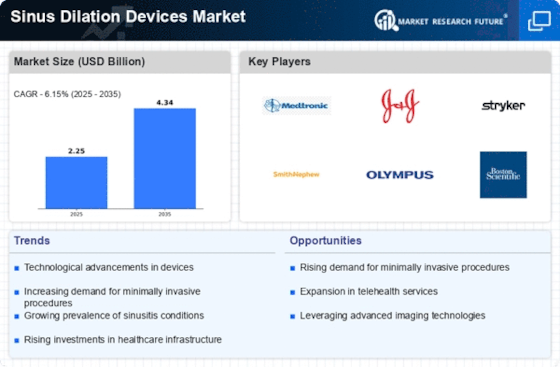
As per Market Research Future analysis, the Sinus Dilation Devices Market was estimated at 2.25 USD Billion in 2024. The Sinus Dilation Devices industry is projected to grow from 2.389 USD Billion in 2025 to 4.339 USD Billion by 2035, exhibiting a compound annual growth rate (CAGR) of 6.15% during the forecast period 2025 - 2035

Key Market Trends & Highlights

The Sinus Dilation Devices Market is experiencing robust growth driven by technological advancements and increasing awareness of sinus health.

  • Technological advancements are enhancing the efficacy and safety of sinus dilation devices, particularly in North America. The market for balloon sinus dilation devices remains the largest segment, while rigid sinus dilation devices are witnessing rapid growth in Asia-Pacific. Endoscopic sinus surgery continues to dominate the market, whereas office-based sinus procedures are emerging as the fastest-growing segment. Key market drivers include the rising incidence of sinusitis and the shift towards minimally invasive procedures, reflecting a broader trend in healthcare.

Market Size & Forecast

2024 Market Size 2.25 (USD Billion)
2035 Market Size 4.339 (USD Billion)
CAGR (2025 - 2035) 6.15%
Largest Regional Market Share in 2024 North America

Major Players

<p>Medtronic (US), Johnson &amp; Johnson (US), Stryker (US), Smith &amp; Nephew (GB), Olympus Corporation (JP), Boston Scientific (US), Entellus Medical (US), Hoya Corporation (JP), Karl Storz (DE)</p>

Market Trends

The Sinus Dilation Devices Market is currently experiencing a notable transformation, driven by advancements in technology and an increasing awareness of sinus-related health issues. Innovations in device design and functionality are enhancing patient outcomes, leading to a growing preference for minimally invasive procedures. This shift is reflected in the rising adoption of balloon sinus dilation techniques, which offer significant benefits over traditional surgical methods. Furthermore, the integration of digital health solutions is facilitating better patient management and follow-up care, thereby improving overall treatment efficacy. In addition, the market is witnessing a surge in demand for sinus dilation devices due to the increasing prevalence of chronic sinusitis and other related conditions. As healthcare providers seek to offer more effective treatment options, the focus on patient-centered care is becoming paramount. This trend is likely to continue, as stakeholders in the Sinus Dilation Devices Market strive to meet the evolving needs of patients and healthcare systems. Overall, the landscape appears promising, with ongoing research and development efforts poised to further enhance the capabilities of these devices, ultimately benefiting patients worldwide.

Technological Advancements

The Sinus Dilation Devices Market is seeing rapid technological progress, particularly in the development of innovative devices that enhance surgical precision and patient comfort. These advancements are likely to lead to improved outcomes and reduced recovery times.

Rising Awareness of Sinus Health

There is a growing recognition of the importance of sinus health among both patients and healthcare providers. This heightened awareness is driving demand for effective treatment options, thereby expanding the market for sinus dilation devices.

Shift Towards Minimally Invasive Procedures

A notable trend in the Sinus Dilation Devices Market is the increasing preference for minimally invasive techniques. These procedures are associated with less pain and quicker recovery, making them more appealing to patients and healthcare professionals alike.

Sinus Dilation Devices Market Market Drivers

Rising Awareness of Sinus Health

In recent years, there has been a marked increase in public awareness regarding sinus health, which is significantly influencing the Sinus Dilation Devices Market. Educational campaigns and health initiatives are informing individuals about the symptoms and treatment options for sinus-related conditions. This heightened awareness is leading to more patients seeking medical advice and treatment for chronic sinusitis and other related disorders. Consequently, healthcare providers are responding by expanding their offerings of sinus dilation procedures. Market data indicates that the demand for sinus dilation devices is expected to rise as more patients opt for these treatments, which are perceived as effective solutions for alleviating sinus issues. This trend suggests a promising future for the Sinus Dilation Devices Market as awareness continues to grow.

Increasing Incidence of Sinusitis

The rising incidence of sinusitis is a critical driver for the Sinus Dilation Devices Market. Sinusitis, characterized by inflammation of the sinus cavities, affects millions of individuals worldwide, leading to a growing need for effective treatment options. Factors such as environmental changes, allergies, and respiratory infections contribute to the increasing prevalence of this condition. As more patients seek relief from chronic sinusitis, the demand for sinus dilation devices is expected to surge. Recent statistics indicate that approximately 30 million adults in the United States alone are diagnosed with sinusitis each year, highlighting the substantial market potential. This growing patient population is likely to stimulate further innovation and investment in the Sinus Dilation Devices Market, as healthcare providers aim to address the needs of those suffering from sinus-related ailments.

Shift Towards Minimally Invasive Procedures

The trend towards minimally invasive procedures is reshaping the landscape of the Sinus Dilation Devices Market. Patients increasingly prefer treatments that involve less discomfort, shorter recovery times, and reduced risk of complications. Minimally invasive sinus dilation techniques, such as balloon sinus dilation, are gaining popularity due to their effectiveness and lower impact on surrounding tissues. This shift is prompting healthcare providers to adopt these techniques, leading to an increase in the utilization of sinus dilation devices. Market analysis reveals that the minimally invasive segment is expected to capture a significant share of the overall sinus dilation devices market, with projections indicating a growth rate of around 7% annually. This trend underscores the evolving preferences of patients and the healthcare industry's response to meet these demands.

Aging Population and Associated Health Issues

The aging population is a significant factor influencing the Sinus Dilation Devices Market. As individuals age, they often experience a higher incidence of sinus-related health issues, including chronic sinusitis and nasal obstruction. This demographic shift is leading to an increased demand for effective treatment options, including sinus dilation procedures. Healthcare systems are recognizing the need to cater to this growing population, which is likely to drive the adoption of advanced sinus dilation devices. Market forecasts suggest that the aging population will contribute to a steady growth rate in the sinus dilation devices market, with estimates indicating an increase of around 5% annually. This trend underscores the importance of addressing the unique health challenges faced by older adults, thereby enhancing the prospects for the Sinus Dilation Devices Market.

Technological Advancements in Sinus Dilation Devices

The Sinus Dilation Devices Market is experiencing a notable transformation due to rapid technological advancements. Innovations such as balloon sinus dilation techniques and improved imaging technologies are enhancing the efficacy of sinus procedures. These advancements not only improve patient outcomes but also reduce recovery times, making procedures more appealing to both patients and healthcare providers. The introduction of smart devices that allow for real-time monitoring and data collection is also gaining traction. According to recent data, the market for sinus dilation devices is projected to grow at a compound annual growth rate of approximately 6.5% over the next few years, driven by these technological innovations. As a result, healthcare facilities are increasingly adopting these advanced devices, which is likely to further propel the growth of the Sinus Dilation Devices Market.

Market Segment Insights

By Product Type: Balloon Sinus Dilation Devices (Largest) vs. Rigid Sinus Dilation Devices (Fastest-Growing)

<p>The sinus dilation devices market is characterized by a noteworthy segmentation, with Balloon Sinus Dilation Devices holding the largest market share. Their dominance can be attributed to their minimally invasive nature and effectiveness in relieving chronic sinusitis, which positions them favorably among healthcare providers and patients alike. Rigid Sinus Dilation Devices, while coming in second, are rapidly gaining traction due to advancements in surgical techniques and enhanced patient outcomes, making them an attractive option for ENT specialists. In terms of growth trends, the Navigational Sinus Dilation Devices are witnessing an emerging demand fueled by the rising preference for precision in surgical procedures. Their ability to enhance accuracy during surgeries is driving this segment's popularity. Additionally, Hybrid Sinus Dilation Devices are also expected to see growth, leveraging the advantages of both balloon and rigid technologies, thus catering to a broader range of patient needs and surgeon preferences.</p>

<p>Balloon Sinus Dilation Devices (Dominant) vs. Navigational Sinus Dilation Devices (Emerging)</p>

<p>Balloon Sinus Dilation Devices are considered the dominant force in the sinus dilation devices market, recognized for their efficiency in treating sinus conditions with minimal discomfort. They are designed to expand the sinus openings, thereby facilitating better drainage and airflow, making them a preferred choice among patients with chronic sinusitis. The technology behind these devices offers a less invasive option with faster recovery times. In contrast, Navigational Sinus Dilation Devices are emerging as a significant player in the market. Their incorporation of advanced imaging and navigation technologies allows for enhanced surgical accuracy, leading to improved patient outcomes. As more surgeons adopt these navigational tools, the segment is expected to grow, driven by a demand for precision in surgical interventions.</p>

By Procedure Type: Endoscopic Sinus Surgery (Largest) vs. Office-Based Sinus Procedures (Fastest-Growing)

<p>The Sinus Dilation Devices Market exhibits a clear segmentation by procedure type, predominantly characterized by Endoscopic Sinus Surgery, Office-Based Sinus Procedures, and Outpatient Sinus Surgery. Endoscopic Sinus Surgery maintains the largest market share due to its established effectiveness and widespread adoption among healthcare professionals. This segment is favored for its ability to directly address complex sinus conditions and is performed in specialized settings. On the other hand, Office-Based Sinus Procedures represent a significant shift in practice, capturing attention for their efficiency and less invasive nature, appealing especially to patients seeking quicker recovery times. Examining the growth trends within these procedure types reveals distinct drivers behind their trajectories. The increasing preference for minimally invasive techniques is propelling the rise of Office-Based Sinus Procedures, positioning it as the fastest-growing segment. Moreover, technological advancements and enhanced training for practitioners contribute to this trend. Additionally, the shift toward outpatient care is bolstering the Outpatient Sinus Surgery segment, driven by insurance reimbursements and patient demand for convenience. Overall, these segment trends highlight an evolving market that is adapting to both practitioner and patient preferences in sinus care.</p>

<p>Endoscopic Sinus Surgery (Dominant) vs. Office-Based Sinus Procedures (Emerging)</p>

<p>Endoscopic Sinus Surgery remains the dominant procedure type in the Sinus Dilation Devices Market due to its comprehensive approach to treating <a href="https://www.marketresearchfuture.com/reports/chronic-idiopathic-constipation-market-5931">chronic </a>sinusitis and other related disorders. This traditional method enables surgeons to visualize the sinus cavities clearly and employ various techniques to remove obstructions effectively. Its established protocols and extensive usage in hospitals have solidified its market position. Conversely, Office-Based Sinus Procedures are emerging as a strong contender, characterized by their non-invasive nature and the convenience they offer patients. These procedures are typically performed in less clinical environments, enhancing patient comfort and reducing the need for general anesthesia. The growing acceptance and adoption of these office-based methods indicate a shift toward more patient-centered care, suggesting they may soon rival more established practices.</p>

By End User: Hospitals (Largest) vs. Ambulatory Surgical Centers (Fastest-Growing)

<p>The Sinus Dilation Devices Market showcases significant market share distribution across its primary end users: Hospitals, Ambulatory Surgical Centers, and ENT Clinics. Hospitals dominate this landscape, leveraging extensive patient access and advanced medical facilities. Ambulatory Surgical Centers, however, are rapidly gaining traction due to their cost-effective treatment options and shorter patient turnaround times, thus attracting a considerable patient base.</p>

<p>Hospitals (Dominant) vs. Ambulatory Surgical Centers (Emerging)</p>

<p>Hospitals remain the dominant end user in the Sinus Dilation Devices Market, primarily due to their comprehensive healthcare services and advanced surgical facilities. They cater to complex cases that require intricate procedures, contributing to a high volume of sinus surgeries. Conversely, Ambulatory Surgical Centers stand as an emerging segment, characterized by quick procedure capabilities and lower expenses for patients. Their growth trajectory is further fueled by the preference for outpatient settings, as they offer convenience and efficiency that align with modern healthcare demands.</p>

By Application: Chronic Sinusitis (Largest) vs. Sinus Polyps (Fastest-Growing)

<p>The application segment of the Sinus Dilation Devices Market is primarily driven by chronic sinusitis, which holds the largest share due to the increasing prevalence of the condition among various demographics. Acute sinusitis and sinus polyps also contribute significantly to the market, with each segment reflecting specific patient needs and treatment approaches. These values showcase a diversified market that caters to varying degrees of sinus-related health issues, emphasizing the importance of tailored solutions within the industry. Growing awareness and advancements in treatment options are elevating the adoption rates of sinus dilation devices, particularly in chronic sinusitis management. Meanwhile, sinus polyps are emerging as a fast-growing segment due to increased recognition of their impact on sinus health and the rising demand for effective surgical solutions. The continual evolution of devices and techniques enhances patient outcomes, further boosting market dynamics and growth potential.</p>

<p>Chronic Sinusitis (Dominant) vs. Sinus Polyps (Emerging)</p>

<p>Chronic sinusitis represents the dominant application within the Sinus Dilation Devices Market, characterized by its prolonged inflammatory condition that necessitates advanced treatment options to relieve persistent symptoms. Medical professionals often recommend dilation procedures, leading to a consistent demand for innovative devices tailored to this chronic ailment. In contrast, sinus polyps are recognized as an emerging area of focus, with growing attention due to their prevalence and connection to chronic sinusitis. The faster adoption of dilation devices for polyp removal highlights a response to patient demands for minimally invasive options. Both segment values are integral to comprehensive care, as they address the spectrum of sinus health challenges faced by patients today.</p>

Get more detailed insights about Sinus Dilation Devices Market Report-Forecast till 2035

Regional Insights

The Sinus Dilation Devices Market demonstrates significant revenue growth across diverse regional markets, valued at 2.12 USD Billion in 2023 and projected at 3.5 USD Billion by 2032. North America holds a majority share, valued at 0.9 USD Billion in 2023 and increasing to 1.5 USD Billion in 2032, highlighting its dominant position driven by advanced healthcare infrastructure and high demand for innovative sinus treatments.

Europe follows with a substantial valuation of 0.6 USD Billion in 2023, expected to reach 1.0 USD Billion by 2032, benefiting from increasing awareness of sinus-related conditions and the adoption of minimally invasive procedures.The APAC market, valued at 0.4 USD Billion in 2023 and anticipated to grow to 0.7 USD Billion, is emerging rapidly due to rising healthcare expenditure and a growing patient base. South America shows modest progress, with a current valuation of 0.1 USD Billion, projected to double to 0.2 USD Billion, indicating expanding healthcare access.

The MEA market, although the smallest at 0.12 USD Billion in 2023, is also on an upward trajectory, expected to reach 0.18 USD Billion, driven by increasing health awareness and improving medical facilities.The segmentation of the Sinus Dilation Devices Market reflects varied growth opportunities and challenges based on regional dynamics, driving innovations and strategic initiatives within the industry.

Key Players and Competitive Insights

The Sinus Dilation Devices Market is characterized by a rapidly evolving landscape marked by technological advancements, increasing prevalence of sinus-related diseases, and a growing emphasis on minimally invasive surgical procedures. As the global demand for sinus dilation procedures continues to rise, numerous companies are vying for market share by innovating and enhancing their product offerings. This competitive environment is driven by an increasing number of regulations, diverse product portfolios, and a focus on patient outcomes, compelling companies to leverage strategic partnerships, acquisitions, and research initiatives.
The need for improved healthcare solutions is stimulating advancements in sinus dilation technologies, leading to heightened competition among key players in the market.Olympus Corporation has established itself as a prominent player in the Sinus Dilation Devices Market, known for its commitment to innovation and quality in the field of medical technology. The company pairs its strong research and development capabilities with a comprehensive understanding of patient needs, allowing it to deliver advanced sinus dilation solutions that promote improved clinical outcomes.
Olympus Corporation's effective marketing and distribution strategies have enabled it to build a robust presence in the market, contributing to its reputation for reliability and performance. The company's ability to offer a diverse range of products designed for varying levels of sinus conditions further strengthens its competitive edge, allowing it to cater to a wide array of healthcare professionals and institutions seeking effective surgical interventions.HumiSeal has carved out its niche in the Sinus Dilation Devices Market by focusing on creating high-quality solutions that enhance procedural efficiency and patient comfort.
The company boasts a solid foundation in the development of innovative products specifically designed for sinus dilation procedures, which has bolstered its position within the competitive landscape. HumiSeal’s dedication to producing durable and effective devices aligns well with the growing demand for minimally invasive options, making it a sought-after choice among healthcare providers. Moreover, HumiSeal's emphasis on quality assurance and adherence to international regulatory standards solidifies its reputation as a trustworthy partner for medical practitioners, facilitating the delivery of safer and more effective sinus dilation treatments to patients worldwide.

Key Companies in the Sinus Dilation Devices Market include

Industry Developments

Recent developments in the Sinus Dilation Devices Market have been marked by a surge in technological advancements and regulatory approvals. Companies like Medtronic and Stryker have been at the forefront, launching innovative devices aimed at improving the efficacy of sinus procedures. The focus on minimally invasive techniques is driving significant growth as healthcare providers and patients seek faster recovery times and reduced complications. There have been notable acquisitions within the sector, such as Johnson & Johnson's acquisition of a smaller device manufacturer to diversify its product offerings and enhance its market presence.

Additionally, Olympus Corporation has been reported to strengthen its portfolio through strategic partnerships aimed at research and development in sinus dilation technologies. The financial performance of key players like Boston Scientific and Halyard Health indicates an upward trajectory, reflecting increased demand and investment in the sinus dilation market. The overall valuation of the market is expected to rise as leading companies adapt to changing consumer needs and technological advancements. The trend toward enhanced patient outcomes and healthcare efficiency among organizations is expected to significantly impact market dynamics moving forward.

Future Outlook

Sinus Dilation Devices Market Future Outlook

The Sinus Dilation Devices Market is projected to grow at a 6.15% CAGR from 2025 to 2035, driven by technological advancements, increasing prevalence of sinusitis, and rising healthcare expenditure.

New opportunities lie in:

  • Development of minimally invasive surgical tools for outpatient procedures.
  • Expansion into emerging markets with tailored product offerings.
  • Integration of AI-driven diagnostics for personalized treatment plans.

By 2035, the market is expected to achieve substantial growth, reflecting evolving healthcare needs and technological innovations.

Market Segmentation

Sinus Dilation Devices Market End User Outlook

  • Hospitals
  • Ambulatory Surgical Centers
  • ENT Clinics

Sinus Dilation Devices Market Application Outlook

  • Chronic Sinusitis
  • Acute Sinusitis
  • Sinus Polyps

Sinus Dilation Devices Market Product Type Outlook

  • Balloon Sinus Dilation Devices
  • Rigid Sinus Dilation Devices
  • Navigational Sinus Dilation Devices
  • Hybrid Sinus Dilation Devices

Sinus Dilation Devices Market Procedure Type Outlook

  • Endoscopic Sinus Surgery
  • Office-Based Sinus Procedures
  • Outpatient Sinus Surgery

Report Scope

MARKET SIZE 2024 2.25(USD Billion)
MARKET SIZE 2025 2.389(USD Billion)
MARKET SIZE 2035 4.339(USD Billion)
COMPOUND ANNUAL GROWTH RATE (CAGR) 6.15% (2025 - 2035)
REPORT COVERAGE Revenue Forecast, Competitive Landscape, Growth Factors, and Trends
BASE YEAR 2024
Market Forecast Period 2025 - 2035
Historical Data 2019 - 2024
Market Forecast Units USD Billion
Key Companies Profiled Medtronic (US), Johnson & Johnson (US), Stryker (US), Smith & Nephew (GB), Olympus Corporation (JP), Boston Scientific (US), Entellus Medical (US), Hoya Corporation (JP), Karl Storz (DE)
Segments Covered Product Type, Procedure Type, End Users, Applications, Regional
Key Market Opportunities Advancements in minimally invasive techniques enhance growth potential in the Sinus Dilation Devices Market.
Key Market Dynamics Technological advancements and regulatory changes drive innovation and competition in the sinus dilation devices market.
Countries Covered North America, Europe, APAC, South America, MEA

FAQs

What is the projected market valuation of the Sinus Dilation Devices Market by 2035?

<p>The Sinus Dilation Devices Market is projected to reach approximately 4.339 USD Billion by 2035.</p>

What was the market valuation of the Sinus Dilation Devices Market in 2024?

<p>In 2024, the overall market valuation of the Sinus Dilation Devices Market was 2.25 USD Billion.</p>

What is the expected CAGR for the Sinus Dilation Devices Market during the forecast period 2025 - 2035?

<p>The expected CAGR for the Sinus Dilation Devices Market during the forecast period 2025 - 2035 is 6.15%.</p>

Which product type segment is projected to have the highest valuation by 2035?

<p>The Balloon Sinus Dilation Devices segment is projected to reach approximately 1.275 USD Billion by 2035.</p>

What are the key players in the Sinus Dilation Devices Market?

<p>Key players in the Sinus Dilation Devices Market include Medtronic, Johnson & Johnson, Stryker, and Boston Scientific.</p>

How does the market for Endoscopic Sinus Surgery compare to other procedure types by 2035?

<p>By 2035, the market for Endoscopic Sinus Surgery is projected to reach around 1.7 USD Billion, indicating strong growth compared to other procedure types.</p>

What is the projected valuation for the Hybrid Sinus Dilation Devices segment by 2035?

<p>The Hybrid Sinus Dilation Devices segment is expected to reach approximately 0.9 USD Billion by 2035.</p>

Which end user segment is anticipated to grow the most by 2035?

<p>The Hospitals segment is anticipated to grow significantly, reaching around 1.7 USD Billion by 2035.</p>

What applications are driving growth in the Sinus Dilation Devices Market?

<p>Chronic Sinusitis and Sinus Polyps are key applications driving growth, with projections of 1.275 USD Billion and 1.789 USD Billion respectively by 2035.</p>

How do the valuations of outpatient sinus surgery compare to office-based sinus procedures by 2035?

<p>By 2035, outpatient sinus surgery is projected to reach approximately 1.4 USD Billion, surpassing the office-based sinus procedures segment, which is expected to reach around 1.2 USD Billion.</p>

  1. SECTION I: EXECUTIVE SUMMARY AND KEY HIGHLIGHTS
    1. | 1.1 EXECUTIVE SUMMARY
    2. | | 1.1.1 Market Overview
    3. | | 1.1.2 Key Findings
    4. | | 1.1.3 Market Segmentation
    5. | | 1.1.4 Competitive Landscape
    6. | | 1.1.5 Challenges and Opportunities
    7. | | 1.1.6 Future Outlook
  2. SECTION II: SCOPING, METHODOLOGY AND MARKET STRUCTURE
    1. | 2.1 MARKET INTRODUCTION
    2. | | 2.1.1 Definition
    3. | | 2.1.2 Scope of the study
    4. | | | 2.1.2.1 Research Objective
    5. | | | 2.1.2.2 Assumption
    6. | | | 2.1.2.3 Limitations
    7. | 2.2 RESEARCH METHODOLOGY
    8. | | 2.2.1 Overview
    9. | | 2.2.2 Data Mining
    10. | | 2.2.3 Secondary Research
    11. | | 2.2.4 Primary Research
    12. | | | 2.2.4.1 Primary Interviews and Information Gathering Process
    13. | | | 2.2.4.2 Breakdown of Primary Respondents
    14. | | 2.2.5 Forecasting Model
    15. | | 2.2.6 Market Size Estimation
    16. | | | 2.2.6.1 Bottom-Up Approach
    17. | | | 2.2.6.2 Top-Down Approach
    18. | | 2.2.7 Data Triangulation
    19. | | 2.2.8 Validation
  3. SECTION III: QUALITATIVE ANALYSIS
    1. | 3.1 MARKET DYNAMICS
    2. | | 3.1.1 Overview
    3. | | 3.1.2 Drivers
    4. | | 3.1.3 Restraints
    5. | | 3.1.4 Opportunities
    6. | 3.2 MARKET FACTOR ANALYSIS
    7. | | 3.2.1 Value chain Analysis
    8. | | 3.2.2 Porter's Five Forces Analysis
    9. | | | 3.2.2.1 Bargaining Power of Suppliers
    10. | | | 3.2.2.2 Bargaining Power of Buyers
    11. | | | 3.2.2.3 Threat of New Entrants
    12. | | | 3.2.2.4 Threat of Substitutes
    13. | | | 3.2.2.5 Intensity of Rivalry
    14. | | 3.2.3 COVID-19 Impact Analysis
    15. | | | 3.2.3.1 Market Impact Analysis
    16. | | | 3.2.3.2 Regional Impact
    17. | | | 3.2.3.3 Opportunity and Threat Analysis
  4. SECTION IV: QUANTITATIVE ANALYSIS
    1. | 4.1 Healthcare, BY Product Type (USD Billion)
    2. | | 4.1.1 Balloon Sinus Dilation Devices
    3. | | 4.1.2 Rigid Sinus Dilation Devices
    4. | | 4.1.3 Navigational Sinus Dilation Devices
    5. | | 4.1.4 Hybrid Sinus Dilation Devices
    6. | 4.2 Healthcare, BY Procedure Type (USD Billion)
    7. | | 4.2.1 Endoscopic Sinus Surgery
    8. | | 4.2.2 Office-Based Sinus Procedures
    9. | | 4.2.3 Outpatient Sinus Surgery
    10. | 4.3 Healthcare, BY End User (USD Billion)
    11. | | 4.3.1 Hospitals
    12. | | 4.3.2 Ambulatory Surgical Centers
    13. | | 4.3.3 ENT Clinics
    14. | 4.4 Healthcare, BY Application (USD Billion)
    15. | | 4.4.1 Chronic Sinusitis
    16. | | 4.4.2 Acute Sinusitis
    17. | | 4.4.3 Sinus Polyps
    18. | 4.5 Healthcare, BY Region (USD Billion)
    19. | | 4.5.1 North America
    20. | | | 4.5.1.1 US
    21. | | | 4.5.1.2 Canada
    22. | | 4.5.2 Europe
    23. | | | 4.5.2.1 Germany
    24. | | | 4.5.2.2 UK
    25. | | | 4.5.2.3 France
    26. | | | 4.5.2.4 Russia
    27. | | | 4.5.2.5 Italy
    28. | | | 4.5.2.6 Spain
    29. | | | 4.5.2.7 Rest of Europe
    30. | | 4.5.3 APAC
    31. | | | 4.5.3.1 China
    32. | | | 4.5.3.2 India
    33. | | | 4.5.3.3 Japan
    34. | | | 4.5.3.4 South Korea
    35. | | | 4.5.3.5 Malaysia
    36. | | | 4.5.3.6 Thailand
    37. | | | 4.5.3.7 Indonesia
    38. | | | 4.5.3.8 Rest of APAC
    39. | | 4.5.4 South America
    40. | | | 4.5.4.1 Brazil
    41. | | | 4.5.4.2 Mexico
    42. | | | 4.5.4.3 Argentina
    43. | | | 4.5.4.4 Rest of South America
    44. | | 4.5.5 MEA
    45. | | | 4.5.5.1 GCC Countries
    46. | | | 4.5.5.2 South Africa
    47. | | | 4.5.5.3 Rest of MEA
  5. SECTION V: COMPETITIVE ANALYSIS
    1. | 5.1 Competitive Landscape
    2. | | 5.1.1 Overview
    3. | | 5.1.2 Competitive Analysis
    4. | | 5.1.3 Market share Analysis
    5. | | 5.1.4 Major Growth Strategy in the Healthcare
    6. | | 5.1.5 Competitive Benchmarking
    7. | | 5.1.6 Leading Players in Terms of Number of Developments in the Healthcare
    8. | | 5.1.7 Key developments and growth strategies
    9. | | | 5.1.7.1 New Product Launch/Service Deployment
    10. | | | 5.1.7.2 Merger & Acquisitions
    11. | | | 5.1.7.3 Joint Ventures
    12. | | 5.1.8 Major Players Financial Matrix
    13. | | | 5.1.8.1 Sales and Operating Income
    14. | | | 5.1.8.2 Major Players R&D Expenditure. 2023
    15. | 5.2 Company Profiles
    16. | | 5.2.1 Medtronic (US)
    17. | | | 5.2.1.1 Financial Overview
    18. | | | 5.2.1.2 Products Offered
    19. | | | 5.2.1.3 Key Developments
    20. | | | 5.2.1.4 SWOT Analysis
    21. | | | 5.2.1.5 Key Strategies
    22. | | 5.2.2 Johnson & Johnson (US)
    23. | | | 5.2.2.1 Financial Overview
    24. | | | 5.2.2.2 Products Offered
    25. | | | 5.2.2.3 Key Developments
    26. | | | 5.2.2.4 SWOT Analysis
    27. | | | 5.2.2.5 Key Strategies
    28. | | 5.2.3 Stryker (US)
    29. | | | 5.2.3.1 Financial Overview
    30. | | | 5.2.3.2 Products Offered
    31. | | | 5.2.3.3 Key Developments
    32. | | | 5.2.3.4 SWOT Analysis
    33. | | | 5.2.3.5 Key Strategies
    34. | | 5.2.4 Smith & Nephew (GB)
    35. | | | 5.2.4.1 Financial Overview
    36. | | | 5.2.4.2 Products Offered
    37. | | | 5.2.4.3 Key Developments
    38. | | | 5.2.4.4 SWOT Analysis
    39. | | | 5.2.4.5 Key Strategies
    40. | | 5.2.5 Olympus Corporation (JP)
    41. | | | 5.2.5.1 Financial Overview
    42. | | | 5.2.5.2 Products Offered
    43. | | | 5.2.5.3 Key Developments
    44. | | | 5.2.5.4 SWOT Analysis
    45. | | | 5.2.5.5 Key Strategies
    46. | | 5.2.6 Boston Scientific (US)
    47. | | | 5.2.6.1 Financial Overview
    48. | | | 5.2.6.2 Products Offered
    49. | | | 5.2.6.3 Key Developments
    50. | | | 5.2.6.4 SWOT Analysis
    51. | | | 5.2.6.5 Key Strategies
    52. | | 5.2.7 Entellus Medical (US)
    53. | | | 5.2.7.1 Financial Overview
    54. | | | 5.2.7.2 Products Offered
    55. | | | 5.2.7.3 Key Developments
    56. | | | 5.2.7.4 SWOT Analysis
    57. | | | 5.2.7.5 Key Strategies
    58. | | 5.2.8 Hoya Corporation (JP)
    59. | | | 5.2.8.1 Financial Overview
    60. | | | 5.2.8.2 Products Offered
    61. | | | 5.2.8.3 Key Developments
    62. | | | 5.2.8.4 SWOT Analysis
    63. | | | 5.2.8.5 Key Strategies
    64. | | 5.2.9 Karl Storz (DE)
    65. | | | 5.2.9.1 Financial Overview
    66. | | | 5.2.9.2 Products Offered
    67. | | | 5.2.9.3 Key Developments
    68. | | | 5.2.9.4 SWOT Analysis
    69. | | | 5.2.9.5 Key Strategies
    70. | 5.3 Appendix
    71. | | 5.3.1 References
    72. | | 5.3.2 Related Reports
  6. LIST OF FIGURES
    1. | 6.1 MARKET SYNOPSIS
    2. | 6.2 NORTH AMERICA MARKET ANALYSIS
    3. | 6.3 US MARKET ANALYSIS BY PRODUCT TYPE
    4. | 6.4 US MARKET ANALYSIS BY PROCEDURE TYPE
    5. | 6.5 US MARKET ANALYSIS BY END USER
    6. | 6.6 US MARKET ANALYSIS BY APPLICATION
    7. | 6.7 CANADA MARKET ANALYSIS BY PRODUCT TYPE
    8. | 6.8 CANADA MARKET ANALYSIS BY PROCEDURE TYPE
    9. | 6.9 CANADA MARKET ANALYSIS BY END USER
    10. | 6.10 CANADA MARKET ANALYSIS BY APPLICATION
    11. | 6.11 EUROPE MARKET ANALYSIS
    12. | 6.12 GERMANY MARKET ANALYSIS BY PRODUCT TYPE
    13. | 6.13 GERMANY MARKET ANALYSIS BY PROCEDURE TYPE
    14. | 6.14 GERMANY MARKET ANALYSIS BY END USER
    15. | 6.15 GERMANY MARKET ANALYSIS BY APPLICATION
    16. | 6.16 UK MARKET ANALYSIS BY PRODUCT TYPE
    17. | 6.17 UK MARKET ANALYSIS BY PROCEDURE TYPE
    18. | 6.18 UK MARKET ANALYSIS BY END USER
    19. | 6.19 UK MARKET ANALYSIS BY APPLICATION
    20. | 6.20 FRANCE MARKET ANALYSIS BY PRODUCT TYPE
    21. | 6.21 FRANCE MARKET ANALYSIS BY PROCEDURE TYPE
    22. | 6.22 FRANCE MARKET ANALYSIS BY END USER
    23. | 6.23 FRANCE MARKET ANALYSIS BY APPLICATION
    24. | 6.24 RUSSIA MARKET ANALYSIS BY PRODUCT TYPE
    25. | 6.25 RUSSIA MARKET ANALYSIS BY PROCEDURE TYPE
    26. | 6.26 RUSSIA MARKET ANALYSIS BY END USER
    27. | 6.27 RUSSIA MARKET ANALYSIS BY APPLICATION
    28. | 6.28 ITALY MARKET ANALYSIS BY PRODUCT TYPE
    29. | 6.29 ITALY MARKET ANALYSIS BY PROCEDURE TYPE
    30. | 6.30 ITALY MARKET ANALYSIS BY END USER
    31. | 6.31 ITALY MARKET ANALYSIS BY APPLICATION
    32. | 6.32 SPAIN MARKET ANALYSIS BY PRODUCT TYPE
    33. | 6.33 SPAIN MARKET ANALYSIS BY PROCEDURE TYPE
    34. | 6.34 SPAIN MARKET ANALYSIS BY END USER
    35. | 6.35 SPAIN MARKET ANALYSIS BY APPLICATION
    36. | 6.36 REST OF EUROPE MARKET ANALYSIS BY PRODUCT TYPE
    37. | 6.37 REST OF EUROPE MARKET ANALYSIS BY PROCEDURE TYPE
    38. | 6.38 REST OF EUROPE MARKET ANALYSIS BY END USER
    39. | 6.39 REST OF EUROPE MARKET ANALYSIS BY APPLICATION
    40. | 6.40 APAC MARKET ANALYSIS
    41. | 6.41 CHINA MARKET ANALYSIS BY PRODUCT TYPE
    42. | 6.42 CHINA MARKET ANALYSIS BY PROCEDURE TYPE
    43. | 6.43 CHINA MARKET ANALYSIS BY END USER
    44. | 6.44 CHINA MARKET ANALYSIS BY APPLICATION
    45. | 6.45 INDIA MARKET ANALYSIS BY PRODUCT TYPE
    46. | 6.46 INDIA MARKET ANALYSIS BY PROCEDURE TYPE
    47. | 6.47 INDIA MARKET ANALYSIS BY END USER
    48. | 6.48 INDIA MARKET ANALYSIS BY APPLICATION
    49. | 6.49 JAPAN MARKET ANALYSIS BY PRODUCT TYPE
    50. | 6.50 JAPAN MARKET ANALYSIS BY PROCEDURE TYPE
    51. | 6.51 JAPAN MARKET ANALYSIS BY END USER
    52. | 6.52 JAPAN MARKET ANALYSIS BY APPLICATION
    53. | 6.53 SOUTH KOREA MARKET ANALYSIS BY PRODUCT TYPE
    54. | 6.54 SOUTH KOREA MARKET ANALYSIS BY PROCEDURE TYPE
    55. | 6.55 SOUTH KOREA MARKET ANALYSIS BY END USER
    56. | 6.56 SOUTH KOREA MARKET ANALYSIS BY APPLICATION
    57. | 6.57 MALAYSIA MARKET ANALYSIS BY PRODUCT TYPE
    58. | 6.58 MALAYSIA MARKET ANALYSIS BY PROCEDURE TYPE
    59. | 6.59 MALAYSIA MARKET ANALYSIS BY END USER
    60. | 6.60 MALAYSIA MARKET ANALYSIS BY APPLICATION
    61. | 6.61 THAILAND MARKET ANALYSIS BY PRODUCT TYPE
    62. | 6.62 THAILAND MARKET ANALYSIS BY PROCEDURE TYPE
    63. | 6.63 THAILAND MARKET ANALYSIS BY END USER
    64. | 6.64 THAILAND MARKET ANALYSIS BY APPLICATION
    65. | 6.65 INDONESIA MARKET ANALYSIS BY PRODUCT TYPE
    66. | 6.66 INDONESIA MARKET ANALYSIS BY PROCEDURE TYPE
    67. | 6.67 INDONESIA MARKET ANALYSIS BY END USER
    68. | 6.68 INDONESIA MARKET ANALYSIS BY APPLICATION
    69. | 6.69 REST OF APAC MARKET ANALYSIS BY PRODUCT TYPE
    70. | 6.70 REST OF APAC MARKET ANALYSIS BY PROCEDURE TYPE
    71. | 6.71 REST OF APAC MARKET ANALYSIS BY END USER
    72. | 6.72 REST OF APAC MARKET ANALYSIS BY APPLICATION
    73. | 6.73 SOUTH AMERICA MARKET ANALYSIS
    74. | 6.74 BRAZIL MARKET ANALYSIS BY PRODUCT TYPE
    75. | 6.75 BRAZIL MARKET ANALYSIS BY PROCEDURE TYPE
    76. | 6.76 BRAZIL MARKET ANALYSIS BY END USER
    77. | 6.77 BRAZIL MARKET ANALYSIS BY APPLICATION
    78. | 6.78 MEXICO MARKET ANALYSIS BY PRODUCT TYPE
    79. | 6.79 MEXICO MARKET ANALYSIS BY PROCEDURE TYPE
    80. | 6.80 MEXICO MARKET ANALYSIS BY END USER
    81. | 6.81 MEXICO MARKET ANALYSIS BY APPLICATION
    82. | 6.82 ARGENTINA MARKET ANALYSIS BY PRODUCT TYPE
    83. | 6.83 ARGENTINA MARKET ANALYSIS BY PROCEDURE TYPE
    84. | 6.84 ARGENTINA MARKET ANALYSIS BY END USER
    85. | 6.85 ARGENTINA MARKET ANALYSIS BY APPLICATION
    86. | 6.86 REST OF SOUTH AMERICA MARKET ANALYSIS BY PRODUCT TYPE
    87. | 6.87 REST OF SOUTH AMERICA MARKET ANALYSIS BY PROCEDURE TYPE
    88. | 6.88 REST OF SOUTH AMERICA MARKET ANALYSIS BY END USER
    89. | 6.89 REST OF SOUTH AMERICA MARKET ANALYSIS BY APPLICATION
    90. | 6.90 MEA MARKET ANALYSIS
    91. | 6.91 GCC COUNTRIES MARKET ANALYSIS BY PRODUCT TYPE
    92. | 6.92 GCC COUNTRIES MARKET ANALYSIS BY PROCEDURE TYPE
    93. | 6.93 GCC COUNTRIES MARKET ANALYSIS BY END USER
    94. | 6.94 GCC COUNTRIES MARKET ANALYSIS BY APPLICATION
    95. | 6.95 SOUTH AFRICA MARKET ANALYSIS BY PRODUCT TYPE
    96. | 6.96 SOUTH AFRICA MARKET ANALYSIS BY PROCEDURE TYPE
    97. | 6.97 SOUTH AFRICA MARKET ANALYSIS BY END USER
    98. | 6.98 SOUTH AFRICA MARKET ANALYSIS BY APPLICATION
    99. | 6.99 REST OF MEA MARKET ANALYSIS BY PRODUCT TYPE
    100. | 6.100 REST OF MEA MARKET ANALYSIS BY PROCEDURE TYPE
    101. | 6.101 REST OF MEA MARKET ANALYSIS BY END USER
    102. | 6.102 REST OF MEA MARKET ANALYSIS BY APPLICATION
    103. | 6.103 KEY BUYING CRITERIA OF HEALTHCARE
    104. | 6.104 RESEARCH PROCESS OF MRFR
    105. | 6.105 DRO ANALYSIS OF HEALTHCARE
    106. | 6.106 DRIVERS IMPACT ANALYSIS: HEALTHCARE
    107. | 6.107 RESTRAINTS IMPACT ANALYSIS: HEALTHCARE
    108. | 6.108 SUPPLY / VALUE CHAIN: HEALTHCARE
    109. | 6.109 HEALTHCARE, BY PRODUCT TYPE, 2024 (% SHARE)
    110. | 6.110 HEALTHCARE, BY PRODUCT TYPE, 2024 TO 2035 (USD Billion)
    111. | 6.111 HEALTHCARE, BY PROCEDURE TYPE, 2024 (% SHARE)
    112. | 6.112 HEALTHCARE, BY PROCEDURE TYPE, 2024 TO 2035 (USD Billion)
    113. | 6.113 HEALTHCARE, BY END USER, 2024 (% SHARE)
    114. | 6.114 HEALTHCARE, BY END USER, 2024 TO 2035 (USD Billion)
    115. | 6.115 HEALTHCARE, BY APPLICATION, 2024 (% SHARE)
    116. | 6.116 HEALTHCARE, BY APPLICATION, 2024 TO 2035 (USD Billion)
    117. | 6.117 BENCHMARKING OF MAJOR COMPETITORS
  7. LIST OF TABLES
    1. | 7.1 LIST OF ASSUMPTIONS
    2. | | 7.1.1
    3. | 7.2 North America MARKET SIZE ESTIMATES; FORECAST
    4. | | 7.2.1 BY PRODUCT TYPE, 2025-2035 (USD Billion)
    5. | | 7.2.2 BY PROCEDURE TYPE, 2025-2035 (USD Billion)
    6. | | 7.2.3 BY END USER, 2025-2035 (USD Billion)
    7. | | 7.2.4 BY APPLICATION, 2025-2035 (USD Billion)
    8. | 7.3 US MARKET SIZE ESTIMATES; FORECAST
    9. | | 7.3.1 BY PRODUCT TYPE, 2025-2035 (USD Billion)
    10. | | 7.3.2 BY PROCEDURE TYPE, 2025-2035 (USD Billion)
    11. | | 7.3.3 BY END USER, 2025-2035 (USD Billion)
    12. | | 7.3.4 BY APPLICATION, 2025-2035 (USD Billion)
    13. | 7.4 Canada MARKET SIZE ESTIMATES; FORECAST
    14. | | 7.4.1 BY PRODUCT TYPE, 2025-2035 (USD Billion)
    15. | | 7.4.2 BY PROCEDURE TYPE, 2025-2035 (USD Billion)
    16. | | 7.4.3 BY END USER, 2025-2035 (USD Billion)
    17. | | 7.4.4 BY APPLICATION, 2025-2035 (USD Billion)
    18. | 7.5 Europe MARKET SIZE ESTIMATES; FORECAST
    19. | | 7.5.1 BY PRODUCT TYPE, 2025-2035 (USD Billion)
    20. | | 7.5.2 BY PROCEDURE TYPE, 2025-2035 (USD Billion)
    21. | | 7.5.3 BY END USER, 2025-2035 (USD Billion)
    22. | | 7.5.4 BY APPLICATION, 2025-2035 (USD Billion)
    23. | 7.6 Germany MARKET SIZE ESTIMATES; FORECAST
    24. | | 7.6.1 BY PRODUCT TYPE, 2025-2035 (USD Billion)
    25. | | 7.6.2 BY PROCEDURE TYPE, 2025-2035 (USD Billion)
    26. | | 7.6.3 BY END USER, 2025-2035 (USD Billion)
    27. | | 7.6.4 BY APPLICATION, 2025-2035 (USD Billion)
    28. | 7.7 UK MARKET SIZE ESTIMATES; FORECAST
    29. | | 7.7.1 BY PRODUCT TYPE, 2025-2035 (USD Billion)
    30. | | 7.7.2 BY PROCEDURE TYPE, 2025-2035 (USD Billion)
    31. | | 7.7.3 BY END USER, 2025-2035 (USD Billion)
    32. | | 7.7.4 BY APPLICATION, 2025-2035 (USD Billion)
    33. | 7.8 France MARKET SIZE ESTIMATES; FORECAST
    34. | | 7.8.1 BY PRODUCT TYPE, 2025-2035 (USD Billion)
    35. | | 7.8.2 BY PROCEDURE TYPE, 2025-2035 (USD Billion)
    36. | | 7.8.3 BY END USER, 2025-2035 (USD Billion)
    37. | | 7.8.4 BY APPLICATION, 2025-2035 (USD Billion)
    38. | 7.9 Russia MARKET SIZE ESTIMATES; FORECAST
    39. | | 7.9.1 BY PRODUCT TYPE, 2025-2035 (USD Billion)
    40. | | 7.9.2 BY PROCEDURE TYPE, 2025-2035 (USD Billion)
    41. | | 7.9.3 BY END USER, 2025-2035 (USD Billion)
    42. | | 7.9.4 BY APPLICATION, 2025-2035 (USD Billion)
    43. | 7.10 Italy MARKET SIZE ESTIMATES; FORECAST
    44. | | 7.10.1 BY PRODUCT TYPE, 2025-2035 (USD Billion)
    45. | | 7.10.2 BY PROCEDURE TYPE, 2025-2035 (USD Billion)
    46. | | 7.10.3 BY END USER, 2025-2035 (USD Billion)
    47. | | 7.10.4 BY APPLICATION, 2025-2035 (USD Billion)
    48. | 7.11 Spain MARKET SIZE ESTIMATES; FORECAST
    49. | | 7.11.1 BY PRODUCT TYPE, 2025-2035 (USD Billion)
    50. | | 7.11.2 BY PROCEDURE TYPE, 2025-2035 (USD Billion)
    51. | | 7.11.3 BY END USER, 2025-2035 (USD Billion)
    52. | | 7.11.4 BY APPLICATION, 2025-2035 (USD Billion)
    53. | 7.12 Rest of Europe MARKET SIZE ESTIMATES; FORECAST
    54. | | 7.12.1 BY PRODUCT TYPE, 2025-2035 (USD Billion)
    55. | | 7.12.2 BY PROCEDURE TYPE, 2025-2035 (USD Billion)
    56. | | 7.12.3 BY END USER, 2025-2035 (USD Billion)
    57. | | 7.12.4 BY APPLICATION, 2025-2035 (USD Billion)
    58. | 7.13 APAC MARKET SIZE ESTIMATES; FORECAST
    59. | | 7.13.1 BY PRODUCT TYPE, 2025-2035 (USD Billion)
    60. | | 7.13.2 BY PROCEDURE TYPE, 2025-2035 (USD Billion)
    61. | | 7.13.3 BY END USER, 2025-2035 (USD Billion)
    62. | | 7.13.4 BY APPLICATION, 2025-2035 (USD Billion)
    63. | 7.14 China MARKET SIZE ESTIMATES; FORECAST
    64. | | 7.14.1 BY PRODUCT TYPE, 2025-2035 (USD Billion)
    65. | | 7.14.2 BY PROCEDURE TYPE, 2025-2035 (USD Billion)
    66. | | 7.14.3 BY END USER, 2025-2035 (USD Billion)
    67. | | 7.14.4 BY APPLICATION, 2025-2035 (USD Billion)
    68. | 7.15 India MARKET SIZE ESTIMATES; FORECAST
    69. | | 7.15.1 BY PRODUCT TYPE, 2025-2035 (USD Billion)
    70. | | 7.15.2 BY PROCEDURE TYPE, 2025-2035 (USD Billion)
    71. | | 7.15.3 BY END USER, 2025-2035 (USD Billion)
    72. | | 7.15.4 BY APPLICATION, 2025-2035 (USD Billion)
    73. | 7.16 Japan MARKET SIZE ESTIMATES; FORECAST
    74. | | 7.16.1 BY PRODUCT TYPE, 2025-2035 (USD Billion)
    75. | | 7.16.2 BY PROCEDURE TYPE, 2025-2035 (USD Billion)
    76. | | 7.16.3 BY END USER, 2025-2035 (USD Billion)
    77. | | 7.16.4 BY APPLICATION, 2025-2035 (USD Billion)
    78. | 7.17 South Korea MARKET SIZE ESTIMATES; FORECAST
    79. | | 7.17.1 BY PRODUCT TYPE, 2025-2035 (USD Billion)
    80. | | 7.17.2 BY PROCEDURE TYPE, 2025-2035 (USD Billion)
    81. | | 7.17.3 BY END USER, 2025-2035 (USD Billion)
    82. | | 7.17.4 BY APPLICATION, 2025-2035 (USD Billion)
    83. | 7.18 Malaysia MARKET SIZE ESTIMATES; FORECAST
    84. | | 7.18.1 BY PRODUCT TYPE, 2025-2035 (USD Billion)
    85. | | 7.18.2 BY PROCEDURE TYPE, 2025-2035 (USD Billion)
    86. | | 7.18.3 BY END USER, 2025-2035 (USD Billion)
    87. | | 7.18.4 BY APPLICATION, 2025-2035 (USD Billion)
    88. | 7.19 Thailand MARKET SIZE ESTIMATES; FORECAST
    89. | | 7.19.1 BY PRODUCT TYPE, 2025-2035 (USD Billion)
    90. | | 7.19.2 BY PROCEDURE TYPE, 2025-2035 (USD Billion)
    91. | | 7.19.3 BY END USER, 2025-2035 (USD Billion)
    92. | | 7.19.4 BY APPLICATION, 2025-2035 (USD Billion)
    93. | 7.20 Indonesia MARKET SIZE ESTIMATES; FORECAST
    94. | | 7.20.1 BY PRODUCT TYPE, 2025-2035 (USD Billion)
    95. | | 7.20.2 BY PROCEDURE TYPE, 2025-2035 (USD Billion)
    96. | | 7.20.3 BY END USER, 2025-2035 (USD Billion)
    97. | | 7.20.4 BY APPLICATION, 2025-2035 (USD Billion)
    98. | 7.21 Rest of APAC MARKET SIZE ESTIMATES; FORECAST
    99. | | 7.21.1 BY PRODUCT TYPE, 2025-2035 (USD Billion)
    100. | | 7.21.2 BY PROCEDURE TYPE, 2025-2035 (USD Billion)
    101. | | 7.21.3 BY END USER, 2025-2035 (USD Billion)
    102. | | 7.21.4 BY APPLICATION, 2025-2035 (USD Billion)
    103. | 7.22 South America MARKET SIZE ESTIMATES; FORECAST
    104. | | 7.22.1 BY PRODUCT TYPE, 2025-2035 (USD Billion)
    105. | | 7.22.2 BY PROCEDURE TYPE, 2025-2035 (USD Billion)
    106. | | 7.22.3 BY END USER, 2025-2035 (USD Billion)
    107. | | 7.22.4 BY APPLICATION, 2025-2035 (USD Billion)
    108. | 7.23 Brazil MARKET SIZE ESTIMATES; FORECAST
    109. | | 7.23.1 BY PRODUCT TYPE, 2025-2035 (USD Billion)
    110. | | 7.23.2 BY PROCEDURE TYPE, 2025-2035 (USD Billion)
    111. | | 7.23.3 BY END USER, 2025-2035 (USD Billion)
    112. | | 7.23.4 BY APPLICATION, 2025-2035 (USD Billion)
    113. | 7.24 Mexico MARKET SIZE ESTIMATES; FORECAST
    114. | | 7.24.1 BY PRODUCT TYPE, 2025-2035 (USD Billion)
    115. | | 7.24.2 BY PROCEDURE TYPE, 2025-2035 (USD Billion)
    116. | | 7.24.3 BY END USER, 2025-2035 (USD Billion)
    117. | | 7.24.4 BY APPLICATION, 2025-2035 (USD Billion)
    118. | 7.25 Argentina MARKET SIZE ESTIMATES; FORECAST
    119. | | 7.25.1 BY PRODUCT TYPE, 2025-2035 (USD Billion)
    120. | | 7.25.2 BY PROCEDURE TYPE, 2025-2035 (USD Billion)
    121. | | 7.25.3 BY END USER, 2025-2035 (USD Billion)
    122. | | 7.25.4 BY APPLICATION, 2025-2035 (USD Billion)
    123. | 7.26 Rest of South America MARKET SIZE ESTIMATES; FORECAST
    124. | | 7.26.1 BY PRODUCT TYPE, 2025-2035 (USD Billion)
    125. | | 7.26.2 BY PROCEDURE TYPE, 2025-2035 (USD Billion)
    126. | | 7.26.3 BY END USER, 2025-2035 (USD Billion)
    127. | | 7.26.4 BY APPLICATION, 2025-2035 (USD Billion)
    128. | 7.27 MEA MARKET SIZE ESTIMATES; FORECAST
    129. | | 7.27.1 BY PRODUCT TYPE, 2025-2035 (USD Billion)
    130. | | 7.27.2 BY PROCEDURE TYPE, 2025-2035 (USD Billion)
    131. | | 7.27.3 BY END USER, 2025-2035 (USD Billion)
    132. | | 7.27.4 BY APPLICATION, 2025-2035 (USD Billion)
    133. | 7.28 GCC Countries MARKET SIZE ESTIMATES; FORECAST
    134. | | 7.28.1 BY PRODUCT TYPE, 2025-2035 (USD Billion)
    135. | | 7.28.2 BY PROCEDURE TYPE, 2025-2035 (USD Billion)
    136. | | 7.28.3 BY END USER, 2025-2035 (USD Billion)
    137. | | 7.28.4 BY APPLICATION, 2025-2035 (USD Billion)
    138. | 7.29 South Africa MARKET SIZE ESTIMATES; FORECAST
    139. | | 7.29.1 BY PRODUCT TYPE, 2025-2035 (USD Billion)
    140. | | 7.29.2 BY PROCEDURE TYPE, 2025-2035 (USD Billion)
    141. | | 7.29.3 BY END USER, 2025-2035 (USD Billion)
    142. | | 7.29.4 BY APPLICATION, 2025-2035 (USD Billion)
    143. | 7.30 Rest of MEA MARKET SIZE ESTIMATES; FORECAST
    144. | | 7.30.1 BY PRODUCT TYPE, 2025-2035 (USD Billion)
    145. | | 7.30.2 BY PROCEDURE TYPE, 2025-2035 (USD Billion)
    146. | | 7.30.3 BY END USER, 2025-2035 (USD Billion)
    147. | | 7.30.4 BY APPLICATION, 2025-2035 (USD Billion)
    148. | 7.31 PRODUCT LAUNCH/PRODUCT DEVELOPMENT/APPROVAL
    149. | | 7.31.1
    150. | 7.32 ACQUISITION/PARTNERSHIP
    151. | | 7.32.1

Healthcare Market Segmentation

Healthcare By Product Type (USD Billion, 2025-2035)

  • Balloon Sinus Dilation Devices
  • Rigid Sinus Dilation Devices
  • Navigational Sinus Dilation Devices
  • Hybrid Sinus Dilation Devices

Healthcare By Procedure Type (USD Billion, 2025-2035)

  • Endoscopic Sinus Surgery
  • Office-Based Sinus Procedures
  • Outpatient Sinus Surgery

Healthcare By End User (USD Billion, 2025-2035)

  • Hospitals
  • Ambulatory Surgical Centers
  • ENT Clinics

Healthcare By Application (USD Billion, 2025-2035)

  • Chronic Sinusitis
  • Acute Sinusitis
  • Sinus Polyps
Infographic

Free Sample Request

Kindly complete the form below to receive a free sample of this Report

Get Free Sample

Customer Strories

Compare Licence

×
Features License Type
Single User Multiuser License Enterprise User
Price $4,950 $5,950 $7,250
Maximum User Access Limit 1 User Upto 10 Users Unrestricted Access Throughout the Organization
Free Customization
Direct Access to Analyst
Deliverable Format
Platform Access
Discount on Next Purchase 10% 15% 15%
Printable Versions