×
Request Free Sample ×

Kindly complete the form below to receive a free sample of this Report

* Please use a valid business email

Leading companies partner with us for data-driven Insights

clients tt-cursor
Hero Background

Sheet Metal Processing Equipment Market

ID: MRFR/PCM/26432-HCR
100 Pages
Tejas Chaudhary
February 2026

Sheet Metal Processing Equipment Market Research Report By Application (Automotive, Aerospace & Defense, Electronics, Construction & Building, Medical, Others), By Type (Laser Cutting Machines, Plasma Cutting Machines, Waterjet Cutting Machines, Punching Machines, Bending Machines, Others), By Material Type (Steel, Aluminum, Stainless Steel, Copper, Brass, Others), By Capacity (Low-Capacity (Up to 500 W), Medium-Capacity (500 W to 1 kW), High-Capacity (1 kW and Above)), By Automation (Manual, Semi-Automated, Fully Automated) and By Regional (North America, Europe, South America, Asia Pacific, Middle East and Africa) - Forecast to 2035

Share:
Download PDF ×

We do not share your information with anyone. However, we may send you emails based on your report interest from time to time. You may contact us at any time to opt-out.

Sheet Metal Processing Equipment Market Infographic
Purchase Options

Sheet Metal Processing Equipment Market Summary

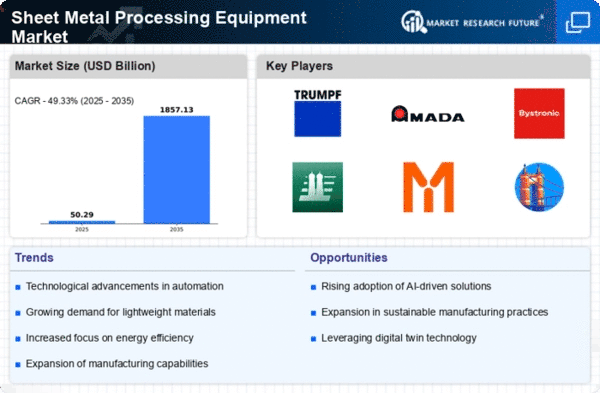
As per MRFR analysis, the Sheet Metal Processing Equipment Market Size was estimated at 33.68 USD Billion in 2024. The Sheet Metal Processing Equipment industry is projected to grow from 50.29 USD Billion in 2025 to 1857.13 USD Billion by 2035, exhibiting a compound annual growth rate (CAGR) of 49.33 during the forecast period 2025 - 2035.

Key Market Trends & Highlights

The Sheet Metal Processing Equipment Market is poised for robust growth driven by technological advancements and increasing demand across various sectors.

  • Technological advancements are reshaping the sheet metal processing landscape, enhancing efficiency and precision.
  • Sustainability initiatives are gaining traction, prompting manufacturers to adopt eco-friendly practices in production.
  • The automotive segment remains the largest market, while the aerospace segment is experiencing rapid growth due to increased demand for lightweight materials.
  • Rising demand in the automotive sector and growth in construction activities are key drivers propelling market expansion.

Market Size & Forecast

2024 Market Size 33.68 (USD Billion)
2035 Market Size 1857.13 (USD Billion)
CAGR (2025 - 2035) 49.33%

Major Players

Trumpf (DE), Amada (JP), Bystronic (CH), LVD (BE), Mazak (JP), Cincinnati (US), KUKA (DE), Haco (BE), Mitsubishi Electric (JP)

Our Impact
Enabled $4.3B Revenue Impact for Fortune 500 and Leading Multinationals
Partnering with 2000+ Global Organizations Each Year
30K+ Citations by Top-Tier Firms in the Industry

Sheet Metal Processing Equipment Market Trends

The Sheet Metal Processing Equipment Market is currently experiencing a dynamic evolution, driven by advancements in technology and increasing demand across various industries. The integration of automation and smart technologies appears to enhance efficiency and precision in metal processing operations. As manufacturers strive to optimize production processes, the adoption of innovative equipment is likely to rise, reflecting a shift towards more sophisticated solutions. Furthermore, sustainability concerns are influencing the market, as companies seek to minimize waste and energy consumption in their operations. This trend suggests a growing emphasis on eco-friendly practices within the sector. In addition, the Sheet Metal Processing Equipment Market is witnessing a diversification of applications, with sectors such as automotive, aerospace, and construction increasingly relying on advanced metalworking technologies. This broadening of use cases indicates a robust potential for growth, as industries seek to leverage the benefits of high-quality metal components. Moreover, the ongoing globalization of supply chains may further stimulate demand for efficient processing equipment, as businesses aim to remain competitive in a rapidly changing landscape. Overall, the market appears poised for continued expansion, driven by technological innovation and evolving industry needs.

Technological Advancements

The Sheet Metal Processing Equipment Market is significantly influenced by rapid technological advancements. Innovations such as automation, artificial intelligence, and machine learning are enhancing operational efficiency and precision. These developments enable manufacturers to streamline processes, reduce errors, and improve overall productivity, thereby attracting more investments in advanced equipment.

Sustainability Initiatives

Sustainability initiatives are becoming increasingly prominent within the Sheet Metal Processing Equipment Market. Companies are focusing on reducing waste and energy consumption, which aligns with global environmental goals. This trend indicates a shift towards eco-friendly practices, prompting manufacturers to develop equipment that supports sustainable production methods.

Diversification of Applications

The diversification of applications across various industries is shaping the Sheet Metal Processing Equipment Market. Sectors such as automotive, aerospace, and construction are increasingly adopting advanced metal processing technologies. This broadening of applications suggests a robust growth potential, as industries seek to enhance the quality and efficiency of their metal components.

Sheet Metal Processing Equipment Market Drivers

Technological Advancements

The Global Sheet Metal Processing Equipment Market Industry is experiencing a surge in technological advancements, which enhances efficiency and precision in manufacturing processes. Innovations such as laser cutting, CNC machining, and automation are transforming traditional methods. For instance, the integration of IoT in machinery allows for real-time monitoring and predictive maintenance, reducing downtime. As manufacturers adopt these technologies, productivity increases, leading to a projected market value of 136.1 USD Billion in 2024. This trend indicates a shift towards smart manufacturing, which is likely to drive growth in the industry.

Expansion of Aerospace Industry

The aerospace industry is a vital driver of the Global Sheet Metal Processing Equipment Market Industry, as it requires high-precision components and materials. With the increasing demand for air travel and advancements in aerospace technology, manufacturers are investing in sophisticated sheet metal processing equipment. This sector's growth is expected to contribute significantly to the market's expansion, with a projected value of 216.1 USD Billion by 2035. The need for lightweight and durable materials in aircraft manufacturing further emphasizes the importance of advanced processing technologies, indicating a robust future for the industry.

Growth in Construction Activities

The Global Sheet Metal Processing Equipment Market Industry is significantly influenced by the growth in construction activities worldwide. As urbanization accelerates, the demand for metal structures and components in buildings and infrastructure projects increases. This trend is particularly evident in emerging economies, where rapid development is underway. The market is projected to reach 216.1 USD Billion by 2035, driven by the need for durable and efficient materials. Consequently, manufacturers are likely to invest in advanced sheet metal processing technologies to meet the rising demand, thereby propelling the market forward.

Increased Focus on Energy Efficiency

Energy efficiency is becoming a crucial consideration in the Global Sheet Metal Processing Equipment Market Industry. Manufacturers are increasingly seeking equipment that minimizes energy consumption while maximizing output. This shift is driven by regulatory pressures and the need for sustainable practices. Equipment that incorporates energy-efficient technologies not only reduces operational costs but also aligns with global sustainability goals. As a result, the market is likely to see a rise in demand for such innovative solutions, contributing to a projected CAGR of 4.29% from 2025 to 2035, as companies strive to enhance their environmental performance.

Rising Demand from Automotive Sector

The automotive sector is a primary driver of the Global Sheet Metal Processing Equipment Market Industry, as it requires high-quality metal components for vehicle production. With the increasing production of electric vehicles and lightweight materials, the demand for advanced sheet metal processing equipment is expected to rise. In 2024, the market is valued at 136.1 USD Billion, reflecting the automotive industry's pivotal role. Furthermore, as the automotive sector aims for sustainability, manufacturers are likely to invest in more efficient processing technologies, potentially increasing the market's CAGR to 4.29% from 2025 to 2035.


Market Segment Insights

By Application: Cutting (Largest) vs. Bending (Fastest-Growing)

The Sheet Metal Processing Equipment Market is segmented into several applications: Cutting, Bending, Forming, Welding, and Punching. Among these, Cutting emerges as the largest segment, dominating the market share due to its essential role in sheet metal fabrication. Bending and Welding follow, each contributing significantly but with varying growth rates. Punching and Forming are vital as well, but they occupy smaller portions of the overall market. Companies are investing in advanced cutting technologies to increase efficiency and precision, which further solidifies Cutting's leading position.

Cutting (Dominant) vs. Bending (Emerging)

The Cutting segment in the Sheet Metal Processing Equipment Market is characterized by its widespread applicability across various industries, ensuring its dominance. Key technologies in this segment include laser and plasma cutting, which are favored for their precision and speed. On the other hand, the Bending segment is emerging rapidly, driven by innovation in bending equipment and increasing demand for complex shapes in sheet metal. Bending machines are evolving with advanced controls and automation, catering to diverse requirements across sectors. As customization and flexibility become increasingly crucial, both Cutting and Bending are set to enhance their market positions.

By End Use Industry: Automotive (Largest) vs. Aerospace (Fastest-Growing)

The sheet metal processing equipment market exhibits a diverse distribution across various end-use industries. The automotive sector holds a significant share due to the substantial demand for sheet metal components in vehicle manufacturing, driven by innovations in car design and fuel efficiency requirements. Following closely, the electronics and construction industries also contribute to market demand, both of which increasingly rely on sheet metal solutions for various applications, thus reflecting a well-rounded segment distribution across these key sectors. On the growth front, the aerospace industry emerges as the fastest-growing segment due to advancements in aviation technologies and an increasing focus on lightweight materials. The push for electric vehicles in the automotive sector also catalyzes growth, leading to heightened investments in innovative sheet metal processing machinery tailored for new manufacturing processes. Additionally, the construction industry is adapting to evolving building standards, further driving the demand for advanced sheet metal solutions.

Automotive: Dominant vs. Aerospace: Emerging

The automotive sector is recognized as the dominant player in the sheet metal processing equipment market due to its longstanding reliance on precise and efficient metalworking. OEMs prioritize high-quality fabrication to meet stringent safety standards and improve vehicle performance. Meanwhile, the aerospace segment, although it holds a smaller share compared to automotive, is positioned as an emerging market driven by technological advancements in aircraft manufacturing. With increasing investments in fuel-efficient aircraft designs, this sector is rapidly adopting advanced sheet metal processing technologies. The contrast between automotive and aerospace highlights a distinct market dynamic where automotive maintains dominance, while aerospace showcases significant growth potential as manufacturers leverage innovation to address evolving demands.

By Material Type: Steel (Largest) vs. Aluminum (Fastest-Growing)

The Sheet Metal Processing Equipment Market exhibits a diverse mix of material types, with steel leading the charge as the largest segment due to its widespread applicability in various end-use sectors like automotive and construction. Steel's dominance can be attributed to its strength, versatility, and cost-effectiveness, making it the material of choice for numerous applications, thereby commanding a significant share in the market. In contrast, aluminum is rapidly gaining traction as the fastest-growing segment, driven by its lightweight properties and increasing demand in industries focused on energy efficiency and sustainability, such as aerospace and automotive.

Steel (Dominant) vs. Aluminum (Emerging)

Steel remains the dominant material in the Sheet Metal Processing Equipment Market, renowned for its robustness and versatility across multiple applications. It is favored for structural and automotive components where strength and durability are paramount. Meanwhile, aluminum is emerging as a key player, particularly in sectors where weight reduction is crucial for fuel efficiency and performance. With an increasing focus on sustainable practices and innovations in metal processing, aluminum's lighter weight and corrosion resistance make it an appealing alternative. The transition towards greener technologies is likely to accelerate aluminum's adoption, positioning it as a significant contender in the coming years.

By Technology: Laser Cutting (Largest) vs. Plasma Cutting (Fastest-Growing)

In the Sheet Metal Processing Equipment Market, the major technologies utilized include laser cutting, plasma cutting, waterjet cutting, mechanical cutting, and press brake. Among these, laser cutting holds a significant share, recognized for its precision and versatility in handling various materials. Plasma cutting, on the other hand, is observing rapid growth due to its efficiency in processing thicker materials and its cost-effectiveness, appealing to a broader range of users and industries. As the demand for precision engineering increases, laser cutting is expected to maintain its lead, while plasma cutting continues to rise in popularity. The growth trends in this segment are driven by advancements in technology and increasing applications across industries such as automotive, aerospace, and manufacturing. Laser cutting technology benefits from innovations that enhance speed and accuracy, leading to higher adoption rates. Meanwhile, plasma cutting is favored for its structural capabilities and ease of use, making it more accessible for smaller operations. Overall, both technologies are shaping the market dynamics, fueling competition and expansion among manufacturers.

Technology: Laser Cutting (Dominant) vs. Plasma Cutting (Emerging)

In the realm of sheet metal processing equipment, laser cutting stands out as the dominant technology. Known for its precision and efficiency, laser cutting is preferred for intricate designs and superior finish quality, making it the go-to choice for high-end manufacturing sectors. The ability to cut various materials, including metals and plastics, adds to its versatility. On the other hand, plasma cutting is emerging rapidly as an efficient solution for cutting thicker materials. Its faster speed and lower operating costs appeal particularly to small to medium-sized businesses. Both technologies are being propelled by technological advancements, enhancing their capabilities and operational efficiency, thus driving their respective market positions.

By Product Type: Shears (Largest) vs. Lasers (Fastest-Growing)

In the Sheet Metal Processing Equipment Market, the distribution of market share among different product types shows a competitive landscape. Shears hold the largest share due to their versatility and efficiency in cutting operations, making them a preferred choice for manufacturers. Presses and punching machines also contribute significantly to the market, known for their precision and effectiveness in shaping metal. Lasers and benders, while currently smaller in share, are gaining traction due to advancements in technology and increasing automation in production processes.

Shears (Dominant) vs. Lasers (Emerging)

Shears stand out as the dominant product in the sheet metal processing sector, celebrated for their cutting capabilities and widespread application across industries. They are favored for a variety of metal thicknesses and provide consistent quality in cuts. Lasers, on the other hand, represent the emerging technology in this market, increasingly adopted for their precision and ability to handle complex designs with minimal material wastage. Their rapid growth is driven by the push for automation and high-speed operations, appealing to manufacturers aiming for flexibility and efficiency in their processing operations.

Get more detailed insights about Sheet Metal Processing Equipment Market

Regional Insights

North America : Market Leader in Equipment

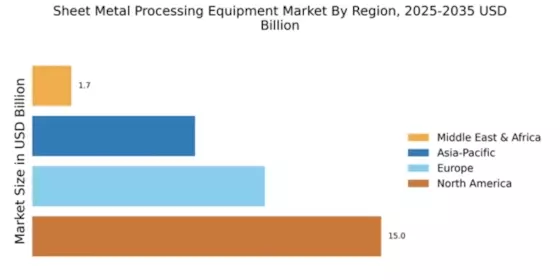
North America is poised to maintain its leadership in the Sheet Metal Processing Equipment Market, holding a significant market share of 15.0 in 2024. The region's growth is driven by robust manufacturing sectors, technological advancements, and increasing automation in production processes. Regulatory support for innovation and sustainability further fuels demand, making it a hotbed for investment in advanced manufacturing technologies. The competitive landscape is characterized by key players such as Trumpf, Cincinnati, and KUKA, who are at the forefront of innovation. The U.S. and Canada are leading countries, with a strong emphasis on R&D and high-quality production standards. The presence of established companies and a skilled workforce enhances the region's attractiveness for new entrants and investors alike.

Europe : Innovation and Sustainability Focus

Europe's Sheet Metal Processing Equipment Market is projected to grow significantly, with a market size of 10.0. The region benefits from stringent regulations promoting sustainability and energy efficiency, driving demand for advanced processing technologies. Countries like Germany and Italy are leading the charge, supported by government initiatives aimed at enhancing manufacturing capabilities and reducing environmental impact. The competitive landscape is vibrant, featuring major players such as Amada and Bystronic. Germany stands out as a manufacturing powerhouse, while Italy and France also contribute significantly to market growth. The focus on innovation and collaboration among industry stakeholders positions Europe as a key player in the global market, fostering a culture of continuous improvement and technological advancement.

Asia-Pacific : Emerging Market Potential

Asia-Pacific is witnessing rapid growth in the Sheet Metal Processing Equipment Market, with a market size of 7.0. The region's expansion is driven by increasing industrialization, urbanization, and a growing demand for consumer goods. Countries like China and Japan are at the forefront, supported by government initiatives aimed at boosting manufacturing efficiency and technological adoption. The competitive landscape is evolving, with key players such as Mitsubishi Electric and Mazak leading the market. China's significant investments in manufacturing infrastructure and Japan's focus on automation and robotics are shaping the future of the industry. The region's potential for growth is immense, making it an attractive destination for both local and international investors.

Middle East and Africa : Untapped Market Opportunities

The Middle East and Africa region, with a market size of 1.68, presents untapped opportunities in the Sheet Metal Processing Equipment Market. The growth is driven by increasing investments in infrastructure and manufacturing sectors, particularly in countries like the UAE and South Africa. Government initiatives aimed at diversifying economies and enhancing local manufacturing capabilities are key catalysts for market expansion. The competitive landscape is still developing, with a mix of local and international players entering the market. The presence of companies like Haco and LVD is notable, but there is significant room for growth as the region seeks to enhance its manufacturing capabilities. The focus on innovation and technology adoption will be crucial for capturing market share in this emerging landscape.

Sheet Metal Processing Equipment Market Regional Image

Key Players and Competitive Insights

The Sheet Metal Processing Equipment Market is currently characterized by a dynamic competitive landscape, driven by technological advancements and increasing demand for precision manufacturing. Key players such as Trumpf (Germany), Amada (Japan), and Bystronic (Switzerland) are at the forefront, each adopting distinct strategies to enhance their market positioning. Trumpf (Germany) emphasizes innovation through substantial investments in R&D, focusing on laser technology and automation solutions. Meanwhile, Amada (Japan) has been expanding its global footprint by establishing new manufacturing facilities in emerging markets, thereby enhancing its production capabilities and responsiveness to local demands. Bystronic (Switzerland) is leveraging digital transformation initiatives, integrating smart manufacturing solutions to optimize operational efficiency and customer engagement. Collectively, these strategies contribute to a competitive environment that is increasingly focused on technological differentiation and customer-centric solutions.In terms of business tactics, companies are localizing manufacturing to reduce lead times and enhance supply chain resilience. This approach is particularly evident in the moderately fragmented market structure, where a mix of established players and smaller firms coexist. The collective influence of key players shapes market dynamics, as they compete not only on price but also on technological innovation and service offerings, which are becoming critical differentiators in the industry.
In November Trumpf (Germany) announced the launch of its latest laser cutting system, which incorporates advanced AI algorithms to enhance cutting precision and reduce operational costs. This strategic move underscores the company's commitment to innovation and positions it to capture a larger share of the market by addressing the growing demand for efficient and high-quality manufacturing solutions. The integration of AI into their equipment is likely to set a new standard in the industry, compelling competitors to accelerate their own technological advancements.
In October Amada (Japan) unveiled a new partnership with a leading software provider to develop cloud-based solutions for sheet metal processing. This collaboration aims to enhance data analytics capabilities and improve production planning for customers. By aligning with a technology partner, Amada (Japan) not only strengthens its product offerings but also positions itself as a leader in the digital transformation of the manufacturing sector, potentially attracting a broader customer base seeking integrated solutions.
In September Bystronic (Switzerland) expanded its operations in North America by acquiring a local competitor, which allows it to enhance its market presence and service capabilities in the region. This acquisition is strategically significant as it enables Bystronic (Switzerland) to leverage existing customer relationships and distribution networks, thereby accelerating its growth trajectory in a key market. Such strategic moves reflect a broader trend of consolidation within the industry, as companies seek to enhance their competitive edge through scale and resource optimization.
As of December the Sheet Metal Processing Equipment Market is witnessing trends such as digitalization, sustainability, and AI integration, which are reshaping competitive dynamics. Strategic alliances are increasingly prevalent, as companies recognize the value of collaboration in driving innovation and expanding market reach. Looking ahead, competitive differentiation is likely to evolve from traditional price-based competition to a focus on technological innovation, reliability in supply chains, and sustainable practices. This shift indicates a transformative phase in the market, where companies that prioritize these elements may gain a substantial competitive advantage.

Key Companies in the Sheet Metal Processing Equipment Market include

Industry Developments

The Sheet Metal Processing Equipment Market is poised to grow steadily in the coming years, driven by increasing demand from various industries such as automotive, construction, and electronics. Technological advancements in laser cutting, welding, and bending machines are expected to further propel market growth.

Key market players are focusing on developing innovative solutions to meet the evolving needs of customers. For instance, in 2023, TRUMPF, a leading manufacturer of sheet metal processing equipment, introduced a new generation of fiber lasers with improved beam quality and cutting speeds. Such developments are anticipated to shape the future landscape of the sheet metal processing equipment market.

Future Outlook

Sheet Metal Processing Equipment Market Future Outlook

The Sheet Metal Processing Equipment Market is projected to grow at a 49.33% CAGR from 2025 to 2035, driven by technological advancements, increased automation, and rising demand across various industries.

New opportunities lie in:

  • Integration of AI-driven predictive maintenance solutions Expansion into emerging markets with tailored product offerings Development of eco-friendly sheet metal processing technologies

By 2035, the market is expected to achieve substantial growth, solidifying its position as a leader in manufacturing innovation.

Market Segmentation

Sheet Metal Processing Equipment Market Technology Outlook

  • Laser Cutting
  • Plasma Cutting
  • Waterjet Cutting
  • Mechanical Cutting
  • Press Brake

Sheet Metal Processing Equipment Market Application Outlook

  • Cutting
  • Bending
  • Forming
  • Welding
  • Punching

Sheet Metal Processing Equipment Market Product Type Outlook

  • Shears
  • Presses
  • Lasers
  • Benders
  • Punching Machines

Sheet Metal Processing Equipment Market Material Type Outlook

  • Aluminum
  • Steel
  • Copper
  • Brass
  • Titanium

Sheet Metal Processing Equipment Market End Use Industry Outlook

  • Automotive
  • Aerospace
  • Construction
  • Electronics
  • Manufacturing

Report Scope

MARKET SIZE 2024 33.68(USD Billion)
MARKET SIZE 2025 50.29(USD Billion)
MARKET SIZE 2035 1857.13(USD Billion)
COMPOUND ANNUAL GROWTH RATE (CAGR) 49.33% (2025 - 2035)
REPORT COVERAGE Revenue Forecast, Competitive Landscape, Growth Factors, and Trends
BASE YEAR 2024
Market Forecast Period 2025 - 2035
Historical Data 2019 - 2024
Market Forecast Units USD Billion
Key Companies Profiled Trumpf (DE), Amada (JP), Bystronic (CH), LVD (BE), Mazak (JP), Cincinnati (US), KUKA (DE), Haco (BE), Mitsubishi Electric (JP)
Segments Covered Application, End Use Industry, Material Type, Technology, Product Type
Key Market Opportunities Integration of automation and smart technologies enhances efficiency in the Sheet Metal Processing Equipment Market.
Key Market Dynamics Technological advancements and automation drive efficiency and competitiveness in the Sheet Metal Processing Equipment Market.
Countries Covered North America, Europe, APAC, South America, MEA
Leave a Comment

FAQs

What was the current market size of the Sheet Metal Processing Equipment Market?

The Sheet Metal Processing Equipment Market was valued at 132.46 billion U.S. dollars in 2023.

What is the projected market size of the Sheet Metal Processing Equipment Market in 2035?

The Sheet Metal Processing Equipment Market is projected to reach 191.24 billion U.S. dollars by 2035.

What is the expected CAGR of the Sheet Metal Processing Equipment Market from 2024 to 2035?

The Sheet Metal Processing Equipment Market is expected to grow at a CAGR of 4.16% from 2025 to 2035.

Which region is expected to hold the largest market share in the Sheet Metal Processing Equipment Market?

Asia Pacific is expected to hold the largest market share in the Sheet Metal Processing Equipment Market throughout the forecast period.

Which are the key application segments of the Sheet Metal Processing Equipment Market?

The key application segments of the Sheet Metal Processing Equipment Market include automotive, construction, electronics, and aerospace.

Who are the major competitors in the Sheet Metal Processing Equipment Market?

Some of the major competitors in the Sheet Metal Processing Equipment Market include Amada, Bystronic, LVD, Prima Power, and Trumpf.

What are the key factors driving the growth of the Sheet Metal Processing Equipment Market?

The growth of the Sheet Metal Processing Equipment Market is driven by factors such as increasing demand from the automotive and construction industries, technological advancements, and rising disposable incomes.

What are the challenges faced by the Sheet Metal Processing Equipment Market?

The Sheet Metal Processing Equipment Market faces challenges such as intense competition, fluctuating raw material prices, and stringent environmental regulations.

What are the opportunities for the Sheet Metal Processing Equipment Market?

Opportunities for the Sheet Metal Processing Equipment Market include the growing demand for lightweight and durable materials, increasing adoption of automation, and expanding applications in emerging industries.

What are the key trends in the Sheet Metal Processing Equipment Market?

The key trends in the Sheet Metal Processing Equipment Market include the adoption of digital technologies, the integration of robotics and automation, and the increasing focus on sustainability.

Download Free Sample

Kindly complete the form below to receive a free sample of this Report

Compare Licence

×
Features License Type
Single User Multiuser License Enterprise User
Price $4,950 $5,950 $7,250
Maximum User Access Limit 1 User Upto 10 Users Unrestricted Access Throughout the Organization
Free Customization
Direct Access to Analyst
Deliverable Format
Platform Access
Discount on Next Purchase 10% 15% 15%
Printable Versions