×
Request Free Sample ×

Kindly complete the form below to receive a free sample of this Report

* Please use a valid business email

Leading companies partner with us for data-driven Insights

clients tt-cursor
Hero Background
English
Chinese
French
Japanese
Korean
German
Spanish

Semiconductor Fabrication Materials Market Share

ID: MRFR/CnM/10401-HCR
128 Pages
Priya Nagrale
February 2026

Semiconductor Fabrication Materials Market Research Report Information By Material (Silicon Wafers, Photomasks, Photoresists, Wet Chemicals, CMP Slurry and Pads, Gases, Sputter Targets, and Photoresist Ancillaries), By Application (Consumer Appliances, Power Generation, Electronic Components, and Others), By End User Industry (Telecommunication, Energy, Electrical and Electronics, Medical and Healthcare, Automotive, and Others), and By Region (North America, Europe, Asia-Pacific, and Rest Of The World) – Market Forecast Till 2035

Share:
Download PDF ×

We do not share your information with anyone. However, we may send you emails based on your report interest from time to time. You may contact us at any time to opt-out.

Semiconductor Fabrication Materials Market Infographic
Purchase Options

Market Share

Semiconductor Fabrication Materials Market Share Analysis

Different companies adopt various approaches to create a unique presence within the highly competitive Semiconductor Fabrication Materials Market. For this reason, market share positioning mainly involves innovating fabrication materials, processes, and technologies. The importance of these materials in semiconductor manufacture necessitates considerations such as purity, precision and their compatibility with modern technology. Pricing strategy is one factor that plays a key role in defining how our firm gets positioned in terms of its market share within semiconductor fabrication materials markets. Some companies choose to be cost leaders, thus offering materials at affordable prices to a wider range of semiconductor manufacturers. On the contrary, those who focus on advanced formulations, ultra-high purity levels, or specialized materials tailored for specific semiconductor applications tend to charge premium prices. Market share positioning is heavily reliant on creating an effective and extensive distribution network. This is achieved by joining hands with semiconductor makers, electronics assembly service providers, and suppliers to make their fabrication materials available. In the semiconductor fabrication materials market, strategic partnerships and collaborations with key players in the semiconductor and electronic industry are important for gaining market share. By way of alliances with semiconductor manufacturers, technology research institutions, or equipment suppliers, together they can gain a competitive advantage through shared know-how while accessing new markets and collectively resolving issues concerning specifications, regulations, and changing industry standards. Joint collaborative efforts like joint ventures upon which shares are swopped between companies have grown significantly in important ways that contribute to varying market strategies followed by various organizations over time. Market share growth requires efficient marketing strategy and branding efforts. To do this, firms invest heavily in brand development, promotion of their fabrication materials through digital marketing channels such as online adverts and social media sites, corporate events participation, and supporting other professionals within the semiconductor & electron industries. Innovation has become an essential determinant of a firm's position among the market leaders in the Semiconductor Fabrication Materials Market. R&D resources aimed at launching fabrications like ultra-thin dielectrics or other advanced deposition technologies that fit evolving environmental regulations governing semiconductor manufacturing globally also cause dynamics in the semiconductor fabrication materials market alongside innovation-driven initiatives. Customer-centric strategies are also part of a company's success formula when it comes to achieving a good share of the market. Understanding the needs of specific types of semiconductor producers becomes critical as these companies take into consideration customer preferences regarding product features.


Author
Priya Nagrale
Senior Research Analyst

With an experience of over five years in market research industry (Chemicals & Materials domain), I gather and analyze market data from diverse sources to produce results, which are then presented back to a client. Also, provide recommendations based on the findings. As a Senior Research Analyst, I perform quality checks (QC) for market estimations, QC for reports, and handle queries and work extensively on client customizations. Also, handle the responsibilities of client proposals, report planning, report finalization, and execution

Leave a Comment

FAQs

What is the projected market valuation of The Global Semiconductor Fabrication Materials by 2035?

<p>The projected market valuation for The Global Semiconductor Fabrication Materials is expected to reach 119.9 USD Billion by 2035.</p>

What was the market valuation of The Global Semiconductor Fabrication Materials in 2024?

<p>The overall market valuation of The Global Semiconductor Fabrication Materials was 59.96 USD Billion in 2024.</p>

What is the expected CAGR for The Global Semiconductor Fabrication Materials during the forecast period 2025 - 2035?

<p>The expected CAGR for The Global Semiconductor Fabrication Materials during the forecast period 2025 - 2035 is 6.5%.</p>

Which companies are considered key players in The Global Semiconductor Fabrication Materials?

<p>Key players in The Global Semiconductor Fabrication Materials include Intel Corporation, Samsung Electronics, and Taiwan Semiconductor Manufacturing Company.</p>

What are the main segments of The Global Semiconductor Fabrication Materials?

<p>The main segments of The Global Semiconductor Fabrication Materials include materials, applications, and end-user industries.</p>

How much is the market for Silicon Wafers projected to grow by 2035?

<p>The market for Silicon Wafers is projected to grow from 20.0 USD Billion to 40.0 USD Billion by 2035.</p>

What is the projected valuation for the Electronic Components application segment by 2035?

The projected valuation for the Electronic Components application segment is expected to increase from 25.0 USD Billion to 50.0 USD Billion by 2035.

What is the expected growth for the Telecommunication end-user industry segment by 2035?

The Telecommunication end-user industry segment is expected to grow from 10.0 USD Billion to 20.0 USD Billion by 2035.

What is the projected growth for Wet Chemicals in the materials segment by 2035?

The projected growth for Wet Chemicals in the materials segment is expected to rise from 6.0 USD Billion to 12.0 USD Billion by 2035.

How does the market for Photoresists compare to that of Photomasks by 2035?

By 2035, the market for Photoresists is projected to grow from 8.0 USD Billion to 16.0 USD Billion, while Photomasks are expected to increase from 10.0 USD Billion to 20.0 USD Billion.

Market Summary

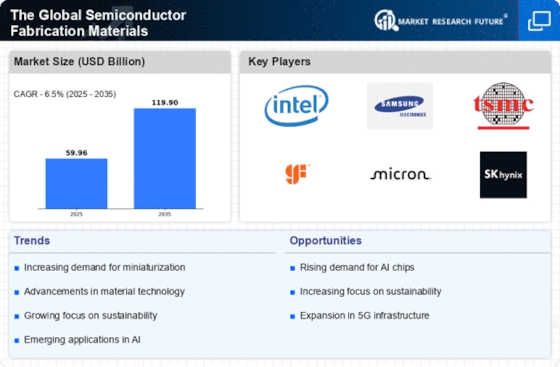
As per Market Research Future analysis, The Global Semiconductor Fabrication Materials Market was estimated at 59.96 USD Billion in 2024. The semiconductor fabrication materials industry is projected to grow from 63.86 USD Billion in 2025 to 119.9 USD Billion by 2035, exhibiting a compound annual growth rate (CAGR) of 6.5% during the forecast period 2025 - 2035

Key Market Trends & Highlights

The Global Semiconductor Fabrication Materials Market is poised for robust growth driven by technological advancements and sustainability initiatives.

  • North America remains the largest market for semiconductor fabrication materials, reflecting its strong consumer electronics sector.
  • Asia-Pacific is the fastest-growing region, propelled by increasing investments in electric vehicles and advanced manufacturing technologies.
  • Silicon wafers dominate the market as the largest segment, while photomasks are emerging as the fastest-growing segment due to rising demand for advanced lithography.
  • Key market drivers include the rising demand for consumer electronics and advancements in 5G technology, which are fueling growth across various segments.

Market Size & Forecast

2024 Market Size 59.96 (USD Billion)
2035 Market Size 119.9 (USD Billion)
CAGR (2025 - 2035) 6.5%
Largest Regional Market Share in 2024 North America

Major Players

Intel Corporation (US), Samsung Electronics (KR), Taiwan Semiconductor Manufacturing Company (TW), GlobalFoundries (US), Micron Technology (US), SK Hynix (KR), Applied Materials (US), ASML Holding (NL), Tokyo Electron Limited (JP)

Market Trends

The Global Semiconductor Fabrication Materials Market is currently experiencing a dynamic evolution, driven by the increasing demand for advanced electronic devices and the ongoing miniaturization of technology. This market encompasses a wide array of materials essential for the production of semiconductors, including silicon wafers, photoresists, and various chemicals. As industries such as automotive, telecommunications, and consumer electronics continue to expand, the need for high-performance materials becomes more pronounced. Furthermore, the shift towards sustainable practices and eco-friendly materials is influencing manufacturers to innovate and adapt their offerings to meet environmental standards. In addition, the rise of artificial intelligence and the Internet of Things is propelling the market forward, as these technologies require sophisticated semiconductor solutions. Companies are investing in research and development to enhance material properties, improve yield rates, and reduce production costs. The competitive landscape is characterized by collaborations and partnerships among key players, aiming to leverage each other's strengths to capture market share. Overall, The Global Semiconductor Fabrication Materials Market appears poised for growth, with numerous opportunities emerging as technology continues to advance and diversify.

Sustainability Initiatives

There is a growing emphasis on sustainable practices within The Global Semiconductor Fabrication Materials Market. Manufacturers are increasingly focusing on eco-friendly materials and processes to reduce environmental impact. This trend reflects a broader commitment to sustainability across various industries, as companies seek to align with global environmental standards and consumer expectations.

Technological Advancements

Rapid technological advancements are reshaping The Global Semiconductor Fabrication Materials Market. Innovations in material science are leading to the development of new compounds and formulations that enhance performance and efficiency. These advancements are crucial for meeting the demands of next-generation electronic devices, which require higher precision and reliability.

Increased Demand for Miniaturization

The trend towards miniaturization in electronics is significantly influencing The Global Semiconductor Fabrication Materials Market. As devices become smaller and more powerful, the need for specialized materials that can support intricate designs and functionalities is rising. This demand drives manufacturers to explore novel materials that can meet the challenges posed by miniaturized technology.

Semiconductor Fabrication Materials Market Market Drivers

Growth of Electric Vehicles

The automotive sector is undergoing a transformation with the rise of electric vehicles (EVs), which significantly influences the Semiconductor Fabrication Materials Market. As EV adoption accelerates, the demand for semiconductors in automotive applications is expected to increase substantially. By 2025, The Global Semiconductor Fabrication Materials Market is anticipated to surpass 800 billion USD, creating a substantial need for advanced semiconductor materials. These materials are crucial for various applications, including battery management systems and power electronics. The shift towards electrification in transportation not only drives demand for semiconductor fabrication materials but also encourages innovation in material science, thereby enhancing the overall market landscape.

Advancements in 5G Technology

The rollout of 5G technology is a transformative force impacting the Semiconductor Fabrication Materials Market. With the deployment of 5G networks, there is a heightened demand for semiconductors that can support faster data transmission and improved connectivity. The global 5G infrastructure market is projected to reach over 300 billion USD by 2025, necessitating the use of advanced fabrication materials to meet the performance requirements of 5G devices. This technological advancement compels manufacturers to explore new materials that can withstand higher frequencies and improve signal integrity, thereby driving growth in the Semiconductor Fabrication Materials Market.

Rising Demand for Consumer Electronics

The increasing demand for consumer electronics is a pivotal driver for the Semiconductor Fabrication Materials Market. As technology continues to advance, consumers are seeking more sophisticated devices, which in turn drives the need for high-performance semiconductors. In 2025, The Global Semiconductor Fabrication Materials Market is projected to reach approximately 1 trillion USD, indicating a robust growth trajectory. This surge in demand necessitates the use of advanced fabrication materials, which are essential for producing smaller, more efficient chips. Consequently, manufacturers are compelled to invest in innovative materials that enhance performance and reduce energy consumption, thereby propelling the Semiconductor Fabrication Materials Market forward.

Emerging Applications in Artificial Intelligence

The rise of artificial intelligence (AI) applications is significantly influencing the Semiconductor Fabrication Materials Market. As AI technologies become more prevalent across various sectors, the demand for specialized semiconductors that can handle complex computations is increasing. The Global Semiconductor Fabrication Materials Market is projected to reach approximately 500 billion USD by 2025, driving the need for advanced fabrication materials that support high-performance computing. This trend encourages manufacturers to develop innovative materials that enhance processing power and efficiency, thereby propelling growth in the Semiconductor Fabrication Materials Market. The intersection of AI and semiconductor technology presents a unique opportunity for market expansion.

Increased Investment in Research and Development

Investment in research and development (R&D) is a critical driver for the Semiconductor Fabrication Materials Market. As companies strive to innovate and maintain competitive advantages, R&D spending has surged. In 2025, global R&D expenditure in the semiconductor sector is expected to exceed 100 billion USD, reflecting a commitment to developing new materials and processes. This investment is essential for creating next-generation semiconductors that meet the evolving demands of various industries, including telecommunications and computing. Enhanced R&D efforts not only foster innovation but also contribute to the overall growth and sustainability of the Semiconductor Fabrication Materials Market.

Market Segment Insights

By Material: Silicon Wafers (Largest) vs. Photomasks (Fastest-Growing)

In The Global Semiconductor Fabrication Materials Market, <a href="https://www.marketresearchfuture.com/reports/silicon-wafers-market-2052" target="_blank" title="silicon wafers">Silicon Wafers</a> hold the largest market share, constituting a significant portion of overall material usage. Following them, Photomasks are emerging rapidly, driven by innovations in photolithography techniques that enhance their significance in semiconductor production. Other noteworthy materials such as Photoresists and Wet Chemicals contribute to the diverse composition of the market, but their shares remain smaller in comparison to the leading segments. As technologies advance, the distribution of market share is expected to evolve, reflecting the dynamic nature of the industry.

Silicon Wafers (Dominant) vs. Photomasks (Emerging)

Silicon Wafers are the backbone of semiconductor fabrication and have established themselves as the dominant material in the market, essential for the production of integrated circuits. They offer excellent electrical properties, enabling high performance and efficiency in semiconductor devices. On the other hand, Photomasks, though currently a smaller segment, are rapidly emerging due to advancements in lithography technology and the increasing demand for higher resolution chips. Their capacity to accurately represent circuit designs on silicon wafers makes them critical, indicating a strong growth trajectory fueled by innovation and increasing application in complex chip fabrication.

By Application: Electronic Components (Largest) vs. Power Generation (Fastest-Growing)

The Global Semiconductor Fabrication Materials Market is predominantly driven by the electronic components segment, which accounts for the largest share within the overall market. This segment encompasses materials used in various electronic devices including processors, memory chips, and sensors. Meanwhile, the consumer appliances and others segments contribute to the market, though to a lesser extent. The distribution reflects a strong reliance on consumer electronics, where demand for advanced semiconductor materials continues to rise. The power generation segment, while smaller, is noted as the fastest-growing segment due to the increasing demand for renewable energy systems and smart grid technologies. The push for energy efficiency and the integration of semiconductors in power electronics are significant growth drivers. Additionally, as electric vehicles become more prevalent, the need for specialized semiconductor fabrication materials in power systems is surging, indicating a robust shift towards sustainable energy solutions.

Consumer Appliances: Electronic Components (Dominant) vs. Power Generation (Emerging)

Electronic components dominate The Global Semiconductor Fabrication Materials Market due to their extensive application in the manufacturing of essential electronics. This segment benefits from continuous technological advancements, resulting in a constant need for innovative materials that enhance performance and efficiency. In contrast, while the power generation segment is emerging, it showcases significant potential as demand for renewable energy rises. Materials used in this sector focus on improving energy conversion efficiency and durability in various power applications, including solar inverters and energy storage systems. The synergy between emerging technologies and the expanding footprint of semiconductor materials in power generation indicates that both segments have a prominent role in shaping the future landscape of the semiconductor industry.

By End User Industry: Electrical and Electronics (Largest) vs. Automotive (Fastest-Growing)

The Global Semiconductor Fabrication Materials Market is largely dominated by the Electrical and Electronics sector, which accounts for a significant portion of market share due to the high demand for chips and components in consumer electronics, telecommunications, and computing devices. Following closely is the Automotive industry, which is rapidly catching up as it integrates more semiconductor technologies into vehicles, particularly with the rise of electric and autonomous vehicles.

Electrical and Electronics: Dominant vs. Automotive: Emerging

The Electrical and Electronics sector stands as the dominant force in The Global Semiconductor Fabrication Materials Market, driven by continuous innovation and the increasing adoption of advanced technologies such as IoT, AI, and 5G. This segment requires high-purity materials and advanced fabrication processes to meet stringent quality and performance standards. On the other hand, the Automotive sector is emerging as a fast-growing segment due to the escalating demand for semiconductor solutions in electric vehicles, driver assistance systems, and overall vehicle connectivity. This shift signifies a substantial transition in the automotive landscape, where traditional electronics are evolving towards more sophisticated semiconductor applications.

Get more detailed insights about Semiconductor Fabrication Materials Market Research Report—Global Forecast till 2035

Regional Insights

By region, the study provides the market insights into North America, Europe, Asia-Pacific and Rest of the World. The North America Semiconductor Fabrication Materials Market dominated this market in 2022 (45.80%). This is because companies like Applied Materials Inc., Kla Corporation, LAM Research Laboratories, and others are present in the market. Therefore, big providers operating in the region are looking to build factories in locations with generous subsidies. Further, the U.S. Semiconductor Fabrication Materials market held the largest market share, and the Canada Semiconductor Fabrication Materials Market was the fastest growing market in the North America region.

Further, the major countries studied in the market report are The US, Canada, German, France, the UK, Italy, Spain, China, Japan, India, Australia, South Korea, and Brazil.

Figure 2: SEMICONDUCTOR FABRICATION MATERIALS MARKET SHARE BY REGION 2022 (USD Billion)

Europe Semiconductor Fabrication Materials Market accounted for the healthy market share in 2022. This is due to improved economic ties with other nations and government measures to fund the construction of new semiconductor manufacturing facilities. For example, Euractiv Germany Reports said that the German government intended to invest USD 3.39 billion in the semiconductor manufacturing facility. Further, the German Semiconductor Fabrication Materials Market held the largest market share, and the U.K Semiconductor Fabrication Materials Market was the fastest growing market in the European region

The Asia Pacific Semiconductor Fabrication Materials Market is expected to register significant growth from 2023 to 2032. This is a result of rising consumer demand for consumer electronics in these developing nations as well as rising demand for wireless technologies. Consumer electronics are in high demand in Taiwan, China, and India. Taiwan is the world's largest maker of semiconductors. Taiwan is home to many significant market participants. This is fueling the expansion of the Asia Pacific semiconductor materials market.

Moreover, China’s Semiconductor Fabrication Materials Market held the largest market share and the Indian Semiconductor Fabrication Materials Market was the fastest growing market in the Asia-Pacific region.

Key Players and Competitive Insights

Leading market players are investing heavily in research and development in order to expand their product lines, which will help the Semiconductor Fabrication Materials Market, grow even more. Market participants are also undertaking a variety of strategic activities to expand their global footprint, with important market developments including new product launches, contractual agreements, mergers and acquisitions, higher investments, and collaboration with other organizations. To expand and survive in a more competitive and rising market climate, Semiconductor Fabrication Materials industry must offer cost-effective items.
Manufacturing locally to minimize operational costs is one of the key business tactics used by manufacturers in the global Semiconductor Fabrication Materials industry to benefit clients and increase the market sector. In recent years, the Semiconductor Fabrication Materials industry has offered some of the most significant advantages to medicine. Major players in the Semiconductor Fabrication Materials Market, including BASF SE, Kanto Chemical Co., Inc., Praxair, Inc., Dow Chemical Company, Air Products and Chemicals Inc., Air Liquide SA, Taiyo Nippon Sanso, Alent Plc, JSR Corporation, and Linde AG, are attempting to increase market demand by investing in research and development Applications.
An organisation called Indium Software runs a business that offers digital engineering services. In order to assist clients in implementing technology that generates quantifiable business value, the company offers to give extensive knowledge in application engineering, cloud engineering, data and analytics, DevOps, digital assurance, and gaming. Indium Corporation, a global materials supplier to American electronics assembly and semiconductor packaging firms, completed its newest 37,500-square-foot manufacturing facility in Penang, Malaysia, in November 2022. The new plant has started producing goods and will boost output to better serve the company's customers in Malaysia and the surrounding region, particularly Thailand and Vietnam.
Chemicals are produced by LG Chem Ltd., a division of LG Corp. Petrochemicals, IT and electrical materials, and energy solutions are all produced and sold by the corporation. Polyvinyl chloride (PVC), ethylene, propylene, butadiene, benzene, polarizers, glass substrates, semiconductor materials, and RO membranes are just a few of the products it offers. Additionally, it sells anti-diabetic medications, growth hormone, vaccines, and battery materials. It also produces and distributes display and battery materials for LCD photoresist, OLED materials, and other displays. In Daesan, Yeosu, Ochang, Cheongju, Ulsan, Naju, Iksan, Paju, and Gimcheon, it owns and runs manufacturing plants.
The business operates, among other places, in China, India, Germany, the US, Vietnam, Brazil, Taiwan, Hong Kong, and Poland. Seoul, South Korea, serves as the company's main office. L.G. Chem started creating photoresist (P.R. ), a material used in semiconductor back-end processes, in May 2022 with the goal of making it available to all semiconductor enterprises globally.

Key Companies in the Semiconductor Fabrication Materials Market include

Industry Developments

July 2021: In order to meet the demand for its product, Showa Denko Materials Co. announced that it would enhance production capacity for semiconductor materials at its Taiwanese subsidiary.

March 2021: In response to a global chip shortage in the automotive and electronics sectors and worries that the United States is lagging behind in semiconductor production, Intel announced a USD 20 billion investment in two factories in Arizona.

Future Outlook

Semiconductor Fabrication Materials Market Future Outlook

The Global Semiconductor Fabrication Materials Market is projected to grow at a 6.5% CAGR from 2025 to 2035, driven by advancements in technology, increasing demand for electronics, and the rise of AI applications.

New opportunities lie in:

  • Development of advanced photolithography materials for next-gen chips.
  • Investment in sustainable semiconductor materials to meet regulatory demands.
  • Expansion of supply chain partnerships to enhance material sourcing efficiency.

By 2035, the market is expected to achieve robust growth, positioning itself as a leader in semiconductor innovation.

Market Segmentation

Semiconductor Fabrication Materials Market Material Outlook

  • Silicon Wafers
  • Photomasks
  • Photoresists
  • Wet Chemicals
  • CMP Slurry and Pads
  • Gases
  • Sputter Targets
  • Photoresist Ancillaries

Semiconductor Fabrication Materials Market Application Outlook

  • Consumer Appliances
  • Power Generation
  • Electronic Components
  • Others

Semiconductor Fabrication Materials Market End User Industry Outlook

  • Telecommunication
  • Energy
  • Electrical and Electronics
  • Medical and Healthcare
  • Automotive
  • Others

Report Scope

MARKET SIZE 2024 59.96(USD Billion)
MARKET SIZE 2025 63.86(USD Billion)
MARKET SIZE 2035 119.9(USD Billion)
COMPOUND ANNUAL GROWTH RATE (CAGR) 6.5% (2025 - 2035)
REPORT COVERAGE Revenue Forecast, Competitive Landscape, Growth Factors, and Trends
BASE YEAR 2024
Market Forecast Period 2025 - 2035
Historical Data 2019 - 2024
Market Forecast Units USD Billion
Key Companies Profiled Intel Corporation (US), Samsung Electronics (KR), Taiwan Semiconductor Manufacturing Company (TW), GlobalFoundries (US), Micron Technology (US), SK Hynix (KR), Applied Materials (US), ASML Holding (NL), Tokyo Electron Limited (JP)
Segments Covered Material, Application, End User Industry, Region
Key Market Opportunities Advancements in 5G technology drive demand for innovative materials in The Global Semiconductor Fabrication Materials.
Key Market Dynamics Rising demand for advanced materials drives innovation and competition in semiconductor fabrication processes.
Countries Covered North America, Europe, APAC, South America, MEA

FAQs

What is the projected market valuation of The Global Semiconductor Fabrication Materials by 2035?

<p>The projected market valuation for The Global Semiconductor Fabrication Materials is expected to reach 119.9 USD Billion by 2035.</p>

What was the market valuation of The Global Semiconductor Fabrication Materials in 2024?

<p>The overall market valuation of The Global Semiconductor Fabrication Materials was 59.96 USD Billion in 2024.</p>

What is the expected CAGR for The Global Semiconductor Fabrication Materials during the forecast period 2025 - 2035?

<p>The expected CAGR for The Global Semiconductor Fabrication Materials during the forecast period 2025 - 2035 is 6.5%.</p>

Which companies are considered key players in The Global Semiconductor Fabrication Materials?

<p>Key players in The Global Semiconductor Fabrication Materials include Intel Corporation, Samsung Electronics, and Taiwan Semiconductor Manufacturing Company.</p>

What are the main segments of The Global Semiconductor Fabrication Materials?

<p>The main segments of The Global Semiconductor Fabrication Materials include materials, applications, and end-user industries.</p>

How much is the market for Silicon Wafers projected to grow by 2035?

<p>The market for Silicon Wafers is projected to grow from 20.0 USD Billion to 40.0 USD Billion by 2035.</p>

What is the projected valuation for the Electronic Components application segment by 2035?

The projected valuation for the Electronic Components application segment is expected to increase from 25.0 USD Billion to 50.0 USD Billion by 2035.

What is the expected growth for the Telecommunication end-user industry segment by 2035?

The Telecommunication end-user industry segment is expected to grow from 10.0 USD Billion to 20.0 USD Billion by 2035.

What is the projected growth for Wet Chemicals in the materials segment by 2035?

The projected growth for Wet Chemicals in the materials segment is expected to rise from 6.0 USD Billion to 12.0 USD Billion by 2035.

How does the market for Photoresists compare to that of Photomasks by 2035?

By 2035, the market for Photoresists is projected to grow from 8.0 USD Billion to 16.0 USD Billion, while Photomasks are expected to increase from 10.0 USD Billion to 20.0 USD Billion.

  1. SECTION I: EXECUTIVE SUMMARY AND KEY HIGHLIGHTS
    1. | 1.1 EXECUTIVE SUMMARY
    2. | | 1.1.1 Market Overview
    3. | | 1.1.2 Key Findings
    4. | | 1.1.3 Market Segmentation
    5. | | 1.1.4 Competitive Landscape
    6. | | 1.1.5 Challenges and Opportunities
    7. | | 1.1.6 Future Outlook
  2. SECTION II: SCOPING, METHODOLOGY AND MARKET STRUCTURE
    1. | 2.1 MARKET INTRODUCTION
    2. | | 2.1.1 Definition
    3. | | 2.1.2 Scope of the study
    4. | | | 2.1.2.1 Research Objective
    5. | | | 2.1.2.2 Assumption
    6. | | | 2.1.2.3 Limitations
    7. | 2.2 RESEARCH METHODOLOGY
    8. | | 2.2.1 Overview
    9. | | 2.2.2 Data Mining
    10. | | 2.2.3 Secondary Research
    11. | | 2.2.4 Primary Research
    12. | | | 2.2.4.1 Primary Interviews and Information Gathering Process
    13. | | | 2.2.4.2 Breakdown of Primary Respondents
    14. | | 2.2.5 Forecasting Model
    15. | | 2.2.6 Market Size Estimation
    16. | | | 2.2.6.1 Bottom-Up Approach
    17. | | | 2.2.6.2 Top-Down Approach
    18. | | 2.2.7 Data Triangulation
    19. | | 2.2.8 Validation
  3. SECTION III: QUALITATIVE ANALYSIS
    1. | 3.1 MARKET DYNAMICS
    2. | | 3.1.1 Overview
    3. | | 3.1.2 Drivers
    4. | | 3.1.3 Restraints
    5. | | 3.1.4 Opportunities
    6. | 3.2 MARKET FACTOR ANALYSIS
    7. | | 3.2.1 Value chain Analysis
    8. | | 3.2.2 Porter's Five Forces Analysis
    9. | | | 3.2.2.1 Bargaining Power of Suppliers
    10. | | | 3.2.2.2 Bargaining Power of Buyers
    11. | | | 3.2.2.3 Threat of New Entrants
    12. | | | 3.2.2.4 Threat of Substitutes
    13. | | | 3.2.2.5 Intensity of Rivalry
    14. | | 3.2.3 COVID-19 Impact Analysis
    15. | | | 3.2.3.1 Market Impact Analysis
    16. | | | 3.2.3.2 Regional Impact
    17. | | | 3.2.3.3 Opportunity and Threat Analysis
  4. SECTION IV: QUANTITATIVE ANALYSIS
    1. | 4.1 Chemicals and Materials, BY Material (USD Billion)
    2. | | 4.1.1 Silicon Wafers
    3. | | 4.1.2 Photomasks
    4. | | 4.1.3 Photoresists
    5. | | 4.1.4 Wet Chemicals
    6. | | 4.1.5 CMP Slurry and Pads
    7. | | 4.1.6 Gases
    8. | | 4.1.7 Sputter Targets
    9. | | 4.1.8 Photoresist Ancillaries
    10. | 4.2 Chemicals and Materials, BY Application (USD Billion)
    11. | | 4.2.1 Consumer Appliances
    12. | | 4.2.2 Power Generation
    13. | | 4.2.3 Electronic Components
    14. | | 4.2.4 Others
    15. | 4.3 Chemicals and Materials, BY End User Industry (USD Billion)
    16. | | 4.3.1 Telecommunication
    17. | | 4.3.2 Energy
    18. | | 4.3.3 Electrical and Electronics
    19. | | 4.3.4 Medical and Healthcare
    20. | | 4.3.5 Automotive
    21. | | 4.3.6 Others
    22. | 4.4 Chemicals and Materials, BY Region (USD Billion)
    23. | | 4.4.1 North America
    24. | | | 4.4.1.1 US
    25. | | | 4.4.1.2 Canada
    26. | | 4.4.2 Europe
    27. | | | 4.4.2.1 Germany
    28. | | | 4.4.2.2 UK
    29. | | | 4.4.2.3 France
    30. | | | 4.4.2.4 Russia
    31. | | | 4.4.2.5 Italy
    32. | | | 4.4.2.6 Spain
    33. | | | 4.4.2.7 Rest of Europe
    34. | | 4.4.3 APAC
    35. | | | 4.4.3.1 China
    36. | | | 4.4.3.2 India
    37. | | | 4.4.3.3 Japan
    38. | | | 4.4.3.4 South Korea
    39. | | | 4.4.3.5 Malaysia
    40. | | | 4.4.3.6 Thailand
    41. | | | 4.4.3.7 Indonesia
    42. | | | 4.4.3.8 Rest of APAC
    43. | | 4.4.4 South America
    44. | | | 4.4.4.1 Brazil
    45. | | | 4.4.4.2 Mexico
    46. | | | 4.4.4.3 Argentina
    47. | | | 4.4.4.4 Rest of South America
    48. | | 4.4.5 MEA
    49. | | | 4.4.5.1 GCC Countries
    50. | | | 4.4.5.2 South Africa
    51. | | | 4.4.5.3 Rest of MEA
  5. SECTION V: COMPETITIVE ANALYSIS
    1. | 5.1 Competitive Landscape
    2. | | 5.1.1 Overview
    3. | | 5.1.2 Competitive Analysis
    4. | | 5.1.3 Market share Analysis
    5. | | 5.1.4 Major Growth Strategy in the Chemicals and Materials
    6. | | 5.1.5 Competitive Benchmarking
    7. | | 5.1.6 Leading Players in Terms of Number of Developments in the Chemicals and Materials
    8. | | 5.1.7 Key developments and growth strategies
    9. | | | 5.1.7.1 New Product Launch/Service Deployment
    10. | | | 5.1.7.2 Merger & Acquisitions
    11. | | | 5.1.7.3 Joint Ventures
    12. | | 5.1.8 Major Players Financial Matrix
    13. | | | 5.1.8.1 Sales and Operating Income
    14. | | | 5.1.8.2 Major Players R&D Expenditure. 2023
    15. | 5.2 Company Profiles
    16. | | 5.2.1 Intel Corporation (US)
    17. | | | 5.2.1.1 Financial Overview
    18. | | | 5.2.1.2 Products Offered
    19. | | | 5.2.1.3 Key Developments
    20. | | | 5.2.1.4 SWOT Analysis
    21. | | | 5.2.1.5 Key Strategies
    22. | | 5.2.2 Samsung Electronics (KR)
    23. | | | 5.2.2.1 Financial Overview
    24. | | | 5.2.2.2 Products Offered
    25. | | | 5.2.2.3 Key Developments
    26. | | | 5.2.2.4 SWOT Analysis
    27. | | | 5.2.2.5 Key Strategies
    28. | | 5.2.3 Taiwan Semiconductor Manufacturing Company (TW)
    29. | | | 5.2.3.1 Financial Overview
    30. | | | 5.2.3.2 Products Offered
    31. | | | 5.2.3.3 Key Developments
    32. | | | 5.2.3.4 SWOT Analysis
    33. | | | 5.2.3.5 Key Strategies
    34. | | 5.2.4 GlobalFoundries (US)
    35. | | | 5.2.4.1 Financial Overview
    36. | | | 5.2.4.2 Products Offered
    37. | | | 5.2.4.3 Key Developments
    38. | | | 5.2.4.4 SWOT Analysis
    39. | | | 5.2.4.5 Key Strategies
    40. | | 5.2.5 Micron Technology (US)
    41. | | | 5.2.5.1 Financial Overview
    42. | | | 5.2.5.2 Products Offered
    43. | | | 5.2.5.3 Key Developments
    44. | | | 5.2.5.4 SWOT Analysis
    45. | | | 5.2.5.5 Key Strategies
    46. | | 5.2.6 SK Hynix (KR)
    47. | | | 5.2.6.1 Financial Overview
    48. | | | 5.2.6.2 Products Offered
    49. | | | 5.2.6.3 Key Developments
    50. | | | 5.2.6.4 SWOT Analysis
    51. | | | 5.2.6.5 Key Strategies
    52. | | 5.2.7 Applied Materials (US)
    53. | | | 5.2.7.1 Financial Overview
    54. | | | 5.2.7.2 Products Offered
    55. | | | 5.2.7.3 Key Developments
    56. | | | 5.2.7.4 SWOT Analysis
    57. | | | 5.2.7.5 Key Strategies
    58. | | 5.2.8 ASML Holding (NL)
    59. | | | 5.2.8.1 Financial Overview
    60. | | | 5.2.8.2 Products Offered
    61. | | | 5.2.8.3 Key Developments
    62. | | | 5.2.8.4 SWOT Analysis
    63. | | | 5.2.8.5 Key Strategies
    64. | | 5.2.9 Tokyo Electron Limited (JP)
    65. | | | 5.2.9.1 Financial Overview
    66. | | | 5.2.9.2 Products Offered
    67. | | | 5.2.9.3 Key Developments
    68. | | | 5.2.9.4 SWOT Analysis
    69. | | | 5.2.9.5 Key Strategies
    70. | 5.3 Appendix
    71. | | 5.3.1 References
    72. | | 5.3.2 Related Reports
  6. LIST OF FIGURES
    1. | 6.1 MARKET SYNOPSIS
    2. | 6.2 NORTH AMERICA MARKET ANALYSIS
    3. | 6.3 US MARKET ANALYSIS BY MATERIAL
    4. | 6.4 US MARKET ANALYSIS BY APPLICATION
    5. | 6.5 US MARKET ANALYSIS BY END USER INDUSTRY
    6. | 6.6 CANADA MARKET ANALYSIS BY MATERIAL
    7. | 6.7 CANADA MARKET ANALYSIS BY APPLICATION
    8. | 6.8 CANADA MARKET ANALYSIS BY END USER INDUSTRY
    9. | 6.9 EUROPE MARKET ANALYSIS
    10. | 6.10 GERMANY MARKET ANALYSIS BY MATERIAL
    11. | 6.11 GERMANY MARKET ANALYSIS BY APPLICATION
    12. | 6.12 GERMANY MARKET ANALYSIS BY END USER INDUSTRY
    13. | 6.13 UK MARKET ANALYSIS BY MATERIAL
    14. | 6.14 UK MARKET ANALYSIS BY APPLICATION
    15. | 6.15 UK MARKET ANALYSIS BY END USER INDUSTRY
    16. | 6.16 FRANCE MARKET ANALYSIS BY MATERIAL
    17. | 6.17 FRANCE MARKET ANALYSIS BY APPLICATION
    18. | 6.18 FRANCE MARKET ANALYSIS BY END USER INDUSTRY
    19. | 6.19 RUSSIA MARKET ANALYSIS BY MATERIAL
    20. | 6.20 RUSSIA MARKET ANALYSIS BY APPLICATION
    21. | 6.21 RUSSIA MARKET ANALYSIS BY END USER INDUSTRY
    22. | 6.22 ITALY MARKET ANALYSIS BY MATERIAL
    23. | 6.23 ITALY MARKET ANALYSIS BY APPLICATION
    24. | 6.24 ITALY MARKET ANALYSIS BY END USER INDUSTRY
    25. | 6.25 SPAIN MARKET ANALYSIS BY MATERIAL
    26. | 6.26 SPAIN MARKET ANALYSIS BY APPLICATION
    27. | 6.27 SPAIN MARKET ANALYSIS BY END USER INDUSTRY
    28. | 6.28 REST OF EUROPE MARKET ANALYSIS BY MATERIAL
    29. | 6.29 REST OF EUROPE MARKET ANALYSIS BY APPLICATION
    30. | 6.30 REST OF EUROPE MARKET ANALYSIS BY END USER INDUSTRY
    31. | 6.31 APAC MARKET ANALYSIS
    32. | 6.32 CHINA MARKET ANALYSIS BY MATERIAL
    33. | 6.33 CHINA MARKET ANALYSIS BY APPLICATION
    34. | 6.34 CHINA MARKET ANALYSIS BY END USER INDUSTRY
    35. | 6.35 INDIA MARKET ANALYSIS BY MATERIAL
    36. | 6.36 INDIA MARKET ANALYSIS BY APPLICATION
    37. | 6.37 INDIA MARKET ANALYSIS BY END USER INDUSTRY
    38. | 6.38 JAPAN MARKET ANALYSIS BY MATERIAL
    39. | 6.39 JAPAN MARKET ANALYSIS BY APPLICATION
    40. | 6.40 JAPAN MARKET ANALYSIS BY END USER INDUSTRY
    41. | 6.41 SOUTH KOREA MARKET ANALYSIS BY MATERIAL
    42. | 6.42 SOUTH KOREA MARKET ANALYSIS BY APPLICATION
    43. | 6.43 SOUTH KOREA MARKET ANALYSIS BY END USER INDUSTRY
    44. | 6.44 MALAYSIA MARKET ANALYSIS BY MATERIAL
    45. | 6.45 MALAYSIA MARKET ANALYSIS BY APPLICATION
    46. | 6.46 MALAYSIA MARKET ANALYSIS BY END USER INDUSTRY
    47. | 6.47 THAILAND MARKET ANALYSIS BY MATERIAL
    48. | 6.48 THAILAND MARKET ANALYSIS BY APPLICATION
    49. | 6.49 THAILAND MARKET ANALYSIS BY END USER INDUSTRY
    50. | 6.50 INDONESIA MARKET ANALYSIS BY MATERIAL
    51. | 6.51 INDONESIA MARKET ANALYSIS BY APPLICATION
    52. | 6.52 INDONESIA MARKET ANALYSIS BY END USER INDUSTRY
    53. | 6.53 REST OF APAC MARKET ANALYSIS BY MATERIAL
    54. | 6.54 REST OF APAC MARKET ANALYSIS BY APPLICATION
    55. | 6.55 REST OF APAC MARKET ANALYSIS BY END USER INDUSTRY
    56. | 6.56 SOUTH AMERICA MARKET ANALYSIS
    57. | 6.57 BRAZIL MARKET ANALYSIS BY MATERIAL
    58. | 6.58 BRAZIL MARKET ANALYSIS BY APPLICATION
    59. | 6.59 BRAZIL MARKET ANALYSIS BY END USER INDUSTRY
    60. | 6.60 MEXICO MARKET ANALYSIS BY MATERIAL
    61. | 6.61 MEXICO MARKET ANALYSIS BY APPLICATION
    62. | 6.62 MEXICO MARKET ANALYSIS BY END USER INDUSTRY
    63. | 6.63 ARGENTINA MARKET ANALYSIS BY MATERIAL
    64. | 6.64 ARGENTINA MARKET ANALYSIS BY APPLICATION
    65. | 6.65 ARGENTINA MARKET ANALYSIS BY END USER INDUSTRY
    66. | 6.66 REST OF SOUTH AMERICA MARKET ANALYSIS BY MATERIAL
    67. | 6.67 REST OF SOUTH AMERICA MARKET ANALYSIS BY APPLICATION
    68. | 6.68 REST OF SOUTH AMERICA MARKET ANALYSIS BY END USER INDUSTRY
    69. | 6.69 MEA MARKET ANALYSIS
    70. | 6.70 GCC COUNTRIES MARKET ANALYSIS BY MATERIAL
    71. | 6.71 GCC COUNTRIES MARKET ANALYSIS BY APPLICATION
    72. | 6.72 GCC COUNTRIES MARKET ANALYSIS BY END USER INDUSTRY
    73. | 6.73 SOUTH AFRICA MARKET ANALYSIS BY MATERIAL
    74. | 6.74 SOUTH AFRICA MARKET ANALYSIS BY APPLICATION
    75. | 6.75 SOUTH AFRICA MARKET ANALYSIS BY END USER INDUSTRY
    76. | 6.76 REST OF MEA MARKET ANALYSIS BY MATERIAL
    77. | 6.77 REST OF MEA MARKET ANALYSIS BY APPLICATION
    78. | 6.78 REST OF MEA MARKET ANALYSIS BY END USER INDUSTRY
    79. | 6.79 KEY BUYING CRITERIA OF CHEMICALS AND MATERIALS
    80. | 6.80 RESEARCH PROCESS OF MRFR
    81. | 6.81 DRO ANALYSIS OF CHEMICALS AND MATERIALS
    82. | 6.82 DRIVERS IMPACT ANALYSIS: CHEMICALS AND MATERIALS
    83. | 6.83 RESTRAINTS IMPACT ANALYSIS: CHEMICALS AND MATERIALS
    84. | 6.84 SUPPLY / VALUE CHAIN: CHEMICALS AND MATERIALS
    85. | 6.85 CHEMICALS AND MATERIALS, BY MATERIAL, 2024 (% SHARE)
    86. | 6.86 CHEMICALS AND MATERIALS, BY MATERIAL, 2024 TO 2035 (USD Billion)
    87. | 6.87 CHEMICALS AND MATERIALS, BY APPLICATION, 2024 (% SHARE)
    88. | 6.88 CHEMICALS AND MATERIALS, BY APPLICATION, 2024 TO 2035 (USD Billion)
    89. | 6.89 CHEMICALS AND MATERIALS, BY END USER INDUSTRY, 2024 (% SHARE)
    90. | 6.90 CHEMICALS AND MATERIALS, BY END USER INDUSTRY, 2024 TO 2035 (USD Billion)
    91. | 6.91 BENCHMARKING OF MAJOR COMPETITORS
  7. LIST OF TABLES
    1. | 7.1 LIST OF ASSUMPTIONS
    2. | | 7.1.1
    3. | 7.2 North America MARKET SIZE ESTIMATES; FORECAST
    4. | | 7.2.1 BY MATERIAL, 2025-2035 (USD Billion)
    5. | | 7.2.2 BY APPLICATION, 2025-2035 (USD Billion)
    6. | | 7.2.3 BY END USER INDUSTRY, 2025-2035 (USD Billion)
    7. | 7.3 US MARKET SIZE ESTIMATES; FORECAST
    8. | | 7.3.1 BY MATERIAL, 2025-2035 (USD Billion)
    9. | | 7.3.2 BY APPLICATION, 2025-2035 (USD Billion)
    10. | | 7.3.3 BY END USER INDUSTRY, 2025-2035 (USD Billion)
    11. | 7.4 Canada MARKET SIZE ESTIMATES; FORECAST
    12. | | 7.4.1 BY MATERIAL, 2025-2035 (USD Billion)
    13. | | 7.4.2 BY APPLICATION, 2025-2035 (USD Billion)
    14. | | 7.4.3 BY END USER INDUSTRY, 2025-2035 (USD Billion)
    15. | 7.5 Europe MARKET SIZE ESTIMATES; FORECAST
    16. | | 7.5.1 BY MATERIAL, 2025-2035 (USD Billion)
    17. | | 7.5.2 BY APPLICATION, 2025-2035 (USD Billion)
    18. | | 7.5.3 BY END USER INDUSTRY, 2025-2035 (USD Billion)
    19. | 7.6 Germany MARKET SIZE ESTIMATES; FORECAST
    20. | | 7.6.1 BY MATERIAL, 2025-2035 (USD Billion)
    21. | | 7.6.2 BY APPLICATION, 2025-2035 (USD Billion)
    22. | | 7.6.3 BY END USER INDUSTRY, 2025-2035 (USD Billion)
    23. | 7.7 UK MARKET SIZE ESTIMATES; FORECAST
    24. | | 7.7.1 BY MATERIAL, 2025-2035 (USD Billion)
    25. | | 7.7.2 BY APPLICATION, 2025-2035 (USD Billion)
    26. | | 7.7.3 BY END USER INDUSTRY, 2025-2035 (USD Billion)
    27. | 7.8 France MARKET SIZE ESTIMATES; FORECAST
    28. | | 7.8.1 BY MATERIAL, 2025-2035 (USD Billion)
    29. | | 7.8.2 BY APPLICATION, 2025-2035 (USD Billion)
    30. | | 7.8.3 BY END USER INDUSTRY, 2025-2035 (USD Billion)
    31. | 7.9 Russia MARKET SIZE ESTIMATES; FORECAST
    32. | | 7.9.1 BY MATERIAL, 2025-2035 (USD Billion)
    33. | | 7.9.2 BY APPLICATION, 2025-2035 (USD Billion)
    34. | | 7.9.3 BY END USER INDUSTRY, 2025-2035 (USD Billion)
    35. | 7.10 Italy MARKET SIZE ESTIMATES; FORECAST
    36. | | 7.10.1 BY MATERIAL, 2025-2035 (USD Billion)
    37. | | 7.10.2 BY APPLICATION, 2025-2035 (USD Billion)
    38. | | 7.10.3 BY END USER INDUSTRY, 2025-2035 (USD Billion)
    39. | 7.11 Spain MARKET SIZE ESTIMATES; FORECAST
    40. | | 7.11.1 BY MATERIAL, 2025-2035 (USD Billion)
    41. | | 7.11.2 BY APPLICATION, 2025-2035 (USD Billion)
    42. | | 7.11.3 BY END USER INDUSTRY, 2025-2035 (USD Billion)
    43. | 7.12 Rest of Europe MARKET SIZE ESTIMATES; FORECAST
    44. | | 7.12.1 BY MATERIAL, 2025-2035 (USD Billion)
    45. | | 7.12.2 BY APPLICATION, 2025-2035 (USD Billion)
    46. | | 7.12.3 BY END USER INDUSTRY, 2025-2035 (USD Billion)
    47. | 7.13 APAC MARKET SIZE ESTIMATES; FORECAST
    48. | | 7.13.1 BY MATERIAL, 2025-2035 (USD Billion)
    49. | | 7.13.2 BY APPLICATION, 2025-2035 (USD Billion)
    50. | | 7.13.3 BY END USER INDUSTRY, 2025-2035 (USD Billion)
    51. | 7.14 China MARKET SIZE ESTIMATES; FORECAST
    52. | | 7.14.1 BY MATERIAL, 2025-2035 (USD Billion)
    53. | | 7.14.2 BY APPLICATION, 2025-2035 (USD Billion)
    54. | | 7.14.3 BY END USER INDUSTRY, 2025-2035 (USD Billion)
    55. | 7.15 India MARKET SIZE ESTIMATES; FORECAST
    56. | | 7.15.1 BY MATERIAL, 2025-2035 (USD Billion)
    57. | | 7.15.2 BY APPLICATION, 2025-2035 (USD Billion)
    58. | | 7.15.3 BY END USER INDUSTRY, 2025-2035 (USD Billion)
    59. | 7.16 Japan MARKET SIZE ESTIMATES; FORECAST
    60. | | 7.16.1 BY MATERIAL, 2025-2035 (USD Billion)
    61. | | 7.16.2 BY APPLICATION, 2025-2035 (USD Billion)
    62. | | 7.16.3 BY END USER INDUSTRY, 2025-2035 (USD Billion)
    63. | 7.17 South Korea MARKET SIZE ESTIMATES; FORECAST
    64. | | 7.17.1 BY MATERIAL, 2025-2035 (USD Billion)
    65. | | 7.17.2 BY APPLICATION, 2025-2035 (USD Billion)
    66. | | 7.17.3 BY END USER INDUSTRY, 2025-2035 (USD Billion)
    67. | 7.18 Malaysia MARKET SIZE ESTIMATES; FORECAST
    68. | | 7.18.1 BY MATERIAL, 2025-2035 (USD Billion)
    69. | | 7.18.2 BY APPLICATION, 2025-2035 (USD Billion)
    70. | | 7.18.3 BY END USER INDUSTRY, 2025-2035 (USD Billion)
    71. | 7.19 Thailand MARKET SIZE ESTIMATES; FORECAST
    72. | | 7.19.1 BY MATERIAL, 2025-2035 (USD Billion)
    73. | | 7.19.2 BY APPLICATION, 2025-2035 (USD Billion)
    74. | | 7.19.3 BY END USER INDUSTRY, 2025-2035 (USD Billion)
    75. | 7.20 Indonesia MARKET SIZE ESTIMATES; FORECAST
    76. | | 7.20.1 BY MATERIAL, 2025-2035 (USD Billion)
    77. | | 7.20.2 BY APPLICATION, 2025-2035 (USD Billion)
    78. | | 7.20.3 BY END USER INDUSTRY, 2025-2035 (USD Billion)
    79. | 7.21 Rest of APAC MARKET SIZE ESTIMATES; FORECAST
    80. | | 7.21.1 BY MATERIAL, 2025-2035 (USD Billion)
    81. | | 7.21.2 BY APPLICATION, 2025-2035 (USD Billion)
    82. | | 7.21.3 BY END USER INDUSTRY, 2025-2035 (USD Billion)
    83. | 7.22 South America MARKET SIZE ESTIMATES; FORECAST
    84. | | 7.22.1 BY MATERIAL, 2025-2035 (USD Billion)
    85. | | 7.22.2 BY APPLICATION, 2025-2035 (USD Billion)
    86. | | 7.22.3 BY END USER INDUSTRY, 2025-2035 (USD Billion)
    87. | 7.23 Brazil MARKET SIZE ESTIMATES; FORECAST
    88. | | 7.23.1 BY MATERIAL, 2025-2035 (USD Billion)
    89. | | 7.23.2 BY APPLICATION, 2025-2035 (USD Billion)
    90. | | 7.23.3 BY END USER INDUSTRY, 2025-2035 (USD Billion)
    91. | 7.24 Mexico MARKET SIZE ESTIMATES; FORECAST
    92. | | 7.24.1 BY MATERIAL, 2025-2035 (USD Billion)
    93. | | 7.24.2 BY APPLICATION, 2025-2035 (USD Billion)
    94. | | 7.24.3 BY END USER INDUSTRY, 2025-2035 (USD Billion)
    95. | 7.25 Argentina MARKET SIZE ESTIMATES; FORECAST
    96. | | 7.25.1 BY MATERIAL, 2025-2035 (USD Billion)
    97. | | 7.25.2 BY APPLICATION, 2025-2035 (USD Billion)
    98. | | 7.25.3 BY END USER INDUSTRY, 2025-2035 (USD Billion)
    99. | 7.26 Rest of South America MARKET SIZE ESTIMATES; FORECAST
    100. | | 7.26.1 BY MATERIAL, 2025-2035 (USD Billion)
    101. | | 7.26.2 BY APPLICATION, 2025-2035 (USD Billion)
    102. | | 7.26.3 BY END USER INDUSTRY, 2025-2035 (USD Billion)
    103. | 7.27 MEA MARKET SIZE ESTIMATES; FORECAST
    104. | | 7.27.1 BY MATERIAL, 2025-2035 (USD Billion)
    105. | | 7.27.2 BY APPLICATION, 2025-2035 (USD Billion)
    106. | | 7.27.3 BY END USER INDUSTRY, 2025-2035 (USD Billion)
    107. | 7.28 GCC Countries MARKET SIZE ESTIMATES; FORECAST
    108. | | 7.28.1 BY MATERIAL, 2025-2035 (USD Billion)
    109. | | 7.28.2 BY APPLICATION, 2025-2035 (USD Billion)
    110. | | 7.28.3 BY END USER INDUSTRY, 2025-2035 (USD Billion)
    111. | 7.29 South Africa MARKET SIZE ESTIMATES; FORECAST
    112. | | 7.29.1 BY MATERIAL, 2025-2035 (USD Billion)
    113. | | 7.29.2 BY APPLICATION, 2025-2035 (USD Billion)
    114. | | 7.29.3 BY END USER INDUSTRY, 2025-2035 (USD Billion)
    115. | 7.30 Rest of MEA MARKET SIZE ESTIMATES; FORECAST
    116. | | 7.30.1 BY MATERIAL, 2025-2035 (USD Billion)
    117. | | 7.30.2 BY APPLICATION, 2025-2035 (USD Billion)
    118. | | 7.30.3 BY END USER INDUSTRY, 2025-2035 (USD Billion)
    119. | 7.31 PRODUCT LAUNCH/PRODUCT DEVELOPMENT/APPROVAL
    120. | | 7.31.1
    121. | 7.32 ACQUISITION/PARTNERSHIP
    122. | | 7.32.1

Chemicals and Materials Market Segmentation

Chemicals and Materials By Material (USD Billion, 2025-2035)

  • Silicon Wafers
  • Photomasks
  • Photoresists
  • Wet Chemicals
  • CMP Slurry and Pads
  • Gases
  • Sputter Targets
  • Photoresist Ancillaries

Chemicals and Materials By Application (USD Billion, 2025-2035)

  • Consumer Appliances
  • Power Generation
  • Electronic Components
  • Others

Chemicals and Materials By End User Industry (USD Billion, 2025-2035)

  • Telecommunication
  • Energy
  • Electrical and Electronics
  • Medical and Healthcare
  • Automotive
  • Others
Infographic

Free Sample Request

Kindly complete the form below to receive a free sample of this Report

Get Free Sample

Customer Strories

Compare Licence

×
Features License Type
Single User Multiuser License Enterprise User
Price $4,950 $5,950 $7,250
Maximum User Access Limit 1 User Upto 10 Users Unrestricted Access Throughout the Organization
Free Customization
Direct Access to Analyst
Deliverable Format
Platform Access
Discount on Next Purchase 10% 15% 15%
Printable Versions