×
Request Free Sample ×

Kindly complete the form below to receive a free sample of this Report

* Please use a valid business email

Leading companies partner with us for data-driven Insights

clients tt-cursor
Hero Background

Self Defence Batons Market

ID: MRFR/AD/38339-HCR
128 Pages
Sejal Akre
February 2026

Self-Defence Batons Market Size, Share, Industry Trend & Analysis Research Report By Usage (Personal Protection, Law Enforcement, Military), By Material (Rubber, Metal, Plastic, Composite), By Length (Short, Medium, Long), By Type (Expandable Batons, Fixed Batons, Telescopic Batons) andBy Regional (North America, Europe, South America, Asia Pacific, Middle East and Africa)- Forecast to 2035.

Share:
Download PDF ×

We do not share your information with anyone. However, we may send you emails based on your report interest from time to time. You may contact us at any time to opt-out.

Self Defence Batons Market  Infographic
Purchase Options

Self Defence Batons Market Summary

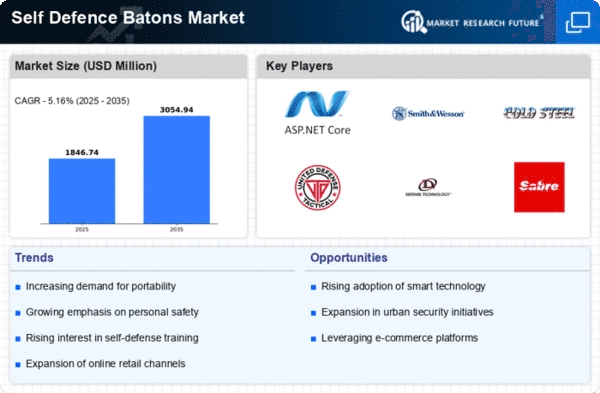
As per MRFR analysis, the Self Defence Batons Market Size was estimated at 1756.12 USD Million in 2024. The Self Defence Batons industry is projected to grow from 1846.77 in 2025 to 3054.94 by 2035, exhibiting a compound annual growth rate (CAGR) of 5.16 during the forecast period 2025 - 2035.

Key Market Trends & Highlights

The Self Defence Batons Market is experiencing a dynamic shift towards non-lethal options and innovative designs.

  • The demand for non-lethal self-defense options is rising, particularly in North America, which remains the largest market.
  • Product innovation is increasingly emphasized, with a notable focus on materials such as aluminum and steel.
  • Asia-Pacific is emerging as the fastest-growing region, driven by a heightened awareness of personal safety.
  • Key market drivers include the growing awareness of personal safety and the rising incidents of violence, which are shaping consumer preferences.

Market Size & Forecast

2024 Market Size 1756.12 (USD Million)
2035 Market Size 3054.94 (USD Million)
CAGR (2025 - 2035) 5.16%

Major Players

ASP Inc (US), Smith & Wesson (US), Cold Steel (US), United Tactical Systems (US), Defense Technology (US), Sabre (US), Blackhawk (US), Mace Brand (US)

Our Impact
Enabled $4.3B Revenue Impact for Fortune 500 and Leading Multinationals
Partnering with 2000+ Global Organizations Each Year
30K+ Citations by Top-Tier Firms in the Industry

Self Defence Batons Market Trends

defense

Self Defence Batons Market Drivers

Law Enforcement Adoption

The Global Self Defence Batons Market Industry benefits from the ongoing adoption of batons by law enforcement agencies worldwide. Police departments increasingly integrate batons into their standard equipment, recognizing their effectiveness in controlling situations without resorting to lethal force. This trend is particularly pronounced in countries where law enforcement agencies emphasize de-escalation tactics. For example, the introduction of training programs for officers on baton usage has led to a notable increase in their deployment. As a result, the market is expected to expand significantly, contributing to a projected growth to 2750 USD Million by 2035.

Technological Advancements

Technological advancements play a pivotal role in shaping the Global Self Defence Batons Market Industry. Innovations in materials and design enhance the functionality and durability of batons, making them more appealing to consumers. For instance, the introduction of lightweight yet robust materials allows for easier handling and increased effectiveness. Additionally, features such as built-in flashlights or ergonomic grips cater to modern consumer preferences. These advancements not only attract new users but also encourage existing users to upgrade their equipment. Consequently, the market is anticipated to grow at a CAGR of 7.43% from 2025 to 2035, driven by these technological improvements.

Rising Personal Safety Concerns

The Global Self Defence Batons Market Industry experiences growth driven by increasing personal safety concerns among individuals. As urban crime rates fluctuate, citizens seek effective self-defense tools to enhance their security. For instance, cities with higher crime statistics witness a surge in baton sales, as individuals prioritize personal safety. This trend is particularly evident in regions where violent crime rates have prompted local governments to encourage self-defense training. The market is projected to reach 1250 USD Million in 2024, reflecting a growing awareness of personal safety and the need for accessible self-defense options.

Regulatory Support and Legislation

Regulatory support and legislation surrounding self-defense tools significantly influence the Global Self Defence Batons Market Industry. Governments are increasingly recognizing the importance of self-defense rights, leading to favorable regulations that allow citizens to carry batons for personal protection. This shift in policy is particularly notable in regions where self-defense laws have been liberalized, enabling individuals to possess and use batons legally. As a result, the market is likely to see an uptick in sales as more individuals feel empowered to carry self-defense tools. This regulatory environment creates a conducive atmosphere for market growth.

Increased Awareness and Training Programs

The Global Self Defence Batons Market Industry is further propelled by increased awareness and training programs focused on self-defense. Educational institutions and community organizations are increasingly offering self-defense classes, which often include baton training as a key component. This rise in training initiatives fosters a culture of preparedness and self-reliance among individuals. As more people become educated about self-defense techniques, the demand for batons rises correspondingly. This trend is particularly evident in urban areas, where self-defense classes are gaining popularity. The growing participation in these programs indicates a robust market potential for self-defense batons.


Market Segment Insights

By Application: Personal Safety (Largest) vs. Self-Defense Training (Fastest-Growing)

In the Self Defence Batons Market, the distribution of market share demonstrates that Personal Safety is the largest segment, reflecting the high demand among individuals seeking personal protection in various environments. This segment resonates with consumers prioritizing safety and is supported by increasing awareness of self-defense options. Law Enforcement and Security Services closely follow in terms of market presence, but Personal Safety continues to dominate the landscape with a significant share. On the growth front, Self-Defense Training is emerging as the fastest-growing segment, driven by an increasing emphasis on self-protection and educational initiatives. The rise in personal safety concerns among the general public, coupled with the growing availability of self-defense courses, has propelled this segment. Additionally, the integration of self-defense training in community programs further enhances its growth trajectory, indicating a shift towards proactivity in personal safety measures.

Law Enforcement (Dominant) vs. Security Services (Emerging)

Within the context of the Self Defence Batons Market, Law Enforcement serves as a dominant segment, largely driven by extensive government contracts and the essential role of batons in police work, contributing to public safety and law enforcement operations. Their usage aligns with strict regulations and training, which emphasize effective and safe deployment. In contrast, the Security Services segment is an emerging market, growing in response to increasing private security needs within various sectors, such as commercial and residential. This segment is characterized by a diverse range of applications including event security and personal protection services, showcasing a trend towards customized self-defense solutions bolstered by advancements in baton technology and training methodologies.

By Material: Aluminum (Largest) vs. Steel (Fastest-Growing)

The Self Defence Batons Market is characterized by a diverse material composition, with aluminum and steel dominating the landscape. Aluminum batons are widely adopted for their lightweight and portability, providing a significant share in the market. Steel batons, known for their durability and strength, are also gaining traction, particularly among law enforcement and security personnel seeking reliable options. Meanwhile, polymer and composite materials are emerging players, contributing to the growing variety of available self-defense options for consumers.

Aluminum: Lightweight (Dominant) vs. Steel: Strength (Emerging)

Aluminum batons are prized for their lightweight nature, making them ideal for everyday carry while also ensuring comfort during use. Their affordability and resistance to corrosion contribute to their market dominance. In contrast, steel batons, known for their exceptional strength and durability, are considered essential tools for law enforcement officers and security professionals. Their heavier weight provides added force during self-defense situations, indicating their emerging role in the market. The combination of aluminum's portability and steel's robustness illustrates a complementary balance in the self-defense baton segment, catering to diverse consumer preferences.

By Length: Compact (Largest) vs. Extended (Fastest-Growing)

The Self Defence Batons Market exhibits distinct preferences for baton lengths, with the Compact segment commanding the largest share among consumers. Compact batons are favored for their ease of portability and discretion, appealing particularly to urban dwellers and individuals seeking effective personal safety solutions without sacrificing convenience. The Standard length, while still significant, trails behind due to its balance of size and usability, whereas Extended batons, although currently less popular, are rapidly gaining traction for their increased reach and striking power. Growing concerns over personal safety and self-defense have driven increased interest in longer batons, notably in the Extended category. As awareness of self-defense products rises, consumer preference is shifting towards options that offer enhanced performance and versatility. The emergence of advanced materials and designs is further boosting the appeal of Extended batons, positioning them as essential tools for those seeking effective self-defense measures without compromising on accessibility and ease of use.

Compact: Dominant vs. Extended: Emerging

The Compact segment of the Self Defence Batons Market remains dominant due to its popularity among consumers who prioritize portability and discretion in personal safety tools. Compact batons are typically lightweight, easily fitting in bags or pockets, making them a practical choice for everyday carry. Their design often combines utility with a subtle appearance, ensuring that they can be carried without drawing unwanted attention. On the other hand, the Extended segment is classified as emerging, capturing the attention of consumers looking for enhanced defensive capabilities. Extended batons offer greater reach and striking force, making them appealing for individuals who are particularly concerned about personal security in various environments. As consumer awareness about the effectiveness and versatility of longer batons continues to grow, the Extended segment is poised for rapid growth in the coming years.

By Type: Expandable (Largest) vs. Fixed (Fastest-Growing)

In the self-defense batons market, the distribution of market share among the segment values reveals that expandable batons hold the largest market share. These batons are popular for their compact design and ease of use, making them a preferred choice among consumers seeking effective self-defense tools. Fixed batons, while not as widespread as expandables, are witnessing a significant rise in demand due to their robustness and reliability, appealing to both law enforcement and personal protection users.

Expandable: Dominant vs. Fixed: Emerging

Expandable batons are recognized for their versatility and portability, making them the dominant choice for consumers who prioritize convenience and readiness in self-defense scenarios. Their ability to expand quickly provides users with an effective tool for immediate protection. On the other hand, fixed batons are emerging strongly in the market, favored for their solid construction and the perception of enhanced safety and control during use. This shift is partly driven by increased awareness of personal safety and by professionals in security sectors who prefer the reliability of fixed options in high-stress situations. The characteristics of these batons cater to varied consumer needs, shaping a competitive landscape.

By User Demographics: Adults (Largest) vs. Youth (Fastest-Growing)

In the Self Defence Batons Market, adults represent the largest demographic segment. This group encompasses individuals aged 18 and above, making them a primary target for personal safety products. The increasing awareness of personal safety concerns and self-defense has led to a robust demand among this group, contributing significantly to the market's overall share. Meanwhile, the youth demographic, encompassing those aged 12 to 17, is emerging as the fastest-growing segment. The trend is fueled by increasing youth engagement in self-defense training and a heightened awareness of personal safety.

Adults: Established (Dominant) vs. Youth: Engaged (Emerging)

The adult segment in the Self Defence Batons Market is characterized by a strong focus on practical self-defense solutions and personal safety. Adults tend to prioritize quality and reliability, often opting for batons that offer durability and ease of use. Additionally, marketing strategies targeting this demographic emphasize the importance of self-defense in everyday life. In contrast, the youth demographic is engaging rapidly with self-defense batons, driven by social media influence and public interest in self-defense techniques. Youths often lean towards products that feature modern designs and innovative functionalities, reflecting their unique preferences. This segment is becoming increasingly critical as it shapes future market trends.

Get more detailed insights about Self Defence Batons Market

Regional Insights

North America : Market Leader in Self Defence

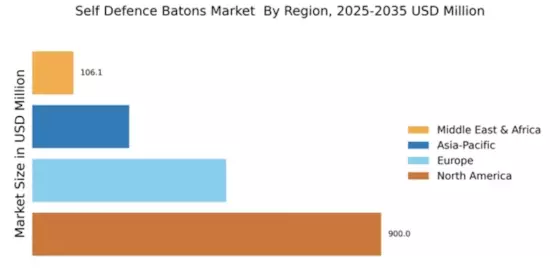
North America continues to lead the self defence batons market, holding a significant share of 900.0. The region's growth is driven by increasing concerns over personal safety, rising crime rates, and a growing acceptance of self-defence tools. Regulatory support for personal protection products further fuels demand, with various states enacting laws that favor the use of self-defence batons. This trend is expected to continue as consumers prioritize safety and security. The competitive landscape in North America is robust, featuring key players such as ASP Inc, Smith & Wesson, and Cold Steel. These companies are leveraging advanced technology and innovative designs to enhance product offerings. The presence of established brands and a strong distribution network contribute to the region's dominance. As the market evolves, companies are also focusing on compliance with local regulations to ensure product acceptance and consumer trust.

Europe : Growing Market with Regulations

Europe's self defence batons market is expanding, with a market size of 500.0. The growth is attributed to increasing awareness of personal safety and the implementation of regulations that support self-defence products. Countries like Germany and the UK are leading the charge, with laws that facilitate the legal use of self-defence batons. This regulatory environment encourages consumers to invest in personal safety tools, driving market demand. The competitive landscape in Europe features a mix of local and international players, with companies like Sabre and Mace Brand making significant inroads. The presence of diverse consumer preferences across countries necessitates tailored marketing strategies. As the market matures, companies are focusing on innovation and compliance with EU regulations to capture a larger share of the growing market.

Asia-Pacific : Emerging Market with Potential

The Asia-Pacific self defence batons market, valued at 250.0, is witnessing gradual growth driven by rising urbanization and increasing crime rates. Countries like Australia and Japan are seeing a surge in demand for personal safety products, including self-defence batons. The region's regulatory landscape is evolving, with governments beginning to recognize the importance of personal safety tools, which is expected to further stimulate market growth. The competitive environment in Asia-Pacific is characterized by a mix of local manufacturers and international brands. Companies are focusing on affordability and accessibility to cater to a diverse consumer base. As awareness of personal safety increases, the presence of key players is expected to expand, leading to a more competitive market landscape in the coming years.

Middle East and Africa : Developing Market with Challenges

The Middle East and Africa self defence batons market, with a size of 106.12, faces unique challenges, including regulatory hurdles and varying consumer perceptions of self-defence products. However, the growing concern over personal safety and security is driving demand for self-defence batons. Countries like South Africa are witnessing an increase in crime rates, prompting consumers to seek personal protection tools, which is expected to boost market growth in the region. The competitive landscape is still developing, with a limited number of key players operating in the market. Local manufacturers are beginning to emerge, but international brands are also looking to penetrate this market. As awareness of personal safety increases, the market is likely to see more entrants, leading to a more dynamic competitive environment.

Self Defence Batons Market  Regional Image

Key Players and Competitive Insights

The Self Defence Batons Market is currently characterized by a competitive landscape that is both dynamic and multifaceted. Key growth drivers include increasing concerns over personal safety, rising crime rates, and a growing awareness of self-defense tools among the general populace. Major players such as ASP Inc (US), Smith & Wesson (US), and Cold Steel (US) are strategically positioned to leverage these trends. ASP Inc (US) focuses on innovation, particularly in the development of lightweight and durable materials for their batons, while Smith & Wesson (US) emphasizes brand recognition and a broad product range. Cold Steel (US) appears to be concentrating on expanding its market presence through aggressive marketing strategies and partnerships, collectively shaping a competitive environment that is increasingly reliant on product differentiation and brand loyalty.In terms of business tactics, companies are localizing manufacturing to reduce costs and enhance supply chain efficiency. The market structure is moderately fragmented, with several key players holding substantial market shares. This fragmentation allows for a variety of product offerings, catering to diverse consumer preferences. The collective influence of these key players is significant, as they drive innovation and set industry standards, thereby shaping consumer expectations and competitive dynamics.

In November ASP Inc (US) announced the launch of a new line of batons made from advanced composite materials, which are touted to be 30% lighter than traditional models. This strategic move not only enhances their product offering but also positions them as a leader in innovation within the market. The introduction of these batons is likely to attract a broader customer base, particularly among law enforcement and security personnel who prioritize lightweight equipment.

In October Smith & Wesson (US) expanded its distribution network by partnering with several online retailers, aiming to increase accessibility for consumers. This strategic action is significant as it reflects a shift towards e-commerce, allowing the company to tap into a growing segment of online shoppers. By enhancing their distribution channels, Smith & Wesson (US) is likely to improve its market penetration and brand visibility.

In September Cold Steel (US) entered into a strategic alliance with a leading outdoor gear retailer to co-develop a new line of tactical batons. This collaboration is indicative of a trend towards partnerships that leverage complementary strengths, potentially enhancing product innovation and market reach. Such alliances may also facilitate shared marketing efforts, thereby amplifying brand exposure and consumer engagement.

As of December current competitive trends in the Self Defence Batons Market include a pronounced focus on digitalization, sustainability, and the integration of AI technologies in product development. Strategic alliances are increasingly shaping the landscape, allowing companies to pool resources and expertise. Looking ahead, competitive differentiation is expected to evolve, with a shift from price-based competition to a greater emphasis on innovation, technological advancements, and supply chain reliability. This transition suggests that companies that prioritize these aspects will likely gain a competitive edge in an ever-evolving market.

Key Companies in the Self Defence Batons Market include

Industry Developments

Recent news developments in the  Self Defence Batons Market indicate a growing emphasis on safety and security, driving demand for effective self-defense tools. Companies like Fox Knives and Walther have been introducing innovative designs and materials, catering to consumers seeking lightweight yet durable options.

The rise in urban crime rates and the increased awareness of personal safety contribute significantly to the market's growth. Defense Technology and Blackhawk are expanding their product lines by incorporating technology into batons, enhancing usability for law enforcement and civilian users. Furthermore, mergers and acquisitions are shaping the landscape, with companies like ASP and Taser International exploring partnerships to broaden their product offerings and market reach. This consolidation trend is likely to result in improved research and development capabilities, further enhancing the market's value.

A recent surge in investments in manufacturing and distribution channels indicates a positive outlook for the self-defense baton industry, as brands like Cold Steel and Smith & Wesson continue to focus on expanding their market presence ly.

Overall, these developments underscore the dynamic nature of the market and its responsiveness to consumer needs and safety concerns.

Future Outlook

Self Defence Batons Market Future Outlook

The Self Defence Batons Market is projected to grow at a 5.16% CAGR from 2025 to 2035, driven by increasing safety concerns and demand for personal protection.

New opportunities lie in:

  • Expansion into e-commerce platforms for direct consumer sales.
  • Development of smart batons with integrated safety features.
  • Partnerships with law enforcement agencies for bulk procurement.

By 2035, the market is expected to solidify its position as a key player in personal safety solutions.

Market Segmentation

Self Defence Batons Market Type Outlook

  • Expandable
  • Fixed
  • Collapsible

Self Defence Batons Market Length Outlook

  • Compact
  • Standard
  • Extended

Self Defence Batons Market Material Outlook

  • Aluminum
  • Steel
  • Polymer
  • Composite

Self Defence Batons Market Application Outlook

  • Personal Safety
  • Law Enforcement
  • Security Services
  • Self-Defense Training

Self Defence Batons Market User Demographics Outlook

  • Adults
  • Youth
  • Professionals

Report Scope

MARKET SIZE 20241756.12(USD Million)
MARKET SIZE 20251846.77(USD Million)
MARKET SIZE 20353054.94(USD Million)
COMPOUND ANNUAL GROWTH RATE (CAGR)5.16% (2025 - 2035)
REPORT COVERAGERevenue Forecast, Competitive Landscape, Growth Factors, and Trends
BASE YEAR2024
Market Forecast Period2025 - 2035
Historical Data2019 - 2024
Market Forecast UnitsUSD Million
Key Companies ProfiledASP Inc (US), Smith & Wesson (US), Cold Steel (US), United Tactical Systems (US), Defense Technology (US), Sabre (US), Blackhawk (US), Mace Brand (US)
Segments CoveredApplication, Material, Length, Type, User Demographics
Key Market OpportunitiesGrowing consumer awareness of personal safety drives demand in the Self Defence Batons Market.
Key Market DynamicsRising consumer awareness of personal safety drives demand for self defence batons amid evolving regulatory landscapes.
Countries CoveredNorth America, Europe, APAC, South America, MEA
Leave a Comment

FAQs

What is the expected market size of the Self Defence Batons Market by 2034 ?

The Self Defence Batons Market is expected to be valued at 2.90 USD Billion by 2034.

What is the projected CAGR for the Self Defence Batons Market from 2025 to 2034?

The Self Defence Batons Market is expected to grow at a CAGR of 5.16% from 2025 to 2034.

Which region is anticipated to dominate the Self Defence Batons Market by 2032?

North America is expected to dominate the Self Defence Batons Market with a value of 0.8 USD Billion by 2032.

What is the market value for the Personal Protection segment in the Self Defence Batons Market by 2034?

The Personal Protection segment is anticipated to be valued at 1.15 USD Billion in the Self Defence Batons Market by 2034.

What is the expected market value for the Law Enforcement segment by 2034?

The Law Enforcement segment is expected to reach a value of 0.94 USD Billion in the Self Defence Batons Market by 2034.

Who are the key players in the Self Defence Batons Market?

Key players in the market include Fox Knives, Walther, Sabre, Baton Defense, and Smith Wesson among others.

What is the market size for the Military segment of the Self Defence Batons Market in 2034?

The Military segment is projected to be valued at 0.41 USD Billion in the Self Defence Batons Market by 2034.

What is the anticipated market value for Europe in the Self Defence Batons Market by 2034?

The European region is expected to have a market value of 0.55 USD Billion in the Self Defence Batons Market by 2034.

What growth rate can be expected for the APAC region in the Self Defence Batons Market by 2034?

The APAC region is expected to be valued at 0.65 USD Billion in the Self Defence Batons Market by 2034.

What is the projected market size for South America in the Self Defence Batons Market by 2032?

South America is anticipated to reach a value of 0.3 USD Billion in the Self Defence Batons Market by 2032.

Download Free Sample

Kindly complete the form below to receive a free sample of this Report

Compare Licence

×
Features License Type
Single User Multiuser License Enterprise User
Price $4,950 $5,950 $7,250
Maximum User Access Limit 1 User Upto 10 Users Unrestricted Access Throughout the Organization
Free Customization
Direct Access to Analyst
Deliverable Format
Platform Access
Discount on Next Purchase 10% 15% 15%
Printable Versions