×
Request Free Sample ×

Kindly complete the form below to receive a free sample of this Report

* Please use a valid business email

Leading companies partner with us for data-driven Insights

clients tt-cursor
Hero Background

Scleral Lenses Market

ID: MRFR/HC/17657-HCR
128 Pages
Rahul Gotadki
February 2026

Scleral Lenses Market Research Report Information By Type (Corneo-Scleral Lenses and Semi-Scleral Lenses, Mini-Scleral Lenses, and Full Scleral Lenses), By Application (Irregular Cornea, Ocular Surface Disease, Refractive Error, and Other Applications), By End User (Hospitals, Eye Clinics, and Other End Users), And By Region (North America, Europe, Asia-Pacific, And Rest of The World) –Market Forecast Till 2035

Share:
Download PDF ×

We do not share your information with anyone. However, we may send you emails based on your report interest from time to time. You may contact us at any time to opt-out.

Scleral Lenses Market Infographic
Purchase Options

Scleral Lenses Market Summary

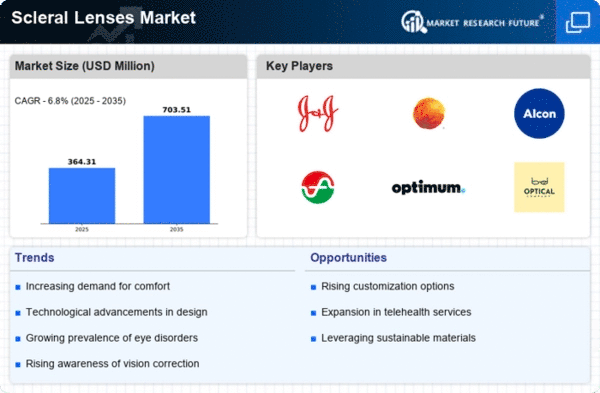
As per MRFR analysis, the Scleral Lenses Market Size was estimated at 341.11 USD Million in 2024. The Scleral Lenses industry is projected to grow from 364.31 USD Million in 2025 to 703.51 USD Million by 2035, exhibiting a compound annual growth rate (CAGR) of 6.8 during the forecast period 2025 - 2035.

Key Market Trends & Highlights

The Scleral Lenses Market is poised for substantial growth driven by technological advancements and increasing awareness.

  • North America remains the largest market for scleral lenses, driven by a well-established healthcare infrastructure.
  • The Asia-Pacific region is emerging as the fastest-growing market, reflecting a rising demand for advanced eye care solutions.
  • The therapeutic segment dominates the market, while the cosmetic segment is experiencing rapid growth due to changing consumer preferences.
  • Technological innovations in scleral lenses and the increasing prevalence of eye disorders are key drivers propelling market expansion.

Market Size & Forecast

2024 Market Size 341.11 (USD Million)
2035 Market Size 703.51 (USD Million)
CAGR (2025 - 2035) 6.8%

Major Players

Bausch + Lomb (US), Johnson & Johnson (US), CooperVision (US), Alcon (CH), Menicon (JP), Optimum (US), Art Optical (US), Scleral Lens Education Society (US)

Our Impact
Enabled $4.3B Revenue Impact for Fortune 500 and Leading Multinationals
Partnering with 2000+ Global Organizations Each Year
30K+ Citations by Top-Tier Firms in the Industry

Scleral Lenses Market Trends

The Scleral Lenses Market is currently experiencing a notable transformation, driven by advancements in technology and an increasing awareness of the benefits these lenses offer. Scleral lenses, which are larger than traditional contact lenses, provide enhanced comfort and vision correction for individuals with irregular corneas or severe dry eye conditions. As the demand for customized vision solutions rises, manufacturers are focusing on developing innovative designs and materials that cater to diverse patient needs. This shift is likely to foster a more competitive landscape, encouraging companies to invest in research and development to enhance product offerings.

Moreover, the growing prevalence of eye disorders and the aging population are contributing to the expansion of the Scleral Lenses Market. Healthcare professionals are increasingly recommending these lenses as a viable option for patients who have not found success with conventional lenses. This trend suggests a potential increase in patient education initiatives aimed at informing individuals about the advantages of scleral lenses. As awareness continues to spread, the market may witness a surge in adoption rates, further solidifying the role of scleral lenses in modern optometry practices.

Technological Advancements

Recent innovations in lens manufacturing techniques and materials are enhancing the performance and comfort of scleral lenses. These advancements allow for better customization, enabling practitioners to tailor lenses to individual patient needs more effectively.

Rising Awareness

There is a growing recognition among both patients and healthcare providers regarding the benefits of scleral lenses. This heightened awareness is likely to drive demand, as more individuals seek solutions for complex vision issues.

Aging Population

The increasing number of elderly individuals globally is contributing to a higher prevalence of eye conditions that necessitate specialized vision correction. This demographic shift is expected to bolster the Scleral Lenses Market as more seniors require effective visual aids.

Scleral Lenses Market Drivers

Market Growth Projections

The Global Scleral Lenses Market Industry is projected to experience substantial growth over the next decade. With an estimated market value of 0.34 USD Billion in 2024, it is anticipated to reach 0.7 USD Billion by 2035. This growth trajectory suggests a compound annual growth rate of 6.85% from 2025 to 2035, reflecting the increasing adoption of scleral lenses across various demographics. The market dynamics indicate a robust demand for innovative and effective vision correction solutions, positioning scleral lenses as a key player in the optical industry.

Growing Geriatric Population

The aging population globally is a crucial driver for the Global Scleral Lenses Market Industry. As individuals age, they often experience various eye-related issues, including presbyopia and other refractive errors. Scleral lenses offer a viable solution for older adults who may struggle with traditional contact lenses or glasses. The increasing number of elderly individuals is expected to contribute to the market's expansion, as more seniors seek effective vision correction options. This demographic shift is likely to sustain a compound annual growth rate of 6.85% from 2025 to 2035.

Enhanced Comfort and Vision Quality

Scleral lenses are recognized for their ability to provide enhanced comfort and superior vision quality compared to traditional lenses. This characteristic is particularly appealing to individuals with irregular corneas or other complex eye conditions. The Global Scleral Lenses Market Industry benefits from this trend, as patients increasingly seek solutions that offer both comfort and clarity. As more individuals experience the advantages of scleral lenses, the market is expected to expand, driven by the demand for high-quality vision correction solutions.

Increasing Prevalence of Eye Disorders

The Global Scleral Lenses Market Industry is witnessing growth due to the rising incidence of eye disorders such as keratoconus and severe dry eye syndrome. These conditions often necessitate specialized vision correction solutions, with scleral lenses emerging as a preferred option. The demand for scleral lenses is expected to rise as more individuals seek effective treatments for these debilitating conditions. In 2024, the market is projected to reach 0.34 USD Billion, reflecting a growing awareness and acceptance of scleral lenses among both patients and healthcare providers.

Technological Advancements in Lens Design

Innovations in lens design and manufacturing processes are propelling the Global Scleral Lenses Market Industry forward. Advances in materials and digital manufacturing techniques have led to the development of more comfortable, durable, and customizable scleral lenses. These improvements not only enhance patient satisfaction but also expand the range of conditions that can be effectively treated with scleral lenses. As a result, the market is likely to experience significant growth, with projections indicating a rise to 0.7 USD Billion by 2035, driven by these technological enhancements.

Rising Awareness and Acceptance of Specialty Lenses

There is a notable increase in awareness and acceptance of specialty lenses, including scleral lenses, within the Global Scleral Lenses Market Industry. Educational initiatives by healthcare professionals and organizations have played a pivotal role in informing patients about the benefits of scleral lenses. This growing awareness is likely to lead to higher adoption rates, as patients become more informed about their options for vision correction. Consequently, the market is poised for growth, with an anticipated increase in demand for scleral lenses in the coming years.


Market Segment Insights

By Application: Therapeutic (Largest) vs. Cosmetic (Fastest-Growing)

The Scleral Lenses Market features distinct application segments, with the therapeutic segment holding the largest share. This dominance is due to the increasing prevalence of eye conditions such as keratoconus and dry eye syndrome that require specialized lenses for effective vision correction and comfort. Conversely, the cosmetic segment is gaining traction, offering innovative designs that enhance aesthetic appeal and enabling individuals to change their eye color or pattern, thus capturing the interest of a broader audience. The growth trends within this segment reveal that while therapeutic applications are essential for patients with specific medical needs, the popularity of cosmetic scleral lenses is surging. This trend is driven by a growing awareness of fashion in eye care and the increasing influence of social media. Consumers are investing in lenses that not only improve vision but also allow for self-expression, leading to a robust expansion in the cosmetic segment.

Therapeutic: Dominant vs. Cosmetic: Emerging

The therapeutic application stands as the dominant player within the Scleral Lenses Market, primarily due to its critical role in treating vision-related medical conditions. This segment includes products designed to alleviate symptoms associated with severe eye disorders, offering functional and comfort benefits to users. On the other hand, the cosmetic application is emerging as a significant force, appealing to a younger, trend-savvy demographic. These lenses are crafted not only for vision correction but also for style enhancement, filling a niche for cosmetic alterations. As both segments continue to evolve, they reflect the dual demands for medical necessity and aesthetic appeal in the marketplace.

By Material Type: Silicone Hydrogel (Largest) vs. Gas Permeable (Fastest-Growing)

In the Scleral Lenses Market, the material type segments exhibit a diverse distribution of market share. Silicone Hydrogel is recognized as the largest segment, driven by its comfort and oxygen permeability, making it a preferred choice for many wearers. Gas Permeable lenses, while not the largest segment, are rapidly gaining traction due to their superior vision quality and continued innovations in materials and designs. Hydrogel and PMMA materials are comparatively smaller but play important roles in specific user demographics. Growth trends in this market are influenced by increasing consumer awareness regarding eye health and advancements in lens technology. Silicone Hydrogel has shown robust demand growth, thanks to its enhanced comfort and moisture retention capabilities. Meanwhile, Gas Permeable lenses are seen as the fastest-growing segment due to their effectiveness for astigmatism and irregular corneas, attracting those seeking corrective options. Overall, the material type segment is poised for continued expansion driven by innovation and heightened regulatory focus on eye care products.

Silicone Hydrogel (Dominant) vs. Gas Permeable (Emerging)

Silicone Hydrogel lenses are established as the dominant material type in the Scleral Lenses Market, characterized by excellent oxygen permeability and comfort. These lenses are designed to minimize dryness and irritation, offering an appealing option for extended wear, which drives their popularity among users. Conversely, Gas Permeable lenses represent an emerging segment, gaining momentum due to their superior vision quality and customizability. They are particularly advantageous for patients with astigmatism or other corneal issues. Innovations in gas permeable materials are enhancing user experience and contributing to their growth. Both segments cater to distinct consumer needs and preferences, showcasing the market's diversity in fulfilling various vision correction requirements.

By Design Type: Standard Scleral Lenses (Largest) vs. Mini Scleral Lenses (Fastest-Growing)

The Scleral Lenses Market is witnessing a diverse distribution in design types, with Standard Scleral Lenses commanding the largest share. These lenses are favored for their versatility, providing effective solutions for various ocular conditions and preferences. Mini Scleral Lenses, although lower in overall market share compared to Standard options, are rapidly gaining traction in the market due to their ease of use and suitability for patients with specific needs. Their growing adoption contributes significantly to the segment. In terms of growth trends, Mini Scleral Lenses have been identified as the fastest-growing segment, driven by advancements in manufacturing technologies and patient-centric design innovations. As awareness regarding the benefits of specialty lenses increases, both Standard and Mini Scleral Lenses are set to benefit. Factors such as rising incidences of corneal irregularities and increased awareness about eye care also drive the demand for these designs, reinforcing their market presence in upcoming years.

Standard Scleral Lenses (Dominant) vs. Custom Scleral Lenses (Emerging)

Standard Scleral Lenses are characterized by their broad applicability and high level of acceptance among eye care professionals. They are designed to support a wide variety of patients suffering from conditions like keratoconus and severe dry eye. Leveraging proven materials and established fitting techniques, these lenses maintain a dominant position in the market. In contrast, Custom Scleral Lenses are emerging as a tailored solution for patients with unique ocular needs, such as those requiring specific curvature or diameter adjustments. These lenses, though still niche, are gaining attention for their ability to provide highly personalized fit and comfort, creating a new opportunity for growth in the market. The increasing patient demand for customized solutions is expected to propel the Custom Scleral Lenses segment forward, particularly as technology evolves to support more intricate designs.

By End User: Hospitals (Largest) vs. Specialty Eye Care Centers (Fastest-Growing)

In the Scleral Lenses Market, the distribution among end user segments is clearly defined. Hospitals primarily lead this segment, capturing the largest portion of the market share due to their comprehensive resources and capabilities to handle complex eye conditions requiring scleral lenses. Optometry clinics and home care services also contribute to the market, but with less significant shares. Specialty eye care centers, however, have emerged as vital players by catering specifically to patients needing advanced ocular care, bolstering their presence in the market.

End User Dynamics: Hospitals (Dominant) vs. Specialty Eye Care Centers (Emerging)

Hospitals dominate the scleral lenses market due to their robust infrastructure and specialized staff capable of handling a wide range of ocular issues, making them the first choice for many patients requiring scleral lenses. They offer an integrated approach combining surgeries, immediate checks, and follow-ups, thus ensuring continuity of care. On the other hand, specialty eye care centers are rapidly emerging as key players, primarily focusing on personalized patient care and advanced fitting techniques for scleral lenses. Their growth is driven by an increasing number of patients with complex visual impairments who seek tailored solutions that hospitals may not provide, positioning them effectively within this niche market.

Get more detailed insights about Scleral Lenses Market

Regional Insights

North America : Market Leader in Scleral Lenses

North America is poised to maintain its leadership in the scleral lenses market, holding a significant share of 170.56 million in 2025. The growth is driven by increasing awareness of eye health, advancements in lens technology, and a rising prevalence of ocular conditions. Regulatory support from health authorities further catalyzes market expansion, ensuring safety and efficacy in lens production. The competitive landscape is robust, with key players like Bausch + Lomb, Johnson & Johnson, and CooperVision leading the charge. The U.S. remains the largest market, supported by a strong healthcare infrastructure and consumer demand for innovative vision correction solutions. The presence of organizations like the Scleral Lens Education Society enhances market dynamics by promoting education and awareness.

Europe : Emerging Market with Growth Potential

Europe's scleral lenses market is valued at 90.0 million, reflecting a growing demand driven by an aging population and increasing incidences of eye disorders. Regulatory frameworks in the EU are evolving to support innovative medical devices, which is expected to further boost market growth. The emphasis on patient-centered care and advancements in lens technology are key factors propelling this market forward. Leading countries such as Germany, France, and the UK are at the forefront of this growth, with a competitive landscape featuring major players like Alcon and Menicon. The presence of strong healthcare systems and a focus on research and development contribute to the market's expansion. As awareness of scleral lenses increases, more patients are opting for these advanced solutions for vision correction.

Asia-Pacific : Rapidly Growing Market Segment

The Asia-Pacific region is witnessing a burgeoning scleral lenses market, valued at 60.0 million. Factors such as rising disposable incomes, increasing awareness of eye health, and a growing elderly population are driving demand. Regulatory bodies are also becoming more supportive of innovative medical devices, which is expected to enhance market growth in the coming years. Countries like Japan, Australia, and China are leading the market, with a competitive landscape that includes key players such as Menicon and CooperVision. The region's diverse healthcare systems and increasing investments in eye care technology are pivotal in shaping the market. As more consumers seek effective vision correction solutions, the scleral lenses market is set for significant expansion.

Middle East and Africa : Emerging Market with Unique Challenges

The Middle East and Africa region's scleral lenses market is valued at 20.55 million, reflecting a nascent but growing segment. The market is driven by increasing awareness of eye health and the rising prevalence of vision-related issues. However, challenges such as limited access to advanced healthcare facilities and varying regulatory environments can hinder growth. Efforts to improve healthcare infrastructure are crucial for market expansion. Countries like South Africa and the UAE are leading the market, with a competitive landscape that includes both local and international players. The presence of organizations focused on eye health education is vital for increasing awareness and adoption of scleral lenses. As healthcare systems improve, the potential for market growth in this region is significant.

Key Players and Competitive Insights

The The Scleral Lenses Market is currently characterized by a dynamic competitive landscape, driven by increasing demand for specialized vision correction solutions and advancements in lens technology. Key players such as Bausch + Lomb (US), Johnson & Johnson (US), and CooperVision (US) are at the forefront, each adopting distinct strategies to enhance their market presence. Bausch + Lomb (US) focuses on innovation, particularly in developing advanced scleral lens designs that cater to complex ocular conditions. Meanwhile, Johnson & Johnson (US) emphasizes regional expansion, leveraging its extensive distribution network to penetrate emerging markets. CooperVision (US) appears to prioritize partnerships with eye care professionals to foster education and awareness about scleral lenses, thereby shaping a more informed consumer base.
The business tactics employed by these companies reflect a moderately fragmented market structure, where localized manufacturing and supply chain optimization are becoming increasingly vital. The collective influence of these key players is significant, as they not only drive technological advancements but also set industry standards that smaller competitors must follow. This competitive environment encourages innovation while also fostering collaboration among companies to address shared challenges in the market.
In November 2025, Bausch + Lomb (US) announced the launch of a new line of custom scleral lenses designed specifically for patients with irregular corneas. This strategic move is likely to enhance their product portfolio and cater to a niche market segment, potentially increasing their market share. The introduction of these lenses underscores the company's commitment to addressing complex ocular needs, which may further solidify its position as a leader in the industry.
In October 2025, Johnson & Johnson (US) expanded its manufacturing capabilities in Asia, aiming to streamline production and reduce lead times for scleral lenses. This expansion is strategically important as it not only enhances operational efficiency but also positions the company to better serve the growing demand in the Asia-Pacific region. By localizing production, Johnson & Johnson (US) may improve its responsiveness to market changes and customer needs, thereby gaining a competitive edge.
In September 2025, CooperVision (US) entered into a partnership with a leading eye care clinic to provide training and resources for eye care professionals on the benefits of scleral lenses. This initiative is indicative of the company's strategy to enhance awareness and education surrounding scleral lenses, which could lead to increased adoption rates among patients. By fostering relationships with healthcare providers, CooperVision (US) is likely to strengthen its market position and drive future growth.
As of December 2025, the Scleral Lenses Market is witnessing trends such as digitalization, sustainability, and the integration of AI technologies. These trends are reshaping competitive dynamics, with companies increasingly focusing on strategic alliances to enhance their capabilities. The shift from price-based competition to a focus on innovation, technology, and supply chain reliability is evident. Moving forward, competitive differentiation will likely hinge on the ability to leverage these trends effectively, ensuring that companies remain agile and responsive to evolving consumer demands.

Key Companies in the Scleral Lenses Market include

Industry Developments

  • Q2 2024: Bausch + Lomb Launches Zenlens Scleral Contact Lenses in Europe Bausch + Lomb announced the European launch of its Zenlens scleral contact lenses, expanding its specialty lens portfolio to address the needs of patients with irregular corneas and ocular surface disease.
  • Q2 2024: CooperVision Specialty EyeCare Expands Paragon CRT and Scleral Lens Manufacturing Facility in Arizona CooperVision Specialty EyeCare completed an expansion of its manufacturing facility in Arizona to increase production capacity for Paragon CRT and scleral lenses, supporting growing demand in North America and international markets.
  • Q3 2024: FDA Grants 510(k) Clearance to BostonSight SCLERAL Multifocal Scleral Lens BostonSight received 510(k) clearance from the U.S. FDA for its BostonSight SCLERAL Multifocal lens, enabling broader clinical use for patients with presbyopia and irregular corneas.
  • Q3 2024: SynergEyes Appoints New CEO to Drive Growth in Scleral and Hybrid Lens Segments SynergEyes announced the appointment of a new Chief Executive Officer, aiming to accelerate innovation and market expansion in the scleral and hybrid contact lens categories.
  • Q4 2024: AccuLens Partners with Eaglet Eye to Integrate Profilometry Data for Custom Scleral Lens Design AccuLens entered a partnership with Eaglet Eye to integrate profilometry data into its custom scleral lens design process, enhancing precision and fit for patients with complex corneal conditions.
  • Q4 2024: Art Optical Receives CE Mark for Ampleye Scleral Lens in Europe Art Optical announced it has received CE Mark approval for its Ampleye scleral lens, allowing the company to market and distribute the product across the European Union.
  • Q1 2025: Visionary Optics Launches Latitude Custom Scleral Lens Platform Visionary Optics launched its Latitude platform, a new custom scleral lens solution designed to provide improved comfort and vision for patients with irregular corneas.
  • Q1 2025: Menicon Announces Strategic Partnership with Topcon for Scleral Lens Fitting Technology Menicon entered a strategic partnership with Topcon to co-develop advanced scleral lens fitting technology, aiming to streamline the fitting process and improve patient outcomes.
  • Q2 2025: FDA Approves New Material for Scleral Lenses Market by Contamac Contamac received FDA approval for a new high-oxygen-permeable material for use in scleral lenses, supporting longer wear times and improved ocular health.
  • Q2 2025: EssilorLuxottica Acquires Specialty Contact Lens Manufacturer SpecialEyes EssilorLuxottica completed the acquisition of SpecialEyes, a U.S.-based manufacturer specializing in custom and scleral contact lenses, to strengthen its position in the specialty lens market.

Future Outlook

Scleral Lenses Market Future Outlook

The Scleral Lenses Market is projected to grow at a 6.8% CAGR from 2025 to 2035, driven by increasing prevalence of ocular conditions and technological advancements.

New opportunities lie in:

  • Expansion of telehealth services for remote fittings
  • Development of customizable scleral lens designs
  • Partnerships with eye care professionals for patient education

By 2035, the market is expected to achieve substantial growth, solidifying its position in the ophthalmic sector.

Market Segmentation

Scleral Lenses Market End User Outlook

  • Hospitals
  • Optometry Clinics
  • Specialty Eye Care Centers
  • Home Care

Scleral Lenses Market Application Outlook

  • Therapeutic
  • Cosmetic
  • Refractive
  • Prosthetic

Scleral Lenses Market Design Type Outlook

  • Standard Scleral Lenses
  • Mini Scleral Lenses
  • Large Scleral Lenses
  • Custom Scleral Lenses

Scleral Lenses Market Material Type Outlook

  • Gas Permeable
  • Hydrogel
  • Silicone Hydrogel
  • PMMA

Report Scope

MARKET SIZE 2024 341.11(USD Million)
MARKET SIZE 2025 364.31(USD Million)
MARKET SIZE 2035 703.51(USD Million)
COMPOUND ANNUAL GROWTH RATE (CAGR) 6.8% (2025 - 2035)
REPORT COVERAGE Revenue Forecast, Competitive Landscape, Growth Factors, and Trends
BASE YEAR 2024
Market Forecast Period 2025 - 2035
Historical Data 2019 - 2024
Market Forecast Units USD Million
Key Companies Profiled Bausch + Lomb (US), Johnson & Johnson (US), CooperVision (US), Alcon (CH), Menicon (JP), Optimum (US), Art Optical (US), Scleral Lens Education Society (US)
Segments Covered Application, Material Type, Design Type, End User
Key Market Opportunities Advancements in custom scleral lens technology enhance comfort and vision correction for diverse patient needs.
Key Market Dynamics Rising demand for customized scleral lenses drives innovation and competition among manufacturers in the market.
Countries Covered North America, Europe, APAC, South America, MEA
Leave a Comment

FAQs

What is the projected growth of the Scleral Lenses market?

The Scleral Lenses market is the expected increase in total market value of 0.7 USD billion over a defined forecast period 2025–2035. It is driven by factors such as demand trends, technological advances, regulatory changes, and geographic expansion.

What is the size of the Scleral Lenses market?

Scleral Lenses market size was valued at approximately 0.34 billion USD in 2024. This figure will reach 0.7 billion USD covering all regions (America, Europe, Asia, MEA and ROW), focusing its segments / services / distribution channels till 2035.

What is the CAGR of the Scleral Lenses market?

Scleral Lenses market is expected to grow at a CAGR of 6.8% between 2025 and 2035.

How much will the Scleral Lenses market be worth by 2035?

Scleral Lenses market is expected to be worth of 0.7 billion USD, reflecting growth driven by usage, technology and global demands by the end of 2035.

How will the Scleral Lenses market perform over the next 10 years?

Over the next 10 years the Scleral Lenses market is expected to shift from usd billion 0.34 to 0.7 billion USD, led by adoption of advanced tech, demographic trends, regulatory approvals, with potential headwinds from 2025 to 2035.

Which region held the largest market share in the Scleral Lenses Market?

North America had the largest share of the market

Download Free Sample

Kindly complete the form below to receive a free sample of this Report

Compare Licence

×
Features License Type
Single User Multiuser License Enterprise User
Price $4,950 $5,950 $7,250
Maximum User Access Limit 1 User Upto 10 Users Unrestricted Access Throughout the Organization
Free Customization
Direct Access to Analyst
Deliverable Format
Platform Access
Discount on Next Purchase 10% 15% 15%
Printable Versions