×
Request Free Sample ×

Kindly complete the form below to receive a free sample of this Report

* Please use a valid business email

Leading companies partner with us for data-driven Insights

clients tt-cursor
Hero Background
English
Chinese
French
Japanese
Korean
German
Spanish

Scale Inhibitors Market Analysis

ID: MRFR/CnM/4941-CR
151 Pages
Chitranshi Jaiswal
September 2018

Scale Inhibitors Market Research Report Information By Type (Phosphonates, Carboxylate/Acrylate, Sulfonates and Others), By Application (Power, Mining, Oil & Gas, Petrochemicals, Paper Mills and Others) - Forecast till 2035

Share:
Download PDF ×

We do not share your information with anyone. However, we may send you emails based on your report interest from time to time. You may contact us at any time to opt-out.

Scale Inhibitors Market Infographic
×
Scale Inhibitors Market Infographic Full View
Purchase Options

Market Analysis

In-depth Analysis of Scale Inhibitors Market Industry Landscape

Within chemical treatments for industrial processes particularly within the ambit of scale inhibitors market, there have been notable shifts and trends in recent years regarding its market dynamics. Scale inhibitors play an essential role in preventing scaling deposits formation across various industries such as oil & gas production, water treatment and manufacturing sector etc. The scale inhibitors market depends on several factors such as rise in demand for efficient production processes; strict environmental standards; technological advances etc.

One of main growth drivers behind scale inhibitor market is increasing demand from end-use sectors. In industries like oil & gas where production processes operate under high pressures and temperatures effective inhibiting scales are necessary to support the system efficiency. Similarly, water treatment industry relies heavily on scale inhibitors in order for pipelines and equipment not to be scaled due to availability clean water. This has contributed immensely to the growth of the scale inhibitors market as diverse industries demand for it.

Furthermore, strict environmental regulations on wastewater treatment and discharge have promoted the use of eco-friendly scale inhibitors. As sustainability becomes a focus in many industries, there is a preference for environmentally friendly scale inhibitors that are green and biodegradable instead of traditional chemical treatments. Consequently, this move to ecological solutions has resulted in innovative products that are highly effective in inhibiting scales while being safe for environment; thereby drastically impacting market behavior.

Additionally, technological advancements have played a significant role in shaping the scale inhibitors market. Continuous research and development efforts have led to the introduction of advanced formulations and application techniques that enhance the efficiency and performance of scale inhibitors. For instance, nanoscale inhibitors offer high efficacy at lower doses which leads to reduced environmental impact and hence overall costs for operations. Moreover, smart technologies integrated into monitoring and controlling systems for dosing scale inhibitors has made treatment processes more precise and efficient thus encouraging market expansion.

However, despite having favorable drivers such as industry dynamics related with regional markets or cost effectiveness associated with green alternatives along with increasing pace of industrialization across emerging countries among others; there are still some challenges within the industry concerning these areas. It’s worth noting that pricing pressures, fluctuating raw material prices as well as alternative methods for preventing scaling represent some hurdles faced by companies operating within this sector. In addition, various regions display different demand patterns or regulatory landscapes hence their strategies need adjustment accordingly.

Scale inhibitors market is a highly competitive landscape where both the established and emerging companies struggle to get an upper hand. Market players are involved in strategic activities such as mergers and acquisitions, partnerships and product development to enhance their position in the market. Working with end-users to customize products, as well as expanding distribution networks, are also important strategies employed by market players for greater market share.

Author
Chitranshi Jaiswal
Research Analyst Level I

In her 3 years of experience in the market research field, she has handled critical cross-domain projects. She has an in-depth knowledge of market estimation & analysis, problem-solving, primary as well as secondary research, and team management.She holds an engineering degree and is an MBA professional from a well-known university, capable of evaluating the market and competitive conditions. An exceptional strategist with excellent communication skills and a passion for delivering cutting-edge & practical insights for the market. Proficient in multi-tasking, and can successfully deal with competing demands, while maintaining complete confidentiality. Generated business through active client and project development, networking, and high-quality responses. Her knowledge and skills have helped in making solid business decisions, securing funding from investors, and avoiding business failures.

Leave a Comment

FAQs

What is the contribution of the application segment towards the market?

The application segments comprise certain areas like petrochemicals, mining, oil and gas sectors, paper mills units, and many more. The power application units cover a growth of CAGR of 4.67% in the upcoming years where a huge amount is spent on the development. The power segment has marked that it owns a CAGR of 26.67% in the overall scale inhibitors market during the market forecast period. These power sectors and the units owe to the escalating requirement for the treatment of wastewater. The oil and gas units occupy the second-largest growth because the government is investing much more in deepwater as well as in ultra-deepwater exploration activities especially in the South China Sea along with an increase in the availability of oil reserves along with the regions of the Gulf of Mexico.

What notes about the North American market?

The scale inhibitors market growth in the North American region occupies a significant growth due to the large exploration activities of shale gas. The market in the United States is said to be the most advanced market throughout the market region where it should retain its contribution during the assessment period. In some of the industries of power and construction, mining industry, oil, and gas industry contribute to large advancement activities are the major factors that steer up the scale inhibitors market growth and scale inhibitors market size.

How does the progress in the Middle East and African region take place?

It has been found that the Middle East and African region occupies a CAGR of 5.61% during the forecast period. Concerning the rise in demand for crude oil the growth of scale, types of research pieces, types of researchGange of researchGangeinhibitors are largely used in industries where it has been used in mining sectors, power treatment, water treatment which will bolster up the market size.

Market Summary

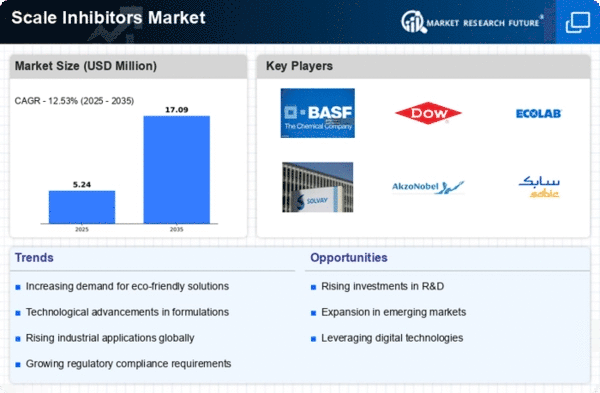
As per MRFR analysis, the Scale Inhibitors Market Size was estimated at 4.66 USD Million in 2024. The Scale Inhibitors industry is projected to grow from 5.25 in 2025 to 17.09 by 2035, exhibiting a compound annual growth rate (CAGR) of 12.53 during the forecast period 2025 - 2035.

Key Market Trends & Highlights

The Scale Inhibitors Market is poised for growth driven by sustainability and technological advancements.

  • North America remains the largest market for scale inhibitors, driven by increasing industrial activities and stringent regulatory frameworks.
  • The Asia-Pacific region is emerging as the fastest-growing market, fueled by rapid urbanization and industrial expansion.
  • The water treatment segment continues to dominate the market, while the oil and gas segment is witnessing the fastest growth due to rising energy demands.
  • Key market drivers include increasing water treatment needs and regulatory compliance, which are shaping the demand for effective scale inhibition solutions.

Market Size & Forecast

2024 Market Size 4.66 (USD Million)
2035 Market Size 17.09 (USD Million)
CAGR (2025 - 2035) 12.53%
Largest Regional Market Share in 2024 North America

Major Players

<p>BASF SE (DE), Dow Inc. (US), Ecolab Inc. (US), Solvay S.A. (BE), AkzoNobel N.V. (NL), SABIC (SA), Nalco Champion (US), GE Water & Process Technologies (US), Clariant AG (CH)</p>

Market Trends

The Scale Inhibitors Market is currently experiencing a notable transformation driven by various factors, including technological advancements and increasing industrial applications. The demand for effective scale management solutions is rising, particularly in sectors such as oil and gas, water treatment, and power generation. Companies are focusing on developing innovative formulations that enhance performance and reduce environmental impact. This shift towards sustainability is prompting manufacturers to explore eco-friendly alternatives, which may reshape product offerings in the near future. Furthermore, the growing awareness of the detrimental effects of scale formation on operational efficiency is likely to propel market growth, as industries seek to mitigate these challenges through advanced inhibitors. In addition, the Scale Inhibitors Market appears to be influenced by regulatory frameworks that emphasize environmental protection and resource conservation. As industries adapt to these regulations, there is a potential shift towards biodegradable and less toxic inhibitors. This trend may encourage collaboration between manufacturers and research institutions to develop cutting-edge solutions that align with sustainability goals. Overall, the Scale Inhibitors Market is poised for growth, driven by innovation, regulatory pressures, and a collective commitment to environmental stewardship.

Sustainability Focus

The emphasis on environmentally friendly solutions is becoming increasingly prominent in the Scale Inhibitors Market. Manufacturers are exploring biodegradable options and formulations that minimize ecological impact, responding to both regulatory demands and consumer preferences.

Technological Advancements

Innovations in formulation chemistry are driving the development of more effective scale inhibitors. Enhanced performance characteristics are being achieved through advanced technologies, which may lead to improved efficiency in various industrial applications.

Regulatory Influence

The Scale Inhibitors Market is being shaped by stringent regulations aimed at reducing environmental harm. Compliance with these regulations is pushing companies to adopt greener practices and invest in research for sustainable alternatives.

Scale Inhibitors Market Market Drivers

Increasing Industrial Demand

The Global Scale Inhibitors Market Industry experiences a surge in demand driven by various industrial sectors, particularly oil and gas, water treatment, and power generation. Industries are increasingly adopting scale inhibitors to enhance operational efficiency and reduce maintenance costs associated with scale formation. For instance, the oil and gas sector utilizes scale inhibitors to prevent mineral deposits in pipelines, which can lead to costly downtime. As of 2024, the market is valued at approximately 2.89 USD Billion, indicating a robust growth trajectory. This trend is expected to continue, with projections suggesting a market value of 4.13 USD Billion by 2035, reflecting a compound annual growth rate of 3.28% from 2025 to 2035.

Market Segment Insights

By Application: Water Treatment (Largest) vs. Oil and Gas (Fastest-Growing)

<p>The Scale Inhibitors Market is notably shaped by various application segments, with Water Treatment commanding the largest market share. This segment is primarily driven by the crucial need for effective scale prevention in municipal and industrial water systems. Following closely, the Oil and Gas sector presents significant opportunities and is on track to become the fastest-growing application, attributed to increasing offshore drilling activities and stringent regulations on water usage. As the industrial landscape evolves, the demand for scale inhibitors in Oil and Gas is expected to surge. Enhanced recovery techniques and advancements in hydraulic fracturing are accelerating this trend. Industrial Processes, Power Generation, and Mining also play vital roles in the market, but their growth remains comparatively steady, influenced by operational efficiencies and environmental compliance requirements.</p>

<p>Water Treatment (Dominant) vs. Mining (Emerging)</p>

<p>In the Scale Inhibitors Market, the Water Treatment segment stands as the dominant application, characterized by its extensive use in both municipal and industrial settings. This segment focuses on preventing mineral scale formation in water systems, ensuring operational efficiency and compliance with health standards. Meanwhile, the Mining sector emerges as a significant player, driven by the necessity to manage mineral deposits in water used for extraction processes. As companies increasingly prioritize sustainable practices, the demand for effective scale management in Mining is projected to grow, driven by innovations and environment-friendly solutions aimed at reducing water waste and maximizing resource recovery.</p>

By Type: Phosphate Scale Inhibitors (Largest) vs. Organic Scale Inhibitors (Fastest-Growing)

<p>The Scale Inhibitors Market is currently characterized by its diverse types, with Phosphate Scale Inhibitors commanding the largest market share among the various segment values. These inhibitors are widely used in various industrial applications and are crucial for preventing scale buildup. Following closely are Polymeric and Organic Scale Inhibitors, which also hold significant portions of the market. Inorganic Scale Inhibitors, while essential, occupy a smaller share compared to their counterparts. This distribution reflects varying applications and preferences across industries.</p>

<p>Phosphate Scale Inhibitors (Dominant) vs. Organic Scale Inhibitors (Emerging)</p>

<p>Phosphate Scale Inhibitors are recognized as the dominant type in the Scale Inhibitors Market, largely due to their effectiveness in preventing scale formation in water systems. They are favored in sectors like oil and gas, power generation, and water treatment. In contrast, Organic Scale Inhibitors, while still emerging, are rapidly gaining traction due to their biodegradable nature and enhanced performance in challenging environments. This segment is propelled by increasing environmental regulations and a shift towards sustainable solutions, making them attractive options for companies seeking to balance performance with ecological responsibility.</p>

By End Use Industry: Chemical Manufacturing (Largest) vs. Food and Beverage (Fastest-Growing)

<p>In the Scale Inhibitors Market, the distribution of market share among end use industries reveals that Chemical Manufacturing maintains a dominant position due to its extensive use of scale inhibitors to enhance production efficiency and minimize equipment failures. Following closely, Energy and Utilities also hold a significant share, owing to the necessity of maintaining operational integrity in water treatment processes. Meanwhile, industries like Mining and Metallurgy, and Pulp and Paper utilize scale inhibitors to optimize their processes, although they represent a smaller portion compared to the aforementioned sectors. Growth trends indicate that the Food and Beverage industry is emerging rapidly due to increasing demand for clean water and resource optimization in production processes. Additionally, regulatory measures aimed at reducing environmental impact are driving the adoption of scale inhibitors across industries. As sustainability becomes more critical, sectors like Energy and Utilities are likely to adapt more innovative scale management solutions, fostering growth in the overall market.</p>

<p>Chemical Manufacturing (Dominant) vs. Mining and Metallurgy (Emerging)</p>

<p>The Chemical Manufacturing industry is characterized by a high dependency on scale inhibitors to regulate mineral deposits and enhance the efficiency of chemical reactions. This sector benefits from a mature understanding of chemical processes, leading to robust demand for advanced scale inhibition solutions. In contrast, Mining and Metallurgy represents an emerging segment, where the integration of scale inhibitors is increasingly seen as vital to optimize operational processes and extend equipment life. With continuous advancements in extraction technologies, this sector is gradually recognizing the importance of employing scale inhibitors to mitigate challenges posed by scaling and fouling, which are common in mining operations. The transition towards greener and more efficient practices within Mining and Metallurgy is expected to broaden the scope of scale inhibitors in this segment.</p>

Get more detailed insights about Scale Inhibitors Market Research Report – Forecast to 2035

Regional Insights

North America : Market Leader in Scale Inhibitors

North America is poised to maintain its leadership in the Scale Inhibitors Market, holding a significant market share of 2.0 in 2024. The region's growth is driven by increasing industrial activities, stringent regulations on water treatment, and a rising demand for efficient water management solutions. The presence of major players and technological advancements further bolster market expansion. The United States stands out as the leading country, with key players like Dow Inc. and Ecolab Inc. driving innovation and competition. The competitive landscape is characterized by strategic partnerships and mergers, enhancing product offerings. The focus on sustainable practices and regulatory compliance is expected to shape the market dynamics in the coming years.

Europe : Emerging Market with Growth Potential

Europe is witnessing a growing demand for scale inhibitors, with a market size of 1.5 in 2024. The region's growth is fueled by increasing industrialization, stringent environmental regulations, and a focus on sustainable water management practices. The European Union's initiatives to promote water conservation and treatment technologies are significant catalysts for market expansion. Leading countries such as Germany, France, and the UK are at the forefront of this market, with key players like BASF SE and AkzoNobel N.V. enhancing their market presence. The competitive landscape is marked by innovation and collaboration among companies to develop advanced solutions. The emphasis on regulatory compliance and sustainability is expected to drive future growth in the region.

Asia-Pacific : Rapidly Growing Market Segment

Asia-Pacific is emerging as a significant player in the Scale Inhibitors Market, with a market size of 0.9 in 2024. The region's growth is driven by rapid industrialization, urbanization, and increasing investments in water treatment infrastructure. Governments are implementing regulations to improve water quality, which is further propelling demand for scale inhibitors. Countries like China and India are leading the market, with a growing number of local and international players entering the landscape. The competitive environment is characterized by a mix of established companies and new entrants, focusing on innovative solutions to meet the rising demand. The region's emphasis on sustainable practices and regulatory compliance is expected to shape its market dynamics in the future.

Middle East and Africa : Emerging Market with Challenges

The Middle East and Africa represent an emerging market for scale inhibitors, with a market size of 0.26 in 2024. The region faces challenges such as water scarcity and the need for efficient water management solutions, driving the demand for scale inhibitors. Government initiatives aimed at improving water quality and treatment processes are key growth drivers. Countries like South Africa and Saudi Arabia are leading the market, with a focus on enhancing water treatment facilities. The competitive landscape includes both local and international players, striving to address the unique challenges of the region. The emphasis on regulatory compliance and sustainable practices is expected to influence market dynamics in the coming years.

Key Players and Competitive Insights

The Scale Inhibitors Market is currently characterized by a competitive landscape that is both dynamic and multifaceted. Key growth drivers include the increasing demand for water treatment solutions across various industries, particularly in oil and gas, power generation, and manufacturing. Major players such as BASF SE (DE), Dow Inc. (US), and Ecolab Inc. (US) are strategically positioned to leverage their extensive product portfolios and technological innovations. BASF SE (DE) focuses on sustainable solutions, while Dow Inc. (US) emphasizes digital transformation and operational efficiency. Ecolab Inc. (US) is known for its strong emphasis on partnerships and customer-centric solutions, which collectively shape a competitive environment that is increasingly reliant on innovation and sustainability.

In terms of business tactics, companies are localizing manufacturing to enhance supply chain resilience and optimize costs. The market structure appears moderately fragmented, with several key players exerting considerable influence. This fragmentation allows for niche players to thrive, while larger corporations consolidate their market share through strategic acquisitions and partnerships. The collective influence of these key players fosters a competitive atmosphere where agility and responsiveness to market demands are paramount.

In November 2025, Ecolab Inc. (US) announced a strategic partnership with a leading technology firm to develop AI-driven solutions for water treatment processes. This move is significant as it underscores Ecolab's commitment to integrating advanced technologies into its offerings, potentially enhancing operational efficiencies and customer satisfaction. The partnership may also position Ecolab as a frontrunner in the digital transformation of the water treatment sector, aligning with current market trends.

In October 2025, BASF SE (DE) launched a new line of eco-friendly scale inhibitors aimed at reducing environmental impact while maintaining high performance. This initiative reflects BASF's strategic focus on sustainability, which is increasingly becoming a critical factor in customer decision-making. By prioritizing environmentally friendly products, BASF may strengthen its market position and appeal to a broader customer base that values sustainability.

In September 2025, Dow Inc. (US) expanded its manufacturing capabilities in Asia to meet the growing demand for scale inhibitors in the region. This expansion is indicative of Dow's strategy to enhance its supply chain efficiency and responsiveness to regional market needs. By localizing production, Dow could potentially reduce lead times and costs, thereby improving its competitive edge in the Asian market.

As of December 2025, current competitive trends in the Scale Inhibitors Market are heavily influenced by digitalization, sustainability, and the integration of AI technologies. Strategic alliances are increasingly shaping the landscape, allowing companies to pool resources and expertise to drive innovation. The competitive differentiation is likely to evolve from traditional price-based competition to a focus on technological advancements, sustainability, and supply chain reliability. This shift suggests that companies that prioritize innovation and customer-centric solutions will be better positioned to thrive in the future.

Key Companies in the Scale Inhibitors Market include

Industry Developments

May 2023:

 ScaleTek, a manufacturer of scale inhibitors, announced the acquisition of ScaleGuard, a competitor in the market. The acquisition is expected to strengthen ScaleTek's position in the market and expand its product offerings.

June 2023:

 ChemTreat, a provider of water treatment chemicals, announced the launch of its new scale inhibitor product, ChemTreat ScaleGuard Xtreme. The product is designed to be more effective than traditional scale inhibitors and to provide longer-lasting protection.

Future Outlook

Scale Inhibitors Market Future Outlook

<p>The Scale Inhibitors Market is projected to grow at a 12.53% CAGR from 2024 to 2035, driven by increasing industrial applications and stringent water quality regulations.</p>

New opportunities lie in:

  • <p>Development of eco-friendly scale inhibitors for sustainable industries.</p>
  • <p>Integration of IoT technology for real-time monitoring and control.</p>
  • <p>Expansion into emerging markets with tailored product offerings.</p>

<p>By 2035, the Scale Inhibitors Market is expected to achieve substantial growth and innovation.</p>

Market Segmentation

Scale Inhibitors Market Type Outlook

  • Phosphate Scale Inhibitors
  • Polymeric Scale Inhibitors
  • Organic Scale Inhibitors
  • Inorganic Scale Inhibitors

Scale Inhibitors Market Application Outlook

  • Water Treatment
  • Oil and Gas
  • Industrial Processes
  • Power Generation
  • Mining

Scale Inhibitors Market End Use Industry Outlook

  • Chemical Manufacturing
  • Energy and Utilities
  • Mining and Metallurgy
  • Pulp and Paper
  • Food and Beverage

Report Scope

MARKET SIZE 20244.66(USD Million)
MARKET SIZE 20255.25(USD Million)
MARKET SIZE 203517.09(USD Million)
COMPOUND ANNUAL GROWTH RATE (CAGR)12.53% (2024 - 2035)
REPORT COVERAGERevenue Forecast, Competitive Landscape, Growth Factors, and Trends
BASE YEAR2024
Market Forecast Period2025 - 2035
Historical Data2019 - 2024
Market Forecast UnitsUSD Million
Key Companies ProfiledBASF SE (DE), Dow Inc. (US), Ecolab Inc. (US), Solvay S.A. (BE), AkzoNobel N.V. (NL), SABIC (SA), Nalco Champion (US), GE Water & Process Technologies (US), Clariant AG (CH)
Segments CoveredApplication, Type, End Use Industry
Key Market OpportunitiesAdvancements in eco-friendly formulations drive growth in the Scale Inhibitors Market.
Key Market DynamicsRising demand for eco-friendly scale inhibitors drives innovation and regulatory compliance across various industries.
Countries CoveredNorth America, Europe, APAC, South America, MEA

FAQs

What is the contribution of the application segment towards the market?

The application segments comprise certain areas like petrochemicals, mining, oil and gas sectors, paper mills units, and many more. The power application units cover a growth of CAGR of 4.67% in the upcoming years where a huge amount is spent on the development. The power segment has marked that it owns a CAGR of 26.67% in the overall scale inhibitors market during the market forecast period. These power sectors and the units owe to the escalating requirement for the treatment of wastewater. The oil and gas units occupy the second-largest growth because the government is investing much more in deepwater as well as in ultra-deepwater exploration activities especially in the South China Sea along with an increase in the availability of oil reserves along with the regions of the Gulf of Mexico.

What notes about the North American market?

The scale inhibitors market growth in the North American region occupies a significant growth due to the large exploration activities of shale gas. The market in the United States is said to be the most advanced market throughout the market region where it should retain its contribution during the assessment period. In some of the industries of power and construction, mining industry, oil, and gas industry contribute to large advancement activities are the major factors that steer up the scale inhibitors market growth and scale inhibitors market size.

How does the progress in the Middle East and African region take place?

It has been found that the Middle East and African region occupies a CAGR of 5.61% during the forecast period. Concerning the rise in demand for crude oil the growth of scale, types of research pieces, types of researchGange of researchGangeinhibitors are largely used in industries where it has been used in mining sectors, power treatment, water treatment which will bolster up the market size.

  1. SECTION I: EXECUTIVE SUMMARY AND KEY HIGHLIGHTS
    1. | 1.1 EXECUTIVE SUMMARY
  2. SECTION II: SCOPING, METHODOLOGY AND MARKET STRUCTURE
    1. | 2.1 MARKET INTRODUCTION
    2. | 2.2 RESEARCH METHODOLOGY
  3. SECTION III: QUALITATIVE ANALYSIS
    1. | 3.1 MARKET DYNAMICS
    2. | 3.2 MARKET FACTOR ANALYSIS
  4. SECTION IV: QUANTITATIVE ANALYSIS
    1. | 4.1 Chemicals and Materials, BY Application (USD Million)
    2. | 4.2 Chemicals and Materials, BY Type (USD Million)
    3. | 4.3 Chemicals and Materials, BY End Use Industry (USD Million)
    4. | 4.4 Chemicals and Materials, BY Region (USD Million)
  5. SECTION V: COMPETITIVE ANALYSIS
    1. | 5.1 Competitive Landscape
    2. | 5.2 Company Profiles
    3. | 5.3 Appendix

Scale Inhibitors Market Segmentation

Market Segmentation Overview

  • Detailed segmentation data will be available in the full report
  • Comprehensive analysis by multiple parameters
  • Regional and country-level breakdowns
  • Market size forecasts by segment
Infographic

Free Sample Request

Kindly complete the form below to receive a free sample of this Report

Get Free Sample

Customer Strories

Compare Licence

×
Features License Type
Single User Multiuser License Enterprise User
Price $4,950 $5,950 $7,250
Maximum User Access Limit 1 User Upto 10 Users Unrestricted Access Throughout the Organization
Free Customization
Direct Access to Analyst
Deliverable Format
Platform Access
Discount on Next Purchase 10% 15% 15%
Printable Versions