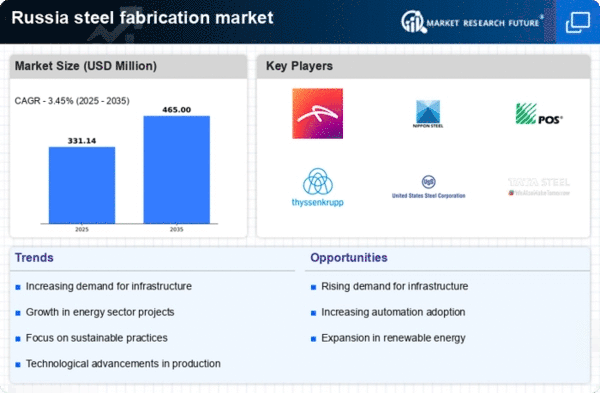
The steel fabrication market exhibits a complex competitive landscape characterized by a blend of established players and emerging innovators. Key growth drivers include increasing demand for infrastructure development, advancements in manufacturing technologies, and a heightened focus on sustainability. Major companies such as ArcelorMittal (LU), Nippon Steel Corporation (JP), and Tata Steel Limited (IN) are strategically positioned to leverage these trends. ArcelorMittal (LU) emphasizes innovation through its investment in advanced steelmaking technologies, while Nippon Steel Corporation (JP) focuses on regional expansion and partnerships to enhance its market presence. Tata Steel Limited (IN) is actively pursuing digital transformation initiatives to optimize its operations, collectively shaping a competitive environment that prioritizes technological advancement and operational efficiency.The market's competitive structure appears moderately fragmented, with key players employing various business tactics to gain an edge. Localizing manufacturing and optimizing supply chains are prevalent strategies among these companies, allowing them to respond swiftly to regional demands and fluctuations in raw material prices. The collective influence of these major players fosters a dynamic environment where agility and responsiveness are paramount, further intensifying competition.
In September ArcelorMittal (LU) announced a strategic partnership with a leading technology firm to develop AI-driven solutions aimed at enhancing production efficiency. This move is significant as it underscores the company's commitment to integrating cutting-edge technology into its operations, potentially leading to reduced operational costs and improved product quality. Such initiatives may position ArcelorMittal (LU) as a frontrunner in the market, particularly in the context of increasing pressure for sustainable practices.
In October Tata Steel Limited (IN) unveiled its new sustainability initiative, which aims to reduce carbon emissions by 30% by 2030. This initiative is crucial as it aligns with global trends towards environmental responsibility and positions Tata Steel Limited (IN) favorably among environmentally conscious consumers and investors. The company's proactive approach to sustainability may enhance its competitive advantage, particularly in markets where regulatory pressures are intensifying.
In August Nippon Steel Corporation (JP) expanded its operations in Eastern Europe by acquiring a local steel fabrication company. This acquisition is indicative of Nippon Steel's strategy to bolster its market share in emerging regions, allowing for greater access to new customers and resources. Such strategic moves not only enhance operational capabilities but also reflect a broader trend of consolidation within the industry, as companies seek to fortify their positions in a competitive landscape.
As of November current competitive trends are increasingly defined by digitalization, sustainability, and the integration of AI technologies. Strategic alliances are becoming more prevalent, enabling companies to pool resources and expertise to navigate the complexities of the market. Looking ahead, competitive differentiation is likely to evolve, shifting from traditional price-based competition to a focus on innovation, technological advancement, and supply chain reliability. This transition may redefine the parameters of success in the steel fabrication market, emphasizing the importance of adaptability and forward-thinking strategies.