×
Request Free Sample ×

Kindly complete the form below to receive a free sample of this Report

* Please use a valid business email

Leading companies partner with us for data-driven Insights

clients tt-cursor
Hero Background

Rocket Missile Market

ID: MRFR/AD/8843-HCR
167 Pages
Swapnil Palwe
February 2026

Rocket and Missile Market Size, Share, Industry Trend & Analysis Research Report Information By Launch Mode (Surface-To-Surface, Surface-To-Air, Subsea-To-Surface, Air-To-Air and Air-To-Surface), Propulsion (Solid Propulsion, Liquid Propulsion, Hybrid Propulsion, Turbojet, Ramjet and Scramjet) and Region (North America, Europe, Asia-Pacific, Middle East & Africa and Latin America) - Forecast till 2035

Share:
Download PDF ×

We do not share your information with anyone. However, we may send you emails based on your report interest from time to time. You may contact us at any time to opt-out.

Rocket Missile Market Infographic
Purchase Options

Rocket Missile Market Summary

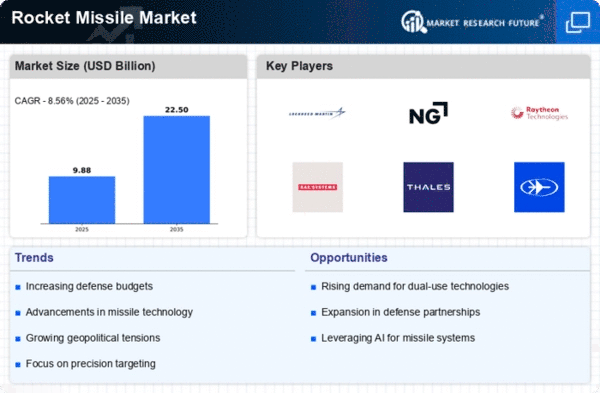
As per MRFR analysis, the Rocket Missile Market Size was estimated at 9.1 USD Billion in 2024. The Rocket Missile industry is projected to grow from 9.9 in 2025 to 22.5 by 2035, exhibiting a compound annual growth rate (CAGR) of 8.56 during the forecast period 2025 - 2035.

Key Market Trends & Highlights

The Rocket Missile Market is poised for substantial growth driven by technological advancements and geopolitical dynamics.

  • North America remains the largest market for rocket missiles, driven by robust military expenditure and advanced defense technologies.
  • The Asia-Pacific region is emerging as the fastest-growing market, fueled by increasing defense budgets and regional security concerns.
  • The military segment continues to dominate the market, while the space exploration segment is witnessing rapid growth due to rising interest in satellite deployment.
  • Technological advancements in missile systems and increased geopolitical tensions are key drivers propelling market expansion.

Market Size & Forecast

2024 Market Size 9.1 (USD Billion)
2035 Market Size 22.5 (USD Billion)
CAGR (2025 - 2035) 8.56%

Major Players

Lockheed Martin (US), Northrop Grumman (US), Raytheon Technologies (US), BAE Systems (GB), Thales Group (FR), Rafael Advanced Defense Systems (IL), MBDA (GB), Kongsberg Gruppen (NO), Hanwha Defense (KR)

Our Impact
Enabled $4.3B Revenue Impact for Fortune 500 and Leading Multinationals
Partnering with 2000+ Global Organizations Each Year
30K+ Citations by Top-Tier Firms in the Industry

Rocket Missile Market Trends

The Rocket Missile Market is currently experiencing a dynamic evolution, driven by advancements in technology and increasing geopolitical tensions. Nations are investing heavily in missile defense systems and precision-guided munitions, which are perceived as essential for maintaining national security. The integration of artificial intelligence and automation into missile systems is also becoming more prevalent, enhancing targeting accuracy and operational efficiency. Furthermore, the demand for versatile and adaptable missile systems is rising, as military forces seek to address a wide range of potential threats. This trend indicates a shift towards more sophisticated and multi-functional missile capabilities, reflecting the complexities of modern warfare. In addition to technological advancements, the Rocket Missile Market is influenced by international collaborations and defense partnerships. Countries are increasingly engaging in joint development programs, sharing resources and expertise to create advanced missile systems. This collaborative approach not only reduces costs but also fosters innovation within the industry. As nations navigate the complexities of global security, the Rocket Missile Market is poised for continued growth, with an emphasis on developing next-generation systems that can respond to evolving threats. The interplay of technology, collaboration, and strategic defense initiatives suggests a robust future for this sector, as it adapts to the changing landscape of military needs.

Technological Advancements

The Rocket Missile Market is witnessing rapid technological advancements, particularly in the areas of guidance systems and propulsion technologies. Innovations such as hypersonic missiles and enhanced targeting algorithms are reshaping the capabilities of missile systems, allowing for greater precision and speed. This trend indicates a shift towards more sophisticated weaponry that can effectively counter emerging threats.

Increased Geopolitical Tensions

Rising geopolitical tensions across various regions are driving demand within the Rocket Missile Market. Nations are prioritizing the development and procurement of advanced missile systems to bolster their defense capabilities. This trend reflects a broader strategy to deter potential adversaries and ensure national security in an increasingly volatile global environment.

Collaborative Defense Initiatives

The Rocket Missile Market is experiencing a surge in collaborative defense initiatives among nations. Countries are forming partnerships to jointly develop missile technologies, sharing expertise and resources. This trend not only enhances innovation but also promotes interoperability among allied forces, ultimately strengthening collective defense strategies.

Market Segment Insights

By Application: Military (Largest) vs. Space Exploration (Fastest-Growing)

The Rocket Missile Market showcases a diverse application segment, where Military applications hold the largest share. This dominance is spearheaded by a continuous demand for advanced missile systems for defense and security purposes across numerous nations. In contrast, sectors such as Civil and Research applications display considerably smaller proportions, though they contribute significantly to niche markets. Meanwhile, Space Exploration is developing rapidly, attracting investments and interest for launching satellites and other space-related missions.

Military (Dominant) vs. Space Exploration (Emerging)

In the Rocket Missile Market, the Military application emerges as the dominant segment, driven by ongoing geopolitical tensions and an escalating need for national security. Military applications encompass a wide array of missile types, including tactical, strategic, and anti-ballistic systems, ensuring robust market engagement. Conversely, the Space Exploration sector is increasingly recognized as an emerging application area, leveraging advancements in missile technology for satellite launches and interplanetary missions. While the Military segment benefits from consistent government budgets, Space Exploration is gaining momentum due to partnerships with commercial entities and international collaborations aimed at reducing launch costs and enhancing access to space.

By Type: Ballistic Missile (Largest) vs. Cruise Missile (Fastest-Growing)

In the Rocket Missile Market, the segmentation reveals a prominent share held by Ballistic Missiles, which are recognized for their long-range capabilities and effectiveness in traditional warfare scenarios. These missiles dominate the market due to their established technology and extensive use by military forces worldwide. Cruise Missiles, meanwhile, are experiencing rapid growth, driven by advancements in precision targeting and a rising demand for standoff attack capabilities. Their ability to be deployed from various platforms is also boosting their market presence.

Ballistic Missile (Dominant) vs. Cruise Missile (Emerging)

Ballistic Missiles, characterized by their high altitude and long-range trajectory, represent a dominant force in the rocket missile landscape. They are primarily used for strategic national defense and deterrence, finding favor among many nations with significant military budgets. In contrast, Cruise Missiles are emerging as a fast-growing segment, appealing to modern warfare strategies that emphasize precision and flexibility. Their design allows for lower flight paths and the ability to evade radar detection, making them increasingly attractive for tactical missions. This shift reflects a broader trend toward more sophisticated missile technology in military operations.

By Launch Platform: Land-Based (Largest) vs. Sea-Based (Fastest-Growing)

The Rocket Missile Market exhibits significant diversification in its launch platforms, with Land-Based systems currently commanding the largest share. This segment benefits from widespread adoption by military forces worldwide, primarily due to their stability and scalability for ground operations. Conversely, Sea-Based platforms are emerging as a rapid contender, driven by naval modernization and defense strategies that emphasize deterrence capabilities. This shift in focus is reshaping the competitive landscape of the rocket missile segment.

Land-Based (Dominant) vs. Sea-Based (Emerging)

Land-Based launch platforms maintain a dominant position in the Rocket Missile Market due to extensive infrastructure and operational flexibility. They offer various missile types suited for different operational theaters, resulting in robust military training and deployment strategies. In contrast, Sea-Based platforms represent an emerging segment characterized by their strategic advantage in mobility and concealment. Growing naval capabilities and the demand for multi-role platforms have spurred investments in this sector, making Sea-Based launches an attractive option for future defense initiatives, particularly in maritime conflict zones.

By Guidance System: GPS Guidance (Largest) vs. Inertial Guidance (Fastest-Growing)

The Rocket Missile Market exhibits a diverse array of guidance systems, with GPS Guidance leading the charge in terms of market share. This segment capitalizes on accurate real-time positioning, making it a staple in modern missile technology. Following closely are Inertial Guidance and Active Radar Guidance, each contributing to the overall efficacy of battlefield operations. Terminal Homing and Command Guidance, while essential, hold smaller shares but still play significant roles in guided munitions.

Guidance Systems: GPS Guidance (Dominant) vs. Inertial Guidance (Emerging)

GPS Guidance stands out as the dominant force in the guidance system arena for the Rocket Missile Market, offering unmatched accuracy and reliability. Its widespread adoption across military and defense sectors reinforces its market position. In contrast, Inertial Guidance is emerging as a key player, particularly in environments where GPS signals may be unreliable or jammed. This technology’s ability to provide autonomous tracking and navigation during complex missions equips it with a dynamic edge, appealing to military strategists seeking resilience in various combat scenarios.

By Range: Short Range (Largest) vs. Intercontinental Range (Fastest-Growing)

The Rocket Missile Market is distinctly segmented by range, with Short Range missiles commanding the largest share. This segment thrives due to their effectiveness in tactical situations and their cost-efficiency, appealing to various military factions. Conversely, the Intercontinental Range segment, while currently smaller, is witnessing remarkable growth, driven by increased geopolitical tensions and a surge in global defense spending. As nations bolster their deterrence capabilities, the demand for longer-range capabilities is expected to escalate. The preferences among military buyers are leaning towards innovations, particularly in the Intercontinental Range, which is integrating cutting-edge technology for enhanced accuracy and reliability. The Short Range segment continues to benefit from established production lines and operational familiarity, ensuring steady demand. However, the Intercontinental Range is gaining momentum, spurred by advancements in missile technology and the strategic importance of long-range capabilities in modern conflict scenarios.

Short Range (Dominant) vs. Long Range (Emerging)

Short Range missiles hold a dominant position in the Rocket Missile Market, primarily serving tactical roles for immediate engagements and requiring less complex infrastructure. Their user-friendly designs and versatility in deployment make them preferred choices among military branches. In contrast, Long Range missiles represent an emerging segment, attracting significant investment for their potential to engage targets at greater distances, thus offering strategic advantages. They are characterized by their ability to deliver payloads over vast expanses, a feature increasingly sought in contemporary warfare. Despite higher costs and technical challenges in development, the sustained investment in R&D is poised to enhance their capabilities, making them a critical asset for modern military operations.

Get more detailed insights about Rocket Missile Market

Regional Insights

North America : Defense Innovation Leader

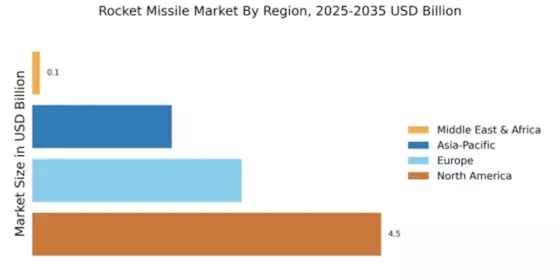
North America continues to lead the rocket missile market, holding a significant share of 4.55 in 2024. The region's growth is driven by increased defense budgets, technological advancements, and a focus on modernization of military capabilities. Regulatory support from government initiatives further catalyzes demand, ensuring that North America remains at the forefront of missile technology development. The competitive landscape is characterized by major players such as Lockheed Martin, Northrop Grumman, and Raytheon Technologies, which dominate the market. These companies are heavily invested in R&D, leading to innovative solutions that meet evolving defense needs. The U.S. government’s commitment to enhancing national security through advanced missile systems solidifies the region's position as a global leader in the rocket missile sector.

Europe : Strategic Defense Collaborations

Europe's rocket missile market is projected to grow, with a market size of 2.73 in 2024. The region benefits from strategic collaborations among NATO countries, which enhance defense capabilities and foster innovation. Regulatory frameworks are increasingly supportive, promoting joint ventures and technology sharing, which are crucial for meeting the rising defense demands in Europe. Leading countries such as the UK, France, and Germany are at the forefront of this market, with key players like BAE Systems and Thales Group driving advancements. The competitive landscape is marked by a focus on developing next-generation missile systems, ensuring that European nations can effectively respond to emerging threats. The emphasis on collaborative defense initiatives further strengthens the region's market position.

Asia-Pacific : Emerging Defense Market

The Asia-Pacific region is witnessing rapid growth in the rocket missile market, with a size of 1.82 in 2024. This growth is fueled by increasing military expenditures, regional tensions, and a focus on indigenous defense production. Countries are investing heavily in modernizing their armed forces, which is driving demand for advanced missile systems and technologies. Key players in this region include Hanwha Defense and Kongsberg Gruppen, which are expanding their presence through partnerships and local manufacturing. Nations like India, South Korea, and Japan are leading the charge in missile development, focusing on enhancing their defense capabilities. The competitive landscape is evolving, with a strong emphasis on innovation and technological advancements to meet the unique security needs of the region.

Middle East and Africa : Emerging Defense Sector

The Middle East and Africa region represents a nascent market for rocket missiles, with a size of 0.1 in 2024. Despite its smaller market share, there is significant potential for growth driven by geopolitical tensions and increasing defense budgets. Countries in this region are recognizing the need to enhance their military capabilities, leading to a gradual rise in demand for missile systems. Key players are beginning to establish a foothold in this market, with local defense companies exploring partnerships with global firms. Nations such as the UAE and Saudi Arabia are investing in advanced military technologies, aiming to bolster their defense strategies. The competitive landscape is still developing, but the focus on modernization presents opportunities for growth in the rocket missile sector.


Rocket Missile Market Regional Image

Key Players and Competitive Insights

The Rocket Missile Market is characterized by a dynamic competitive landscape, driven by technological advancements, geopolitical tensions, and increasing defense budgets across various nations. Key players such as Lockheed Martin (US), Northrop Grumman (US), and Raytheon Technologies (US) are at the forefront, each adopting distinct strategies to enhance their market positioning. Lockheed Martin (US) emphasizes innovation through its investment in advanced missile systems, while Northrop Grumman (US) focuses on strategic partnerships to bolster its capabilities. Raytheon Technologies (US) is actively pursuing digital transformation initiatives to streamline operations and improve product offerings. Collectively, these strategies contribute to a competitive environment that is increasingly focused on technological superiority and operational efficiency.In terms of business tactics, companies are localizing manufacturing to reduce costs and enhance supply chain resilience. This approach is particularly evident in regions with burgeoning defense sectors, where firms are establishing production facilities to cater to local demands. The market structure appears moderately fragmented, with several key players exerting influence, yet the presence of emerging companies is gradually reshaping the competitive dynamics. The collective actions of these major firms indicate a trend towards consolidation, as they seek to leverage synergies and enhance their competitive edge.

In November Lockheed Martin (US) announced a strategic partnership with a leading technology firm to develop next-generation missile systems that integrate artificial intelligence (AI) capabilities. This collaboration is poised to enhance Lockheed Martin's product offerings, enabling more precise targeting and improved operational efficiency. The integration of AI into missile systems is likely to redefine operational paradigms, positioning Lockheed Martin as a leader in innovative defense solutions.

In October Northrop Grumman (US) secured a multi-million dollar contract with the U.S. Department of Defense to supply advanced missile defense systems. This contract not only underscores Northrop Grumman's robust capabilities but also reflects the increasing demand for sophisticated defense solutions amid rising global tensions. The financial implications of this contract are substantial, potentially enhancing Northrop Grumman's market share and reinforcing its strategic position in the sector.

In September Raytheon Technologies (US) unveiled a new missile system designed for enhanced interoperability with allied forces. This development is indicative of Raytheon's commitment to fostering international partnerships and ensuring that its products meet the evolving needs of global defense strategies. The emphasis on interoperability may facilitate collaborative defense efforts, thereby strengthening Raytheon's competitive stance in the market.

As of December the Rocket Missile Market is witnessing trends that emphasize digitalization, sustainability, and AI integration. Strategic alliances are increasingly shaping the competitive landscape, as companies recognize the value of collaboration in driving innovation. The shift from price-based competition to a focus on technological advancement and supply chain reliability is becoming evident. Moving forward, competitive differentiation will likely hinge on the ability to innovate and adapt to emerging technologies, positioning firms that prioritize these aspects at the forefront of the market.

Key Companies in the Rocket Missile Market include

Industry Developments

  • Q2 2024: Lockheed Martin wins $4.5 billion U.S. Army contract for next-generation missile systems Lockheed Martin was awarded a $4.5 billion contract by the U.S. Army to produce next-generation missile systems, including upgrades to the Precision Strike Missile (PrSM) program, aimed at enhancing long-range strike capabilities.
  • Q2 2024: Northrop Grumman opens new missile manufacturing facility in West Virginia Northrop Grumman inaugurated a new state-of-the-art missile manufacturing facility in West Virginia, expanding its production capacity for advanced missile systems to meet growing defense demand.
  • Q2 2024: Rafael and Raytheon sign partnership to co-develop next-gen air defense missile Israeli defense company Rafael and U.S.-based Raytheon announced a strategic partnership to co-develop a new generation of air defense missiles, targeting both domestic and international markets.
  • Q3 2024: India successfully tests Agni-Prime ballistic missile India's Defence Research and Development Organisation (DRDO) announced the successful test launch of the Agni-Prime ballistic missile, marking a significant milestone in the country's indigenous missile development program.
  • Q3 2024: MBDA secures €1.2 billion contract to supply air defense missiles to Germany European missile manufacturer MBDA signed a €1.2 billion contract to supply Germany with advanced air defense missile systems as part of the country's military modernization efforts.
  • Q3 2024: South Korea's Hanwha Aerospace wins $1 billion missile export deal with UAE Hanwha Aerospace secured a $1 billion contract to export guided missile systems to the United Arab Emirates, strengthening South Korea's position in the global defense market.
  • Q4 2024: Aerojet Rocketdyne completes acquisition by L3Harris Technologies Aerojet Rocketdyne announced the completion of its acquisition by L3Harris Technologies, creating a combined entity with expanded capabilities in rocket propulsion and missile systems.
  • Q4 2024: Japan's Mitsubishi Heavy Industries unveils new hypersonic missile prototype Mitsubishi Heavy Industries revealed a prototype of its new hypersonic missile, designed for rapid deployment and enhanced maneuverability, as part of Japan's defense modernization strategy.
  • Q1 2025: U.S. Department of Defense awards $2.1 billion missile contract to Raytheon Raytheon Technologies received a $2.1 billion contract from the U.S. Department of Defense to supply advanced missile systems for both domestic and allied military forces.
  • Q1 2025: Thales launches new surface-to-air missile system for export markets Thales Group announced the launch of its latest surface-to-air missile system, targeting export markets in Asia and the Middle East, with enhanced targeting and countermeasure capabilities.
  • Q2 2025: BAE Systems appoints new CEO to lead missile and rocket division BAE Systems named a new CEO for its missile and rocket division, signaling a strategic focus on innovation and international expansion in advanced weaponry.
  • Q2 2025: Kongsberg signs $475 million contract to deliver Naval Strike Missiles to U.S. Navy Kongsberg Defence & Aerospace secured a $475 million contract to supply its Naval Strike Missile system to the U.S. Navy, supporting fleet modernization and enhanced maritime strike capabilities.

Segmentation

By Launch Mode

  • Surface-To-Surface: This segment accounted for the largest market share in 2019 and is expected to register a steady CAGR during the forecast period. The surface-to-surface rockets and missiles are conventional weapons and thus are primarily used by the military forces.
  • Air-To-Surface: The segment is expected to register the highest CAGR during the review period. The increasing use of guided missiles that are launched by fighter jets and helicopters is expected to drive the growth of this segment.
  • Surface-To-Air: The segment accounted for the second-largest market share in 2019. This can be attributed to the increasing use of surface-to-air missiles for destroying enemy aircraft.

By Propulsion

  • Solid Propulsion: The segment dominated the rocket and missile market in 2019. This is due to the wide use of solid-state propulsion systems in rockets.
  • Hybrid Propulsion: The segment is expected to register the highest CAGR during the forecast period. This is due to the increasing demand for hybrid propulsion systems for intercontinental ballistic missiles.
  • Turbojet: The segment is expected to witness steady growth during the forecast period, 2019 to 2026. The turbojet propulsion systems are widely used in missiles.

By Region

  • North America: North America dominates the rocket and missile market and is projected to continue to do so throughout the forecast period. The increasing adoption of rocket and missile by the US and Canada for performing military missions are expected to drive the growth of the regional market.
  • Europe: Europe accounted for the second-largest market share in 2019 primarily due to the presence of prominent players, such as Kongsberg Gruppen ASA, Thales Group, MBDA Holdings SAS, and Saab AB, and increasing investments by these companies in developing advanced rockets and missiles.
  • Asia-Pacific: The market in this region is projected to expand at a high CAGR during the forecast period. Increasing defense expenditure and rising terrorist activities in India, Indonesia, and Australia are driving the growth of the regional market.
  • Middle East & Africa: The increasing defense expenditures by countries such as Saudi Arabia, the UAE, and Israel is driving the growth of the rocket and missile market in the Middle East & Africa.
  • Latin America: An increase in the use of advanced weapon systems by the defense organizations in Brazil and Mexico is also expected to boost the demand for rockets and missiles in the region.

Future Outlook

Rocket Missile Market Future Outlook

The Rocket Missile Market is projected to grow at an 8.56% CAGR from 2025 to 2035, driven by technological advancements, increased defense budgets, and geopolitical tensions.

New opportunities lie in:

  • Development of advanced propulsion systems for enhanced range and accuracy.
  • Integration of AI for real-time targeting and decision-making capabilities.
  • Expansion into emerging markets with tailored missile solutions.

By 2035, the market is expected to solidify its position as a critical component of global defense strategies.

Market Segmentation

Rocket Missile Market Type Outlook

  • Ballistic Missile
  • Cruise Missile
  • Anti-Ship Missile
  • Surface-to-Air Missile
  • Air-to-Surface Missile

Rocket Missile Market Range Outlook

  • Short Range
  • Medium Range
  • Long Range
  • Intercontinental Range
  • Tactical Range

Rocket Missile Market Application Outlook

  • Military
  • Civil
  • Research
  • Commercial
  • Space Exploration

Rocket Missile Market Guidance System Outlook

  • Inertial Guidance
  • GPS Guidance
  • Terminal Homing
  • Command Guidance
  • Active Radar Guidance

Rocket Missile Market Launch Platform Outlook

  • Land-Based
  • Sea-Based
  • Air-Based
  • Submarine-Based
  • Mobile Launchers

Report Scope

MARKET SIZE 20249.1(USD Billion)
MARKET SIZE 20259.9(USD Billion)
MARKET SIZE 203522.5(USD Billion)
COMPOUND ANNUAL GROWTH RATE (CAGR)8.56% (2025 - 2035)
REPORT COVERAGERevenue Forecast, Competitive Landscape, Growth Factors, and Trends
BASE YEAR2024
Market Forecast Period2025 - 2035
Historical Data2019 - 2024
Market Forecast UnitsUSD Billion
Key Companies ProfiledLockheed Martin (US), Northrop Grumman (US), Raytheon Technologies (US), BAE Systems (GB), Thales Group (FR), Rafael Advanced Defense Systems (IL), MBDA (GB), Kongsberg Gruppen (NO), Hanwha Defense (KR)
Segments CoveredApplication, Type, Launch Platform, Guidance System, Range
Key Market OpportunitiesAdvancements in precision-guided munitions enhance operational effectiveness in the Rocket Missile Market.
Key Market DynamicsTechnological advancements and geopolitical tensions drive innovation and competition in the rocket missile market.
Countries CoveredNorth America, Europe, APAC, South America, MEA

Market Highlights

Author
Swapnil Palwe
Team Lead - Research

With a technical background as Bachelor's in Mechanical Engineering, with MBA in Operations Management , Swapnil has 6+ years of experience in market research, consulting and analytics with the tasks of data mining, analysis, and project execution. He is the POC for our clients, for their consulting projects running under the Automotive/A&D domain. Swapnil has worked on major projects in verticals such as Aerospace & Defense, Automotive and many other domain projects. He has worked on projects for fortune 500 companies' syndicate and consulting projects along with several government projects.

Leave a Comment

FAQs

What is the projected market value of the global rocket and missile market?

global rocket and missile market is projected to acquire the market value of USD 54 Billion during the forecast period from 2022 to 2030

At what CAGR is the global rocket and missile market estimated to expand?

The global rocket and missile market is estimated at 5% during the forecast period from 2022 to 2030

What is the USP of the global rocket and missile market during the forecast period?

Development of guided missile systems is the anticipated market USP of the rocket and missile market.

Who are the key players of the global rocket and missile market?

Denel Dynamics (South Africa), Mesko SA (Poland), Lockheed Martin Corporation (U.S.), and Roketsan AS (Turkey) are some of the renowned players in the global rocket and missile market.

Download Free Sample

Kindly complete the form below to receive a free sample of this Report

Compare Licence

×
Features License Type
Single User Multiuser License Enterprise User
Price $4,950 $5,950 $7,250
Maximum User Access Limit 1 User Upto 10 Users Unrestricted Access Throughout the Organization
Free Customization
Direct Access to Analyst
Deliverable Format
Platform Access
Discount on Next Purchase 10% 15% 15%
Printable Versions