North America : Market Leader in Demand Response
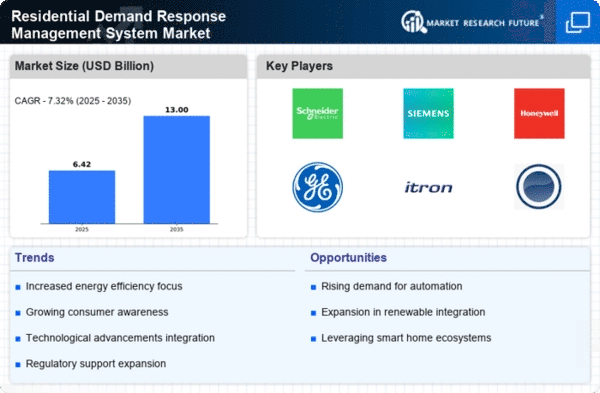
North America is poised to maintain its leadership in the Residential Demand Response Management System market, holding a significant market share of 3.0 by December 2025. Key growth drivers include increasing energy costs, regulatory support for energy efficiency, and a growing emphasis on renewable energy integration. The region's robust infrastructure and technological advancements further enhance demand for these systems, making it a focal point for innovation and investment in energy management solutions.
The competitive landscape in North America is characterized by the presence of major players such as Schneider Electric, Honeywell, and Duke Energy. These companies are leveraging advanced technologies to enhance system efficiency and customer engagement. The U.S. leads the market, driven by favorable policies and incentives aimed at promoting energy conservation. As demand for smart home technologies rises, the market is expected to expand, attracting new entrants and fostering innovation.
Europe : Emerging Market with Growth Potential
Europe is witnessing a transformative phase in the Residential Demand Response Management System market, with a projected market size of 1.5 by December 2025. The region's growth is fueled by stringent regulations aimed at reducing carbon emissions and enhancing energy efficiency. Initiatives such as the European Green Deal and various national policies are driving consumer adoption of demand response technologies, creating a favorable environment for market expansion.
Leading countries in this region include Germany, France, and the UK, where significant investments in smart grid technologies are being made. The competitive landscape features key players like Siemens and Landis+Gyr, who are actively developing innovative solutions to meet regulatory requirements. As Europe transitions towards a more sustainable energy model, the demand for residential demand response systems is expected to rise significantly, supported by government incentives and consumer awareness initiatives.
Asia-Pacific : Rapid Growth in Energy Management
The Asia-Pacific region is emerging as a significant player in the Residential Demand Response Management System market, with a projected size of 1.8 by December 2025. Key growth drivers include rapid urbanization, increasing energy consumption, and government initiatives aimed at enhancing energy efficiency. Countries like China and India are leading the charge, implementing policies that encourage the adoption of smart energy solutions and demand response technologies to manage peak loads effectively.
China is at the forefront, with substantial investments in smart grid infrastructure and energy management systems. The competitive landscape is marked by the presence of both local and international players, including Itron and C3.ai, who are innovating to meet the growing demand. As the region continues to develop its energy infrastructure, the demand for residential demand response systems is expected to grow, driven by both regulatory support and consumer interest in energy savings.
Middle East and Africa : Emerging Market with Challenges
The Middle East and Africa region is gradually developing its Residential Demand Response Management System market, with a projected size of 0.68 by December 2025. The growth is primarily driven by increasing energy demand and the need for efficient energy management solutions. However, challenges such as regulatory hurdles and limited infrastructure development may hinder rapid market expansion. Governments are beginning to recognize the importance of demand response systems in managing energy resources effectively.
Countries like South Africa and the UAE are taking steps to implement smart grid technologies and promote energy efficiency. The competitive landscape is still in its infancy, with few key players establishing a presence. As awareness of energy management solutions grows, the market is expected to evolve, attracting investments and fostering innovation in demand response technologies.