Economic Growth
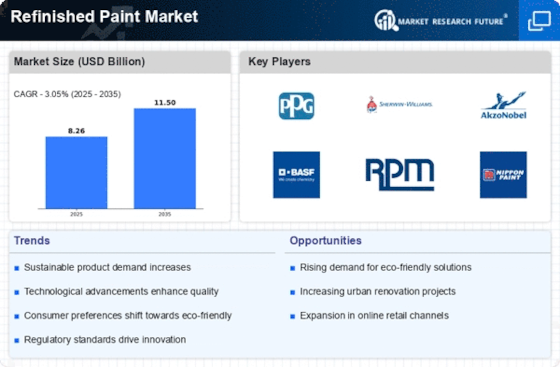
Economic growth is a significant driver influencing the Refinished Paint Market. As disposable incomes rise, consumers are more inclined to invest in home improvement projects, including refinishing. This trend is particularly evident in emerging markets, where urbanization and rising living standards are fueling demand for quality refinishing products. In 2025, the market is projected to expand as more individuals undertake renovation projects, thereby increasing the consumption of refinished paints. Additionally, the commercial sector is also experiencing growth, with businesses seeking to enhance their premises through aesthetic improvements. Consequently, the Refinished Paint Market is likely to see a robust increase in demand driven by overall economic conditions.
Customization Demand
Customization trends are increasingly shaping the Refinished Paint Market, as consumers seek personalized solutions that reflect their unique tastes and preferences. The desire for bespoke colors and finishes has led to a surge in demand for tailored refinishing services. In 2025, it is estimated that the market for customized refinishing solutions could account for a substantial portion of overall sales, as consumers are willing to invest in products that enhance their living spaces. This trend is particularly pronounced in residential applications, where homeowners are looking to create distinctive environments. As a result, companies that offer a wide range of customizable options may find themselves well-positioned to capture a larger share of the Refinished Paint Market.
Regulatory Compliance
Regulatory compliance is becoming an increasingly important driver in the Refinished Paint Market. Governments worldwide are implementing stricter regulations regarding the use of hazardous materials in paint products. This shift is prompting manufacturers to reformulate their products to meet these new standards, particularly concerning VOC emissions. In 2025, compliance with these regulations is expected to shape product offerings significantly, as companies strive to avoid penalties and maintain market access. The emphasis on safety and environmental responsibility is likely to resonate with consumers, further driving demand for compliant refinishing products. As a result, the Refinished Paint Market may experience a transformation, with a focus on safer, more sustainable options.
Technological Innovations
Technological advancements are playing a crucial role in the evolution of the Refinished Paint Market. Innovations in paint formulation and application techniques are enhancing product performance and user experience. For instance, the introduction of advanced spray technologies and improved drying times is making refinishing projects more efficient and accessible. In 2025, the market is expected to benefit from these innovations, as they not only improve the quality of finishes but also reduce labor costs. Furthermore, the integration of digital tools for color matching and design visualization is likely to attract a broader customer base. Companies that leverage these technological advancements may gain a competitive edge in the Refinished Paint Market.
Sustainability Initiatives
The increasing emphasis on sustainability appears to be a pivotal driver in the Refinished Paint Market. Consumers and manufacturers alike are gravitating towards eco-friendly products that minimize environmental impact. This trend is evidenced by the rise in demand for low-VOC and water-based paints, which are perceived as safer alternatives. In 2025, the market for sustainable refinishing products is projected to grow significantly, as regulations tighten and consumer awareness heightens. Companies that prioritize sustainable practices may find themselves at a competitive advantage, as they align with the values of environmentally conscious consumers. The Refinished Paint Market is thus likely to witness a shift towards products that not only meet aesthetic needs but also contribute positively to environmental sustainability.