×
Request Free Sample ×

Kindly complete the form below to receive a free sample of this Report

* Please use a valid business email

Leading companies partner with us for data-driven Insights

clients tt-cursor
Hero Background

Recycled Lead Market

ID: MRFR/CnM/30638-HCR
128 Pages
Priya Nagrale
February 2026

Recycled Lead Market Size, Share & Industry Analysis Research Report By Lead Source (Post-Consumer Batteries, Industrial Scrap, Manufacturing Scrap), By End Use Applications (Automotive Batteries, Power Backup Systems, Renewable Energy Storage), By Processing Methods (Pyrometallurgical Process, Hydrometallurgical Process), By Purity Levels (High Purity Lead, Standard Purity Lead), By Market Participants (Recyclers, Manufacturers of Lead-Based Products, Suppliers) and By Regional (North America, Europe, South America, Asia Pacific, Middle East and Africa) - Forecast to 2035.

Share:
Download PDF ×

We do not share your information with anyone. However, we may send you emails based on your report interest from time to time. You may contact us at any time to opt-out.

Recycled Lead Market Infographic
Purchase Options

Recycled Lead Market Summary

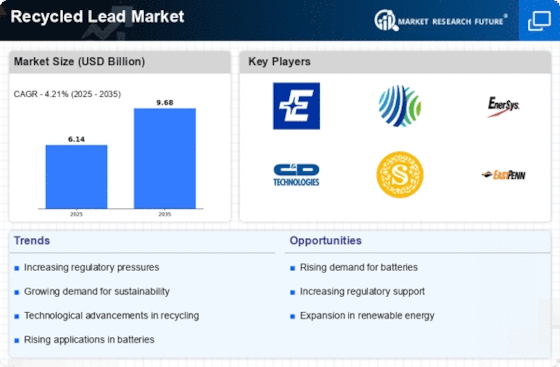
As per Market Research Future analysis, the Recycled Lead Market Size was estimated at 6.145 USD Billion in 2024. The Recycled Lead industry is projected to grow from 6.404 USD Billion in 2025 to 9.675 USD Billion by 2035, exhibiting a compound annual growth rate (CAGR) of 4.21% during the forecast period 2025 - 2035

Key Market Trends & Highlights

The Recycled Lead Market is experiencing robust growth driven by sustainability initiatives and technological advancements.

  • North America remains the largest market for recycled lead, driven by stringent environmental regulations and sustainability efforts.
  • Asia-Pacific is emerging as the fastest-growing region, propelled by increasing industrialization and demand for recycled materials.
  • Post-consumer batteries represent the largest segment, while industrial scrap is witnessing the fastest growth due to rising recycling rates.
  • Key market drivers include the increasing demand for batteries and growing awareness of sustainability, which are shaping industry dynamics.

Market Size & Forecast

2024 Market Size 6.145 (USD Billion)
2035 Market Size 9.675 (USD Billion)
CAGR (2025 - 2035) 4.21%

Major Players

Exide Technologies (US), Johnson Controls International (IE), EnerSys (US), C&D Technologies (US), Sonnenschein (DE), East Penn Manufacturing (US), Crown Battery Manufacturing (US), RSR Corporation (US)

Our Impact
Enabled $4.3B Revenue Impact for Fortune 500 and Leading Multinationals
Partnering with 2000+ Global Organizations Each Year
30K+ Citations by Top-Tier Firms in the Industry

Recycled Lead Market Trends

The Recycled Lead Market is currently experiencing a notable transformation, driven by increasing environmental awareness and stringent regulations regarding waste management. As industries seek sustainable alternatives, the demand for recycled lead is likely to rise, reflecting a shift towards circular economy practices. This market appears to be influenced by the growing need for lead-acid batteries, which are extensively utilized in various applications, including automotive and renewable energy sectors. Furthermore, advancements in recycling technologies may enhance the efficiency of lead recovery processes, thereby potentially increasing the overall supply of recycled lead in the market. In addition, the Recycled Lead Market seems to be shaped by the rising costs associated with primary lead extraction, which could make recycled lead a more economically viable option for manufacturers. The emphasis on reducing carbon footprints and promoting sustainable practices is likely to encourage more companies to invest in recycled materials. As a result, the market may witness a surge in partnerships and collaborations aimed at improving recycling infrastructure and expanding the reach of recycled lead products. Overall, the Recycled Lead Market is poised for growth, reflecting broader trends in sustainability and resource management.

Sustainability Initiatives

The Recycled Lead Market is increasingly influenced by global sustainability initiatives. Companies are prioritizing eco-friendly practices, leading to a heightened focus on recycling processes. This trend suggests that businesses are recognizing the importance of reducing waste and conserving natural resources, which may drive demand for recycled lead.

Technological Advancements

Innovations in recycling technologies are playing a crucial role in the Recycled Lead Market. Enhanced methods for lead recovery and processing are likely to improve efficiency and yield. This trend indicates that as technology evolves, the market could benefit from increased production capabilities and reduced operational costs.

Regulatory Pressures

The Recycled Lead Market is subject to growing regulatory pressures aimed at promoting responsible waste management. Governments are implementing stricter regulations on lead disposal and encouraging recycling practices. This trend may compel industries to adopt recycled lead solutions, thereby fostering market growth.

Recycled Lead Market Drivers

Environmental Regulations

The Recycled Lead Market is significantly influenced by stringent environmental regulations aimed at reducing lead pollution and promoting recycling. Governments worldwide are implementing policies that encourage the use of recycled materials, particularly in industries such as construction and electronics. For instance, regulations mandating the recycling of lead-acid batteries have led to an increase in the collection and processing of used batteries. In 2025, it is estimated that over 90% of lead-acid batteries are recycled, highlighting the effectiveness of these regulations. This regulatory landscape not only fosters a more sustainable approach to lead usage but also enhances the market for recycled lead, as companies strive to comply with environmental standards while minimizing their ecological footprint.

Increasing Demand for Batteries

The Recycled Lead Market is experiencing a notable surge in demand for lead-acid batteries, primarily driven by the automotive sector. As electric vehicles gain traction, the need for efficient energy storage solutions becomes paramount. In 2025, the lead-acid battery market is projected to reach approximately 40 billion USD, with a significant portion attributed to recycled lead. This trend underscores the importance of sustainable practices in battery production, as manufacturers increasingly seek to source materials from recycled lead to meet both economic and environmental goals. The Recycled Lead Market is thus positioned to benefit from this growing demand, as it provides a reliable source of lead that reduces the need for virgin materials, aligning with broader sustainability initiatives.

Economic Incentives for Recycling

The Recycled Lead Market is positively impacted by various economic incentives that promote recycling practices. Governments and organizations are increasingly offering financial incentives, such as tax breaks and subsidies, to encourage the recycling of lead and other materials. These incentives not only make recycling more economically viable for businesses but also stimulate investment in recycling infrastructure. In 2025, it is anticipated that these economic measures will lead to a 20% increase in the volume of recycled lead available in the market. This influx of recycled lead will not only support the Recycled Lead Market but also contribute to a more sustainable economy by reducing reliance on virgin materials and minimizing waste.

Growing Awareness of Sustainability

The Recycled Lead Market is witnessing a shift in consumer preferences towards sustainable products, driven by increasing awareness of environmental issues. As consumers become more conscious of their ecological impact, there is a growing demand for products made from recycled materials, including lead. This trend is particularly evident in sectors such as construction and automotive, where companies are actively seeking to incorporate recycled lead into their products. In 2025, it is projected that the market for recycled lead will grow by approximately 10% annually, reflecting this heightened consumer awareness. The Recycled Lead Market stands to gain from this trend, as businesses strive to meet consumer expectations for sustainability while also benefiting from the cost advantages of using recycled materials.

Technological Innovations in Recycling

The Recycled Lead Market is benefiting from advancements in recycling technologies that enhance the efficiency and effectiveness of lead recovery processes. Innovations such as hydrometallurgical methods and improved smelting techniques are enabling higher recovery rates of lead from scrap materials. In 2025, the efficiency of lead recycling processes is expected to improve by approximately 15%, driven by these technological advancements. This increase in efficiency not only reduces operational costs for recycling facilities but also ensures a more sustainable supply of recycled lead. As the industry embraces these innovations, the Recycled Lead Market is likely to see a rise in both production capacity and profitability, further solidifying its role in the circular economy.


Market Segment Insights

By Lead Source: Post-Consumer Batteries (Largest) vs. Industrial Scrap (Fastest-Growing)

In the Recycled Lead Market, the lead source segment is dominated by Post-Consumer Batteries, which account for a significant portion of the overall market share. These batteries are crucial because they represent the largest stockpile of recyclable lead due to the growing number of electric vehicles and renewable energy storage systems. In contrast, Industrial Scrap follows as a noteworthy contributor, but its share pales in comparison to the substantial influence of Post-Consumer Batteries, reflecting an essential dependency on consumer behavior and regulations promoting recycling. On the other hand, the Industrial Scrap segment is rapidly expanding, driven by increased efforts in manufacturing waste reduction and recycling initiatives. This segment is benefitting from the rise in industrial activities and stringent environmental regulations that encourage firms to recycle their lead content. Similarly, Manufacturing Scrap is witnessing growth, yet it does not match the pace of Industrial Scrap, mainly due to factors such as limited availability and stricter quality control measures that hinder its impact in the recycled lead landscape.

Post-Consumer Batteries (Dominant) vs. Industrial Scrap (Emerging)

Post-Consumer Batteries are a dominant source in the Recycled Lead Market, primarily derived from used lead-acid batteries. They offer high lead recovery rates due to established collection and recycling infrastructure. The segment is characterized by a growing demand as lead-acid battery usage escalates in both automotive and stationary applications. On the other hand, Industrial Scrap represents an emerging opportunity for lead recovery, sourced from manufacturing processes, production leftovers, and defective products. This segment is gaining traction as industries strive to adhere to sustainable practices. Despite its current smaller share, Industrial Scrap is becoming increasingly vital as companies are incentivized to recycle more efficiently and minimize environmental impact, thus reflecting a shift towards systematic lead recycling.

By End Use Applications: Automotive Batteries (Largest) vs. Power Backup Systems (Fastest-Growing)

In the recycled lead market, automotive batteries hold the largest share thanks to their widespread use in vehicles and the growing trend towards electric vehicles which require sustainable sourcing of lead. Power backup systems are emerging as a significant segment, fueled by the increasing demand for reliable energy sources in both residential and commercial settings. Renewable energy storage is growing steadily but remains a smaller segment when compared to automotive applications and power backup.

Automotive Batteries (Dominant) vs. Power Backup Systems (Emerging)

Automotive batteries are the dominant application in the recycled lead market, representing the primary use of recycled lead due to the high volume of lead-acid batteries recycling in the automotive industry. These batteries are essential for vehicle operation and are leading the drive towards sustainability in transportation. On the other hand, power backup systems represent an emerging segment characterized by the growing demand for uninterrupted power supply, particularly in regions with unreliable energy infrastructure. This segment is witnessing rapid growth, driven by both consumer and industrial needs for energy resilience, thus positioning it as a critical area for future expansion in the recycled lead market.

By Processing Methods: Pyrometallurgical Process (Largest) vs. Hydrometallurgical Process (Fastest-Growing)

The Recycled Lead Market exhibits a clear segmentation between the pyrometallurgical and hydrometallurgical processes. The pyrometallurgical process dominates the market, capturing a larger share due to its established techniques and cost-effectiveness in smelting lead-bearing materials. This method has been the traditional choice for lead recycling, giving it a solid foothold in the industry. On the other hand, the hydrometallurgical process is emerging as a fast-growing alternative, driven by advancements in technology and increasing environmental awareness. This method offers a more eco-friendly approach, appealing to industries aiming for sustainability in their operations.

Processing Methods: Pyrometallurgical (Dominant) vs. Hydrometallurgical (Emerging)

The pyrometallurgical process is characterized by its high efficiency and cost-effectiveness, making it the dominant method in lead recycling. This process involves the heating of lead-containing materials to separate lead from impurities, resulting in a relatively quick and effective recycling method. However, it is energy-intensive and raises environmental concerns regarding emissions. In contrast, the hydrometallurgical process is gaining traction as an emerging alternative, utilizing aqueous solutions to recover lead, thereby minimizing environmental impact. This process is viewed as more sustainable and is expected to attract investments as regulatory pressures strengthen on carbon emissions and waste management. As demand for eco-friendly practices rises, the hydrometallurgical approach may redefine the future landscape of the recycled lead market.

By Purity Levels: High Purity Lead (Largest) vs. Standard Purity Lead (Fastest-Growing)

In the Recycled Lead Market, the distribution of purity levels is characterized by a significant dominance of High Purity Lead, which commands a substantial share due to its extensive applications in high-performance batteries and electronic devices. This segment accounts for a large portion of market revenue, as manufacturers increasingly rely on high purity standards to meet stringent regulatory requirements and performance expectations.

Purity Levels: High Purity Lead (Dominant) vs. Standard Purity Lead (Emerging)

High Purity Lead is recognized for its superior quality and extensive use in specialized industries such as aerospace, automotive, and high-tech manufacturing. This segment leverages advanced recycling techniques to achieve purity levels that meet rigorous industry standards. Conversely, Standard Purity Lead, while lower in purity, is gaining traction as manufacturers seek cost-effective solutions for less demanding applications. This segment is particularly emerging in sectors where high purity is not critically essential. The evolving demand dynamics indicate that while High Purity Lead remains dominant, Standard Purity Lead is expected to see rapid growth driven by increasing recycling rates and lower production costs.

Get more detailed insights about Recycled Lead Market

Regional Insights

North America : Leading Market for Recycled Lead Market

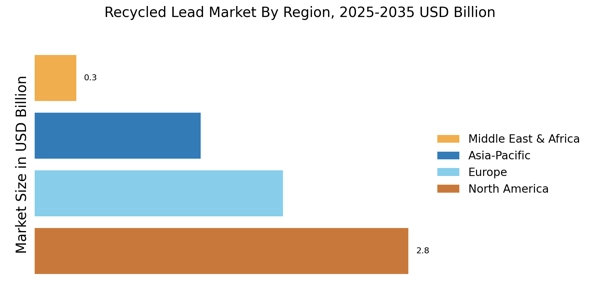
North America is the largest market for recycled lead, holding approximately 45% of the global share. The growth is driven by stringent environmental regulations and increasing demand for sustainable energy solutions. The region's focus on recycling initiatives and battery manufacturing has catalyzed market expansion, with a notable rise in lead-acid battery recycling. The U.S. and Canada are the primary contributors, with the U.S. alone accounting for about 35% of the market share. The competitive landscape in North America is robust, featuring key players such as Exide Technologies, Johnson Controls International, and EnerSys. These companies are investing in advanced recycling technologies to enhance efficiency and reduce environmental impact. The presence of established manufacturers and a growing emphasis on sustainability are expected to further drive market growth in the coming years.

Europe : Regulatory-Driven Market Dynamics

Europe is the second-largest market for recycled lead, capturing around 30% of the global market share. The region's growth is significantly influenced by the European Union's stringent regulations on waste management and recycling. Initiatives like the Circular Economy Action Plan are pivotal in promoting lead recycling, thereby reducing environmental impact. Countries like Germany and the UK are leading the charge, with Germany holding approximately 15% of the market share due to its advanced recycling infrastructure. The competitive landscape in Europe is characterized by a mix of local and international players, including Sonnenschein and C&D Technologies. The market is witnessing increased collaboration among companies to enhance recycling processes and meet regulatory standards. The focus on sustainability and innovation is driving investments in new technologies, positioning Europe as a leader in the recycled lead market.

Asia-Pacific : Emerging Market Potential

Asia-Pacific is rapidly emerging as a significant player in the recycled lead market, holding approximately 20% of the global share. The region's growth is fueled by rising industrialization, urbanization, and increasing demand for lead-acid batteries in automotive and renewable energy sectors. Countries like China and India are at the forefront, with China accounting for about 12% of the market share, driven by its extensive battery manufacturing capabilities and recycling initiatives. The competitive landscape in Asia-Pacific is evolving, with both established players and new entrants vying for market share. Companies are increasingly focusing on enhancing recycling technologies and processes to meet the growing demand. The presence of key players such as East Penn Manufacturing and Crown Battery Manufacturing is expected to bolster market growth, as they invest in sustainable practices and innovation to capture the expanding market opportunities.

Middle East and Africa : Resource-Rich Market Landscape

The Middle East and Africa region is gradually developing its recycled lead market, currently holding about 5% of the global share. The growth is primarily driven by increasing industrial activities and a rising awareness of environmental sustainability. Countries like South Africa and the UAE are leading the market, with South Africa contributing significantly due to its mining and recycling capabilities. The region's focus on improving waste management practices is expected to catalyze further growth in the coming years. The competitive landscape in the Middle East and Africa is still in its nascent stages, with several local players emerging to meet the growing demand for recycled lead. The presence of key players is limited, but there is a growing interest from international companies looking to invest in the region. As regulations around recycling become more stringent, the market is poised for growth, driven by both local and foreign investments.

Recycled Lead Market Regional Image

Key Players and Competitive Insights

The Recycled Lead Market is currently characterized by a dynamic competitive landscape, driven by increasing demand for sustainable practices and stringent regulatory frameworks. Key players such as Exide Technologies (US), Johnson Controls International (IE), and EnerSys (US) are strategically positioned to leverage their extensive operational capabilities and technological advancements. Exide Technologies (US) focuses on innovation in battery recycling processes, aiming to enhance efficiency and reduce environmental impact. Meanwhile, Johnson Controls International (IE) emphasizes regional expansion and partnerships to strengthen its market presence, particularly in Europe and North America. EnerSys (US) is actively pursuing digital transformation initiatives to optimize its supply chain and improve customer engagement, thereby shaping a competitive environment that prioritizes sustainability and technological integration.In terms of business tactics, companies are increasingly localizing manufacturing to reduce transportation costs and enhance supply chain resilience. The Recycled Lead Market appears moderately fragmented, with several key players exerting influence over their respective regions. This fragmentation allows for a diverse range of strategies, as companies seek to differentiate themselves through localized operations and optimized supply chains.

In August Exide Technologies (US) announced a partnership with a leading technology firm to develop advanced recycling technologies aimed at increasing lead recovery rates. This strategic move is significant as it not only enhances Exide's operational efficiency but also aligns with the growing emphasis on sustainable practices within the industry. By investing in innovative recycling technologies, Exide positions itself as a leader in the transition towards a circular economy.

In September Johnson Controls International (IE) launched a new initiative focused on expanding its recycling facilities in Europe. This expansion is crucial as it allows the company to meet the rising demand for recycled lead in the region, driven by regulatory pressures and consumer preferences for sustainable products. The initiative underscores Johnson Controls' commitment to sustainability and its strategic focus on enhancing its operational footprint in key markets.

In July EnerSys (US) unveiled a digital platform designed to streamline its recycling operations and improve customer interactions. This platform is expected to enhance operational efficiency and provide real-time data analytics, which could lead to better decision-making processes. The introduction of such digital solutions reflects a broader trend within the industry towards integrating technology into traditional operations, thereby fostering innovation and improving service delivery.

As of October the Recycled Lead Market is witnessing trends that emphasize digitalization, sustainability, and the integration of artificial intelligence. Strategic alliances among key players are increasingly shaping the competitive landscape, as companies collaborate to enhance their technological capabilities and market reach. Looking ahead, it is likely that competitive differentiation will evolve, shifting from price-based competition to a focus on innovation, technology, and supply chain reliability. This transition may redefine how companies position themselves in the market, ultimately fostering a more sustainable and efficient industry.

Key Companies in the Recycled Lead Market include

Industry Developments

  • Q2 2024: Aqua Metals Announces Commissioning of First Commercial-Scale Clean Lead Recycling Facility Aqua Metals announced the commissioning of its first commercial-scale clean lead recycling facility in Tahoe-Reno Industrial Center, Nevada, marking a significant milestone in sustainable lead recycling using its proprietary AquaRefining technology.
  • Q2 2024: Gravita India Limited Commences Commercial Production at New Recycled Lead Market Plant in Tanzania Gravita India Limited announced the start of commercial production at its new recycled lead processing plant in Tanzania, expanding its international footprint and increasing its total recycling capacity.
  • Q2 2024: Boliden Invests in Expansion of Lead Recycling Operations at Bergsöe Facility Boliden Group announced a major investment to expand lead recycling capacity at its Bergsöe facility in Sweden, aiming to meet growing demand for recycled lead in Europe.
  • Q3 2024: Gravita India Limited Secures Long-Term Supply Contract for Recycled Lead Market with Global Battery Manufacturer Gravita India Limited signed a multi-year supply agreement to provide recycled lead to a leading global battery manufacturer, strengthening its position in the international recycled lead supply chain.
  • Q3 2024: Aqua Metals and 6K Energy Announce Strategic Partnership to Advance Sustainable Battery Materials Aqua Metals and 6K Energy entered a strategic partnership to develop and commercialize sustainable battery materials, leveraging recycled lead and advanced manufacturing technologies.
  • Q4 2024: Europe’s Largest Lead Recycler, Eco-Bat, Appoints New CEO to Drive Expansion Eco-Bat, Europe’s largest lead recycling company, appointed a new CEO to lead its next phase of expansion and investment in advanced recycling technologies.
  • Q4 2024: India’s Gravita to Invest $25 Million in New Recycled Lead Market Facility in Latin America Gravita India announced a $25 million investment to build a new recycled lead facility in Latin America, targeting increased demand from the automotive and energy storage sectors.
  • Q1 2025: Aqua Metals Raises $40 Million in Public Offering to Expand Clean Lead Recycling Operations Aqua Metals completed a $40 million public offering to fund the expansion of its clean lead recycling operations and accelerate commercialization of its proprietary technology.
  • Q1 2025: Boliden Group Signs Agreement with European Automotive Consortium for Recycled Lead Market Supply Boliden Group signed a supply agreement with a consortium of European automotive manufacturers to provide recycled lead for use in new vehicle batteries.
  • Q2 2025: Gravita India Limited Launches New Recycled Lead Market Product Line for Renewable Energy Storage Gravita India Limited launched a new product line of recycled lead specifically designed for renewable energy storage applications, targeting the growing solar and wind energy markets.
  • Q2 2025: Eco-Bat Announces Acquisition of UK-Based Lead Recycling Firm Eco-Bat announced the acquisition of a UK-based lead recycling company, expanding its market share and recycling capacity in the region.
  • Q3 2025: Aqua Metals Signs Memorandum of Understanding with US Department of Energy for Lead Battery Recycling Research Aqua Metals signed an MoU with the US Department of Energy to collaborate on research and development of advanced lead battery recycling technologies.

Future Outlook

Recycled Lead Market Future Outlook

The Recycled Lead Market is projected to grow at a 4.21% CAGR from 2025 to 2035, driven by increasing demand for sustainable materials and regulatory support.

New opportunities lie in:

  • Expansion of battery recycling facilities in emerging markets.
  • Development of advanced lead recovery technologies for efficiency.
  • Partnerships with automotive manufacturers for sustainable sourcing.

By 2035, the market is expected to solidify its position as a leader in sustainable materials.

Market Segmentation

Recycled Lead Market Lead Source Outlook

  • Post-Consumer Batteries
  • Industrial Scrap
  • Manufacturing Scrap

Recycled Lead Market Purity Levels Outlook

  • High Purity Lead
  • Standard Purity Lead

Recycled Lead Market Processing Methods Outlook

  • Pyrometallurgical Process
  • Hydrometallurgical Process

Recycled Lead Market End Use Applications Outlook

  • Automotive Batteries
  • Power Backup Systems
  • Renewable Energy Storage

Report Scope

MARKET SIZE 20246.145(USD Billion)
MARKET SIZE 20256.404(USD Billion)
MARKET SIZE 20359.675(USD Billion)
COMPOUND ANNUAL GROWTH RATE (CAGR)4.21% (2025 - 2035)
REPORT COVERAGERevenue Forecast, Competitive Landscape, Growth Factors, and Trends
BASE YEAR2024
Market Forecast Period2025 - 2035
Historical Data2019 - 2024
Market Forecast UnitsUSD Billion
Key Companies ProfiledExide Technologies (US), Johnson Controls International (IE), EnerSys (US), C&D Technologies (US), Sonnenschein (DE), East Penn Manufacturing (US), Crown Battery Manufacturing (US), RSR Corporation (US)
Segments CoveredLead Source, End Use Applications, Processing Methods, Purity Levels, Market Participants, Regional
Key Market OpportunitiesGrowing demand for sustainable battery solutions drives innovation in the Recycled Lead Market.
Key Market DynamicsRising regulatory pressures and technological advancements drive innovation and competition in the recycled lead market.
Countries CoveredNorth America, Europe, APAC, South America, MEA
Leave a Comment

FAQs

What is the projected market valuation of the Recycled Lead Market by 2035?

The Recycled Lead Market is projected to reach a valuation of 9.675 USD Billion by 2035.

What was the market valuation of the Recycled Lead Market in 2024?

In 2024, the overall market valuation was 6.145 USD Billion.

What is the expected CAGR for the Recycled Lead Market during the forecast period 2025 - 2035?

The expected CAGR for the Recycled Lead Market during the forecast period 2025 - 2035 is 4.21%.

Which companies are considered key players in the Recycled Lead Market?

Key players in the Recycled Lead Market include Exide Technologies, Johnson Controls International, and EnerSys, among others.

What are the main segments of the Recycled Lead Market based on lead source?

The main segments based on lead source include Post-Consumer Batteries, Industrial Scrap, and Manufacturing Scrap.

How much is the Post-Consumer Batteries segment valued at in 2025?

The Post-Consumer Batteries segment is valued at approximately 3.675 USD Billion in 2025.

What is the valuation of the Automotive Batteries segment in 2025?

The Automotive Batteries segment is projected to be valued at 4.0 USD Billion in 2025.

What processing methods are utilized in the Recycled Lead Market?

The Recycled Lead Market utilizes processing methods such as Pyrometallurgical and Hydrometallurgical processes.

What is the projected value of the Hydrometallurgical Process segment in 2035?

The Hydrometallurgical Process segment is projected to reach a value of 5.35 USD Billion by 2035.

Download Free Sample

Kindly complete the form below to receive a free sample of this Report

Compare Licence

×
Features License Type
Single User Multiuser License Enterprise User
Price $4,950 $ $7,250
Maximum User Access Limit 1 User Upto 10 Users Unrestricted Access Throughout the Organization
Free Customization
Direct Access to Analyst
Deliverable Format
Platform Access
Discount on Next Purchase 10% 15% 15%
Printable Versions