×
Request Free Sample ×

Kindly complete the form below to receive a free sample of this Report

* Please use a valid business email

Leading companies partner with us for data-driven Insights

clients tt-cursor
Hero Background
English
Chinese
French
Japanese
Korean
German
Spanish

Reading Glasses Market Share

ID: MRFR/HC/10501-HCR
128 Pages
Rahul Gotadki
October 2025

Reading Glasses Market Research Report Information By Age Group (Less Than 18 Years, 18-64 Years, and 65 Years and Greater), By Type (Prescription Reading Glasses and OTC Reading Glasses), By Distribution Channel (Retail Stores, Online Sales Channels, and Ophthalmology Clinics), and By Region (North America, Europe, Asia-Pacific, and Rest Of The World) – Market Forecast Till 2035

Share:
Download PDF ×

We do not share your information with anyone. However, we may send you emails based on your report interest from time to time. You may contact us at any time to opt-out.

Reading Glasses Market Infographic
Purchase Options

Market Share

Reading Glasses Market Share Analysis

The Reading Glasses market, catering to individuals with presbyopia or age-related farsightedness, requires strategic market positioning. Companies operating in this consumer eyewear sector employ various strategies to gain and retain market share while meeting the diverse needs of their target audience. In Reading Glasses market, a few businesses target specifically a certain age group through their marketing endeavors. Lack of adjustability of the readable font makes the information less perceptible for the baby boomers and the elderly as they need change of either size or magnification. What make the Reading Glasses market prominently are their original designs particularly when it comes to being stylish and in fashion. The provision of frames that partly have the same trends with fashion gives consumers not only what they need but also a stylish erotic to the ears, making the readers a fashion accessory. Judicious collaboration with retailers and realization of conspicuous in-store displays is a basic factor of sale presence in the Reading Glasses market. Setting strategically in the eyewear sections, having clear signage and attractive displays can play an important role of given you the opportunity to attract clients that need read glasses. Recognizing wide usage of these glasses, organizations may build-up their low price plans. By offering a special deal that allows certain customers to buy several pairs at one low price, we make bulk purchases a reality, establish our brand as reliable and inexpensive. Aware of the heterogeneous reading needs of road users, e.g., company owners (in the context of road users) create goods adapted to different reading distances. Among factors to consider could be providing reading glasses with asymmetric magnification strengths to ensure customers get the correct measures that will not impair their vision. The manufacturers participating in the Reading Glasses market normally integrate health and eye-popping slogans while advertising their products. Directing attention on how we all should execute routine eye examinations, use proper glasses as protection policy and overall eye health play a major role in building trust and naming you a wellbeing consumer agent.

Companies contribute to customer education by providing content on eye health, presbyopia, and the benefits of using reading glasses. This not only helps consumers make informed choices but also positions the brand as an authority in vision care. Actively seeking and integrating customer feedback is crucial for product improvement. Companies monitor reviews and engage in two-way communication to address concerns, refine designs, and enhance overall customer satisfaction, contributing to a positive brand image.

Author
Rahul Gotadki
Assistant Manager

He holds an experience of about 7+ years in Market Research and Business Consulting, working under the spectrum of Life Sciences and Healthcare domains. Rahul conceptualizes and implements a scalable business strategy and provides strategic leadership to the clients. His expertise lies in market estimation, competitive intelligence, pipeline analysis, customer assessment, etc. In addition to the above, his other responsibility includes strategic tracking of high growth markets & advising clients on the potential areas of focus they could direct their business initiatives

Leave a Comment

FAQs

How much is the Reading Glasses market?

The Reading Glasses Market Type was valued at USD 38.9 Billion in 2022.

What is the growth rate of the Reading Glasses market?

The global market is projected to grow at a CAGR of 5.70% during the forecast period, 2023-2032.

Which region held the largest market share in the Reading Glasses market?

North America had the largest share in the global market

Who are the key players in the Reading Glasses market?

The key players in the market are Bausch & Lomb Incorporated., EssilorLuxottica, Carl Zeiss, Johnson & Johnson Services, Inc., Hoya Corporation, De Rigo Vision S.p.A., ZENNI OPTICAL, INC., and ThinkOptic Inc

Which Age Group led the Reading Glasses market?

The 18-64 Years Age Group dominated the market in 2022.

Which Type had the largest market share in the Reading Glasses market?

The Prescription Reading Glasses Type had the largest share in the global market.

Market Summary

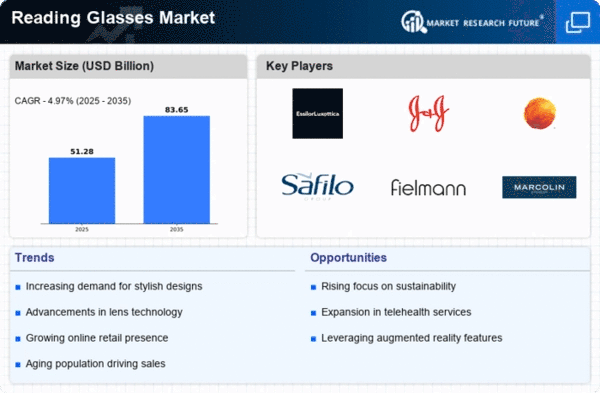
As per MRFR analysis, the Reading Glasses Market Size was estimated at 48.85 USD Billion in 2024. The Reading Glasses industry is projected to grow from 51.84 USD Billion in 2025 to 83.65 USD Billion by 2035, exhibiting a compound annual growth rate (CAGR) of 4.97 during the forecast period 2025 - 2035.

Key Market Trends & Highlights

The Reading Glasses Market is experiencing a dynamic shift towards stylish and sustainable options driven by technological advancements and demographic changes.

  • The demand for stylish designs in reading glasses is surging, particularly among adults in North America. Online retail is expanding rapidly, making reading glasses more accessible to consumers in the Asia-Pacific region. Sustainability is becoming a focal point, with brands increasingly adopting eco-friendly materials and practices. The aging population and rising awareness of eye health are key drivers propelling growth in the reading glasses market.

Market Size & Forecast

2024 Market Size 48.85 (USD Billion)
2035 Market Size 83.65 (USD Billion)
CAGR (2025 - 2035) 4.97%
Largest Regional Market Share in 2024 North America

Major Players

<p><a href="https://www.essilorluxottica.com/en/brands/eyewear/">EssilorLuxottica</a> (FR), Johnson &amp; Johnson (US), Bausch + Lomb (CA), CooperVision (US), Safilo Group (IT), Fielmann AG (DE), Marcolin S.p.A. (IT), Kering Eyewear (FR), Rodenstock GmbH (DE)</p>

Market Trends

The Reading Glasses Market is currently experiencing a notable transformation, driven by various factors that influence consumer preferences and technological advancements. As individuals age, the prevalence of presbyopia increases, leading to a heightened demand for reading glasses. This trend is further amplified by the growing awareness of eye health and the importance of vision correction. Additionally, the rise of digital devices has contributed to an increase in eye strain, prompting consumers to seek solutions that alleviate discomfort. Consequently, manufacturers are innovating to create stylish, functional, and comfortable eyewear that caters to diverse consumer needs. Moreover, the Reading Glasses Market is witnessing a shift towards online retail channels, as consumers increasingly prefer the convenience of purchasing eyewear from the comfort of their homes. This trend is supported by advancements in virtual try-on technologies, which enhance the online shopping experience. Furthermore, sustainability is becoming a focal point, with brands exploring eco-friendly materials and production methods. As the market evolves, it appears poised for growth, driven by a combination of demographic shifts, technological innovations, and changing consumer behaviors.

Increased Demand for Stylish Designs

The Reading Glasses Market is seeing a surge in demand for fashionable eyewear. Consumers are increasingly seeking reading glasses that not only serve a functional purpose but also reflect personal style. This trend indicates a shift towards viewing reading glasses as a fashion accessory rather than merely a necessity.

Growth of Online Retail

The transition to online shopping is reshaping the Reading Glasses Market. With the convenience of e-commerce, consumers are more inclined to purchase eyewear online. This trend is bolstered by advancements in technology that allow for virtual try-ons, enhancing consumer confidence in online purchases.

Focus on Sustainability

Sustainability is becoming a critical consideration in the Reading Glasses Market. Brands are exploring eco-friendly materials and sustainable production practices. This trend reflects a growing consumer preference for environmentally responsible products, indicating a potential shift in market dynamics.

Reading Glasses Market Market Drivers

Aging Population

The Global Reading Glasses Market Industry is significantly influenced by the aging population, which is projected to increase substantially in the coming years. As individuals age, the prevalence of presbyopia, a condition that affects nearly everyone over the age of 40, rises. In 2024, the market is valued at approximately 42.7 USD Billion, driven by the growing need for vision correction among older adults. This demographic shift suggests that the demand for reading glasses will continue to expand, as older consumers seek solutions to maintain their quality of life and independence.

E-commerce Growth

The expansion of e-commerce platforms is reshaping the Global Reading Glasses Market Industry by providing consumers with greater access to a variety of products. Online shopping allows for convenient comparisons of styles, prices, and features, enabling consumers to make informed choices. This trend is particularly appealing to younger consumers who prefer the convenience of online shopping. As e-commerce continues to thrive, it is likely to enhance market penetration and drive sales, further contributing to the industry's growth trajectory in the coming years.

Increased Screen Time

The rise in screen time, particularly among younger demographics, is a notable driver of the Global Reading Glasses Market Industry. With more individuals engaging with digital devices for work and leisure, the incidence of digital eye strain has surged. This condition often necessitates the use of reading glasses to alleviate discomfort and improve visual performance. As awareness of eye health grows, consumers are more inclined to invest in specialized eyewear, contributing to the market's projected growth to 75.7 USD Billion by 2035.

Market Growth Projections

The Global Reading Glasses Market Industry is poised for substantial growth, with projections indicating a market value of 42.7 USD Billion in 2024 and an anticipated increase to 75.7 USD Billion by 2035. This growth reflects a CAGR of 5.34% from 2025 to 2035, underscoring the industry's resilience and adaptability in response to evolving consumer needs. The upward trajectory of the market is indicative of the increasing importance of vision correction solutions in daily life, driven by demographic shifts and technological advancements.

Technological Advancements

Innovations in lens technology and frame design are propelling the Global Reading Glasses Market Industry forward. Advancements such as blue light filtering lenses and lightweight materials enhance user comfort and visual clarity. These developments cater to a tech-savvy consumer base that increasingly relies on digital devices, which can exacerbate eye strain. As a result, the market is expected to grow at a CAGR of 5.34% from 2025 to 2035, indicating a robust response to consumer demands for improved functionality and style in reading glasses.

Health Awareness and Preventive Care

Growing health awareness and a focus on preventive care are pivotal in shaping the Global Reading Glasses Market Industry. Consumers are increasingly recognizing the importance of regular eye examinations and proactive measures to maintain vision health. This trend is reflected in the rising demand for reading glasses as individuals seek to address vision issues before they escalate. The market's growth is indicative of a broader societal shift towards prioritizing health and wellness, which is expected to sustain momentum in the coming years.

Market Segment Insights

By Application: Reading (Largest) vs. Computer Use (Fastest-Growing)

<p>In the Reading Glasses Market, the application segment exhibits a diverse range of uses, with the reading application holding the largest share. It caters to a broad demographic, reflecting steady consumer demand for reading glasses that provide comfort and clarity. Following closely, computer use has gained significant traction, driven by the increasing reliance on screens in both personal and professional settings, marking a notable shift in consumer preferences and needs.</p>

<p>Reading (Dominant) vs. Computer Use (Emerging)</p>

<p>Reading glasses serve a vital role in enhancing everyday reading experiences, making this segment a dominant force in the market. They are designed primarily for short to medium vision correction, often featuring lightweight frames and stylish designs that attract a wide customer base. In contrast, computer use glasses are an emerging segment, catering to the growing population of digital device users. These glasses often incorporate advanced coatings to reduce eye strain from prolonged screen exposure, making them increasingly popular among professionals. As remote work and technology adoption rise, computer use glasses are positioned for rapid growth.</p>

By End User: Adults (Largest) vs. Seniors (Fastest-Growing)

<p>In the Reading Glasses Market, the 'Adults' segment holds the largest share, driven by the increasing prevalence of vision-related issues among this demographic. Adults, typically aged between 30 and 60, frequently use reading glasses for tasks such as reading, working on computers, and other daily activities. This has led to a robust demand within this segment, reflecting a significant portion of overall market sales. On the other hand, the 'Seniors' segment is emerging as the fastest-growing demographic for reading glasses. As the global population ages, more seniors require reading glasses to cope with age-related visual impairments, particularly presbyopia. This rapid increase indicates a shift in consumer needs and creates new opportunities for growth within this segment.</p>

<p>Adults (Dominant) vs. Seniors (Emerging)</p>

<p>The 'Adults' segment in the Reading Glasses Market is characterized by a wide range of styles and functionalities that cater to the versatile demands of working and reading adults. This demographic focuses on practical, durable, and trendy designs, often prioritizing functionality and aesthetics equally. Many brands are innovating by introducing adjustable lenses and blue light blocking features tailored for adults who spend prolonged hours on digital screens. Conversely, the 'Seniors' segment represents an emerging market driven by a growing population of older individuals needing reading assistance. This demographic values comfort, ease of use, and lightweight designs. Companies are increasingly targeting seniors with specialized offerings that include progressive and bifocal lenses, ensuring that the needs of this segment are met effectively.</p>

By Material: Plastic (Largest) vs. Metal (Fastest-Growing)

<p>The Reading Glasses Market showcases a diverse range of materials, with plastic leading the way due to its lightweight and durable properties. Plastic frames are preferred by consumers for their affordability and comfort. Metal frames, while historically less popular, are experiencing a resurgence, capturing a growing share of the market as styles evolve towards more premium materials. Glass, polycarbonate, and acrylic have their niche markets, often preferred for specific design aesthetics or functional needs. In terms of growth trends, plastic remains the dominant choice, driven by consumer demand for budget-friendly options, while metal is on the rise, appealing to fashion-forward consumers seeking durability and style. Another contributing factor to the growth of metal frames is the increasing popularity of sustainable materials, reflecting a shift in consumer preferences towards eco-friendly products. Polycarbonate and acrylic, though less prominent, continue to cater to a distinct audience focused on specific benefits like impact resistance and lightweight characteristics.</p>

<p>Plastic (Dominant) vs. Metal (Emerging)</p>

<p>Plastic frames dominate the Reading Glasses Market due to their appealing combination of affordability, comfort, and variety. They cater to a broad demographic, from budget-conscious buyers to fashion-forward individuals seeking style without sacrificing durability. The lightweight nature of plastic makes it an ideal choice for everyday wear. In contrast, metal frames are emerging in popularity, particularly among consumers looking for premium options that offer a sophisticated aesthetic. These frames are often associated with durability and a higher-end look, which has led to an increasing number of brands introducing metal designs, particularly as fashion trends gravitate towards elegance and sustainability, positioning metal as a viable competitor to plastic.</p>

By Lens Type: Single Vision (Largest) vs. Progressive (Fastest-Growing)

<p>In the Reading Glasses Market, Single Vision lenses hold the largest market share due to their simplicity and widespread prescription use. The ease of use and affordability of Single Vision lenses make them a popular choice among consumers. Meanwhile, Progressive lenses are rapidly gaining popularity due to their multifocal capabilities, allowing users to adapt to different vision needs without the need for multiple pairs of glasses, thus carving out a significant share in a relatively short time.</p>

<p>Single Vision (Dominant) vs. Progressive (Emerging)</p>

<p>Single Vision lenses dominate the Reading Glasses Market, appealing to a broad demographic with their straightforward design, catering to those who primarily need help with near vision. Their accessibility contributes greatly to their market dominance. On the other hand, Progressive lenses are positioned as a significant emerging segment, offering a seamless transition between different focal lengths, appealing particularly to aging populations and tech-savvy individuals looking for versatile solutions. The rise in digital screen usage has driven interest in progressive options, influencing their rapid growth.</p>

By Style: Full Frame (Largest) vs. Rimless (Fastest-Growing)

<p>The Reading Glasses Market is diverse, with Full Frame, Half Frame, Rimless, Reading Clip-ons, and Fashion Reading Glasses vying for consumer attention. Among these, Full Frame glasses dominate the market due to their wide availability and versatility in styles and designs. Half Frame glasses hold a smaller yet significant share, appealing to individuals who prefer lightweight options. Rimless glasses, while traditionally a niche choice, are gaining traction and are becoming increasingly popular in modern fashions. Growth trends in the Reading Glasses Market are driven by an aging population experiencing vision problems, as well as the increasing prevalence of digital eye strain among younger demographics. Consumers are seeking more stylish and comfortable options, propelling the demand for Rimless glasses. As consumers become more fashion-conscious, Fashion Reading Glasses are also starting to shape purchasing decisions, signaling a shift towards innovation and aesthetic appeal in an otherwise functional segment.</p>

<p>Full Frame (Dominant) vs. Rimless (Emerging)</p>

<p>Full Frame glasses have established themselves as the dominant style in the Reading Glasses Market, known for their robustness and the ability to accommodate progressive lenses. These frames provide full facial coverage, making them a practical choice for many consumers who prioritize comfort and visual clarity. They are available in a plethora of designs, catering to various fashion preferences, which further solidifies their popularity. In contrast, Rimless glasses are emerging as a stylish alternative, particularly among younger consumers or professionals who value minimalism and elegance. These frames offer a lightweight feel and a nearly invisible look, making them appealing to those who prefer a subtle aesthetic. As the trend towards modern, unobtrusive eyewear continues, Rimless glasses are expected to capture a more significant share of the market.</p>

Get more detailed insights about Reading Glasses Market Research Report—Global Forecast till 2035

Regional Insights

North America : Market Leader in Reading Glasses

North America is poised to maintain its leadership in the reading glasses market, holding a significant market share of 20.0 in 2024. The region's growth is driven by an aging population, increasing screen time, and a rising awareness of eye health. Regulatory support for vision care and eyewear accessibility further fuels demand, making it a robust market for reading glasses. The competitive landscape in North America is characterized by the presence of major players such as EssilorLuxottica, Johnson & Johnson, and Bausch + Lomb. These companies are leveraging innovative technologies and marketing strategies to capture consumer attention. The U.S. and Canada are the leading countries, with a strong retail presence and a growing trend towards online sales, enhancing market accessibility.

Europe : Emerging Trends in Eyewear

Europe's reading glasses market is projected to grow, with a market size of 15.0 in 2024. Key growth drivers include an increasing elderly population, rising digital device usage, and heightened awareness of vision health. Regulatory frameworks in various countries support eye care initiatives, contributing to market expansion. The region is also witnessing a shift towards sustainable eyewear solutions, aligning with consumer preferences for eco-friendly products. Leading countries in Europe include Germany, France, and Italy, where companies like Fielmann AG and Safilo Group are prominent. The competitive landscape is marked by a mix of established brands and emerging players focusing on innovative designs and materials. The market is also seeing a rise in online retail channels, making eyewear more accessible to consumers.

Asia-Pacific : Rapid Growth in Eyewear Market

The Asia-Pacific region is experiencing significant growth in the reading glasses market, with a market size of 10.0 in 2024. Factors driving this growth include increasing urbanization, a growing middle class, and rising awareness of eye health. Additionally, government initiatives aimed at improving healthcare access are contributing to the demand for reading glasses, making this region a key player in the global market. Countries like China, Japan, and India are leading the charge, with a competitive landscape featuring both local and international brands. Key players such as CooperVision and Marcolin S.p.A. are expanding their presence through innovative product offerings and strategic partnerships. The rise of e-commerce is also transforming the way consumers purchase eyewear, enhancing market reach and accessibility.

Middle East and Africa : Emerging Market Potential

The Middle East and Africa (MEA) region is gradually emerging in the reading glasses market, with a market size of 3.85 in 2024. The growth is driven by increasing awareness of eye health, rising disposable incomes, and a growing population. Regulatory efforts to improve healthcare access are also playing a crucial role in expanding the market for reading glasses in this region. Leading countries in the MEA region include South Africa and the UAE, where the presence of key players like Rodenstock GmbH is notable. The competitive landscape is evolving, with both local and international brands vying for market share. The region is witnessing a shift towards online retail, which is enhancing accessibility and convenience for consumers seeking reading glasses.

Key Players and Competitive Insights

The Reading Glasses Market is characterized by a dynamic competitive landscape, driven by an increasing aging population and a growing prevalence of vision-related issues. Key players such as EssilorLuxottica (FR), Johnson & Johnson (US), and Bausch + Lomb (CA) are strategically positioned to leverage innovation and technological advancements. EssilorLuxottica (FR) focuses on integrating digital solutions into its product offerings, enhancing customer experience through augmented reality (AR) applications. Meanwhile, Johnson & Johnson (US) emphasizes expanding its product portfolio through strategic acquisitions, thereby diversifying its market presence. Bausch + Lomb (CA) is concentrating on sustainability initiatives, aiming to reduce its environmental footprint while maintaining product quality. Collectively, these strategies contribute to a competitive environment that is increasingly centered on innovation and customer-centric solutions.The market structure appears moderately fragmented, with a mix of established players and emerging brands. Key business tactics such as localizing manufacturing and optimizing supply chains are prevalent among major companies. For instance, many firms are investing in regional production facilities to reduce lead times and enhance responsiveness to local market demands. This localized approach not only improves operational efficiency but also allows companies to adapt more swiftly to changing consumer preferences, thereby strengthening their competitive positions.


In November EssilorLuxottica (FR) announced a partnership with a leading tech firm to develop smart reading glasses that integrate AI capabilities. This strategic move is likely to position the company at the forefront of technological innovation in the reading glasses segment, appealing to tech-savvy consumers seeking enhanced functionality. The collaboration underscores the importance of integrating advanced technology into eyewear, potentially reshaping consumer expectations and driving market growth.


In October Johnson & Johnson (US) completed the acquisition of a prominent eyewear startup specializing in customizable reading glasses. This acquisition is indicative of the company's strategy to diversify its offerings and cater to the growing demand for personalized eyewear solutions. By enhancing its product range, Johnson & Johnson (US) aims to capture a larger market share and respond effectively to evolving consumer preferences.


In September Bausch + Lomb (CA) launched a new line of eco-friendly reading glasses made from recycled materials. This initiative aligns with the increasing consumer demand for sustainable products and reflects the company's commitment to environmental responsibility. By prioritizing sustainability, Bausch + Lomb (CA) not only enhances its brand image but also positions itself favorably in a market that is progressively leaning towards eco-conscious choices.


As of December current trends in the Reading Glasses Market indicate a strong emphasis on digitalization, sustainability, and the integration of AI technologies. Strategic alliances among key players are shaping the competitive landscape, fostering innovation and collaboration. The shift from price-based competition to a focus on technological advancements and supply chain reliability is becoming increasingly evident. Moving forward, companies that prioritize innovation and sustainability are likely to differentiate themselves in a crowded market, ultimately driving long-term growth and consumer loyalty.

Key Companies in the Reading Glasses Market include

Industry Developments

July 2022: Together, Carl Zeiss Meditec and Precise Bio will develop and market tissue-based implants for the field of ophthalmology.

March 2022: The U.S. Food and Drug Administration (FDA) has approved ACUVUE Theravision with Ketotifen (etafilcon), according to Johnson & Johnson Vision Care, Inc., a leader in eye health on a global scale. a ketotifen-containing drug-eluting contact lens).

Future Outlook

Reading Glasses Market Future Outlook

<p>The Reading Glasses Market is projected to grow at a 4.97% CAGR from 2025 to 2035, driven by aging populations, increasing digital device usage, and rising awareness of eye health.</p>

New opportunities lie in:

  • <p>Expansion of online retail platforms for direct-to-consumer sales. Development of customizable reading glasses with advanced lens technology. Partnerships with healthcare providers for integrated <a href="https://www.marketresearchfuture.com/reports/vision-care-market-8450">vision care</a> solutions.</p>

<p>By 2035, the Reading Glasses Market is expected to achieve robust growth, reflecting evolving consumer needs and technological advancements.</p>

Market Segmentation

Reading Glasses Market Style Outlook

  • Full Frame
  • Half Frame
  • Rimless
  • Reading Clip-ons
  • Fashion Reading Glasses

Reading Glasses Market End User Outlook

  • Adults
  • Seniors
  • Children
  • Professionals
  • Students

Reading Glasses Market Material Outlook

  • Plastic
  • Metal
  • Glass
  • Polycarbonate
  • Acrylic

Reading Glasses Market Lens Type Outlook

  • Single Vision
  • Bifocal
  • Progressive
  • Photochromic
  • Blue Light Blocking

Reading Glasses Market Application Outlook

  • Reading
  • Computer Use
  • Mobile Device Use
  • Crafting
  • Professional Use

Report Scope

MARKET SIZE 2024 48.85(USD Billion)
MARKET SIZE 2025 51.84(USD Billion)
MARKET SIZE 2035 83.65(USD Billion)
COMPOUND ANNUAL GROWTH RATE (CAGR) 4.97% (2025 - 2035)
REPORT COVERAGE Revenue Forecast, Competitive Landscape, Growth Factors, and Trends
BASE YEAR 2024
Market Forecast Period 2025 - 2035
Historical Data 2019 - 2024
Market Forecast Units USD Billion
Key Companies Profiled EssilorLuxottica (FR), Johnson & Johnson (US), Bausch + Lomb (CA), CooperVision (US), Safilo Group (IT), Fielmann AG (DE), Marcolin S.p.A. (IT), Kering Eyewear (FR), Rodenstock GmbH (DE)
Segments Covered Application, End User, Material, Lens Type, Style
Key Market Opportunities Integration of smart technology in Reading Glasses Market enhances user experience and functionality.
Key Market Dynamics Rising consumer demand for stylish and functional reading glasses drives innovation and competition among manufacturers.
Countries Covered North America, Europe, APAC, South America, MEA

FAQs

How much is the Reading Glasses market?

The Reading Glasses Market Type was valued at USD 38.9 Billion in 2022.

What is the growth rate of the Reading Glasses market?

The global market is projected to grow at a CAGR of 5.70% during the forecast period, 2023-2032.

Which region held the largest market share in the Reading Glasses market?

North America had the largest share in the global market

Who are the key players in the Reading Glasses market?

The key players in the market are Bausch &amp; Lomb Incorporated., EssilorLuxottica, Carl Zeiss, Johnson &amp; Johnson Services, Inc., Hoya Corporation, De Rigo Vision S.p.A., ZENNI OPTICAL, INC., and ThinkOptic Inc

Which Age Group led the Reading Glasses market?

The 18-64 Years Age Group dominated the market in 2022.

Which Type had the largest market share in the Reading Glasses market?

The Prescription Reading Glasses Type had the largest share in the global market.

  1. SECTION I: EXECUTIVE SUMMARY AND KEY HIGHLIGHTS
    1. | 1.1 EXECUTIVE SUMMARY
    2. | 1.1.1 Market Overview
    3. | 1.1.2 Key Findings
    4. | 1.1.3 Market Segmentation
    5. | 1.1.4 Competitive Landscape
    6. | 1.1.5 Challenges and Opportunities
    7. | 1.1.6 Future Outlook
  2. SECTION II: SCOPING, METHODOLOGY AND MARKET STRUCTURE
    1. | 2.1 MARKET INTRODUCTION
    2. | 2.1.1 Definition
    3. | 2.1.2 Scope of the study
    4. |-- 2.1.2.1 Research Objective
    5. |-- 2.1.2.2 Assumption
    6. |-- 2.1.2.3 Limitations
    7. | 2.2 RESEARCH METHODOLOGY
    8. | 2.2.1 Overview
    9. | 2.2.2 Data Mining
    10. | 2.2.3 Secondary Research
    11. | 2.2.4 Primary Research
    12. |-- 2.2.4.1 Primary Interviews and Information Gathering Process
    13. |-- 2.2.4.2 Breakdown of Primary Respondents
    14. | 2.2.5 Forecasting Model
    15. | 2.2.6 Market Size Estimation
    16. |-- 2.2.6.1 Bottom-Up Approach
    17. |-- 2.2.6.2 Top-Down Approach
    18. | 2.2.7 Data Triangulation
    19. | 2.2.8 Validation
  3. SECTION III: QUALITATIVE ANALYSIS
    1. | 3.1 MARKET DYNAMICS
    2. | 3.1.1 Overview
    3. | 3.1.2 Drivers
    4. | 3.1.3 Restraints
    5. | 3.1.4 Opportunities
    6. | 3.2 MARKET FACTOR ANALYSIS
    7. | 3.2.1 Value chain Analysis
    8. | 3.2.2 Porter's Five Forces Analysis
    9. |-- 3.2.2.1 Bargaining Power of Suppliers
    10. |-- 3.2.2.2 Bargaining Power of Buyers
    11. |-- 3.2.2.3 Threat of New Entrants
    12. |-- 3.2.2.4 Threat of Substitutes
    13. |-- 3.2.2.5 Intensity of Rivalry
    14. | 3.2.3 COVID-19 Impact Analysis
    15. |-- 3.2.3.1 Market Impact Analysis
    16. |-- 3.2.3.2 Regional Impact
    17. |-- 3.2.3.3 Opportunity and Threat Analysis
  4. SECTION IV: QUANTITATIVE ANALYSIS
    1. | 4.1 Healthcare, BY Application (USD Billion)
    2. | 4.1.1 Reading
    3. | 4.1.2 Computer Use
    4. | 4.1.3 Mobile Device Use
    5. | 4.1.4 Crafting
    6. | 4.1.5 Professional Use
    7. | 4.2 Healthcare, BY End User (USD Billion)
    8. | 4.2.1 Adults
    9. | 4.2.2 Seniors
    10. | 4.2.3 Children
    11. | 4.2.4 Professionals
    12. | 4.2.5 Students
    13. | 4.3 Healthcare, BY Material (USD Billion)
    14. | 4.3.1 Plastic
    15. | 4.3.2 Metal
    16. | 4.3.3 Glass
    17. | 4.3.4 Polycarbonate
    18. | 4.3.5 Acrylic
    19. | 4.4 Healthcare, BY Lens Type (USD Billion)
    20. | 4.4.1 Single Vision
    21. | 4.4.2 Bifocal
    22. | 4.4.3 Progressive
    23. | 4.4.4 Photochromic
    24. | 4.4.5 Blue Light Blocking
    25. | 4.5 Healthcare, BY Style (USD Billion)
    26. | 4.5.1 Full Frame
    27. | 4.5.2 Half Frame
    28. | 4.5.3 Rimless
    29. | 4.5.4 Reading Clip-ons
    30. | 4.5.5 Fashion Reading Glasses
    31. | 4.6 Healthcare, BY Region (USD Billion)
    32. | 4.6.1 North America
    33. |-- 4.6.1.1 US
    34. |-- 4.6.1.2 Canada
    35. | 4.6.2 Europe
    36. |-- 4.6.2.1 Germany
    37. |-- 4.6.2.2 UK
    38. |-- 4.6.2.3 France
    39. |-- 4.6.2.4 Russia
    40. |-- 4.6.2.5 Italy
    41. |-- 4.6.2.6 Spain
    42. |-- 4.6.2.7 Rest of Europe
    43. | 4.6.3 APAC
    44. |-- 4.6.3.1 China
    45. |-- 4.6.3.2 India
    46. |-- 4.6.3.3 Japan
    47. |-- 4.6.3.4 South Korea
    48. |-- 4.6.3.5 Malaysia
    49. |-- 4.6.3.6 Thailand
    50. |-- 4.6.3.7 Indonesia
    51. |-- 4.6.3.8 Rest of APAC
    52. | 4.6.4 South America
    53. |-- 4.6.4.1 Brazil
    54. |-- 4.6.4.2 Mexico
    55. |-- 4.6.4.3 Argentina
    56. |-- 4.6.4.4 Rest of South America
    57. | 4.6.5 MEA
    58. |-- 4.6.5.1 GCC Countries
    59. |-- 4.6.5.2 South Africa
    60. |-- 4.6.5.3 Rest of MEA
  5. SECTION V: COMPETITIVE ANALYSIS
    1. | 5.1 Competitive Landscape
    2. | 5.1.1 Overview
    3. | 5.1.2 Competitive Analysis
    4. | 5.1.3 Market share Analysis
    5. | 5.1.4 Major Growth Strategy in the Healthcare
    6. | 5.1.5 Competitive Benchmarking
    7. | 5.1.6 Leading Players in Terms of Number of Developments in the Healthcare
    8. | 5.1.7 Key developments and growth strategies
    9. |-- 5.1.7.1 New Product Launch/Service Deployment
    10. |-- 5.1.7.2 Merger & Acquisitions
    11. |-- 5.1.7.3 Joint Ventures
    12. | 5.1.8 Major Players Financial Matrix
    13. |-- 5.1.8.1 Sales and Operating Income
    14. |-- 5.1.8.2 Major Players R&D Expenditure. 2023
    15. | 5.2 Company Profiles
    16. | 5.2.1 EssilorLuxottica (FR)
    17. |-- 5.2.1.1 Financial Overview
    18. |-- 5.2.1.2 Products Offered
    19. |-- 5.2.1.3 Key Developments
    20. |-- 5.2.1.4 SWOT Analysis
    21. |-- 5.2.1.5 Key Strategies
    22. | 5.2.2 Johnson & Johnson (US)
    23. |-- 5.2.2.1 Financial Overview
    24. |-- 5.2.2.2 Products Offered
    25. |-- 5.2.2.3 Key Developments
    26. |-- 5.2.2.4 SWOT Analysis
    27. |-- 5.2.2.5 Key Strategies
    28. | 5.2.3 Bausch + Lomb (CA)
    29. |-- 5.2.3.1 Financial Overview
    30. |-- 5.2.3.2 Products Offered
    31. |-- 5.2.3.3 Key Developments
    32. |-- 5.2.3.4 SWOT Analysis
    33. |-- 5.2.3.5 Key Strategies
    34. | 5.2.4 CooperVision (US)
    35. |-- 5.2.4.1 Financial Overview
    36. |-- 5.2.4.2 Products Offered
    37. |-- 5.2.4.3 Key Developments
    38. |-- 5.2.4.4 SWOT Analysis
    39. |-- 5.2.4.5 Key Strategies
    40. | 5.2.5 Safilo Group (IT)
    41. |-- 5.2.5.1 Financial Overview
    42. |-- 5.2.5.2 Products Offered
    43. |-- 5.2.5.3 Key Developments
    44. |-- 5.2.5.4 SWOT Analysis
    45. |-- 5.2.5.5 Key Strategies
    46. | 5.2.6 Fielmann AG (DE)
    47. |-- 5.2.6.1 Financial Overview
    48. |-- 5.2.6.2 Products Offered
    49. |-- 5.2.6.3 Key Developments
    50. |-- 5.2.6.4 SWOT Analysis
    51. |-- 5.2.6.5 Key Strategies
    52. | 5.2.7 Marcolin S.p.A. (IT)
    53. |-- 5.2.7.1 Financial Overview
    54. |-- 5.2.7.2 Products Offered
    55. |-- 5.2.7.3 Key Developments
    56. |-- 5.2.7.4 SWOT Analysis
    57. |-- 5.2.7.5 Key Strategies
    58. | 5.2.8 Kering Eyewear (FR)
    59. |-- 5.2.8.1 Financial Overview
    60. |-- 5.2.8.2 Products Offered
    61. |-- 5.2.8.3 Key Developments
    62. |-- 5.2.8.4 SWOT Analysis
    63. |-- 5.2.8.5 Key Strategies
    64. | 5.2.9 Rodenstock GmbH (DE)
    65. |-- 5.2.9.1 Financial Overview
    66. |-- 5.2.9.2 Products Offered
    67. |-- 5.2.9.3 Key Developments
    68. |-- 5.2.9.4 SWOT Analysis
    69. |-- 5.2.9.5 Key Strategies
    70. | 5.3 Appendix
    71. | 5.3.1 References
    72. | 5.3.2 Related Reports

Healthcare Market Segmentation

Healthcare By Application (USD Billion, 2025-2035)

  • Reading
  • Computer Use
  • Mobile Device Use
  • Crafting
  • Professional Use

Healthcare By End User (USD Billion, 2025-2035)

  • Adults
  • Seniors
  • Children
  • Professionals
  • Students

Healthcare By Material (USD Billion, 2025-2035)

  • Plastic
  • Metal
  • Glass
  • Polycarbonate
  • Acrylic

Healthcare By Lens Type (USD Billion, 2025-2035)

  • Single Vision
  • Bifocal
  • Progressive
  • Photochromic
  • Blue Light Blocking

Healthcare By Style (USD Billion, 2025-2035)

  • Full Frame
  • Half Frame
  • Rimless
  • Reading Clip-ons
  • Fashion Reading Glasses
Infographic

Free Sample Request

Kindly complete the form below to receive a free sample of this Report

Get Free Sample

Customer Strories

Compare Licence

×
Features License Type
Single User Multiuser License Enterprise User
Price $4,950 $5,950 $7,250
Maximum User Access Limit 1 User Upto 10 Users Unrestricted Access Throughout the Organization
Free Customization
Direct Access to Analyst
Deliverable Format
Platform Access
Discount on Next Purchase 10% 15% 15%
Printable Versions