×
Request Free Sample ×

Kindly complete the form below to receive a free sample of this Report

* Please use a valid business email

Leading companies partner with us for data-driven Insights

clients tt-cursor
Hero Background

Pyridine Market

ID: MRFR/CnM/2307-HCR
137 Pages
Priya Nagrale
February 2026

Pyridine Market Size, Share & Industry Analysis Research Report Information By Type {(Alpha Picoline, Beta Picoline, Gamma Picoline, 2-Methyl-5-Ethylpyridine (Mep), And Others)}, End Use (Pharmaceutical, Agrochemical, Food & Beverage, Chemicals, And Others) And By Region- Forecast Till 2035

Share:
Download PDF ×

We do not share your information with anyone. However, we may send you emails based on your report interest from time to time. You may contact us at any time to opt-out.

Pyridine Market Infographic
Purchase Options

Pyridine Market Summary

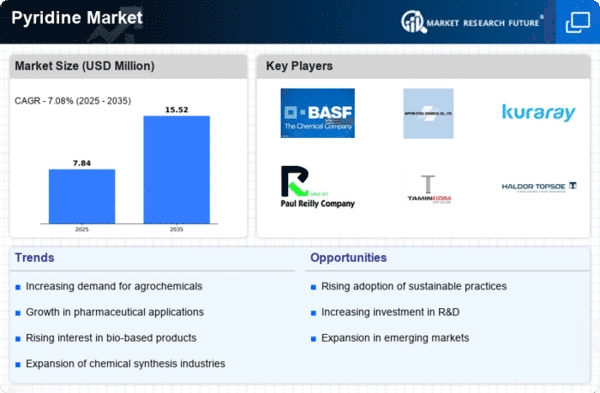
As per MRFR analysis, the Pyridine Market Size was estimated at 7.32 USD Million in 2024. The Pyridine industry is projected to grow from 7.83 in 2025 to 15.52 by 2035, exhibiting a compound annual growth rate (CAGR) of 7.08 during the forecast period 2025 - 2035.

Key Market Trends & Highlights

The Pyridine Market is experiencing a dynamic shift towards sustainable practices and diversified applications.

  • North America remains the largest market for pyridine, driven by robust demand in agriculture and pharmaceuticals.
  • The Asia-Pacific region is the fastest-growing market, reflecting increasing investments in production and technological advancements.
  • The agriculture segment, particularly in pesticides, continues to dominate the market, while the pharmaceutical segment is witnessing rapid growth.
  • Rising demand in agrochemicals and regulatory support for sustainable practices are key drivers influencing market dynamics.

Market Size & Forecast

2024 Market Size 7.32 (USD Million)
2035 Market Size 15.52 (USD Million)
CAGR (2025 - 2035) 7.08%

Major Players

BASF SE (DE), Nippon Steel Chemical & Material Co., Ltd. (JP), Kuraray Co., Ltd. (JP), Reilly Industries, Inc. (US), Taminco (BE), Haldor Topsoe A/S (DK), Eastman Chemical Company (US), Solvay S.A. (BE)

Our Impact
Enabled $4.3B Revenue Impact for Fortune 500 and Leading Multinationals
Partnering with 2000+ Global Organizations Each Year
30K+ Citations by Top-Tier Firms in the Industry

Pyridine Market Trends

The Pyridine Market is currently experiencing a dynamic phase characterized by evolving applications and increasing demand across various sectors. This compound, primarily utilized in the production of agrochemicals, pharmaceuticals, and specialty chemicals, is witnessing a shift in consumer preferences towards more sustainable and eco-friendly alternatives. As industries strive to reduce their environmental footprint, the Pyridine Market is adapting by exploring innovative production methods and alternative sources. Furthermore, the growing emphasis on research and development is likely to enhance the compound's versatility, potentially leading to new applications that could reshape market dynamics. In addition, The Pyridine is influenced by regulatory frameworks that promote safety and environmental sustainability. These regulations may drive manufacturers to invest in cleaner technologies and processes, thereby fostering a competitive landscape. The interplay between supply chain dynamics and fluctuating raw material prices also plays a crucial role in shaping market trends. As the Pyridine Market continues to evolve, stakeholders must remain vigilant to emerging opportunities and challenges that could impact their strategic decisions.

Sustainable Production Practices

The Pyridine Market is increasingly leaning towards sustainable production methods. Manufacturers are exploring greener alternatives to traditional synthesis processes, which may reduce environmental impact. This trend reflects a broader industry shift towards sustainability, driven by consumer demand for eco-friendly products.

Diversification of Applications

There is a noticeable expansion in the applications of pyridine beyond its conventional uses. Industries such as electronics and food processing are beginning to adopt pyridine derivatives, suggesting a potential for market growth. This diversification may open new avenues for innovation and development.

Regulatory Influence on Market Dynamics

Regulatory frameworks are playing a pivotal role in shaping the Pyridine Market. Stricter environmental regulations are prompting manufacturers to adapt their practices, which could lead to increased investment in research and development. This regulatory influence may create both challenges and opportunities for market participants.

Pyridine Market Drivers

Rising Demand in Agrochemicals

The Global Pyridine Market Industry is experiencing heightened demand due to its essential role in the production of agrochemicals. Pyridine Market derivatives are utilized in the synthesis of herbicides, insecticides, and fungicides, which are critical for enhancing agricultural productivity. As the global population continues to grow, the need for efficient crop protection solutions becomes increasingly urgent. This trend is reflected in the projected market value of 2500 USD Million in 2024, indicating a robust growth trajectory. The agrochemical sector's expansion is likely to drive the demand for pyridine, contributing to a compound annual growth rate of 4.37% from 2025 to 2035.

Advancements in Chemical Synthesis

Innovations in chemical synthesis techniques are shaping the Global Pyridine Market Industry. Enhanced methods for producing pyridine, such as catalytic processes and greener synthesis routes, are being developed to improve efficiency and reduce environmental impact. These advancements not only lower production costs but also align with global sustainability goals. As industries increasingly prioritize eco-friendly practices, the demand for sustainably produced pyridine is likely to rise. This trend may further bolster the market's growth, as companies seek to adopt more responsible sourcing and manufacturing practices, thereby enhancing their competitive edge.

Emerging Markets and Economic Growth

Emerging markets are playing a pivotal role in the Global Pyridine Market Industry's expansion. Countries in Asia-Pacific and Latin America are experiencing rapid industrialization and urbanization, leading to increased demand for pyridine in various applications. Economic growth in these regions is fostering investments in agriculture, pharmaceuticals, and manufacturing, which are key consumers of pyridine. As these markets develop, the overall demand for pyridine is expected to rise, contributing to a projected market value of 4000 USD Million by 2035. This trend indicates a promising outlook for pyridine producers looking to capitalize on growth opportunities in these regions.

Growth in Pharmaceutical Applications

The Global Pyridine Market Industry is significantly influenced by its applications in the pharmaceutical sector. Pyridine Market and its derivatives serve as key intermediates in the synthesis of various medications, including anti-inflammatory and anti-tuberculosis drugs. The increasing prevalence of chronic diseases and the rising healthcare expenditure globally are propelling the demand for pharmaceutical products. This surge is expected to contribute to the market's growth, with projections indicating a market value of 4000 USD Million by 2035. The pharmaceutical industry's reliance on pyridine compounds underscores the material's importance in developing innovative therapeutic solutions.

Increasing Use in Rubber and Plastics

The Global Pyridine Market Industry is witnessing a surge in demand from the rubber and plastics sectors. Pyridine Market is utilized as a solvent and a chemical intermediate in the production of various rubber products and plastic materials. As the automotive and construction industries expand, the need for durable and high-performance materials is driving the consumption of pyridine. This trend is expected to contribute to the overall market growth, with the industry poised to reach a valuation of 2500 USD Million in 2024. The integration of pyridine in these sectors highlights its versatility and essential role in modern manufacturing processes.


Market Segment Insights

By Application: Agriculture (Largest) vs. Pharmaceuticals (Fastest-Growing)

In the Pyridine Market, the application segments reveal a diverse distribution of uses, with Agriculture holding the largest market share. This segment leverages Pyridine in the production of herbicides and pesticides, essential for enhancing crop yield and quality. Following Agriculture, Pharmaceuticals remains a significant force, utilizing Pyridine as a building block for various medicinal compounds, driven by its effectiveness and efficiency in drug formulation.

Agriculture: Dominant vs. Pharmaceuticals: Emerging

The Agriculture segment is a dominant player in the Pyridine Market, heavily relying on Pyridine for the development of agrochemicals, particularly herbicides, and fungicides that improve crop productivity. Its substantial usage in this sector is attributed to the increasing global demand for food and the necessity for effective pest control solutions. In contrast, the Pharmaceuticals segment is emerging rapidly, with interest growing in the synthesis of various therapeutic agents. The increasing prevalence of diseases and the rising need for new drug development are propelling this segment forward, ensuring Pyridine's continued relevance in pharmaceutical applications.

By End Use: Pesticides (Largest) vs. Herbicides (Fastest-Growing)

The Pyridine market exhibits a varied market share distribution across its end-use applications. Pesticides hold the largest share of this segment due to their extensive usage in agriculture for controlling pests and improving crop yield. Herbicides, while smaller in share, are rapidly gaining traction as the demand for sustainable and efficient weed management practices grows. Other segments such as vitamins, solvents, and resins also contribute to the market but are considerably less dominant than pesticides and herbicides. Growth trends in the Pyridine market's end-use segment are driven primarily by increased agricultural activities and an expanding focus on food security. The rise in organic farming and sustainable practices is propelling the demand for herbicides as effective weed control methodologies. Additionally, the pharmaceutical sector's interest in pyridine derivatives for manufacturing vitamins and solvents signifies positive growth opportunities. As environmental regulations tighten, the market is likely to experience significant changes in usage patterns among these end-use applications.

Pesticides (Dominant) vs. Solvents (Emerging)

The Pesticides segment of the Pyridine market remains dominant, driven by its critical role in agriculture and crop protection. This segment utilizes pyridine in forms such as fungicides and insecticides, which are essential for increasing agricultural productivity. Environmental considerations and safety measures are shaping formulations, leading to innovations. In comparison, the Solvents segment is emerging due to the rising application of pyridine in chemical synthesis and as a solvent in various industrial processes. While still playing a secondary role, the Solvents segment is benefiting from growth in pharmaceuticals and chemical manufacturing, highlighting a trend toward multi-functional, eco-friendly solvents.

By Production Method: Chemical Synthesis (Largest) vs. Biotechnological Processes (Fastest-Growing)

The 'Production Method' segment in the Pyridine market is dominated by Chemical Synthesis, which accounts for a substantial share of the overall market. This method is widely adopted due to its efficiency and cost-effectiveness, particularly for larger-scale production. In contrast, Biotechnological Processes, while smaller in share, are rapidly gaining traction as consumers and industries move toward more sustainable and environmentally-friendly methods in chemical production. This shift illustrates the increasing importance of sustainability in chemical manufacturing. Over the coming years, Biotechnological Processes are anticipated to experience faster growth, fueled by advancements in biotechnology and a growing demand for bio-based chemicals. The increasing awareness of environmental impacts associated with traditional chemical production processes drives the interest toward green alternatives. Furthermore, innovations in bioprocessing technologies are set to enhance product yields and reduce production costs, thus propelling the adoption of biotechnological methods in the pyridine market.

Chemical Synthesis (Dominant) vs. Extraction Methods (Emerging)

Chemical Synthesis remains the dominant production method in the Pyridine market, characterized by its established infrastructure and proficiency in producing high-purity pyridine at scale. This method benefits from consistent raw material availability and well-understood production processes, providing a competitive edge in pricing. Conversely, Extraction Methods are emerging as a relevant alternative, primarily due to their potential for utilizing renewable resources and reducing toxic waste. Although currently a smaller segment, Extraction Methods are increasingly viewed as an innovative approach, particularly in regions focused on sustainability. This appeal is bolstered by consumer demand for greener products, positioning Extraction Methods as a promising avenue for future growth and attracting investments into research and development.

By Purity Level: Industrial Grade (Largest) vs. Pharmaceutical Grade (Fastest-Growing)

In the Pyridine Market, the purity level segment showcases a clear distribution of market share among its categories: Industrial Grade, Laboratory Grade, and Pharmaceutical Grade. Industrial Grade pyridine accounts for a significant portion of the market, driven by its widespread applications in agriculture and chemical synthesis. On the other hand, Pharmaceutical Grade, while relatively smaller in proportion, is gaining traction due to the rising demand for high-purity chemicals in drug formulation and healthcare products. This changing dynamic indicates an evolving landscape where quality is increasingly prioritized. The growth trajectory for the Purity Level segment indicates strong upward trends for Pharmaceutical Grade pyridine, driven by innovations in the pharmaceutical industry. Factors such as the increasing focus on advanced drug development, the need for stringent quality standards, and enhanced research activities contribute to this segment's rapid growth. Meanwhile, Industrial Grade remains stable, benefiting from continual demand in diverse industrial applications, but is perceived as a mature market. Overall, the emphasis on quality and purity is shaping this segment's future.

Industrial Grade (Dominant) vs. Pharmaceutical Grade (Emerging)

Industrial Grade pyridine holds a dominant position within the Pyridine Market, primarily due to its extensive applications in agrochemicals, dyes, and solvents, which cater to a wide array of industrial needs. This segment's stability is supported by consistent demand across sectors reliant on chemical intermediates. In contrast, Pharmaceutical Grade pyridine is emerging as a key player, reflective of the pharmaceutical industry's shift towards high-purity compounds. Characterized by rigorous manufacturing standards and compliance with health regulations, Pharmaceutical Grade is gaining market significance as it fuels advancements in medicine and therapeutics. As both segments evolve, the interplay between industrial necessity and high-quality requirements will be pivotal in determining their future trajectories.

By Form: Liquid (Largest) vs. Solid (Fastest-Growing)

In the Pyridine Market, the segment values of 'Form' demonstrate distinct roles in market dynamics. The Liquid form emerges as the largest segment, establishing a competitive advantage due to its versatility in various applications such as solvents and agrochemicals. Meanwhile, the Solid form exhibits considerable growth, attracting investments and innovations aimed at enhancing its usability in pharmaceuticals and chemical syntheses. The Gas form, while significant, does not capture the same market share and remains a niche player in comparison. Growth trends within this segment are shaped by several key drivers. The increasing demand for Liquid pyridine in agrochemicals and the rising application of Solid pyridine in pharmaceuticals highlight the shifting preferences in industry practices. Furthermore, advancements in manufacturing processes and sustainable approaches are propelling the Solid segment forward, establishing it as a promising player in the future of the Pyridine Market.

Liquid (Dominant) vs. Solid (Emerging)

The Liquid form of pyridine maintains its dominance in the market, largely due to its wide range of applications. It is favored for its solvency properties, making it essential in producing agrochemicals and for use in industrial solvents. The adaptability of Liquid pyridine enables it to meet varied consumer requirements effectively. On the other hand, the Solid form is recognized as an emerging segment, gaining traction in pharmaceutical applications where its stability and effectiveness are increasingly utilized. Innovations in solid formulations, particularly for drug delivery systems, are driving its growth, capturing attention for future development. While Liquid pyridine leads in volume and application diversity, Solid pyridine is poised to carve out a significant niche within an evolving market landscape.

Get more detailed insights about Pyridine Market

Regional Insights

North America : Stable Growth Environment

The North American pyridine market is projected to grow steadily, driven by increasing demand in agrochemicals and pharmaceuticals. With a market size of $1.5 billion, the region benefits from robust regulatory frameworks that support chemical manufacturing. The focus on sustainable practices and innovation in production methods is expected to further enhance market growth. Leading countries like the US and Canada are home to major players such as Reilly Industries, Inc. and Eastman Chemical Company. The competitive landscape is characterized by strategic partnerships and investments in R&D, ensuring a steady supply of high-quality pyridine derivatives. The presence of established companies fosters a favorable environment for market expansion.

Europe : Innovation and Sustainability Focus

Europe's pyridine market, valued at $2.0 billion, is characterized by a strong emphasis on innovation and sustainability. Regulatory initiatives aimed at reducing environmental impact are driving demand for eco-friendly pyridine derivatives. The region's market share is bolstered by increasing applications in agrochemicals and specialty chemicals, aligning with EU regulations promoting sustainable practices. Germany, France, and Belgium are key players in this market, hosting companies like BASF SE and Solvay S.A. The competitive landscape is marked by significant investments in green chemistry and collaborations among industry leaders. This focus on sustainability positions Europe as a leader in The Pyridine.

Asia-Pacific : Emerging Market Leader

Asia-Pacific is the largest regional market for pyridine, with a size of $3.5 billion, driven by rapid industrialization and increasing demand in agriculture and pharmaceuticals. The region's growth is supported by favorable government policies and investments in chemical manufacturing. Countries like China and Japan are leading the charge, with a focus on expanding production capacities and enhancing supply chains. China, in particular, is a significant contributor, hosting major players like Nippon Steel Chemical & Material Co., Ltd. and Kuraray Co., Ltd. The competitive landscape is evolving, with local manufacturers increasing their market share through strategic partnerships and technological advancements. This dynamic environment positions Asia-Pacific as a powerhouse in The Pyridine.

Middle East and Africa : Developing Market Potential

The Middle East and Africa (MEA) pyridine market, valued at $0.32 billion, is in a developing phase, with growth driven by increasing industrial activities and demand for agrochemicals. The region's market share is gradually expanding as governments invest in chemical manufacturing and infrastructure development. Regulatory frameworks are evolving to support sustainable practices, which is expected to enhance market dynamics. Countries like South Africa and the UAE are emerging as key players, with local companies exploring opportunities in pyridine production. The competitive landscape is characterized by a mix of local and international players, fostering innovation and collaboration. As the region continues to develop, the pyridine market is poised for growth.

Key Players and Competitive Insights

The Pyridine Market is currently characterized by a dynamic competitive landscape, driven by increasing demand across various applications such as agrochemicals, pharmaceuticals, and food additives. Key players are actively engaging in strategies that emphasize innovation, regional expansion, and sustainability. For instance, BASF SE (DE) has been focusing on enhancing its product portfolio through research and development initiatives aimed at creating more sustainable pyridine derivatives. Similarly, Eastman Chemical Company (US) is leveraging its technological capabilities to optimize production processes, thereby improving efficiency and reducing environmental impact. These strategic orientations not only bolster their market positions but also contribute to a more competitive environment where innovation and sustainability are paramount.In terms of business tactics, companies are increasingly localizing manufacturing to mitigate supply chain disruptions and enhance responsiveness to regional market demands. The Pyridine Market appears moderately fragmented, with several players vying for market share. This fragmentation allows for a diverse range of products and innovations, yet it also necessitates that companies differentiate themselves through unique value propositions. The collective influence of key players, such as Nippon Steel Chemical & Material Co., Ltd. (JP) and Kuraray Co., Ltd. (JP), is shaping the market structure, as they implement strategies that focus on supply chain optimization and strategic partnerships.
In November Haldor Topsoe A/S (DK) announced a strategic partnership with a leading agricultural firm to develop bio-based pyridine derivatives. This collaboration is significant as it aligns with the growing trend towards sustainable agricultural practices, potentially positioning Haldor Topsoe as a leader in eco-friendly pyridine solutions. The partnership not only enhances their product offerings but also reflects a broader industry shift towards sustainability.
In October Taminco (BE) expanded its production capacity for pyridine derivatives in response to rising global demand. This expansion is crucial as it enables Taminco to better serve its customers while also reinforcing its competitive edge in a market that is increasingly focused on meeting specific regional needs. The move indicates a proactive approach to scaling operations in line with market trends.
In September Reilly Industries, Inc. (US) launched a new line of pyridine-based products aimed at the pharmaceutical sector. This launch is indicative of the company's commitment to innovation and its strategic focus on high-growth sectors. By diversifying its product range, Reilly Industries is likely to capture a larger market share and enhance its competitive positioning.
As of December the Pyridine Market is witnessing trends that emphasize digitalization, sustainability, and the integration of advanced technologies such as AI. Strategic alliances are increasingly shaping the competitive landscape, allowing companies to pool resources and expertise to drive innovation. The shift from price-based competition to a focus on technological advancement and supply chain reliability is becoming evident. Moving forward, competitive differentiation will likely hinge on the ability to innovate and adapt to changing market demands, with sustainability at the forefront of strategic initiatives.

Key Companies in the Pyridine Market include

Industry Developments

February 2021 

Vertellus is a company that agreed to a new acquisition. It is buying the products of ESIM chemicals that will create many developments. Both companies will create chemicals that will be useful for industries. Pharmaceutical coating and fuel industries are having highest demand for the new product. 

June 2021 

 Trineso is acquiring the shares of Synthomer PLC. This is a vinyl Pyridine Market latex business that produces chemicals such as Pyridine Market. Through this partnership, the companies will strengthen their portfolio. Also, the product line of these companies will improve due to this. The product of the company will have mire supply in many regions. 

Intended Audience

    • Pyridine Market manufacturers
    • Traders and Distributors of pyridine
    • Production Process Industries
    • Potential Investors
    • Raw Material Suppliers
    • Nationalized Laboratory

Pyridine Market Industry Developments

  • Q1 2024: Jubilant Ingrevia commissions new pyridine derivatives plant in India Jubilant Ingrevia announced the commissioning of a new manufacturing facility for pyridine and its derivatives in Bharuch, Gujarat, India, aimed at expanding its specialty chemicals capacity and meeting growing global demand.
  • Q2 2024: Bayer expands pyridine-based crop protection production in Germany Bayer AG announced the expansion of its Leverkusen facility to increase production of pyridine-based intermediates used in next-generation crop protection products.
  • Q2 2024: Lonza appoints new Head of Pyridine Market Business Unit Lonza Group announced the appointment of Dr. Martina Keller as the new Head of its Pyridine Market Business Unit, effective May 2024, to drive innovation and growth in specialty chemicals.
  • Q3 2024: Mitsubishi Chemical launches new sustainable pyridine production process Mitsubishi Chemical Group unveiled a new, lower-emission process for pyridine synthesis at its Okayama plant, targeting reduced environmental impact and improved efficiency.
  • Q3 2024: Jubilant Pharmova secures multi-year contract for pyridine supply with European agrochemical major Jubilant Pharmova signed a multi-year supply agreement to provide pyridine and derivatives to a leading European agrochemical company, strengthening its export business.
  • Q4 2024: Imperial Chemical opens new R&D center for pyridine applications Imperial Chemical Corporation inaugurated a new research and development center in the UK focused on novel pyridine-based compounds for pharmaceuticals and agrochemicals.
  • Q4 2024: Nippon Steel & Sumikin Chemical announces partnership with Koei Chemical for pyridine technology Nippon Steel & Sumikin Chemical entered a strategic partnership with Koei Chemical to co-develop advanced pyridine production technologies and expand market reach in Asia.
  • Q1 2025: Bayer receives EU regulatory approval for new pyridine-based herbicide Bayer AG announced that its new pyridine-based herbicide received regulatory approval from the European Union, enabling commercial launch across member states.
  • Q1 2025: Jubilant Ingrevia signs long-term supply agreement with US pharmaceutical company Jubilant Ingrevia entered into a long-term contract to supply pyridine derivatives to a major US-based pharmaceutical manufacturer, supporting drug synthesis operations.
  • Q2 2025: Mitsubishi Chemical invests in new pyridine production line in Japan Mitsubishi Chemical Group announced a significant investment to build a new pyridine production line at its existing facility in Japan, aiming to meet rising demand in Asia-Pacific.
  • Q2 2025: Lonza secures contract to supply pyridine intermediates to European pharma company Lonza Group signed a contract to supply high-purity pyridine intermediates to a leading European pharmaceutical company for use in active pharmaceutical ingredient (API) synthesis.
  • Q3 2025: Bayer launches new pyridine-based fungicide in Latin America Bayer AG announced the commercial launch of a new pyridine-based fungicide targeting key crops in Brazil and Argentina, expanding its crop protection portfolio in the region.

Future Outlook

Pyridine Market Future Outlook

The Pyridine Market is projected to grow at a 7.08% CAGR from 2025 to 2035, driven by increasing demand in agrochemicals, pharmaceuticals, and specialty chemicals.

New opportunities lie in:

  • Expansion into emerging markets with tailored pyridine derivatives. Investment in sustainable production technologies to reduce environmental impact. Development of pyridine-based formulations for advanced agricultural applications.

By 2035, the Pyridine Market is expected to achieve robust growth, solidifying its position in key industries.

Market Segmentation

Pyridine Market Form Outlook

  • Liquid
  • Solid
  • Gas

Pyridine Market End Use Outlook

  • Pesticides
  • Herbicides
  • Vitamins
  • Solvents
  • Resins

Pyridine Market Application Outlook

  • Agriculture
  • Pharmaceuticals
  • Chemical Synthesis
  • Food Additives
  • Dyes and Pigments

Pyridine Market Purity Level Outlook

  • Industrial Grade
  • Laboratory Grade
  • Pharmaceutical Grade

Pyridine Market Production Method Outlook

  • Chemical Synthesis
  • Biotechnological Processes
  • Catalytic Processes
  • Extraction Methods

Report Scope

MARKET SIZE 2024 7.32(USD Million)
MARKET SIZE 2025 7.83(USD Million)
MARKET SIZE 2035 15.52(USD Million)
COMPOUND ANNUAL GROWTH RATE (CAGR) 7.08% (2025 - 2035)
REPORT COVERAGE Revenue Forecast, Competitive Landscape, Growth Factors, and Trends
BASE YEAR 2024
Market Forecast Period 2025 - 2035
Historical Data 2019 - 2024
Market Forecast Units USD Million
Key Companies Profiled BASF SE (DE), Nippon Steel Chemical & Material Co., Ltd. (JP), Kuraray Co., Ltd. (JP), Reilly Industries, Inc. (US), Taminco (BE), Haldor Topsoe A/S (DK), Eastman Chemical Company (US), Solvay S.A. (BE)
Segments Covered Application, End Use, Production Method, Purity Level, Form
Key Market Opportunities Growing demand for agrochemicals and pharmaceuticals drives innovation in the Pyridine Market.
Key Market Dynamics Rising demand for agrochemicals drives pyridine market growth amid evolving regulatory frameworks and competitive pressures.
Countries Covered North America, Europe, APAC, South America, MEA

Market Highlights

Author
Priya Nagrale
Senior Research Analyst

With an experience of over five years in market research industry (Chemicals & Materials domain), I gather and analyze market data from diverse sources to produce results, which are then presented back to a client. Also, provide recommendations based on the findings. As a Senior Research Analyst, I perform quality checks (QC) for market estimations, QC for reports, and handle queries and work extensively on client customizations. Also, handle the responsibilities of client proposals, report planning, report finalization, and execution

Leave a Comment

FAQs

What are the major product types in the market?

By product, the pyridine market is segmented into alpha picoline, beta picoline, gamma picoline, 2-methyl-5-ethylpyridine, and others.

What is the major driver for the market?

Growing demand from the pharmaceutical and agrochemical industries is the major driver for the pyridine market.

Which is the leading regional market?

Asia Pacific is the leading regional market.

What are the key players in the market?

Leading players in the market include Jubilant Life Sciences, Dow, and Bayer AG, among others.

What are the leading applications of pyridine?

Major applications of pyridine are in the electronics, dyes, building and construction, paints and coatings, and rubber industries.

Download Free Sample

Kindly complete the form below to receive a free sample of this Report

Compare Licence

×
Features License Type
Single User Multiuser License Enterprise User
Price $4,950 $5,950 $7,250
Maximum User Access Limit 1 User Upto 10 Users Unrestricted Access Throughout the Organization
Free Customization
Direct Access to Analyst
Deliverable Format
Platform Access
Discount on Next Purchase 10% 15% 15%
Printable Versions