×
Request Free Sample ×

Kindly complete the form below to receive a free sample of this Report

* Please use a valid business email

Leading companies partner with us for data-driven Insights

clients tt-cursor
Hero Background

Polymer Antioxidants Market

ID: MRFR/CnM/37457-HCR
111 Pages
Chitranshi Jaiswal
February 2026

Polymer Antioxidants Market Research Report By Type (Phenolic Antioxidants, Phosphite Antioxidants, Thioester Antioxidants, Others), By Application (Plastics, Rubber, Coatings, Adhesives), By End Use Industry (Automotive, Packaging, Construction, Electronics), By Form (Solid, Liquid, Powder) and By Regional (North America, Europe, South America, Asia Pacific, Middle East and Africa) - Forecast to 2035

Share:
Download PDF ×

We do not share your information with anyone. However, we may send you emails based on your report interest from time to time. You may contact us at any time to opt-out.

Polymer Antioxidants Market Infographic
Purchase Options

Polymer Antioxidants Market Summary

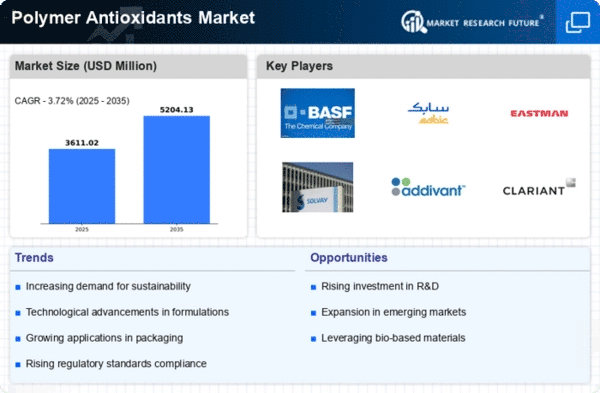
As per MRFR analysis, the Polymer Antioxidants Market Size was estimated at 3481.51 USD Million in 2024. The Polymer Antioxidants industry is projected to grow from 3611.09 USD Million in 2025 to 5204.13 USD Million by 2035, exhibiting a compound annual growth rate (CAGR) of 3.72 during the forecast period 2025 - 2035.

Key Market Trends & Highlights

The Polymer Antioxidants Market is poised for robust growth driven by sustainability and technological advancements.

  • The market is witnessing a pronounced shift towards sustainability, influencing product development and consumer preferences.
  • Technological advancements in polymer chemistry are enhancing the performance and efficiency of antioxidants in various applications.
  • North America remains the largest market, while Asia-Pacific is emerging as the fastest-growing region, reflecting diverse regional demands.
  • The rising demand for durable materials and growth in the packaging industry are key drivers propelling market expansion.

Market Size & Forecast

2024 Market Size 3481.51 (USD Million)
2035 Market Size 5204.13 (USD Million)
CAGR (2025 - 2035) 3.72%

Major Players

BASF SE (DE), SABIC (SA), Eastman Chemical Company (US), Solvay S.A. (BE), Addivant USA LLC (US), Clariant AG (CH), Hawkins, Inc. (US), Kraton Corporation (US), Songwon Industrial Co., Ltd. (KR)

Our Impact
Enabled $4.3B Revenue Impact for Fortune 500 and Leading Multinationals
Partnering with 2000+ Global Organizations Each Year
30K+ Citations by Top-Tier Firms in the Industry

Polymer Antioxidants Market Trends

The Polymer Antioxidants Market is currently experiencing a notable evolution, driven by the increasing demand for enhanced durability and longevity in various applications. Industries such as automotive, packaging, and electronics are increasingly recognizing the necessity of incorporating antioxidants into their products to mitigate oxidative degradation. This trend appears to be fueled by a growing awareness of the benefits associated with polymer antioxidants, which include improved thermal stability and resistance to environmental stressors. As manufacturers strive to meet stringent quality standards, the integration of these additives is becoming more prevalent, suggesting a robust growth trajectory for the market. Moreover, the Polymer Antioxidants Market is likely to witness advancements in technology and formulation, which could lead to the development of more efficient and eco-friendly alternatives. The shift towards sustainable practices is prompting companies to explore bio-based antioxidants, which may offer similar protective properties while minimizing environmental impact. This transition indicates a potential shift in consumer preferences, as stakeholders increasingly prioritize sustainability alongside performance. Consequently, the market landscape is poised for transformation, with innovation playing a crucial role in shaping future offerings and meeting evolving consumer demands.

Sustainability Focus

The Polymer Antioxidants Market is increasingly influenced by a growing emphasis on sustainability. Manufacturers are exploring bio-based alternatives that not only provide effective protection against oxidative degradation but also align with eco-friendly practices. This trend suggests a shift in consumer preferences towards products that minimize environmental impact.

Technological Advancements

Ongoing technological innovations are reshaping the Polymer Antioxidants Market. Enhanced formulations and processing techniques are being developed to improve the efficiency and effectiveness of antioxidants. This evolution indicates a potential for higher performance products that meet the rigorous demands of various industries.

Regulatory Compliance

The Polymer Antioxidants Market is also being shaped by stringent regulatory frameworks. As industries face increasing pressure to comply with safety and environmental regulations, the demand for compliant antioxidant solutions is likely to rise. This trend highlights the importance of integrating regulatory considerations into product development.

Polymer Antioxidants Market Drivers

Stringent Regulatory Standards

The Global Polymer Antioxidants Market Industry is influenced by stringent regulatory standards aimed at ensuring product safety and environmental protection. Governments worldwide are implementing regulations that require the use of additives that meet specific safety criteria. This regulatory landscape compels manufacturers to adopt high-quality polymer antioxidants that comply with these standards, thereby fostering market growth. For example, the European Union's REACH regulations necessitate the assessment of chemical substances, including polymer antioxidants, which drives innovation and compliance within the industry. As a result, the market is expected to grow at a CAGR of 3.73% from 2025 to 2035, reflecting the ongoing adaptation to regulatory requirements.

Growth of the Packaging Industry

The Global Polymer Antioxidants Market Industry is significantly benefiting from the growth of the packaging industry, particularly in food and beverage sectors. The increasing consumer demand for packaged goods necessitates the use of polymer antioxidants to enhance the shelf life and quality of packaging materials. As sustainability becomes a priority, manufacturers are seeking antioxidants that not only improve performance but also reduce environmental impact. This trend is expected to propel the market forward, with an estimated market value of 3.48 USD Billion in 2024. The integration of polymer antioxidants in packaging solutions is likely to become a standard practice, further solidifying their importance in the industry.

Rising Demand for Durable Materials

The Global Polymer Antioxidants Market Industry is experiencing a surge in demand for durable materials across various sectors, including automotive, packaging, and construction. As industries increasingly prioritize longevity and performance, the need for polymer antioxidants, which enhance the stability and lifespan of polymers, becomes paramount. For instance, the automotive sector is projected to grow significantly, leading to an increased requirement for high-performance materials. This trend is expected to contribute to the market's growth, with projections indicating a market value of 3.48 USD Billion in 2024, reflecting the industry's commitment to enhancing material durability.

Emerging Markets and Economic Growth

Emerging markets are playing a pivotal role in the expansion of the Global Polymer Antioxidants Market Industry. As economies in regions such as Asia-Pacific and Latin America continue to grow, the demand for polymers and their additives is on the rise. This growth is driven by increased industrialization and urbanization, leading to higher consumption of consumer goods and automotive products. Consequently, manufacturers are focusing on these regions to capitalize on the burgeoning demand for polymer antioxidants. The projected market value of 5.21 USD Billion by 2035 highlights the potential of these emerging markets to shape the future of the industry.

Market Trends and Growth Projections

The Global Polymer Antioxidants Market Industry is characterized by various trends that indicate its growth trajectory. The market is expected to witness a steady increase in demand, driven by factors such as technological advancements and regulatory compliance. The anticipated market value of 3.48 USD Billion in 2024 and a projected growth to 5.21 USD Billion by 2035 suggest a robust market environment. Furthermore, the CAGR of 3.73% from 2025 to 2035 indicates sustained interest and investment in polymer antioxidants, reflecting their critical role in enhancing the performance and longevity of polymer products.

Technological Advancements in Polymer Production

Technological advancements in polymer production processes are playing a crucial role in the Global Polymer Antioxidants Market Industry. Innovations such as improved polymerization techniques and the development of bio-based antioxidants are enhancing the efficiency and sustainability of polymer production. These advancements not only reduce production costs but also align with the growing demand for environmentally friendly materials. As a result, manufacturers are increasingly incorporating advanced polymer antioxidants into their products, which is likely to drive market growth. The anticipated market value of 5.21 USD Billion by 2035 underscores the potential impact of these technological developments on the industry.


Market Segment Insights

By Application: Plastics (Largest) vs. Rubber (Fastest-Growing)

In the Polymer Antioxidants Market, the application segment showcases a diverse distribution among various materials, with Plastics leading the charge as the largest shareholding sector. This prominence is fueled by the extensive use of polymer antioxidants in improving the durability and longevity of plastic products, which are integral in numerous industries, from packaging to automotive. Following closely is the Rubber segment, which, while not as large, demonstrates a significant share and potential for expansion as rubber applications in various sectors like automotive and consumer goods continue to rise.

Plastics (Dominant) vs. Rubber (Emerging)

Plastics remain the dominant segment in the Polymer Antioxidants Market, primarily due to their ubiquitous presence across multiple applications including consumer goods, packaging, and automotive parts. The incorporation of antioxidant compounds in plastics enhances their resistance to oxidative degradation, thereby increasing product lifespan and reliability. In contrast, the Rubber segment, identified as emerging, is gaining traction as the demand for high-performance rubber products surges, driven by advancements in technology and the rising need for durable materials in industries like automotive and construction. This trend reflects a shift toward more robust rubber formulations, which increasingly rely on polymer antioxidants for enhanced performance and longevity.

By End Use: Automotive (Largest) vs. Electronics (Fastest-Growing)

In the Polymer Antioxidants Market, the distribution of end-use segments is predominantly led by the automotive sector, which holds a substantial share due to the increasing demand for durable and high-performance materials in automotive manufacturing. Following closely are the electronics and consumer goods, powered by their reliance on polymers that enhance product longevity and performance. The construction and aerospace sectors, while growing, represent relatively smaller slices in the overall market, primarily driven by specific application requirements. Growth trends within the polymer antioxidants segment are being significantly fueled by the automotive industry's shift towards materials that foster sustainability and reduce environmental impact. The electronics sector, labeled as the fastest-growing segment, is boosted by advancements in technology and the need for high-temperature resistance in electronic components. Consumer goods exhibit steady growth driven by consumer preferences for quality and durability. As industries increasingly focus on performance and environmental considerations, the market is poised for continued expansion across these key sectors.

Automotive: Dominant vs. Electronics: Emerging

The automotive segment remains dominant in the Polymer Antioxidants Market, characterized by the necessity for materials that can withstand prolonged exposure to heat and oxidative conditions. As automotive manufacturers increasingly adopt advanced polymers, the demand for high-quality antioxidants that enhance the stability and lifespan of these materials grows. On the other hand, the electronics segment is emerging rapidly, driven by the proliferation of electronic devices that require specialized polymer blends to ensure performance under high stress and temperature variations. Innovations in the electronics sector, such as flexible displays and compact designs, demand advanced antioxidants that can cater to such specifications. This duality highlights a landscape where traditional markets adapt and innovate, creating robust opportunities for growth in both sectors.

By Type: Phenolic Antioxidants (Largest) vs. Phosphite Antioxidants (Fastest-Growing)

In the Polymer Antioxidants Market, the distribution of market share is heavily tilted towards Phenolic Antioxidants, which dominate the landscape due to their widespread application and significant effectiveness in prolonging the lifespan of polymers. Following closely, Phosphite Antioxidants have also captured a notable portion of the market, appealing particularly to industries seeking to balance cost and performance. Meanwhile, Thioester Antioxidants and Hindered Amine Light Stabilizers account for smaller shares but nonetheless play crucial roles in specialized applications.

Phenolic Antioxidants (Dominant) vs. Phosphite Antioxidants (Emerging)

Phenolic Antioxidants are regarded as the dominant players within the Polymer Antioxidants Market, prized for their exceptional ability to protect polymers from oxidative degradation and improve long-term stability. Their extensive use in plastics, rubber, and coatings emphasizes their critical role in maintaining the integrity of materials. On the other hand, Phosphite Antioxidants are emerging as strong contenders, particularly favored for their specific advantages in providing heat stability and compatibility with various polymer types. As industries pursue innovative formulations and efficient production methods, the unique benefits of Phosphite Antioxidants are being increasingly recognized, positioning them as vital components in modern polymer applications.

By Form: Granules (Largest) vs. Powder (Fastest-Growing)

The Polymer Antioxidants Market showcases a diverse range of forms, each contributing significantly to the overall landscape. Granules hold the largest share of the market due to their versatility in processing and application across various industries. Following granules, powder form is emerging prominently, offering an adaptable solution that is gaining traction among manufacturers aiming for innovative formulations. Liquid and masterbatch forms also play pivotal roles in niche applications, but they currently account for smaller portions of market share due to specific requirements in end-use industries.

Granules (Dominant) vs. Powder (Emerging)

Granules stand out as the dominant form in the Polymer Antioxidants Market due to their stability and ease of handling, making them highly favored in production processes. They are extensively utilized in applications requiring consistent performance under varying thermal conditions. On the other hand, powder form is considered an emerging segment, driven by advancements in processing technologies and demand for more efficient antioxidant solutions. Its growing appeal lies in its capacity to blend seamlessly with various polymers, catering to the evolving needs of manufacturers looking to enhance product durability and performance. As production strategies evolve, both forms are expected to thrive within the market.

Get more detailed insights about Polymer Antioxidants Market

Regional Insights

North America : Innovation and Sustainability Focus

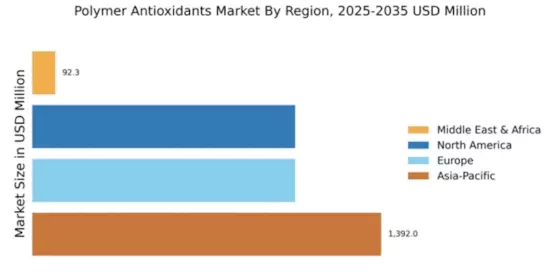
The North American polymer antioxidants market is projected to reach $1048.6 million by 2025, driven by increasing demand for high-performance materials in automotive and packaging sectors. Regulatory support for sustainable practices and innovations in polymer formulations are key growth catalysts. The region's focus on reducing environmental impact is pushing manufacturers to develop eco-friendly antioxidant solutions, enhancing market dynamics. Leading countries like the US and Canada dominate the market, with major players such as BASF SE and Eastman Chemical Company driving competition. The presence of established chemical manufacturers and a robust supply chain further strengthen the market landscape. As companies invest in R&D, the competitive environment is expected to intensify, fostering innovation and product differentiation.

Europe : Regulatory Compliance and Innovation

Europe's polymer antioxidants market is valued at $1048.6 million, with a strong emphasis on regulatory compliance and sustainability. The European Union's stringent regulations on plastic waste and environmental impact are driving demand for advanced antioxidant solutions. This regulatory landscape encourages innovation, pushing manufacturers to develop products that meet both performance and environmental standards. Germany, France, and the UK are leading markets, with key players like Solvay S.A. and Clariant AG actively participating in the sector. The competitive landscape is characterized by a mix of established firms and emerging players focusing on sustainable practices. As the market evolves, collaboration between industry stakeholders and regulatory bodies will be crucial for driving growth and compliance.

Asia-Pacific : Emerging Powerhouse in Antioxidants

Asia-Pacific is the largest market for polymer antioxidants, projected to reach $1392.0 million by 2025. The region's rapid industrialization, coupled with increasing demand from automotive and electronics sectors, drives market growth. Additionally, favorable government policies and investments in infrastructure are enhancing production capabilities, making it a key player in the global market. China, Japan, and India are the leading countries in this region, with significant contributions from companies like SABIC and Songwon Industrial Co., Ltd. The competitive landscape is marked by a mix of local and international players, all vying for market share. As the region continues to expand, innovation and strategic partnerships will play a vital role in maintaining growth and competitiveness.

Middle East and Africa : Resource-Rich Frontier

The Middle East and Africa polymer antioxidants market is valued at $92.31 million, with significant growth potential driven by increasing industrial activities and demand for high-quality materials. The region's rich natural resources and investments in petrochemical industries are key factors contributing to market expansion. Additionally, rising awareness of product quality and performance is pushing manufacturers to adopt advanced antioxidant solutions. Countries like Saudi Arabia and South Africa are at the forefront of this market, with local and international players competing for dominance. The presence of key companies such as Addivant USA LLC and Hawkins, Inc. highlights the competitive landscape. As the market matures, the focus on innovation and sustainability will be crucial for attracting investments and fostering growth.

Polymer Antioxidants Market Regional Image

Key Players and Competitive Insights

The Polymer Antioxidants Market is currently characterized by a competitive landscape that is both dynamic and multifaceted. Key growth drivers include the increasing demand for high-performance materials across various industries, such as automotive, packaging, and electronics. Major players like BASF SE (DE), SABIC (SA), and Eastman Chemical Company (US) are strategically positioned to leverage their extensive product portfolios and innovative capabilities. For instance, BASF SE (DE) has focused on enhancing its research and development efforts to introduce advanced antioxidant solutions, while SABIC (SA) emphasizes sustainability in its product offerings, aligning with global environmental standards. Collectively, these strategies contribute to a competitive environment that is increasingly shaped by innovation and sustainability initiatives.In terms of business tactics, companies are increasingly localizing manufacturing to reduce lead times and optimize supply chains. This approach is particularly relevant in a moderately fragmented market where regional players also exert influence. The competitive structure is characterized by a mix of large multinational corporations and smaller, specialized firms, which together create a diverse landscape. The collective influence of these key players is significant, as they drive technological advancements and set industry standards.

In November Eastman Chemical Company (US) announced the launch of a new line of polymer antioxidants designed specifically for high-temperature applications. This strategic move is indicative of Eastman's commitment to innovation and its responsiveness to evolving market needs. By addressing the specific requirements of high-performance materials, Eastman positions itself as a leader in this niche segment, potentially capturing a larger market share.Similarly, in October 2025, Solvay S.A. (BE) unveiled a partnership with a leading automotive manufacturer to develop sustainable polymer solutions. This collaboration underscores Solvay's focus on integrating sustainability into its product development processes. By aligning with industry leaders, Solvay not only enhances its market presence but also reinforces its commitment to environmentally friendly practices, which are increasingly valued by consumers and regulatory bodies alike.

In December Addivant USA LLC (US) revealed its plans to expand its production capacity in response to rising global demand for polymer antioxidants. This expansion is crucial as it reflects Addivant's proactive approach to meeting market needs and ensuring supply chain reliability. By increasing its production capabilities, the company aims to solidify its position in the market and enhance its competitive edge.

As of December current trends in the Polymer Antioxidants Market are heavily influenced by digitalization, sustainability, and the integration of artificial intelligence (AI) in production processes. Strategic alliances are becoming increasingly important, as companies seek to pool resources and expertise to drive innovation. The competitive differentiation is likely to evolve from traditional price-based competition towards a focus on technological advancements, product innovation, and supply chain reliability. This shift suggests that companies that prioritize these aspects will be better positioned to thrive in the future.

Key Companies in the Polymer Antioxidants Market include

Industry Developments

The Polymer Antioxidants Market has been experiencing significant developments recently. Companies like 3M and BASF are reportedly increasing their focus on sustainable polymer antioxidant solutions to meet changing industry demands for environmentally friendly products.

Solvay has also been investing in innovation to enhance its product line, which is projected to bolster its market share. In terms of mergers and acquisitions, there have been noteworthy activities, such as Clariant exploring strategic partnerships to expand its footprint in the polymer antioxidants space.

Investment from Hindustan Petroleum into new manufacturing technologies is expected to elevate its competitive edge, while Kraton Corporation has been enhancing its production capacities to address growing demands.

Pricing pressures and raw material availability remain ongoing concerns that are influencing market dynamics. Furthermore, the increasing awareness of the importance of polymer stability and durability in sectors such as automotive and packaging is driving demand for advanced antioxidant solutions from companies like Evonik Industries, SABIC, and Addivant.

The overall growth trajectory and investment activities in the market indicate a robust economic outlook for participants.

Future Outlook

Polymer Antioxidants Market Future Outlook

The Polymer Antioxidants Market is projected to grow at a 3.72% CAGR from 2025 to 2035, driven by increasing demand in automotive and packaging applications.

New opportunities lie in:

  • Development of bio-based polymer antioxidants for sustainable products.
  • Expansion into emerging markets with tailored product offerings.
  • Investment in R&D for advanced antioxidant formulations to enhance performance.

By 2035, the market is expected to solidify its position as a key component in polymer applications.

Market Segmentation

Polymer Antioxidants Market Form Outlook

  • Granules
  • Powder
  • Liquid
  • Masterbatch

Polymer Antioxidants Market Type Outlook

  • Phenolic Antioxidants
  • Phosphite Antioxidants
  • Thioester Antioxidants
  • Hindered Amine Light Stabilizers
  • Others

Polymer Antioxidants Market End Use Outlook

  • Automotive
  • Electronics
  • Construction
  • Consumer Goods
  • Aerospace

Polymer Antioxidants Market Application Outlook

  • Plastics
  • Rubber
  • Coatings
  • Adhesives
  • Textiles

Report Scope

MARKET SIZE 20243481.51(USD Million)
MARKET SIZE 20253611.09(USD Million)
MARKET SIZE 20355204.13(USD Million)
COMPOUND ANNUAL GROWTH RATE (CAGR)3.72% (2025 - 2035)
REPORT COVERAGERevenue Forecast, Competitive Landscape, Growth Factors, and Trends
BASE YEAR2024
Market Forecast Period2025 - 2035
Historical Data2019 - 2024
Market Forecast UnitsUSD Million
Key Companies ProfiledBASF SE (DE), SABIC (SA), Eastman Chemical Company (US), Solvay S.A. (BE), Addivant USA LLC (US), Clariant AG (CH), Hawkins, Inc. (US), Kraton Corporation (US), Songwon Industrial Co., Ltd. (KR)
Segments CoveredApplication, End Use, Type, Form
Key Market OpportunitiesGrowing demand for sustainable materials drives innovation in the Polymer Antioxidants Market.
Key Market DynamicsRising demand for sustainable materials drives innovation in polymer antioxidants, influencing competitive dynamics and regulatory frameworks.
Countries CoveredNorth America, Europe, APAC, South America, MEA
Leave a Comment

FAQs

What is the expected CAGR for the Polymer Antioxidants Market from 2025 to 2034?

Polymer Antioxidants Market is expected to grow with a CAGR of 3.72% in the period 2025-2035

Which region held the largest market share in the Polymer Antioxidants Market?

North America held the largest market share within the Polymer Antioxidants Market, valued at 1.06 USD Billion in 2024.

What will be the market value of Phenolic Antioxidants by 2034?

The market value of Phenolic Antioxidants is projected to reach 1.432 USD Billion by 2034.

Who are the key players in the Polymer Antioxidants Market?

Key players in the Polymer Antioxidants Market include 3M, Solvay, SABIC, and BASF among others.

How much was the APAC region valued in the Polymer Antioxidants Market in 2024?

The APAC region was valued at 1.25 USD Billion in the Polymer Antioxidants Market in 2024.

What is the projected market value of Thioester Antioxidants by 2034?

The projected market value of Thioester Antioxidants is expected to be 0.941 USD Billion by 2034.

What challenges could impact the growth of the Polymer Antioxidants Market?

Challenges such as raw material availability and regulatory compliance could affect the growth of the market.

What is the expected value of the South American region within the market by 2034?

The South American region is expected to grow to 0.09 USD Billion in the Polymer Antioxidants Market by 2034.

What are the key applications of Polymer Antioxidants in the market?

Key applications of Polymer Antioxidants include their use in plastics, rubber, and other materials to enhance stability and performance.

Download Free Sample

Kindly complete the form below to receive a free sample of this Report

Compare Licence

×
Features License Type
Single User Multiuser License Enterprise User
Price $4,950 $5,950 $7,250
Maximum User Access Limit 1 User Upto 10 Users Unrestricted Access Throughout the Organization
Free Customization
Direct Access to Analyst
Deliverable Format
Platform Access
Discount on Next Purchase 10% 15% 15%
Printable Versions