×
Request Free Sample ×

Kindly complete the form below to receive a free sample of this Report

* Please use a valid business email

Leading companies partner with us for data-driven Insights

clients tt-cursor
Hero Background

Plastisols market

ID: MRFR/CnM/8167-HCR
100 Pages
Chitranshi Jaiswal
February 2026

Plastisol Market Research Report By Type (Pastes, Liquids, Powders, Others), By Application (Dip Molding, Slush Molding, Spin Casting, Rotational Molding, Others), By End-Use Industry (Automotive, Industrial, Construction, Consumer Products, Others), By Substrate (Metal, Plastic, Rubber, Textiles, Others), By Curing Method (Heat Curing, UV Curing, Electron Beam Curing, Others), By Colour (Transparent, Opaque, Metallic, Fluorescent, Others), By Molecular Weight (Low, Medium, High, Others) and By Regional (North America, Europe, South America, Asia Pacific, Middle East and Africa) - Forecast to 2035

Share:
Download PDF ×

We do not share your information with anyone. However, we may send you emails based on your report interest from time to time. You may contact us at any time to opt-out.

Plastisols market Infographic
Purchase Options

Plastisols market Summary

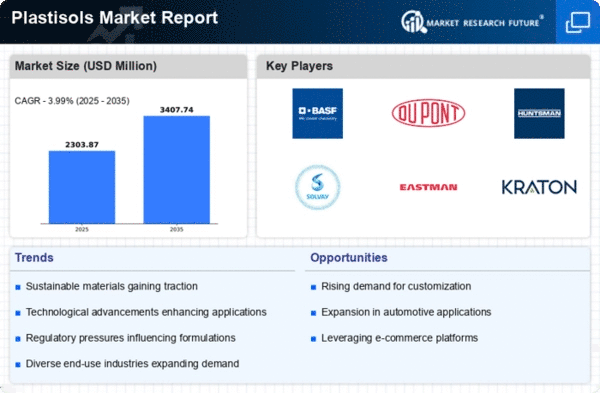
As per MRFR analysis, the Plastisols market size was estimated at 2215.47 USD Million in 2024. The Plastisols industry is projected to grow from 2303.91 USD Million in 2025 to 3407.74 USD Million by 2035, exhibiting a compound annual growth rate (CAGR) of 3.99 during the forecast period 2025 - 2035.

Key Market Trends & Highlights

The Plastisols market is experiencing a dynamic shift towards sustainability and innovation, driven by diverse applications across key sectors.

  • North America remains the largest market for Plastisols, driven by robust demand in the automotive sector.
  • Asia-Pacific is emerging as the fastest-growing region, fueled by rapid industrialization and urbanization.
  • The coatings segment continues to dominate the market, while the adhesives segment is witnessing the highest growth rates.
  • Rising demand in the automotive sector and an increased focus on sustainability are key drivers propelling market expansion.

Market Size & Forecast

2024 Market Size 2215.47 (USD Million)
2035 Market Size 3407.74 (USD Million)
CAGR (2025 - 2035) 3.99%

Major Players

BASF (DE), DuPont (US), Huntsman (US), Solvay (BE), Eastman Chemical Company (US), Kraton Corporation (US), Mitsubishi Chemical Corporation (JP), SABIC (SA), 3M (US)

Our Impact
Enabled $4.3B Revenue Impact for Fortune 500 and Leading Multinationals
Partnering with 2000+ Global Organizations Each Year
30K+ Citations by Top-Tier Firms in the Industry

Plastisols market Trends

The Plastisols market is currently experiencing a dynamic phase characterized by evolving applications and increasing demand across various industries. This versatile material, primarily composed of PVC particles suspended in a liquid plasticizer, is gaining traction due to its unique properties such as flexibility, durability, and ease of processing. Industries such as automotive, textiles, and construction are increasingly adopting plastisols for coatings, adhesives, and sealants, which suggests a broadening scope of utilization. Furthermore, the growing emphasis on sustainability and eco-friendly materials is likely to influence the market, as manufacturers explore bio-based alternatives and recycling methods to reduce environmental impact.

In addition, technological advancements in production processes are enhancing the efficiency and quality of plastisol formulations. Innovations in formulation chemistry and application techniques appear to be driving the development of high-performance plastisols that meet stringent industry standards. 

As the Plastisols market continues to evolve, it may witness a shift towards customization and tailored solutions to meet specific customer needs. Overall, the market landscape is poised for growth, driven by diverse applications and a focus on sustainable practices, indicating a promising future for this segment.

The global plastisol market is currently pivoting toward a "circular chemistry" model, where manufacturers prioritize bio-derived plasticizers and recycled PVC resins to meet the tightening environmental standards of the European Union and North America.

Sustainability Initiatives

The Plastisols market is witnessing a notable shift towards sustainable practices. Manufacturers are increasingly exploring eco-friendly formulations and production methods to reduce environmental impact. This trend reflects a broader industry movement towards sustainability, as companies aim to meet regulatory requirements and consumer preferences for greener products.

Technological Advancements

Technological advances are playing a crucial role in the evolution of the Plastisols market. Innovation in the global plastisol market is now centered on "smart coatings" for the electric vehicle sector, providing essential flame retardancy and vibration damping for high-capacity battery enclosures.

Diverse Application Growth

The range of applications for plastisols is expanding across various sectors. Industries such as automotive, textiles, and construction are increasingly utilizing plastisols for coatings, adhesives, and sealants. This diversification suggests a growing recognition of the material's versatility and performance characteristics.

Plastisols market Drivers

Technological Advancements

Technological advancements play a crucial role in shaping the Global Plastisol Market Industry. Innovations in production techniques and formulations are enhancing the performance and application range of Plastisol. For instance, the development of eco-friendly Plastisol formulations is addressing environmental concerns, thereby attracting a broader customer base. These advancements not only improve the material properties but also reduce production costs, making Plastisol more competitive against alternative materials. As a result, the market is poised for growth, with projections indicating a potential increase in value as manufacturers leverage these technologies to meet evolving market demands.

Expansion in Consumer Goods

The Global Plastisol Market Industry is witnessing significant growth fueled by the expansion of consumer goods. Plastisol's versatility makes it an ideal choice for various applications, including textiles, toys, and household items. As consumer preferences shift towards high-quality, durable products, manufacturers are increasingly adopting Plastisol for its superior performance characteristics. The market is expected to grow to 3.41 USD Billion by 2035, reflecting a compound annual growth rate of 3.98% from 2025 to 2035. This trend indicates a strong alignment between consumer demand and the capabilities of Plastisol, positioning it as a key material in the consumer goods sector.

Growing Demand in Automotive Sector

The Global Plastisol Market Industry is experiencing a notable surge in demand, particularly from the automotive sector. Plastisol is increasingly utilized for coatings and sealants in vehicle manufacturing due to its durability and resistance to environmental factors. As automotive production ramps up, the market is projected to reach 2.22 USD Billion in 2024. This growth is driven by the need for lightweight materials that enhance fuel efficiency and reduce emissions. Additionally, the trend towards electric vehicles further amplifies the demand for advanced materials, suggesting a robust future for Plastisol applications in this sector.

Diverse Applications Across Industries

The Global Plastisol Market Industry is characterized by its diverse applications across multiple sectors, including construction, healthcare, and electronics. This versatility is a key driver of market growth, as Plastisol can be tailored to meet specific performance requirements in different applications. For example, in the construction sector, Plastisol is used for roofing membranes and waterproofing solutions, while in healthcare, it is utilized for medical device coatings. The broad applicability of Plastisol suggests a robust market trajectory, as industries increasingly recognize its benefits, thereby expanding its usage and contributing to overall market growth.

Regulatory Support for Sustainable Materials

Regulatory support for sustainable materials is influencing the Global Plastisol Market Industry positively. Governments worldwide are implementing stricter regulations aimed at reducing environmental impact, which encourages the adoption of eco-friendly materials, including Plastisol. This regulatory landscape is fostering innovation and investment in sustainable Plastisol formulations, which are increasingly favored by manufacturers. As sustainability becomes a priority, the market is likely to benefit from increased demand for compliant products. This shift not only aligns with global sustainability goals but also positions Plastisol as a viable alternative in various industries, enhancing its market potential.

Market Segment Insights

By Application: Coatings (Largest) vs. Adhesives (Fastest-Growing)

In the Plastisols market, the application segment is characterized by diverse usages, with coatings holding the largest market share. Coatings are widely utilized across various industries, contributing significantly to the overall demand for plastisol products. Conversely, adhesives are emerging as a fast-growing segment, driven by increased requirements for strong bonding solutions in automotive and construction applications. As innovation continues, both segments are expected to evolve in response to market demands.

Coatings (Dominant) vs. Adhesives (Emerging)

Coatings are the dominant segment within the Plastisols market due to their versatile applications, which include automotive, industrial, and architectural coatings. This segment benefits from advancements in technology that enhance performance features such as durability and weather resistance. On the other hand, adhesives represent an emerging segment, gaining traction as industries prioritize efficient and reliable bonding solutions. The rise in manufacturing activities and the push for lightweight materials are driving the demand for adhesives, presenting new opportunities for growth. Together, these segments reflect the dynamic nature of the Plastisols market.

By End Use: Automotive (Largest) vs. Medical (Fastest-Growing)

The Plastisols market showcases a diverse application spectrum across various end-use industries. In this landscape, the Automotive sector emerges as the largest segment, harnessing the unique characteristics of plastisols for manufacturing components that require durability and flexibility. Other significant segments include Construction, Consumer Goods, and Electronics, which, while influential, do not match the automotive demand in terms of overall market share. Consequently, the distribution reveals a strong preference for automotive applications compared to other end uses. Looking ahead, the Medical sector is poised to witness the fastest growth within the Plastisols market. This surge is driven by increasing healthcare demands, innovations in medical device manufacturing, and a trend towards using plastisols for protective applications. Similarly, the Construction and Consumer Goods sectors are maintaining steady momentum, benefiting from advancements in material technology and sustainability practices. Overall, the diverse applicability of plastisols drives continued growth across all segments, with particular momentum in automation and health-related uses.

Automotive: Dominant vs. Medical: Emerging

The Automotive segment stands as the dominant force in the Plastisols market, owing its strength to the critical need for high-performance materials in vehicle manufacturing. Plastisols are used in a variety of applications, including coatings, sealants, and interior components, due to their excellent durability, resistance to chemicals, and flexibility. This segment benefits from continuous innovations in automotive design and manufacturing practices, particularly in enhancing vehicle longevity and functionality. Conversely, the Medical segment is emerging rapidly, gaining traction due to an increased focus on health-related products and devices. The adaptability of plastisols allows for their use in medical coatings, soft-touch applications, and protective barriers, making them indispensable in an evolving healthcare landscape. This dynamic presents a bright future for plastisols in both segments.

By Formulation Type: PVC Plastisol (Largest) vs. Specialty Plastisol (Fastest-Growing)

In the Plastisols market, the formulation type segment is characterized by a diverse range of offerings, with PVC Plastisol commanding the largest share. Its widespread application in manufacturing and industrial processes positions it as a dominant player. Meanwhile, Specialty Plastisol is emerging as the fastest-growing formulation type due to its tailored properties that cater to specific applications, enhancing versatility and performance across various industries. The growth trends in the formulation type segment are primarily driven by advancements in technology and innovation. The increasing demand for PVC Plastisol in sectors such as automotive and construction continues to bolster its market presence. On the other hand, Specialty Plastisol is gaining traction as industries seek customized solutions that enhance product functionality. This shift towards specialization presents new opportunities for manufacturers to innovate and cater to evolving market needs.

PVC Plastisol (Dominant) vs. Specialty Plastisol (Emerging)

PVC Plastisol remains the dominant formulation type in the Plastisols market, recognized for its excellent heat stability and durability. It is widely used in applications ranging from coatings to adhesives, making it critical in various sectors, particularly in automotive and construction. Its established production processes and cost-effectiveness contribute to its continuous prominence. Conversely, Specialty Plastisol is emerging rapidly due to its unique formulations that meet specific needs. It offers enhanced flexibility, chemical resistance, and compatibility with different substrates, positioning it favorably in niche markets. As customer demands evolve, manufacturers are increasingly focused on developing Specialty Plastisol to create innovative solutions that enhance product performance and meet the unique challenges faced in diverse applications.

By Processing Method: Screen Printing (Largest) vs. Dip Coating (Fastest-Growing)

In the Plastisols market, the processing method segment showcases a diverse distribution among key techniques such as screen printing, dip coating, injection molding, and extrusion. Among these, screen printing holds the largest share, recognized for its efficiency and versatility, thus catering to a broad array of applications. On the other hand, dip coating is evolving rapidly, capturing considerable attention due to its ability to provide a uniform coating, making it a preferred choice for many manufacturers looking to enhance product quality and performance.

Screen Printing (Dominant) vs. Dip Coating (Emerging)

Screen printing stands out as the dominant processing method in the Plastisols market, renowned for its capacity to create intricate designs on a variety of substrates efficiently. Its popularity is primarily attributed to its cost-effectiveness and the ability to produce high-quality prints that are durable. Meanwhile, dip coating is gaining traction as an emerging technique due to its unique advantages, such as ensuring uniform coating and excellent adhesion properties. This method is particularly favored in sectors requiring thorough coverage, thus driving its growth as manufacturers increasingly adopt innovative technologies to improve product design and functionality.

By Additive Type: Plasticizers (Largest) vs. Stabilizers (Fastest-Growing)

In the Plastisols market, the additive type segment consists primarily of four key players: plasticizers, stabilizers, fillers, and colorants. Among these, plasticizers hold the largest market share due to their critical role in enhancing the flexibility and durability of plastisol formulations. Stabilizers, while currently smaller in market share, are emerging rapidly, driven by the increasing need for thermal stability in various applications. Fillers and colorants, although significant, play supporting roles in the overall market dynamics.

Plasticizers (Dominant) vs. Stabilizers (Emerging)

Plasticizers dominate the Plastisols market by providing essential properties that enhance the performance of end products. They improve flexibility, reduce brittleness, and enhance overall durability, which makes them invaluable across industries like automotive, construction, and textiles. On the other hand, stabilizers are emerging as a crucial segment given the rising focus on product longevity and environmental regulations. As manufacturers increasingly seek to mitigate thermal degradation, stabilizers are gaining traction as key additives, thereby fostering growth in this segment.

Get more detailed insights about Plastisols market

Regional Insights

North America : Market Leader in Plastisols

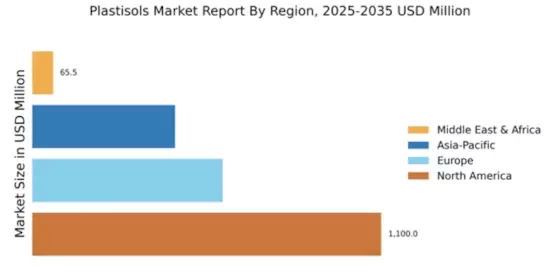
North America is poised to maintain its leadership in the Plastisols market, holding a significant share of 1100.0 million. The region's growth is driven by robust demand in automotive, construction, and consumer goods sectors. Regulatory support for sustainable materials and innovations in manufacturing processes further catalyze market expansion. The increasing adoption of Plastisols in various applications underscores the region's pivotal role in the global landscape. The United States stands as the primary market, with key players like BASF, DuPont, and Huntsman leading the charge. The competitive landscape is characterized by continuous innovation and strategic partnerships among major companies. The presence of advanced manufacturing facilities and a skilled workforce enhances the region's capability to meet growing demand, ensuring North America's dominance in the Plastisols market.

Europe : Emerging Market Dynamics

Europe's Plastisols market is projected to grow significantly, with a market size of 600.0 million. The region benefits from stringent regulations promoting eco-friendly materials, driving demand for sustainable Plastisol solutions. Innovations in product formulations and applications in automotive and healthcare sectors are key growth drivers. The increasing focus on reducing carbon footprints aligns with regulatory frameworks, enhancing market prospects. Leading countries such as Germany, France, and the UK are at the forefront of this growth, with major players like Solvay and Eastman Chemical Company actively participating. The competitive landscape is marked by collaborations and investments in R&D to develop advanced Plastisol products. The presence of established manufacturing hubs further strengthens Europe's position in the global market.

Asia-Pacific : Rapid Growth Potential

The Asia-Pacific Plastisols market, valued at 400.0 million, is experiencing rapid growth due to increasing industrialization and urbanization. Countries like China and India are leading this growth, driven by rising demand in automotive, textiles, and construction sectors. 

Driven by the "Make in India" initiative, the India Plastisol Market is seeing a rapid expansion in the automotive component sector, specifically for underbody sealants and anti-corrosive coatings that improve vehicle longevity. The region's diverse applications for Plastisols are expected to drive significant growth in the coming years.

China stands out as the largest market in the region, with substantial investments in manufacturing capabilities. The competitive landscape features key players such as Eastman Chemical Company and PolyOne Corporation, who are focusing on innovation and product development. The growing emphasis on quality and performance in Plastisols applications is likely to enhance the region's market position, making Asia-Pacific a vital area for future investments.

Middle East and Africa : Niche Market Opportunities

The Middle East and Africa (MEA) Plastisols market, valued at 115.47 million, is gradually emerging as a significant player in the global landscape. The growth is primarily driven by increasing demand in construction and automotive sectors, alongside a rising focus on industrialization. As a strategic logistics hub, the UAE Plastisol Market is also seeing a rise in demand for specialized packaging sealants and metal finishing products used in the Middle-East booming regional construction and aerospace industries. The region's unique challenges also present opportunities for innovation and development in Plastisols applications.

Leading countries in the MEA region include South Africa and the UAE, where local players are beginning to establish a foothold in the market. The competitive landscape is evolving, with companies focusing on strategic partnerships and collaborations to enhance their market presence. As the region continues to develop, the Plastisols market is poised for growth, driven by increasing investments and a focus on sustainability.


Plastisols market Regional Image

Key Players and Competitive Insights

The Plastisols market exhibits a dynamic competitive landscape characterized by innovation and strategic partnerships. Key players such as BASF (DE), DuPont (US), and Huntsman (US) are actively shaping the market through their distinct operational focuses. BASF (DE) emphasizes sustainability in its product development, aiming to reduce environmental impact while enhancing performance. DuPont (US) is leveraging its extensive research capabilities to innovate new formulations that cater to diverse applications, while Huntsman (US) is pursuing strategic acquisitions to bolster its market presence and expand its product portfolio. Collectively, these strategies foster a competitive environment that prioritizes technological advancement and sustainability.
In terms of business tactics, companies are increasingly localizing manufacturing to enhance supply chain efficiency and responsiveness to regional demands. The market structure appears moderately fragmented, with several players vying for market share. However, the influence of major companies is substantial, as they set industry standards and drive innovation. This competitive structure allows for a blend of established players and emerging companies, creating a vibrant ecosystem.
In November 2025, BASF (DE) announced the launch of a new line of eco-friendly Plastisols designed for automotive applications. This strategic move underscores BASF's commitment to sustainability and positions the company to capture a growing segment of environmentally conscious consumers. The introduction of these products is likely to enhance BASF's competitive edge by aligning with global trends towards greener manufacturing processes.
In October 2025, DuPont (US) unveiled a partnership with a leading automotive manufacturer to develop advanced Plastisol coatings that improve durability and reduce weight. This collaboration not only showcases DuPont's innovative capabilities but also highlights the increasing demand for high-performance materials in the automotive sector. Such partnerships are pivotal in driving technological advancements and expanding market reach.
In September 2025, Huntsman (US) completed the acquisition of a specialty chemical company that specializes in Plastisol formulations. This acquisition is expected to enhance Huntsman's product offerings and strengthen its position in the market. By integrating the acquired company's technologies, Huntsman aims to deliver more comprehensive solutions to its customers, thereby reinforcing its competitive stance.
As of December 2025, the Plastisols market is witnessing trends that emphasize digitalization, sustainability, and the integration of AI technologies. Strategic alliances are increasingly shaping the competitive landscape, enabling companies to pool resources and expertise. The shift from price-based competition to a focus on innovation and supply chain reliability is evident, suggesting that future differentiation will hinge on technological advancements and sustainable practices. Companies that can effectively navigate these trends are likely to emerge as leaders in the evolving market.

Key Companies in the Plastisols market include

Industry Developments

Recent developments in the industry include the launch of new eco-friendly plastisol formulations, strategic partnerships between manufacturers and distributors, and the expansion of production capacities in emerging regions.

Key market players are focusing on research and development to enhance the performance and sustainability of plastisol products. The increasing demand for plastisol in various applications, such as printing inks, coatings, and adhesives, is driving market growth.

Future Outlook

Plastisols market Future Outlook

The Plastisols market is projected to grow at a 3.99% CAGR from 2025 to 2035, driven by increasing demand in automotive, textiles, and construction sectors. The plastisols market is entering a transformative phase driven by a global shift toward high-performance, sustainable coating solutions. 

The future outlook for the plastisols market is increasingly defined by the transition from traditional formulations to phthalate-free and bio-based alternatives, directly responding to stringent environmental regulations in the automotive and textile sectors. In the automotive industry, the plastisols market is benefiting from the rise of electric vehicles, which require specialized underbody coatings and sound-dampening sealants that offer both durability and thermal insulation. 

Furthermore, the plastisols market is expanding into advanced healthcare applications, where antimicrobial and biocompatible grades are essential. By integrating nanotechnology and smart additives, the industry is securing its role as a versatile cornerstone for modern manufacturing through 2030.

By 2035, the Plastisols market is expected to achieve robust growth and diversification.

New opportunities lie in:

  • Development of eco-friendly plastisol formulations
  • Expansion into emerging markets with tailored products
  • Integration of advanced manufacturing technologies for efficiency

By 2035, the Plastisols market is expected to achieve robust growth, reflecting evolving industry needs.

Market Segmentation

Plastisols market End Use Outlook

  • Automotive
  • Construction
  • Consumer Goods
  • Electronics
  • Medical

Plastisols market Application Outlook

  • Coatings
  • Adhesives
  • Inks
  • Textiles
  • Molded Products

Plastisols market Additive Type Outlook

  • Stabilizers
  • Plasticizers
  • Fillers
  • Colorants

Plastisols market Formulation Type Outlook

  • PVC Plastisol
  • Polymer Plastisol
  • Thermoplastic Elastomer Plastisol
  • Specialty Plastisol

Plastisols market Processing Method Outlook

  • Screen Printing
  • Dip Coating
  • Injection Molding
  • Extrusion

Report Scope

MARKET SIZE 2024 2215.47(USD Million)
MARKET SIZE 2025 2303.91(USD Million)
MARKET SIZE 2035 3407.74(USD Million)
COMPOUND ANNUAL GROWTH RATE (CAGR) 3.99% (2025 - 2035)
REPORT COVERAGE Revenue Forecast, Competitive Landscape, Growth Factors, and Trends
BASE YEAR 2024
Market Forecast Period 2025 - 2035
Historical Data 2019 - 2024
Market Forecast Units USD Million
Key Companies Profiled BASF (DE), DuPont (US), Huntsman (US), Solvay (BE), Eastman Chemical Company (US), Kraton Corporation (US), Mitsubishi Chemical Corporation (JP), SABIC (SA), 3M (US)
Segments Covered Application, End Use, Formulation Type, Processing Method, Additive Type
Key Market Opportunities Growing demand for eco-friendly Plastisols in automotive and textile applications presents significant market opportunities.
Key Market Dynamics Rising demand for eco-friendly materials drives innovation and competition in the Plastisols market.
Countries Covered North America, Europe, APAC, South America, MEA
Leave a Comment

FAQs

What was the market size of the Plastisol Market in 2024?

The Plastisol Market was valued at approximately USD 2.22 Billion in 2024.

What is the projected market size of the Plastisol Market by the end of the forecast period?

Plastisols market is expected to grow with a CAGR of 3.99% in the period 2025-2035

Which region is expected to hold the largest market share in the Plastisol Market by 2035?

Asia Pacific is expected to hold the largest market share in the Plastisol Market by 2035, owing to the increasing demand for plastisol in various industries in the region.

What are the key applications of plastisol?

Plastisol is widely used in various applications, such as printing inks, coatings, and adhesives.

Who are some of the key competitors in the Plastisol Market?

Some of the key competitors in the Plastisol Market include BASF SE, Evonik Industries, and Arkema.

What are the key growth drivers for the Plastisol Market?

The growth of the Plastisol Market is driven by factors such as the increasing demand for plastisol in the printing and packaging industries and the rising demand for plastisol in emerging economies.

What are the potential challenges in the Plastisol Market?

The Plastisol Market may face challenges such as the availability of raw materials and the environmental impact of plastisol production.

What is the expected CAGR of the Plastisol Market during the forecast period?

Plastisols market is projected to grow at a CAGR of 3.99% during the forecast period, 2025-2035

What are the key trends in the Plastisol Market?

Some of the key trends in the Plastisol Market include the increasing demand for plastisol in digital printing and the development of bio-based plastisols.

What are some of the potential applications of plastisol in the future?

Plastisol has potential applications in various industries, including automotive, construction, and healthcare.

Download Free Sample

Kindly complete the form below to receive a free sample of this Report

Compare Licence

×
Features License Type
Single User Multiuser License Enterprise User
Price $4,950 $5,950 $6,250
Maximum User Access Limit 1 User Upto 10 Users Unrestricted Access Throughout the Organization
Free Customization
Direct Access to Analyst
Deliverable Format
Platform Access
Discount on Next Purchase 10% 15% 15%
Printable Versions