×
Request Free Sample ×

Kindly complete the form below to receive a free sample of this Report

* Please use a valid business email

Leading companies partner with us for data-driven Insights

clients tt-cursor
Hero Background
English
Chinese
French
Japanese
Korean
German
Spanish

Photovoltaic Materials Market Share

ID: MRFR/CnM/1740-HCR
140 Pages
Anshula Mandaokar
February 2026

Photovoltaic (PV) Materials Market Research Report Information by Type (Thin Film, Crystalline Materials and Others), Material (Silicon Based and Non-Silicon Based), End-Use (Residential, Commercial and Utility) And By Region (North America, Europe, Asia-Pacific, And Rest Of The World) –Market Forecast Till 2035

Share:
Download PDF ×

We do not share your information with anyone. However, we may send you emails based on your report interest from time to time. You may contact us at any time to opt-out.

Photovoltaic Materials Market Infographic
Purchase Options

Market Share

Photovoltaic Materials Market Share Analysis

Various pieces of the pie situating methodologies are utilized by the Photovoltaic (PV) Materials market, a key part in the sustainable power area, to remain in front of the opposition and satisfy changing client needs. Here is a compact breakdown of these systems in a pointer design: Innovative Progressions: One of the main strategies is to constantly innovate PV materials. Organizations put vigorously into innovative work to upgrade the proficiency and execution of photovoltaic cells. The creation of materials of the next generation, enhanced cell architectures, or novel manufacturing procedures are all examples of technological advancements. Cost Decrease through Scaling: Accomplishing economies of scale is key in the PV Materials market. Organizations center around increasing creation to diminish producing costs. Bringing down the expense of photovoltaic materials makes sun-oriented energy more serious, interesting to a more extensive purchaser base and supporting the development of the sun powered energy market. Durability and efficacy of the material: Underscoring the effectiveness and strength of PV materials is pivotal for market situating. Organizations endeavor to foster materials that can endure ecological circumstances and guarantee long haul execution. Solar panels are more reliable when they are made of durable, high-quality materials, which gives customers and others in the industry confidence. Production network Improvement: Given the worldwide idea of the PV Materials market, improving the inventory network is an essential objective. Organizations work to lay out proficient and versatile stock chains to guarantee a stable and savvy stream of unrefined substances and parts. Production network enhancement additionally includes key organizations with providers and wholesalers to smooth out strategies and decrease lead times. Worldwide Market Extension: Venturing into new geographic business sectors is a typical procedure to take advantage of the developing interest for sun-oriented energy around the world. Organizations lay out a presence in developing business sectors or locales with solid responsibilities to environmentally friendly power, lining up with worldwide patterns and expanding their client base. Manageability and Natural Certifications: Because of expanding natural mindfulness, organizations in the PV Materials market focus on manageability in assembling cycles and item lifecycles. Materials with lower natural effect, reusing drives, and adherence to manageability confirmations add to a positive market picture. Vital Associations and Joint efforts: Coordinated efforts with other industry players, research foundations, and innovation suppliers work with information trade and joint innovative work endeavors. Key organizations can prompt leap forwards in materials science, producing cycles, and generally speaking innovation, giving organizations an upper hand on the lookout. Brand Notoriety and Trust: Building areas of strength for a standing is fundamental for market situating. Organizations put resources into promoting endeavors to feature the dependability, execution, and maintainability of their PV materials. A positive brand picture imparts trust among buyers, impacting buying choices in a market driven by both innovation and trust. Government and Administrative Consistence: Complying with unofficial laws and industry norms is a crucial procedure. Organizations guarantee that their PV materials consent to somewhere safe, quality, and execution norms set by administrative specialists. Consistence meets lawful necessities as well as positions organizations as mindful and reliable players on the lookout. Investing in Awareness and Education: Training and mindfulness drives assume a vital part in market situations. Organizations put resources into teaching customers, organizations, and policymakers about the advantages of sun-based energy and the nature of their PV materials. Positive perceptions of solar technology are fueled by increased awareness, which in turn drives demand for high-quality PV materials.


Author
Anshula Mandaokar
Team Lead - Research

Anshula Mandaokar holds an academic degree in Chemical Engineering and has been contributing to the field for more than 5 years. She has expertise in Market Research and Business Consulting and serves as a Team Lead for a reputed Market Research firm under the Chemicals and Materials domain spectrum. She has worked on multiple projects, generating explicit results in a quick turnaround time. Her understanding of data interpretation justifies her role as a leader.

Leave a Comment

FAQs

What is the current valuation of the Photovoltaic (PV) Materials Market?

<p>As of 2024, the Photovoltaic (PV) Materials Market was valued at 72.16 USD Billion.</p>

What is the projected market size for the Photovoltaic (PV) Materials Market by 2035?

<p>The market is projected to reach 158.28 USD Billion by 2035.</p>

What is the expected CAGR for the Photovoltaic (PV) Materials Market during the forecast period 2025 - 2035?

<p>The expected CAGR for the market during the forecast period 2025 - 2035 is 7.4%.</p>

Which segment of the Photovoltaic (PV) Materials Market had the highest valuation in 2024?

<p>In 2024, the Crystalline Materials segment had the highest valuation at 40.0 USD Billion.</p>

What are the projected valuations for the Thin Film segment by 2035?

<p>The Thin Film segment is projected to reach 22.0 USD Billion by 2035.</p>

How does the valuation of Silicon Based materials compare to Non-Silicon Based materials in 2024?

<p>In 2024, Silicon Based materials were valued at 50.0 USD Billion, while Non-Silicon Based materials were valued at 22.16 USD Billion.</p>

What is the expected growth for the Utility end-use segment by 2035?

The Utility end-use segment is expected to grow to 78.28 USD Billion by 2035.

Which companies are considered key players in the Photovoltaic (PV) Materials Market?

Key players in the market include First Solar, Canadian Solar, JinkoSolar, and Trina Solar, among others.

What is the projected valuation for the Residential end-use segment by 2035?

The Residential end-use segment is projected to reach 45.0 USD Billion by 2035.

What is the expected valuation for the Others segment by 2035?

The Others segment is expected to reach 46.28 USD Billion by 2035.

Market Summary

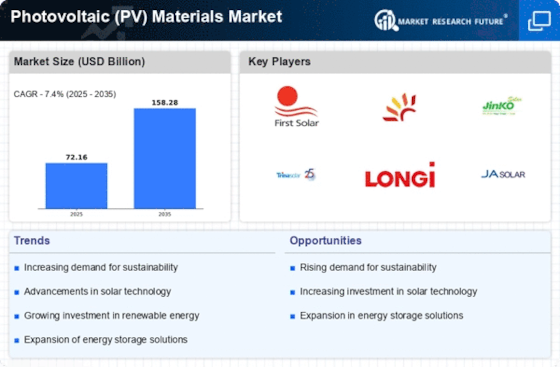
As per Market Research Future analysis, the Photovoltaic (PV) Materials Market Size was estimated at 72.16 USD Billion in 2024. The Photovoltaic (PV) Materials industry is projected to grow from 77.5 USD Billion in 2025 to 158.28 USD Billion by 2035, exhibiting a compound annual growth rate (CAGR) of 7.4% during the forecast period 2025 - 2035

Key Market Trends & Highlights

The Photovoltaic (PV) Materials Market is experiencing robust growth driven by technological advancements and supportive government policies.

  • Technological advancements in materials are enhancing the efficiency and performance of photovoltaic systems. North America remains the largest market, while Asia-Pacific is emerging as the fastest-growing region for PV materials. Crystalline materials dominate the market, yet thin film technologies are rapidly gaining traction due to their flexibility and lower production costs. Rising demand for renewable energy sources and government support are key drivers propelling the growth of the PV materials market.

Market Size & Forecast

2024 Market Size 72.16 (USD Billion)
2035 Market Size 158.28 (USD Billion)
CAGR (2025 - 2035) 7.4%
Largest Regional Market Share in 2024 Asia Pacific

Major Players

First Solar (US), Canadian Solar (CA), JinkoSolar (CN), Trina Solar (CN), LONGi Green Energy (CN), JA Solar (CN), SunPower (US), Q CELLS (KR), REC Group (NO)

Market Trends

The Humic Acid Market is currently experiencing a notable transformation, driven by increasing awareness of sustainable agricultural practices and the rising demand for organic fertilizers. This shift appears to be influenced by a growing recognition of the benefits associated with humic acid, such as enhanced soil fertility, improved nutrient uptake, and increased crop yields. As environmental concerns continue to shape agricultural policies, the humic acid market is benefiting from reduced reliance on synthetic fertilizers and chemical soil conditioners. The versatility of humic acid in applications such as horticulture, turf management, and soil remediation further strengthens the growth outlook of the global humic acid market.  In addition to agricultural applications, the Humic Acid Market is also witnessing interest from the industrial sector, particularly in water treatment and waste management.

The ability of humic acid to bind heavy metals and organic pollutants indicates its potential utility in environmental remediation efforts. As regulatory frameworks become more stringent regarding waste disposal and water quality, the demand for humic acid in these applications may increase contributing significantly to overall humic acid market size growth. These evolving applications underscore shifting humic acid market trends toward multifunctional and sustainability-driven solutions. . Overall, the Humic Acid Market appears poised for expansion, driven by both agricultural and industrial needs, as stakeholders seek sustainable solutions to address contemporary challenges in soil health and environmental protection.

Technological Advancements in Materials

Recent innovations in material science are enhancing the efficiency and durability of photovoltaic systems. New compounds and manufacturing techniques are being explored, which may lead to improved energy conversion rates and lower production costs.

Government Policies and Incentives

Supportive regulatory frameworks and financial incentives are encouraging the adoption of solar technologies. These measures are likely to stimulate investment in the Photovoltaic (PV) Materials Market, fostering growth and innovation.

Emerging Market Segments

The rise of niche applications, such as building-integrated photovoltaics and portable solar solutions, is creating new opportunities within the Photovoltaic (PV) Materials Market. These segments may attract diverse consumer bases, further driving market expansion.

Photovoltaic Materials Market Market Drivers

Cost Reductions in Solar Technology

Cost reductions in solar technology are significantly influencing the Photovoltaic (PV) Materials Market. Over the past decade, the cost of solar panels has decreased dramatically, making solar energy more accessible to a wider audience. This decline is attributed to advancements in manufacturing processes, economies of scale, and increased competition among suppliers. According to industry reports, the cost of solar photovoltaic systems has dropped by nearly 90% since 2010. As prices continue to fall, the adoption of solar energy is likely to accelerate, further driving demand for photovoltaic materials. This trend suggests a promising outlook for the Photovoltaic (PV) Materials Market as it aligns with the global push for affordable renewable energy.

Rising Demand for Renewable Energy Sources

The increasing The Photovoltaic (PV) Materials Industry. As concerns over climate change and energy security intensify, nations are prioritizing the transition to sustainable energy solutions. The International Energy Agency projects that solar energy could account for a substantial portion of the global energy mix by 2030. This shift is likely to result in heightened investments in solar infrastructure, thereby boosting the demand for photovoltaic materials. The Photovoltaic (PV) Materials Market stands to benefit significantly from this trend, as more consumers and businesses seek to harness solar energy for their power needs.

Government Support and Regulatory Frameworks

Government policies and regulatory frameworks play a crucial role in shaping the Photovoltaic (PV) Materials Market. Many countries are implementing supportive measures, such as tax incentives, subsidies, and renewable energy mandates, to promote solar energy adoption. For example, the introduction of feed-in tariffs and net metering policies has encouraged investments in solar technologies. According to recent data, countries with robust government support have seen a significant increase in solar installations, which directly impacts the demand for PV materials. This supportive environment is likely to continue fostering innovation and investment in the Photovoltaic (PV) Materials Market, making it an attractive sector for stakeholders.

Growing Awareness of Environmental Sustainability

The growing awareness of environmental sustainability is a pivotal driver for the Photovoltaic (PV) Materials Market. As consumers and businesses become more conscious of their carbon footprints, there is a marked shift towards adopting cleaner energy solutions. This heightened awareness is fostering a culture of sustainability, where solar energy is increasingly viewed as a viable alternative to fossil fuels. Educational campaigns and advocacy for renewable energy are likely to further enhance public perception and acceptance of solar technologies. Consequently, this trend is expected to stimulate demand for photovoltaic materials, as stakeholders seek to align their operations with sustainable practices in the Photovoltaic (PV) Materials Market.

Technological Innovations in Photovoltaic Materials

The Photovoltaic (PV) Materials Market is experiencing a surge in technological innovations that enhance the efficiency and durability of solar panels. Recent advancements in materials such as perovskite and bifacial solar cells have shown promising results, potentially increasing energy conversion rates beyond traditional silicon-based technologies. For instance, perovskite solar cells have demonstrated efficiencies exceeding 25%, which could revolutionize the market landscape. Furthermore, the integration of nanotechnology in PV materials is likely to improve light absorption and reduce production costs. As these technologies mature, they may lead to a broader adoption of solar energy solutions, thereby driving growth in the Photovoltaic (PV) Materials Market.

Market Segment Insights

By Type: Crystalline Materials (Largest) vs. Thin Film (Fastest-Growing)

In the Photovoltaic (PV) Materials Market, Crystalline Materials holds the largest share, dominating the landscape with its established technology and widespread adoption in various applications. Thin Film, while currently smaller in market share, is gaining traction and has emerged as a competitive alternative due to its unique properties and flexibility, catering to niche applications where traditional methods may fall short. Others, representing a mix of innovative materials and technologies, play a minor yet significant role in diversifying the market.

Crystalline Materials (Dominant) vs. Thin Film (Emerging)

Crystalline Materials, best known for high efficiency and reliability, dominate the PV materials market. This segment includes monocrystalline and polycrystalline <a href="https://www.marketresearchfuture.com/reports/silicon-nitride-market-8132">silicon</a> types, favored for their robust performance in large-scale solar farms and residential systems. On the other hand, Thin Film technology represents an emerging trend, characterized by lightweight, flexible materials that can be integrated into a variety of surfaces and structures, expanding potential applications. With lower production costs and simple manufacturing processes, Thin Film is increasingly seen as a viable option for customization and innovative solar solutions, particularly in urban environments where space is a constraint.

By Material: Silicon Based (Largest) vs. Non-Silicon Based (Fastest-Growing)

In the Photovoltaic (PV) Materials Market, the distribution of market share is heavily in favor of silicon-based materials, which dominate due to their established technology and robustness. Non-silicon-based materials, while currently holding a smaller portion of the market, are increasingly being recognized for their potential benefits, including lower costs and flexibility. This dynamic creates distinct competitive advantages for both segments, thus shaping the overall landscape of PV materials.

Material: Silicon Based (Dominant) vs. Non-Silicon Based (Emerging)

Silicon-based materials remain the dominant force in the Photovoltaic (PV) Materials Market, primarily due to their widespread availability and proven efficiency in converting sunlight into electricity. This <a href="https://www.marketresearchfuture.com/reports/tire-material-market-8286">material</a> type benefits from decades of research and development, resulting in highly efficient solar cells that continue to improve. On the other hand, non-silicon-based materials, including perovskite and organic photovoltaics, are emerging as innovative alternatives. These materials are notable for their potential to reduce production costs and enable lightweight, flexible solar panels that can be applied in a variety of contexts, paving the way for innovative solutions in solar energy generation.

By End-Use: Residential (Largest) vs. Utility (Fastest-Growing)

In the Photovoltaic (PV) Materials Market, the end-use segment is primarily dominated by the residential sector, which accounts for a significant share of the market due to increasing consumer awareness and preference for sustainable energy solutions. The commercial sector also plays a vital role, though it holds a smaller portion as more businesses start to adopt solar energy systems. The utility segment, while traditionally smaller, is rapidly gaining traction as large-scale solar projects are being initiated globally, contributing to its growing market presence.

End-Use: Residential (Dominant) vs. Utility (Emerging)

The residential end-use segment remains dominant in the Photovoltaic (PV) Materials Market, characterized by a strong shift towards solar panel installation in homes. This sector benefits from government incentives, increased environmental awareness among homeowners, and the declining costs of solar technologies. In contrast, the utility segment is emerging powerfully, driven by large-scale solar farms aiming to meet renewable energy targets. Utilities are increasingly investing in solar materials to enhance energy production capacity, thus playing a crucial role in the transition to renewable energy. The growth in this sector is fueled by advancements in solar technology that enhance efficiency and lower operational costs, making solar power more competitive.

Get more detailed insights about Photovoltaic (PV) Materials Market Research Report - Global Forecast till 2035

Regional Insights

By region, the study provides the market insights into North America, Europe, Asia-Pacific and Rest of the World. The Asia-Pacific Photovoltaic (PV) Materials Market dominated this market in 2022 (45.80%). This is due to increase favorable solar resources, encouraging government regulations, and a commitment to renewable energy sources. Further, China’s Photovoltaic (PV) Materials market held the largest market share, and the Indian Photovoltaic (PV) Materials market was the fastest growing market in the Asia-Pacific region.

Further, the major countries studied in the market report are The U.S., Canada, German, France, the UK, Italy, Spain, China, Japan, India, Australia, South Korea, and Brazil.

Figure 2: PHOTOVOLTAIC (PV) MATERIALS MARKET SHARE BY REGION 2022 (USD Billion)

Europe Photovoltaic (PV) Materials market accounts for the second-largest market share. This is due to the area has made a major dedication to renewable energy and has put favorable regulations in place to assist the development of solar power, such as feed-in tariffs and targets for renewable energy. Further, the German Photovoltaic (PV) Materials market held the largest market share, and the UK Photovoltaic (PV) Materials market was the fastest growing market in the European region

The North America Photovoltaic (PV) Materials Market is expected to grow at the fastest CAGR from 2023 to 2032. Due to environmental concerns and goals for renewable energy, this region is predicted to experience the biggest growth. Moreover, the U.S. Photovoltaic (PV) Materials market held the largest market share, and the Canada Photovoltaic (PV) Materials market was the fastest growing market in the North America region.

Key Players and Competitive Insights

Leading market players are investing heavily in research and development in order to expand their product lines, which will help the Photovoltaic (PV) Materials market, grow even more. Market participants are also undertaking a variety of strategic activities to expand their footprint, with important market developments including new product launches, contractual agreements, mergers and acquisitions, higher investments, and collaboration with other organizations. To expand and survive in a more competitive and rising market climate, Photovoltaic (PV) Materials industry must offer cost-effective items.Manufacturing locally to minimize operational costs is one of the key business tactics used by manufacturers in the photovoltaic materials industry to benefit clients and increase the market sector. In recent years, the Photovoltaic (PV) Materials industry has offered some of the most significant advantages to medicine. Major players in the photovoltaic (PV) Materials market, including Wacker Chemie AG (Germany), I. du Pont de Nemours and Company (US), Honeywell International Inc. (US), Coveme SpA (Italy), Mitsubishi Materials Corporation (Japan), Targray (Canada), Hangzhou Foster Applied Materials Co. Ltd (China), Ferrotec Corporation (US), JinkoSolar Holding Co.Ltd (China), SunPower Corporation (US), Baoding Lightway Green Energy Technology Ltd (China), Shine Earth (Fujian) New Energy Co. Ltd (China), Power Solar Systems Ltd (India), Wuxi Suntech Power Co. Ltd (China), Acciona Energía SA (Spain), and others, are attempting to increase market demand by investing in research and development operations.Wacker Chemie AG, headquartered in Germany, is a leading player in the photovoltaic (PV) materials market. The business specialises in the creation of cutting-edge materials used in the production of solar cells and modules. The creation of high-quality solar cells requires a variety of PV materials, including silicones, polymers, and high-purity chemicals, all of which are provided by Wacker Chemie. Wacker Chemie consistently works to improve the effectiveness, efficiency, and durability of PV materials with a strong emphasis on research and development.The company can produce cutting-edge materials that adhere to the exacting standards of the PV industry because to its knowledge in silicon chemistry and cutting-edge manufacturing capabilities. PV materials from Wacker Chemie are widely used by solar module producers worldwide, fostering the expansion of the solar energy industry. As it seeks to offer clean and renewable energy solutions, the company's dedication to sustainability and environmental responsibility is consistent with the objectives of the photovoltaic sector.Honeywell International Inc., a multinational conglomerate based in the United States. To meet the rising need for renewable energy, the company provides a wide range of PV materials and solutions. Advanced encapsulants, backsheets, adhesives, and other speciality materials from Honeywell's portfolio of PV materials improve the efficiency and dependability of solar cells and modules. With its proficiency in materials science and engineering, Honeywell offers creative solutions aimed at enhancing the effectiveness, resilience, and financial viability of PV systems.PV module manufacturers all around the world use the company's products to improve the power production, long-term reliability, and environmental robustness of solar installations. Honeywell's PV materials selections demonstrate its dedication to sustainability and renewable energy. Instigating the shift to renewable energy sources, Honeywell plays a critical role by facilitating the development of high-quality solar modules.Dow Chemical, a chemical conglomerate based in the United States, will offer a photovoltaic (PV) product line in 2023, including six silicone-based sealants and adhesives for PV module assembly.DOWSIL is a new product line designed to provide durability and performance for frame sealing, rail and junction box bonding, potting, and constructing integrated photovoltaic installation materials.One of the most important events on the renewables calendar, All-Energy Australia, will conclude for another year in 2023, following a likely record-breaking turnout. The official numbers are not yet in, but there were 15,000 registrations, and word is that the number of attendance will easily exceed last year's event, which drew 8,500 people.

Key Companies in the Photovoltaic Materials Market include

Industry Developments

April 2021: The largest integrated solar company with an Indian base, Tata Power Solar Systems Ltd., has revealed a huge expansion of its cutting-edge production plant in Bengaluru. The company wants to increase its entire cell and module production capacity to 1,100 MW. Due to the government of India's supporting policies, the company's solar modules are now in greater demand, and the rise in production is in line with that demand.

Future Outlook

Photovoltaic Materials Market Future Outlook

The Photovoltaic (PV) Materials Market is projected to grow at a 7.4% CAGR from 2025 to 2035, driven by technological advancements, increasing demand for renewable energy, and supportive government policies.

New opportunities lie in:

  • <p>Development of advanced bifacial <a href="https://www.marketresearchfuture.com/reports/solar-panels-market-3237" target="_blank" title="solar panels">solar panels</a> for enhanced efficiency.</p>
  • <p> </p>
  • <p>Expansion into emerging markets with tailored PV solutions.</p>
  • <p>Investment in recycling technologies for sustainable material recovery.</p>

By 2035, the market is expected to solidify its position as a leader in renewable energy solutions.

Market Segmentation

Photovoltaic Materials Market Type Outlook

  • Thin Film
  • Crystalline Materials
  • Others

Photovoltaic Materials Market End-Use Outlook

  • Residential
  • Commercial
  • Utility

Photovoltaic Materials Market Material Outlook

  • Silicon Based
  • Non-Silicon Based

Report Scope

MARKET SIZE 2024 72.16(USD Billion)
MARKET SIZE 2025 77.5(USD Billion)
MARKET SIZE 2035 158.28(USD Billion)
COMPOUND ANNUAL GROWTH RATE (CAGR) 7.4% (2025 - 2035)
REPORT COVERAGE Revenue Forecast, Competitive Landscape, Growth Factors, and Trends
BASE YEAR 2024
Market Forecast Period 2025 - 2035
Historical Data 2019 - 2024
Market Forecast Units USD Billion
Key Companies Profiled First Solar (US), Canadian Solar (CA), JinkoSolar (CN), Trina Solar (CN), LONGi Green Energy (CN), JA Solar (CN), SunPower (US), Q CELLS (KR), REC Group (NO)
Segments Covered Type, Region
Key Market Opportunities Advancements in perovskite solar cells enhance efficiency and reduce costs in the Photovoltaic (PV) Materials Market.
Key Market Dynamics Rising demand for sustainable energy drives innovation and competition in the Photovoltaic Materials Market.
Countries Covered North America, Europe, APAC, South America, MEA

FAQs

What is the current valuation of the Photovoltaic (PV) Materials Market?

<p>As of 2024, the Photovoltaic (PV) Materials Market was valued at 72.16 USD Billion.</p>

What is the projected market size for the Photovoltaic (PV) Materials Market by 2035?

<p>The market is projected to reach 158.28 USD Billion by 2035.</p>

What is the expected CAGR for the Photovoltaic (PV) Materials Market during the forecast period 2025 - 2035?

<p>The expected CAGR for the market during the forecast period 2025 - 2035 is 7.4%.</p>

Which segment of the Photovoltaic (PV) Materials Market had the highest valuation in 2024?

<p>In 2024, the Crystalline Materials segment had the highest valuation at 40.0 USD Billion.</p>

What are the projected valuations for the Thin Film segment by 2035?

<p>The Thin Film segment is projected to reach 22.0 USD Billion by 2035.</p>

How does the valuation of Silicon Based materials compare to Non-Silicon Based materials in 2024?

<p>In 2024, Silicon Based materials were valued at 50.0 USD Billion, while Non-Silicon Based materials were valued at 22.16 USD Billion.</p>

What is the expected growth for the Utility end-use segment by 2035?

The Utility end-use segment is expected to grow to 78.28 USD Billion by 2035.

Which companies are considered key players in the Photovoltaic (PV) Materials Market?

Key players in the market include First Solar, Canadian Solar, JinkoSolar, and Trina Solar, among others.

What is the projected valuation for the Residential end-use segment by 2035?

The Residential end-use segment is projected to reach 45.0 USD Billion by 2035.

What is the expected valuation for the Others segment by 2035?

The Others segment is expected to reach 46.28 USD Billion by 2035.

  1. SECTION I: EXECUTIVE SUMMARY AND KEY HIGHLIGHTS
    1. | 1.1 EXECUTIVE SUMMARY
    2. | | 1.1.1 Market Overview
    3. | | 1.1.2 Key Findings
    4. | | 1.1.3 Market Segmentation
    5. | | 1.1.4 Competitive Landscape
    6. | | 1.1.5 Challenges and Opportunities
    7. | | 1.1.6 Future Outlook
  2. SECTION II: SCOPING, METHODOLOGY AND MARKET STRUCTURE
    1. | 2.1 MARKET INTRODUCTION
    2. | | 2.1.1 Definition
    3. | | 2.1.2 Scope of the study
    4. | | | 2.1.2.1 Research Objective
    5. | | | 2.1.2.2 Assumption
    6. | | | 2.1.2.3 Limitations
    7. | 2.2 RESEARCH METHODOLOGY
    8. | | 2.2.1 Overview
    9. | | 2.2.2 Data Mining
    10. | | 2.2.3 Secondary Research
    11. | | 2.2.4 Primary Research
    12. | | | 2.2.4.1 Primary Interviews and Information Gathering Process
    13. | | | 2.2.4.2 Breakdown of Primary Respondents
    14. | | 2.2.5 Forecasting Model
    15. | | 2.2.6 Market Size Estimation
    16. | | | 2.2.6.1 Bottom-Up Approach
    17. | | | 2.2.6.2 Top-Down Approach
    18. | | 2.2.7 Data Triangulation
    19. | | 2.2.8 Validation
  3. SECTION III: QUALITATIVE ANALYSIS
    1. | 3.1 MARKET DYNAMICS
    2. | | 3.1.1 Overview
    3. | | 3.1.2 Drivers
    4. | | 3.1.3 Restraints
    5. | | 3.1.4 Opportunities
    6. | 3.2 MARKET FACTOR ANALYSIS
    7. | | 3.2.1 Value chain Analysis
    8. | | 3.2.2 Porter's Five Forces Analysis
    9. | | | 3.2.2.1 Bargaining Power of Suppliers
    10. | | | 3.2.2.2 Bargaining Power of Buyers
    11. | | | 3.2.2.3 Threat of New Entrants
    12. | | | 3.2.2.4 Threat of Substitutes
    13. | | | 3.2.2.5 Intensity of Rivalry
    14. | | 3.2.3 COVID-19 Impact Analysis
    15. | | | 3.2.3.1 Market Impact Analysis
    16. | | | 3.2.3.2 Regional Impact
    17. | | | 3.2.3.3 Opportunity and Threat Analysis
  4. SECTION IV: QUANTITATIVE ANALYSIS
    1. | 4.1 Chemicals and Materials, BY Type (USD Billion)
    2. | | 4.1.1 Thin Film
    3. | | 4.1.2 Crystalline Materials
    4. | | 4.1.3 Others
    5. | 4.2 Chemicals and Materials, BY Material (USD Billion)
    6. | | 4.2.1 Silicon Based
    7. | | 4.2.2 Non-Silicon Based
    8. | 4.3 Chemicals and Materials, BY End-Use (USD Billion)
    9. | | 4.3.1 Residential
    10. | | 4.3.2 Commercial
    11. | | 4.3.3 Utility
    12. | 4.4 Chemicals and Materials, BY Region (USD Billion)
    13. | | 4.4.1 North America
    14. | | | 4.4.1.1 US
    15. | | | 4.4.1.2 Canada
    16. | | 4.4.2 Europe
    17. | | | 4.4.2.1 Germany
    18. | | | 4.4.2.2 UK
    19. | | | 4.4.2.3 France
    20. | | | 4.4.2.4 Russia
    21. | | | 4.4.2.5 Italy
    22. | | | 4.4.2.6 Spain
    23. | | | 4.4.2.7 Rest of Europe
    24. | | 4.4.3 APAC
    25. | | | 4.4.3.1 China
    26. | | | 4.4.3.2 India
    27. | | | 4.4.3.3 Japan
    28. | | | 4.4.3.4 South Korea
    29. | | | 4.4.3.5 Malaysia
    30. | | | 4.4.3.6 Thailand
    31. | | | 4.4.3.7 Indonesia
    32. | | | 4.4.3.8 Rest of APAC
    33. | | 4.4.4 South America
    34. | | | 4.4.4.1 Brazil
    35. | | | 4.4.4.2 Mexico
    36. | | | 4.4.4.3 Argentina
    37. | | | 4.4.4.4 Rest of South America
    38. | | 4.4.5 MEA
    39. | | | 4.4.5.1 GCC Countries
    40. | | | 4.4.5.2 South Africa
    41. | | | 4.4.5.3 Rest of MEA
  5. SECTION V: COMPETITIVE ANALYSIS
    1. | 5.1 Competitive Landscape
    2. | | 5.1.1 Overview
    3. | | 5.1.2 Competitive Analysis
    4. | | 5.1.3 Market share Analysis
    5. | | 5.1.4 Major Growth Strategy in the Chemicals and Materials
    6. | | 5.1.5 Competitive Benchmarking
    7. | | 5.1.6 Leading Players in Terms of Number of Developments in the Chemicals and Materials
    8. | | 5.1.7 Key developments and growth strategies
    9. | | | 5.1.7.1 New Product Launch/Service Deployment
    10. | | | 5.1.7.2 Merger & Acquisitions
    11. | | | 5.1.7.3 Joint Ventures
    12. | | 5.1.8 Major Players Financial Matrix
    13. | | | 5.1.8.1 Sales and Operating Income
    14. | | | 5.1.8.2 Major Players R&D Expenditure. 2023
    15. | 5.2 Company Profiles
    16. | | 5.2.1 First Solar (US)
    17. | | | 5.2.1.1 Financial Overview
    18. | | | 5.2.1.2 Products Offered
    19. | | | 5.2.1.3 Key Developments
    20. | | | 5.2.1.4 SWOT Analysis
    21. | | | 5.2.1.5 Key Strategies
    22. | | 5.2.2 Canadian Solar (CA)
    23. | | | 5.2.2.1 Financial Overview
    24. | | | 5.2.2.2 Products Offered
    25. | | | 5.2.2.3 Key Developments
    26. | | | 5.2.2.4 SWOT Analysis
    27. | | | 5.2.2.5 Key Strategies
    28. | | 5.2.3 JinkoSolar (CN)
    29. | | | 5.2.3.1 Financial Overview
    30. | | | 5.2.3.2 Products Offered
    31. | | | 5.2.3.3 Key Developments
    32. | | | 5.2.3.4 SWOT Analysis
    33. | | | 5.2.3.5 Key Strategies
    34. | | 5.2.4 Trina Solar (CN)
    35. | | | 5.2.4.1 Financial Overview
    36. | | | 5.2.4.2 Products Offered
    37. | | | 5.2.4.3 Key Developments
    38. | | | 5.2.4.4 SWOT Analysis
    39. | | | 5.2.4.5 Key Strategies
    40. | | 5.2.5 LONGi Green Energy (CN)
    41. | | | 5.2.5.1 Financial Overview
    42. | | | 5.2.5.2 Products Offered
    43. | | | 5.2.5.3 Key Developments
    44. | | | 5.2.5.4 SWOT Analysis
    45. | | | 5.2.5.5 Key Strategies
    46. | | 5.2.6 JA Solar (CN)
    47. | | | 5.2.6.1 Financial Overview
    48. | | | 5.2.6.2 Products Offered
    49. | | | 5.2.6.3 Key Developments
    50. | | | 5.2.6.4 SWOT Analysis
    51. | | | 5.2.6.5 Key Strategies
    52. | | 5.2.7 SunPower (US)
    53. | | | 5.2.7.1 Financial Overview
    54. | | | 5.2.7.2 Products Offered
    55. | | | 5.2.7.3 Key Developments
    56. | | | 5.2.7.4 SWOT Analysis
    57. | | | 5.2.7.5 Key Strategies
    58. | | 5.2.8 Q CELLS (KR)
    59. | | | 5.2.8.1 Financial Overview
    60. | | | 5.2.8.2 Products Offered
    61. | | | 5.2.8.3 Key Developments
    62. | | | 5.2.8.4 SWOT Analysis
    63. | | | 5.2.8.5 Key Strategies
    64. | | 5.2.9 REC Group (NO)
    65. | | | 5.2.9.1 Financial Overview
    66. | | | 5.2.9.2 Products Offered
    67. | | | 5.2.9.3 Key Developments
    68. | | | 5.2.9.4 SWOT Analysis
    69. | | | 5.2.9.5 Key Strategies
    70. | 5.3 Appendix
    71. | | 5.3.1 References
    72. | | 5.3.2 Related Reports
  6. LIST OF FIGURES
    1. | 6.1 MARKET SYNOPSIS
    2. | 6.2 NORTH AMERICA MARKET ANALYSIS
    3. | 6.3 US MARKET ANALYSIS BY TYPE
    4. | 6.4 US MARKET ANALYSIS BY MATERIAL
    5. | 6.5 US MARKET ANALYSIS BY END-USE
    6. | 6.6 CANADA MARKET ANALYSIS BY TYPE
    7. | 6.7 CANADA MARKET ANALYSIS BY MATERIAL
    8. | 6.8 CANADA MARKET ANALYSIS BY END-USE
    9. | 6.9 EUROPE MARKET ANALYSIS
    10. | 6.10 GERMANY MARKET ANALYSIS BY TYPE
    11. | 6.11 GERMANY MARKET ANALYSIS BY MATERIAL
    12. | 6.12 GERMANY MARKET ANALYSIS BY END-USE
    13. | 6.13 UK MARKET ANALYSIS BY TYPE
    14. | 6.14 UK MARKET ANALYSIS BY MATERIAL
    15. | 6.15 UK MARKET ANALYSIS BY END-USE
    16. | 6.16 FRANCE MARKET ANALYSIS BY TYPE
    17. | 6.17 FRANCE MARKET ANALYSIS BY MATERIAL
    18. | 6.18 FRANCE MARKET ANALYSIS BY END-USE
    19. | 6.19 RUSSIA MARKET ANALYSIS BY TYPE
    20. | 6.20 RUSSIA MARKET ANALYSIS BY MATERIAL
    21. | 6.21 RUSSIA MARKET ANALYSIS BY END-USE
    22. | 6.22 ITALY MARKET ANALYSIS BY TYPE
    23. | 6.23 ITALY MARKET ANALYSIS BY MATERIAL
    24. | 6.24 ITALY MARKET ANALYSIS BY END-USE
    25. | 6.25 SPAIN MARKET ANALYSIS BY TYPE
    26. | 6.26 SPAIN MARKET ANALYSIS BY MATERIAL
    27. | 6.27 SPAIN MARKET ANALYSIS BY END-USE
    28. | 6.28 REST OF EUROPE MARKET ANALYSIS BY TYPE
    29. | 6.29 REST OF EUROPE MARKET ANALYSIS BY MATERIAL
    30. | 6.30 REST OF EUROPE MARKET ANALYSIS BY END-USE
    31. | 6.31 APAC MARKET ANALYSIS
    32. | 6.32 CHINA MARKET ANALYSIS BY TYPE
    33. | 6.33 CHINA MARKET ANALYSIS BY MATERIAL
    34. | 6.34 CHINA MARKET ANALYSIS BY END-USE
    35. | 6.35 INDIA MARKET ANALYSIS BY TYPE
    36. | 6.36 INDIA MARKET ANALYSIS BY MATERIAL
    37. | 6.37 INDIA MARKET ANALYSIS BY END-USE
    38. | 6.38 JAPAN MARKET ANALYSIS BY TYPE
    39. | 6.39 JAPAN MARKET ANALYSIS BY MATERIAL
    40. | 6.40 JAPAN MARKET ANALYSIS BY END-USE
    41. | 6.41 SOUTH KOREA MARKET ANALYSIS BY TYPE
    42. | 6.42 SOUTH KOREA MARKET ANALYSIS BY MATERIAL
    43. | 6.43 SOUTH KOREA MARKET ANALYSIS BY END-USE
    44. | 6.44 MALAYSIA MARKET ANALYSIS BY TYPE
    45. | 6.45 MALAYSIA MARKET ANALYSIS BY MATERIAL
    46. | 6.46 MALAYSIA MARKET ANALYSIS BY END-USE
    47. | 6.47 THAILAND MARKET ANALYSIS BY TYPE
    48. | 6.48 THAILAND MARKET ANALYSIS BY MATERIAL
    49. | 6.49 THAILAND MARKET ANALYSIS BY END-USE
    50. | 6.50 INDONESIA MARKET ANALYSIS BY TYPE
    51. | 6.51 INDONESIA MARKET ANALYSIS BY MATERIAL
    52. | 6.52 INDONESIA MARKET ANALYSIS BY END-USE
    53. | 6.53 REST OF APAC MARKET ANALYSIS BY TYPE
    54. | 6.54 REST OF APAC MARKET ANALYSIS BY MATERIAL
    55. | 6.55 REST OF APAC MARKET ANALYSIS BY END-USE
    56. | 6.56 SOUTH AMERICA MARKET ANALYSIS
    57. | 6.57 BRAZIL MARKET ANALYSIS BY TYPE
    58. | 6.58 BRAZIL MARKET ANALYSIS BY MATERIAL
    59. | 6.59 BRAZIL MARKET ANALYSIS BY END-USE
    60. | 6.60 MEXICO MARKET ANALYSIS BY TYPE
    61. | 6.61 MEXICO MARKET ANALYSIS BY MATERIAL
    62. | 6.62 MEXICO MARKET ANALYSIS BY END-USE
    63. | 6.63 ARGENTINA MARKET ANALYSIS BY TYPE
    64. | 6.64 ARGENTINA MARKET ANALYSIS BY MATERIAL
    65. | 6.65 ARGENTINA MARKET ANALYSIS BY END-USE
    66. | 6.66 REST OF SOUTH AMERICA MARKET ANALYSIS BY TYPE
    67. | 6.67 REST OF SOUTH AMERICA MARKET ANALYSIS BY MATERIAL
    68. | 6.68 REST OF SOUTH AMERICA MARKET ANALYSIS BY END-USE
    69. | 6.69 MEA MARKET ANALYSIS
    70. | 6.70 GCC COUNTRIES MARKET ANALYSIS BY TYPE
    71. | 6.71 GCC COUNTRIES MARKET ANALYSIS BY MATERIAL
    72. | 6.72 GCC COUNTRIES MARKET ANALYSIS BY END-USE
    73. | 6.73 SOUTH AFRICA MARKET ANALYSIS BY TYPE
    74. | 6.74 SOUTH AFRICA MARKET ANALYSIS BY MATERIAL
    75. | 6.75 SOUTH AFRICA MARKET ANALYSIS BY END-USE
    76. | 6.76 REST OF MEA MARKET ANALYSIS BY TYPE
    77. | 6.77 REST OF MEA MARKET ANALYSIS BY MATERIAL
    78. | 6.78 REST OF MEA MARKET ANALYSIS BY END-USE
    79. | 6.79 KEY BUYING CRITERIA OF CHEMICALS AND MATERIALS
    80. | 6.80 RESEARCH PROCESS OF MRFR
    81. | 6.81 DRO ANALYSIS OF CHEMICALS AND MATERIALS
    82. | 6.82 DRIVERS IMPACT ANALYSIS: CHEMICALS AND MATERIALS
    83. | 6.83 RESTRAINTS IMPACT ANALYSIS: CHEMICALS AND MATERIALS
    84. | 6.84 SUPPLY / VALUE CHAIN: CHEMICALS AND MATERIALS
    85. | 6.85 CHEMICALS AND MATERIALS, BY TYPE, 2024 (% SHARE)
    86. | 6.86 CHEMICALS AND MATERIALS, BY TYPE, 2024 TO 2035 (USD Billion)
    87. | 6.87 CHEMICALS AND MATERIALS, BY MATERIAL, 2024 (% SHARE)
    88. | 6.88 CHEMICALS AND MATERIALS, BY MATERIAL, 2024 TO 2035 (USD Billion)
    89. | 6.89 CHEMICALS AND MATERIALS, BY END-USE, 2024 (% SHARE)
    90. | 6.90 CHEMICALS AND MATERIALS, BY END-USE, 2024 TO 2035 (USD Billion)
    91. | 6.91 BENCHMARKING OF MAJOR COMPETITORS
  7. LIST OF TABLES
    1. | 7.1 LIST OF ASSUMPTIONS
    2. | | 7.1.1
    3. | 7.2 North America MARKET SIZE ESTIMATES; FORECAST
    4. | | 7.2.1 BY TYPE, 2025-2035 (USD Billion)
    5. | | 7.2.2 BY MATERIAL, 2025-2035 (USD Billion)
    6. | | 7.2.3 BY END-USE, 2025-2035 (USD Billion)
    7. | 7.3 US MARKET SIZE ESTIMATES; FORECAST
    8. | | 7.3.1 BY TYPE, 2025-2035 (USD Billion)
    9. | | 7.3.2 BY MATERIAL, 2025-2035 (USD Billion)
    10. | | 7.3.3 BY END-USE, 2025-2035 (USD Billion)
    11. | 7.4 Canada MARKET SIZE ESTIMATES; FORECAST
    12. | | 7.4.1 BY TYPE, 2025-2035 (USD Billion)
    13. | | 7.4.2 BY MATERIAL, 2025-2035 (USD Billion)
    14. | | 7.4.3 BY END-USE, 2025-2035 (USD Billion)
    15. | 7.5 Europe MARKET SIZE ESTIMATES; FORECAST
    16. | | 7.5.1 BY TYPE, 2025-2035 (USD Billion)
    17. | | 7.5.2 BY MATERIAL, 2025-2035 (USD Billion)
    18. | | 7.5.3 BY END-USE, 2025-2035 (USD Billion)
    19. | 7.6 Germany MARKET SIZE ESTIMATES; FORECAST
    20. | | 7.6.1 BY TYPE, 2025-2035 (USD Billion)
    21. | | 7.6.2 BY MATERIAL, 2025-2035 (USD Billion)
    22. | | 7.6.3 BY END-USE, 2025-2035 (USD Billion)
    23. | 7.7 UK MARKET SIZE ESTIMATES; FORECAST
    24. | | 7.7.1 BY TYPE, 2025-2035 (USD Billion)
    25. | | 7.7.2 BY MATERIAL, 2025-2035 (USD Billion)
    26. | | 7.7.3 BY END-USE, 2025-2035 (USD Billion)
    27. | 7.8 France MARKET SIZE ESTIMATES; FORECAST
    28. | | 7.8.1 BY TYPE, 2025-2035 (USD Billion)
    29. | | 7.8.2 BY MATERIAL, 2025-2035 (USD Billion)
    30. | | 7.8.3 BY END-USE, 2025-2035 (USD Billion)
    31. | 7.9 Russia MARKET SIZE ESTIMATES; FORECAST
    32. | | 7.9.1 BY TYPE, 2025-2035 (USD Billion)
    33. | | 7.9.2 BY MATERIAL, 2025-2035 (USD Billion)
    34. | | 7.9.3 BY END-USE, 2025-2035 (USD Billion)
    35. | 7.10 Italy MARKET SIZE ESTIMATES; FORECAST
    36. | | 7.10.1 BY TYPE, 2025-2035 (USD Billion)
    37. | | 7.10.2 BY MATERIAL, 2025-2035 (USD Billion)
    38. | | 7.10.3 BY END-USE, 2025-2035 (USD Billion)
    39. | 7.11 Spain MARKET SIZE ESTIMATES; FORECAST
    40. | | 7.11.1 BY TYPE, 2025-2035 (USD Billion)
    41. | | 7.11.2 BY MATERIAL, 2025-2035 (USD Billion)
    42. | | 7.11.3 BY END-USE, 2025-2035 (USD Billion)
    43. | 7.12 Rest of Europe MARKET SIZE ESTIMATES; FORECAST
    44. | | 7.12.1 BY TYPE, 2025-2035 (USD Billion)
    45. | | 7.12.2 BY MATERIAL, 2025-2035 (USD Billion)
    46. | | 7.12.3 BY END-USE, 2025-2035 (USD Billion)
    47. | 7.13 APAC MARKET SIZE ESTIMATES; FORECAST
    48. | | 7.13.1 BY TYPE, 2025-2035 (USD Billion)
    49. | | 7.13.2 BY MATERIAL, 2025-2035 (USD Billion)
    50. | | 7.13.3 BY END-USE, 2025-2035 (USD Billion)
    51. | 7.14 China MARKET SIZE ESTIMATES; FORECAST
    52. | | 7.14.1 BY TYPE, 2025-2035 (USD Billion)
    53. | | 7.14.2 BY MATERIAL, 2025-2035 (USD Billion)
    54. | | 7.14.3 BY END-USE, 2025-2035 (USD Billion)
    55. | 7.15 India MARKET SIZE ESTIMATES; FORECAST
    56. | | 7.15.1 BY TYPE, 2025-2035 (USD Billion)
    57. | | 7.15.2 BY MATERIAL, 2025-2035 (USD Billion)
    58. | | 7.15.3 BY END-USE, 2025-2035 (USD Billion)
    59. | 7.16 Japan MARKET SIZE ESTIMATES; FORECAST
    60. | | 7.16.1 BY TYPE, 2025-2035 (USD Billion)
    61. | | 7.16.2 BY MATERIAL, 2025-2035 (USD Billion)
    62. | | 7.16.3 BY END-USE, 2025-2035 (USD Billion)
    63. | 7.17 South Korea MARKET SIZE ESTIMATES; FORECAST
    64. | | 7.17.1 BY TYPE, 2025-2035 (USD Billion)
    65. | | 7.17.2 BY MATERIAL, 2025-2035 (USD Billion)
    66. | | 7.17.3 BY END-USE, 2025-2035 (USD Billion)
    67. | 7.18 Malaysia MARKET SIZE ESTIMATES; FORECAST
    68. | | 7.18.1 BY TYPE, 2025-2035 (USD Billion)
    69. | | 7.18.2 BY MATERIAL, 2025-2035 (USD Billion)
    70. | | 7.18.3 BY END-USE, 2025-2035 (USD Billion)
    71. | 7.19 Thailand MARKET SIZE ESTIMATES; FORECAST
    72. | | 7.19.1 BY TYPE, 2025-2035 (USD Billion)
    73. | | 7.19.2 BY MATERIAL, 2025-2035 (USD Billion)
    74. | | 7.19.3 BY END-USE, 2025-2035 (USD Billion)
    75. | 7.20 Indonesia MARKET SIZE ESTIMATES; FORECAST
    76. | | 7.20.1 BY TYPE, 2025-2035 (USD Billion)
    77. | | 7.20.2 BY MATERIAL, 2025-2035 (USD Billion)
    78. | | 7.20.3 BY END-USE, 2025-2035 (USD Billion)
    79. | 7.21 Rest of APAC MARKET SIZE ESTIMATES; FORECAST
    80. | | 7.21.1 BY TYPE, 2025-2035 (USD Billion)
    81. | | 7.21.2 BY MATERIAL, 2025-2035 (USD Billion)
    82. | | 7.21.3 BY END-USE, 2025-2035 (USD Billion)
    83. | 7.22 South America MARKET SIZE ESTIMATES; FORECAST
    84. | | 7.22.1 BY TYPE, 2025-2035 (USD Billion)
    85. | | 7.22.2 BY MATERIAL, 2025-2035 (USD Billion)
    86. | | 7.22.3 BY END-USE, 2025-2035 (USD Billion)
    87. | 7.23 Brazil MARKET SIZE ESTIMATES; FORECAST
    88. | | 7.23.1 BY TYPE, 2025-2035 (USD Billion)
    89. | | 7.23.2 BY MATERIAL, 2025-2035 (USD Billion)
    90. | | 7.23.3 BY END-USE, 2025-2035 (USD Billion)
    91. | 7.24 Mexico MARKET SIZE ESTIMATES; FORECAST
    92. | | 7.24.1 BY TYPE, 2025-2035 (USD Billion)
    93. | | 7.24.2 BY MATERIAL, 2025-2035 (USD Billion)
    94. | | 7.24.3 BY END-USE, 2025-2035 (USD Billion)
    95. | 7.25 Argentina MARKET SIZE ESTIMATES; FORECAST
    96. | | 7.25.1 BY TYPE, 2025-2035 (USD Billion)
    97. | | 7.25.2 BY MATERIAL, 2025-2035 (USD Billion)
    98. | | 7.25.3 BY END-USE, 2025-2035 (USD Billion)
    99. | 7.26 Rest of South America MARKET SIZE ESTIMATES; FORECAST
    100. | | 7.26.1 BY TYPE, 2025-2035 (USD Billion)
    101. | | 7.26.2 BY MATERIAL, 2025-2035 (USD Billion)
    102. | | 7.26.3 BY END-USE, 2025-2035 (USD Billion)
    103. | 7.27 MEA MARKET SIZE ESTIMATES; FORECAST
    104. | | 7.27.1 BY TYPE, 2025-2035 (USD Billion)
    105. | | 7.27.2 BY MATERIAL, 2025-2035 (USD Billion)
    106. | | 7.27.3 BY END-USE, 2025-2035 (USD Billion)
    107. | 7.28 GCC Countries MARKET SIZE ESTIMATES; FORECAST
    108. | | 7.28.1 BY TYPE, 2025-2035 (USD Billion)
    109. | | 7.28.2 BY MATERIAL, 2025-2035 (USD Billion)
    110. | | 7.28.3 BY END-USE, 2025-2035 (USD Billion)
    111. | 7.29 South Africa MARKET SIZE ESTIMATES; FORECAST
    112. | | 7.29.1 BY TYPE, 2025-2035 (USD Billion)
    113. | | 7.29.2 BY MATERIAL, 2025-2035 (USD Billion)
    114. | | 7.29.3 BY END-USE, 2025-2035 (USD Billion)
    115. | 7.30 Rest of MEA MARKET SIZE ESTIMATES; FORECAST
    116. | | 7.30.1 BY TYPE, 2025-2035 (USD Billion)
    117. | | 7.30.2 BY MATERIAL, 2025-2035 (USD Billion)
    118. | | 7.30.3 BY END-USE, 2025-2035 (USD Billion)
    119. | 7.31 PRODUCT LAUNCH/PRODUCT DEVELOPMENT/APPROVAL
    120. | | 7.31.1
    121. | 7.32 ACQUISITION/PARTNERSHIP
    122. | | 7.32.1

Chemicals and Materials Market Segmentation

Chemicals and Materials By Type (USD Billion, 2025-2035)

  • Thin Film
  • Crystalline Materials
  • Others

Chemicals and Materials By Material (USD Billion, 2025-2035)

  • Silicon Based
  • Non-Silicon Based

Chemicals and Materials By End-Use (USD Billion, 2025-2035)

  • Residential
  • Commercial
  • Utility
Infographic

Free Sample Request

Kindly complete the form below to receive a free sample of this Report

Get Free Sample

Customer Strories

Compare Licence

×
Features License Type
Single User Multiuser License Enterprise User
Price $4,950 $5,950 $7,250
Maximum User Access Limit 1 User Upto 10 Users Unrestricted Access Throughout the Organization
Free Customization
Direct Access to Analyst
Deliverable Format
Platform Access
Discount on Next Purchase 10% 15% 15%
Printable Versions