
×
Request Free Sample ×

Kindly complete the form below to receive a free sample of this Report

* Please use a valid business email

Leading companies partner with us for data-driven Insights

clients tt-cursor
Hero Background
English
Chinese
French
Japanese
Korean
German
Spanish

Pet Food Market Trends

ID: MRFR/Agri/0996-CR
128 Pages
Snehal Singh
June 2023

Pet Food Market Size, Share, Industry Trend & Analysis Size, Industry, Share & Research Report By Product Type (Dry Food, Wet Food, Snacks and Treats, Raw Food, Food Supplements), By Animal Type (Dogs, Cats, Birds, Others), By Distribution Channel (Online Retail, Offline Retail, Pet Specialty Stores, Supermarkets and Hypermarkets), By Formulation (Organic, Natural, Grain-Free, High-Protein) and By Regional (North America, Europe, South America, Asia Pacific, Middle East and Africa) - Forecast to 2035.

Share:
Download PDF ×

We do not share your information with anyone. However, we may send you emails based on your report interest from time to time. You may contact us at any time to opt-out.

Pet Food Market Infographic
Purchase Options

Market Trends

Key Emerging Trends in the Pet Food Market

Pet food is a thriving industry that has witnessed significant growth in recent years, driven by the increasing number of pet owners and their growing awareness of the nutritional needs of their furry companions. Within this competitive landscape, market share positioning strategies play a crucial role in determining the success of pet food brands.

The pet food market is differentiated by one of the key strategies adopted by companies, which is differentiation. Brands are attempting to differ by providing specialized formulations for different dietary requirements or health problems of pets through universally utilized strategies. Likewise, some companies specialize in grain-free or hypoallergenic diets, which are pet products targeted at the pet owners with animals that have dietary sensitive. Differentiation like this is not only of assistance in attracting a petit segment of the market but also enables the companies to create loyalty near the pet owners for targeted solutions for their pets.

The distribution channel is also another vital factor in determining the market share positioning in the petfood industry. The strategic brand selection of places where products are distributed and how these products are being distributed is done to make sure that they are reaching their intended audience. For some brands, specialty pet stores or vet clinics are preferred as partners, since the items are suggested with expert recommendations and high level of service. Still others prefer wide market penetration through supermarkets or online platforms, thus the increase of visibility and wider access in order to get the biggest potential market share.

However, marketing and branding elements are inseparable in the pet food industry market share positioning. The effective brands in the pet space dedicate their time and resources in creating strong, well-liked brand identities that connect with pet owners. Many marketing strategies make use of emotional connections, so they show how pets make their owners happy and healthy and how they become their faithful companions. One of the ways through which companies can create and own their brands is by creating a strong and remarkable brand image which in turn enhances the customer loyalty.

Innovation being a driving force, positioning strategies in the pet food category are characterized by its leadership. Firms that engage in consistent research and development to build on unique formulations, flavors and packaging, win the competitive advantage. Pet owners will be more inclined to buy products that are claimed to be leading edge in nutritional science and those which meet the requirement of new trends like sustainable packaging or utilization of ingredients from environmentally sustainable sources. Growing public knowledge of pet health issues has focused increased attention on dog weight management and improvement. Consumers choose from a wide selection of foods and place a high value on product brands. Producers are always trying to get into the premium food product industry in order to boost their overall profit margin.

Author
Snehal Singh
Assistant Manager - Research

High acumen in analyzing complex macro & micro markets with more than 6 years of work experience in the field of market research. By implementing her analytical skills in forecasting and estimation into market research reports, she has expertise in Packaging, Construction, and Equipment domains. She handles a team size of 20-25 resources and ensures smooth running of the projects, associated marketing activities, and client servicing.

Leave a Comment

FAQs

What is the projected market valuation of The Global Pet Food by 2035?

<p>The Global Pet Food is projected to reach a valuation of 150.06 USD Billion by 2035.</p>

What was the market valuation of The Global Pet Food in 2024?

<p>In 2024, The Global Pet Food was valued at 107.6 USD Billion.</p>

What is the expected CAGR for The Global Pet Food during the forecast period 2025 - 2035?

<p>The expected CAGR for The Global Pet Food during the forecast period 2025 - 2035 is 3.07%.</p>

Which segment of The Global Pet Food had the highest valuation in 2024?

<p>In 2024, the Dry Food segment had the highest valuation at 55.0 USD Billion.</p>

What are the projected valuations for the Snacks and Treats segment by 2035?

<p>The Snacks and Treats segment is projected to reach valuations between 20.0 and 30.0 USD Billion by 2035.</p>

Which animal type segment is expected to dominate The Global Pet Food?

<p>The Dogs segment is expected to dominate the market, with projected valuations between 45.0 and 60.0 USD Billion by 2035.</p>

What distribution channel is anticipated to see significant growth in The Global Pet Food?

<p>The Online Retail distribution channel is anticipated to grow significantly, with projected valuations between 15.0 and 25.0 USD Billion by 2035.</p>

Which formulation type is expected to have the highest market valuation by 2035?

<p>The High-Protein formulation type is expected to have the highest market valuation, projected between 47.6 and 65.06 USD Billion by 2035.</p>

Who are the key players in The Global Pet Food?

<p>Key players in The Global Pet Food include Nestle Purina PetCare, Mars Petcare, and Hill's Pet Nutrition, among others.</p>

What is the projected valuation range for the Cats segment by 2035?

<p>The Cats segment is projected to reach valuations between 35.0 and 50.0 USD Billion by 2035.</p>

Market Summary

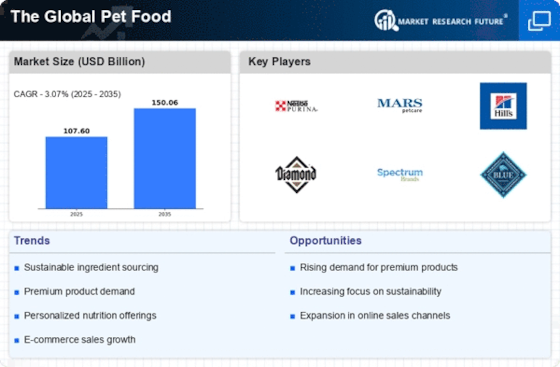
As per Market Research Future analysis, The Global Pet Food Market Size was estimated at 107.6 USD Billion in 2024. The pet food industry is projected to grow from 110.9 USD Billion in 2025 to 150.06 USD Billion by 2035, exhibiting a compound annual growth rate (CAGR) of 3.07% during the forecast period 2025 - 2035

Key Market Trends & Highlights

The Global Pet Food Market is experiencing robust growth driven by evolving consumer preferences and innovative product offerings.

  • The market is increasingly oriented towards health and wellness, with consumers prioritizing nutritious options for their pets. E-commerce continues to expand, providing convenient access to a wider range of pet food products, particularly in North America. Sustainability initiatives are gaining traction, influencing brands to adopt eco-friendly practices and packaging. The premiumization of pet food and rising pet ownership are key drivers, particularly in the dry food segment for dogs, while wet food for cats is witnessing rapid growth in the Asia-Pacific region.

Market Size & Forecast

2024 Market Size 107.6 (USD Billion)
2035 Market Size 150.06 (USD Billion)
CAGR (2025 - 2035) 3.07%
Largest Regional Market Share in 2024 North America

Major Players

Nestle Purina PetCare (US), Mars Petcare (US), <a href="https://www.hillspet.com/">Hill's Pet Nutrition</a> (US), Diamond Pet Foods (US), Spectrum Brands (US), Blue Buffalo (US), WellPet (US), <a href="https://www.generalmills.co.in/">General Mills</a> (US), Unicharm Corporation (JP), Colgate-Palmolive (US)

Market Trends

The Global Pet Food Market is currently experiencing a dynamic evolution, driven by shifting consumer preferences and an increasing focus on pet health and wellness. Pet owners are becoming more discerning, seeking high-quality, nutritious options for their animals. This trend is reflected in the growing demand for premium and organic pet food products, which are perceived as healthier alternatives. Additionally, the rise of e-commerce platforms has transformed the way consumers purchase pet food, allowing for greater convenience and access to a wider variety of products. As a result, traditional retail channels are adapting to this new landscape, emphasizing the importance of online presence and customer engagement. Moreover, sustainability is emerging as a pivotal factor influencing purchasing decisions within The Global Pet Food Market. Consumers are increasingly concerned about the environmental impact of their choices, prompting brands to adopt eco-friendly practices and packaging. This shift towards sustainability not only appeals to environmentally conscious pet owners but also aligns with broader societal trends towards responsible consumption. Consequently, companies are likely to invest in innovative solutions that minimize their ecological footprint while maintaining product quality. Overall, The Global Pet Food Market appears poised for continued growth, driven by these evolving consumer demands and a commitment to sustainability.

Health and Wellness Focus

There is a noticeable shift towards health-oriented pet food products, as owners prioritize nutrition and overall well-being for their pets. This trend encompasses a variety of offerings, including grain-free, high-protein, and functional foods designed to address specific health concerns.

E-commerce Growth

The rise of online shopping is reshaping The Global Pet Food Market, with more consumers opting for the convenience of purchasing pet food through digital platforms. This trend is prompting traditional retailers to enhance their online presence and adapt to changing consumer behaviors.

Sustainability Initiatives

Sustainability is becoming increasingly important in the pet food sector, as consumers demand environmentally friendly products and practices. Brands are responding by implementing eco-conscious sourcing, packaging, and production methods to appeal to this growing demographic.

Pet Food Market Market Drivers

Rising Pet Ownership

The increase in pet ownership globally is a notable driver for The Global Pet Food Industry. Recent statistics suggest that pet ownership rates have surged, with households increasingly welcoming pets as family members. This trend is particularly pronounced in urban areas, where the convenience of pet ownership is appealing. As more individuals and families adopt pets, the demand for pet food naturally escalates. Market data indicates that the number of pet dogs and cats has risen significantly, leading to an estimated increase in pet food sales by 5% annually. This growing pet population not only boosts the demand for traditional pet food but also opens avenues for specialized products catering to various dietary needs.

Premiumization of Pet Food

The trend towards premiumization in the pet food sector appears to be a driving force in The Global Pet Food Industry. Consumers increasingly seek high-quality, nutritious options for their pets, often willing to pay a premium for organic, natural, or specialized diets. This shift is reflected in the market data, which indicates that the premium segment is projected to grow at a compound annual growth rate (CAGR) of approximately 8% over the next five years. As pet owners become more discerning, brands that offer unique formulations, such as grain-free or high-protein options, are likely to capture a larger share of the market. This trend not only enhances the overall value proposition of pet food products but also encourages manufacturers to innovate and diversify their offerings.

Expansion of Distribution Channels

The expansion of distribution channels is a crucial driver for The Global Pet Food Industry. The rise of e-commerce platforms has transformed how pet food is marketed and sold, allowing consumers to access a wider variety of products from the comfort of their homes. This shift is complemented by the growth of brick-and-mortar stores, including specialty pet shops and supermarkets, which are increasingly dedicating space to premium pet food brands. Market data indicates that online sales of pet food are expected to grow by 15% annually, reflecting changing shopping habits. This diversification in distribution not only increases product availability but also enhances competition among brands, ultimately benefiting consumers through better pricing and product choices.

Shift Towards Natural and Organic Ingredients

The shift towards natural and organic ingredients in pet food is a significant driver within The Global Pet Food Industry. Consumers are increasingly concerned about the ingredients in their pets' diets, leading to a preference for products that are free from artificial additives and preservatives. This trend is supported by market data, which shows that sales of natural pet food products have grown by over 10% annually. As pet owners become more educated about pet nutrition, they are more likely to choose brands that prioritize transparency and quality sourcing. This movement not only reflects changing consumer preferences but also encourages manufacturers to reformulate their products to align with these values, thereby enhancing their market position.

Technological Advancements in Pet Food Production

Technological advancements in pet food production are reshaping the landscape of The Global Pet Food Industry. Innovations in food processing, preservation, and packaging are enhancing product quality and shelf life. For instance, the adoption of extrusion technology has improved the nutritional profile of dry pet food, making it more appealing to health-conscious consumers. Additionally, advancements in supply chain logistics are enabling faster distribution and better inventory management, which is crucial in meeting the rising demand. Market data suggests that companies investing in technology are likely to see a competitive edge, with projections indicating a 6% growth in market share for tech-savvy brands over the next few years. This trend underscores the importance of efficiency and quality in the pet food sector.

Market Segment Insights

By Type: Dry Food (Largest) vs. Wet Food (Fastest-Growing)

<p>In The Global Pet Food, the 'By Type' segment showcases a diverse range of products, with dry food holding the largest market share. This preference is due to its convenience, longer shelf life, and perceived cost-effectiveness. Wet food, while smaller in overall market share compared to dry food, has been gaining traction recently due to its appeal among pet owners who prioritize moisture content and palatability for their pets. Snacks and treats, raw food, and food supplements also play significant roles, catering to different consumer needs and pet health focus areas. As pet owners increasingly recognize the importance of nutritional quality and variety, growth trends within this segment are being shaped significantly. Wet food is witnessing rapid expansion, driven by trends such as premiumization and the growing demand for natural, wholesome ingredients. On the other hand, dry food remains a staple, bolstered by marketing strategies emphasizing its health benefits and value. Innovations in packaging and formulation are expected to further influence purchasing decisions, alongside the rising trend of pet humanization, which encourages owners to consider their pet's dietary needs more closely.</p>

<p>Dry Food: Dominant vs. Snacks and Treats: Emerging</p>

<p>In the current landscape of The Global Pet Food, dry food stands out as the dominant segment due to its established consumer base and broad acceptance among pet owners. Its key characteristics include a longer shelf life, cost-effectiveness, and convenience, making it a preferred choice for many. Dry food formulations are also increasingly tailored to meet specific dietary needs, further enhancing their appeal. On the other hand, snacks and treats are emerging as a vital player within this market sector. Their growth is driven by the humanization of pets and a rising interest in functional treats that offer health benefits, such as dental care or supplementary nutrition. With a shift towards natural and organic options, the snacks and treats segment represents a dynamic and rapidly evolving market, catering to the diverse preferences of pet owners.</p>

By Animal Type: Dogs (Largest) vs. Cats (Fastest-Growing)

<p>The Global Pet Food showcases a diverse distribution among various animal types, with dogs dominating the sector. This dominance can be attributed to the strong human-dog bond, leading to a higher demand for premium dog food products. In contrast, cats are emerging as a significant segment, reflecting changing consumer preferences and an increase in cat ownership. The rise of cat food options has positioned it as a rapidly expanding category within the market.</p>

<p>Dogs: Dominant vs. Cats: Emerging</p>

<p>Dogs have established themselves as the dominant force in The Global Pet Food, largely due to their longstanding companionship with humans and significant spending on quality nutrition. Pet owners often prioritize health and well-being for their dogs, driving demand for specialized diets, including grain-free, organic, and human-grade options. Meanwhile, the cat segment, though smaller, is quickly gaining traction as an emerging market. Factors such as increasing urbanization, the rise in millennial pet ownership, and greater awareness of feline nutritional needs are leading to a profound shift. As cat food innovations proliferate, this segment continues to attract investments and grow rapidly in response to changing consumer habits.</p>

By Distribution Channel: Online Retail (Largest) vs. Pet Specialty Stores (Fastest-Growing)

<p>In The Global Pet Food, the distribution of sales across various channels highlights the significance of Online Retail as the largest segment. This sector continues to dominate the market share, driven by increasing e-commerce adoption among pet owners seeking convenience and variety. Offline Retail, including Pet Specialty Stores and Supermarkets and Hypermarkets, also retains a considerable share, as many consumers prefer to purchase pet food in person, valuing the opportunity to inspect products and seek advice from staff. Pet Specialty Stores have emerged as the fastest-growing segment, appealing to niche markets that demand high-quality and specialized pet products. Growth is largely attributed to the increasing trend of pet humanization, where owners are seeking premium options and personalized services. Additionally, health-conscious pet owners are more inclined to purchase organic and sustainable pet foods available in specialty stores, fostering both rapid growth and market positioning.</p>

<p>Online Retail (Dominant) vs. Supermarkets and Hypermarkets (Emerging)</p>

<p>Online Retail is solidifying its dominance in The Global Pet Food, appealing to tech-savvy consumers who prefer the convenience of home delivery and vast product selection. This segment benefits from advancements in logistics and targeted marketing strategies. Meanwhile, Supermarkets and Hypermarkets represent an emerging segment, catering to traditional shoppers who appreciate one-stop shopping for various needs. They offer a combination of convenience and affordability, making them attractive options for budget-conscious pet owners. However, as online shopping continues to rise, traditional retailers must adapt by enhancing their in-store experience and offering exclusive products to remain competitive.</p>

By Formulation: Natural (Largest) vs. Grain-Free (Fastest-Growing)

<p>The formulation segment of The Global Pet Food exhibits a diverse range of preferences among consumers, with Natural pet food holding the largest market share. This segment resonates with pet owners seeking healthier options for their pets, emphasizing quality, and transparency in ingredient sourcing. Organic pet food is also positioned notably, attracting a niche market focused on holistic wellness. Meanwhile, High-Protein formulations cater to performance-oriented pet parents who prioritize muscle health and energy for their pets. Growth trends indicate a significant shift towards premium and specialized pet food formulations, especially among millennial pet owners interested in ethical sourcing and nutritional transparency. Grain-Free options are experiencing the fastest growth, driven by rising awareness of pet dietary needs and food intolerances. The demand for unique, tailored nutrition is steering innovation in this segment, making it a dynamic field for pet food brands and retailers alike.</p>

<p>Natural (Dominant) vs. Grain-Free (Emerging)</p>

<p>Natural pet food products have established themselves as the dominant category within the formulation segment of The Global Pet Food, characterized by a focus on minimally processed ingredients free from artificial additives and preservatives. This trend aligns with growing consumer demand for transparency and health-conscious choices for their pets. Conversely, Grain-Free formulations emerge as an exciting segment that caters to modern dietary preferences and perceived food sensitivities in pets. They often feature high-quality protein sources and are seen as a suitable alternative to traditional grain-based diets. The ability to adapt quickly to consumer trends and preferences positions Grain-Free products as a competitive and pivotal part of the market.</p>

Get more detailed insights about Pet Food Market Research Report - Forecast till 2035

Regional Insights

North America : Market Leader in Pet Food Market

North America is the largest market for pet food, accounting for approximately 40% of the global market share. The region's growth is driven by increasing pet ownership, premiumization of pet food products, and a growing trend towards natural and organic ingredients. Regulatory support for pet food safety and quality standards further catalyzes market expansion. The U.S. is the primary contributor, followed by Canada, which holds around 10% of the market share. The competitive landscape in North America is characterized by the presence of major players such as Nestle Purina PetCare, Mars Petcare, and Hill's Pet Nutrition. These companies dominate the market with a wide range of products catering to various pet needs. The focus on innovation and sustainability is evident, with brands increasingly investing in research and development to meet consumer demands for healthier and more environmentally friendly options.

Europe : Emerging Trends in Pet Nutrition

Europe is witnessing significant growth in the pet food market, holding approximately 30% of the global share. The demand for premium and specialized pet food products is on the rise, driven by changing consumer preferences towards health and wellness for pets. Regulatory frameworks in the EU promote high standards for pet food safety, which further supports market growth. The UK and Germany are the largest markets, together accounting for nearly 15% of the total market share. Leading countries in Europe are characterized by a competitive landscape with key players like Unicharm Corporation and Colgate-Palmolive. The market is increasingly influenced by trends such as sustainability and transparency in sourcing ingredients. Companies are focusing on product innovation to cater to the growing demand for organic and natural pet food options, ensuring they meet the evolving needs of pet owners.

Asia-Pacific : Rapid Growth in Pet Ownership

Asia-Pacific is rapidly emerging as a significant player in The Global Pet Food Market, holding around 20% of the market share. The region's growth is fueled by increasing disposable incomes, urbanization, and a rising trend of pet ownership, particularly in countries like China and India. Regulatory bodies are beginning to implement stricter guidelines for pet food safety, which is expected to enhance consumer confidence and drive market growth. China is the largest market in the region, followed by Japan, which contributes significantly to the overall market share. The competitive landscape in Asia-Pacific is evolving, with both local and international brands vying for market share. Key players such as Blue Buffalo and WellPet are expanding their presence in the region, focusing on product diversification and innovation. The demand for premium and specialized pet food products is increasing, reflecting a shift in consumer preferences towards higher quality and health-oriented options for pets.

Middle East and Africa : Untapped Potential in Pet Food Market

The Middle East and Africa represent an emerging frontier in The Global Pet Food Market, accounting for approximately 10% of the market share. The region is experiencing a gradual increase in pet ownership, driven by urbanization and changing lifestyles. Regulatory frameworks are still developing, but there is a growing emphasis on pet food safety and quality standards, which is expected to catalyze market growth. South Africa and the UAE are the leading markets, contributing significantly to the regional share. The competitive landscape is characterized by a mix of local and international players, with companies increasingly focusing on product innovation to cater to the unique preferences of consumers in the region. The demand for premium and specialized pet food products is on the rise, reflecting a shift towards higher quality offerings. As awareness of pet nutrition grows, the market is poised for substantial growth in the coming years.

Key Players and Competitive Insights

The Global Pet Food Industry has witnessed significant growth in recent years, driven by increasing pet ownership, evolving consumer preferences, and a greater focus on premium and health-oriented pet food products.
Competitors in this market are innovating and adapting their offerings to meet the diverse needs of pet owners, who are increasingly looking for products that contribute to the overall well-being of their pets.
This highly competitive landscape is characterized by various established and emerging brands, each striving to capture market share through differentiated product lines, marketing strategies, and targeted consumer engagement.
With sustainability and health trends at the forefront of consumer concerns, companies are focusing on transparency in sourcing, ingredient quality, and environmentally friendly packaging to gain a competitive edge.
In the Global Pet Food Market, WellPet has established a strong presence, leveraging its commitment to high-quality ingredients and nutritious formulations. WellPet’s product offerings include a range of dry and wet foods, treats, and dietary supplements that are specifically designed to cater to the needs of pets across different life stages.
The company’s strengths lie in its dedication to natural ingredients, which resonate well with health-conscious pet owners looking for wholesome options. WellPet emphasizes its manufacturing processes, ensuring that products are created with rigorous quality control standards.
By maintaining a strong brand reputation centered around pet health, WellPet successfully attracts a loyal customer base, enabling it to compete effectively in both premium and mainstream market segments on a global scale.
Champion Petfoods is another prominent player in the Global Pet Food Industry, known for its commitment to producing biologically appropriate pet food. The company operates with a narrative that emphasizes the importance of raw and natural ingredients, with key products that include various types of dry and wet dog and cat food.
Champion Petfoods showcases its strengths through its unique sourcing of fresh, regional ingredients and transparency in its manufacturing process, allowing customers to have confidence in the nutritional value of their offerings.
The brand has leveraged strategic mergers and acquisitions to enhance its market presence and expand its product line, further solidifying its position within the global landscape. Champion Petfoods continues to invest in research and development, constantly innovating to meet the changing preferences of pet owners and ensuring that it remains a formidable competitor in the ever-evolving pet food industry.

Key Companies in the Pet Food Market include

Industry Developments

The Global Pet Food Market has seen significant developments in recent months. Notably, WellPet announced a renewed focus on sustainability, enhancing their ingredient sourcing in October 2023. Meanwhile, Champion Petfoods is expanding its distribution network in Asia, responding to growing demand for premium pet food in the region.

Additionally, in November 2023, PetCurean Pet Nutrition launched a new line of grain-free pet food, aimed at the health-conscious consumer segment. In terms of mergers and acquisitions, Mars Petcare acquired Merrick Pet Care in September 2023 to bolster its premium product offerings, which has been widely covered across various trusted media outlets.

Growth in market valuation for companies like Nestle Purina PetCare and Royal Canin is being driven by a rising trend of pet humanization, as consumers increasingly seek high-quality, nutritious options for their pets.

Over the past few years, Blue Buffalo has also expanded its portfolio, launching several new products reflecting shifts towards organic and natural ingredients, with significant growth reported in 2021 and 2022. These developments underscore the dynamic nature of the Global Pet Food Market, reflecting changing consumer preferences and competitive strategies.

Future Outlook

Pet Food Market Future Outlook

The Global Pet Food Market is projected to grow at a 3.07% CAGR from 2025 to 2035, driven by increasing pet ownership, premiumization, and health-conscious consumer trends.

New opportunities lie in:

  • Expansion of subscription-based pet food delivery services
  • Development of plant-based and alternative protein pet food products
  • Investment in smart pet feeding technology and IoT solutions

By 2035, the market is expected to achieve robust growth, reflecting evolving consumer preferences and innovative product offerings.

Market Segmentation

Pet Food Market Type Outlook

  • Dry Food
  • Wet Food
  • Snacks and Treats
  • Raw Food
  • Food Supplements

Pet Food Market Animal Type Outlook

  • Dogs
  • Cats
  • Birds
  • Others

Pet Food Market Formulation Outlook

  • Organic
  • Natural
  • Grain-Free
  • High-Protein

Pet Food Market Distribution Channel Outlook

  • Online Retail
  • Offline Retail
  • Pet Specialty Stores
  • Supermarkets and Hypermarkets

Report Scope

MARKET SIZE 2024 107.6(USD Billion)
MARKET SIZE 2025 110.9(USD Billion)
MARKET SIZE 2035 150.06(USD Billion)
COMPOUND ANNUAL GROWTH RATE (CAGR) 3.07% (2025 - 2035)
REPORT COVERAGE Revenue Forecast, Competitive Landscape, Growth Factors, and Trends
BASE YEAR 2024
Market Forecast Period 2025 - 2035
Historical Data 2019 - 2024
Market Forecast Units USD Billion
Key Companies Profiled Nestle Purina PetCare (US), Mars Petcare (US), Hill's Pet Nutrition (US), Diamond Pet Foods (US), Spectrum Brands (US), Blue Buffalo (US), WellPet (US), General Mills (US), Unicharm Corporation (JP), Colgate-Palmolive (US)
Segments Covered Product Type, Animal Type, Distribution Channel, Formulation, Regional
Key Market Opportunities Growing demand for premium, natural ingredients in The Global Pet Food presents significant opportunities.
Key Market Dynamics Rising consumer demand for premium and natural pet food products drives innovation and competition among manufacturers.
Countries Covered North America, Europe, APAC, South America, MEA

FAQs

What is the projected market valuation of The Global Pet Food by 2035?

<p>The Global Pet Food is projected to reach a valuation of 150.06 USD Billion by 2035.</p>

What was the market valuation of The Global Pet Food in 2024?

<p>In 2024, The Global Pet Food was valued at 107.6 USD Billion.</p>

What is the expected CAGR for The Global Pet Food during the forecast period 2025 - 2035?

<p>The expected CAGR for The Global Pet Food during the forecast period 2025 - 2035 is 3.07%.</p>

Which segment of The Global Pet Food had the highest valuation in 2024?

<p>In 2024, the Dry Food segment had the highest valuation at 55.0 USD Billion.</p>

What are the projected valuations for the Snacks and Treats segment by 2035?

<p>The Snacks and Treats segment is projected to reach valuations between 20.0 and 30.0 USD Billion by 2035.</p>

Which animal type segment is expected to dominate The Global Pet Food?

<p>The Dogs segment is expected to dominate the market, with projected valuations between 45.0 and 60.0 USD Billion by 2035.</p>

What distribution channel is anticipated to see significant growth in The Global Pet Food?

<p>The Online Retail distribution channel is anticipated to grow significantly, with projected valuations between 15.0 and 25.0 USD Billion by 2035.</p>

Which formulation type is expected to have the highest market valuation by 2035?

<p>The High-Protein formulation type is expected to have the highest market valuation, projected between 47.6 and 65.06 USD Billion by 2035.</p>

Who are the key players in The Global Pet Food?

<p>Key players in The Global Pet Food include Nestle Purina PetCare, Mars Petcare, and Hill's Pet Nutrition, among others.</p>

What is the projected valuation range for the Cats segment by 2035?

<p>The Cats segment is projected to reach valuations between 35.0 and 50.0 USD Billion by 2035.</p>

  1. SECTION I: EXECUTIVE SUMMARY AND KEY HIGHLIGHTS
    1. | 1.1 EXECUTIVE SUMMARY
    2. | | 1.1.1 Market Overview
    3. | | 1.1.2 Key Findings
    4. | | 1.1.3 Market Segmentation
    5. | | 1.1.4 Competitive Landscape
    6. | | 1.1.5 Challenges and Opportunities
    7. | | 1.1.6 Future Outlook
  2. SECTION II: SCOPING, METHODOLOGY AND MARKET STRUCTURE
    1. | 2.1 MARKET INTRODUCTION
    2. | | 2.1.1 Definition
    3. | | 2.1.2 Scope of the study
    4. | | | 2.1.2.1 Research Objective
    5. | | | 2.1.2.2 Assumption
    6. | | | 2.1.2.3 Limitations
    7. | 2.2 RESEARCH METHODOLOGY
    8. | | 2.2.1 Overview
    9. | | 2.2.2 Data Mining
    10. | | 2.2.3 Secondary Research
    11. | | 2.2.4 Primary Research
    12. | | | 2.2.4.1 Primary Interviews and Information Gathering Process
    13. | | | 2.2.4.2 Breakdown of Primary Respondents
    14. | | 2.2.5 Forecasting Model
    15. | | 2.2.6 Market Size Estimation
    16. | | | 2.2.6.1 Bottom-Up Approach
    17. | | | 2.2.6.2 Top-Down Approach
    18. | | 2.2.7 Data Triangulation
    19. | | 2.2.8 Validation
  3. SECTION III: QUALITATIVE ANALYSIS
    1. | 3.1 MARKET DYNAMICS
    2. | | 3.1.1 Overview
    3. | | 3.1.2 Drivers
    4. | | 3.1.3 Restraints
    5. | | 3.1.4 Opportunities
    6. | 3.2 MARKET FACTOR ANALYSIS
    7. | | 3.2.1 Value chain Analysis
    8. | | 3.2.2 Porter's Five Forces Analysis
    9. | | | 3.2.2.1 Bargaining Power of Suppliers
    10. | | | 3.2.2.2 Bargaining Power of Buyers
    11. | | | 3.2.2.3 Threat of New Entrants
    12. | | | 3.2.2.4 Threat of Substitutes
    13. | | | 3.2.2.5 Intensity of Rivalry
    14. | | 3.2.3 COVID-19 Impact Analysis
    15. | | | 3.2.3.1 Market Impact Analysis
    16. | | | 3.2.3.2 Regional Impact
    17. | | | 3.2.3.3 Opportunity and Threat Analysis
  4. SECTION IV: QUANTITATIVE ANALYSIS
    1. | 4.1 Medical Device, BY Type (USD Billion)
    2. | | 4.1.1 Dry Food
    3. | | 4.1.2 Wet Food
    4. | | 4.1.3 Snacks and Treats
    5. | | 4.1.4 Raw Food
    6. | | 4.1.5 Food Supplements
    7. | 4.2 Medical Device, BY Animal Type (USD Billion)
    8. | | 4.2.1 Dogs
    9. | | 4.2.2 Cats
    10. | | 4.2.3 Birds
    11. | | 4.2.4 Others
    12. | 4.3 Medical Device, BY Distribution Channel (USD Billion)
    13. | | 4.3.1 Online Retail
    14. | | 4.3.2 Offline Retail
    15. | | 4.3.3 Pet Specialty Stores
    16. | | 4.3.4 Supermarkets and Hypermarkets
    17. | 4.4 Medical Device, BY Formulation (USD Billion)
    18. | | 4.4.1 Organic
    19. | | 4.4.2 Natural
    20. | | 4.4.3 Grain-Free
    21. | | 4.4.4 High-Protein
    22. | 4.5 Medical Device, BY Region (USD Billion)
    23. | | 4.5.1 North America
    24. | | | 4.5.1.1 US
    25. | | | 4.5.1.2 Canada
    26. | | 4.5.2 Europe
    27. | | | 4.5.2.1 Germany
    28. | | | 4.5.2.2 UK
    29. | | | 4.5.2.3 France
    30. | | | 4.5.2.4 Russia
    31. | | | 4.5.2.5 Italy
    32. | | | 4.5.2.6 Spain
    33. | | | 4.5.2.7 Rest of Europe
    34. | | 4.5.3 APAC
    35. | | | 4.5.3.1 China
    36. | | | 4.5.3.2 India
    37. | | | 4.5.3.3 Japan
    38. | | | 4.5.3.4 South Korea
    39. | | | 4.5.3.5 Malaysia
    40. | | | 4.5.3.6 Thailand
    41. | | | 4.5.3.7 Indonesia
    42. | | | 4.5.3.8 Rest of APAC
    43. | | 4.5.4 South America
    44. | | | 4.5.4.1 Brazil
    45. | | | 4.5.4.2 Mexico
    46. | | | 4.5.4.3 Argentina
    47. | | | 4.5.4.4 Rest of South America
    48. | | 4.5.5 MEA
    49. | | | 4.5.5.1 GCC Countries
    50. | | | 4.5.5.2 South Africa
    51. | | | 4.5.5.3 Rest of MEA
  5. SECTION V: COMPETITIVE ANALYSIS
    1. | 5.1 Competitive Landscape
    2. | | 5.1.1 Overview
    3. | | 5.1.2 Competitive Analysis
    4. | | 5.1.3 Market share Analysis
    5. | | 5.1.4 Major Growth Strategy in the Medical Device
    6. | | 5.1.5 Competitive Benchmarking
    7. | | 5.1.6 Leading Players in Terms of Number of Developments in the Medical Device
    8. | | 5.1.7 Key developments and growth strategies
    9. | | | 5.1.7.1 New Product Launch/Service Deployment
    10. | | | 5.1.7.2 Merger & Acquisitions
    11. | | | 5.1.7.3 Joint Ventures
    12. | | 5.1.8 Major Players Financial Matrix
    13. | | | 5.1.8.1 Sales and Operating Income
    14. | | | 5.1.8.2 Major Players R&D Expenditure. 2023
    15. | 5.2 Company Profiles
    16. | | 5.2.1 Nestle Purina PetCare (US)
    17. | | | 5.2.1.1 Financial Overview
    18. | | | 5.2.1.2 Products Offered
    19. | | | 5.2.1.3 Key Developments
    20. | | | 5.2.1.4 SWOT Analysis
    21. | | | 5.2.1.5 Key Strategies
    22. | | 5.2.2 Mars Petcare (US)
    23. | | | 5.2.2.1 Financial Overview
    24. | | | 5.2.2.2 Products Offered
    25. | | | 5.2.2.3 Key Developments
    26. | | | 5.2.2.4 SWOT Analysis
    27. | | | 5.2.2.5 Key Strategies
    28. | | 5.2.3 Hill's Pet Nutrition (US)
    29. | | | 5.2.3.1 Financial Overview
    30. | | | 5.2.3.2 Products Offered
    31. | | | 5.2.3.3 Key Developments
    32. | | | 5.2.3.4 SWOT Analysis
    33. | | | 5.2.3.5 Key Strategies
    34. | | 5.2.4 Diamond Pet Foods (US)
    35. | | | 5.2.4.1 Financial Overview
    36. | | | 5.2.4.2 Products Offered
    37. | | | 5.2.4.3 Key Developments
    38. | | | 5.2.4.4 SWOT Analysis
    39. | | | 5.2.4.5 Key Strategies
    40. | | 5.2.5 Spectrum Brands (US)
    41. | | | 5.2.5.1 Financial Overview
    42. | | | 5.2.5.2 Products Offered
    43. | | | 5.2.5.3 Key Developments
    44. | | | 5.2.5.4 SWOT Analysis
    45. | | | 5.2.5.5 Key Strategies
    46. | | 5.2.6 Blue Buffalo (US)
    47. | | | 5.2.6.1 Financial Overview
    48. | | | 5.2.6.2 Products Offered
    49. | | | 5.2.6.3 Key Developments
    50. | | | 5.2.6.4 SWOT Analysis
    51. | | | 5.2.6.5 Key Strategies
    52. | | 5.2.7 WellPet (US)
    53. | | | 5.2.7.1 Financial Overview
    54. | | | 5.2.7.2 Products Offered
    55. | | | 5.2.7.3 Key Developments
    56. | | | 5.2.7.4 SWOT Analysis
    57. | | | 5.2.7.5 Key Strategies
    58. | | 5.2.8 General Mills (US)
    59. | | | 5.2.8.1 Financial Overview
    60. | | | 5.2.8.2 Products Offered
    61. | | | 5.2.8.3 Key Developments
    62. | | | 5.2.8.4 SWOT Analysis
    63. | | | 5.2.8.5 Key Strategies
    64. | | 5.2.9 Unicharm Corporation (JP)
    65. | | | 5.2.9.1 Financial Overview
    66. | | | 5.2.9.2 Products Offered
    67. | | | 5.2.9.3 Key Developments
    68. | | | 5.2.9.4 SWOT Analysis
    69. | | | 5.2.9.5 Key Strategies
    70. | | 5.2.10 Colgate-Palmolive (US)
    71. | | | 5.2.10.1 Financial Overview
    72. | | | 5.2.10.2 Products Offered
    73. | | | 5.2.10.3 Key Developments
    74. | | | 5.2.10.4 SWOT Analysis
    75. | | | 5.2.10.5 Key Strategies
    76. | 5.3 Appendix
    77. | | 5.3.1 References
    78. | | 5.3.2 Related Reports
  6. LIST OF FIGURES
    1. | 6.1 MARKET SYNOPSIS
    2. | 6.2 NORTH AMERICA MARKET ANALYSIS
    3. | 6.3 US MARKET ANALYSIS BY TYPE
    4. | 6.4 US MARKET ANALYSIS BY ANIMAL TYPE
    5. | 6.5 US MARKET ANALYSIS BY DISTRIBUTION CHANNEL
    6. | 6.6 US MARKET ANALYSIS BY FORMULATION
    7. | 6.7 CANADA MARKET ANALYSIS BY TYPE
    8. | 6.8 CANADA MARKET ANALYSIS BY ANIMAL TYPE
    9. | 6.9 CANADA MARKET ANALYSIS BY DISTRIBUTION CHANNEL
    10. | 6.10 CANADA MARKET ANALYSIS BY FORMULATION
    11. | 6.11 EUROPE MARKET ANALYSIS
    12. | 6.12 GERMANY MARKET ANALYSIS BY TYPE
    13. | 6.13 GERMANY MARKET ANALYSIS BY ANIMAL TYPE
    14. | 6.14 GERMANY MARKET ANALYSIS BY DISTRIBUTION CHANNEL
    15. | 6.15 GERMANY MARKET ANALYSIS BY FORMULATION
    16. | 6.16 UK MARKET ANALYSIS BY TYPE
    17. | 6.17 UK MARKET ANALYSIS BY ANIMAL TYPE
    18. | 6.18 UK MARKET ANALYSIS BY DISTRIBUTION CHANNEL
    19. | 6.19 UK MARKET ANALYSIS BY FORMULATION
    20. | 6.20 FRANCE MARKET ANALYSIS BY TYPE
    21. | 6.21 FRANCE MARKET ANALYSIS BY ANIMAL TYPE
    22. | 6.22 FRANCE MARKET ANALYSIS BY DISTRIBUTION CHANNEL
    23. | 6.23 FRANCE MARKET ANALYSIS BY FORMULATION
    24. | 6.24 RUSSIA MARKET ANALYSIS BY TYPE
    25. | 6.25 RUSSIA MARKET ANALYSIS BY ANIMAL TYPE
    26. | 6.26 RUSSIA MARKET ANALYSIS BY DISTRIBUTION CHANNEL
    27. | 6.27 RUSSIA MARKET ANALYSIS BY FORMULATION
    28. | 6.28 ITALY MARKET ANALYSIS BY TYPE
    29. | 6.29 ITALY MARKET ANALYSIS BY ANIMAL TYPE
    30. | 6.30 ITALY MARKET ANALYSIS BY DISTRIBUTION CHANNEL
    31. | 6.31 ITALY MARKET ANALYSIS BY FORMULATION
    32. | 6.32 SPAIN MARKET ANALYSIS BY TYPE
    33. | 6.33 SPAIN MARKET ANALYSIS BY ANIMAL TYPE
    34. | 6.34 SPAIN MARKET ANALYSIS BY DISTRIBUTION CHANNEL
    35. | 6.35 SPAIN MARKET ANALYSIS BY FORMULATION
    36. | 6.36 REST OF EUROPE MARKET ANALYSIS BY TYPE
    37. | 6.37 REST OF EUROPE MARKET ANALYSIS BY ANIMAL TYPE
    38. | 6.38 REST OF EUROPE MARKET ANALYSIS BY DISTRIBUTION CHANNEL
    39. | 6.39 REST OF EUROPE MARKET ANALYSIS BY FORMULATION
    40. | 6.40 APAC MARKET ANALYSIS
    41. | 6.41 CHINA MARKET ANALYSIS BY TYPE
    42. | 6.42 CHINA MARKET ANALYSIS BY ANIMAL TYPE
    43. | 6.43 CHINA MARKET ANALYSIS BY DISTRIBUTION CHANNEL
    44. | 6.44 CHINA MARKET ANALYSIS BY FORMULATION
    45. | 6.45 INDIA MARKET ANALYSIS BY TYPE
    46. | 6.46 INDIA MARKET ANALYSIS BY ANIMAL TYPE
    47. | 6.47 INDIA MARKET ANALYSIS BY DISTRIBUTION CHANNEL
    48. | 6.48 INDIA MARKET ANALYSIS BY FORMULATION
    49. | 6.49 JAPAN MARKET ANALYSIS BY TYPE
    50. | 6.50 JAPAN MARKET ANALYSIS BY ANIMAL TYPE
    51. | 6.51 JAPAN MARKET ANALYSIS BY DISTRIBUTION CHANNEL
    52. | 6.52 JAPAN MARKET ANALYSIS BY FORMULATION
    53. | 6.53 SOUTH KOREA MARKET ANALYSIS BY TYPE
    54. | 6.54 SOUTH KOREA MARKET ANALYSIS BY ANIMAL TYPE
    55. | 6.55 SOUTH KOREA MARKET ANALYSIS BY DISTRIBUTION CHANNEL
    56. | 6.56 SOUTH KOREA MARKET ANALYSIS BY FORMULATION
    57. | 6.57 MALAYSIA MARKET ANALYSIS BY TYPE
    58. | 6.58 MALAYSIA MARKET ANALYSIS BY ANIMAL TYPE
    59. | 6.59 MALAYSIA MARKET ANALYSIS BY DISTRIBUTION CHANNEL
    60. | 6.60 MALAYSIA MARKET ANALYSIS BY FORMULATION
    61. | 6.61 THAILAND MARKET ANALYSIS BY TYPE
    62. | 6.62 THAILAND MARKET ANALYSIS BY ANIMAL TYPE
    63. | 6.63 THAILAND MARKET ANALYSIS BY DISTRIBUTION CHANNEL
    64. | 6.64 THAILAND MARKET ANALYSIS BY FORMULATION
    65. | 6.65 INDONESIA MARKET ANALYSIS BY TYPE
    66. | 6.66 INDONESIA MARKET ANALYSIS BY ANIMAL TYPE
    67. | 6.67 INDONESIA MARKET ANALYSIS BY DISTRIBUTION CHANNEL
    68. | 6.68 INDONESIA MARKET ANALYSIS BY FORMULATION
    69. | 6.69 REST OF APAC MARKET ANALYSIS BY TYPE
    70. | 6.70 REST OF APAC MARKET ANALYSIS BY ANIMAL TYPE
    71. | 6.71 REST OF APAC MARKET ANALYSIS BY DISTRIBUTION CHANNEL
    72. | 6.72 REST OF APAC MARKET ANALYSIS BY FORMULATION
    73. | 6.73 SOUTH AMERICA MARKET ANALYSIS
    74. | 6.74 BRAZIL MARKET ANALYSIS BY TYPE
    75. | 6.75 BRAZIL MARKET ANALYSIS BY ANIMAL TYPE
    76. | 6.76 BRAZIL MARKET ANALYSIS BY DISTRIBUTION CHANNEL
    77. | 6.77 BRAZIL MARKET ANALYSIS BY FORMULATION
    78. | 6.78 MEXICO MARKET ANALYSIS BY TYPE
    79. | 6.79 MEXICO MARKET ANALYSIS BY ANIMAL TYPE
    80. | 6.80 MEXICO MARKET ANALYSIS BY DISTRIBUTION CHANNEL
    81. | 6.81 MEXICO MARKET ANALYSIS BY FORMULATION
    82. | 6.82 ARGENTINA MARKET ANALYSIS BY TYPE
    83. | 6.83 ARGENTINA MARKET ANALYSIS BY ANIMAL TYPE
    84. | 6.84 ARGENTINA MARKET ANALYSIS BY DISTRIBUTION CHANNEL
    85. | 6.85 ARGENTINA MARKET ANALYSIS BY FORMULATION
    86. | 6.86 REST OF SOUTH AMERICA MARKET ANALYSIS BY TYPE
    87. | 6.87 REST OF SOUTH AMERICA MARKET ANALYSIS BY ANIMAL TYPE
    88. | 6.88 REST OF SOUTH AMERICA MARKET ANALYSIS BY DISTRIBUTION CHANNEL
    89. | 6.89 REST OF SOUTH AMERICA MARKET ANALYSIS BY FORMULATION
    90. | 6.90 MEA MARKET ANALYSIS
    91. | 6.91 GCC COUNTRIES MARKET ANALYSIS BY TYPE
    92. | 6.92 GCC COUNTRIES MARKET ANALYSIS BY ANIMAL TYPE
    93. | 6.93 GCC COUNTRIES MARKET ANALYSIS BY DISTRIBUTION CHANNEL
    94. | 6.94 GCC COUNTRIES MARKET ANALYSIS BY FORMULATION
    95. | 6.95 SOUTH AFRICA MARKET ANALYSIS BY TYPE
    96. | 6.96 SOUTH AFRICA MARKET ANALYSIS BY ANIMAL TYPE
    97. | 6.97 SOUTH AFRICA MARKET ANALYSIS BY DISTRIBUTION CHANNEL
    98. | 6.98 SOUTH AFRICA MARKET ANALYSIS BY FORMULATION
    99. | 6.99 REST OF MEA MARKET ANALYSIS BY TYPE
    100. | 6.100 REST OF MEA MARKET ANALYSIS BY ANIMAL TYPE
    101. | 6.101 REST OF MEA MARKET ANALYSIS BY DISTRIBUTION CHANNEL
    102. | 6.102 REST OF MEA MARKET ANALYSIS BY FORMULATION
    103. | 6.103 KEY BUYING CRITERIA OF MEDICAL DEVICE
    104. | 6.104 RESEARCH PROCESS OF MRFR
    105. | 6.105 DRO ANALYSIS OF MEDICAL DEVICE
    106. | 6.106 DRIVERS IMPACT ANALYSIS: MEDICAL DEVICE
    107. | 6.107 RESTRAINTS IMPACT ANALYSIS: MEDICAL DEVICE
    108. | 6.108 SUPPLY / VALUE CHAIN: MEDICAL DEVICE
    109. | 6.109 MEDICAL DEVICE, BY TYPE, 2024 (% SHARE)
    110. | 6.110 MEDICAL DEVICE, BY TYPE, 2024 TO 2035 (USD Billion)
    111. | 6.111 MEDICAL DEVICE, BY ANIMAL TYPE, 2024 (% SHARE)
    112. | 6.112 MEDICAL DEVICE, BY ANIMAL TYPE, 2024 TO 2035 (USD Billion)
    113. | 6.113 MEDICAL DEVICE, BY DISTRIBUTION CHANNEL, 2024 (% SHARE)
    114. | 6.114 MEDICAL DEVICE, BY DISTRIBUTION CHANNEL, 2024 TO 2035 (USD Billion)
    115. | 6.115 MEDICAL DEVICE, BY FORMULATION, 2024 (% SHARE)
    116. | 6.116 MEDICAL DEVICE, BY FORMULATION, 2024 TO 2035 (USD Billion)
    117. | 6.117 BENCHMARKING OF MAJOR COMPETITORS
  7. LIST OF TABLES
    1. | 7.1 LIST OF ASSUMPTIONS
    2. | | 7.1.1
    3. | 7.2 North America MARKET SIZE ESTIMATES; FORECAST
    4. | | 7.2.1 BY TYPE, 2025-2035 (USD Billion)
    5. | | 7.2.2 BY ANIMAL TYPE, 2025-2035 (USD Billion)
    6. | | 7.2.3 BY DISTRIBUTION CHANNEL, 2025-2035 (USD Billion)
    7. | | 7.2.4 BY FORMULATION, 2025-2035 (USD Billion)
    8. | 7.3 US MARKET SIZE ESTIMATES; FORECAST
    9. | | 7.3.1 BY TYPE, 2025-2035 (USD Billion)
    10. | | 7.3.2 BY ANIMAL TYPE, 2025-2035 (USD Billion)
    11. | | 7.3.3 BY DISTRIBUTION CHANNEL, 2025-2035 (USD Billion)
    12. | | 7.3.4 BY FORMULATION, 2025-2035 (USD Billion)
    13. | 7.4 Canada MARKET SIZE ESTIMATES; FORECAST
    14. | | 7.4.1 BY TYPE, 2025-2035 (USD Billion)
    15. | | 7.4.2 BY ANIMAL TYPE, 2025-2035 (USD Billion)
    16. | | 7.4.3 BY DISTRIBUTION CHANNEL, 2025-2035 (USD Billion)
    17. | | 7.4.4 BY FORMULATION, 2025-2035 (USD Billion)
    18. | 7.5 Europe MARKET SIZE ESTIMATES; FORECAST
    19. | | 7.5.1 BY TYPE, 2025-2035 (USD Billion)
    20. | | 7.5.2 BY ANIMAL TYPE, 2025-2035 (USD Billion)
    21. | | 7.5.3 BY DISTRIBUTION CHANNEL, 2025-2035 (USD Billion)
    22. | | 7.5.4 BY FORMULATION, 2025-2035 (USD Billion)
    23. | 7.6 Germany MARKET SIZE ESTIMATES; FORECAST
    24. | | 7.6.1 BY TYPE, 2025-2035 (USD Billion)
    25. | | 7.6.2 BY ANIMAL TYPE, 2025-2035 (USD Billion)
    26. | | 7.6.3 BY DISTRIBUTION CHANNEL, 2025-2035 (USD Billion)
    27. | | 7.6.4 BY FORMULATION, 2025-2035 (USD Billion)
    28. | 7.7 UK MARKET SIZE ESTIMATES; FORECAST
    29. | | 7.7.1 BY TYPE, 2025-2035 (USD Billion)
    30. | | 7.7.2 BY ANIMAL TYPE, 2025-2035 (USD Billion)
    31. | | 7.7.3 BY DISTRIBUTION CHANNEL, 2025-2035 (USD Billion)
    32. | | 7.7.4 BY FORMULATION, 2025-2035 (USD Billion)
    33. | 7.8 France MARKET SIZE ESTIMATES; FORECAST
    34. | | 7.8.1 BY TYPE, 2025-2035 (USD Billion)
    35. | | 7.8.2 BY ANIMAL TYPE, 2025-2035 (USD Billion)
    36. | | 7.8.3 BY DISTRIBUTION CHANNEL, 2025-2035 (USD Billion)
    37. | | 7.8.4 BY FORMULATION, 2025-2035 (USD Billion)
    38. | 7.9 Russia MARKET SIZE ESTIMATES; FORECAST
    39. | | 7.9.1 BY TYPE, 2025-2035 (USD Billion)
    40. | | 7.9.2 BY ANIMAL TYPE, 2025-2035 (USD Billion)
    41. | | 7.9.3 BY DISTRIBUTION CHANNEL, 2025-2035 (USD Billion)
    42. | | 7.9.4 BY FORMULATION, 2025-2035 (USD Billion)
    43. | 7.10 Italy MARKET SIZE ESTIMATES; FORECAST
    44. | | 7.10.1 BY TYPE, 2025-2035 (USD Billion)
    45. | | 7.10.2 BY ANIMAL TYPE, 2025-2035 (USD Billion)
    46. | | 7.10.3 BY DISTRIBUTION CHANNEL, 2025-2035 (USD Billion)
    47. | | 7.10.4 BY FORMULATION, 2025-2035 (USD Billion)
    48. | 7.11 Spain MARKET SIZE ESTIMATES; FORECAST
    49. | | 7.11.1 BY TYPE, 2025-2035 (USD Billion)
    50. | | 7.11.2 BY ANIMAL TYPE, 2025-2035 (USD Billion)
    51. | | 7.11.3 BY DISTRIBUTION CHANNEL, 2025-2035 (USD Billion)
    52. | | 7.11.4 BY FORMULATION, 2025-2035 (USD Billion)
    53. | 7.12 Rest of Europe MARKET SIZE ESTIMATES; FORECAST
    54. | | 7.12.1 BY TYPE, 2025-2035 (USD Billion)
    55. | | 7.12.2 BY ANIMAL TYPE, 2025-2035 (USD Billion)
    56. | | 7.12.3 BY DISTRIBUTION CHANNEL, 2025-2035 (USD Billion)
    57. | | 7.12.4 BY FORMULATION, 2025-2035 (USD Billion)
    58. | 7.13 APAC MARKET SIZE ESTIMATES; FORECAST
    59. | | 7.13.1 BY TYPE, 2025-2035 (USD Billion)
    60. | | 7.13.2 BY ANIMAL TYPE, 2025-2035 (USD Billion)
    61. | | 7.13.3 BY DISTRIBUTION CHANNEL, 2025-2035 (USD Billion)
    62. | | 7.13.4 BY FORMULATION, 2025-2035 (USD Billion)
    63. | 7.14 China MARKET SIZE ESTIMATES; FORECAST
    64. | | 7.14.1 BY TYPE, 2025-2035 (USD Billion)
    65. | | 7.14.2 BY ANIMAL TYPE, 2025-2035 (USD Billion)
    66. | | 7.14.3 BY DISTRIBUTION CHANNEL, 2025-2035 (USD Billion)
    67. | | 7.14.4 BY FORMULATION, 2025-2035 (USD Billion)
    68. | 7.15 India MARKET SIZE ESTIMATES; FORECAST
    69. | | 7.15.1 BY TYPE, 2025-2035 (USD Billion)
    70. | | 7.15.2 BY ANIMAL TYPE, 2025-2035 (USD Billion)
    71. | | 7.15.3 BY DISTRIBUTION CHANNEL, 2025-2035 (USD Billion)
    72. | | 7.15.4 BY FORMULATION, 2025-2035 (USD Billion)
    73. | 7.16 Japan MARKET SIZE ESTIMATES; FORECAST
    74. | | 7.16.1 BY TYPE, 2025-2035 (USD Billion)
    75. | | 7.16.2 BY ANIMAL TYPE, 2025-2035 (USD Billion)
    76. | | 7.16.3 BY DISTRIBUTION CHANNEL, 2025-2035 (USD Billion)
    77. | | 7.16.4 BY FORMULATION, 2025-2035 (USD Billion)
    78. | 7.17 South Korea MARKET SIZE ESTIMATES; FORECAST
    79. | | 7.17.1 BY TYPE, 2025-2035 (USD Billion)
    80. | | 7.17.2 BY ANIMAL TYPE, 2025-2035 (USD Billion)
    81. | | 7.17.3 BY DISTRIBUTION CHANNEL, 2025-2035 (USD Billion)
    82. | | 7.17.4 BY FORMULATION, 2025-2035 (USD Billion)
    83. | 7.18 Malaysia MARKET SIZE ESTIMATES; FORECAST
    84. | | 7.18.1 BY TYPE, 2025-2035 (USD Billion)
    85. | | 7.18.2 BY ANIMAL TYPE, 2025-2035 (USD Billion)
    86. | | 7.18.3 BY DISTRIBUTION CHANNEL, 2025-2035 (USD Billion)
    87. | | 7.18.4 BY FORMULATION, 2025-2035 (USD Billion)
    88. | 7.19 Thailand MARKET SIZE ESTIMATES; FORECAST
    89. | | 7.19.1 BY TYPE, 2025-2035 (USD Billion)
    90. | | 7.19.2 BY ANIMAL TYPE, 2025-2035 (USD Billion)
    91. | | 7.19.3 BY DISTRIBUTION CHANNEL, 2025-2035 (USD Billion)
    92. | | 7.19.4 BY FORMULATION, 2025-2035 (USD Billion)
    93. | 7.20 Indonesia MARKET SIZE ESTIMATES; FORECAST
    94. | | 7.20.1 BY TYPE, 2025-2035 (USD Billion)
    95. | | 7.20.2 BY ANIMAL TYPE, 2025-2035 (USD Billion)
    96. | | 7.20.3 BY DISTRIBUTION CHANNEL, 2025-2035 (USD Billion)
    97. | | 7.20.4 BY FORMULATION, 2025-2035 (USD Billion)
    98. | 7.21 Rest of APAC MARKET SIZE ESTIMATES; FORECAST
    99. | | 7.21.1 BY TYPE, 2025-2035 (USD Billion)
    100. | | 7.21.2 BY ANIMAL TYPE, 2025-2035 (USD Billion)
    101. | | 7.21.3 BY DISTRIBUTION CHANNEL, 2025-2035 (USD Billion)
    102. | | 7.21.4 BY FORMULATION, 2025-2035 (USD Billion)
    103. | 7.22 South America MARKET SIZE ESTIMATES; FORECAST
    104. | | 7.22.1 BY TYPE, 2025-2035 (USD Billion)
    105. | | 7.22.2 BY ANIMAL TYPE, 2025-2035 (USD Billion)
    106. | | 7.22.3 BY DISTRIBUTION CHANNEL, 2025-2035 (USD Billion)
    107. | | 7.22.4 BY FORMULATION, 2025-2035 (USD Billion)
    108. | 7.23 Brazil MARKET SIZE ESTIMATES; FORECAST
    109. | | 7.23.1 BY TYPE, 2025-2035 (USD Billion)
    110. | | 7.23.2 BY ANIMAL TYPE, 2025-2035 (USD Billion)
    111. | | 7.23.3 BY DISTRIBUTION CHANNEL, 2025-2035 (USD Billion)
    112. | | 7.23.4 BY FORMULATION, 2025-2035 (USD Billion)
    113. | 7.24 Mexico MARKET SIZE ESTIMATES; FORECAST
    114. | | 7.24.1 BY TYPE, 2025-2035 (USD Billion)
    115. | | 7.24.2 BY ANIMAL TYPE, 2025-2035 (USD Billion)
    116. | | 7.24.3 BY DISTRIBUTION CHANNEL, 2025-2035 (USD Billion)
    117. | | 7.24.4 BY FORMULATION, 2025-2035 (USD Billion)
    118. | 7.25 Argentina MARKET SIZE ESTIMATES; FORECAST
    119. | | 7.25.1 BY TYPE, 2025-2035 (USD Billion)
    120. | | 7.25.2 BY ANIMAL TYPE, 2025-2035 (USD Billion)
    121. | | 7.25.3 BY DISTRIBUTION CHANNEL, 2025-2035 (USD Billion)
    122. | | 7.25.4 BY FORMULATION, 2025-2035 (USD Billion)
    123. | 7.26 Rest of South America MARKET SIZE ESTIMATES; FORECAST
    124. | | 7.26.1 BY TYPE, 2025-2035 (USD Billion)
    125. | | 7.26.2 BY ANIMAL TYPE, 2025-2035 (USD Billion)
    126. | | 7.26.3 BY DISTRIBUTION CHANNEL, 2025-2035 (USD Billion)
    127. | | 7.26.4 BY FORMULATION, 2025-2035 (USD Billion)
    128. | 7.27 MEA MARKET SIZE ESTIMATES; FORECAST
    129. | | 7.27.1 BY TYPE, 2025-2035 (USD Billion)
    130. | | 7.27.2 BY ANIMAL TYPE, 2025-2035 (USD Billion)
    131. | | 7.27.3 BY DISTRIBUTION CHANNEL, 2025-2035 (USD Billion)
    132. | | 7.27.4 BY FORMULATION, 2025-2035 (USD Billion)
    133. | 7.28 GCC Countries MARKET SIZE ESTIMATES; FORECAST
    134. | | 7.28.1 BY TYPE, 2025-2035 (USD Billion)
    135. | | 7.28.2 BY ANIMAL TYPE, 2025-2035 (USD Billion)
    136. | | 7.28.3 BY DISTRIBUTION CHANNEL, 2025-2035 (USD Billion)
    137. | | 7.28.4 BY FORMULATION, 2025-2035 (USD Billion)
    138. | 7.29 South Africa MARKET SIZE ESTIMATES; FORECAST
    139. | | 7.29.1 BY TYPE, 2025-2035 (USD Billion)
    140. | | 7.29.2 BY ANIMAL TYPE, 2025-2035 (USD Billion)
    141. | | 7.29.3 BY DISTRIBUTION CHANNEL, 2025-2035 (USD Billion)
    142. | | 7.29.4 BY FORMULATION, 2025-2035 (USD Billion)
    143. | 7.30 Rest of MEA MARKET SIZE ESTIMATES; FORECAST
    144. | | 7.30.1 BY TYPE, 2025-2035 (USD Billion)
    145. | | 7.30.2 BY ANIMAL TYPE, 2025-2035 (USD Billion)
    146. | | 7.30.3 BY DISTRIBUTION CHANNEL, 2025-2035 (USD Billion)
    147. | | 7.30.4 BY FORMULATION, 2025-2035 (USD Billion)
    148. | 7.31 PRODUCT LAUNCH/PRODUCT DEVELOPMENT/APPROVAL
    149. | | 7.31.1
    150. | 7.32 ACQUISITION/PARTNERSHIP
    151. | | 7.32.1

Medical Device Market Segmentation

Medical Device By Type (USD Billion, 2025-2035)

  • Dry Food
  • Wet Food
  • Snacks and Treats
  • Raw Food
  • Food Supplements

Medical Device By Animal Type (USD Billion, 2025-2035)

  • Dogs
  • Cats
  • Birds
  • Others

Medical Device By Distribution Channel (USD Billion, 2025-2035)

  • Online Retail
  • Offline Retail
  • Pet Specialty Stores
  • Supermarkets and Hypermarkets

Medical Device By Formulation (USD Billion, 2025-2035)

  • Organic
  • Natural
  • Grain-Free
  • High-Protein
Infographic

Free Sample Request

Kindly complete the form below to receive a free sample of this Report

Get Free Sample

Customer Strories

Compare Licence

×
Features License Type
Single User Multiuser License Enterprise User
Price $4,950 $5,950 $7,250
Maximum User Access Limit 1 User Upto 10 Users Unrestricted Access Throughout the Organization
Free Customization
Direct Access to Analyst
Deliverable Format
Platform Access
Discount on Next Purchase 10% 15% 15%
Printable Versions