×
Request Free Sample ×

Kindly complete the form below to receive a free sample of this Report

* Please use a valid business email

Leading companies partner with us for data-driven Insights

clients tt-cursor
Hero Background
English
Chinese
French
Japanese
Korean
German
Spanish

Organic Spices Herbs Market Share

ID: MRFR/FnB/2831-CR
142 Pages
Snehal Singh
February 2021

Organic Spices and Herbs Market Size, Share, Industry Trend & Analysis Research Report Information- by Spices Type (Chilies, Garlic, Ginger, Turmeric, Cumin, Pepper, Cinnamon, Cloves, Cardamom), by Herbs Type (Basil, Mint, Marjoram, Parsley, Oregano, Sage, Bay Leaves, Dill, Thyme, Rosemary, Celery, Kaffir lime leaves ), by Form (Whole, Powder, Crushed/Chopped, Essential oil and Others), by Application (Culinary, Meat ;Poultry Products, Sauces dips, Snacks Convenience Foods, SoupsNoodles, Ready to Eat Meals, Beverages, Personal Care ) and Region - Forecast to 2035

Share:
Download PDF ×

We do not share your information with anyone. However, we may send you emails based on your report interest from time to time. You may contact us at any time to opt-out.

Organic Spices Herbs Market Infographic
Purchase Options

Market Share

Organic Spices Herbs Market Share Analysis

Promoting Fair Trade in Organic Spices: A Global Initiative

Fair trade standards have been established for the bulk production of spices and herbs by producer groups. In this system, producers play a significant role in decision-making processes that shape the future of the organic spices market. Fairtrade International, jointly owned and managed by certified producers, allows them to have a say in prices, premiums, standards, and overall strategy through its Board, Committees, and consultation processes. Fairtrade has become the most widely recognized social and development label globally, providing companies with a credible way to ensure positive impacts throughout the entire trade chain. Fair trade plays a crucial role in maintaining a healthy environment for organic spice producers worldwide.

Increasing Demand from Ready-to-Eat Food Manufacturers

The demand for organic spices from food manufacturers is substantial due to changing consumer food habits. In developed countries, organic spices have become essential ingredients for healthy food. Many convenience food manufacturers use organic spices to create product differentiation and expand their product portfolios. The rise in disposable income in developing countries has generated significant demand for food products made with organic spices as a natural flavoring agent.

Growing Popularity of Ethnic and Exotic Foods

Globalization has led various food service companies to open new branches in different countries to tap into new markets. Consumers are also actively seeking new food products. The increasing disposable income of consumers creates a favorable environment for enhancing the demand for ethnic foods. Food service companies focus on various promotional events to create strong awareness among consumers. This presents a massive opportunity for organic spice manufacturers, as they can collaborate with these food service companies to reach new customer bases, ultimately boosting overall profitability.

Growing Popularity of Sports Nutrition Products: A Healthier Choice

Sports nutritional products are specially designed dietary supplements for athletes, providing them with the specific nutrients they need. These products include vitamins, minerals, and various organic substances like proteins, fats, and carbohydrates. The demand for sports nutritional products is on the rise, both in developed and developing countries.

Recently, more people around the world have become health-conscious due to the increasing prevalence of chronic diseases such as malnutrition and obesity. This has led to a heightened interest in maintaining a healthy lifestyle. The growing participation in various sports events, coupled with increased awareness, is expected to boost the sales of sports nutritional products. Organic herbs, known for their natural properties, are widely used as ingredients in sports nutritional products, contributing to the overall demand for these healthier alternatives.

 

Author
Snehal Singh
Assistant Manager - Research

High acumen in analyzing complex macro & micro markets with more than 6 years of work experience in the field of market research. By implementing her analytical skills in forecasting and estimation into market research reports, she has expertise in Packaging, Construction, and Equipment domains. She handles a team size of 20-25 resources and ensures smooth running of the projects, associated marketing activities, and client servicing.

Leave a Comment

FAQs

What is the current valuation of the US organic spices and herbs market?

<p>The market valuation was 2.1 USD Million in 2024.</p>

What is the projected market size for the US organic spices and herbs market by 2035?

<p>The projected valuation for 2035 is 3.93 USD Million.</p>

What is the expected CAGR for the US organic spices and herbs market during the forecast period?

<p>The expected CAGR for the market from 2025 to 2035 is 5.86%.</p>

Which companies are the key players in the US organic spices and herbs market?

<p>Key players include McCormick & Company, Frontier Co-op, Simply Organic, and others.</p>

What are the main applications of organic spices and herbs in the market?

<p>The main applications include culinary, medicinal, cosmetic, and aromatherapy.</p>

How do the sales of organic spices and herbs vary by distribution channel?

<p>Sales are distributed across online retail, supermarkets, health food stores, and specialty stores.</p>

What forms do organic spices and herbs take in the market?

<p>The market includes whole spices, ground spices, herbal teas, and extracts.</p>

What are the end-use segments for organic spices and herbs?

<p>End-use segments encompass household, food service, pharmaceuticals, and cosmetics.</p>

How did the valuation of culinary organic spices change from 2024 to 2026?

<p>Culinary organic spices increased from 0.84 USD Million in 2024 to 1.56 USD Million in 2026.</p>

What is the growth trend for medicinal organic spices from 2024 to 2026?

<p>Medicinal organic spices grew from 0.63 USD Million in 2024 to 1.17 USD Million in 2026.</p>

Market Summary

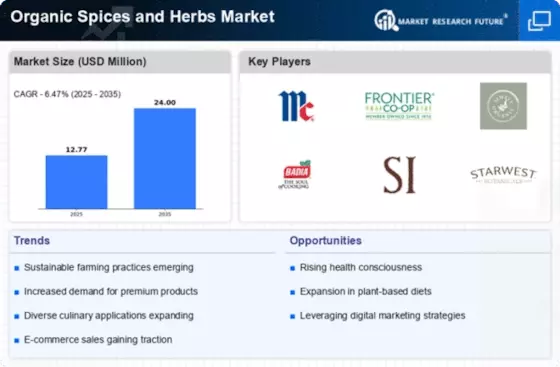
As per MRFR analysis, the Organic Spices Herbs Market Size was estimated at 11.99 USD Million in 2024. The Organic Spices Herbs industry is projected to grow from 12.9 in 2025 to 24.0 by 2035, exhibiting a compound annual growth rate (CAGR) of 6.47% during the forecast period 2025 - 2035.

Key Market Trends & Highlights

The Organic Spices Herbs Market is experiencing robust growth driven by sustainability and health trends.

  • The market is increasingly influenced by sustainability and ethical sourcing practices, particularly in North America.
  • E-commerce is rapidly transforming the distribution landscape, enabling wider access to organic spices and herbs.
  • Health and wellness trends are propelling consumer interest in organic products, especially in the Asia-Pacific region.
  • Consumer demand for natural ingredients and culinary exploration are key drivers fueling market expansion.

Market Size & Forecast

2024 Market Size 11.99 (USD Million)
2035 Market Size 24.0 (USD Million)
CAGR (2025 - 2035) 6.47%
Largest Regional Market Share in 2024 North America

Major Players

<p>McCormick & Company (US), Frontier Co-op (US), Simply Organic (US), Badia Spices (US), Spice Islands (US), Starwest Botanicals (US), Penzeys Spices (US), Organic Spices (IN), Herb Pharm (US)</p>

Market Trends

The Organic Spices Herbs Market is currently experiencing a notable transformation, driven by a growing consumer preference for natural and organic products. This shift is largely influenced by increasing awareness regarding health benefits associated with organic spices and herbs, as well as a rising demand for clean-label products. Consumers are becoming more discerning, seeking transparency in sourcing and production methods. As a result, manufacturers are adapting their strategies to meet these evolving expectations, focusing on sustainable practices and ethical sourcing. This trend is likely to foster innovation within the sector, as companies explore new product formulations and packaging solutions that align with consumer values. Moreover, the Organic Spices Herbs Market is witnessing a surge in online retail channels, which appears to be reshaping traditional distribution methods. E-commerce platforms are providing consumers with greater access to a diverse range of organic products, enhancing convenience and choice. This shift not only benefits consumers but also allows smaller producers to reach wider audiences without the constraints of physical retail spaces. As the market continues to evolve, it seems poised for further growth, driven by the intersection of consumer demand, technological advancements, and a commitment to sustainability.

Sustainability and Ethical Sourcing

There is a growing emphasis on sustainability within the Organic Spices Herbs Market. Consumers increasingly prefer products that are sourced ethically and produced with minimal environmental impact. This trend encourages companies to adopt sustainable farming practices and transparent supply chains.

Rise of E-commerce

The expansion of e-commerce is significantly influencing the Organic Spices Herbs Market. Online platforms are becoming essential for distribution, allowing consumers to access a wider variety of organic products conveniently. This shift is particularly beneficial for smaller producers.

Health and Wellness Focus

The Organic Spices Herbs Market is seeing a heightened focus on health and wellness. Consumers are more inclined to choose organic options due to perceived health benefits, driving demand for products that promote well-being and natural living.

Organic Spices Herbs Market Market Drivers

Regulatory Support for Organic Farming

Regulatory frameworks that support organic farming practices are emerging as a crucial driver in the Organic Spices Herbs Market. Governments in various regions are implementing policies that promote organic agriculture, providing incentives for farmers to transition from conventional to organic methods. This regulatory support not only enhances the availability of organic spices and herbs but also assures consumers of the quality and authenticity of these products. Market data indicates that regions with robust organic certification processes are witnessing a higher growth rate in organic product sales. As these regulations continue to evolve, they are likely to bolster consumer confidence and expand the Organic Spices Herbs Market.

Consumer Demand for Natural Ingredients

The increasing consumer preference for natural and organic products is a pivotal driver in the Organic Spices Herbs Market. As consumers become more health-conscious, they are gravitating towards products that are free from synthetic additives and chemicals. This trend is reflected in market data, which indicates that the organic food sector has been experiencing a compound annual growth rate of approximately 10% over the past few years. The demand for organic spices and herbs is particularly pronounced among millennials and Generation Z, who prioritize transparency in sourcing and production. This shift in consumer behavior is likely to propel the Organic Spices Herbs Market further, as brands adapt their offerings to meet these evolving preferences.

Culinary Exploration and Global Flavors

The growing interest in culinary exploration and the incorporation of The Organic Spices Herbs Industry. Consumers are increasingly seeking diverse and exotic flavors, which has led to a surge in the demand for organic spices and herbs from various regions. Market analysis suggests that the popularity of cooking shows and social media platforms has further fueled this trend, as individuals are inspired to experiment with new recipes and ingredients. This cultural shift towards embracing international cuisines is expected to enhance the market landscape, as consumers actively seek out organic options to elevate their culinary experiences.

Sustainability Initiatives in Agriculture

Sustainability initiatives within the agricultural sector are increasingly shaping the Organic Spices Herbs Market. As environmental concerns gain prominence, consumers are more inclined to support brands that prioritize sustainable farming practices. This trend is reflected in market statistics, which show that a significant portion of consumers is willing to pay a premium for sustainably sourced organic products. The emphasis on reducing carbon footprints and promoting biodiversity is driving farmers to adopt organic methods, thereby enhancing the supply of organic spices and herbs. This alignment with sustainability goals is expected to create a favorable environment for growth within the Organic Spices Herbs Market.

Technological Advancements in Agriculture

Technological advancements in agricultural practices are playing a transformative role in the Organic Spices Herbs Market. Innovations such as precision farming, biotechnology, and advanced irrigation techniques are enabling farmers to enhance yield and quality while minimizing environmental impact. These technologies facilitate the efficient cultivation of organic spices and herbs, making them more accessible to consumers. Industry expert's suggest that the integration of technology in organic farming is likely to lead to increased productivity and reduced costs, thereby fostering growth in the Organic Spices Herbs Market. As these advancements continue to evolve, they may redefine the landscape of organic agriculture.

Market Segment Insights

By Application: Culinary (Largest) vs. Medicinal (Fastest-Growing)

<p>In the Organic Spices Herbs Market, the application segment showcases Culinary as the leading contributor, renowned for its expansive use in various cuisines globally. This segment enjoys a substantial share, as it incorporates a diverse array of spices and herbs that enhance flavor and aroma, driving consumer preferences. On the other hand, Medicinal applications have emerged as a significant focus, with consumers increasingly turning to organic spices for their health benefits. This shift illustrates a growing trend towards natural remedies over synthetic alternatives, believed to be safer and more effective.</p>

<p>Culinary (Dominant) vs. Medicinal (Emerging)</p>

<p>The Culinary segment holds a dominant position in the Organic Spices Herbs Market, leveraging its extensive application in cooking and food preparation. This segment thrives on the versatility of herbs and spices, which cater to a wide range of culinary practices worldwide. In contrast, the Medicinal segment is emerging rapidly, characterized by a rising consumer preference for herbal remedies. This trend is driven by an increased awareness of the health benefits associated with organic spices, such as anti-inflammatory and antioxidant properties. As consumers seek healthier lifestyle choices, the Medicinal segment is poised for significant growth, capitalizing on the shift towards holistic health solutions.</p>

By Distribution Channel: Online Retail (Largest) vs. Supermarkets (Fastest-Growing)

<p>In the US organic spices and herbs market, Online Retail holds the largest share as consumers increasingly prefer convenience and ease of access to products. This channel benefits from the growth of e-commerce, allowing a wide variety of organic spices and herbs to be accessible from the comfort of home. In comparison, Supermarkets, while traditionally strong, are facing competition as online platforms expand their offerings significantly, particularly during the ongoing shifts in consumer purchasing behavior. The growth trends in this segment are primarily driven by changing consumer preferences towards organic products and the convenience of delivery options. Specialty Stores and Health Food Stores, while experiencing steady demand, are not growing as rapidly as Online Retail and Supermarkets. The online channel's rise reflects broader trends in digital shopping habits, with many consumers favoring the flexibility of online orders, which has accelerated during recent global events shaping retail landscapes.</p>

<p>Online Retail (Dominant) vs. Health Food Stores (Emerging)</p>

<p>Online Retail is dominating the US organic spices and herbs market, driven by convenience, accessibility, and a broad array of product offerings. Consumers are increasingly turning to digital platforms for their grocery needs, seeking a variety of organic spice and herb products at competitive prices. This channel allows consumers to explore brands and products that may not be available locally. Conversely, Health Food Stores are considered an emerging segment, appealing primarily to health-conscious consumers seeking organic and specialty offerings. While they provide personalized shopping experiences and a curated selection, their market presence is limited compared to the extensive reach of Online Retail, and they are adapting to embrace e-commerce to stay relevant.</p>

By Form: Whole Spices (Largest) vs. Ground Spices (Fastest-Growing)

<p>In the US organic spices and herbs market, Whole Spices account for the largest share, driven by consumers' preferences for unprocessed and minimally processed ingredients. Ground Spices follow, gaining traction among consumers looking for convenience and short preparation times. Herbal Teas and Extracts also contribute to the market, appealing to health-conscious consumers seeking natural alternatives. While Whole Spices maintain a strong market presence, the shift towards ready-to-use options is influencing the dynamics of the segment. The growth trends in this segment are influenced by several factors, including an increasing awareness of the health benefits associated with organic spices and herbs. Ground Spices are emerging as the fastest-growing segment due to their convenience and versatility in various culinary applications. Additionally, the rise in demand for herbal teas, associated with wellness trends, reflects changing consumer preferences towards organic and natural products, further enhancing the segment's growth potential.</p>

<p>Whole Spices: Dominant vs. Ground Spices: Emerging</p>

<p>Whole Spices are viewed as a dominant force in the US organic spices and herbs market, largely due to their preference among chefs and home cooks for unground options that retain natural oils and flavors. They provide culinary versatility and allow for customized blending, appealing particularly to organic fans who favor holistic cooking methodologies. Conversely, Ground Spices are rapidly emerging as a favored choice among busy consumers who value ease of use and quick meal preparation. Their popularity is further propelled by the growing trend of ready-to-eat meals and spice blends that require little to no additional preparation, making them a staple in modern kitchens.</p>

By End Use: Household (Largest) vs. Food Service (Fastest-Growing)

<p>In the US organic spices and herbs market, the Household segment holds the largest share, reflecting a strong consumer preference for organic options in home cooking. This segment is driven by a growing awareness of health benefits and an increasing trend towards home-cooked meals among consumers. Food Service, on the other hand, is rapidly gaining traction, as restaurants and food chains integrate organic ingredients into their offerings to meet the rising demand for healthy dining options. The collaboration between suppliers and foodservice operators is also enhancing the availability of organic spices and herbs in this segment.</p>

<p>Household (Dominant) vs. Food Service (Emerging)</p>

<p>The Household segment is characterized by a diverse range of organic spices and herbs being used in everyday cooking, emphasizing flavor and health benefits. It is dominated by retail sales through supermarkets and online platforms, catering to health-conscious consumers who prioritize organic products. Conversely, the Food Service segment, although currently smaller, is emerging rapidly due to the trend of healthy eating and sustainable sourcing. Restaurants and catering services are expanding their menus to include organic options, attracting consumers looking for quality dining experiences. This shifting focus towards organic ingredients presents significant opportunities for growth and innovation within the Food Service segment.</p>

Get more detailed insights about Organic Spices and Herbs Market Research Report- Forecast to 2035

Regional Insights

North America : Market Leader in Organic Spices

North America leads the organic spices and herbs market, holding a significant share of 5.99 in 2024. The growth is driven by increasing consumer awareness regarding health benefits, coupled with a rising demand for organic products. Regulatory support, including stringent quality standards, further propels market expansion. The trend towards clean labeling and sustainable sourcing is also a key driver, as consumers seek transparency in food production. The competitive landscape is robust, with key players like McCormick & Company, Frontier Co-op, and Simply Organic dominating the market. The U.S. is the largest contributor, supported by a well-established distribution network and a growing preference for organic options. The presence of various local and international brands enhances competition, ensuring a diverse product offering for consumers.

Europe : Emerging Market for Organic Products

Europe's organic spices and herbs market is valued at 3.0, reflecting a growing trend towards organic consumption. Factors such as increasing health consciousness and government initiatives promoting organic farming are driving this growth. The European Union's regulations on organic labeling and quality standards are pivotal in shaping consumer trust and market dynamics, encouraging more consumers to opt for organic products. Leading countries in this region include Germany, France, and the UK, where the demand for organic spices is surging. The competitive landscape features both local and international players, with brands like Badia Spices and Spice Islands gaining traction. The market is characterized by a diverse range of products, catering to various culinary preferences, which enhances its appeal to consumers.

Asia-Pacific : Growing Market Potential

The Asia-Pacific region, with a market size of 2.0, is witnessing a burgeoning interest in organic spices and herbs. This growth is fueled by rising disposable incomes, urbanization, and a shift towards healthier eating habits. Regulatory frameworks are gradually evolving to support organic farming, which is essential for market expansion. The increasing availability of organic products in retail outlets is also contributing to this trend, as consumers become more health-conscious. India and Australia are leading players in this market, with India being a significant exporter of organic spices. The competitive landscape is becoming more dynamic, with local brands like Organic Spices gaining prominence alongside international players. The region's diverse culinary traditions further enhance the demand for a variety of organic spices, making it a promising market for future growth.

Middle East and Africa : Untapped Market Opportunities

The Middle East and Africa region, with a market size of 1.0, presents untapped opportunities in the organic spices and herbs market. The growth is driven by increasing health awareness and a rising demand for organic products among consumers. Government initiatives aimed at promoting organic agriculture are also contributing to market development. However, challenges such as limited awareness and distribution channels remain, hindering faster growth. Countries like South Africa and the UAE are emerging as key players in this market, with a growing number of local brands entering the organic segment. The competitive landscape is evolving, with both local and international companies vying for market share. As consumer preferences shift towards organic options, the region is poised for significant growth in the coming years.

Key Players and Competitive Insights

The Organic Spices Herbs Market is currently characterized by a dynamic competitive landscape, driven by increasing consumer demand for organic products and heightened awareness of health benefits associated with natural ingredients. Key players such as McCormick & Company (US), Frontier Co-op (US), and Simply Organic (US) are strategically positioned to leverage these trends. McCormick & Company (US) has focused on innovation, particularly in product development that emphasizes sustainability and health-conscious offerings. Frontier Co-op (US) has adopted a community-centric approach, emphasizing ethical sourcing and partnerships with local farmers, which enhances its brand reputation. Simply Organic (US) continues to expand its product line, catering to the growing vegan and gluten-free markets, thereby shaping a competitive environment that prioritizes health and sustainability.

In terms of business tactics, companies are increasingly localizing manufacturing to reduce supply chain vulnerabilities and enhance freshness. The market structure appears moderately fragmented, with a mix of established brands and emerging players. This fragmentation allows for diverse consumer choices but also intensifies competition among key players, who are vying for market share through innovative strategies and operational efficiencies.

In January 2026, McCormick & Company (US) announced a partnership with a leading tech firm to integrate AI into its supply chain management, aiming to enhance operational efficiency and reduce waste. This strategic move is likely to bolster McCormick's competitive edge by optimizing inventory management and improving responsiveness to market demands. Such technological integration reflects a broader trend within the industry towards digital transformation, which is becoming increasingly essential for maintaining competitiveness.

In December 2025, Frontier Co-op (US) launched a new line of organic spices sourced from regenerative agriculture practices. This initiative not only aligns with consumer preferences for sustainability but also positions Frontier as a leader in environmentally responsible sourcing. The strategic importance of this move lies in its potential to attract environmentally conscious consumers, thereby expanding market reach and reinforcing brand loyalty.

In November 2025, Simply Organic (US) introduced a subscription service for its organic spice products, allowing consumers to receive curated selections monthly. This innovative approach caters to the growing trend of convenience in consumer purchasing behavior and enhances customer engagement. By adopting a subscription model, Simply Organic (US) is likely to foster long-term customer relationships and ensure consistent revenue streams.

As of February 2026, the competitive trends within the Organic Spices Herbs Market are increasingly defined by digitalization, sustainability, and the integration of advanced technologies. Strategic alliances are playing a crucial role in shaping the landscape, as companies collaborate to enhance product offerings and operational capabilities. Looking ahead, competitive differentiation is expected to evolve, with a notable shift from price-based competition towards innovation, technology integration, and supply chain reliability. This evolution suggests that companies that prioritize these aspects will likely secure a more sustainable competitive advantage in the future.

Key Companies in the Organic Spices Herbs Market include

Industry Developments

    • The Global Organic Spices and Herbs market is estimated to reach USD 510.6 million by 2030 with a growth rate of 7.78%
    • The essential oil form of organic spices and herbs will rise at impressing rate of 4.11% during the forecast period
    • Innovation in farming is the key to success

Report Outlook

    • Market overview highlights the global recognition of the Global Organic Spices and Herbs market
    • Analysis based upon COVID 19
    • Explanation upon the Market Dynamics
    • Market segmentation overview
    • The regional analysis of the Flavored Spirits Market
    • Competitive landscape analysis
    • Recent Developments of Flavored Spirits Market

Future Outlook

Organic Spices Herbs Market Future Outlook

The Organic Spices Herbs Market is projected to grow at a 6.47% CAGR from 2024 to 2035, driven by increasing health consciousness and demand for natural products.

New opportunities lie in:

  • Expansion into e-commerce platforms for direct consumer sales.
  • Development of value-added organic spice blends targeting gourmet markets.
  • Partnerships with health food brands for co-branded product lines.

By 2035, the market is expected to solidify its position as a leader in the organic food sector.

Market Segmentation

Organic Spices Herbs Market Form Outlook

  • Whole
  • Ground
  • Extract
  • Infused
  • Blended

Organic Spices Herbs Market End Use Outlook

  • Household
  • Food Industry
  • Pharmaceuticals
  • Cosmetics
  • Beverage Industry

Organic Spices Herbs Market Application Outlook

  • Culinary
  • Medicinal
  • Cosmetic
  • Aromatic
  • Preservative

Organic Spices Herbs Market Distribution Channel Outlook

  • Online
  • Supermarket
  • Specialty Store
  • Direct Sales
  • Wholesale

Report Scope

MARKET SIZE 2024 11.99(USD Million)
MARKET SIZE 2025 12.9(USD Million)
MARKET SIZE 2035 24.0(USD Million)
COMPOUND ANNUAL GROWTH RATE (CAGR) 6.47% (2024 - 2035)
REPORT COVERAGE Revenue Forecast, Competitive Landscape, Growth Factors, and Trends
BASE YEAR 2024
Market Forecast Period 2025 - 2035
Historical Data 2019 - 2024
Market Forecast Units USD Million
Key Companies Profiled McCormick & Company (US), Frontier Co-op (US), Simply Organic (US), Badia Spices (US), Spice Islands (US), Starwest Botanicals (US), Penzeys Spices (US), Organic Spices (IN), Herb Pharm (US)
Segments Covered Application, Form, Distribution Channel, End Use
Key Market Opportunities Growing consumer preference for organic products drives demand in the Organic Spices Herbs Market.
Key Market Dynamics Rising consumer demand for organic products drives innovation and competition in the organic spices and herbs market.
Countries Covered North America, Europe, APAC, South America, MEA

FAQs

What is the current valuation of the US organic spices and herbs market?

<p>The market valuation was 2.1 USD Million in 2024.</p>

What is the projected market size for the US organic spices and herbs market by 2035?

<p>The projected valuation for 2035 is 3.93 USD Million.</p>

What is the expected CAGR for the US organic spices and herbs market during the forecast period?

<p>The expected CAGR for the market from 2025 to 2035 is 5.86%.</p>

Which companies are the key players in the US organic spices and herbs market?

<p>Key players include McCormick & Company, Frontier Co-op, Simply Organic, and others.</p>

What are the main applications of organic spices and herbs in the market?

<p>The main applications include culinary, medicinal, cosmetic, and aromatherapy.</p>

How do the sales of organic spices and herbs vary by distribution channel?

<p>Sales are distributed across online retail, supermarkets, health food stores, and specialty stores.</p>

What forms do organic spices and herbs take in the market?

<p>The market includes whole spices, ground spices, herbal teas, and extracts.</p>

What are the end-use segments for organic spices and herbs?

<p>End-use segments encompass household, food service, pharmaceuticals, and cosmetics.</p>

How did the valuation of culinary organic spices change from 2024 to 2026?

<p>Culinary organic spices increased from 0.84 USD Million in 2024 to 1.56 USD Million in 2026.</p>

What is the growth trend for medicinal organic spices from 2024 to 2026?

<p>Medicinal organic spices grew from 0.63 USD Million in 2024 to 1.17 USD Million in 2026.</p>

  1. SECTION I: EXECUTIVE SUMMARY AND KEY HIGHLIGHTS
    1. | 1.1 EXECUTIVE SUMMARY
    2. | | 1.1.1 Market Overview
    3. | | 1.1.2 Key Findings
    4. | | 1.1.3 Market Segmentation
    5. | | 1.1.4 Competitive Landscape
    6. | | 1.1.5 Challenges and Opportunities
    7. | | 1.1.6 Future Outlook
  2. SECTION II: SCOPING, METHODOLOGY AND MARKET STRUCTURE
    1. | 2.1 MARKET INTRODUCTION
    2. | | 2.1.1 Definition
    3. | | 2.1.2 Scope of the study
    4. | | | 2.1.2.1 Research Objective
    5. | | | 2.1.2.2 Assumption
    6. | | | 2.1.2.3 Limitations
    7. | 2.2 RESEARCH METHODOLOGY
    8. | | 2.2.1 Overview
    9. | | 2.2.2 Data Mining
    10. | | 2.2.3 Secondary Research
    11. | | 2.2.4 Primary Research
    12. | | | 2.2.4.1 Primary Interviews and Information Gathering Process
    13. | | | 2.2.4.2 Breakdown of Primary Respondents
    14. | | 2.2.5 Forecasting Model
    15. | | 2.2.6 Market Size Estimation
    16. | | | 2.2.6.1 Bottom-Up Approach
    17. | | | 2.2.6.2 Top-Down Approach
    18. | | 2.2.7 Data Triangulation
    19. | | 2.2.8 Validation
  3. SECTION III: QUALITATIVE ANALYSIS
    1. | 3.1 MARKET DYNAMICS
    2. | | 3.1.1 Overview
    3. | | 3.1.2 Drivers
    4. | | 3.1.3 Restraints
    5. | | 3.1.4 Opportunities
    6. | 3.2 MARKET FACTOR ANALYSIS
    7. | | 3.2.1 Value chain Analysis
    8. | | 3.2.2 Porter's Five Forces Analysis
    9. | | | 3.2.2.1 Bargaining Power of Suppliers
    10. | | | 3.2.2.2 Bargaining Power of Buyers
    11. | | | 3.2.2.3 Threat of New Entrants
    12. | | | 3.2.2.4 Threat of Substitutes
    13. | | | 3.2.2.5 Intensity of Rivalry
    14. | | 3.2.3 COVID-19 Impact Analysis
    15. | | | 3.2.3.1 Market Impact Analysis
    16. | | | 3.2.3.2 Regional Impact
    17. | | | 3.2.3.3 Opportunity and Threat Analysis
  4. SECTION IV: QUANTITATIVE ANALYSIS
    1. | 4.1 Food, Beverages & Nutrition, BY Application (USD Million)
    2. | | 4.1.1 Culinary
    3. | | 4.1.2 Medicinal
    4. | | 4.1.3 Cosmetic
    5. | | 4.1.4 Aromatherapy
    6. | 4.2 Food, Beverages & Nutrition, BY Distribution Channel (USD Million)
    7. | | 4.2.1 Online Retail
    8. | | 4.2.2 Supermarkets
    9. | | 4.2.3 Health Food Stores
    10. | | 4.2.4 Specialty Stores
    11. | 4.3 Food, Beverages & Nutrition, BY Form (USD Million)
    12. | | 4.3.1 Whole Spices
    13. | | 4.3.2 Ground Spices
    14. | | 4.3.3 Herbal Teas
    15. | | 4.3.4 Extracts
    16. | 4.4 Food, Beverages & Nutrition, BY End Use (USD Million)
    17. | | 4.4.1 Household
    18. | | 4.4.2 Food Service
    19. | | 4.4.3 Pharmaceuticals
    20. | | 4.4.4 Cosmetics
  5. SECTION V: COMPETITIVE ANALYSIS
    1. | 5.1 Competitive Landscape
    2. | | 5.1.1 Overview
    3. | | 5.1.2 Competitive Analysis
    4. | | 5.1.3 Market share Analysis
    5. | | 5.1.4 Major Growth Strategy in the Food, Beverages & Nutrition
    6. | | 5.1.5 Competitive Benchmarking
    7. | | 5.1.6 Leading Players in Terms of Number of Developments in the Food, Beverages & Nutrition
    8. | | 5.1.7 Key developments and growth strategies
    9. | | | 5.1.7.1 New Product Launch/Service Deployment
    10. | | | 5.1.7.2 Merger & Acquisitions
    11. | | | 5.1.7.3 Joint Ventures
    12. | | 5.1.8 Major Players Financial Matrix
    13. | | | 5.1.8.1 Sales and Operating Income
    14. | | | 5.1.8.2 Major Players R&D Expenditure. 2023
    15. | 5.2 Company Profiles
    16. | | 5.2.1 McCormick & Company (US)
    17. | | | 5.2.1.1 Financial Overview
    18. | | | 5.2.1.2 Products Offered
    19. | | | 5.2.1.3 Key Developments
    20. | | | 5.2.1.4 SWOT Analysis
    21. | | | 5.2.1.5 Key Strategies
    22. | | 5.2.2 Frontier Co-op (US)
    23. | | | 5.2.2.1 Financial Overview
    24. | | | 5.2.2.2 Products Offered
    25. | | | 5.2.2.3 Key Developments
    26. | | | 5.2.2.4 SWOT Analysis
    27. | | | 5.2.2.5 Key Strategies
    28. | | 5.2.3 Simply Organic (US)
    29. | | | 5.2.3.1 Financial Overview
    30. | | | 5.2.3.2 Products Offered
    31. | | | 5.2.3.3 Key Developments
    32. | | | 5.2.3.4 SWOT Analysis
    33. | | | 5.2.3.5 Key Strategies
    34. | | 5.2.4 Spice Islands (US)
    35. | | | 5.2.4.1 Financial Overview
    36. | | | 5.2.4.2 Products Offered
    37. | | | 5.2.4.3 Key Developments
    38. | | | 5.2.4.4 SWOT Analysis
    39. | | | 5.2.4.5 Key Strategies
    40. | | 5.2.5 Badia Spices (US)
    41. | | | 5.2.5.1 Financial Overview
    42. | | | 5.2.5.2 Products Offered
    43. | | | 5.2.5.3 Key Developments
    44. | | | 5.2.5.4 SWOT Analysis
    45. | | | 5.2.5.5 Key Strategies
    46. | | 5.2.6 Penzeys Spices (US)
    47. | | | 5.2.6.1 Financial Overview
    48. | | | 5.2.6.2 Products Offered
    49. | | | 5.2.6.3 Key Developments
    50. | | | 5.2.6.4 SWOT Analysis
    51. | | | 5.2.6.5 Key Strategies
    52. | | 5.2.7 The Spice House (US)
    53. | | | 5.2.7.1 Financial Overview
    54. | | | 5.2.7.2 Products Offered
    55. | | | 5.2.7.3 Key Developments
    56. | | | 5.2.7.4 SWOT Analysis
    57. | | | 5.2.7.5 Key Strategies
    58. | | 5.2.8 Organic Spices (US)
    59. | | | 5.2.8.1 Financial Overview
    60. | | | 5.2.8.2 Products Offered
    61. | | | 5.2.8.3 Key Developments
    62. | | | 5.2.8.4 SWOT Analysis
    63. | | | 5.2.8.5 Key Strategies
    64. | 5.3 Appendix
    65. | | 5.3.1 References
    66. | | 5.3.2 Related Reports
  6. LIST OF FIGURES
    1. | 6.1 MARKET SYNOPSIS
    2. | 6.2 US MARKET ANALYSIS BY APPLICATION
    3. | 6.3 US MARKET ANALYSIS BY DISTRIBUTION CHANNEL
    4. | 6.4 US MARKET ANALYSIS BY FORM
    5. | 6.5 US MARKET ANALYSIS BY END USE
    6. | 6.6 KEY BUYING CRITERIA OF FOOD, BEVERAGES & NUTRITION
    7. | 6.7 RESEARCH PROCESS OF MRFR
    8. | 6.8 DRO ANALYSIS OF FOOD, BEVERAGES & NUTRITION
    9. | 6.9 DRIVERS IMPACT ANALYSIS: FOOD, BEVERAGES & NUTRITION
    10. | 6.10 RESTRAINTS IMPACT ANALYSIS: FOOD, BEVERAGES & NUTRITION
    11. | 6.11 SUPPLY / VALUE CHAIN: FOOD, BEVERAGES & NUTRITION
    12. | 6.12 FOOD, BEVERAGES & NUTRITION, BY APPLICATION, 2024 (% SHARE)
    13. | 6.13 FOOD, BEVERAGES & NUTRITION, BY APPLICATION, 2024 TO 2035 (USD Million)
    14. | 6.14 FOOD, BEVERAGES & NUTRITION, BY DISTRIBUTION CHANNEL, 2024 (% SHARE)
    15. | 6.15 FOOD, BEVERAGES & NUTRITION, BY DISTRIBUTION CHANNEL, 2024 TO 2035 (USD Million)
    16. | 6.16 FOOD, BEVERAGES & NUTRITION, BY FORM, 2024 (% SHARE)
    17. | 6.17 FOOD, BEVERAGES & NUTRITION, BY FORM, 2024 TO 2035 (USD Million)
    18. | 6.18 FOOD, BEVERAGES & NUTRITION, BY END USE, 2024 (% SHARE)
    19. | 6.19 FOOD, BEVERAGES & NUTRITION, BY END USE, 2024 TO 2035 (USD Million)
    20. | 6.20 BENCHMARKING OF MAJOR COMPETITORS
  7. LIST OF TABLES
    1. | 7.1 LIST OF ASSUMPTIONS
    2. | | 7.1.1
    3. | 7.2 US MARKET SIZE ESTIMATES; FORECAST
    4. | | 7.2.1 BY APPLICATION, 2026-2035 (USD Million)
    5. | | 7.2.2 BY DISTRIBUTION CHANNEL, 2026-2035 (USD Million)
    6. | | 7.2.3 BY FORM, 2026-2035 (USD Million)
    7. | | 7.2.4 BY END USE, 2026-2035 (USD Million)
    8. | 7.3 PRODUCT LAUNCH/PRODUCT DEVELOPMENT/APPROVAL
    9. | | 7.3.1
    10. | 7.4 ACQUISITION/PARTNERSHIP
    11. | | 7.4.1

US Food, Beverages & Nutrition Market Segmentation

Food, Beverages & Nutrition By Application (USD Million, 2026-2035)

  • Culinary
  • Medicinal
  • Cosmetic
  • Aromatherapy

Food, Beverages & Nutrition By Distribution Channel (USD Million, 2026-2035)

  • Online Retail
  • Supermarkets
  • Health Food Stores
  • Specialty Stores

Food, Beverages & Nutrition By Form (USD Million, 2026-2035)

  • Whole Spices
  • Ground Spices
  • Herbal Teas
  • Extracts

Food, Beverages & Nutrition By End Use (USD Million, 2026-2035)

  • Household
  • Food Service
  • Pharmaceuticals
  • Cosmetics
Infographic

Free Sample Request

Kindly complete the form below to receive a free sample of this Report

Get Free Sample

Customer Strories

Compare Licence

×
Features License Type
Single User Multiuser License Enterprise User
Price $4,950 $5,950 $7,250
Maximum User Access Limit 1 User Upto 10 Users Unrestricted Access Throughout the Organization
Free Customization
Direct Access to Analyst
Deliverable Format
Platform Access
Discount on Next Purchase 10% 15% 15%
Printable Versions