×
Request Free Sample ×

Kindly complete the form below to receive a free sample of this Report

* Please use a valid business email

Leading companies partner with us for data-driven Insights

clients tt-cursor
Hero Background
English
Chinese
French
Japanese
Korean
German
Spanish

Ophthalmic Topical Therapeutics Market Share

ID: MRFR/HC/10564-HCR
149 Pages
Rahul Gotadki
February 2026

Ophthalmic Topical Therapeutics Market Research Report Information by Product Type (Artificial Tears, Anti-allergy, Antibiotic Drops, Anti-Inflammatory, Antiglaucoma, and Others), by Disease Type (Dry Eye, Eye Allergy, Glaucoma, Eye Infection, Retinal Disorders, Uveitis, and Others), by Dosage Type (Eye Drops, Gels, Ointments, and Others), by Distribution Channel (Hospital Pharmacies, Drug Stores, Online Pharmacies, and Others) and Region (North America, Europe, Asia-Pacific, and Rest of the World - Forecast till 2035

Share:
Download PDF ×

We do not share your information with anyone. However, we may send you emails based on your report interest from time to time. You may contact us at any time to opt-out.

Ophthalmic Topical Therapeutics Market Infographic
Purchase Options

Market Share

Ophthalmic Topical Therapeutics Market Share Analysis

Separating items by focusing on unambiguous eye conditions. Tailor marketing endeavors and item highlights to resolve normal issues like glaucoma, dry eye, or conjunctivitis, improving importance and acknowledgment in the market. Remaining ahead by putting resources into innovative work to make imaginative plans. Further developed drug transportation components, diminished secondary effects, and improved viability can separate items in the ophthalmic topical therapeutics market. Fostering vital estimating models considering market elements and contender valuing. Offsetting moderateness for patients with productivity is fundamental to draw in many customers while guaranteeing maintainable growth. Rigorously stick to administrative standards to acquire and keep up with market trust. Consistency with wellbeing and adequacy guidelines is principal in the ophthalmic topical therapeutics market, guaranteeing item endorsement and long-haul achievement. Distinguishing undiscovered markets and expand topographically. Understanding provincial inclinations, administrative varieties, and adjusting items similarly can open new roads for growth and market share extension. Embracing innovation to work on persistent results. Coordinating advanced apparatuses for remote observing, telehealth conferences, or electronic wellbeing records can upgrade item worth and put organizations aside in the developing landscape. The ophthalmic topical therapeutics market develops with headways in eye care. Routinely screen market drifts and adjust procedures to line up with changing patient requirements and arising advances, guaranteeing supported market pertinence. Investigating different dispersion channels to contact a more extensive crowd. Working with drug stores, eye care facilities, and online stages can further develop openness and raise the scope of ophthalmic topical therapeutics.

Author
Rahul Gotadki
Research Manager

He holds an experience of about 9+ years in Market Research and Business Consulting, working under the spectrum of Life Sciences and Healthcare domains. Rahul conceptualizes and implements a scalable business strategy and provides strategic leadership to the clients. His expertise lies in market estimation, competitive intelligence, pipeline analysis, customer assessment, etc.

Leave a Comment

FAQs

What is the projected market valuation for the Ophthalmic Topical Therapeutics Market in 2035?

<p>The projected market valuation for the Ophthalmic Topical Therapeutics Market in 2035 is 34.08 USD Billion.</p>

What was the market valuation for the Ophthalmic Topical Therapeutics Market in 2024?

<p>The overall market valuation for the Ophthalmic Topical Therapeutics Market was 15.78 USD Billion in 2024.</p>

What is the expected CAGR for the Ophthalmic Topical Therapeutics Market during the forecast period 2025 - 2035?

<p>The expected CAGR for the Ophthalmic Topical Therapeutics Market during the forecast period 2025 - 2035 is 7.25%.</p>

Which product type segment is projected to have the highest valuation by 2035?

<p>The Antiglaucoma product type segment is projected to reach 8.92 USD Billion by 2035.</p>

What are the projected values for the Dry Eye disease type segment by 2035?

<p>The Dry Eye disease type segment is projected to reach 6.5 USD Billion by 2035.</p>

Which distribution channel is expected to show significant growth by 2035?

<p>The Hospital Pharmacies distribution channel is expected to grow to 10.5 USD Billion by 2035.</p>

What is the projected valuation for Eye Drops as a dosage form by 2035?

The Eye Drops dosage form is projected to reach 13.0 USD Billion by 2035.

Who are the key players in the Ophthalmic Topical Therapeutics Market?

Key players in the market include Allergan, Novartis, Bausch Health, Regeneron Pharmaceuticals, Santen Pharmaceutical, Hoya Corporation, Akorn, and Ocular Therapeutix.

What is the expected growth for the Anti-inflammatory product type segment by 2035?

The Anti-inflammatory product type segment is expected to grow to 6.89 USD Billion by 2035.

How does the market for Eye Allergy disease type segment compare to others by 2035?

The Eye Allergy disease type segment is projected to reach 5.0 USD Billion by 2035, indicating robust growth compared to other segments.

Market Summary

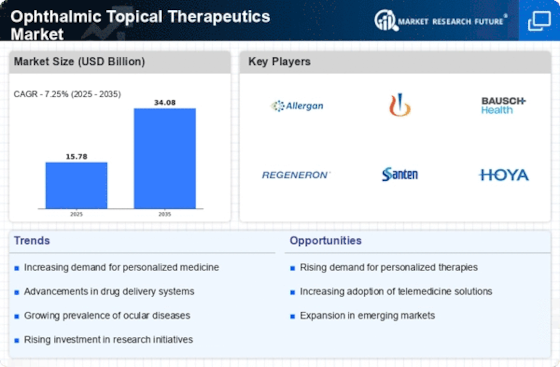
As per Market Research Future analysis, the Ophthalmic Topical Therapeutics Market Size was estimated at 15.78 USD Billion in 2024. The Ophthalmic Topical Therapeutics industry is projected to grow from 16.92 USD Billion in 2025 to 34.08 USD Billion by 2035, exhibiting a compound annual growth rate (CAGR) of 7.25% during the forecast period 2025 - 2035

Key Market Trends & Highlights

The Ophthalmic Topical Therapeutics Market is poised for substantial growth driven by technological advancements and increasing demand for personalized treatments.

  • North America remains the largest market for ophthalmic topical therapeutics, driven by a high prevalence of eye disorders. The Asia-Pacific region is emerging as the fastest-growing market, fueled by rising healthcare investments and awareness. Artificial tears dominate the market as the largest segment, while anti-inflammatory therapies are witnessing rapid growth. Key market drivers include the growing prevalence of eye disorders and technological advancements in ophthalmic formulations.

Market Size & Forecast

2024 Market Size 15.78 (USD Billion)
2035 Market Size 34.08 (USD Billion)
CAGR (2025 - 2035) 7.25%
Largest Regional Market Share in 2024 North America

Major Players

Allergan (US), Novartis (CH), Bausch Health (CA), Regeneron Pharmaceuticals (US), Santen Pharmaceutical (JP), Hoya Corporation (JP), Akorn (US), Ocular Therapeutix (US)

Market Trends

The Ophthalmic Topical Therapeutics Market is currently experiencing a dynamic evolution, driven by advancements in drug formulations and delivery systems. Innovations in nanotechnology and sustained-release mechanisms are enhancing the efficacy and safety profiles of ophthalmic medications. This market is characterized by a growing demand for treatments addressing various ocular conditions, including dry eye syndrome, glaucoma, and allergic conjunctivitis.

The increasing prevalence of these disorders, coupled with an aging population, appears to be propelling the market forward. Furthermore, the rise of telemedicine and digital health solutions is likely to influence patient access to ophthalmic care, potentially reshaping treatment paradigms. In addition, the competitive landscape of the Ophthalmic Topical Therapeutics Market is marked by a surge in research and development activities. Pharmaceutical companies are investing in novel therapeutic agents and exploring combination therapies to enhance treatment outcomes. Regulatory agencies are also adapting to these changes, streamlining approval processes for innovative products.

As the market continues to expand, collaboration between stakeholders, including healthcare providers, researchers, and technology firms, may foster the development of more effective and patient-centric solutions. Overall, the future of the Ophthalmic Topical Therapeutics Market seems promising, with numerous opportunities for growth and innovation on the horizon.

Advancements in Drug Delivery Systems

Recent innovations in drug delivery systems are transforming the Ophthalmic Topical Therapeutics Market. Techniques such as microemulsions and liposomes are being explored to improve the bioavailability and penetration of therapeutic agents. These advancements may lead to enhanced patient compliance and better therapeutic outcomes.

Increased Focus on Personalized Medicine

The trend towards personalized medicine is gaining traction within the Ophthalmic Topical Therapeutics Market. Tailoring treatments to individual patient profiles could optimize therapeutic efficacy and minimize adverse effects. This approach may also facilitate the development of targeted therapies for specific ocular conditions.

Rising Demand for Combination Therapies

Combination therapies are becoming increasingly popular in the Ophthalmic Topical Therapeutics Market. By integrating multiple therapeutic agents, these treatments aim to address complex ocular diseases more effectively. This trend reflects a broader shift towards comprehensive care strategies in ophthalmology.

Ophthalmic Topical Therapeutics Market Market Drivers

Expansion of Distribution Channels

The expansion of distribution channels for ophthalmic products is playing a crucial role in the growth of the Ophthalmic Topical Therapeutics Market. With the rise of e-commerce and online pharmacies, patients now have greater access to a wide range of ophthalmic therapeutics. This shift in distribution not only enhances convenience for consumers but also allows for a broader reach of products, particularly in underserved regions. Additionally, partnerships between pharmaceutical companies and healthcare providers are facilitating better access to these therapies. As distribution networks continue to evolve, the market is likely to experience increased sales and a wider adoption of topical ophthalmic treatments.

Growing Prevalence of Eye Disorders

The increasing prevalence of eye disorders such as glaucoma, dry eye syndrome, and age-related macular degeneration is a primary driver of the Ophthalmic Topical Therapeutics Market. According to recent estimates, millions of individuals are affected by these conditions, leading to a heightened demand for effective therapeutic solutions. As the population ages, the incidence of these disorders is expected to rise, further propelling market growth. The need for innovative treatments that can be administered topically is becoming more pronounced, as patients seek convenient and effective options. This trend indicates a robust market potential for companies specializing in ophthalmic therapeutics, as they strive to develop new formulations and delivery systems that cater to the evolving needs of patients suffering from various eye conditions.

Rising Awareness and Education on Eye Health

There is a notable increase in awareness and education regarding eye health, which is contributing to the growth of the Ophthalmic Topical Therapeutics Market. Public health campaigns and initiatives by various organizations are emphasizing the importance of regular eye examinations and early intervention for eye disorders. This heightened awareness is leading to an increase in patient consultations and a subsequent rise in the demand for ophthalmic therapeutics. Furthermore, as patients become more informed about available treatment options, they are more likely to seek out effective topical therapies. This trend suggests a positive outlook for the market, as educated consumers drive demand for innovative and effective ophthalmic solutions.

Regulatory Support for Ophthalmic Innovations

Regulatory support for the development and approval of new ophthalmic therapies is a significant driver of the Ophthalmic Topical Therapeutics Market. Regulatory agencies are increasingly recognizing the need for innovative treatments to address the growing burden of eye diseases. Initiatives aimed at expediting the approval process for novel therapies are encouraging pharmaceutical companies to invest in research and development. This supportive regulatory environment is likely to foster innovation and bring new products to market more rapidly. As a result, the market is expected to benefit from a steady influx of new ophthalmic therapeutics, catering to the diverse needs of patients and healthcare providers.

Technological Advancements in Ophthalmic Formulations

Technological advancements in drug formulation and delivery systems are significantly influencing the Ophthalmic Topical Therapeutics Market. Innovations such as nanotechnology, sustained-release formulations, and smart delivery systems are enhancing the efficacy and safety of ophthalmic drugs. These advancements allow for improved bioavailability and patient compliance, as they reduce the frequency of administration and enhance therapeutic outcomes. The market is witnessing a surge in research and development activities aimed at creating novel formulations that can address unmet medical needs. As a result, pharmaceutical companies are increasingly investing in R&D to leverage these technologies, which is likely to drive the growth of the market in the coming years.


Market Segment Insights

By Product Type: Artificial Tears (Largest) vs. Anti-inflammatory (Fastest-Growing)

In the Ophthalmic Topical Therapeutics Market, the product types are distributed among several key categories. Artificial Tears holds the largest share, being a staple in the treatment of dry eyes and providing essential lubrication. Meanwhile, Anti-inflammatory products are rapidly gaining popularity as they effectively manage ocular inflammation, demonstrating a strong increase in market adoption. Other categories such as Anti-allergy, Antibiotic Drops, and Antiglaucoma treatments also contribute but occupy smaller portions of the market share.

Artificial Tears (Dominant) vs. Anti-inflammatory (Emerging)

Artificial Tears are a crucial component of the Ophthalmic Topical Therapeutics Market, widely utilized for the treatment of dry eye conditions across various demographic groups. Their dominance stems from their established efficacy and widespread acceptance among both healthcare providers and patients. In contrast, Anti-inflammatory therapies represent an emerging segment, driving interest due to rising cases of ocular surface inflammation. These products are increasingly recognized for their role in enhancing patient comfort and recovery times post-surgery. The growing awareness of ocular health contributes to their rapid market growth, indicating a shift toward more specialized therapeutic solutions.

By Disease Type: Dry Eye (Largest) vs. Glaucoma (Fastest-Growing)

In the Ophthalmic Topical Therapeutics Market, the distribution of market share among different disease types reveals that Dry Eye occupies the largest segment, driven by the rising prevalence of this condition and an aging population. Conversely, Glaucoma is recognized as the fastest-growing segment, supported by increasing awareness and early diagnosis, leading to a surge in treatment options. Other segments, such as Eye Allergy and Eye Infection, also contribute significantly, but they do not match the scale of Dry Eye and the rapid growth of Glaucoma. Furthermore, growth trends in the Ophthalmic Topical Therapeutics Market sector are predominantly influenced by an escalating demand for innovative and effective treatment solutions. Advances in drug formulations and the introduction of novel therapies have bolstered market expansion. The increasing incidence of manageable but chronic conditions like Dry Eye and Glaucoma propels demand, as patients seek reliable therapeutic options. Additionally, the demand for personalized medicine and targeted therapies is shaping the landscape, encouraging pharmaceutical companies to invest in research and development for this market, further driving growth in various segments, particularly in <a href="https://www.marketresearchfuture.com/reports/glaucoma-treatment-market-20299" target="_blank" title="glaucoma treatment">Glaucoma treatments</a>.

Dry Eye (Dominant) vs. Retinal Disorders (Emerging)

Dry Eye stands as the dominant segment within the Ophthalmic Topical Therapeutics Market, characterized by a broad range of available treatment options, including artificial tears and anti-inflammatory medications that cater to a significant patient population. The prevalence of Dry Eye continues to increase, largely due to lifestyle factors and the increasing use of digital devices, prompting continuous innovation in therapeutic offerings. On the other hand, Retinal Disorders represent an emerging segment showing promising growth potential. Treatments in this area are rapidly evolving, harnessing advances in <a href="https://www.marketresearchfuture.com/reports/drug-delivery-system-market-43638" target="_blank" title="drug delivery system">drug delivery systems</a> and targeted therapies that address complex conditions like diabetic retinopathy and age-related macular degeneration. While still smaller compared to established segments, the surge in R&amp;D investments and clinical effectiveness in this specialty creates a vibrant competitive landscape, making Retinal Disorders an attractive area for future development.

By Dosage Form: Eye Drops (Largest) vs. Gels (Fastest-Growing)

In the Ophthalmic Topical Therapeutics Market, the dosage form segment is primarily dominated by Eye Drops, which hold the largest market share among all forms. Eye Drops are widely preferred due to their ease of use and immediate therapeutic action, making them a staple in treating various ocular conditions. Gels, on the other hand, are emerging rapidly in popularity thanks to their longer retention time in the eye, which enhances therapeutic efficacy for conditions requiring extended treatment duration. The growth trends in this segment indicate a significant rise in the adoption of Gels, attributed to advancements in formulation technology and increasing patient preference for products that offer sustained release properties. Furthermore, as awareness of ocular diseases rises, there is a corresponding demand for innovative delivery systems that can enhance patient compliance and comfort. The competitive landscape reflects a strong push among manufacturers to develop more effective and patient-friendly formulations across all dosage forms, particularly focusing on the emerging gel products.

Eye Drops (Dominant) vs. Gels (Emerging)

Eye Drops remain the dominant dosage form in the Ophthalmic Topical Therapeutics Market, characterized by their formulation versatility and user-friendliness. They are widely utilized in the treatment of a range of eye conditions, including allergies, infections, and glaucoma, due to their rapid onset of action. The established presence and widespread acceptance of Eye Drops contribute to their leading market position. In contrast, Gels are regarded as an emerging option, offering advantages such as prolonged contact time with the ocular surface and a higher viscosity, which enhances the therapeutic effect for certain conditions. Gels are gaining traction driven by innovations in drug delivery systems, making them attractive for conditions requiring sustained therapeutic action, thus positioning them as a viable alternative to traditional Eye Drops.

By Distribution Channel: Hospital Pharmacies (Largest) vs. Online Pharmacies (Fastest-Growing)

In the ophthalmic topical therapeutics market, distribution channels are crucial for reaching patients effectively. Hospital pharmacies currently hold the largest market share, benefiting from their direct access to patients during treatment. They provide critical care medications and personalized service which solidifies their position in the market. Conversely, online pharmacies are rapidly growing in popularity, offering convenience and accessibility for patients who seek therapeutic products from the comfort of their homes. Their market share is expanding due to the rising trend of e-commerce in healthcare. The growth drivers in this segment are influenced by the changing consumer behaviors towards digital solutions and the increasing demand for faster access to medications. Online pharmacies are becoming a preferred choice for many consumers, especially in urban areas, as telehealth services gain traction. This shift indicates a significant evolution in how ophthalmic therapeutics are being distributed. Along with competitive pricing and home delivery options, the strategic improvements in online platforms are propelling their growth within the market.

Hospital Pharmacies (Dominant) vs. Online Pharmacies (Emerging)

Hospital pharmacies are considered the dominant force in the ophthalmic topical therapeutics market due to their established infrastructure and patient-centric approach. They ensure optimal patient access to medications during hospital stays, providing essential therapies for acute eye conditions. Moreover, they maintain extensive relationships with healthcare providers, enhancing trust and medication adherence during critical care periods. In contrast, online pharmacies represent the emerging segment, leveraging technology to connect patients with therapies more conveniently. They cater to a tech-savvy demographic that values convenience, offering an array of therapeutic options for ophthalmic needs. With enhanced logistics and data-driven customer insights, online pharmacies are poised for significant growth, meeting the evolving demands of the market.

Get more detailed insights about Ophthalmic Topical Therapeutics Market Research Report—Global Forecast till 2035

Regional Insights

North America : Market Leader in Innovation

North America is the largest market for ophthalmic topical therapeutics, accounting for approximately 45% of the global market share. The region benefits from advanced healthcare infrastructure, high prevalence of eye disorders, and significant investments in R&D. Regulatory support from agencies like the FDA further catalyzes market growth, ensuring rapid approval of innovative therapies. The United States leads the market, followed by Canada, with key players such as Allergan, Regeneron Pharmaceuticals, and Bausch Health dominating the landscape. The competitive environment is characterized by continuous product launches and strategic collaborations, enhancing the availability of advanced therapeutic options for patients.

Europe : Emerging Market with Growth Potential

Europe is the second-largest market for ophthalmic topical therapeutics, holding around 30% of the global market share. The region is witnessing a surge in demand driven by an aging population and increasing awareness of eye health. Regulatory bodies like the European Medicines Agency (EMA) are actively promoting innovative treatments, which is expected to further boost market growth. Leading countries include Germany, France, and the UK, where major players like Novartis and Santen Pharmaceutical are well-established. The competitive landscape is marked by a mix of multinational corporations and local firms, fostering innovation and enhancing patient access to effective therapies.

Asia-Pacific : Rapidly Growing Market Segment

Asia-Pacific is an emerging powerhouse in the ophthalmic topical therapeutics market, contributing approximately 20% to the global share. The region's growth is fueled by rising healthcare expenditure, increasing prevalence of eye diseases, and a growing awareness of eye care. Countries like Japan and China are leading this growth, supported by favorable regulatory frameworks that encourage the introduction of new therapies. Japan is home to key players such as Hoya Corporation and Santen Pharmaceutical, while China is rapidly expanding its market presence. The competitive landscape is evolving, with both local and international companies vying for market share, leading to increased innovation and improved patient outcomes.

Middle East and Africa : Untapped Market Potential

The Middle East and Africa represent a nascent market for ophthalmic topical therapeutics, holding about 5% of the global market share. Growth is driven by increasing healthcare initiatives, rising awareness of eye health, and government investments in healthcare infrastructure. Countries like South Africa and the UAE are at the forefront, with efforts to improve access to eye care services. The competitive landscape is still developing, with a mix of local and international players. Companies are focusing on expanding their product offerings and enhancing distribution channels to meet the growing demand for effective ophthalmic therapies in the region.

Key Players and Competitive Insights

Major market players’ growth is dependent on market conditions, government support, and industry development. Thus, manufacturers are focused on expanding their geographical reach and improving their products. They primarily focus on the development of novel products. Although international players dominate the market, regional and foreign players with small market shares also have a considerable presence in the market of Ophthalmic Topical Therapeutics Market.
Novartis AG (Switzerland) was established through a merger of Ciba-Geigy and Sandoz. Novartis AG and its preceding companies have developed innovative products for over 250 years. The company operates through two major business segments: Innovative Medicines and Sandoz. It focuses on developing and marketing products that contribute to human progress through advances in science and health. It provides ophthalmology, neuroscience, immunology, hematology, dermatology, respiratory, cardio-metabolic, and established medicine products. The company has a strong presence in North America, Europe, Asia-Pacific, and the Middle East & Africa.
Moreover, In April 2022, Sandoz, a Novartis division, launched a generic brimonidine tartrate/timolol maleate eyedrop in the US for patients suffering from ocular hypertension, increasing its leading ophthalmic offering.

Key Companies in the Ophthalmic Topical Therapeutics Market include

Industry Developments

  • In May 2022, Bausch + Lomb Health Canada approved LUMIFY (brimonidine tartrate ophthalmic solution 0.025 percent w/v) as the first and only over the counter (OTC) eye drop containing low dose brimonidine tartrate to treat redness of the eye caused by minor eye irritations in adults.
  • In October 2021, The FDA approved VUITYTM (pilocarpine HCI ophthalmic solution) 1.25 %, the first and only eye drop to treat presbyopia (Age-Related Blurry Near Vision).
  • In June 2021, Santen receives FDA product approval in the US for Verkazia (Cyclosporine Ophthalmic Emulsion, 0.1%) for treating Vernal Keratoconjunctivitis in children and adults.

Future Outlook

Ophthalmic Topical Therapeutics Market Future Outlook

The Ophthalmic Topical Therapeutics Market is projected to grow at a 7.25% CAGR from 2025 to 2035, driven by technological advancements, increasing prevalence of eye disorders, and rising healthcare expenditure.

New opportunities lie in:

  • Development of personalized ophthalmic drug delivery systems.
  • Expansion into emerging markets with tailored product offerings.
  • Investment in <a href="https://www.marketresearchfuture.com/reports/telemedicine-market-2216">telemedicine </a>platforms for remote patient monitoring.

By 2035, the market is expected to achieve substantial growth, reflecting evolving healthcare needs and innovative solutions.

Market Segmentation

Ophthalmic Topical Therapeutics Market Dosage Form Outlook

  • Eye Drops
  • Gels
  • Ointments
  • Others

Ophthalmic Topical Therapeutics Market Disease Type Outlook

  • Dry Eye
  • Eye Allergy
  • Glaucoma
  • Eye Infection
  • Retinal Disorders
  • Uveitis
  • Others

Ophthalmic Topical Therapeutics Market Product Type Outlook

  • Artificial Tears
  • Anti-allergy
  • Antibiotic Drops
  • Anti-inflammatory
  • Antiglaucoma
  • Others

Ophthalmic Topical Therapeutics Market Distribution Channel Outlook

  • Hospital Pharmacies
  • Drug Stores
  • Online Pharmacies
  • Others

Report Scope

MARKET SIZE 2024 15.78(USD Billion)
MARKET SIZE 2025 16.92(USD Billion)
MARKET SIZE 2035 34.08(USD Billion)
COMPOUND ANNUAL GROWTH RATE (CAGR) 7.25% (2025 - 2035)
REPORT COVERAGE Revenue Forecast, Competitive Landscape, Growth Factors, and Trends
BASE YEAR 2024
Market Forecast Period 2025 - 2035
Historical Data 2019 - 2024
Market Forecast Units USD Billion
Key Companies Profiled Allergan (US), Novartis (CH), Bausch Health (CA), Regeneron Pharmaceuticals (US), Santen Pharmaceutical (JP), Hoya Corporation (JP), Akorn (US), Ocular Therapeutix (US)
Segments Covered Product Type, Disease Type, Dosage Type, Distribution Channel
Key Market Opportunities Advancements in drug delivery systems enhance efficacy in the Ophthalmic Topical Therapeutics Market.
Key Market Dynamics Rising demand for innovative therapies drives competition and regulatory scrutiny in the ophthalmic topical therapeutics market.
Countries Covered North America, Europe, APAC, South America, MEA

FAQs

What is the projected market valuation for the Ophthalmic Topical Therapeutics Market in 2035?

<p>The projected market valuation for the Ophthalmic Topical Therapeutics Market in 2035 is 34.08 USD Billion.</p>

What was the market valuation for the Ophthalmic Topical Therapeutics Market in 2024?

<p>The overall market valuation for the Ophthalmic Topical Therapeutics Market was 15.78 USD Billion in 2024.</p>

What is the expected CAGR for the Ophthalmic Topical Therapeutics Market during the forecast period 2025 - 2035?

<p>The expected CAGR for the Ophthalmic Topical Therapeutics Market during the forecast period 2025 - 2035 is 7.25%.</p>

Which product type segment is projected to have the highest valuation by 2035?

<p>The Antiglaucoma product type segment is projected to reach 8.92 USD Billion by 2035.</p>

What are the projected values for the Dry Eye disease type segment by 2035?

<p>The Dry Eye disease type segment is projected to reach 6.5 USD Billion by 2035.</p>

Which distribution channel is expected to show significant growth by 2035?

<p>The Hospital Pharmacies distribution channel is expected to grow to 10.5 USD Billion by 2035.</p>

What is the projected valuation for Eye Drops as a dosage form by 2035?

The Eye Drops dosage form is projected to reach 13.0 USD Billion by 2035.

Who are the key players in the Ophthalmic Topical Therapeutics Market?

Key players in the market include Allergan, Novartis, Bausch Health, Regeneron Pharmaceuticals, Santen Pharmaceutical, Hoya Corporation, Akorn, and Ocular Therapeutix.

What is the expected growth for the Anti-inflammatory product type segment by 2035?

The Anti-inflammatory product type segment is expected to grow to 6.89 USD Billion by 2035.

How does the market for Eye Allergy disease type segment compare to others by 2035?

The Eye Allergy disease type segment is projected to reach 5.0 USD Billion by 2035, indicating robust growth compared to other segments.

  1. SECTION I: EXECUTIVE SUMMARY AND KEY HIGHLIGHTS
    1. | 1.1 EXECUTIVE SUMMARY
    2. | | 1.1.1 Market Overview
    3. | | 1.1.2 Key Findings
    4. | | 1.1.3 Market Segmentation
    5. | | 1.1.4 Competitive Landscape
    6. | | 1.1.5 Challenges and Opportunities
    7. | | 1.1.6 Future Outlook
  2. SECTION II: SCOPING, METHODOLOGY AND MARKET STRUCTURE
    1. | 2.1 MARKET INTRODUCTION
    2. | | 2.1.1 Definition
    3. | | 2.1.2 Scope of the study
    4. | | | 2.1.2.1 Research Objective
    5. | | | 2.1.2.2 Assumption
    6. | | | 2.1.2.3 Limitations
    7. | 2.2 RESEARCH METHODOLOGY
    8. | | 2.2.1 Overview
    9. | | 2.2.2 Data Mining
    10. | | 2.2.3 Secondary Research
    11. | | 2.2.4 Primary Research
    12. | | | 2.2.4.1 Primary Interviews and Information Gathering Process
    13. | | | 2.2.4.2 Breakdown of Primary Respondents
    14. | | 2.2.5 Forecasting Model
    15. | | 2.2.6 Market Size Estimation
    16. | | | 2.2.6.1 Bottom-Up Approach
    17. | | | 2.2.6.2 Top-Down Approach
    18. | | 2.2.7 Data Triangulation
    19. | | 2.2.8 Validation
  3. SECTION III: QUALITATIVE ANALYSIS
    1. | 3.1 MARKET DYNAMICS
    2. | | 3.1.1 Overview
    3. | | 3.1.2 Drivers
    4. | | 3.1.3 Restraints
    5. | | 3.1.4 Opportunities
    6. | 3.2 MARKET FACTOR ANALYSIS
    7. | | 3.2.1 Value chain Analysis
    8. | | 3.2.2 Porter's Five Forces Analysis
    9. | | | 3.2.2.1 Bargaining Power of Suppliers
    10. | | | 3.2.2.2 Bargaining Power of Buyers
    11. | | | 3.2.2.3 Threat of New Entrants
    12. | | | 3.2.2.4 Threat of Substitutes
    13. | | | 3.2.2.5 Intensity of Rivalry
    14. | | 3.2.3 COVID-19 Impact Analysis
    15. | | | 3.2.3.1 Market Impact Analysis
    16. | | | 3.2.3.2 Regional Impact
    17. | | | 3.2.3.3 Opportunity and Threat Analysis
  4. SECTION IV: QUANTITATIVE ANALYSIS
    1. | 4.1 Healthcare, BY Product Type (USD Billion)
    2. | | 4.1.1 Artificial Tears
    3. | | 4.1.2 Anti-allergy
    4. | | 4.1.3 Antibiotic Drops
    5. | | 4.1.4 Anti-inflammatory
    6. | | 4.1.5 Antiglaucoma
    7. | | 4.1.6 Others
    8. | 4.2 Healthcare, BY Disease Type (USD Billion)
    9. | | 4.2.1 Dry Eye
    10. | | 4.2.2 Eye Allergy
    11. | | 4.2.3 Glaucoma
    12. | | 4.2.4 Eye Infection
    13. | | 4.2.5 Retinal Disorders
    14. | | 4.2.6 Uveitis
    15. | | 4.2.7 Others
    16. | 4.3 Healthcare, BY Dosage Form (USD Billion)
    17. | | 4.3.1 Eye Drops
    18. | | 4.3.2 Gels
    19. | | 4.3.3 Ointments
    20. | | 4.3.4 Others
    21. | 4.4 Healthcare, BY Distribution Channel (USD Billion)
    22. | | 4.4.1 Hospital Pharmacies
    23. | | 4.4.2 Drug Stores
    24. | | 4.4.3 Online Pharmacies
    25. | | 4.4.4 Others
    26. | 4.5 Healthcare, BY Region (USD Billion)
    27. | | 4.5.1 North America
    28. | | | 4.5.1.1 US
    29. | | | 4.5.1.2 Canada
    30. | | 4.5.2 Europe
    31. | | | 4.5.2.1 Germany
    32. | | | 4.5.2.2 UK
    33. | | | 4.5.2.3 France
    34. | | | 4.5.2.4 Russia
    35. | | | 4.5.2.5 Italy
    36. | | | 4.5.2.6 Spain
    37. | | | 4.5.2.7 Rest of Europe
    38. | | 4.5.3 APAC
    39. | | | 4.5.3.1 China
    40. | | | 4.5.3.2 India
    41. | | | 4.5.3.3 Japan
    42. | | | 4.5.3.4 South Korea
    43. | | | 4.5.3.5 Malaysia
    44. | | | 4.5.3.6 Thailand
    45. | | | 4.5.3.7 Indonesia
    46. | | | 4.5.3.8 Rest of APAC
    47. | | 4.5.4 South America
    48. | | | 4.5.4.1 Brazil
    49. | | | 4.5.4.2 Mexico
    50. | | | 4.5.4.3 Argentina
    51. | | | 4.5.4.4 Rest of South America
    52. | | 4.5.5 MEA
    53. | | | 4.5.5.1 GCC Countries
    54. | | | 4.5.5.2 South Africa
    55. | | | 4.5.5.3 Rest of MEA
  5. SECTION V: COMPETITIVE ANALYSIS
    1. | 5.1 Competitive Landscape
    2. | | 5.1.1 Overview
    3. | | 5.1.2 Competitive Analysis
    4. | | 5.1.3 Market share Analysis
    5. | | 5.1.4 Major Growth Strategy in the Healthcare
    6. | | 5.1.5 Competitive Benchmarking
    7. | | 5.1.6 Leading Players in Terms of Number of Developments in the Healthcare
    8. | | 5.1.7 Key developments and growth strategies
    9. | | | 5.1.7.1 New Product Launch/Service Deployment
    10. | | | 5.1.7.2 Merger & Acquisitions
    11. | | | 5.1.7.3 Joint Ventures
    12. | | 5.1.8 Major Players Financial Matrix
    13. | | | 5.1.8.1 Sales and Operating Income
    14. | | | 5.1.8.2 Major Players R&D Expenditure. 2023
    15. | 5.2 Company Profiles
    16. | | 5.2.1 Allergan (US)
    17. | | | 5.2.1.1 Financial Overview
    18. | | | 5.2.1.2 Products Offered
    19. | | | 5.2.1.3 Key Developments
    20. | | | 5.2.1.4 SWOT Analysis
    21. | | | 5.2.1.5 Key Strategies
    22. | | 5.2.2 Novartis (CH)
    23. | | | 5.2.2.1 Financial Overview
    24. | | | 5.2.2.2 Products Offered
    25. | | | 5.2.2.3 Key Developments
    26. | | | 5.2.2.4 SWOT Analysis
    27. | | | 5.2.2.5 Key Strategies
    28. | | 5.2.3 Bausch Health (CA)
    29. | | | 5.2.3.1 Financial Overview
    30. | | | 5.2.3.2 Products Offered
    31. | | | 5.2.3.3 Key Developments
    32. | | | 5.2.3.4 SWOT Analysis
    33. | | | 5.2.3.5 Key Strategies
    34. | | 5.2.4 Regeneron Pharmaceuticals (US)
    35. | | | 5.2.4.1 Financial Overview
    36. | | | 5.2.4.2 Products Offered
    37. | | | 5.2.4.3 Key Developments
    38. | | | 5.2.4.4 SWOT Analysis
    39. | | | 5.2.4.5 Key Strategies
    40. | | 5.2.5 Santen Pharmaceutical (JP)
    41. | | | 5.2.5.1 Financial Overview
    42. | | | 5.2.5.2 Products Offered
    43. | | | 5.2.5.3 Key Developments
    44. | | | 5.2.5.4 SWOT Analysis
    45. | | | 5.2.5.5 Key Strategies
    46. | | 5.2.6 Hoya Corporation (JP)
    47. | | | 5.2.6.1 Financial Overview
    48. | | | 5.2.6.2 Products Offered
    49. | | | 5.2.6.3 Key Developments
    50. | | | 5.2.6.4 SWOT Analysis
    51. | | | 5.2.6.5 Key Strategies
    52. | | 5.2.7 Akorn (US)
    53. | | | 5.2.7.1 Financial Overview
    54. | | | 5.2.7.2 Products Offered
    55. | | | 5.2.7.3 Key Developments
    56. | | | 5.2.7.4 SWOT Analysis
    57. | | | 5.2.7.5 Key Strategies
    58. | | 5.2.8 Ocular Therapeutix (US)
    59. | | | 5.2.8.1 Financial Overview
    60. | | | 5.2.8.2 Products Offered
    61. | | | 5.2.8.3 Key Developments
    62. | | | 5.2.8.4 SWOT Analysis
    63. | | | 5.2.8.5 Key Strategies
    64. | 5.3 Appendix
    65. | | 5.3.1 References
    66. | | 5.3.2 Related Reports
  6. LIST OF FIGURES
    1. | 6.1 MARKET SYNOPSIS
    2. | 6.2 NORTH AMERICA MARKET ANALYSIS
    3. | 6.3 US MARKET ANALYSIS BY PRODUCT TYPE
    4. | 6.4 US MARKET ANALYSIS BY DISEASE TYPE
    5. | 6.5 US MARKET ANALYSIS BY DOSAGE FORM
    6. | 6.6 US MARKET ANALYSIS BY DISTRIBUTION CHANNEL
    7. | 6.7 CANADA MARKET ANALYSIS BY PRODUCT TYPE
    8. | 6.8 CANADA MARKET ANALYSIS BY DISEASE TYPE
    9. | 6.9 CANADA MARKET ANALYSIS BY DOSAGE FORM
    10. | 6.10 CANADA MARKET ANALYSIS BY DISTRIBUTION CHANNEL
    11. | 6.11 EUROPE MARKET ANALYSIS
    12. | 6.12 GERMANY MARKET ANALYSIS BY PRODUCT TYPE
    13. | 6.13 GERMANY MARKET ANALYSIS BY DISEASE TYPE
    14. | 6.14 GERMANY MARKET ANALYSIS BY DOSAGE FORM
    15. | 6.15 GERMANY MARKET ANALYSIS BY DISTRIBUTION CHANNEL
    16. | 6.16 UK MARKET ANALYSIS BY PRODUCT TYPE
    17. | 6.17 UK MARKET ANALYSIS BY DISEASE TYPE
    18. | 6.18 UK MARKET ANALYSIS BY DOSAGE FORM
    19. | 6.19 UK MARKET ANALYSIS BY DISTRIBUTION CHANNEL
    20. | 6.20 FRANCE MARKET ANALYSIS BY PRODUCT TYPE
    21. | 6.21 FRANCE MARKET ANALYSIS BY DISEASE TYPE
    22. | 6.22 FRANCE MARKET ANALYSIS BY DOSAGE FORM
    23. | 6.23 FRANCE MARKET ANALYSIS BY DISTRIBUTION CHANNEL
    24. | 6.24 RUSSIA MARKET ANALYSIS BY PRODUCT TYPE
    25. | 6.25 RUSSIA MARKET ANALYSIS BY DISEASE TYPE
    26. | 6.26 RUSSIA MARKET ANALYSIS BY DOSAGE FORM
    27. | 6.27 RUSSIA MARKET ANALYSIS BY DISTRIBUTION CHANNEL
    28. | 6.28 ITALY MARKET ANALYSIS BY PRODUCT TYPE
    29. | 6.29 ITALY MARKET ANALYSIS BY DISEASE TYPE
    30. | 6.30 ITALY MARKET ANALYSIS BY DOSAGE FORM
    31. | 6.31 ITALY MARKET ANALYSIS BY DISTRIBUTION CHANNEL
    32. | 6.32 SPAIN MARKET ANALYSIS BY PRODUCT TYPE
    33. | 6.33 SPAIN MARKET ANALYSIS BY DISEASE TYPE
    34. | 6.34 SPAIN MARKET ANALYSIS BY DOSAGE FORM
    35. | 6.35 SPAIN MARKET ANALYSIS BY DISTRIBUTION CHANNEL
    36. | 6.36 REST OF EUROPE MARKET ANALYSIS BY PRODUCT TYPE
    37. | 6.37 REST OF EUROPE MARKET ANALYSIS BY DISEASE TYPE
    38. | 6.38 REST OF EUROPE MARKET ANALYSIS BY DOSAGE FORM
    39. | 6.39 REST OF EUROPE MARKET ANALYSIS BY DISTRIBUTION CHANNEL
    40. | 6.40 APAC MARKET ANALYSIS
    41. | 6.41 CHINA MARKET ANALYSIS BY PRODUCT TYPE
    42. | 6.42 CHINA MARKET ANALYSIS BY DISEASE TYPE
    43. | 6.43 CHINA MARKET ANALYSIS BY DOSAGE FORM
    44. | 6.44 CHINA MARKET ANALYSIS BY DISTRIBUTION CHANNEL
    45. | 6.45 INDIA MARKET ANALYSIS BY PRODUCT TYPE
    46. | 6.46 INDIA MARKET ANALYSIS BY DISEASE TYPE
    47. | 6.47 INDIA MARKET ANALYSIS BY DOSAGE FORM
    48. | 6.48 INDIA MARKET ANALYSIS BY DISTRIBUTION CHANNEL
    49. | 6.49 JAPAN MARKET ANALYSIS BY PRODUCT TYPE
    50. | 6.50 JAPAN MARKET ANALYSIS BY DISEASE TYPE
    51. | 6.51 JAPAN MARKET ANALYSIS BY DOSAGE FORM
    52. | 6.52 JAPAN MARKET ANALYSIS BY DISTRIBUTION CHANNEL
    53. | 6.53 SOUTH KOREA MARKET ANALYSIS BY PRODUCT TYPE
    54. | 6.54 SOUTH KOREA MARKET ANALYSIS BY DISEASE TYPE
    55. | 6.55 SOUTH KOREA MARKET ANALYSIS BY DOSAGE FORM
    56. | 6.56 SOUTH KOREA MARKET ANALYSIS BY DISTRIBUTION CHANNEL
    57. | 6.57 MALAYSIA MARKET ANALYSIS BY PRODUCT TYPE
    58. | 6.58 MALAYSIA MARKET ANALYSIS BY DISEASE TYPE
    59. | 6.59 MALAYSIA MARKET ANALYSIS BY DOSAGE FORM
    60. | 6.60 MALAYSIA MARKET ANALYSIS BY DISTRIBUTION CHANNEL
    61. | 6.61 THAILAND MARKET ANALYSIS BY PRODUCT TYPE
    62. | 6.62 THAILAND MARKET ANALYSIS BY DISEASE TYPE
    63. | 6.63 THAILAND MARKET ANALYSIS BY DOSAGE FORM
    64. | 6.64 THAILAND MARKET ANALYSIS BY DISTRIBUTION CHANNEL
    65. | 6.65 INDONESIA MARKET ANALYSIS BY PRODUCT TYPE
    66. | 6.66 INDONESIA MARKET ANALYSIS BY DISEASE TYPE
    67. | 6.67 INDONESIA MARKET ANALYSIS BY DOSAGE FORM
    68. | 6.68 INDONESIA MARKET ANALYSIS BY DISTRIBUTION CHANNEL
    69. | 6.69 REST OF APAC MARKET ANALYSIS BY PRODUCT TYPE
    70. | 6.70 REST OF APAC MARKET ANALYSIS BY DISEASE TYPE
    71. | 6.71 REST OF APAC MARKET ANALYSIS BY DOSAGE FORM
    72. | 6.72 REST OF APAC MARKET ANALYSIS BY DISTRIBUTION CHANNEL
    73. | 6.73 SOUTH AMERICA MARKET ANALYSIS
    74. | 6.74 BRAZIL MARKET ANALYSIS BY PRODUCT TYPE
    75. | 6.75 BRAZIL MARKET ANALYSIS BY DISEASE TYPE
    76. | 6.76 BRAZIL MARKET ANALYSIS BY DOSAGE FORM
    77. | 6.77 BRAZIL MARKET ANALYSIS BY DISTRIBUTION CHANNEL
    78. | 6.78 MEXICO MARKET ANALYSIS BY PRODUCT TYPE
    79. | 6.79 MEXICO MARKET ANALYSIS BY DISEASE TYPE
    80. | 6.80 MEXICO MARKET ANALYSIS BY DOSAGE FORM
    81. | 6.81 MEXICO MARKET ANALYSIS BY DISTRIBUTION CHANNEL
    82. | 6.82 ARGENTINA MARKET ANALYSIS BY PRODUCT TYPE
    83. | 6.83 ARGENTINA MARKET ANALYSIS BY DISEASE TYPE
    84. | 6.84 ARGENTINA MARKET ANALYSIS BY DOSAGE FORM
    85. | 6.85 ARGENTINA MARKET ANALYSIS BY DISTRIBUTION CHANNEL
    86. | 6.86 REST OF SOUTH AMERICA MARKET ANALYSIS BY PRODUCT TYPE
    87. | 6.87 REST OF SOUTH AMERICA MARKET ANALYSIS BY DISEASE TYPE
    88. | 6.88 REST OF SOUTH AMERICA MARKET ANALYSIS BY DOSAGE FORM
    89. | 6.89 REST OF SOUTH AMERICA MARKET ANALYSIS BY DISTRIBUTION CHANNEL
    90. | 6.90 MEA MARKET ANALYSIS
    91. | 6.91 GCC COUNTRIES MARKET ANALYSIS BY PRODUCT TYPE
    92. | 6.92 GCC COUNTRIES MARKET ANALYSIS BY DISEASE TYPE
    93. | 6.93 GCC COUNTRIES MARKET ANALYSIS BY DOSAGE FORM
    94. | 6.94 GCC COUNTRIES MARKET ANALYSIS BY DISTRIBUTION CHANNEL
    95. | 6.95 SOUTH AFRICA MARKET ANALYSIS BY PRODUCT TYPE
    96. | 6.96 SOUTH AFRICA MARKET ANALYSIS BY DISEASE TYPE
    97. | 6.97 SOUTH AFRICA MARKET ANALYSIS BY DOSAGE FORM
    98. | 6.98 SOUTH AFRICA MARKET ANALYSIS BY DISTRIBUTION CHANNEL
    99. | 6.99 REST OF MEA MARKET ANALYSIS BY PRODUCT TYPE
    100. | 6.100 REST OF MEA MARKET ANALYSIS BY DISEASE TYPE
    101. | 6.101 REST OF MEA MARKET ANALYSIS BY DOSAGE FORM
    102. | 6.102 REST OF MEA MARKET ANALYSIS BY DISTRIBUTION CHANNEL
    103. | 6.103 KEY BUYING CRITERIA OF HEALTHCARE
    104. | 6.104 RESEARCH PROCESS OF MRFR
    105. | 6.105 DRO ANALYSIS OF HEALTHCARE
    106. | 6.106 DRIVERS IMPACT ANALYSIS: HEALTHCARE
    107. | 6.107 RESTRAINTS IMPACT ANALYSIS: HEALTHCARE
    108. | 6.108 SUPPLY / VALUE CHAIN: HEALTHCARE
    109. | 6.109 HEALTHCARE, BY PRODUCT TYPE, 2024 (% SHARE)
    110. | 6.110 HEALTHCARE, BY PRODUCT TYPE, 2024 TO 2035 (USD Billion)
    111. | 6.111 HEALTHCARE, BY DISEASE TYPE, 2024 (% SHARE)
    112. | 6.112 HEALTHCARE, BY DISEASE TYPE, 2024 TO 2035 (USD Billion)
    113. | 6.113 HEALTHCARE, BY DOSAGE FORM, 2024 (% SHARE)
    114. | 6.114 HEALTHCARE, BY DOSAGE FORM, 2024 TO 2035 (USD Billion)
    115. | 6.115 HEALTHCARE, BY DISTRIBUTION CHANNEL, 2024 (% SHARE)
    116. | 6.116 HEALTHCARE, BY DISTRIBUTION CHANNEL, 2024 TO 2035 (USD Billion)
    117. | 6.117 BENCHMARKING OF MAJOR COMPETITORS
  7. LIST OF TABLES
    1. | 7.1 LIST OF ASSUMPTIONS
    2. | | 7.1.1
    3. | 7.2 North America MARKET SIZE ESTIMATES; FORECAST
    4. | | 7.2.1 BY PRODUCT TYPE, 2025-2035 (USD Billion)
    5. | | 7.2.2 BY DISEASE TYPE, 2025-2035 (USD Billion)
    6. | | 7.2.3 BY DOSAGE FORM, 2025-2035 (USD Billion)
    7. | | 7.2.4 BY DISTRIBUTION CHANNEL, 2025-2035 (USD Billion)
    8. | 7.3 US MARKET SIZE ESTIMATES; FORECAST
    9. | | 7.3.1 BY PRODUCT TYPE, 2025-2035 (USD Billion)
    10. | | 7.3.2 BY DISEASE TYPE, 2025-2035 (USD Billion)
    11. | | 7.3.3 BY DOSAGE FORM, 2025-2035 (USD Billion)
    12. | | 7.3.4 BY DISTRIBUTION CHANNEL, 2025-2035 (USD Billion)
    13. | 7.4 Canada MARKET SIZE ESTIMATES; FORECAST
    14. | | 7.4.1 BY PRODUCT TYPE, 2025-2035 (USD Billion)
    15. | | 7.4.2 BY DISEASE TYPE, 2025-2035 (USD Billion)
    16. | | 7.4.3 BY DOSAGE FORM, 2025-2035 (USD Billion)
    17. | | 7.4.4 BY DISTRIBUTION CHANNEL, 2025-2035 (USD Billion)
    18. | 7.5 Europe MARKET SIZE ESTIMATES; FORECAST
    19. | | 7.5.1 BY PRODUCT TYPE, 2025-2035 (USD Billion)
    20. | | 7.5.2 BY DISEASE TYPE, 2025-2035 (USD Billion)
    21. | | 7.5.3 BY DOSAGE FORM, 2025-2035 (USD Billion)
    22. | | 7.5.4 BY DISTRIBUTION CHANNEL, 2025-2035 (USD Billion)
    23. | 7.6 Germany MARKET SIZE ESTIMATES; FORECAST
    24. | | 7.6.1 BY PRODUCT TYPE, 2025-2035 (USD Billion)
    25. | | 7.6.2 BY DISEASE TYPE, 2025-2035 (USD Billion)
    26. | | 7.6.3 BY DOSAGE FORM, 2025-2035 (USD Billion)
    27. | | 7.6.4 BY DISTRIBUTION CHANNEL, 2025-2035 (USD Billion)
    28. | 7.7 UK MARKET SIZE ESTIMATES; FORECAST
    29. | | 7.7.1 BY PRODUCT TYPE, 2025-2035 (USD Billion)
    30. | | 7.7.2 BY DISEASE TYPE, 2025-2035 (USD Billion)
    31. | | 7.7.3 BY DOSAGE FORM, 2025-2035 (USD Billion)
    32. | | 7.7.4 BY DISTRIBUTION CHANNEL, 2025-2035 (USD Billion)
    33. | 7.8 France MARKET SIZE ESTIMATES; FORECAST
    34. | | 7.8.1 BY PRODUCT TYPE, 2025-2035 (USD Billion)
    35. | | 7.8.2 BY DISEASE TYPE, 2025-2035 (USD Billion)
    36. | | 7.8.3 BY DOSAGE FORM, 2025-2035 (USD Billion)
    37. | | 7.8.4 BY DISTRIBUTION CHANNEL, 2025-2035 (USD Billion)
    38. | 7.9 Russia MARKET SIZE ESTIMATES; FORECAST
    39. | | 7.9.1 BY PRODUCT TYPE, 2025-2035 (USD Billion)
    40. | | 7.9.2 BY DISEASE TYPE, 2025-2035 (USD Billion)
    41. | | 7.9.3 BY DOSAGE FORM, 2025-2035 (USD Billion)
    42. | | 7.9.4 BY DISTRIBUTION CHANNEL, 2025-2035 (USD Billion)
    43. | 7.10 Italy MARKET SIZE ESTIMATES; FORECAST
    44. | | 7.10.1 BY PRODUCT TYPE, 2025-2035 (USD Billion)
    45. | | 7.10.2 BY DISEASE TYPE, 2025-2035 (USD Billion)
    46. | | 7.10.3 BY DOSAGE FORM, 2025-2035 (USD Billion)
    47. | | 7.10.4 BY DISTRIBUTION CHANNEL, 2025-2035 (USD Billion)
    48. | 7.11 Spain MARKET SIZE ESTIMATES; FORECAST
    49. | | 7.11.1 BY PRODUCT TYPE, 2025-2035 (USD Billion)
    50. | | 7.11.2 BY DISEASE TYPE, 2025-2035 (USD Billion)
    51. | | 7.11.3 BY DOSAGE FORM, 2025-2035 (USD Billion)
    52. | | 7.11.4 BY DISTRIBUTION CHANNEL, 2025-2035 (USD Billion)
    53. | 7.12 Rest of Europe MARKET SIZE ESTIMATES; FORECAST
    54. | | 7.12.1 BY PRODUCT TYPE, 2025-2035 (USD Billion)
    55. | | 7.12.2 BY DISEASE TYPE, 2025-2035 (USD Billion)
    56. | | 7.12.3 BY DOSAGE FORM, 2025-2035 (USD Billion)
    57. | | 7.12.4 BY DISTRIBUTION CHANNEL, 2025-2035 (USD Billion)
    58. | 7.13 APAC MARKET SIZE ESTIMATES; FORECAST
    59. | | 7.13.1 BY PRODUCT TYPE, 2025-2035 (USD Billion)
    60. | | 7.13.2 BY DISEASE TYPE, 2025-2035 (USD Billion)
    61. | | 7.13.3 BY DOSAGE FORM, 2025-2035 (USD Billion)
    62. | | 7.13.4 BY DISTRIBUTION CHANNEL, 2025-2035 (USD Billion)
    63. | 7.14 China MARKET SIZE ESTIMATES; FORECAST
    64. | | 7.14.1 BY PRODUCT TYPE, 2025-2035 (USD Billion)
    65. | | 7.14.2 BY DISEASE TYPE, 2025-2035 (USD Billion)
    66. | | 7.14.3 BY DOSAGE FORM, 2025-2035 (USD Billion)
    67. | | 7.14.4 BY DISTRIBUTION CHANNEL, 2025-2035 (USD Billion)
    68. | 7.15 India MARKET SIZE ESTIMATES; FORECAST
    69. | | 7.15.1 BY PRODUCT TYPE, 2025-2035 (USD Billion)
    70. | | 7.15.2 BY DISEASE TYPE, 2025-2035 (USD Billion)
    71. | | 7.15.3 BY DOSAGE FORM, 2025-2035 (USD Billion)
    72. | | 7.15.4 BY DISTRIBUTION CHANNEL, 2025-2035 (USD Billion)
    73. | 7.16 Japan MARKET SIZE ESTIMATES; FORECAST
    74. | | 7.16.1 BY PRODUCT TYPE, 2025-2035 (USD Billion)
    75. | | 7.16.2 BY DISEASE TYPE, 2025-2035 (USD Billion)
    76. | | 7.16.3 BY DOSAGE FORM, 2025-2035 (USD Billion)
    77. | | 7.16.4 BY DISTRIBUTION CHANNEL, 2025-2035 (USD Billion)
    78. | 7.17 South Korea MARKET SIZE ESTIMATES; FORECAST
    79. | | 7.17.1 BY PRODUCT TYPE, 2025-2035 (USD Billion)
    80. | | 7.17.2 BY DISEASE TYPE, 2025-2035 (USD Billion)
    81. | | 7.17.3 BY DOSAGE FORM, 2025-2035 (USD Billion)
    82. | | 7.17.4 BY DISTRIBUTION CHANNEL, 2025-2035 (USD Billion)
    83. | 7.18 Malaysia MARKET SIZE ESTIMATES; FORECAST
    84. | | 7.18.1 BY PRODUCT TYPE, 2025-2035 (USD Billion)
    85. | | 7.18.2 BY DISEASE TYPE, 2025-2035 (USD Billion)
    86. | | 7.18.3 BY DOSAGE FORM, 2025-2035 (USD Billion)
    87. | | 7.18.4 BY DISTRIBUTION CHANNEL, 2025-2035 (USD Billion)
    88. | 7.19 Thailand MARKET SIZE ESTIMATES; FORECAST
    89. | | 7.19.1 BY PRODUCT TYPE, 2025-2035 (USD Billion)
    90. | | 7.19.2 BY DISEASE TYPE, 2025-2035 (USD Billion)
    91. | | 7.19.3 BY DOSAGE FORM, 2025-2035 (USD Billion)
    92. | | 7.19.4 BY DISTRIBUTION CHANNEL, 2025-2035 (USD Billion)
    93. | 7.20 Indonesia MARKET SIZE ESTIMATES; FORECAST
    94. | | 7.20.1 BY PRODUCT TYPE, 2025-2035 (USD Billion)
    95. | | 7.20.2 BY DISEASE TYPE, 2025-2035 (USD Billion)
    96. | | 7.20.3 BY DOSAGE FORM, 2025-2035 (USD Billion)
    97. | | 7.20.4 BY DISTRIBUTION CHANNEL, 2025-2035 (USD Billion)
    98. | 7.21 Rest of APAC MARKET SIZE ESTIMATES; FORECAST
    99. | | 7.21.1 BY PRODUCT TYPE, 2025-2035 (USD Billion)
    100. | | 7.21.2 BY DISEASE TYPE, 2025-2035 (USD Billion)
    101. | | 7.21.3 BY DOSAGE FORM, 2025-2035 (USD Billion)
    102. | | 7.21.4 BY DISTRIBUTION CHANNEL, 2025-2035 (USD Billion)
    103. | 7.22 South America MARKET SIZE ESTIMATES; FORECAST
    104. | | 7.22.1 BY PRODUCT TYPE, 2025-2035 (USD Billion)
    105. | | 7.22.2 BY DISEASE TYPE, 2025-2035 (USD Billion)
    106. | | 7.22.3 BY DOSAGE FORM, 2025-2035 (USD Billion)
    107. | | 7.22.4 BY DISTRIBUTION CHANNEL, 2025-2035 (USD Billion)
    108. | 7.23 Brazil MARKET SIZE ESTIMATES; FORECAST
    109. | | 7.23.1 BY PRODUCT TYPE, 2025-2035 (USD Billion)
    110. | | 7.23.2 BY DISEASE TYPE, 2025-2035 (USD Billion)
    111. | | 7.23.3 BY DOSAGE FORM, 2025-2035 (USD Billion)
    112. | | 7.23.4 BY DISTRIBUTION CHANNEL, 2025-2035 (USD Billion)
    113. | 7.24 Mexico MARKET SIZE ESTIMATES; FORECAST
    114. | | 7.24.1 BY PRODUCT TYPE, 2025-2035 (USD Billion)
    115. | | 7.24.2 BY DISEASE TYPE, 2025-2035 (USD Billion)
    116. | | 7.24.3 BY DOSAGE FORM, 2025-2035 (USD Billion)
    117. | | 7.24.4 BY DISTRIBUTION CHANNEL, 2025-2035 (USD Billion)
    118. | 7.25 Argentina MARKET SIZE ESTIMATES; FORECAST
    119. | | 7.25.1 BY PRODUCT TYPE, 2025-2035 (USD Billion)
    120. | | 7.25.2 BY DISEASE TYPE, 2025-2035 (USD Billion)
    121. | | 7.25.3 BY DOSAGE FORM, 2025-2035 (USD Billion)
    122. | | 7.25.4 BY DISTRIBUTION CHANNEL, 2025-2035 (USD Billion)
    123. | 7.26 Rest of South America MARKET SIZE ESTIMATES; FORECAST
    124. | | 7.26.1 BY PRODUCT TYPE, 2025-2035 (USD Billion)
    125. | | 7.26.2 BY DISEASE TYPE, 2025-2035 (USD Billion)
    126. | | 7.26.3 BY DOSAGE FORM, 2025-2035 (USD Billion)
    127. | | 7.26.4 BY DISTRIBUTION CHANNEL, 2025-2035 (USD Billion)
    128. | 7.27 MEA MARKET SIZE ESTIMATES; FORECAST
    129. | | 7.27.1 BY PRODUCT TYPE, 2025-2035 (USD Billion)
    130. | | 7.27.2 BY DISEASE TYPE, 2025-2035 (USD Billion)
    131. | | 7.27.3 BY DOSAGE FORM, 2025-2035 (USD Billion)
    132. | | 7.27.4 BY DISTRIBUTION CHANNEL, 2025-2035 (USD Billion)
    133. | 7.28 GCC Countries MARKET SIZE ESTIMATES; FORECAST
    134. | | 7.28.1 BY PRODUCT TYPE, 2025-2035 (USD Billion)
    135. | | 7.28.2 BY DISEASE TYPE, 2025-2035 (USD Billion)
    136. | | 7.28.3 BY DOSAGE FORM, 2025-2035 (USD Billion)
    137. | | 7.28.4 BY DISTRIBUTION CHANNEL, 2025-2035 (USD Billion)
    138. | 7.29 South Africa MARKET SIZE ESTIMATES; FORECAST
    139. | | 7.29.1 BY PRODUCT TYPE, 2025-2035 (USD Billion)
    140. | | 7.29.2 BY DISEASE TYPE, 2025-2035 (USD Billion)
    141. | | 7.29.3 BY DOSAGE FORM, 2025-2035 (USD Billion)
    142. | | 7.29.4 BY DISTRIBUTION CHANNEL, 2025-2035 (USD Billion)
    143. | 7.30 Rest of MEA MARKET SIZE ESTIMATES; FORECAST
    144. | | 7.30.1 BY PRODUCT TYPE, 2025-2035 (USD Billion)
    145. | | 7.30.2 BY DISEASE TYPE, 2025-2035 (USD Billion)
    146. | | 7.30.3 BY DOSAGE FORM, 2025-2035 (USD Billion)
    147. | | 7.30.4 BY DISTRIBUTION CHANNEL, 2025-2035 (USD Billion)
    148. | 7.31 PRODUCT LAUNCH/PRODUCT DEVELOPMENT/APPROVAL
    149. | | 7.31.1
    150. | 7.32 ACQUISITION/PARTNERSHIP
    151. | | 7.32.1

Healthcare Market Segmentation

Healthcare By Product Type (USD Billion, 2025-2035)

  • Artificial Tears
  • Anti-allergy
  • Antibiotic Drops
  • Anti-inflammatory
  • Antiglaucoma
  • Others

Healthcare By Disease Type (USD Billion, 2025-2035)

  • Dry Eye
  • Eye Allergy
  • Glaucoma
  • Eye Infection
  • Retinal Disorders
  • Uveitis
  • Others

Healthcare By Dosage Form (USD Billion, 2025-2035)

  • Eye Drops
  • Gels
  • Ointments
  • Others

Healthcare By Distribution Channel (USD Billion, 2025-2035)

  • Hospital Pharmacies
  • Drug Stores
  • Online Pharmacies
  • Others
Infographic

Free Sample Request

Kindly complete the form below to receive a free sample of this Report

Get Free Sample

Customer Strories

Compare Licence

×
Features License Type
Single User Multiuser License Enterprise User
Price $4,950 $5,950 $7,250
Maximum User Access Limit 1 User Upto 10 Users Unrestricted Access Throughout the Organization
Free Customization
Direct Access to Analyst
Deliverable Format
Platform Access
Discount on Next Purchase 10% 15% 15%
Printable Versions