Request Free Sample ×

Kindly complete the form below to receive a free sample of this Report

* Please use a valid business email

Leading companies partner with us for data-driven Insights

clients tt-cursor
Hero Background
English
Chinese
French
Japanese
Korean
German
Spanish

Odontogenic Tumor Market Share

ID: MRFR/MED/4920-HCR
100 Pages
Rahul Gotadki
March 2026

Odontogenic Tumor Market, by Tumor Type (Malignant Odontogenic Tumor and Others), by Diagnosis (Computerized Tomography Scan and Others), by Treatment (Surgery and Others), by End-Users (Dental Clinics, Hospitals, and Others)– Forecast Till 2035

Share:
Download PDF ×

We do not share your information with anyone. However, we may send you emails based on your report interest from time to time. You may contact us at any time to opt-out.

Odontogenic Tumor Market Infographic
Purchase Options

Market Share

Odontogenic Tumor Market Share Analysis

In the Odontogenic Tumor Market, a highly competitive industry, many companies use various market share positioning strategies to gain advantage and establish themselves firmly. Such tactics help in determining an organization’s place in the market and how well it caters to different types of healthcare providers and their clientele. Product differentiation is one common approach whereby companies concentrate on creating unique therapies or diagnostic devices for odontogenic tumors. Through such attributes as better features or higher efficiency, they hope to be able to attract healthcare providers and thus gain a bigger chunk of the market.

Another significant strategy utilized by firms is pricing policies whereby a company sets its prices strategically so as to appeal to particular group within the marketplace. Some companies may apply premium pricing where their products are positioned as high quality and advanced while others may opt for more cost effective approaches to win larger market shares. This pricing strategy often depends on the perceived value of the product and what price consumers are willing to pay depending on the target audience’s affordability perspective. The ability of this aspect to determine whether or not there will be a shift in market shares cannot be overemphasized.

Moreover, constructing strong connections with healthcare practitioners as well as institutions is also crucial among Odontogenic Tumor Market corporations. This entails participation in collaborative research undertakings, funding educational materials, offering ancillary services that add value. As reliable partners within health care system these entities can foster customer loyalty which strengthens their position within this market.

Besides identifying and targeting specific subgroups within the Odontogenic Tumor Market, market share positioning also involves segmentation processes. These groups may be based on such factors as geography, demographics, or disease characteristics among others across whom products are tailored towards serving them effectively thus penetrating niche markets successfully leading into competitive edges.

Strategic alliances with other firms or organizations involved in research or providing health care services play a major role in market share positioning. They give access to complementary resources and expertise. Such a collaborative approach not only leads to more comprehensive solutions but also expands the reach of products through established networks.

Moreover, successful market share positioning cannot be achieved without an effective marketing and communication strategy. This entails the need for companies to articulate their products’ unique value proposition, communicate their differentiation strategies as well as increase awareness amongst healthcare providers and patients on such approaches. These can be reached through various channels such as online platforms, conferences or publishing thus reaching a large number of clients while also influencing purchase decisions.

Author
Author Profile
Rahul Gotadki
Research Manager

He holds an experience of about 9+ years in Market Research and Business Consulting, working under the spectrum of Life Sciences and Healthcare domains. Rahul conceptualizes and implements a scalable business strategy and provides strategic leadership to the clients. His expertise lies in market estimation, competitive intelligence, pipeline analysis, customer assessment, etc.

Leave a Comment

FAQs

What is the current valuation of the Odontogenic Tumor Market?

<p>The Odontogenic Tumor Market was valued at 616.13 USD Million in 2024.</p>

What is the projected market size for the Odontogenic Tumor Market by 2035?

<p>The market is projected to reach 1223.1 USD Million by 2035.</p>

What is the expected CAGR for the Odontogenic Tumor Market during the forecast period?

<p>The expected CAGR for the Odontogenic Tumor Market from 2025 to 2035 is 6.39%.</p>

Which companies are considered key players in the Odontogenic Tumor Market?

<p>Key players include Dentsply Sirona, Straumann, Henry Schein, 3M, Danaher, Nobel Biocare, Align Technology, GC Corporation, and Kavo Kerr.</p>

What are the main types of odontogenic tumors and their market values?

<p>Ameloblastoma, Odontoma, Adenomatoid Odontogenic Tumor, Calcifying Odontogenic Cyst, and Cementoblastoma have market values ranging from 34.37 to 245.0 USD Million.</p>

What diagnostic methods are utilized in the Odontogenic Tumor Market?

Diagnostic methods include Radiographic Examination, Histopathological Analysis, Clinical Examination, Immunohistochemistry, and Genetic Testing, with values from 80.0 to 323.1 USD Million.

What treatment approaches are available for odontogenic tumors?

Treatment approaches encompass Surgical Resection, Chemotherapy, Radiation Therapy, Observation, and Combination Therapy, with market values from 30.0 to 603.1 USD Million.

How do patient demographics influence the Odontogenic Tumor Market?

Patient demographics, including Age Group, Gender, Socioeconomic Status, Geographic Location, and Ethnicity, have market values ranging from 80.0 to 323.1 USD Million.

What segment is expected to show the highest growth in the Odontogenic Tumor Market?

The Combination Therapy segment is likely to show the highest growth, with a projected value of 603.1 USD Million by 2035.

How does the Odontogenic Tumor Market compare to other dental markets?

While specific comparisons are complex, the Odontogenic Tumor Market's growth trajectory appears promising, particularly with a projected valuation increase to 1223.1 USD Million by 2035.

Market Summary

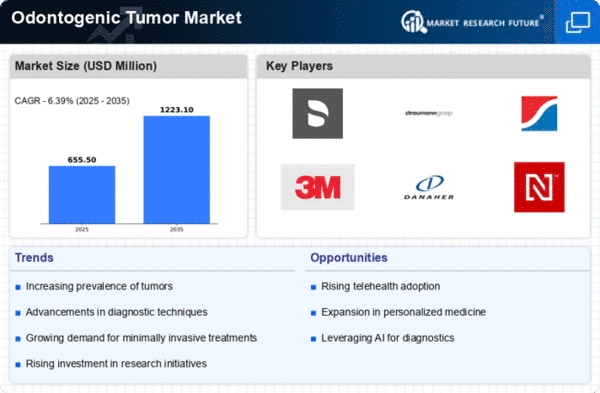
As per MRFR analysis, the Odontogenic Tumor Market Size was estimated at 616.13 USD Million in 2024. The Odontogenic Tumor industry is projected to grow from 662.56 in 2025 to 1223.1 by 2035, exhibiting a compound annual growth rate (CAGR) of 6.39% during the forecast period 2025 - 2035.

Key Market Trends & Highlights

The Odontogenic Tumor Market is poised for growth driven by technological advancements and increasing awareness.

  • Technological advancements in diagnostics are enhancing the detection and treatment of odontogenic tumors in North America.
  • Rising awareness and preventive care initiatives are contributing to market expansion in the Asia-Pacific region.
  • Ameloblastoma remains the largest segment, while odontoma is experiencing the fastest growth in the market.
  • The increasing incidence of odontogenic tumors and advancements in surgical techniques are key drivers of market growth.

Market Size & Forecast

2024 Market Size 616.13 (USD Million)
2035 Market Size 1223.1 (USD Million)
CAGR (2025 - 2035) 6.39%
Largest Regional Market Share in 2024 North America

Major Players

Dentsply Sirona (US), Straumann (CH), Henry Schein (US), 3M (US), Danaher (US), Nobel Biocare (CH), Align Technology (US), GC Corporation (JP), Kavo Kerr (DE)

Market Trends

The Odontogenic Tumor Market is currently experiencing a notable evolution, driven by advancements in diagnostic techniques and treatment modalities. Increased awareness regarding oral health and the significance of early detection has led to a rise in patient consultations. This heightened focus on preventive care appears to be influencing the demand for innovative therapeutic options. Furthermore, the integration of technology in dental practices, such as digital imaging and minimally invasive procedures, seems to enhance the overall patient experience, potentially leading to improved outcomes. As a result, stakeholders in the Odontogenic Tumor Market are likely to invest in research and development to create more effective treatment solutions. In addition, the growing prevalence of odontogenic tumors, coupled with an aging population, suggests a sustained need for specialized dental care. The market landscape is also shaped by collaborations between healthcare providers and research institutions, which may facilitate the development of novel therapies. Moreover, the increasing emphasis on personalized medicine indicates a shift towards tailored treatment approaches, aligning with individual patient needs. Overall, the Odontogenic Tumor Market appears poised for growth, driven by a combination of technological advancements, increased awareness, and evolving patient expectations.

Technological Advancements in Diagnostics

Recent innovations in imaging technologies and diagnostic tools are transforming the Odontogenic Tumor Market. Enhanced imaging techniques, such as cone beam computed tomography, allow for more accurate detection and characterization of tumors, leading to timely interventions. This trend indicates a shift towards precision in diagnosis, which may improve patient outcomes.

Rising Awareness and Preventive Care

There is a growing emphasis on oral health education and preventive measures among the general population. Increased awareness regarding the signs and symptoms of odontogenic tumors is likely to result in earlier diagnosis and treatment. This trend suggests that public health initiatives could play a crucial role in shaping the market.

Personalized Treatment Approaches

The Odontogenic Tumor Market is witnessing a shift towards personalized medicine, where treatment plans are tailored to individual patient profiles. This trend may enhance the effectiveness of therapies and improve patient satisfaction, as healthcare providers increasingly focus on customized care strategies.

Odontogenic Tumor Market Market Drivers

Market Growth Projections

The Global Odontogenic Tumor Market Industry is projected to experience substantial growth over the next decade. With a market value of 0.31 USD Billion in 2024, it is anticipated to reach 1.01 USD Billion by 2035. This growth trajectory suggests a compound annual growth rate of 11.34% from 2025 to 2035. Such projections highlight the increasing demand for diagnostic and therapeutic solutions in the management of odontogenic tumors. Factors contributing to this growth include advancements in technology, rising awareness, and improved treatment options, all of which are likely to shape the future landscape of the market.

Improved Treatment Modalities

The development of improved treatment modalities is a significant factor propelling the Global Odontogenic Tumor Market Industry. Advances in surgical techniques, radiation therapy, and targeted therapies have enhanced the management of odontogenic tumors. For example, minimally invasive surgical approaches have reduced recovery times and improved patient outcomes. Furthermore, the introduction of novel pharmacological agents offers new avenues for treatment. As these modalities become more widely adopted, the market is poised for growth, with projections indicating a potential market size of 1.01 USD Billion by 2035, reflecting the increasing demand for effective treatment options.

Regulatory Support and Funding

Regulatory support and funding for research and development in the field of odontogenic tumors are crucial for the Global Odontogenic Tumor Market Industry. Government initiatives aimed at promoting research into rare tumors, including odontogenic tumors, provide financial backing and resources for innovation. For instance, grants and funding from health departments encourage studies that explore new treatment options and diagnostic methods. This support not only fosters advancements in the field but also enhances the overall market landscape. As funding continues to grow, the market is likely to benefit from increased research activities and improved patient care.

Rising Awareness and Education

The growing awareness and education regarding odontogenic tumors among healthcare professionals and the general public are pivotal for the Global Odontogenic Tumor Market Industry. Educational initiatives and campaigns aimed at improving knowledge about these tumors lead to earlier diagnosis and treatment. For instance, dental associations are increasingly incorporating odontogenic tumor education into their training programs. This heightened awareness is likely to result in increased patient referrals for diagnosis and treatment, thereby driving market growth. As the understanding of these tumors expands, the market could experience a compound annual growth rate of 11.34% from 2025 to 2035.

Advancements in Diagnostic Techniques

Technological advancements in diagnostic techniques are significantly influencing the Global Odontogenic Tumor Market Industry. Innovations such as digital imaging, 3D imaging, and molecular diagnostics enhance the accuracy of tumor detection and characterization. These advancements not only facilitate early diagnosis but also improve treatment outcomes. For example, the integration of artificial intelligence in radiographic analysis has shown promise in identifying odontogenic tumors more effectively. As these technologies become more accessible, the market is expected to grow, potentially reaching a valuation of 1.01 USD Billion by 2035, driven by increased demand for precise diagnostic tools.

Increasing Incidence of Odontogenic Tumors

The rising incidence of odontogenic tumors globally is a primary driver for the Global Odontogenic Tumor Market Industry. Factors such as genetic predisposition and environmental influences contribute to this increase. For instance, studies indicate that odontogenic tumors account for approximately 10% of all jaw tumors, with a notable prevalence in certain populations. This growing incidence is expected to propel market growth, with projections estimating the market value to reach 0.31 USD Billion in 2024. As awareness of these tumors increases, the demand for diagnostic and therapeutic options is likely to rise, further stimulating market expansion.

Market Segment Insights

By Type of Odontogenic Tumor: Ameloblastoma (Largest) vs. Odontoma (Fastest-Growing)

The Odontogenic Tumor Market displays a diverse distribution among its key segments: Ameloblastoma, Odontoma, Adenomatoid Odontogenic Tumor, Calcifying Odontogenic Cyst, and Cementoblastoma. Ameloblastoma holds a significant share, making it the largest segment within this market due to its frequency and prevalence in patients. Conversely, Odontoma has emerged as the fastest-growing segment, attributed to an increasing awareness of dental health and advancements in diagnostic technologies, which facilitate early detection and treatment options for this benign tumor.

Ameloblastoma (Dominant) vs. Odontoma (Emerging)

Ameloblastoma, as the dominant segment in the Odontogenic Tumor Market, is characterized by its aggressive nature, slow growth, and high recurrence rates after treatment. Its recognition stems from its prevalence in jaw lesions, particularly among young adults. In contrast, Odontoma, the emerging segment, is recognized for its benign characteristics and is composed of both enamel and dentin. Its increasing incidence can be linked to greater healthcare accessibility and improved awareness regarding odontogenic tumors. Both segments reflect the evolving landscape of dental pathology, with Ameloblastoma often necessitating complex surgical interventions, while Odontoma tends to require less aggressive management.

By Diagnosis Method: Radiographic Examination (Largest) vs. Genetic Testing (Fastest-Growing)

<p>In the Odontogenic Tumor Market, the 'By Diagnosis Method' segment showcases a diverse landscape where Radiographic Examination holds the largest market share, emphasizing its conventional and critical role in the identification of odontogenic tumors. Following behind, Histopathological Analysis and Clinical Examination contribute significantly to the diagnostic mix, illustrating the importance of traditional methods in tumor evaluation. <a href="https://www.marketresearchfuture.com/reports/immunohistochemistry-market-21474" target="_blank" title="immunohistochemistry">Immunohistochemistry</a> and Genetic Testing, while smaller in share, are gaining traction and changing the dynamics of the market.</p>

<p>Diagnosis Method: Radiographic Examination (Dominant) vs. Genetic Testing (Emerging)</p>

<p>Radiographic Examination remains the dominant method in diagnosing odontogenic tumors due to its accessibility, ease of use, and clear visualization of the tumor's location and extent. It is widely adopted by dental practitioners and specialists alike, cementing its place as the foundational approach in initial assessments. On the other hand, Genetic Testing is emerging rapidly as a novel approach, providing critical insights into tumor biology and genetic predispositions. This method is particularly valuable in complex cases and offers a tailored approach in treatment planning, positioning it as a key player in future diagnostic strategies.</p>

By Treatment Approach: Surgical Resection (Largest) vs. Chemotherapy (Fastest-Growing)

<p>The Odontogenic Tumor Market's treatment approach segment reveals a varied landscape with Surgical Resection leading as the dominant method due to its curative nature and clear therapeutic benefits. Following Surgical Resection, Combination Therapy and Radiation Therapy are noteworthy alternatives, capturing significant market share as they offer tailored treatments based on tumor types and patient profile. Observation is also present for specific cases, though it holds a smaller share, primarily as a strategy for low-risk tumors. The growth trends within this segment are heavily influenced by advancements in surgical techniques and the increasing adoption of minimally invasive procedures. <a href="https://www.marketresearchfuture.com/reports/chemotherapy-market-5791" target="_blank" title="chemotherapy">Chemotherapy</a> is emerging rapidly as a complementary treatment, fueled by pharmaceutical innovations and the rising incidence of odontogenic tumors. Increased awareness and early diagnosis are further driving the market, especially for Combination Therapy, which is gaining traction as practitioners look for more holistic treatment options in the evolving healthcare landscape.</p>

<p>Surgical Resection (Dominant) vs. Combination Therapy (Emerging)</p>

<p>Surgical Resection stands firm as the dominant treatment approach within the Odontogenic Tumor Market, known for its efficacy in removing tumors while minimizing recurrence risks. This method remains the primary choice due to its direct curative intent and established protocols. In contrast, Combination Therapy is gaining ground as an emerging approach, integrating various modalities such as chemotherapy and radiation, particularly for aggressive tumors or complex cases. This strategy allows healthcare providers to customize treatments based on individual patient needs, leveraging the strengths of each modality to enhance overall effectiveness. Consequently, Combination Therapy is becoming increasingly popular among oncologists, driven by the growing need for personalized medicine.</p>

By Patient Demographics: Age Group (Largest) vs. Gender (Fastest-Growing)

<p>In the Odontogenic Tumor Market, the distribution of patient demographics reveals that age group segments hold a significant share, with a large proportion of cases arising among adults aged 30 to 50 years. This age group accounts for the majority of diagnosed odontogenic tumors, reflecting a trend towards increased awareness and diagnosis in middle-aged populations. On the other hand, gender demographics also play a crucial role, with a notable rise in awareness and diagnosis among females, marking a potential growth area for healthcare providers and researchers.</p>

<p>Age Group: 30-50 Years (Dominant) vs. Gender: Female (Emerging)</p>

<p>The age group of 30 to 50 years stands out as the dominant demographic in the odontogenic tumor market. This segment is characterized by a higher incidence of diagnosed cases, likely due to both biological factors and increased healthcare access, leading to better awareness of oral health issues. Meanwhile, the emerging demographic of females indicates a shift in diagnosis trends, as studies show that women are now more likely to seek dental care and screening. This emerging trend suggests a potential growth area for targeted marketing and treatment strategies tailored to female patients.</p>

Get more detailed insights about Odontogenic Tumor Market Research Report – Forecast to 2035

Regional Insights

North America : Market Leader in Innovation

North America is poised to maintain its leadership in the Odontogenic Tumor market, holding a significant market share of $350.0M in 2025. The region's growth is driven by advanced healthcare infrastructure, increasing awareness of dental health, and a rising prevalence of odontogenic tumors. Regulatory support and innovation in treatment options further catalyze market expansion, making it a hub for research and development in dental oncology. The competitive landscape in North America is robust, featuring key players such as Dentsply Sirona, Henry Schein, and 3M. These companies are at the forefront of technological advancements and product offerings, ensuring a diverse range of solutions for odontogenic tumors. The U.S. remains the leading country, supported by a strong emphasis on dental research and a well-established healthcare system, which collectively enhance market dynamics.

Europe : Emerging Market with Growth Potential

Europe is witnessing a growing interest in the Odontogenic Tumor market, with a market size of $150.0M projected for 2025. Factors such as an aging population, increased dental care awareness, and advancements in treatment technologies are driving demand. Regulatory frameworks across EU countries are becoming more supportive, facilitating innovation and improving patient access to cutting-edge treatments, which is crucial for market growth. Leading countries in Europe include Germany, France, and the UK, where key players like Straumann and Nobel Biocare are making significant contributions. The competitive landscape is characterized by a mix of established companies and emerging startups, fostering innovation. The European market is expected to benefit from collaborative research initiatives and partnerships, enhancing the overall treatment landscape for odontogenic tumors.

Asia-Pacific : Rapidly Growing Market Dynamics

The Asia-Pacific region is emerging as a significant player in the Odontogenic Tumor market, with a projected size of $100.0M by 2025. The growth is fueled by increasing urbanization, rising disposable incomes, and a growing awareness of dental health. Additionally, government initiatives aimed at improving healthcare access and quality are acting as catalysts for market expansion, making it a promising area for investment and development. Countries like Japan, China, and India are leading the charge, with a competitive landscape that includes both local and international players such as GC Corporation and Kavo Kerr. The region's market is characterized by a mix of traditional practices and modern technologies, creating a unique environment for innovation. As healthcare systems evolve, the demand for advanced treatment options for odontogenic tumors is expected to rise significantly, further driving market growth.

Middle East and Africa : Emerging Market with Challenges

The Middle East and Africa region is gradually developing its Odontogenic Tumor market, with a size of $16.13M anticipated by 2025. The growth is primarily driven by increasing healthcare investments, rising awareness of dental health, and a growing population. However, challenges such as limited access to advanced healthcare facilities and varying regulatory environments can hinder market progress. Efforts to improve healthcare infrastructure are essential for unlocking the region's full potential. Countries like South Africa and the UAE are at the forefront of this emerging market, with local players beginning to establish a presence. The competitive landscape is still developing, but there is a growing interest from international companies looking to enter the market. As healthcare systems improve and awareness increases, the demand for effective treatments for odontogenic tumors is expected to rise, paving the way for future growth.

Key Players and Competitive Insights

The Odontogenic Tumor Market is characterized by a competitive landscape that is increasingly shaped by innovation, strategic partnerships, and regional expansions. Key players such as Dentsply Sirona (US), Straumann (CH), and Align Technology (US) are actively pursuing strategies that emphasize technological advancements and market penetration. Dentsply Sirona (US) focuses on enhancing its product portfolio through continuous innovation, while Straumann (CH) is known for its strategic acquisitions aimed at expanding its market share. Align Technology (US) leverages digital transformation to improve patient outcomes, indicating a collective shift towards integrating advanced technologies in treatment methodologies.The market structure appears moderately fragmented, with several players vying for dominance. Companies are increasingly localizing manufacturing and optimizing supply chains to enhance operational efficiency. This trend not only reduces costs but also allows for quicker response times to market demands. The collective influence of these key players is significant, as they drive competition through differentiated offerings and strategic positioning.

In November Dentsply Sirona (US) announced a partnership with a leading AI firm to develop predictive analytics tools for treatment planning. This strategic move is likely to enhance the precision of odontogenic tumor treatments, thereby improving patient outcomes and solidifying Dentsply Sirona's position as a leader in innovation. The integration of AI into treatment protocols may also set a new standard in the industry, compelling competitors to follow suit.

In October Straumann (CH) completed the acquisition of a regional dental technology company, which is expected to bolster its product offerings in the odontogenic tumor segment. This acquisition not only expands Straumann's technological capabilities but also enhances its market presence in key regions. Such strategic maneuvers suggest a trend towards consolidation in the market, as companies seek to leverage synergies and broaden their reach.

In September Align Technology (US) launched a new digital platform aimed at streamlining the treatment process for odontogenic tumors. This platform integrates advanced imaging and treatment planning tools, which could significantly improve the efficiency of care delivery. The launch reflects Align's commitment to digitalization and its potential to reshape patient experiences in the market.

As of December the competitive trends in the Odontogenic Tumor Market are increasingly defined by digitalization, sustainability, and the integration of AI technologies. Strategic alliances are becoming more prevalent, as companies recognize the value of collaboration in enhancing their competitive edge. Looking ahead, it appears that competitive differentiation will evolve from traditional price-based strategies to a focus on innovation, technological advancements, and supply chain reliability, thereby reshaping the market landscape.

Key Companies in the Odontogenic Tumor Market include

Industry Developments

Future Outlook

Odontogenic Tumor Market Future Outlook

The Odontogenic Tumor Market is projected to grow at a 6.39% CAGR from 2025 to 2035, driven by advancements in diagnostic technologies, increasing awareness, and rising healthcare expenditures.

New opportunities lie in:

  • Development of targeted therapies for specific odontogenic tumors.
  • Expansion of telemedicine platforms for remote consultations and follow-ups.
  • Investment in AI-driven diagnostic tools to enhance early detection capabilities.

By 2035, the Odontogenic Tumor Market is expected to achieve substantial growth and innovation.

Market Segmentation

Odontogenic Tumor Market Age Group Outlook

  • Pediatric
  • Adolescent
  • Adult
  • Geriatric

Odontogenic Tumor Market Diagnosis Method Outlook

  • Radiographic Examination
  • Histopathological Analysis
  • Clinical Examination
  • Immunohistochemistry
  • Genetic Testing

Odontogenic Tumor Market Treatment Approach Outlook

  • Surgical Resection
  • Chemotherapy
  • Radiation Therapy
  • Observation
  • Combination Therapy

Odontogenic Tumor Market Type of Odontogenic Tumor Outlook

  • Ameloblastoma
  • Odontoma
  • Adenomatoid Odontogenic Tumor
  • Calcifying Odontogenic Cyst
  • Cementoblastoma

Report Scope

MARKET SIZE 2024 616.13(USD Million)
MARKET SIZE 2025 662.56(USD Million)
MARKET SIZE 2035 1223.1(USD Million)
COMPOUND ANNUAL GROWTH RATE (CAGR) 6.39% (2025 - 2035)
REPORT COVERAGE Revenue Forecast, Competitive Landscape, Growth Factors, and Trends
BASE YEAR 2024
Market Forecast Period 2025 - 2035
Historical Data 2019 - 2024
Market Forecast Units USD Million
Key Companies Profiled Dentsply Sirona (US), Straumann (CH), Henry Schein (US), 3M (US), Danaher (US), Nobel Biocare (CH), Align Technology (US), GC Corporation (JP), Kavo Kerr (DE)
Segments Covered Type of Odontogenic Tumor, Diagnosis Method, Treatment Approach, Age Group
Key Market Opportunities Advancements in minimally invasive surgical techniques enhance treatment options in the Odontogenic Tumor Market.
Key Market Dynamics Rising demand for minimally invasive treatments drives innovation and competition in the odontogenic tumor market.
Countries Covered North America, Europe, APAC, South America, MEA

FAQs

What is the current valuation of the Odontogenic Tumor Market?

<p>The Odontogenic Tumor Market was valued at 616.13 USD Million in 2024.</p>

What is the projected market size for the Odontogenic Tumor Market by 2035?

<p>The market is projected to reach 1223.1 USD Million by 2035.</p>

What is the expected CAGR for the Odontogenic Tumor Market during the forecast period?

<p>The expected CAGR for the Odontogenic Tumor Market from 2025 to 2035 is 6.39%.</p>

Which companies are considered key players in the Odontogenic Tumor Market?

<p>Key players include Dentsply Sirona, Straumann, Henry Schein, 3M, Danaher, Nobel Biocare, Align Technology, GC Corporation, and Kavo Kerr.</p>

What are the main types of odontogenic tumors and their market values?

<p>Ameloblastoma, Odontoma, Adenomatoid Odontogenic Tumor, Calcifying Odontogenic Cyst, and Cementoblastoma have market values ranging from 34.37 to 245.0 USD Million.</p>

What diagnostic methods are utilized in the Odontogenic Tumor Market?

Diagnostic methods include Radiographic Examination, Histopathological Analysis, Clinical Examination, Immunohistochemistry, and Genetic Testing, with values from 80.0 to 323.1 USD Million.

What treatment approaches are available for odontogenic tumors?

Treatment approaches encompass Surgical Resection, Chemotherapy, Radiation Therapy, Observation, and Combination Therapy, with market values from 30.0 to 603.1 USD Million.

How do patient demographics influence the Odontogenic Tumor Market?

Patient demographics, including Age Group, Gender, Socioeconomic Status, Geographic Location, and Ethnicity, have market values ranging from 80.0 to 323.1 USD Million.

What segment is expected to show the highest growth in the Odontogenic Tumor Market?

The Combination Therapy segment is likely to show the highest growth, with a projected value of 603.1 USD Million by 2035.

How does the Odontogenic Tumor Market compare to other dental markets?

While specific comparisons are complex, the Odontogenic Tumor Market's growth trajectory appears promising, particularly with a projected valuation increase to 1223.1 USD Million by 2035.

  1. SECTION I: EXECUTIVE SUMMARY AND KEY HIGHLIGHTS
    1. | 1.1 EXECUTIVE SUMMARY
    2. | | 1.1.1 Market Overview
    3. | | 1.1.2 Key Findings
    4. | | 1.1.3 Market Segmentation
    5. | | 1.1.4 Competitive Landscape
    6. | | 1.1.5 Challenges and Opportunities
    7. | | 1.1.6 Future Outlook
  2. SECTION II: SCOPING, METHODOLOGY AND MARKET STRUCTURE
    1. | 2.1 MARKET INTRODUCTION
    2. | | 2.1.1 Definition
    3. | | 2.1.2 Scope of the study
    4. | | | 2.1.2.1 Research Objective
    5. | | | 2.1.2.2 Assumption
    6. | | | 2.1.2.3 Limitations
    7. | 2.2 RESEARCH METHODOLOGY
    8. | | 2.2.1 Overview
    9. | | 2.2.2 Data Mining
    10. | | 2.2.3 Secondary Research
    11. | | 2.2.4 Primary Research
    12. | | | 2.2.4.1 Primary Interviews and Information Gathering Process
    13. | | | 2.2.4.2 Breakdown of Primary Respondents
    14. | | 2.2.5 Forecasting Model
    15. | | 2.2.6 Market Size Estimation
    16. | | | 2.2.6.1 Bottom-Up Approach
    17. | | | 2.2.6.2 Top-Down Approach
    18. | | 2.2.7 Data Triangulation
    19. | | 2.2.8 Validation
  3. SECTION III: QUALITATIVE ANALYSIS
    1. | 3.1 MARKET DYNAMICS
    2. | | 3.1.1 Overview
    3. | | 3.1.2 Drivers
    4. | | 3.1.3 Restraints
    5. | | 3.1.4 Opportunities
    6. | 3.2 MARKET FACTOR ANALYSIS
    7. | | 3.2.1 Value chain Analysis
    8. | | 3.2.2 Porter's Five Forces Analysis
    9. | | | 3.2.2.1 Bargaining Power of Suppliers
    10. | | | 3.2.2.2 Bargaining Power of Buyers
    11. | | | 3.2.2.3 Threat of New Entrants
    12. | | | 3.2.2.4 Threat of Substitutes
    13. | | | 3.2.2.5 Intensity of Rivalry
    14. | | 3.2.3 COVID-19 Impact Analysis
    15. | | | 3.2.3.1 Market Impact Analysis
    16. | | | 3.2.3.2 Regional Impact
    17. | | | 3.2.3.3 Opportunity and Threat Analysis
  4. SECTION IV: QUANTITATIVE ANALYSIS
    1. | 4.1 Healthcare, BY Type of Odontogenic Tumor (USD Million)
    2. | | 4.1.1 Ameloblastoma
    3. | | 4.1.2 Odontoma
    4. | | 4.1.3 Adenomatoid Odontogenic Tumor
    5. | | 4.1.4 Calcifying Odontogenic Cyst
    6. | | 4.1.5 Cementoblastoma
    7. | 4.2 Healthcare, BY Diagnosis Method (USD Million)
    8. | | 4.2.1 Radiographic Examination
    9. | | 4.2.2 Histopathological Analysis
    10. | | 4.2.3 Clinical Examination
    11. | | 4.2.4 Immunohistochemistry
    12. | | 4.2.5 Genetic Testing
    13. | 4.3 Healthcare, BY Treatment Approach (USD Million)
    14. | | 4.3.1 Surgical Resection
    15. | | 4.3.2 Chemotherapy
    16. | | 4.3.3 Radiation Therapy
    17. | | 4.3.4 Observation
    18. | | 4.3.5 Combination Therapy
    19. | 4.4 Healthcare, BY Patient Demographics (USD Million)
    20. | | 4.4.1 Age Group
    21. | | 4.4.2 Gender
    22. | | 4.4.3 Socioeconomic Status
    23. | | 4.4.4 Geographic Location
    24. | | 4.4.5 Ethnicity
    25. | 4.5 Healthcare, BY Region (USD Million)
    26. | | 4.5.1 North America
    27. | | | 4.5.1.1 US
    28. | | | 4.5.1.2 Canada
    29. | | 4.5.2 Europe
    30. | | | 4.5.2.1 Germany
    31. | | | 4.5.2.2 UK
    32. | | | 4.5.2.3 France
    33. | | | 4.5.2.4 Russia
    34. | | | 4.5.2.5 Italy
    35. | | | 4.5.2.6 Spain
    36. | | | 4.5.2.7 Rest of Europe
    37. | | 4.5.3 APAC
    38. | | | 4.5.3.1 China
    39. | | | 4.5.3.2 India
    40. | | | 4.5.3.3 Japan
    41. | | | 4.5.3.4 South Korea
    42. | | | 4.5.3.5 Malaysia
    43. | | | 4.5.3.6 Thailand
    44. | | | 4.5.3.7 Indonesia
    45. | | | 4.5.3.8 Rest of APAC
    46. | | 4.5.4 South America
    47. | | | 4.5.4.1 Brazil
    48. | | | 4.5.4.2 Mexico
    49. | | | 4.5.4.3 Argentina
    50. | | | 4.5.4.4 Rest of South America
    51. | | 4.5.5 MEA
    52. | | | 4.5.5.1 GCC Countries
    53. | | | 4.5.5.2 South Africa
    54. | | | 4.5.5.3 Rest of MEA
  5. SECTION V: COMPETITIVE ANALYSIS
    1. | 5.1 Competitive Landscape
    2. | | 5.1.1 Overview
    3. | | 5.1.2 Competitive Analysis
    4. | | 5.1.3 Market share Analysis
    5. | | 5.1.4 Major Growth Strategy in the Healthcare
    6. | | 5.1.5 Competitive Benchmarking
    7. | | 5.1.6 Leading Players in Terms of Number of Developments in the Healthcare
    8. | | 5.1.7 Key developments and growth strategies
    9. | | | 5.1.7.1 New Product Launch/Service Deployment
    10. | | | 5.1.7.2 Merger & Acquisitions
    11. | | | 5.1.7.3 Joint Ventures
    12. | | 5.1.8 Major Players Financial Matrix
    13. | | | 5.1.8.1 Sales and Operating Income
    14. | | | 5.1.8.2 Major Players R&D Expenditure. 2023
    15. | 5.2 Company Profiles
    16. | | 5.2.1 Dentsply Sirona (US)
    17. | | | 5.2.1.1 Financial Overview
    18. | | | 5.2.1.2 Products Offered
    19. | | | 5.2.1.3 Key Developments
    20. | | | 5.2.1.4 SWOT Analysis
    21. | | | 5.2.1.5 Key Strategies
    22. | | 5.2.2 Straumann (CH)
    23. | | | 5.2.2.1 Financial Overview
    24. | | | 5.2.2.2 Products Offered
    25. | | | 5.2.2.3 Key Developments
    26. | | | 5.2.2.4 SWOT Analysis
    27. | | | 5.2.2.5 Key Strategies
    28. | | 5.2.3 Henry Schein (US)
    29. | | | 5.2.3.1 Financial Overview
    30. | | | 5.2.3.2 Products Offered
    31. | | | 5.2.3.3 Key Developments
    32. | | | 5.2.3.4 SWOT Analysis
    33. | | | 5.2.3.5 Key Strategies
    34. | | 5.2.4 3M (US)
    35. | | | 5.2.4.1 Financial Overview
    36. | | | 5.2.4.2 Products Offered
    37. | | | 5.2.4.3 Key Developments
    38. | | | 5.2.4.4 SWOT Analysis
    39. | | | 5.2.4.5 Key Strategies
    40. | | 5.2.5 Danaher (US)
    41. | | | 5.2.5.1 Financial Overview
    42. | | | 5.2.5.2 Products Offered
    43. | | | 5.2.5.3 Key Developments
    44. | | | 5.2.5.4 SWOT Analysis
    45. | | | 5.2.5.5 Key Strategies
    46. | | 5.2.6 Nobel Biocare (CH)
    47. | | | 5.2.6.1 Financial Overview
    48. | | | 5.2.6.2 Products Offered
    49. | | | 5.2.6.3 Key Developments
    50. | | | 5.2.6.4 SWOT Analysis
    51. | | | 5.2.6.5 Key Strategies
    52. | | 5.2.7 Align Technology (US)
    53. | | | 5.2.7.1 Financial Overview
    54. | | | 5.2.7.2 Products Offered
    55. | | | 5.2.7.3 Key Developments
    56. | | | 5.2.7.4 SWOT Analysis
    57. | | | 5.2.7.5 Key Strategies
    58. | | 5.2.8 GC Corporation (JP)
    59. | | | 5.2.8.1 Financial Overview
    60. | | | 5.2.8.2 Products Offered
    61. | | | 5.2.8.3 Key Developments
    62. | | | 5.2.8.4 SWOT Analysis
    63. | | | 5.2.8.5 Key Strategies
    64. | | 5.2.9 Kavo Kerr (DE)
    65. | | | 5.2.9.1 Financial Overview
    66. | | | 5.2.9.2 Products Offered
    67. | | | 5.2.9.3 Key Developments
    68. | | | 5.2.9.4 SWOT Analysis
    69. | | | 5.2.9.5 Key Strategies
    70. | 5.3 Appendix
    71. | | 5.3.1 References
    72. | | 5.3.2 Related Reports
  6. LIST OF FIGURES
    1. | 6.1 MARKET SYNOPSIS
    2. | 6.2 NORTH AMERICA MARKET ANALYSIS
    3. | 6.3 US MARKET ANALYSIS BY TYPE OF ODONTOGENIC TUMOR
    4. | 6.4 US MARKET ANALYSIS BY DIAGNOSIS METHOD
    5. | 6.5 US MARKET ANALYSIS BY TREATMENT APPROACH
    6. | 6.6 US MARKET ANALYSIS BY PATIENT DEMOGRAPHICS
    7. | 6.7 CANADA MARKET ANALYSIS BY TYPE OF ODONTOGENIC TUMOR
    8. | 6.8 CANADA MARKET ANALYSIS BY DIAGNOSIS METHOD
    9. | 6.9 CANADA MARKET ANALYSIS BY TREATMENT APPROACH
    10. | 6.10 CANADA MARKET ANALYSIS BY PATIENT DEMOGRAPHICS
    11. | 6.11 EUROPE MARKET ANALYSIS
    12. | 6.12 GERMANY MARKET ANALYSIS BY TYPE OF ODONTOGENIC TUMOR
    13. | 6.13 GERMANY MARKET ANALYSIS BY DIAGNOSIS METHOD
    14. | 6.14 GERMANY MARKET ANALYSIS BY TREATMENT APPROACH
    15. | 6.15 GERMANY MARKET ANALYSIS BY PATIENT DEMOGRAPHICS
    16. | 6.16 UK MARKET ANALYSIS BY TYPE OF ODONTOGENIC TUMOR
    17. | 6.17 UK MARKET ANALYSIS BY DIAGNOSIS METHOD
    18. | 6.18 UK MARKET ANALYSIS BY TREATMENT APPROACH
    19. | 6.19 UK MARKET ANALYSIS BY PATIENT DEMOGRAPHICS
    20. | 6.20 FRANCE MARKET ANALYSIS BY TYPE OF ODONTOGENIC TUMOR
    21. | 6.21 FRANCE MARKET ANALYSIS BY DIAGNOSIS METHOD
    22. | 6.22 FRANCE MARKET ANALYSIS BY TREATMENT APPROACH
    23. | 6.23 FRANCE MARKET ANALYSIS BY PATIENT DEMOGRAPHICS
    24. | 6.24 RUSSIA MARKET ANALYSIS BY TYPE OF ODONTOGENIC TUMOR
    25. | 6.25 RUSSIA MARKET ANALYSIS BY DIAGNOSIS METHOD
    26. | 6.26 RUSSIA MARKET ANALYSIS BY TREATMENT APPROACH
    27. | 6.27 RUSSIA MARKET ANALYSIS BY PATIENT DEMOGRAPHICS
    28. | 6.28 ITALY MARKET ANALYSIS BY TYPE OF ODONTOGENIC TUMOR
    29. | 6.29 ITALY MARKET ANALYSIS BY DIAGNOSIS METHOD
    30. | 6.30 ITALY MARKET ANALYSIS BY TREATMENT APPROACH
    31. | 6.31 ITALY MARKET ANALYSIS BY PATIENT DEMOGRAPHICS
    32. | 6.32 SPAIN MARKET ANALYSIS BY TYPE OF ODONTOGENIC TUMOR
    33. | 6.33 SPAIN MARKET ANALYSIS BY DIAGNOSIS METHOD
    34. | 6.34 SPAIN MARKET ANALYSIS BY TREATMENT APPROACH
    35. | 6.35 SPAIN MARKET ANALYSIS BY PATIENT DEMOGRAPHICS
    36. | 6.36 REST OF EUROPE MARKET ANALYSIS BY TYPE OF ODONTOGENIC TUMOR
    37. | 6.37 REST OF EUROPE MARKET ANALYSIS BY DIAGNOSIS METHOD
    38. | 6.38 REST OF EUROPE MARKET ANALYSIS BY TREATMENT APPROACH
    39. | 6.39 REST OF EUROPE MARKET ANALYSIS BY PATIENT DEMOGRAPHICS
    40. | 6.40 APAC MARKET ANALYSIS
    41. | 6.41 CHINA MARKET ANALYSIS BY TYPE OF ODONTOGENIC TUMOR
    42. | 6.42 CHINA MARKET ANALYSIS BY DIAGNOSIS METHOD
    43. | 6.43 CHINA MARKET ANALYSIS BY TREATMENT APPROACH
    44. | 6.44 CHINA MARKET ANALYSIS BY PATIENT DEMOGRAPHICS
    45. | 6.45 INDIA MARKET ANALYSIS BY TYPE OF ODONTOGENIC TUMOR
    46. | 6.46 INDIA MARKET ANALYSIS BY DIAGNOSIS METHOD
    47. | 6.47 INDIA MARKET ANALYSIS BY TREATMENT APPROACH
    48. | 6.48 INDIA MARKET ANALYSIS BY PATIENT DEMOGRAPHICS
    49. | 6.49 JAPAN MARKET ANALYSIS BY TYPE OF ODONTOGENIC TUMOR
    50. | 6.50 JAPAN MARKET ANALYSIS BY DIAGNOSIS METHOD
    51. | 6.51 JAPAN MARKET ANALYSIS BY TREATMENT APPROACH
    52. | 6.52 JAPAN MARKET ANALYSIS BY PATIENT DEMOGRAPHICS
    53. | 6.53 SOUTH KOREA MARKET ANALYSIS BY TYPE OF ODONTOGENIC TUMOR
    54. | 6.54 SOUTH KOREA MARKET ANALYSIS BY DIAGNOSIS METHOD
    55. | 6.55 SOUTH KOREA MARKET ANALYSIS BY TREATMENT APPROACH
    56. | 6.56 SOUTH KOREA MARKET ANALYSIS BY PATIENT DEMOGRAPHICS
    57. | 6.57 MALAYSIA MARKET ANALYSIS BY TYPE OF ODONTOGENIC TUMOR
    58. | 6.58 MALAYSIA MARKET ANALYSIS BY DIAGNOSIS METHOD
    59. | 6.59 MALAYSIA MARKET ANALYSIS BY TREATMENT APPROACH
    60. | 6.60 MALAYSIA MARKET ANALYSIS BY PATIENT DEMOGRAPHICS
    61. | 6.61 THAILAND MARKET ANALYSIS BY TYPE OF ODONTOGENIC TUMOR
    62. | 6.62 THAILAND MARKET ANALYSIS BY DIAGNOSIS METHOD
    63. | 6.63 THAILAND MARKET ANALYSIS BY TREATMENT APPROACH
    64. | 6.64 THAILAND MARKET ANALYSIS BY PATIENT DEMOGRAPHICS
    65. | 6.65 INDONESIA MARKET ANALYSIS BY TYPE OF ODONTOGENIC TUMOR
    66. | 6.66 INDONESIA MARKET ANALYSIS BY DIAGNOSIS METHOD
    67. | 6.67 INDONESIA MARKET ANALYSIS BY TREATMENT APPROACH
    68. | 6.68 INDONESIA MARKET ANALYSIS BY PATIENT DEMOGRAPHICS
    69. | 6.69 REST OF APAC MARKET ANALYSIS BY TYPE OF ODONTOGENIC TUMOR
    70. | 6.70 REST OF APAC MARKET ANALYSIS BY DIAGNOSIS METHOD
    71. | 6.71 REST OF APAC MARKET ANALYSIS BY TREATMENT APPROACH
    72. | 6.72 REST OF APAC MARKET ANALYSIS BY PATIENT DEMOGRAPHICS
    73. | 6.73 SOUTH AMERICA MARKET ANALYSIS
    74. | 6.74 BRAZIL MARKET ANALYSIS BY TYPE OF ODONTOGENIC TUMOR
    75. | 6.75 BRAZIL MARKET ANALYSIS BY DIAGNOSIS METHOD
    76. | 6.76 BRAZIL MARKET ANALYSIS BY TREATMENT APPROACH
    77. | 6.77 BRAZIL MARKET ANALYSIS BY PATIENT DEMOGRAPHICS
    78. | 6.78 MEXICO MARKET ANALYSIS BY TYPE OF ODONTOGENIC TUMOR
    79. | 6.79 MEXICO MARKET ANALYSIS BY DIAGNOSIS METHOD
    80. | 6.80 MEXICO MARKET ANALYSIS BY TREATMENT APPROACH
    81. | 6.81 MEXICO MARKET ANALYSIS BY PATIENT DEMOGRAPHICS
    82. | 6.82 ARGENTINA MARKET ANALYSIS BY TYPE OF ODONTOGENIC TUMOR
    83. | 6.83 ARGENTINA MARKET ANALYSIS BY DIAGNOSIS METHOD
    84. | 6.84 ARGENTINA MARKET ANALYSIS BY TREATMENT APPROACH
    85. | 6.85 ARGENTINA MARKET ANALYSIS BY PATIENT DEMOGRAPHICS
    86. | 6.86 REST OF SOUTH AMERICA MARKET ANALYSIS BY TYPE OF ODONTOGENIC TUMOR
    87. | 6.87 REST OF SOUTH AMERICA MARKET ANALYSIS BY DIAGNOSIS METHOD
    88. | 6.88 REST OF SOUTH AMERICA MARKET ANALYSIS BY TREATMENT APPROACH
    89. | 6.89 REST OF SOUTH AMERICA MARKET ANALYSIS BY PATIENT DEMOGRAPHICS
    90. | 6.90 MEA MARKET ANALYSIS
    91. | 6.91 GCC COUNTRIES MARKET ANALYSIS BY TYPE OF ODONTOGENIC TUMOR
    92. | 6.92 GCC COUNTRIES MARKET ANALYSIS BY DIAGNOSIS METHOD
    93. | 6.93 GCC COUNTRIES MARKET ANALYSIS BY TREATMENT APPROACH
    94. | 6.94 GCC COUNTRIES MARKET ANALYSIS BY PATIENT DEMOGRAPHICS
    95. | 6.95 SOUTH AFRICA MARKET ANALYSIS BY TYPE OF ODONTOGENIC TUMOR
    96. | 6.96 SOUTH AFRICA MARKET ANALYSIS BY DIAGNOSIS METHOD
    97. | 6.97 SOUTH AFRICA MARKET ANALYSIS BY TREATMENT APPROACH
    98. | 6.98 SOUTH AFRICA MARKET ANALYSIS BY PATIENT DEMOGRAPHICS
    99. | 6.99 REST OF MEA MARKET ANALYSIS BY TYPE OF ODONTOGENIC TUMOR
    100. | 6.100 REST OF MEA MARKET ANALYSIS BY DIAGNOSIS METHOD
    101. | 6.101 REST OF MEA MARKET ANALYSIS BY TREATMENT APPROACH
    102. | 6.102 REST OF MEA MARKET ANALYSIS BY PATIENT DEMOGRAPHICS
    103. | 6.103 KEY BUYING CRITERIA OF HEALTHCARE
    104. | 6.104 RESEARCH PROCESS OF MRFR
    105. | 6.105 DRO ANALYSIS OF HEALTHCARE
    106. | 6.106 DRIVERS IMPACT ANALYSIS: HEALTHCARE
    107. | 6.107 RESTRAINTS IMPACT ANALYSIS: HEALTHCARE
    108. | 6.108 SUPPLY / VALUE CHAIN: HEALTHCARE
    109. | 6.109 HEALTHCARE, BY TYPE OF ODONTOGENIC TUMOR, 2024 (% SHARE)
    110. | 6.110 HEALTHCARE, BY TYPE OF ODONTOGENIC TUMOR, 2024 TO 2035 (USD Million)
    111. | 6.111 HEALTHCARE, BY DIAGNOSIS METHOD, 2024 (% SHARE)
    112. | 6.112 HEALTHCARE, BY DIAGNOSIS METHOD, 2024 TO 2035 (USD Million)
    113. | 6.113 HEALTHCARE, BY TREATMENT APPROACH, 2024 (% SHARE)
    114. | 6.114 HEALTHCARE, BY TREATMENT APPROACH, 2024 TO 2035 (USD Million)
    115. | 6.115 HEALTHCARE, BY PATIENT DEMOGRAPHICS, 2024 (% SHARE)
    116. | 6.116 HEALTHCARE, BY PATIENT DEMOGRAPHICS, 2024 TO 2035 (USD Million)
    117. | 6.117 BENCHMARKING OF MAJOR COMPETITORS
  7. LIST OF TABLES
    1. | 7.1 LIST OF ASSUMPTIONS
    2. | | 7.1.1
    3. | 7.2 North America MARKET SIZE ESTIMATES; FORECAST
    4. | | 7.2.1 BY TYPE OF ODONTOGENIC TUMOR, 2025-2035 (USD Million)
    5. | | 7.2.2 BY DIAGNOSIS METHOD, 2025-2035 (USD Million)
    6. | | 7.2.3 BY TREATMENT APPROACH, 2025-2035 (USD Million)
    7. | | 7.2.4 BY PATIENT DEMOGRAPHICS, 2025-2035 (USD Million)
    8. | 7.3 US MARKET SIZE ESTIMATES; FORECAST
    9. | | 7.3.1 BY TYPE OF ODONTOGENIC TUMOR, 2025-2035 (USD Million)
    10. | | 7.3.2 BY DIAGNOSIS METHOD, 2025-2035 (USD Million)
    11. | | 7.3.3 BY TREATMENT APPROACH, 2025-2035 (USD Million)
    12. | | 7.3.4 BY PATIENT DEMOGRAPHICS, 2025-2035 (USD Million)
    13. | 7.4 Canada MARKET SIZE ESTIMATES; FORECAST
    14. | | 7.4.1 BY TYPE OF ODONTOGENIC TUMOR, 2025-2035 (USD Million)
    15. | | 7.4.2 BY DIAGNOSIS METHOD, 2025-2035 (USD Million)
    16. | | 7.4.3 BY TREATMENT APPROACH, 2025-2035 (USD Million)
    17. | | 7.4.4 BY PATIENT DEMOGRAPHICS, 2025-2035 (USD Million)
    18. | 7.5 Europe MARKET SIZE ESTIMATES; FORECAST
    19. | | 7.5.1 BY TYPE OF ODONTOGENIC TUMOR, 2025-2035 (USD Million)
    20. | | 7.5.2 BY DIAGNOSIS METHOD, 2025-2035 (USD Million)
    21. | | 7.5.3 BY TREATMENT APPROACH, 2025-2035 (USD Million)
    22. | | 7.5.4 BY PATIENT DEMOGRAPHICS, 2025-2035 (USD Million)
    23. | 7.6 Germany MARKET SIZE ESTIMATES; FORECAST
    24. | | 7.6.1 BY TYPE OF ODONTOGENIC TUMOR, 2025-2035 (USD Million)
    25. | | 7.6.2 BY DIAGNOSIS METHOD, 2025-2035 (USD Million)
    26. | | 7.6.3 BY TREATMENT APPROACH, 2025-2035 (USD Million)
    27. | | 7.6.4 BY PATIENT DEMOGRAPHICS, 2025-2035 (USD Million)
    28. | 7.7 UK MARKET SIZE ESTIMATES; FORECAST
    29. | | 7.7.1 BY TYPE OF ODONTOGENIC TUMOR, 2025-2035 (USD Million)
    30. | | 7.7.2 BY DIAGNOSIS METHOD, 2025-2035 (USD Million)
    31. | | 7.7.3 BY TREATMENT APPROACH, 2025-2035 (USD Million)
    32. | | 7.7.4 BY PATIENT DEMOGRAPHICS, 2025-2035 (USD Million)
    33. | 7.8 France MARKET SIZE ESTIMATES; FORECAST
    34. | | 7.8.1 BY TYPE OF ODONTOGENIC TUMOR, 2025-2035 (USD Million)
    35. | | 7.8.2 BY DIAGNOSIS METHOD, 2025-2035 (USD Million)
    36. | | 7.8.3 BY TREATMENT APPROACH, 2025-2035 (USD Million)
    37. | | 7.8.4 BY PATIENT DEMOGRAPHICS, 2025-2035 (USD Million)
    38. | 7.9 Russia MARKET SIZE ESTIMATES; FORECAST
    39. | | 7.9.1 BY TYPE OF ODONTOGENIC TUMOR, 2025-2035 (USD Million)
    40. | | 7.9.2 BY DIAGNOSIS METHOD, 2025-2035 (USD Million)
    41. | | 7.9.3 BY TREATMENT APPROACH, 2025-2035 (USD Million)
    42. | | 7.9.4 BY PATIENT DEMOGRAPHICS, 2025-2035 (USD Million)
    43. | 7.10 Italy MARKET SIZE ESTIMATES; FORECAST
    44. | | 7.10.1 BY TYPE OF ODONTOGENIC TUMOR, 2025-2035 (USD Million)
    45. | | 7.10.2 BY DIAGNOSIS METHOD, 2025-2035 (USD Million)
    46. | | 7.10.3 BY TREATMENT APPROACH, 2025-2035 (USD Million)
    47. | | 7.10.4 BY PATIENT DEMOGRAPHICS, 2025-2035 (USD Million)
    48. | 7.11 Spain MARKET SIZE ESTIMATES; FORECAST
    49. | | 7.11.1 BY TYPE OF ODONTOGENIC TUMOR, 2025-2035 (USD Million)
    50. | | 7.11.2 BY DIAGNOSIS METHOD, 2025-2035 (USD Million)
    51. | | 7.11.3 BY TREATMENT APPROACH, 2025-2035 (USD Million)
    52. | | 7.11.4 BY PATIENT DEMOGRAPHICS, 2025-2035 (USD Million)
    53. | 7.12 Rest of Europe MARKET SIZE ESTIMATES; FORECAST
    54. | | 7.12.1 BY TYPE OF ODONTOGENIC TUMOR, 2025-2035 (USD Million)
    55. | | 7.12.2 BY DIAGNOSIS METHOD, 2025-2035 (USD Million)
    56. | | 7.12.3 BY TREATMENT APPROACH, 2025-2035 (USD Million)
    57. | | 7.12.4 BY PATIENT DEMOGRAPHICS, 2025-2035 (USD Million)
    58. | 7.13 APAC MARKET SIZE ESTIMATES; FORECAST
    59. | | 7.13.1 BY TYPE OF ODONTOGENIC TUMOR, 2025-2035 (USD Million)
    60. | | 7.13.2 BY DIAGNOSIS METHOD, 2025-2035 (USD Million)
    61. | | 7.13.3 BY TREATMENT APPROACH, 2025-2035 (USD Million)
    62. | | 7.13.4 BY PATIENT DEMOGRAPHICS, 2025-2035 (USD Million)
    63. | 7.14 China MARKET SIZE ESTIMATES; FORECAST
    64. | | 7.14.1 BY TYPE OF ODONTOGENIC TUMOR, 2025-2035 (USD Million)
    65. | | 7.14.2 BY DIAGNOSIS METHOD, 2025-2035 (USD Million)
    66. | | 7.14.3 BY TREATMENT APPROACH, 2025-2035 (USD Million)
    67. | | 7.14.4 BY PATIENT DEMOGRAPHICS, 2025-2035 (USD Million)
    68. | 7.15 India MARKET SIZE ESTIMATES; FORECAST
    69. | | 7.15.1 BY TYPE OF ODONTOGENIC TUMOR, 2025-2035 (USD Million)
    70. | | 7.15.2 BY DIAGNOSIS METHOD, 2025-2035 (USD Million)
    71. | | 7.15.3 BY TREATMENT APPROACH, 2025-2035 (USD Million)
    72. | | 7.15.4 BY PATIENT DEMOGRAPHICS, 2025-2035 (USD Million)
    73. | 7.16 Japan MARKET SIZE ESTIMATES; FORECAST
    74. | | 7.16.1 BY TYPE OF ODONTOGENIC TUMOR, 2025-2035 (USD Million)
    75. | | 7.16.2 BY DIAGNOSIS METHOD, 2025-2035 (USD Million)
    76. | | 7.16.3 BY TREATMENT APPROACH, 2025-2035 (USD Million)
    77. | | 7.16.4 BY PATIENT DEMOGRAPHICS, 2025-2035 (USD Million)
    78. | 7.17 South Korea MARKET SIZE ESTIMATES; FORECAST
    79. | | 7.17.1 BY TYPE OF ODONTOGENIC TUMOR, 2025-2035 (USD Million)
    80. | | 7.17.2 BY DIAGNOSIS METHOD, 2025-2035 (USD Million)
    81. | | 7.17.3 BY TREATMENT APPROACH, 2025-2035 (USD Million)
    82. | | 7.17.4 BY PATIENT DEMOGRAPHICS, 2025-2035 (USD Million)
    83. | 7.18 Malaysia MARKET SIZE ESTIMATES; FORECAST
    84. | | 7.18.1 BY TYPE OF ODONTOGENIC TUMOR, 2025-2035 (USD Million)
    85. | | 7.18.2 BY DIAGNOSIS METHOD, 2025-2035 (USD Million)
    86. | | 7.18.3 BY TREATMENT APPROACH, 2025-2035 (USD Million)
    87. | | 7.18.4 BY PATIENT DEMOGRAPHICS, 2025-2035 (USD Million)
    88. | 7.19 Thailand MARKET SIZE ESTIMATES; FORECAST
    89. | | 7.19.1 BY TYPE OF ODONTOGENIC TUMOR, 2025-2035 (USD Million)
    90. | | 7.19.2 BY DIAGNOSIS METHOD, 2025-2035 (USD Million)
    91. | | 7.19.3 BY TREATMENT APPROACH, 2025-2035 (USD Million)
    92. | | 7.19.4 BY PATIENT DEMOGRAPHICS, 2025-2035 (USD Million)
    93. | 7.20 Indonesia MARKET SIZE ESTIMATES; FORECAST
    94. | | 7.20.1 BY TYPE OF ODONTOGENIC TUMOR, 2025-2035 (USD Million)
    95. | | 7.20.2 BY DIAGNOSIS METHOD, 2025-2035 (USD Million)
    96. | | 7.20.3 BY TREATMENT APPROACH, 2025-2035 (USD Million)
    97. | | 7.20.4 BY PATIENT DEMOGRAPHICS, 2025-2035 (USD Million)
    98. | 7.21 Rest of APAC MARKET SIZE ESTIMATES; FORECAST
    99. | | 7.21.1 BY TYPE OF ODONTOGENIC TUMOR, 2025-2035 (USD Million)
    100. | | 7.21.2 BY DIAGNOSIS METHOD, 2025-2035 (USD Million)
    101. | | 7.21.3 BY TREATMENT APPROACH, 2025-2035 (USD Million)
    102. | | 7.21.4 BY PATIENT DEMOGRAPHICS, 2025-2035 (USD Million)
    103. | 7.22 South America MARKET SIZE ESTIMATES; FORECAST
    104. | | 7.22.1 BY TYPE OF ODONTOGENIC TUMOR, 2025-2035 (USD Million)
    105. | | 7.22.2 BY DIAGNOSIS METHOD, 2025-2035 (USD Million)
    106. | | 7.22.3 BY TREATMENT APPROACH, 2025-2035 (USD Million)
    107. | | 7.22.4 BY PATIENT DEMOGRAPHICS, 2025-2035 (USD Million)
    108. | 7.23 Brazil MARKET SIZE ESTIMATES; FORECAST
    109. | | 7.23.1 BY TYPE OF ODONTOGENIC TUMOR, 2025-2035 (USD Million)
    110. | | 7.23.2 BY DIAGNOSIS METHOD, 2025-2035 (USD Million)
    111. | | 7.23.3 BY TREATMENT APPROACH, 2025-2035 (USD Million)
    112. | | 7.23.4 BY PATIENT DEMOGRAPHICS, 2025-2035 (USD Million)
    113. | 7.24 Mexico MARKET SIZE ESTIMATES; FORECAST
    114. | | 7.24.1 BY TYPE OF ODONTOGENIC TUMOR, 2025-2035 (USD Million)
    115. | | 7.24.2 BY DIAGNOSIS METHOD, 2025-2035 (USD Million)
    116. | | 7.24.3 BY TREATMENT APPROACH, 2025-2035 (USD Million)
    117. | | 7.24.4 BY PATIENT DEMOGRAPHICS, 2025-2035 (USD Million)
    118. | 7.25 Argentina MARKET SIZE ESTIMATES; FORECAST
    119. | | 7.25.1 BY TYPE OF ODONTOGENIC TUMOR, 2025-2035 (USD Million)
    120. | | 7.25.2 BY DIAGNOSIS METHOD, 2025-2035 (USD Million)
    121. | | 7.25.3 BY TREATMENT APPROACH, 2025-2035 (USD Million)
    122. | | 7.25.4 BY PATIENT DEMOGRAPHICS, 2025-2035 (USD Million)
    123. | 7.26 Rest of South America MARKET SIZE ESTIMATES; FORECAST
    124. | | 7.26.1 BY TYPE OF ODONTOGENIC TUMOR, 2025-2035 (USD Million)
    125. | | 7.26.2 BY DIAGNOSIS METHOD, 2025-2035 (USD Million)
    126. | | 7.26.3 BY TREATMENT APPROACH, 2025-2035 (USD Million)
    127. | | 7.26.4 BY PATIENT DEMOGRAPHICS, 2025-2035 (USD Million)
    128. | 7.27 MEA MARKET SIZE ESTIMATES; FORECAST
    129. | | 7.27.1 BY TYPE OF ODONTOGENIC TUMOR, 2025-2035 (USD Million)
    130. | | 7.27.2 BY DIAGNOSIS METHOD, 2025-2035 (USD Million)
    131. | | 7.27.3 BY TREATMENT APPROACH, 2025-2035 (USD Million)
    132. | | 7.27.4 BY PATIENT DEMOGRAPHICS, 2025-2035 (USD Million)
    133. | 7.28 GCC Countries MARKET SIZE ESTIMATES; FORECAST
    134. | | 7.28.1 BY TYPE OF ODONTOGENIC TUMOR, 2025-2035 (USD Million)
    135. | | 7.28.2 BY DIAGNOSIS METHOD, 2025-2035 (USD Million)
    136. | | 7.28.3 BY TREATMENT APPROACH, 2025-2035 (USD Million)
    137. | | 7.28.4 BY PATIENT DEMOGRAPHICS, 2025-2035 (USD Million)
    138. | 7.29 South Africa MARKET SIZE ESTIMATES; FORECAST
    139. | | 7.29.1 BY TYPE OF ODONTOGENIC TUMOR, 2025-2035 (USD Million)
    140. | | 7.29.2 BY DIAGNOSIS METHOD, 2025-2035 (USD Million)
    141. | | 7.29.3 BY TREATMENT APPROACH, 2025-2035 (USD Million)
    142. | | 7.29.4 BY PATIENT DEMOGRAPHICS, 2025-2035 (USD Million)
    143. | 7.30 Rest of MEA MARKET SIZE ESTIMATES; FORECAST
    144. | | 7.30.1 BY TYPE OF ODONTOGENIC TUMOR, 2025-2035 (USD Million)
    145. | | 7.30.2 BY DIAGNOSIS METHOD, 2025-2035 (USD Million)
    146. | | 7.30.3 BY TREATMENT APPROACH, 2025-2035 (USD Million)
    147. | | 7.30.4 BY PATIENT DEMOGRAPHICS, 2025-2035 (USD Million)
    148. | 7.31 PRODUCT LAUNCH/PRODUCT DEVELOPMENT/APPROVAL
    149. | | 7.31.1
    150. | 7.32 ACQUISITION/PARTNERSHIP
    151. | | 7.32.1

Healthcare Market Segmentation

Healthcare By Type of Odontogenic Tumor (USD Million, 2025-2035)

  • Ameloblastoma
  • Odontoma
  • Adenomatoid Odontogenic Tumor
  • Calcifying Odontogenic Cyst
  • Cementoblastoma

Healthcare By Diagnosis Method (USD Million, 2025-2035)

  • Radiographic Examination
  • Histopathological Analysis
  • Clinical Examination
  • Immunohistochemistry
  • Genetic Testing

Healthcare By Treatment Approach (USD Million, 2025-2035)

  • Surgical Resection
  • Chemotherapy
  • Radiation Therapy
  • Observation
  • Combination Therapy

Healthcare By Patient Demographics (USD Million, 2025-2035)

  • Age Group
  • Gender
  • Socioeconomic Status
  • Geographic Location
  • Ethnicity
Infographic

Free Sample Request

Kindly complete the form below to receive a free sample of this Report

Get Free Sample

Customer Strories

Compare Licence

×
Features License Type
Single User Multiuser License Enterprise User
Price $4,950 $5,950 $7,250
Maximum User Access Limit 1 User Upto 10 Users Unrestricted Access Throughout the Organization
Free Customization
Direct Access to Analyst
Deliverable Format
Platform Access
Discount on Next Purchase 10% 15% 15%
Printable Versions
%>