×
Request Free Sample ×

Kindly complete the form below to receive a free sample of this Report

* Please use a valid business email

Leading companies partner with us for data-driven Insights

clients tt-cursor
Hero Background
English
Chinese
French
Japanese
Korean
German
Spanish

NonCocoa Confectionery Market Share

ID: MRFR/FnB/1180-HCR
110 Pages
Sakshi Gupta
February 2026

Non-Cocoa Confectionery Market Size, Share, Industry Trend & Analysis Research Report By Product Type (Gum, Hard Candy, Jelly Candy, Mints, Marzipan), By Distribution Channel (Supermarkets/Hypermarkets, Convenience Stores, Online Retail, Specialty Stores), By Consumer Age Group (Children, Teenagers, Adults, Elderly), By Flavor Profile (Fruity, Sour, Minty, Spicy) andBy Regional (North America, Europe, South America, Asia Pacific, Middle East and Africa)- Forecast to 2035

Share:
Download PDF ×

We do not share your information with anyone. However, we may send you emails based on your report interest from time to time. You may contact us at any time to opt-out.

NonCocoa Confectionery Market Infographic
Purchase Options

Market Share

NonCocoa Confectionery Market Share Analysis

Companies seeking to dominate the Non-Cocoa Confectionery industry must use market share positioning tactics. Effective strategies include product differentiation. Companies may stand out by producing distinctive non-cocoa confectionary. Introduce fresh flavours, textures, or packaging to appeal to consumers and differentiate the brand. Successful distinctiveness increases consumer loyalty and market share.

Pricing is another significant tactic. Price points can help companies target different market segments with non-cocoa confectionery. Some emphasize high-quality ingredients or innovative manufacturing techniques with premium pricing, while others focus on affordability to reach more customers. To acquire market share, the effective pricing strategy must understand the target audience and balance perceived value with competitive price.

Non-cocoa confectionery brand positioning is also important. A favorable brand image builds consumer loyalty. Depending on their principles and target demographic, brands might lead in health and wellness, sustainability, or pleasure. Effective branding influences consumer purchases and market share by sending a clear message.

Market share positioning depends on distribution networks. To effectively reach their target audience, companies must deliberately identify channels. This may entail working with merchants, supermarkets, or online platforms that match their brand and target audience. An effective distribution plan makes non-cocoa confectionery items widely available, accessible, and visible, increasing market share.

Strategic alliances and collaborations are becoming significant Non-Cocoa Confectionery tools. Alliances with other brands or influencers may help firms enter new markets, exchange resources, and boost brand exposure. Co-branding or collaborations with health and wellness influencers might attract healthier confectionary customers and increase market share.

Market share positioning requires marketing and promotion. Effective marketing efforts must highlight the distinctive selling characteristics of non-cocoa confectionary items. This might incorporate influencer collaborations, social media campaigns, or traditional advertising. Create awareness, interest, and impact customer views to increase market share.

Successful market share positioning requires consumer interaction and input. Actively collecting and utilizing client input helps organizations understand changing tastes, enhance goods, and personalize them. This customer-centric strategy fosters trust and loyalty, boosting market share and reputation.

Finally, Non-Cocoa Confectionery market competitiveness depends on constant innovation. Investment in R&D helps companies remain ahead of customer trends and preferences. New and better goods keep the brand fresh and relevant, drawing new and current customers and increasing market share.

Author
Sakshi Gupta
Team Lead - Research

Currently a Team Lead in consumer goods, FMCG, and F&B, she translates rigorous research into decisive strategy. She develops GTM roadmaps, pricing architectures, and competitive benchmarks for companies across Europe, the US, and APAC. She synthesize insights, align cross-functional teams, and drive execution from brief to measurable outcomes. She leads end-to-end engagements with crisp analysis, compelling storytelling, and a strong command of Power BI, Tableau, SQL, and advanced research platforms.

Leave a Comment

FAQs

What is the current valuation of the Non-Cocoa Confectionery Market?

<p>The Non-Cocoa Confectionery Market was valued at 120.49 USD Billion in 2024.</p>

What is the projected market size for the Non-Cocoa Confectionery Market by 2035?

<p>The market is expected to reach 162.73 USD Billion by 2035.</p>

What is the expected CAGR for the Non-Cocoa Confectionery Market from 2025 to 2035?

<p>The expected CAGR during the forecast period 2025 - 2035 is 2.77%.</p>

Which distribution channel is projected to generate the highest revenue in the Non-Cocoa Confectionery Market?

<p>Supermarkets and hypermarkets are projected to generate the highest revenue, with a valuation of 80.0 USD Billion.</p>

What segment of the Non-Cocoa Confectionery Market is expected to grow the most in terms of revenue?

<p>Hard candy is anticipated to grow significantly, with a projected valuation of 40.0 USD Billion.</p>

Which age group contributes the most to the Non-Cocoa Confectionery Market?

<p>Adults are expected to contribute the most, with a projected revenue of 75.0 USD Billion.</p>

What flavor profile is likely to dominate the Non-Cocoa Confectionery Market?

<p>The spicy flavor profile is likely to dominate, with a projected valuation of 57.73 USD Billion.</p>

Who are the key players in the Non-Cocoa Confectionery Market?

<p>Key players include Mars Wrigley, Mondelez International, Nestle, Ferrero, and Haribo.</p>

What is the projected revenue for jelly candy in the Non-Cocoa Confectionery Market?

<p>Jelly candy is projected to generate a revenue of 32.0 USD Billion.</p>

How does the online retail segment perform in the Non-Cocoa Confectionery Market?

<p>The online retail segment is expected to grow, with a projected valuation of 25.0 USD Billion.</p>

Market Summary

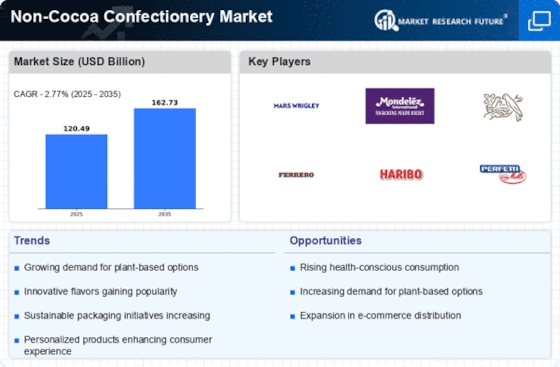
As per Market Research Future analysis, the Non-Cocoa Confectionery Market Size was estimated at 120.49 USD Billion in 2024. The Non-Cocoa Confectionery industry is projected to grow from 123.83 USD Billion in 2025 to 162.73 USD Billion by 2035, exhibiting a compound annual growth rate (CAGR) of 2.77% during the forecast period 2025 - 2035

Key Market Trends & Highlights

The Non-Cocoa Confectionery Market is experiencing a dynamic shift towards health-conscious and innovative offerings.

  • Health-conscious choices are increasingly influencing consumer preferences in the Non-Cocoa Confectionery Market.
  • North America remains the largest market, while the Asia-Pacific region is recognized as the fastest-growing area for non-cocoa confectionery products.
  • Gum continues to dominate the market, whereas hard candy is emerging as the fastest-growing segment.
  • E-commerce growth and sustainability initiatives are key drivers propelling the market forward.

Market Size & Forecast

2024 Market Size 120.49 (USD Billion)
2035 Market Size 162.73 (USD Billion)
CAGR (2025 - 2035) 2.77%
Largest Regional Market Share in 2024 North America

Major Players

Mars Wrigley (US), Mondelez International (US), Nestle (CH), Ferrero (IT), Haribo (DE), Perfetti Van Melle (NL), General Mills (US), Cloetta (SE), Trolli (DE)

Market Trends

The Non-Cocoa Confectionery Market is currently experiencing a dynamic evolution, driven by changing consumer preferences and an increasing focus on health and wellness. As individuals become more health-conscious, there is a noticeable shift towards products that offer natural ingredients and reduced sugar content. This trend is further supported by a growing demand for plant-based and organic options, which appeal to a broader audience seeking healthier alternatives. Additionally, the rise of innovative flavors and unique textures is capturing the interest of consumers, leading to a diversification of product offerings in this sector. Moreover, the Non-Cocoa Confectionery Market is witnessing a surge in online retail channels, as consumers increasingly prefer the convenience of shopping from home. This shift is prompting manufacturers to enhance their digital presence and engage with customers through various online platforms. Social media marketing plays a crucial role in this transformation, allowing brands to connect with their audience and promote new products effectively. As the market continues to adapt to these trends, it appears poised for sustained growth, with opportunities for innovation and expansion in the coming years.

Health-Conscious Choices

Consumers are gravitating towards non-cocoa confectionery products that emphasize natural ingredients and lower sugar levels. This trend reflects a broader societal shift towards healthier eating habits, with many individuals seeking snacks that align with their wellness goals.

Diverse Flavor Profiles

The market is increasingly characterized by a variety of innovative flavors and textures. Manufacturers are experimenting with unique combinations to attract adventurous consumers, thereby expanding the traditional boundaries of non-cocoa confectionery.

E-commerce Growth

The rise of online shopping is reshaping the Non-Cocoa Confectionery Market. As consumers favor the convenience of purchasing products online, brands are enhancing their digital strategies to reach a wider audience and improve customer engagement.

NonCocoa Confectionery Market Market Drivers

E-commerce Growth

The Non-Cocoa confectionery Market is witnessing a significant transformation due to the rapid growth of e-commerce. With the increasing penetration of the internet and mobile devices, consumers are increasingly turning to online platforms for their confectionery purchases. This shift is particularly pronounced among younger consumers who prefer the convenience of online shopping. Recent statistics reveal that e-commerce sales in the confectionery sector have seen double-digit growth, indicating a robust trend that is likely to continue. As a result, brands within the Non-Cocoa Confectionery Market are enhancing their online presence and optimizing their digital marketing strategies to capture this expanding consumer base.

Diverse Flavor Profiles

The Non-Cocoa Confectionery Market is characterized by an increasing demand for diverse flavor profiles. Consumers are no longer satisfied with traditional flavors; they are seeking unique and exotic tastes that provide a novel experience. This trend is evident in the rise of products infused with spices, herbs, and even savory elements. Market data indicates that confectionery items featuring innovative flavors are gaining traction, appealing particularly to younger demographics who are more adventurous in their culinary choices. As a result, manufacturers are investing in research and development to create distinctive flavor combinations, thereby enhancing their competitive edge within the Non-Cocoa Confectionery Market.

Health-Conscious Choices

The Non-Cocoa Confectionery Market is experiencing a notable shift towards health-conscious products. Consumers are increasingly seeking alternatives that align with their dietary preferences, such as sugar-free, organic, and gluten-free options. This trend is driven by a growing awareness of health issues related to sugar consumption and artificial ingredients. According to recent data, the demand for healthier confectionery options has surged, with a significant portion of consumers willing to pay a premium for products that offer perceived health benefits. This shift not only influences product development but also shapes marketing strategies within the Non-Cocoa Confectionery Market, as brands strive to cater to the evolving preferences of health-oriented consumers.

Sustainability Initiatives

The Non-Cocoa Confectionery Market is increasingly influenced by sustainability initiatives. Consumers are becoming more environmentally conscious, prompting brands to adopt sustainable sourcing and production practices. This includes the use of eco-friendly packaging and ethically sourced ingredients. Market Research Future suggests that a significant percentage of consumers are willing to switch brands if they perceive a commitment to sustainability. Consequently, companies within the Non-Cocoa Confectionery Market are prioritizing sustainability in their operations, which not only meets consumer demand but also enhances brand loyalty and reputation.

Innovative Packaging Solutions

The Non-Cocoa Confectionery Market is experiencing a surge in innovative packaging solutions. As competition intensifies, brands are recognizing the importance of packaging not only for protection but also as a marketing tool. Eye-catching designs and functional packaging that enhances convenience are becoming increasingly prevalent. Recent data indicates that consumers are drawn to products with unique packaging that stands out on shelves. This trend is prompting manufacturers within the Non-Cocoa Confectionery Market to invest in creative packaging solutions that not only attract consumers but also communicate brand values and product benefits effectively.

Market Segment Insights

By Type: Gum (Largest) vs. Hard Candy (Fastest-Growing)

<p>The non-cocoa confectionery market exhibits a vibrant distribution of segments, with gum leading as the largest contributor. Following gum, hard candy emerges as a significant player, showcasing robust demand across various demographics. Jelly candy, mints, and marzipan occupy smaller shares but are essential in catering to niche markets. Overall, the competition in this segment is fierce, with diverse options appealing to a broad range of consumer preferences. The growth trends in the non-cocoa confectionery market reflect evolving consumer tastes and health consciousness. Gum is consistently popular due to its versatility and sugar-free options, appealing to health-oriented consumers. Hard candy, particularly with innovative flavors and packaging, is witnessing rapid uptake, especially among younger demographics. This dynamic interplay between tradition and modernity is driving the market forward.</p>

<p>Gum (Dominant) vs. Hard Candy (Emerging)</p>

<p>Gum stands as the dominant force in the non-cocoa confectionery market, appealing to consumers with its wide-ranging varieties, including traditional chewing gum and innovative sugar-free options. Its presence in modern culture, especially among young adults, reinforces its market stronghold. In contrast, hard candy is emerging as a favorite due to its nostalgic appeal and continual innovation in flavors and textures. The shift towards premium and artisanal hard candy has attracted new consumers, fostering growth in this sector. Both segments are marked by distinct consumer loyalties and respond to current trends such as health consciousness and gourmet experiences.</p>

By Distribution Channel: Supermarkets/Hypermarkets (Largest) vs. Online Retail (Fastest-Growing)

<p>In the Non-Cocoa Confectionery Market, the distribution channels reveal a diverse landscape, with Supermarkets and Hypermarkets commanding the largest share. These channels provide consumers with easy access to a wide range of products under one roof, contributing to their dominance in the market. On the other hand, the Online Retail channel is making significant strides, capturing an increasingly larger portion of the market as consumers turn to e-commerce for convenience and variety. This shift indicates a changing dynamic in consumers' shopping habits. As the world becomes more digitalized, the trend towards online shopping continues to gain traction in the Non-Cocoa Confectionery Market. Significant drivers include the convenience of browsing and purchasing from home, the availability of product comparisons, and various promotional offers available online. Furthermore, the pandemic has accelerated this trend, pushing more consumers towards online platforms for their shopping needs. The preference for online retail is likely to continue as logistics and delivery services improve, supporting growth in this channel.</p>

<p>Supermarkets/Hypermarkets (Dominant) vs. Convenience Stores (Emerging)</p>

<p>Supermarkets and Hypermarkets lead the Non-Cocoa Confectionery Market as the dominant distribution channels, offering a broad selection of products and attracting a large customer base. These retailers benefit from their size, allowing them to carry extensive inventories and provide competitive pricing strategies. They often serve as one-stop shopping destinations, enhancing customer experience and ensuring high foot traffic. In contrast, Convenience Stores represent an emerging channel, appealing to consumers seeking convenience and quick access to confectionery products. Though smaller in scale, convenience stores fulfill an essential role by offering quick grab-and-go options, particularly in urban centers. As lifestyle changes continue, convenience stores are strategically positioning themselves to capture more market share by adapting their offerings to meet evolving consumer preferences.</p>

By Consumer Age Group: Children (Largest) vs. Adults (Fastest-Growing)

<p>The Non-Cocoa Confectionery Market exhibits a varied distribution among consumer age groups. Children represent a significant portion of the market, largely due to the high demand for sweet treats that appeal to their preferences. This demographic accounts for a substantial market share, driven by factors such as parental purchasing and a strong affinity for candies and snacks. In contrast, Adults, though smaller in percentage, are experiencing rapid growth as more adult-oriented confectionery products are developed, appealing to their taste for gourmet items and healthier options.</p>

<p>Children (Dominant) vs. Adults (Emerging)</p>

<p>Children dominate the Non-Cocoa Confectionery Market as they are heavily targeted by marketers through vibrant packaging and flavors that resonate with their interests. Products such as gummies, jellies, and chewy candies are especially popular, as they align with children's preferences for fun and playful treats. On the other hand, the Adult segment is emerging as a growth area, driven by an increase in product offerings that focus on quality, sophistication, and health-conscious alternatives. Adults are gravitating towards dark chocolates, sugar-free options, and premium confectionery, indicating a shift towards more discerning purchasing behavior and a growing willingness to spend on higher-end treats.</p>

By Flavor Profile: Fruity (Largest) vs. Sour (Fastest-Growing)

<p>The non-cocoa confectionery market showcases a diverse range of flavor profiles, with the fruity segment commanding the largest share. Fruity flavors, characterized by their vibrant and refreshing tastes, appeal to consumers across all age groups, particularly in gummies and chewy candies. In contrast, the sour flavor profile has emerged as the fastest-growing segment, highlighting a shift in consumer preferences towards bold and unconventional tastes. Sour candies are increasingly popular among younger consumers seeking unique flavor experiences. Analyzing growth trends reveals that the fruity segment remains resilient due to its established market presence and consumer loyalty. However, the surge in interest for sour flavors indicates a dynamic shift, driven by innovative formulations and marketing strategies that appeal to adventurous eaters. Consumers are increasingly looking for distinctive flavor experiences that combine sweetness with tanginess, propelling the sour segment forward in the years to come.</p>

<p>Fruity (Dominant) vs. Sour (Emerging)</p>

<p>The fruity flavor profile stands as the dominant player in the non-cocoa confectionery market, boasting a rich array of offerings that include strawberry, cherry, and citrus flavors. This segment thrives on nostalgia and universal appeal, attracting a broad audience that spans across demographics. Fruity products often leverage vibrant packaging and marketing techniques that evoke fun and excitement. On the other hand, the sour flavor segment is quickly emerging, resonating particularly with younger consumers seeking bold, adventurous tastes. Sour candies often feature unique flavor combinations such as sour-apple or spicy-lime, challenging traditional sweetness. This segment is characterized by its ability to surprise the palate, and its rise is supported by new product launches and creative marketing that emphasizes the thrill associated with sour experiences.</p>

Get more detailed insights about Non-Cocoa Confectionery Market Research Report - Global Forecast till 2035

Regional Insights

The Non-Cocoa Confectionery Market showcases strong regional dynamics, with North America holding a majority share valued at 35.0 USD Billion in 2023, projected to grow to 43.0 USD Billion by 2032. This regional segment dominates due to high consumer demand and established retail infrastructure. Europe follows closely with a valuation of 30.0 USD Billion in 2023, expected to reach 38.0 USD Billion by 2032; innovations in flavor and health-conscious options have significantly driven this market.

Asia-Pacific (APAC) exhibits robust growth potential, being valued at 25.0 USD Billion in 2023 and projected to rise to 34.0 USD Billion by 2032, fueled by a rapidly expanding middle class and changing consumer preferences.

South America, although smaller at 10.0 USD Billion in 2023, is on track to grow to 15.0 USD Billion by 2032, benefiting from an increasing urban population. Meanwhile, the Middle East and Africa (MEA) segment is valued at 17.24 USD Billion in 2023 and is expected to reach 20.0 USD Billion by 2032, driven by rising disposable incomes and a youthful demographic. These regional insights underline the diverse market landscape, where differing consumer behaviors and economic conditions play crucial roles in shaping growth trajectories.

Source Primary Research, Secondary Research, Market Research Future Database and Analyst Review

Key Players and Competitive Insights

The Non-Cocoa Confectionery Market is characterized by its diversity and robust competition, with a wide variety of products ranging from gummy candies and marshmallows to hard candies and fruit chews. As health consciousness grows, companies in the sector are increasingly innovating to meet consumer demand for lower-calorie, sugar-free, and natural ingredient-based options. Competitive insights reveal that major players are investing significantly in research and development to enhance product offerings and maintain a strong market presence. The landscape is influenced by changing consumer preferences, challenges posed by regulatory requirements, and the ongoing impact of e-commerce on distribution channels.As various manufacturers seek to capture market share, they emphasize branding and marketing strategies to resonate with different consumer segments while fostering loyalty.Haribo is a prominent player within the Non-Cocoa Confectionery Market, recognized for its classic gummy candies and its commitment to quality and flavor. The brand has successfully established a strong market presence through strategic product diversification and consistent innovation. Haribo has leveraged its reputation for high-quality ingredients and unique flavors to create products that appeal to both children and adults, fostering brand loyalty and repeat purchases. Furthermore, Haribo's extensive distribution network across supermarkets, convenience stores, and online platforms enhances its accessibility, allowing the brand to maintain a competitive edge.The company’s investment in creative and engaging marketing campaigns helps it connect with its audience, promoting its products effectively and reinforcing its status as a leader in the non-cocoa confectionery sector.Supercandies operates with a focus on health-conscious and innovative offerings in the Non-Cocoa Confectionery Market, catering to a growing segment of consumers looking for guilt-free indulgences. Supercandies differentiates itself through its commitment to using natural ingredients and promoting its products as healthier alternatives in the confectionery landscape. The brand has effectively tapped into the rising demand for improved nutritional profiles, leading to a loyal customer base that appreciates transparency in ingredient sourcing. By implementing strategic marketing initiatives that highlight its unique selling propositions, Supercandies has successfully carved out a niche for itself amidst a competitive array of established brands.The company's ability to adapt to market trends and consumer preferences positions it well for continued growth and engagement within the non-cocoa confectionery category.

Key Companies in the NonCocoa Confectionery Market include

Industry Developments

Recent developments in the Non-Cocoa Confectionery Market have indicated a robust growth trajectory, heavily influenced by companies such as Haribo, Mars, and Mondelez International. Haribo recently expanded its production facilities to increase the output of gummy candies, responding to rising consumer demand. Meanwhile, Mondelez has launched a series of new products aimed at health-conscious consumers, a clear trend in the market. The acquisition of UIB by a prominent industry player was noted, reflecting ongoing consolidation efforts in the sector to enhance product offerings and market reach.

Companies like General Mills and Ferrero continue to innovate their snack lines, leveraging sustainability and natural ingredients, which appeal to modern consumers. Additionally, Cloetta has reported favorable financial results, underscoring the positive market sentiment and consumer interest in non-cocoa products. With rising market valuations, many firms are investing significantly in marketing and product development, adjusting to shifting consumer preferences, which includes an increased focus on plant-based and functional snacks. This trend is reshaping the competitive landscape, positioning these companies for further growth in the dynamically evolving non-cocoa confectionery market.

Future Outlook

NonCocoa Confectionery Market Future Outlook

The Non-Cocoa Confectionery Market is projected to grow at a 2.77% CAGR from 2025 to 2035, driven by health trends, innovative flavors, and expanding distribution channels.

New opportunities lie in:

  • Development of plant-based confectionery lines to cater to health-conscious consumers.
  • Expansion into emerging markets through localized product offerings.
  • Integration of e-commerce platforms for direct-to-consumer sales strategies.

By 2035, the Non-Cocoa Confectionery Market is expected to achieve robust growth and diversification.

Market Segmentation

NonCocoa Confectionery Market Type Outlook

  • Gum
  • Hard Candy
  • Jelly Candy
  • Mints
  • Marzipan

NonCocoa Confectionery Market Flavor Profile Outlook

  • Fruity
  • Sour
  • Minty
  • Spicy

NonCocoa Confectionery Market Consumer Age Group Outlook

  • Children
  • Teenagers
  • Adults
  • Elderly

NonCocoa Confectionery Market Distribution Channel Outlook

  • Supermarkets/Hypermarkets
  • Convenience Stores
  • Online Retail
  • Specialty Stores

Report Scope

MARKET SIZE 2024 120.49(USD Billion)
MARKET SIZE 2025 123.83(USD Billion)
MARKET SIZE 2035 162.73(USD Billion)
COMPOUND ANNUAL GROWTH RATE (CAGR) 2.77% (2025 - 2035)
REPORT COVERAGE Revenue Forecast, Competitive Landscape, Growth Factors, and Trends
BASE YEAR 2024
Market Forecast Period 2025 - 2035
Historical Data 2019 - 2024
Market Forecast Units USD Billion
Key Companies Profiled Mars Wrigley (US), Mondelez International (US), Nestle (CH), Ferrero (IT), Haribo (DE), Perfetti Van Melle (NL), General Mills (US), Cloetta (SE), Trolli (DE)
Segments Covered Product Type, Distribution Channel, Consumer Age Group, Flavor Profile, Regional
Key Market Opportunities Growing demand for healthier, plant-based alternatives in the Non-Cocoa Confectionery Market presents significant opportunities.
Key Market Dynamics Rising consumer preference for healthier snacks drives innovation and competition in the Non-Cocoa Confectionery Market.
Countries Covered North America, Europe, APAC, South America, MEA

FAQs

What is the current valuation of the Non-Cocoa Confectionery Market?

<p>The Non-Cocoa Confectionery Market was valued at 120.49 USD Billion in 2024.</p>

What is the projected market size for the Non-Cocoa Confectionery Market by 2035?

<p>The market is expected to reach 162.73 USD Billion by 2035.</p>

What is the expected CAGR for the Non-Cocoa Confectionery Market from 2025 to 2035?

<p>The expected CAGR during the forecast period 2025 - 2035 is 2.77%.</p>

Which distribution channel is projected to generate the highest revenue in the Non-Cocoa Confectionery Market?

<p>Supermarkets and hypermarkets are projected to generate the highest revenue, with a valuation of 80.0 USD Billion.</p>

What segment of the Non-Cocoa Confectionery Market is expected to grow the most in terms of revenue?

<p>Hard candy is anticipated to grow significantly, with a projected valuation of 40.0 USD Billion.</p>

Which age group contributes the most to the Non-Cocoa Confectionery Market?

<p>Adults are expected to contribute the most, with a projected revenue of 75.0 USD Billion.</p>

What flavor profile is likely to dominate the Non-Cocoa Confectionery Market?

<p>The spicy flavor profile is likely to dominate, with a projected valuation of 57.73 USD Billion.</p>

Who are the key players in the Non-Cocoa Confectionery Market?

<p>Key players include Mars Wrigley, Mondelez International, Nestle, Ferrero, and Haribo.</p>

What is the projected revenue for jelly candy in the Non-Cocoa Confectionery Market?

<p>Jelly candy is projected to generate a revenue of 32.0 USD Billion.</p>

How does the online retail segment perform in the Non-Cocoa Confectionery Market?

<p>The online retail segment is expected to grow, with a projected valuation of 25.0 USD Billion.</p>

  1. SECTION I: EXECUTIVE SUMMARY AND KEY HIGHLIGHTS
    1. | 1.1 EXECUTIVE SUMMARY
    2. | | 1.1.1 Market Overview
    3. | | 1.1.2 Key Findings
    4. | | 1.1.3 Market Segmentation
    5. | | 1.1.4 Competitive Landscape
    6. | | 1.1.5 Challenges and Opportunities
    7. | | 1.1.6 Future Outlook
  2. SECTION II: SCOPING, METHODOLOGY AND MARKET STRUCTURE
    1. | 2.1 MARKET INTRODUCTION
    2. | | 2.1.1 Definition
    3. | | 2.1.2 Scope of the study
    4. | | | 2.1.2.1 Research Objective
    5. | | | 2.1.2.2 Assumption
    6. | | | 2.1.2.3 Limitations
    7. | 2.2 RESEARCH METHODOLOGY
    8. | | 2.2.1 Overview
    9. | | 2.2.2 Data Mining
    10. | | 2.2.3 Secondary Research
    11. | | 2.2.4 Primary Research
    12. | | | 2.2.4.1 Primary Interviews and Information Gathering Process
    13. | | | 2.2.4.2 Breakdown of Primary Respondents
    14. | | 2.2.5 Forecasting Model
    15. | | 2.2.6 Market Size Estimation
    16. | | | 2.2.6.1 Bottom-Up Approach
    17. | | | 2.2.6.2 Top-Down Approach
    18. | | 2.2.7 Data Triangulation
    19. | | 2.2.8 Validation
  3. SECTION III: QUALITATIVE ANALYSIS
    1. | 3.1 MARKET DYNAMICS
    2. | | 3.1.1 Overview
    3. | | 3.1.2 Drivers
    4. | | 3.1.3 Restraints
    5. | | 3.1.4 Opportunities
    6. | 3.2 MARKET FACTOR ANALYSIS
    7. | | 3.2.1 Value chain Analysis
    8. | | 3.2.2 Porter's Five Forces Analysis
    9. | | | 3.2.2.1 Bargaining Power of Suppliers
    10. | | | 3.2.2.2 Bargaining Power of Buyers
    11. | | | 3.2.2.3 Threat of New Entrants
    12. | | | 3.2.2.4 Threat of Substitutes
    13. | | | 3.2.2.5 Intensity of Rivalry
    14. | | 3.2.3 COVID-19 Impact Analysis
    15. | | | 3.2.3.1 Market Impact Analysis
    16. | | | 3.2.3.2 Regional Impact
    17. | | | 3.2.3.3 Opportunity and Threat Analysis
  4. SECTION IV: QUANTITATIVE ANALYSIS
    1. | 4.1 Food, Beverages & Nutrition, BY Type (USD Billion)
    2. | | 4.1.1 Gum
    3. | | 4.1.2 Hard Candy
    4. | | 4.1.3 Jelly Candy
    5. | | 4.1.4 Mints
    6. | | 4.1.5 Marzipan
    7. | 4.2 Food, Beverages & Nutrition, BY Distribution Channel (USD Billion)
    8. | | 4.2.1 Supermarkets/Hypermarkets
    9. | | 4.2.2 Convenience Stores
    10. | | 4.2.3 Online Retail
    11. | | 4.2.4 Specialty Stores
    12. | 4.3 Food, Beverages & Nutrition, BY Consumer Age Group (USD Billion)
    13. | | 4.3.1 Children
    14. | | 4.3.2 Teenagers
    15. | | 4.3.3 Adults
    16. | | 4.3.4 Elderly
    17. | 4.4 Food, Beverages & Nutrition, BY Flavor Profile (USD Billion)
    18. | | 4.4.1 Fruity
    19. | | 4.4.2 Sour
    20. | | 4.4.3 Minty
    21. | | 4.4.4 Spicy
    22. | 4.5 Food, Beverages & Nutrition, BY Region (USD Billion)
    23. | | 4.5.1 North America
    24. | | | 4.5.1.1 US
    25. | | | 4.5.1.2 Canada
    26. | | 4.5.2 Europe
    27. | | | 4.5.2.1 Germany
    28. | | | 4.5.2.2 UK
    29. | | | 4.5.2.3 France
    30. | | | 4.5.2.4 Russia
    31. | | | 4.5.2.5 Italy
    32. | | | 4.5.2.6 Spain
    33. | | | 4.5.2.7 Rest of Europe
    34. | | 4.5.3 APAC
    35. | | | 4.5.3.1 China
    36. | | | 4.5.3.2 India
    37. | | | 4.5.3.3 Japan
    38. | | | 4.5.3.4 South Korea
    39. | | | 4.5.3.5 Malaysia
    40. | | | 4.5.3.6 Thailand
    41. | | | 4.5.3.7 Indonesia
    42. | | | 4.5.3.8 Rest of APAC
    43. | | 4.5.4 South America
    44. | | | 4.5.4.1 Brazil
    45. | | | 4.5.4.2 Mexico
    46. | | | 4.5.4.3 Argentina
    47. | | | 4.5.4.4 Rest of South America
    48. | | 4.5.5 MEA
    49. | | | 4.5.5.1 GCC Countries
    50. | | | 4.5.5.2 South Africa
    51. | | | 4.5.5.3 Rest of MEA
  5. SECTION V: COMPETITIVE ANALYSIS
    1. | 5.1 Competitive Landscape
    2. | | 5.1.1 Overview
    3. | | 5.1.2 Competitive Analysis
    4. | | 5.1.3 Market share Analysis
    5. | | 5.1.4 Major Growth Strategy in the Food, Beverages & Nutrition
    6. | | 5.1.5 Competitive Benchmarking
    7. | | 5.1.6 Leading Players in Terms of Number of Developments in the Food, Beverages & Nutrition
    8. | | 5.1.7 Key developments and growth strategies
    9. | | | 5.1.7.1 New Product Launch/Service Deployment
    10. | | | 5.1.7.2 Merger & Acquisitions
    11. | | | 5.1.7.3 Joint Ventures
    12. | | 5.1.8 Major Players Financial Matrix
    13. | | | 5.1.8.1 Sales and Operating Income
    14. | | | 5.1.8.2 Major Players R&D Expenditure. 2023
    15. | 5.2 Company Profiles
    16. | | 5.2.1 Mars Wrigley (US)
    17. | | | 5.2.1.1 Financial Overview
    18. | | | 5.2.1.2 Products Offered
    19. | | | 5.2.1.3 Key Developments
    20. | | | 5.2.1.4 SWOT Analysis
    21. | | | 5.2.1.5 Key Strategies
    22. | | 5.2.2 Mondelez International (US)
    23. | | | 5.2.2.1 Financial Overview
    24. | | | 5.2.2.2 Products Offered
    25. | | | 5.2.2.3 Key Developments
    26. | | | 5.2.2.4 SWOT Analysis
    27. | | | 5.2.2.5 Key Strategies
    28. | | 5.2.3 Nestle (CH)
    29. | | | 5.2.3.1 Financial Overview
    30. | | | 5.2.3.2 Products Offered
    31. | | | 5.2.3.3 Key Developments
    32. | | | 5.2.3.4 SWOT Analysis
    33. | | | 5.2.3.5 Key Strategies
    34. | | 5.2.4 Ferrero (IT)
    35. | | | 5.2.4.1 Financial Overview
    36. | | | 5.2.4.2 Products Offered
    37. | | | 5.2.4.3 Key Developments
    38. | | | 5.2.4.4 SWOT Analysis
    39. | | | 5.2.4.5 Key Strategies
    40. | | 5.2.5 Haribo (DE)
    41. | | | 5.2.5.1 Financial Overview
    42. | | | 5.2.5.2 Products Offered
    43. | | | 5.2.5.3 Key Developments
    44. | | | 5.2.5.4 SWOT Analysis
    45. | | | 5.2.5.5 Key Strategies
    46. | | 5.2.6 Perfetti Van Melle (NL)
    47. | | | 5.2.6.1 Financial Overview
    48. | | | 5.2.6.2 Products Offered
    49. | | | 5.2.6.3 Key Developments
    50. | | | 5.2.6.4 SWOT Analysis
    51. | | | 5.2.6.5 Key Strategies
    52. | | 5.2.7 General Mills (US)
    53. | | | 5.2.7.1 Financial Overview
    54. | | | 5.2.7.2 Products Offered
    55. | | | 5.2.7.3 Key Developments
    56. | | | 5.2.7.4 SWOT Analysis
    57. | | | 5.2.7.5 Key Strategies
    58. | | 5.2.8 Cloetta (SE)
    59. | | | 5.2.8.1 Financial Overview
    60. | | | 5.2.8.2 Products Offered
    61. | | | 5.2.8.3 Key Developments
    62. | | | 5.2.8.4 SWOT Analysis
    63. | | | 5.2.8.5 Key Strategies
    64. | | 5.2.9 Trolli (DE)
    65. | | | 5.2.9.1 Financial Overview
    66. | | | 5.2.9.2 Products Offered
    67. | | | 5.2.9.3 Key Developments
    68. | | | 5.2.9.4 SWOT Analysis
    69. | | | 5.2.9.5 Key Strategies
    70. | 5.3 Appendix
    71. | | 5.3.1 References
    72. | | 5.3.2 Related Reports
  6. LIST OF FIGURES
    1. | 6.1 MARKET SYNOPSIS
    2. | 6.2 NORTH AMERICA MARKET ANALYSIS
    3. | 6.3 US MARKET ANALYSIS BY TYPE
    4. | 6.4 US MARKET ANALYSIS BY DISTRIBUTION CHANNEL
    5. | 6.5 US MARKET ANALYSIS BY CONSUMER AGE GROUP
    6. | 6.6 US MARKET ANALYSIS BY FLAVOR PROFILE
    7. | 6.7 CANADA MARKET ANALYSIS BY TYPE
    8. | 6.8 CANADA MARKET ANALYSIS BY DISTRIBUTION CHANNEL
    9. | 6.9 CANADA MARKET ANALYSIS BY CONSUMER AGE GROUP
    10. | 6.10 CANADA MARKET ANALYSIS BY FLAVOR PROFILE
    11. | 6.11 EUROPE MARKET ANALYSIS
    12. | 6.12 GERMANY MARKET ANALYSIS BY TYPE
    13. | 6.13 GERMANY MARKET ANALYSIS BY DISTRIBUTION CHANNEL
    14. | 6.14 GERMANY MARKET ANALYSIS BY CONSUMER AGE GROUP
    15. | 6.15 GERMANY MARKET ANALYSIS BY FLAVOR PROFILE
    16. | 6.16 UK MARKET ANALYSIS BY TYPE
    17. | 6.17 UK MARKET ANALYSIS BY DISTRIBUTION CHANNEL
    18. | 6.18 UK MARKET ANALYSIS BY CONSUMER AGE GROUP
    19. | 6.19 UK MARKET ANALYSIS BY FLAVOR PROFILE
    20. | 6.20 FRANCE MARKET ANALYSIS BY TYPE
    21. | 6.21 FRANCE MARKET ANALYSIS BY DISTRIBUTION CHANNEL
    22. | 6.22 FRANCE MARKET ANALYSIS BY CONSUMER AGE GROUP
    23. | 6.23 FRANCE MARKET ANALYSIS BY FLAVOR PROFILE
    24. | 6.24 RUSSIA MARKET ANALYSIS BY TYPE
    25. | 6.25 RUSSIA MARKET ANALYSIS BY DISTRIBUTION CHANNEL
    26. | 6.26 RUSSIA MARKET ANALYSIS BY CONSUMER AGE GROUP
    27. | 6.27 RUSSIA MARKET ANALYSIS BY FLAVOR PROFILE
    28. | 6.28 ITALY MARKET ANALYSIS BY TYPE
    29. | 6.29 ITALY MARKET ANALYSIS BY DISTRIBUTION CHANNEL
    30. | 6.30 ITALY MARKET ANALYSIS BY CONSUMER AGE GROUP
    31. | 6.31 ITALY MARKET ANALYSIS BY FLAVOR PROFILE
    32. | 6.32 SPAIN MARKET ANALYSIS BY TYPE
    33. | 6.33 SPAIN MARKET ANALYSIS BY DISTRIBUTION CHANNEL
    34. | 6.34 SPAIN MARKET ANALYSIS BY CONSUMER AGE GROUP
    35. | 6.35 SPAIN MARKET ANALYSIS BY FLAVOR PROFILE
    36. | 6.36 REST OF EUROPE MARKET ANALYSIS BY TYPE
    37. | 6.37 REST OF EUROPE MARKET ANALYSIS BY DISTRIBUTION CHANNEL
    38. | 6.38 REST OF EUROPE MARKET ANALYSIS BY CONSUMER AGE GROUP
    39. | 6.39 REST OF EUROPE MARKET ANALYSIS BY FLAVOR PROFILE
    40. | 6.40 APAC MARKET ANALYSIS
    41. | 6.41 CHINA MARKET ANALYSIS BY TYPE
    42. | 6.42 CHINA MARKET ANALYSIS BY DISTRIBUTION CHANNEL
    43. | 6.43 CHINA MARKET ANALYSIS BY CONSUMER AGE GROUP
    44. | 6.44 CHINA MARKET ANALYSIS BY FLAVOR PROFILE
    45. | 6.45 INDIA MARKET ANALYSIS BY TYPE
    46. | 6.46 INDIA MARKET ANALYSIS BY DISTRIBUTION CHANNEL
    47. | 6.47 INDIA MARKET ANALYSIS BY CONSUMER AGE GROUP
    48. | 6.48 INDIA MARKET ANALYSIS BY FLAVOR PROFILE
    49. | 6.49 JAPAN MARKET ANALYSIS BY TYPE
    50. | 6.50 JAPAN MARKET ANALYSIS BY DISTRIBUTION CHANNEL
    51. | 6.51 JAPAN MARKET ANALYSIS BY CONSUMER AGE GROUP
    52. | 6.52 JAPAN MARKET ANALYSIS BY FLAVOR PROFILE
    53. | 6.53 SOUTH KOREA MARKET ANALYSIS BY TYPE
    54. | 6.54 SOUTH KOREA MARKET ANALYSIS BY DISTRIBUTION CHANNEL
    55. | 6.55 SOUTH KOREA MARKET ANALYSIS BY CONSUMER AGE GROUP
    56. | 6.56 SOUTH KOREA MARKET ANALYSIS BY FLAVOR PROFILE
    57. | 6.57 MALAYSIA MARKET ANALYSIS BY TYPE
    58. | 6.58 MALAYSIA MARKET ANALYSIS BY DISTRIBUTION CHANNEL
    59. | 6.59 MALAYSIA MARKET ANALYSIS BY CONSUMER AGE GROUP
    60. | 6.60 MALAYSIA MARKET ANALYSIS BY FLAVOR PROFILE
    61. | 6.61 THAILAND MARKET ANALYSIS BY TYPE
    62. | 6.62 THAILAND MARKET ANALYSIS BY DISTRIBUTION CHANNEL
    63. | 6.63 THAILAND MARKET ANALYSIS BY CONSUMER AGE GROUP
    64. | 6.64 THAILAND MARKET ANALYSIS BY FLAVOR PROFILE
    65. | 6.65 INDONESIA MARKET ANALYSIS BY TYPE
    66. | 6.66 INDONESIA MARKET ANALYSIS BY DISTRIBUTION CHANNEL
    67. | 6.67 INDONESIA MARKET ANALYSIS BY CONSUMER AGE GROUP
    68. | 6.68 INDONESIA MARKET ANALYSIS BY FLAVOR PROFILE
    69. | 6.69 REST OF APAC MARKET ANALYSIS BY TYPE
    70. | 6.70 REST OF APAC MARKET ANALYSIS BY DISTRIBUTION CHANNEL
    71. | 6.71 REST OF APAC MARKET ANALYSIS BY CONSUMER AGE GROUP
    72. | 6.72 REST OF APAC MARKET ANALYSIS BY FLAVOR PROFILE
    73. | 6.73 SOUTH AMERICA MARKET ANALYSIS
    74. | 6.74 BRAZIL MARKET ANALYSIS BY TYPE
    75. | 6.75 BRAZIL MARKET ANALYSIS BY DISTRIBUTION CHANNEL
    76. | 6.76 BRAZIL MARKET ANALYSIS BY CONSUMER AGE GROUP
    77. | 6.77 BRAZIL MARKET ANALYSIS BY FLAVOR PROFILE
    78. | 6.78 MEXICO MARKET ANALYSIS BY TYPE
    79. | 6.79 MEXICO MARKET ANALYSIS BY DISTRIBUTION CHANNEL
    80. | 6.80 MEXICO MARKET ANALYSIS BY CONSUMER AGE GROUP
    81. | 6.81 MEXICO MARKET ANALYSIS BY FLAVOR PROFILE
    82. | 6.82 ARGENTINA MARKET ANALYSIS BY TYPE
    83. | 6.83 ARGENTINA MARKET ANALYSIS BY DISTRIBUTION CHANNEL
    84. | 6.84 ARGENTINA MARKET ANALYSIS BY CONSUMER AGE GROUP
    85. | 6.85 ARGENTINA MARKET ANALYSIS BY FLAVOR PROFILE
    86. | 6.86 REST OF SOUTH AMERICA MARKET ANALYSIS BY TYPE
    87. | 6.87 REST OF SOUTH AMERICA MARKET ANALYSIS BY DISTRIBUTION CHANNEL
    88. | 6.88 REST OF SOUTH AMERICA MARKET ANALYSIS BY CONSUMER AGE GROUP
    89. | 6.89 REST OF SOUTH AMERICA MARKET ANALYSIS BY FLAVOR PROFILE
    90. | 6.90 MEA MARKET ANALYSIS
    91. | 6.91 GCC COUNTRIES MARKET ANALYSIS BY TYPE
    92. | 6.92 GCC COUNTRIES MARKET ANALYSIS BY DISTRIBUTION CHANNEL
    93. | 6.93 GCC COUNTRIES MARKET ANALYSIS BY CONSUMER AGE GROUP
    94. | 6.94 GCC COUNTRIES MARKET ANALYSIS BY FLAVOR PROFILE
    95. | 6.95 SOUTH AFRICA MARKET ANALYSIS BY TYPE
    96. | 6.96 SOUTH AFRICA MARKET ANALYSIS BY DISTRIBUTION CHANNEL
    97. | 6.97 SOUTH AFRICA MARKET ANALYSIS BY CONSUMER AGE GROUP
    98. | 6.98 SOUTH AFRICA MARKET ANALYSIS BY FLAVOR PROFILE
    99. | 6.99 REST OF MEA MARKET ANALYSIS BY TYPE
    100. | 6.100 REST OF MEA MARKET ANALYSIS BY DISTRIBUTION CHANNEL
    101. | 6.101 REST OF MEA MARKET ANALYSIS BY CONSUMER AGE GROUP
    102. | 6.102 REST OF MEA MARKET ANALYSIS BY FLAVOR PROFILE
    103. | 6.103 KEY BUYING CRITERIA OF FOOD, BEVERAGES & NUTRITION
    104. | 6.104 RESEARCH PROCESS OF MRFR
    105. | 6.105 DRO ANALYSIS OF FOOD, BEVERAGES & NUTRITION
    106. | 6.106 DRIVERS IMPACT ANALYSIS: FOOD, BEVERAGES & NUTRITION
    107. | 6.107 RESTRAINTS IMPACT ANALYSIS: FOOD, BEVERAGES & NUTRITION
    108. | 6.108 SUPPLY / VALUE CHAIN: FOOD, BEVERAGES & NUTRITION
    109. | 6.109 FOOD, BEVERAGES & NUTRITION, BY TYPE, 2024 (% SHARE)
    110. | 6.110 FOOD, BEVERAGES & NUTRITION, BY TYPE, 2024 TO 2035 (USD Billion)
    111. | 6.111 FOOD, BEVERAGES & NUTRITION, BY DISTRIBUTION CHANNEL, 2024 (% SHARE)
    112. | 6.112 FOOD, BEVERAGES & NUTRITION, BY DISTRIBUTION CHANNEL, 2024 TO 2035 (USD Billion)
    113. | 6.113 FOOD, BEVERAGES & NUTRITION, BY CONSUMER AGE GROUP, 2024 (% SHARE)
    114. | 6.114 FOOD, BEVERAGES & NUTRITION, BY CONSUMER AGE GROUP, 2024 TO 2035 (USD Billion)
    115. | 6.115 FOOD, BEVERAGES & NUTRITION, BY FLAVOR PROFILE, 2024 (% SHARE)
    116. | 6.116 FOOD, BEVERAGES & NUTRITION, BY FLAVOR PROFILE, 2024 TO 2035 (USD Billion)
    117. | 6.117 BENCHMARKING OF MAJOR COMPETITORS
  7. LIST OF TABLES
    1. | 7.1 LIST OF ASSUMPTIONS
    2. | | 7.1.1
    3. | 7.2 North America MARKET SIZE ESTIMATES; FORECAST
    4. | | 7.2.1 BY TYPE, 2025-2035 (USD Billion)
    5. | | 7.2.2 BY DISTRIBUTION CHANNEL, 2025-2035 (USD Billion)
    6. | | 7.2.3 BY CONSUMER AGE GROUP, 2025-2035 (USD Billion)
    7. | | 7.2.4 BY FLAVOR PROFILE, 2025-2035 (USD Billion)
    8. | 7.3 US MARKET SIZE ESTIMATES; FORECAST
    9. | | 7.3.1 BY TYPE, 2025-2035 (USD Billion)
    10. | | 7.3.2 BY DISTRIBUTION CHANNEL, 2025-2035 (USD Billion)
    11. | | 7.3.3 BY CONSUMER AGE GROUP, 2025-2035 (USD Billion)
    12. | | 7.3.4 BY FLAVOR PROFILE, 2025-2035 (USD Billion)
    13. | 7.4 Canada MARKET SIZE ESTIMATES; FORECAST
    14. | | 7.4.1 BY TYPE, 2025-2035 (USD Billion)
    15. | | 7.4.2 BY DISTRIBUTION CHANNEL, 2025-2035 (USD Billion)
    16. | | 7.4.3 BY CONSUMER AGE GROUP, 2025-2035 (USD Billion)
    17. | | 7.4.4 BY FLAVOR PROFILE, 2025-2035 (USD Billion)
    18. | 7.5 Europe MARKET SIZE ESTIMATES; FORECAST
    19. | | 7.5.1 BY TYPE, 2025-2035 (USD Billion)
    20. | | 7.5.2 BY DISTRIBUTION CHANNEL, 2025-2035 (USD Billion)
    21. | | 7.5.3 BY CONSUMER AGE GROUP, 2025-2035 (USD Billion)
    22. | | 7.5.4 BY FLAVOR PROFILE, 2025-2035 (USD Billion)
    23. | 7.6 Germany MARKET SIZE ESTIMATES; FORECAST
    24. | | 7.6.1 BY TYPE, 2025-2035 (USD Billion)
    25. | | 7.6.2 BY DISTRIBUTION CHANNEL, 2025-2035 (USD Billion)
    26. | | 7.6.3 BY CONSUMER AGE GROUP, 2025-2035 (USD Billion)
    27. | | 7.6.4 BY FLAVOR PROFILE, 2025-2035 (USD Billion)
    28. | 7.7 UK MARKET SIZE ESTIMATES; FORECAST
    29. | | 7.7.1 BY TYPE, 2025-2035 (USD Billion)
    30. | | 7.7.2 BY DISTRIBUTION CHANNEL, 2025-2035 (USD Billion)
    31. | | 7.7.3 BY CONSUMER AGE GROUP, 2025-2035 (USD Billion)
    32. | | 7.7.4 BY FLAVOR PROFILE, 2025-2035 (USD Billion)
    33. | 7.8 France MARKET SIZE ESTIMATES; FORECAST
    34. | | 7.8.1 BY TYPE, 2025-2035 (USD Billion)
    35. | | 7.8.2 BY DISTRIBUTION CHANNEL, 2025-2035 (USD Billion)
    36. | | 7.8.3 BY CONSUMER AGE GROUP, 2025-2035 (USD Billion)
    37. | | 7.8.4 BY FLAVOR PROFILE, 2025-2035 (USD Billion)
    38. | 7.9 Russia MARKET SIZE ESTIMATES; FORECAST
    39. | | 7.9.1 BY TYPE, 2025-2035 (USD Billion)
    40. | | 7.9.2 BY DISTRIBUTION CHANNEL, 2025-2035 (USD Billion)
    41. | | 7.9.3 BY CONSUMER AGE GROUP, 2025-2035 (USD Billion)
    42. | | 7.9.4 BY FLAVOR PROFILE, 2025-2035 (USD Billion)
    43. | 7.10 Italy MARKET SIZE ESTIMATES; FORECAST
    44. | | 7.10.1 BY TYPE, 2025-2035 (USD Billion)
    45. | | 7.10.2 BY DISTRIBUTION CHANNEL, 2025-2035 (USD Billion)
    46. | | 7.10.3 BY CONSUMER AGE GROUP, 2025-2035 (USD Billion)
    47. | | 7.10.4 BY FLAVOR PROFILE, 2025-2035 (USD Billion)
    48. | 7.11 Spain MARKET SIZE ESTIMATES; FORECAST
    49. | | 7.11.1 BY TYPE, 2025-2035 (USD Billion)
    50. | | 7.11.2 BY DISTRIBUTION CHANNEL, 2025-2035 (USD Billion)
    51. | | 7.11.3 BY CONSUMER AGE GROUP, 2025-2035 (USD Billion)
    52. | | 7.11.4 BY FLAVOR PROFILE, 2025-2035 (USD Billion)
    53. | 7.12 Rest of Europe MARKET SIZE ESTIMATES; FORECAST
    54. | | 7.12.1 BY TYPE, 2025-2035 (USD Billion)
    55. | | 7.12.2 BY DISTRIBUTION CHANNEL, 2025-2035 (USD Billion)
    56. | | 7.12.3 BY CONSUMER AGE GROUP, 2025-2035 (USD Billion)
    57. | | 7.12.4 BY FLAVOR PROFILE, 2025-2035 (USD Billion)
    58. | 7.13 APAC MARKET SIZE ESTIMATES; FORECAST
    59. | | 7.13.1 BY TYPE, 2025-2035 (USD Billion)
    60. | | 7.13.2 BY DISTRIBUTION CHANNEL, 2025-2035 (USD Billion)
    61. | | 7.13.3 BY CONSUMER AGE GROUP, 2025-2035 (USD Billion)
    62. | | 7.13.4 BY FLAVOR PROFILE, 2025-2035 (USD Billion)
    63. | 7.14 China MARKET SIZE ESTIMATES; FORECAST
    64. | | 7.14.1 BY TYPE, 2025-2035 (USD Billion)
    65. | | 7.14.2 BY DISTRIBUTION CHANNEL, 2025-2035 (USD Billion)
    66. | | 7.14.3 BY CONSUMER AGE GROUP, 2025-2035 (USD Billion)
    67. | | 7.14.4 BY FLAVOR PROFILE, 2025-2035 (USD Billion)
    68. | 7.15 India MARKET SIZE ESTIMATES; FORECAST
    69. | | 7.15.1 BY TYPE, 2025-2035 (USD Billion)
    70. | | 7.15.2 BY DISTRIBUTION CHANNEL, 2025-2035 (USD Billion)
    71. | | 7.15.3 BY CONSUMER AGE GROUP, 2025-2035 (USD Billion)
    72. | | 7.15.4 BY FLAVOR PROFILE, 2025-2035 (USD Billion)
    73. | 7.16 Japan MARKET SIZE ESTIMATES; FORECAST
    74. | | 7.16.1 BY TYPE, 2025-2035 (USD Billion)
    75. | | 7.16.2 BY DISTRIBUTION CHANNEL, 2025-2035 (USD Billion)
    76. | | 7.16.3 BY CONSUMER AGE GROUP, 2025-2035 (USD Billion)
    77. | | 7.16.4 BY FLAVOR PROFILE, 2025-2035 (USD Billion)
    78. | 7.17 South Korea MARKET SIZE ESTIMATES; FORECAST
    79. | | 7.17.1 BY TYPE, 2025-2035 (USD Billion)
    80. | | 7.17.2 BY DISTRIBUTION CHANNEL, 2025-2035 (USD Billion)
    81. | | 7.17.3 BY CONSUMER AGE GROUP, 2025-2035 (USD Billion)
    82. | | 7.17.4 BY FLAVOR PROFILE, 2025-2035 (USD Billion)
    83. | 7.18 Malaysia MARKET SIZE ESTIMATES; FORECAST
    84. | | 7.18.1 BY TYPE, 2025-2035 (USD Billion)
    85. | | 7.18.2 BY DISTRIBUTION CHANNEL, 2025-2035 (USD Billion)
    86. | | 7.18.3 BY CONSUMER AGE GROUP, 2025-2035 (USD Billion)
    87. | | 7.18.4 BY FLAVOR PROFILE, 2025-2035 (USD Billion)
    88. | 7.19 Thailand MARKET SIZE ESTIMATES; FORECAST
    89. | | 7.19.1 BY TYPE, 2025-2035 (USD Billion)
    90. | | 7.19.2 BY DISTRIBUTION CHANNEL, 2025-2035 (USD Billion)
    91. | | 7.19.3 BY CONSUMER AGE GROUP, 2025-2035 (USD Billion)
    92. | | 7.19.4 BY FLAVOR PROFILE, 2025-2035 (USD Billion)
    93. | 7.20 Indonesia MARKET SIZE ESTIMATES; FORECAST
    94. | | 7.20.1 BY TYPE, 2025-2035 (USD Billion)
    95. | | 7.20.2 BY DISTRIBUTION CHANNEL, 2025-2035 (USD Billion)
    96. | | 7.20.3 BY CONSUMER AGE GROUP, 2025-2035 (USD Billion)
    97. | | 7.20.4 BY FLAVOR PROFILE, 2025-2035 (USD Billion)
    98. | 7.21 Rest of APAC MARKET SIZE ESTIMATES; FORECAST
    99. | | 7.21.1 BY TYPE, 2025-2035 (USD Billion)
    100. | | 7.21.2 BY DISTRIBUTION CHANNEL, 2025-2035 (USD Billion)
    101. | | 7.21.3 BY CONSUMER AGE GROUP, 2025-2035 (USD Billion)
    102. | | 7.21.4 BY FLAVOR PROFILE, 2025-2035 (USD Billion)
    103. | 7.22 South America MARKET SIZE ESTIMATES; FORECAST
    104. | | 7.22.1 BY TYPE, 2025-2035 (USD Billion)
    105. | | 7.22.2 BY DISTRIBUTION CHANNEL, 2025-2035 (USD Billion)
    106. | | 7.22.3 BY CONSUMER AGE GROUP, 2025-2035 (USD Billion)
    107. | | 7.22.4 BY FLAVOR PROFILE, 2025-2035 (USD Billion)
    108. | 7.23 Brazil MARKET SIZE ESTIMATES; FORECAST
    109. | | 7.23.1 BY TYPE, 2025-2035 (USD Billion)
    110. | | 7.23.2 BY DISTRIBUTION CHANNEL, 2025-2035 (USD Billion)
    111. | | 7.23.3 BY CONSUMER AGE GROUP, 2025-2035 (USD Billion)
    112. | | 7.23.4 BY FLAVOR PROFILE, 2025-2035 (USD Billion)
    113. | 7.24 Mexico MARKET SIZE ESTIMATES; FORECAST
    114. | | 7.24.1 BY TYPE, 2025-2035 (USD Billion)
    115. | | 7.24.2 BY DISTRIBUTION CHANNEL, 2025-2035 (USD Billion)
    116. | | 7.24.3 BY CONSUMER AGE GROUP, 2025-2035 (USD Billion)
    117. | | 7.24.4 BY FLAVOR PROFILE, 2025-2035 (USD Billion)
    118. | 7.25 Argentina MARKET SIZE ESTIMATES; FORECAST
    119. | | 7.25.1 BY TYPE, 2025-2035 (USD Billion)
    120. | | 7.25.2 BY DISTRIBUTION CHANNEL, 2025-2035 (USD Billion)
    121. | | 7.25.3 BY CONSUMER AGE GROUP, 2025-2035 (USD Billion)
    122. | | 7.25.4 BY FLAVOR PROFILE, 2025-2035 (USD Billion)
    123. | 7.26 Rest of South America MARKET SIZE ESTIMATES; FORECAST
    124. | | 7.26.1 BY TYPE, 2025-2035 (USD Billion)
    125. | | 7.26.2 BY DISTRIBUTION CHANNEL, 2025-2035 (USD Billion)
    126. | | 7.26.3 BY CONSUMER AGE GROUP, 2025-2035 (USD Billion)
    127. | | 7.26.4 BY FLAVOR PROFILE, 2025-2035 (USD Billion)
    128. | 7.27 MEA MARKET SIZE ESTIMATES; FORECAST
    129. | | 7.27.1 BY TYPE, 2025-2035 (USD Billion)
    130. | | 7.27.2 BY DISTRIBUTION CHANNEL, 2025-2035 (USD Billion)
    131. | | 7.27.3 BY CONSUMER AGE GROUP, 2025-2035 (USD Billion)
    132. | | 7.27.4 BY FLAVOR PROFILE, 2025-2035 (USD Billion)
    133. | 7.28 GCC Countries MARKET SIZE ESTIMATES; FORECAST
    134. | | 7.28.1 BY TYPE, 2025-2035 (USD Billion)
    135. | | 7.28.2 BY DISTRIBUTION CHANNEL, 2025-2035 (USD Billion)
    136. | | 7.28.3 BY CONSUMER AGE GROUP, 2025-2035 (USD Billion)
    137. | | 7.28.4 BY FLAVOR PROFILE, 2025-2035 (USD Billion)
    138. | 7.29 South Africa MARKET SIZE ESTIMATES; FORECAST
    139. | | 7.29.1 BY TYPE, 2025-2035 (USD Billion)
    140. | | 7.29.2 BY DISTRIBUTION CHANNEL, 2025-2035 (USD Billion)
    141. | | 7.29.3 BY CONSUMER AGE GROUP, 2025-2035 (USD Billion)
    142. | | 7.29.4 BY FLAVOR PROFILE, 2025-2035 (USD Billion)
    143. | 7.30 Rest of MEA MARKET SIZE ESTIMATES; FORECAST
    144. | | 7.30.1 BY TYPE, 2025-2035 (USD Billion)
    145. | | 7.30.2 BY DISTRIBUTION CHANNEL, 2025-2035 (USD Billion)
    146. | | 7.30.3 BY CONSUMER AGE GROUP, 2025-2035 (USD Billion)
    147. | | 7.30.4 BY FLAVOR PROFILE, 2025-2035 (USD Billion)
    148. | 7.31 PRODUCT LAUNCH/PRODUCT DEVELOPMENT/APPROVAL
    149. | | 7.31.1
    150. | 7.32 ACQUISITION/PARTNERSHIP
    151. | | 7.32.1

Food, Beverages & Nutrition Market Segmentation

Food, Beverages & Nutrition By Type (USD Billion, 2025-2035)

  • Gum
  • Hard Candy
  • Jelly Candy
  • Mints
  • Marzipan

Food, Beverages & Nutrition By Distribution Channel (USD Billion, 2025-2035)

  • Supermarkets/Hypermarkets
  • Convenience Stores
  • Online Retail
  • Specialty Stores

Food, Beverages & Nutrition By Consumer Age Group (USD Billion, 2025-2035)

  • Children
  • Teenagers
  • Adults
  • Elderly

Food, Beverages & Nutrition By Flavor Profile (USD Billion, 2025-2035)

  • Fruity
  • Sour
  • Minty
  • Spicy
Infographic

Free Sample Request

Kindly complete the form below to receive a free sample of this Report

Get Free Sample

Customer Strories

Compare Licence

×
Features License Type
Single User Multiuser License Enterprise User
Price $4,950 $5,950 $7,250
Maximum User Access Limit 1 User Upto 10 Users Unrestricted Access Throughout the Organization
Free Customization
Direct Access to Analyst
Deliverable Format
Platform Access
Discount on Next Purchase 10% 15% 15%
Printable Versions