×
Request Free Sample ×

Kindly complete the form below to receive a free sample of this Report

* Please use a valid business email

Leading companies partner with us for data-driven Insights

clients tt-cursor
Hero Background
English
Chinese
French
Japanese
Korean
German
Spanish

Nisin Market Share

ID: MRFR/FnB/8892-HCR
90 Pages
Snehal Singh
October 2025

Nisin Market Size, Share, Industry Trend & Analysis Research Report Information By Form (Powder and Liquid), Application (Bakery & Confectionery, Dairy & Frozen Desserts, Beverages, Meat, Poultry & Seafood Products, Canned Products and Others) and Region (North America, Europe, Asia-Pacific and Rest of the World) - Forecast till 2035

Share:
Download PDF ×

We do not share your information with anyone. However, we may send you emails based on your report interest from time to time. You may contact us at any time to opt-out.

Nisin Market Infographic
×
Nisin Market Infographic Full View
Purchase Options

Market Share

Nisin Market Share Analysis

The Nisin market, a key player in the food preservatives industry, employs various market share positioning strategies to maintain and enhance its competitive edge. Market share is a crucial metric that reflects a company's portion of total sales within a specific industry. In the context of the Nisin market, several strategies are employed to solidify and expand this market share.

Product differentiation is another major strategy. Nisin producers are gaining great success in that they design distinct and superior products that cannot be found elsewhere. Such will relate to funding in a research and development program to maximize the effectiveness of Nisin as a preservative in the face of the food sector demands changes. A better quality product will help these businesses reach a broader customer base and be a consumer favorite compared to competing companies.

Another cruuciall area in market share positioning for the Nisin industry is called pricing strategies. Companies could use different pricing strategies, for instance, cost-based pricing or price based on value positioning to set competitive prices of their goods. Cheapening quality and therefore decreasing its perceived worth is not only a potential downside of affordable products, but it also might be the reason why this kind of products do not appeal to the majority. Besides pricing for people with different income and bulk purchases bonuses are good for winning over a bigger market share and inciting customers to be loyal.

Channels of distribution can't be overlooked, as they present the determining position in market share presence. Trying to achieve efficiency and ubiquity is a real guarantee somebody will get access to them. Companies may consider a go-to-market strategy where they either dive into distribution channels or open up their own retail store to expand their market. This approach is useful in terms of finding the new marketplaces and acquiring a larger share of the market by making the product available for larger number of consumers.

Marketing and branding efforts play one of the most comprehensive parts of positioning strategies in a market share whose primary characteristic is personality and individualism. Promotion of the brand through various avenues e.g. social media, industries events, and traditional advertising is an insightful approach of building the awareness and brand recognition. Illustrating Nisin's discriminatory advantages in terms of quality, safety and impact on the market could be the difference between the consumer to prefer to your products and bring higher market share. Creating a strong brand image is as much as the main ingredient in long-term success in a competitive market as the ingredients themselves.

The chemical-free Nisin route even called for continuous innovation to keep its market share. Firms put in extensive research and development tasks to beat the competition that comes from the rival companies and to keep in line with the consumer demands and industrial trends. The release of updated and better Nisin variant versions shall ensure the brand remains topical and relevant, thereby attracting both the existing and prospective buyers who in turn will cement the current market share.

Monitoring market and regulatory trends along with their quick changes has always been important for successful market share positioning strategies. Knowing what the consumers’ preferences change to, what kind of standards are in the industry and the regulatory authorities is one aspect that allows companies in the Nisin Market to be proactive and plan ahead; their adjustments will be based on the fact that they are compliant and the favored market position.

Author
Snehal Singh
Assistant Manager - Research

High acumen in analyzing complex macro & micro markets with more than 6 years of work experience in the field of market research. By implementing her analytical skills in forecasting and estimation into market research reports, she has expertise in Packaging, Construction, and Equipment domains. She handles a team size of 20-25 resources and ensures smooth running of the projects, associated marketing activities, and client servicing.

Leave a Comment

FAQs

What is the major Growth driving factor of the nisin market?

The increasing demand for packaged, pre-processed, and frozen foods and effective preservatives is the major factor driving the growth of the Global nisin market.

Which region leads the nisin market in terms of value?

North America accounts for the largest share of the Global nisin market owing to the huge demand for packaged food items.

Which class of nisin is expected to have the highest market value during the current forecast period?

Dairy and frozen desserts are the largest end-user of nisin as a preservative due to its effectiveness in preserving temperature-sensitive products.

Who are the key players of the global nisin market?

The major global companies playing a key role in the nisin market are : DSM (Netherlands),Galactic (Belgium),DuPont (US),Shandong Freda Biotechnology (China),Siveele B.V. (Netherlands),Cayman Chemicals (US),Chihon Biotechnology (China),Handary S.A. (Belgium),Zhejiang Silver-Elephant Bioengineering (China)● Mayasan Biotech (Turkey)

Market Summary

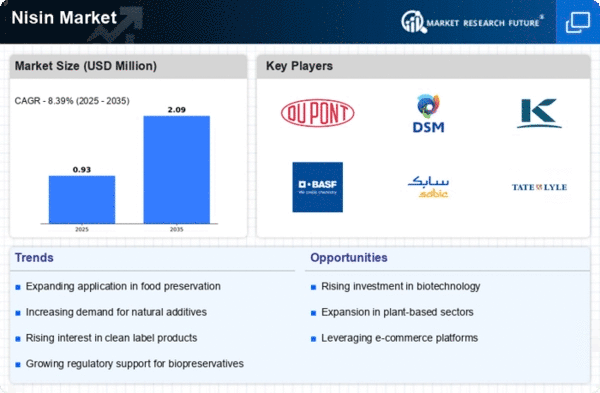
As per MRFR analysis, the Nisin Market Size was estimated at 0.856 USD Million in 2024. The Nisin industry is projected to grow from 0.938 in 2025 to 2.09 by 2035, exhibiting a compound annual growth rate (CAGR) of 8.39 during the forecast period 2025 - 2035.

Key Market Trends & Highlights

The Nisin Market is experiencing robust growth driven by increasing demand for natural preservatives and clean label products.

  • The Nisin Market is witnessing a rising demand for natural preservatives, particularly in North America, which remains the largest market.
  • Expansion into diverse industries, including food preservation and pharmaceuticals, is shaping the market landscape.
  • Regulatory support for natural ingredients is fostering growth, especially in the Asia-Pacific region, which is the fastest-growing market.
  • Key market drivers include increasing consumer awareness of food safety and the growth in the processed food sector, propelling demand for both liquid and powder forms of Nisin.

Market Size & Forecast

2024 Market Size 0.856 (USD Million)
2035 Market Size 2.09 (USD Million)
CAGR (2025 - 2035) 8.39%
Largest Regional Market Share in 2024 Europe

Major Players

DuPont (US), Royal DSM (NL), Kerry Group (IE), BASF (DE), SABIC (SA), Tate & Lyle (GB), Ginkgo BioWorks (US), Mitsubishi Chemical (JP), Wacker Chemie (DE)

Market Trends

The Nisin Market is currently experiencing a notable transformation, driven by increasing consumer awareness regarding food safety and preservation. Nisin, a natural preservative derived from the fermentation of Lactococcus lactis, is gaining traction as a viable alternative to synthetic preservatives. This shift is largely attributed to the growing demand for clean-label products, as consumers increasingly prefer items that are perceived as healthier and more natural. Furthermore, the rise in The Nisin forward. As manufacturers seek to enhance product shelf life without compromising quality, nisin's role becomes increasingly pivotal. In addition to food applications, the Nisin Market is witnessing expansion into the pharmaceutical and cosmetic sectors. The antimicrobial properties of nisin make it an attractive option for preserving various formulations, thereby broadening its applicability. Moreover, ongoing research into the efficacy of nisin in combating antibiotic-resistant bacteria suggests a promising future for its use in healthcare. As regulatory bodies continue to support the use of natural preservatives, the Nisin Market is poised for sustained growth, reflecting a broader trend towards sustainability and health consciousness in consumer choices.

Rising Demand for Natural Preservatives

The Nisin Market is witnessing a surge in demand for natural preservatives as consumers increasingly prioritize health and wellness. This trend is driven by a growing awareness of the potential adverse effects associated with synthetic additives, prompting manufacturers to seek alternatives that align with consumer preferences.

Expansion into Diverse Industries

Nisin is finding applications beyond the food sector, with notable growth in pharmaceuticals and cosmetics. Its antimicrobial properties are being leveraged to enhance product stability and safety, indicating a diversification of its market presence.

Regulatory Support for Natural Ingredients

The Nisin Market benefits from favorable regulatory frameworks that promote the use of natural ingredients in food and other products. This support is likely to encourage further innovation and adoption of nisin, reinforcing its position as a preferred preservative.

Nisin Market Market Drivers

Growing Awareness of Food Safety

In the Global Nisin Market Industry, heightened awareness of food safety plays a crucial role in driving demand for effective preservation methods. Consumers are becoming more informed about foodborne illnesses and the importance of safe food handling practices. Nisin Market, recognized for its ability to combat harmful bacteria, is increasingly utilized in various food products to enhance safety. This awareness is likely to propel the market forward, as food manufacturers prioritize the incorporation of nisin to meet regulatory standards and consumer expectations, thereby fostering a safer food environment.

Expansion in Food and Beverage Sector

The Global Nisin Market Industry is significantly influenced by the expansion of the food and beverage sector, particularly in developing regions. As urbanization and disposable incomes rise, there is an increasing demand for processed and packaged foods. Nisin Market's efficacy in inhibiting spoilage and pathogenic microorganisms makes it a valuable ingredient for manufacturers aiming to ensure product safety and longevity. This trend is expected to contribute to the market's growth, with projections indicating a market size of 490 USD Million by 2035, driven by the ongoing innovation in food preservation techniques.

Rising Demand for Natural Preservatives

The Global Nisin Market Industry experiences a notable surge in demand for natural preservatives as consumers increasingly seek clean-label products. Nisin Market, a natural antimicrobial peptide, aligns with this trend, providing an effective solution for food preservation without synthetic additives. This shift is evidenced by the projected market value of 317.9 USD Million in 2024, reflecting a growing preference for healthier food options. As food safety regulations tighten globally, manufacturers are likely to adopt nisin to enhance product shelf life while meeting consumer expectations for transparency and quality.

Regulatory Support for Natural Additives

Regulatory support for natural additives significantly impacts the Global Nisin Market Industry. Governments worldwide are increasingly endorsing the use of natural preservatives, including nisin, as part of food safety regulations. This support facilitates the acceptance and integration of nisin in various food products, providing manufacturers with a competitive edge. As regulations evolve to favor natural ingredients, the market is expected to flourish, aligning with consumer preferences for healthier options. The anticipated growth trajectory underscores the importance of regulatory frameworks in shaping the future of nisin in food preservation.

Technological Advancements in Food Preservation

Technological advancements in food preservation techniques are reshaping the Global Nisin Market Industry. Innovations in processing methods, such as microencapsulation and nanotechnology, enhance the stability and efficacy of nisin as a preservative. These advancements not only improve the shelf life of food products but also expand the applications of nisin across various food categories. As the industry embraces these technologies, the market is poised for growth, with a projected CAGR of 4.01% from 2025 to 2035, indicating a robust future for nisin in food preservation.

Market Segment Insights

By Application: Food Preservation (Largest) vs. Pharmaceuticals (Fastest-Growing)

In the Nisin Market, the 'Application' segment is predominantly driven by Food Preservation, which captures the largest share. This application is essential in extending the shelf life of various food products, preventing spoilage and maintaining quality. On the other hand, the Pharmaceuticals application is emerging strongly, leveraging Nisin's antimicrobial properties to enhance formulation stability and efficacy. As consumer awareness of food safety increases, the Food Preservation segment is experiencing significant competition from other applications, notably Pharmaceuticals, which is rapidly gaining traction.

Food Preservation: Dominant vs. Pharmaceuticals: Emerging

Food Preservation remains the dominant application in the Nisin Market, leveraging Nisin's natural preservative qualities to meet the growing consumer demand for clean-label products. With stringent food safety regulations and an increasingly discerning consumer base, this segment continues to innovate, pushing for more sustainable and effective preservation techniques. Conversely, the Pharmaceuticals segment is recognized as an emerging player, capitalizing on the unique properties of Nisin to provide solutions in drug formulation and shelf life stability. This application is driven by the rising demand for natural preservatives in medicine and the growing inclination towards organic and eco-friendly products, positioning it as a critical area for investment and growth.

By Formulation Type: Liquid (Largest) vs. Powder (Fastest-Growing)

In the Nisin Market, the formulation type segment is primarily dominated by liquid formulations, which hold the largest market share. This dominance is attributed to the versatility of liquid nisin, which is widely used in various food preservation applications and has a strong presence in the food and beverage industry. Conversely, powder formulations, while accounting for a smaller share, are gaining traction due to their ease of use and long shelf life, positioning them as an emerging option among consumers seeking convenience. Growth trends within the formulation type segment indicate a noticeable shift toward powder forms of nisin, driven by their perceived ease of handling and incorporation into diverse product lines. Moreover, an increase in the rise of clean-label products and the demand for natural preservatives are propelling the growth of powdered nisin. This trend is further emphasized by growing industrial applications and a focus on optimizing product formulations across various sectors, including health and nutrition, where powdered variants are being increasingly favored.

Liquid (Dominant) vs. Powder (Emerging)

Liquid nisin remains the dominant formulation type in the Nisin Market, preferred for its flexibility and effectiveness in food preservation. The liquid form facilitates seamless integration into manufacturing processes, ensuring consistent distribution throughout products. It is highly valued for its ability to enhance shelf life without altering taste or quality. On the other hand, powdered nisin is emerging as a strong contender, owing to its ease of handling and compatibility with various applications, including snacks and dairy products. The powdered form offers convenience for manufacturers and consumers alike, allowing for precise dosing and extended stability. As industry trends shift toward cleaner and more natural ingredients, the demand for powdered nisin is expected to rise significantly, positioning it as a vital player in the formulation type segment.

By End Use Industry: Food and Beverage (Largest) vs. Healthcare (Fastest-Growing)

The Nisin market is prominently driven by the Food and Beverage industry, which holds the largest share due to its extensive applications as a natural preservative in various food products. This segment's dominance is fueled by the increasing consumer demand for clean labels and natural ingredients, which positions Nisin as a preferred choice for manufacturers aiming to enhance food safety and extend shelf life. Conversely, the Healthcare segment is experiencing rapid growth as the use of Nisin in pharmaceutical formulations and its potential as an antimicrobial agent gains traction. This shift towards natural preservatives in healthcare applications is testament to the growing trend of using bio-based products in medicine. The growth trends observed in the Nisin market reflect significant consumer awareness regarding health benefits and food safety. The rising inclination towards organic and natural substances in the Food and Beverage sector enhances Nisin’s market advantage. In Healthcare, innovation in drug formulations is expanding, leading to increased usage of Nisin in therapeutic applications. This duality presents a unique growth trajectory for the Nisin market, driven by consumer preferences and technological advancements, pushing both segments to explore new avenues for application and adoption.

Food and Beverage (Dominant) vs. Healthcare (Emerging)

In the Nisin market, the Food and Beverage segment holds a dominant position, primarily due to its established use in meat products, dairy, and other perishable goods where preservation is crucial. This segment capitalizes on the growing trend of natural preservatives that offer safety without compromising flavor. As consumers increasingly seek out cleaner and safer food options, Nisin's role as a natural antimicrobial agent makes it an ideal ingredient, reinforcing its market dominance. On the other hand, the Healthcare segment is emerging rapidly, characterized by a growing emphasis on natural ingredients in pharmaceutical products. Nisin's efficacy against a broad spectrum of bacteria can support its integration into various healthcare applications, from supplements to advanced drug delivery systems, indicating a promising future in this segment.

By Source: Bacterial Fermentation (Largest) vs. Synthetic Production (Fastest-Growing)

In the Nisin Market, the source segment is primarily divided between Bacterial Fermentation and Synthetic Production. Bacterial Fermentation holds the largest market share due to its natural origins and prevalence in traditional food preservation methods. This approach leverages the use of Lactococcus lactis species, thus establishing its dominance in various food applications, particularly dairy products. Synthetic Production, while currently smaller, is witnessing increasing interest as industries look for scalability and cost-efficiency in nisin production, paving the way for innovation in this niche.

Source: Bacterial Fermentation (Dominant) vs. Synthetic Production (Emerging)

Bacterial Fermentation remains the dominant source of nisin production in the market, favored for its safety profile and acceptance in the food industry. Its method is well-established, relying on naturally occurring bacteria for the fermentation process, which ensures high-quality production. Conversely, Synthetic Production is emerging rapidly, driven by technological advancements that facilitate faster and more cost-effective processes. As manufacturers look for alternatives that can meet increasing demand without compromising on quality, synthetic strategies are being explored. This sector is characterized by strong investment in R&D, aiming to enhance production efficiency and introduce new antimicrobial solutions to the market.

By Regulatory Status: GRAS (Largest) vs. EU Approved (Fastest-Growing)

In the Nisin Market, the regulatory status segmentation reveals a diverse landscape, with GRAS (Generally Recognized As Safe) holding the largest market share. This classification appeals to a wide range of food manufacturers who prioritize safety in their products. In contrast, the EU Approved segment is rapidly gaining traction, as more companies seek compliance with European regulations to enhance their product’s marketability. This dual structure enables significant growth opportunities in the overall market.

Regulatory Status: GRAS (Dominant) vs. Novel Food (Emerging)

The GRAS designation is a dominant force in the Nisin Market, often preferred by manufacturers due to its recognition and reliability in the industry. This status enables easier market entry and consumer confidence, making GRAS a critical factor for product formulation in food and beverage applications. Meanwhile, the Novel Food segment is emerging as a significant player, driven by innovative food technology and changing consumer preferences for novel ingredients. As consumers increasingly seek unique and health-promoting products, the Novel Food category is expected to grow, offering manufacturers avenues to differentiate their offerings in an environmentally conscious market.

Get more detailed insights about Nisin Market Research Report - Forecast till 2035

Regional Insights

North America : Innovation and Demand Growth

The North American Nisin market is projected to grow significantly, driven by increasing consumer demand for natural preservatives and clean-label products. With a market size of $0.3 billion, the region is witnessing a shift towards healthier food options, prompting manufacturers to adopt Nisin as a key ingredient. Regulatory support for natural preservatives further enhances market potential, as food safety standards evolve to favor such solutions. Leading the charge in this market are the United States and Canada, where major players like DuPont and Ginkgo BioWorks are innovating to meet consumer preferences. The competitive landscape is characterized by strategic partnerships and investments in R&D, aimed at enhancing product offerings. As the market matures, companies are focusing on sustainability and efficiency in production processes, positioning themselves for long-term success.

Europe : Market Leader in Nisin Production

Europe holds the largest share of the Nisin market, accounting for $0.4 billion in 2024. The region benefits from stringent food safety regulations that favor the use of natural preservatives, driving demand for Nisin in various food applications. Additionally, the growing trend towards clean-label products is propelling manufacturers to incorporate Nisin, aligning with consumer preferences for healthier options. Countries like the Netherlands, Germany, and the UK are at the forefront of this market, with key players such as Royal DSM and BASF leading the way. The competitive landscape is robust, with companies investing heavily in innovation and sustainability. The presence of established firms and a strong regulatory framework create a conducive environment for growth, ensuring Europe remains a pivotal player in The Nisin.

Asia-Pacific : Emerging Market Potential

The Asia-Pacific Nisin market, valued at $0.1 billion, is on the cusp of significant growth, driven by rising consumer awareness regarding food safety and quality. The region's expanding food and beverage industry is increasingly adopting Nisin as a natural preservative, aligning with global trends towards healthier food options. Regulatory bodies are also beginning to recognize the benefits of natural preservatives, which is expected to catalyze market expansion. Key countries such as Japan, China, and Australia are leading the charge, with local manufacturers exploring innovative applications of Nisin in various food products. The competitive landscape is evolving, with both established players and new entrants vying for market share. As the region embraces modern food technologies, the demand for Nisin is anticipated to rise, creating opportunities for growth and investment.

Middle East and Africa : Untapped Market Opportunities

The Middle East and Africa Nisin market, currently valued at $0.06 billion, presents untapped opportunities for growth. The region is witnessing a gradual shift towards natural food preservatives, driven by increasing health consciousness among consumers. As food safety regulations become more stringent, the demand for Nisin is expected to rise, providing a favorable environment for market expansion. Countries like South Africa and the UAE are emerging as key players in this market, with local manufacturers beginning to adopt Nisin in their product formulations. The competitive landscape is still developing, with opportunities for both local and international companies to establish a foothold. As awareness of the benefits of natural preservatives grows, the Nisin market in this region is poised for significant growth in the coming years.

Key Players and Competitive Insights

The Nisin Market is currently characterized by a dynamic competitive landscape, driven by increasing consumer demand for natural preservatives and the growing awareness of food safety. Key players such as DuPont (US), Royal DSM (NL), and Kerry Group (IE) are strategically positioned to leverage innovation and sustainability in their operations. DuPont (US) focuses on enhancing its product portfolio through research and development, while Royal DSM (NL) emphasizes sustainable practices in its manufacturing processes. Kerry Group (IE) is actively pursuing partnerships to expand its market reach, thereby shaping a competitive environment that prioritizes quality and sustainability.In terms of business tactics, companies are increasingly localizing manufacturing to reduce supply chain vulnerabilities and optimize logistics. The Nisin Market appears moderately fragmented, with several key players exerting influence over their respective segments. This structure allows for a diverse range of products and innovations, fostering competition that is not solely based on price but also on quality and technological advancements.

In November DuPont (US) announced a strategic partnership with a leading biotechnology firm to enhance its Nisin production capabilities. This collaboration is expected to streamline production processes and improve the efficiency of Nisin extraction, thereby positioning DuPont (US) as a frontrunner in the market. The strategic importance of this partnership lies in its potential to reduce costs and increase the availability of Nisin, catering to the rising demand for natural preservatives in the food industry.

In October Royal DSM (NL) launched a new line of Nisin products specifically designed for the dairy sector, targeting the growing need for effective preservation methods. This product launch not only reinforces Royal DSM's commitment to innovation but also highlights its strategic focus on niche markets. By addressing specific industry needs, Royal DSM (NL) is likely to enhance its competitive edge and capture a larger market share.

In September Kerry Group (IE) expanded its operations in Asia by acquiring a local Nisin manufacturer, thereby strengthening its foothold in the region. This acquisition is significant as it allows Kerry Group (IE) to tap into the rapidly growing Asian market, which is increasingly seeking natural food preservatives. The move underscores the importance of regional expansion in the current competitive landscape, where local presence can significantly influence market dynamics.

As of December current trends in the Nisin Market indicate a strong shift towards digitalization, sustainability, and the integration of AI technologies in production processes. Strategic alliances are becoming increasingly vital, as companies seek to enhance their capabilities and market reach. The competitive differentiation is likely to evolve from traditional price-based competition to a focus on innovation, technological advancements, and supply chain reliability, reflecting a broader industry trend towards quality and sustainability.

Key Companies in the Nisin Market include

Industry Developments

  • Q1 2024: DuPont Nutrition & Biosciences Launches New Nisin Market-Based Preservative for dairy Applications DuPont Nutrition & Biosciences announced the launch of a new nisin-based preservative designed specifically for dairy products, aiming to extend shelf life and improve food safety in response to rising consumer demand for natural ingredients.
  • Q2 2024: DSM-Firmenich Expands Nisin Market Production Capacity at Delft Facility DSM-Firmenich completed a major expansion of its nisin production facility in Delft, Netherlands, increasing output to meet growing demand from food and beverage manufacturers seeking natural antimicrobial solutions.
  • Q2 2024: Handary Secures Regulatory Approval for Nisin Market-Based Preservative in Japan Handary received regulatory approval from Japan’s Ministry of Health, Labour and Welfare for its nisin-based food preservative, enabling the company to enter the Japanese market and supply local food processors.
  • Q3 2024: Galactic Signs Strategic Partnership with Nestlé for Nisin Market Application in Ready-to-Eat Meals Galactic announced a strategic partnership with Nestlé to supply nisin for use in Nestlé’s ready-to-eat meal lines, aiming to enhance product safety and shelf life while meeting clean-label requirements.
  • Q3 2024: Chihon Biotechnology Announces $20 Million Investment in New Nisin Market Manufacturing Plant in China Chihon Biotechnology revealed plans to invest $20 million in a new nisin production facility in Jiangsu province, China, to expand its capacity and serve growing demand in the Asia-Pacific region.
  • Q4 2024: Siveele Launches Nisin Market-Based Preservative for Plant-Based Meat Alternatives Siveele introduced a new nisin-based preservative tailored for plant-based meat products, targeting manufacturers seeking natural solutions to extend shelf life and prevent spoilage.
  • Q4 2024: DuPont Nutrition & Biosciences Wins Major Contract to Supply Nisin Market to Unilever DuPont Nutrition & Biosciences secured a multi-year contract to supply nisin to Unilever for use in its global portfolio of processed foods, marking a significant expansion of DuPont’s commercial reach.
  • Q1 2025: Handary Appoints New CEO to Lead Global Expansion of Nisin Market Product Line Handary announced the appointment of a new CEO, tasked with driving international growth and expanding the company’s nisin-based preservative offerings in new markets.
  • Q1 2025: Galactic Receives EU Regulatory Approval for Nisin Market Use in Non-dairy beverages Galactic obtained regulatory clearance from the European Food Safety Authority (EFSA) for the use of nisin in non-dairy beverage applications, opening new market opportunities in Europe.
  • Q2 2025: DSM-Firmenich Announces Partnership with PepsiCo for Nisin Market-Based Preservation in Snack Foods DSM-Firmenich entered into a partnership with PepsiCo to develop and supply nisin-based preservatives for use in select snack food products, aiming to improve shelf life and meet consumer demand for natural ingredients.
  • Q2 2025: Chihon Biotechnology Wins Government Grant for Nisin Market Research and Development Chihon Biotechnology was awarded a government grant to support research and development of advanced nisin formulations, focusing on improved efficacy and broader application in food preservation.
  • Q3 2025: Siveele Opens New R&D Center Focused on Nisin Market Innovation Siveele inaugurated a new research and development center dedicated to nisin innovation, aiming to accelerate the development of novel preservative solutions for the food industry.

Intended Audience

This report will be beneficial for every stakeholder of the nisin market such as :

    • Manufacturers of nisin
    • Food products Laboratories
    • R&D Institutes
    • Traders and distributors
    • Potential investors
    • End-user industries

Report Outlook

This report from Market Research Future provides an in-depth analysis of the nisin market in terms of current value and future forecast. This report has also highlighted the problems and prospects of the given market. Moreover, the technological analysis section of the report will help in understanding the product and its market prospects.  Furthermore, this report contains a detailed analysis of different market segments for the current forecast period. This report has also identified the key players and the current developments in the nisin market. 

Future Outlook

Nisin Market Future Outlook

The Nisin Market is projected to grow at 8.39% CAGR from 2025 to 2035, driven by increasing demand for natural preservatives and food safety regulations.

New opportunities lie in:

  • Expansion into plant-based food preservation solutions.
  • Development of customized nisin formulations for specific food applications.
  • Strategic partnerships with food manufacturers for integrated preservation systems.

By 2035, the Nisin Market is expected to achieve robust growth, solidifying its position in the food preservation sector.

Market Segmentation

Nisin Market Source Outlook

  • Bacterial Fermentation
  • Synthetic Production

Nisin Market Application Outlook

  • Food Preservation
  • Pharmaceuticals
  • Cosmetics
  • Animal Feed

Nisin Market End Use Industry Outlook

  • Food and Beverage
  • Healthcare
  • Personal Care
  • Agriculture

Nisin Market Formulation Type Outlook

  • Liquid
  • Powder
  • Granular

Nisin Market Regulatory Status Outlook

  • GRAS
  • EU Approved
  • Novel Food

Report Scope

MARKET SIZE 20240.856(USD Million)
MARKET SIZE 20250.938(USD Million)
MARKET SIZE 20352.09(USD Million)
COMPOUND ANNUAL GROWTH RATE (CAGR)8.39% (2025 - 2035)
REPORT COVERAGERevenue Forecast, Competitive Landscape, Growth Factors, and Trends
BASE YEAR2024
Market Forecast Period2025 - 2035
Historical Data2019 - 2024
Market Forecast UnitsUSD Million
Key Companies ProfiledDuPont (US), Royal DSM (NL), Kerry Group (IE), BASF (DE), SABIC (SA), Tate & Lyle (GB), Ginkgo BioWorks (US), Mitsubishi Chemical (JP), Wacker Chemie (DE)
Segments CoveredApplication, Formulation Type, End Use Industry, Source, Regulatory Status
Key Market OpportunitiesGrowing demand for natural preservatives in food products enhances opportunities in the Nisin Market.
Key Market DynamicsRising demand for natural preservatives drives innovation and competition in the Nisin market.
Countries CoveredNorth America, Europe, APAC, South America, MEA

FAQs

What is the major Growth driving factor of the nisin market?

The increasing demand for packaged, pre-processed, and frozen foods and effective preservatives is the major factor driving the growth of the Global nisin market.

Which region leads the nisin market in terms of value?

North America accounts for the largest share of the Global nisin market owing to the huge demand for packaged food items.

Which class of nisin is expected to have the highest market value during the current forecast period?

Dairy and frozen desserts are the largest end-user of nisin as a preservative due to its effectiveness in preserving temperature-sensitive products.

Who are the key players of the global nisin market?

The major global companies playing a key role in the nisin market are : DSM (Netherlands),Galactic (Belgium),DuPont (US),Shandong Freda Biotechnology (China),Siveele B.V. (Netherlands),Cayman Chemicals (US),Chihon Biotechnology (China),Handary S.A. (Belgium),Zhejiang Silver-Elephant Bioengineering (China)● Mayasan Biotech (Turkey)

  1. SECTION I: EXECUTIVE SUMMARY AND KEY HIGHLIGHTS
    1. | 1.1 EXECUTIVE SUMMARY
    2. | 1.1.1 Market Overview
    3. | 1.1.2 Key Findings
    4. | 1.1.3 Market Segmentation
    5. | 1.1.4 Competitive Landscape
    6. | 1.1.5 Challenges and Opportunities
    7. | 1.1.6 Future Outlook
  2. SECTION II: SCOPING, METHODOLOGY AND MARKET STRUCTURE
    1. | 2.1 MARKET INTRODUCTION
    2. | 2.1.1 Definition
    3. | 2.1.2 Scope of the study
    4. |-- 2.1.2.1 Research Objective
    5. |-- 2.1.2.2 Assumption
    6. |-- 2.1.2.3 Limitations
    7. | 2.2 RESEARCH METHODOLOGY
    8. | 2.2.1 Overview
    9. | 2.2.2 Data Mining
    10. | 2.2.3 Secondary Research
    11. | 2.2.4 Primary Research
    12. |-- 2.2.4.1 Primary Interviews and Information Gathering Process
    13. |-- 2.2.4.2 Breakdown of Primary Respondents
    14. | 2.2.5 Forecasting Model
    15. | 2.2.6 Market Size Estimation
    16. |-- 2.2.6.1 Bottom-Up Approach
    17. |-- 2.2.6.2 Top-Down Approach
    18. | 2.2.7 Data Triangulation
    19. | 2.2.8 Validation
  3. SECTION III: QUALITATIVE ANALYSIS
    1. | 3.1 MARKET DYNAMICS
    2. | 3.1.1 Overview
    3. | 3.1.2 Drivers
    4. | 3.1.3 Restraints
    5. | 3.1.4 Opportunities
    6. | 3.2 MARKET FACTOR ANALYSIS
    7. | 3.2.1 Value chain Analysis
    8. | 3.2.2 Porter's Five Forces Analysis
    9. |-- 3.2.2.1 Bargaining Power of Suppliers
    10. |-- 3.2.2.2 Bargaining Power of Buyers
    11. |-- 3.2.2.3 Threat of New Entrants
    12. |-- 3.2.2.4 Threat of Substitutes
    13. |-- 3.2.2.5 Intensity of Rivalry
    14. | 3.2.3 COVID-19 Impact Analysis
    15. |-- 3.2.3.1 Market Impact Analysis
    16. |-- 3.2.3.2 Regional Impact
    17. |-- 3.2.3.3 Opportunity and Threat Analysis
  4. SECTION IV: QUANTITATIVE ANALYSIS
    1. | 4.1 Food, Beverages & Nutrition, BY Application (USD Million)
    2. | 4.1.1 Food Preservation
    3. | 4.1.2 Pharmaceuticals
    4. | 4.1.3 Cosmetics
    5. | 4.1.4 Animal Feed
    6. | 4.2 Food, Beverages & Nutrition, BY Formulation Type (USD Million)
    7. | 4.2.1 Liquid
    8. | 4.2.2 Powder
    9. | 4.2.3 Granular
    10. | 4.3 Food, Beverages & Nutrition, BY End Use Industry (USD Million)
    11. | 4.3.1 Food and Beverage
    12. | 4.3.2 Healthcare
    13. | 4.3.3 Personal Care
    14. | 4.3.4 Agriculture
    15. | 4.4 Food, Beverages & Nutrition, BY Source (USD Million)
    16. | 4.4.1 Bacterial Fermentation
    17. | 4.4.2 Synthetic Production
    18. | 4.5 Food, Beverages & Nutrition, BY Regulatory Status (USD Million)
    19. | 4.5.1 GRAS
    20. | 4.5.2 EU Approved
    21. | 4.5.3 Novel Food
    22. | 4.6 Food, Beverages & Nutrition, BY Region (USD Million)
    23. | 4.6.1 North America
    24. |-- 4.6.1.1 US
    25. |-- 4.6.1.2 Canada
    26. | 4.6.2 Europe
    27. |-- 4.6.2.1 Germany
    28. |-- 4.6.2.2 UK
    29. |-- 4.6.2.3 France
    30. |-- 4.6.2.4 Russia
    31. |-- 4.6.2.5 Italy
    32. |-- 4.6.2.6 Spain
    33. |-- 4.6.2.7 Rest of Europe
    34. | 4.6.3 APAC
    35. |-- 4.6.3.1 China
    36. |-- 4.6.3.2 India
    37. |-- 4.6.3.3 Japan
    38. |-- 4.6.3.4 South Korea
    39. |-- 4.6.3.5 Malaysia
    40. |-- 4.6.3.6 Thailand
    41. |-- 4.6.3.7 Indonesia
    42. |-- 4.6.3.8 Rest of APAC
    43. | 4.6.4 South America
    44. |-- 4.6.4.1 Brazil
    45. |-- 4.6.4.2 Mexico
    46. |-- 4.6.4.3 Argentina
    47. |-- 4.6.4.4 Rest of South America
    48. | 4.6.5 MEA
    49. |-- 4.6.5.1 GCC Countries
    50. |-- 4.6.5.2 South Africa
    51. |-- 4.6.5.3 Rest of MEA
  5. SECTION V: COMPETITIVE ANALYSIS
    1. | 5.1 Competitive Landscape
    2. | 5.1.1 Overview
    3. | 5.1.2 Competitive Analysis
    4. | 5.1.3 Market share Analysis
    5. | 5.1.4 Major Growth Strategy in the Food, Beverages & Nutrition
    6. | 5.1.5 Competitive Benchmarking
    7. | 5.1.6 Leading Players in Terms of Number of Developments in the Food, Beverages & Nutrition
    8. | 5.1.7 Key developments and growth strategies
    9. |-- 5.1.7.1 New Product Launch/Service Deployment
    10. |-- 5.1.7.2 Merger & Acquisitions
    11. |-- 5.1.7.3 Joint Ventures
    12. | 5.1.8 Major Players Financial Matrix
    13. |-- 5.1.8.1 Sales and Operating Income
    14. |-- 5.1.8.2 Major Players R&D Expenditure. 2023
    15. | 5.2 Company Profiles
    16. | 5.2.1 DuPont (US)
    17. |-- 5.2.1.1 Financial Overview
    18. |-- 5.2.1.2 Products Offered
    19. |-- 5.2.1.3 Key Developments
    20. |-- 5.2.1.4 SWOT Analysis
    21. |-- 5.2.1.5 Key Strategies
    22. | 5.2.2 Royal DSM (NL)
    23. |-- 5.2.2.1 Financial Overview
    24. |-- 5.2.2.2 Products Offered
    25. |-- 5.2.2.3 Key Developments
    26. |-- 5.2.2.4 SWOT Analysis
    27. |-- 5.2.2.5 Key Strategies
    28. | 5.2.3 Kerry Group (IE)
    29. |-- 5.2.3.1 Financial Overview
    30. |-- 5.2.3.2 Products Offered
    31. |-- 5.2.3.3 Key Developments
    32. |-- 5.2.3.4 SWOT Analysis
    33. |-- 5.2.3.5 Key Strategies
    34. | 5.2.4 BASF (DE)
    35. |-- 5.2.4.1 Financial Overview
    36. |-- 5.2.4.2 Products Offered
    37. |-- 5.2.4.3 Key Developments
    38. |-- 5.2.4.4 SWOT Analysis
    39. |-- 5.2.4.5 Key Strategies
    40. | 5.2.5 SABIC (SA)
    41. |-- 5.2.5.1 Financial Overview
    42. |-- 5.2.5.2 Products Offered
    43. |-- 5.2.5.3 Key Developments
    44. |-- 5.2.5.4 SWOT Analysis
    45. |-- 5.2.5.5 Key Strategies
    46. | 5.2.6 Tate & Lyle (GB)
    47. |-- 5.2.6.1 Financial Overview
    48. |-- 5.2.6.2 Products Offered
    49. |-- 5.2.6.3 Key Developments
    50. |-- 5.2.6.4 SWOT Analysis
    51. |-- 5.2.6.5 Key Strategies
    52. | 5.2.7 Ginkgo BioWorks (US)
    53. |-- 5.2.7.1 Financial Overview
    54. |-- 5.2.7.2 Products Offered
    55. |-- 5.2.7.3 Key Developments
    56. |-- 5.2.7.4 SWOT Analysis
    57. |-- 5.2.7.5 Key Strategies
    58. | 5.2.8 Mitsubishi Chemical (JP)
    59. |-- 5.2.8.1 Financial Overview
    60. |-- 5.2.8.2 Products Offered
    61. |-- 5.2.8.3 Key Developments
    62. |-- 5.2.8.4 SWOT Analysis
    63. |-- 5.2.8.5 Key Strategies
    64. | 5.2.9 Wacker Chemie (DE)
    65. |-- 5.2.9.1 Financial Overview
    66. |-- 5.2.9.2 Products Offered
    67. |-- 5.2.9.3 Key Developments
    68. |-- 5.2.9.4 SWOT Analysis
    69. |-- 5.2.9.5 Key Strategies
    70. | 5.3 Appendix
    71. | 5.3.1 References
    72. | 5.3.2 Related Reports

Food, Beverages & Nutrition Market Segmentation

Food, Beverages & Nutrition By Application (USD Million, 2025-2035)

  • Food Preservation
  • Pharmaceuticals
  • Cosmetics
  • Animal Feed

Food, Beverages & Nutrition By Formulation Type (USD Million, 2025-2035)

  • Liquid
  • Powder
  • Granular

Food, Beverages & Nutrition By End Use Industry (USD Million, 2025-2035)

  • Food and Beverage
  • Healthcare
  • Personal Care
  • Agriculture

Food, Beverages & Nutrition By Source (USD Million, 2025-2035)

  • Bacterial Fermentation
  • Synthetic Production

Food, Beverages & Nutrition By Regulatory Status (USD Million, 2025-2035)

  • GRAS
  • EU Approved
  • Novel Food
Infographic

Free Sample Request

Kindly complete the form below to receive a free sample of this Report

Get Free Sample

Customer Strories

Compare Licence

×
Features License Type
Single User Multiuser License Enterprise User
Price $4,950 $5,950 $7,250
Maximum User Access Limit 1 User Upto 10 Users Unrestricted Access Throughout the Organization
Free Customization
Direct Access to Analyst
Deliverable Format
Platform Access
Discount on Next Purchase 10% 15% 15%
Printable Versions