×
Request Free Sample ×

Kindly complete the form below to receive a free sample of this Report

* Please use a valid business email

Leading companies partner with us for data-driven Insights

clients tt-cursor
Hero Background

Nickel Foam Market

ID: MRFR/CnM/37201-HCR
111 Pages
Chitranshi Jaiswal
February 2026

Nickel Foam Market Research Report By Application (Battery, Electrochemical Devices, Catalyst Support), By Type (Nickel Foam Sheet, Nickel Foam Plate, Nickel Foam Block), By End Use (Energy Storage Systems, Fuel Cells, High-Performance Batteries), By Porosity (Open Cell, Closed Cell) and  By Regional (North America, Europe, South America, Asia Pacific, Middle East and Africa)  - Forecast to 2035.

Share:
Download PDF ×

We do not share your information with anyone. However, we may send you emails based on your report interest from time to time. You may contact us at any time to opt-out.

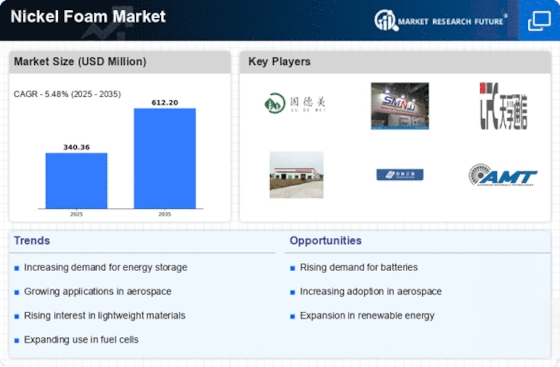
Nickel Foam Market Infographic
Purchase Options

Nickel Foam Market Summary

As per Market Research Future analysis, the Nickel Foam Market Size was estimated at 340.36 USD Million in 2024. The Nickel Foam industry is projected to grow from 359.01 USD Million in 2025 to 612.2 USD Million by 2035, exhibiting a compound annual growth rate (CAGR) of 5.48% during the forecast period 2025 - 2035

Key Market Trends & Highlights

The Nickel Foam Market is poised for growth driven by advancements in technology and increasing demand for sustainable solutions.

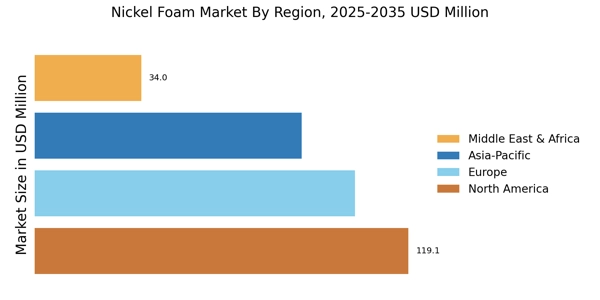
  • North America remains the largest market for nickel foam, driven by its extensive applications in energy storage and aerospace sectors.
  • The Asia-Pacific region is emerging as the fastest-growing market, fueled by rapid industrialization and technological advancements.
  • The battery segment holds the largest share, while the electrochemical devices segment is witnessing the fastest growth due to rising demand for innovative energy solutions.
  • Key market drivers include the rising demand for energy storage solutions and the expansion of the aerospace and defense sector.

Market Size & Forecast

2024 Market Size 340.36 (USD Million)
2035 Market Size 612.2 (USD Million)
CAGR (2025 - 2035) 5.48%

Major Players

Foshan Dingsheng New Materials Co (CN), Ningbo Jinji New Materials Co (CN), Suzhou TFC Technology Co (CN), Hunan Aofeng New Materials Co (CN), Zhongke Sanhuan High-tech Co (CN), Advanced Materials Technologies (US), GKN Sinter Metals (GB), Duke University (US)

Our Impact
Enabled $4.3B Revenue Impact for Fortune 500 and Leading Multinationals
Partnering with 2000+ Global Organizations Each Year
30K+ Citations by Top-Tier Firms in the Industry

Nickel Foam Market Trends

The Nickel Foam Market is currently experiencing a notable evolution, driven by various factors that influence its demand and application across multiple industries. This material, characterized by its lightweight and high porosity, finds extensive use in energy storage systems, particularly in batteries and fuel cells. The increasing emphasis on sustainable energy solutions appears to bolster the market, as nickel foam serves as an efficient conductive substrate, enhancing the performance of these technologies. Furthermore, the automotive sector's shift towards electric vehicles may further stimulate the demand for nickel foam, as it plays a crucial role in the development of advanced battery systems. In addition to energy applications, the Nickel Foam Market is also witnessing growth in the aerospace and defense sectors, where its unique properties contribute to weight reduction and improved structural integrity. The ongoing advancements in manufacturing techniques, such as the development of more efficient production processes, seem to enhance the material's availability and affordability. As industries increasingly prioritize lightweight materials to improve efficiency and reduce emissions, the Nickel Foam Market is poised for continued expansion, potentially leading to innovative applications and increased market penetration in the coming years.

Sustainable Energy Solutions

The Nickel Foam Market is increasingly aligned with the global shift towards sustainable energy. As renewable energy technologies gain traction, nickel foam's role in energy storage systems, particularly in batteries and fuel cells, becomes more pronounced. This trend suggests a growing demand for materials that enhance energy efficiency and performance.

Advancements in Manufacturing Techniques

Recent innovations in manufacturing processes appear to improve the production efficiency of nickel foam. Enhanced techniques may lead to reduced costs and increased availability, making this material more accessible to various industries. This trend indicates a potential for broader adoption across sectors.

Growth in Aerospace and Defense Applications

The aerospace and defense industries are increasingly recognizing the advantages of nickel foam, particularly its lightweight and high-strength characteristics. This trend suggests that as these sectors seek to optimize performance and reduce weight, the demand for nickel foam may rise significantly.

Nickel Foam Market Drivers

Growing Applications in Medical Devices

The Nickel Foam Market is witnessing a growing interest in the use of nickel foam in medical devices, particularly in the field of implants and prosthetics. Nickel foam's biocompatibility and structural integrity make it an attractive option for applications that require lightweight yet durable materials. As the healthcare sector continues to innovate, the demand for advanced materials that can enhance the performance of medical devices is on the rise. Recent studies suggest that the market for medical devices is expected to grow at a CAGR of around 7% in the coming years. This growth is likely to drive the adoption of nickel foam in various medical applications, including orthopedic implants and dental devices. As a result, the Nickel Foam Market is positioned to benefit from this trend, as manufacturers explore new opportunities in the healthcare sector.

Rising Demand for Energy Storage Solutions

The Nickel Foam Market is experiencing a notable surge in demand due to the increasing need for efficient energy storage solutions. Nickel foam is utilized in the production of batteries, particularly nickel-metal hydride (NiMH) batteries, which are gaining traction in electric vehicles and renewable energy systems. As the global push for sustainable energy intensifies, the market for nickel foam is projected to grow significantly. According to recent estimates, the energy storage sector is expected to expand at a compound annual growth rate (CAGR) of over 20% in the coming years. This growth is likely to drive the demand for nickel foam, as manufacturers seek materials that enhance battery performance and longevity. Consequently, the Nickel Foam Market stands to benefit from this trend, as it aligns with the broader shift towards sustainable energy solutions.

Expansion of the Aerospace and Defense Sector

The Nickel Foam Market is benefiting from the expansion of the aerospace and defense sector, which increasingly requires lightweight and high-performance materials. Nickel foam is recognized for its excellent strength-to-weight ratio and thermal stability, making it an ideal choice for applications in aircraft and military equipment. As defense budgets rise and aerospace projects proliferate, the demand for nickel foam is expected to increase. Recent reports indicate that the aerospace sector alone is projected to grow at a CAGR of approximately 5% over the next decade. This growth is likely to drive investments in nickel foam production, as manufacturers seek to cater to the specific needs of aerospace and defense applications. Consequently, the Nickel Foam Market is well-positioned to capitalize on this trend, as it aligns with the increasing focus on advanced materials in these critical sectors.

Technological Innovations in Manufacturing Processes

Technological advancements in manufacturing processes are playing a crucial role in shaping the Nickel Foam Market. Innovations such as improved electroforming techniques and the development of advanced sintering methods are enhancing the quality and efficiency of nickel foam production. These advancements not only reduce production costs but also enable manufacturers to create nickel foam with superior properties, such as increased porosity and conductivity. As a result, the market is witnessing a shift towards higher-quality products that meet the evolving demands of various applications, including fuel cells and batteries. The introduction of automated manufacturing systems is also streamlining production, further contributing to market growth. With these technological innovations, the Nickel Foam Market is poised for expansion, as manufacturers can offer more competitive and efficient products to meet the needs of diverse industries.

Increased Focus on Sustainable Manufacturing Practices

The Nickel Foam Market is increasingly influenced by the global emphasis on sustainable manufacturing practices. As industries strive to reduce their environmental footprint, the demand for materials that can be produced with minimal waste and energy consumption is rising. Nickel foam, known for its recyclability and efficient production methods, aligns well with these sustainability goals. Manufacturers are adopting greener practices, such as utilizing renewable energy sources in production and implementing closed-loop systems to minimize waste. This shift towards sustainability is expected to drive the growth of the nickel foam market, as companies seek to meet regulatory requirements and consumer preferences for eco-friendly products. Recent data indicates that the sustainable materials market is projected to grow significantly, further enhancing the prospects for the Nickel Foam Market as it adapts to these evolving demands.


Market Segment Insights

By Application: Battery (Largest) vs. Electrochemical Devices (Fastest-Growing)

The Nickel Foam Market exhibits a diversified application landscape, with the Battery segment holding the largest market share. This segment encompasses a range of applications including electric vehicles and energy storage systems, solidifying its dominance in the industry. In contrast, the Electrochemical Devices segment, while smaller in comparison to batteries, is witnessing rapid growth as innovations in fuel cells and energy conversion technologies drive increased demand.

Battery (Dominant) vs. Electrochemical Devices (Emerging)

The Battery application segment of the Nickel Foam Market is characterized by its extensive use in advanced energy storage solutions, particularly in electric vehicles and renewable energy systems. This segment benefits from developments in battery technology, which require materials that enhance energy density and efficiency. On the other hand, the Electrochemical Devices segment represents an emerging market fueled by demand for innovative devices like fuel cells. While not as prominent as the battery segment, its growth is being propelled by advancements in electrochemistry and the increasing need for sustainable energy solutions.

By Type: Nickel Foam Market Sheet (Largest) vs. Nickel Foam Market Plate (Fastest-Growing)

In the Nickel Foam Market, the distribution among types reveals that Nickel Foam Market Sheet holds the largest share, largely due to its versatile applications in battery technologies and electronics. It serves as a preferred substrate due to its lightweight and high conductivity. In contrast, Nickel Foam Market Plate is rapidly gaining traction, appealing to sectors such as energy storage and fuel cells, showcasing an increasing market presence thanks to its structural benefits and performance enhancements in various applications. The growth trends within this segment point to an upward trajectory fueled by the rising demand for energy-efficient technologies. As industries strive for innovations in energy storage systems and lightweight components for electronic devices, the Nickel Foam Market Plate is positioned for substantial expansion. Market drivers include advancements in manufacturing processes and increased investments in clean energy solutions, which further bolster the demand for both segment values especially in aerospace and automotive applications.

Nickel Foam Market Sheet (Dominant) vs. Nickel Foam Market Block (Emerging)

Nickel Foam Market Sheet stands out as the dominant product in the Nickel Foam Market, celebrated for its exceptional conductive properties and adaptability across numerous applications including batteries, capacitors, and lightweight components. It is widely recognized for its ability to enhance performance and efficiency in energy storage systems. Meanwhile, Nickel Foam Market Block represents an emerging segment, gaining attention for its structural stability and potential use in specialized applications. Although it currently holds a smaller market share, its robustness makes it attractive for industries seeking superior support in high-stress environments. The potential for innovation and dual-purpose functionality in the Nickel Foam Market Block promises to carve out a significant position in the market as demand for resilient, lightweight materials continues to surge.

By End Use: Energy Storage Systems (Largest) vs. Fuel Cells (Fastest-Growing)

The Nickel Foam Market showcases a distinct distribution among its primary end-use segments: Energy Storage Systems, Fuel Cells, and High-Performance Batteries. Energy Storage Systems command the largest share, driven by the rising demand for efficient energy storage solutions. Meanwhile, Fuel Cells have emerged as a significant player in this market, capturing attention due to their innovative applications in clean energy solutions. High-Performance Batteries are also vital, serving as an essential component within electric vehicles and portable electronics, thus contributing to the overall market dynamics.

Energy Storage Systems (Dominant) vs. Fuel Cells (Emerging)

Energy Storage Systems are the dominant segment in the Nickel Foam Market, benefiting from their critical role in renewable energy integration and backup power solutions. They utilize nickel foam due to its excellent conductivity and lightweight properties, enhancing overall system efficiency. Conversely, Fuel Cells represent the emerging segment, characterized by their rapid adoption in various sectors, including automotive and stationary power generation. The lightweight and conductive nature of nickel foam makes it ideal for fuel cell applications. This segment is being propelled by growing environmental concerns and advancements in technology, positioning Fuel Cells as a sustainable alternative for energy production.

By Porosity: Open Cell (Largest) vs. Closed Cell (Fastest-Growing)

In the Nickel Foam Market, Open Cell porosity currently dominates the market, primarily due to its superior fluid permeability and structural strength. This segment has been recognized for its wide application in energy storage devices and catalysts, thus holding a significant market share. On the other hand, Closed Cell porosity, while smaller in market share, is emerging rapidly, driven by its application in advanced technological sectors seeking lightweight materials with enhanced insulation properties.

Porosity: Open Cell (Dominant) vs. Closed Cell (Emerging)

Open Cell nickel foam is characterized by its high porosity and interconnected structure, making it ideal for applications requiring efficient energy transfer, such as batteries and fuel cells. The versatility and performance of this type has made it the dominate force in the market. In contrast, Closed Cell nickel foam offers advantages such as superior thermal and acoustic insulation. Its rapid growth is fueled by increased demand from sectors focused on lightweight, sustainable materials. While still emerging, Closed Cell products are gaining traction among manufacturers looking to innovate in various applications.

Get more detailed insights about Nickel Foam Market

Regional Insights

North America : Innovation and Demand Surge

North America is witnessing significant growth in the nickel foam market, driven by increasing demand in energy storage and automotive sectors. The region holds approximately 35% of the global market share, making it the largest market. Regulatory support for clean energy technologies and advancements in battery technologies are key growth catalysts. The U.S. and Canada are leading this growth, with a focus on sustainable materials and innovative applications. The competitive landscape is characterized by the presence of major players such as Advanced Materials Technologies and Duke University, which are at the forefront of research and development. The U.S. market is particularly strong due to its robust manufacturing capabilities and investment in renewable energy technologies. Companies are increasingly collaborating with research institutions to enhance product offerings and meet evolving market demands.

Europe : Sustainability and Innovation Focus

Europe is emerging as a significant player in the nickel foam market, driven by stringent environmental regulations and a strong push for sustainable energy solutions. The region accounts for approximately 30% of the global market share, making it the second-largest market. The European Union's commitment to reducing carbon emissions and promoting renewable energy sources is a major driver of demand for nickel foam in applications like batteries and fuel cells. Leading countries in this region include Germany, France, and the UK, where companies are investing heavily in research and development. The competitive landscape features key players such as GKN Sinter Metals, which is focusing on innovative manufacturing processes. The presence of strong regulatory frameworks encourages investment in sustainable technologies, further enhancing market growth.

Asia-Pacific : Emerging Markets and Growth Potential

Asia-Pacific is witnessing rapid growth in the nickel foam market, fueled by industrialization and increasing demand for energy storage solutions. The region holds about 25% of the global market share, with China being the largest contributor. The government's initiatives to promote electric vehicles and renewable energy technologies are significant growth drivers, alongside rising investments in infrastructure and manufacturing. China, Japan, and South Korea are leading countries in this market, with numerous local manufacturers like Foshan Dingsheng New Materials and Ningbo Jinji New Materials. The competitive landscape is evolving, with companies focusing on technological advancements and cost-effective production methods. The region's growth is further supported by favorable government policies aimed at enhancing the adoption of clean energy technologies.

Middle East and Africa : Resource-Rich and Emerging Markets

The Middle East and Africa region is gradually emerging in the nickel foam market, driven by resource availability and increasing industrial activities. The region currently holds about 10% of the global market share, with potential for significant growth as countries diversify their economies. Investments in renewable energy projects and infrastructure development are key factors driving demand for nickel foam in this region. Leading countries include South Africa and the UAE, where local manufacturers are beginning to explore opportunities in the nickel foam sector. The competitive landscape is still developing, with a focus on establishing partnerships and collaborations to enhance production capabilities. As the region continues to invest in sustainable technologies, the nickel foam market is expected to expand significantly in the coming years.

Nickel Foam Market Regional Image

Key Players and Competitive Insights

The Nickel Foam Market is currently characterized by a dynamic competitive landscape, driven by increasing demand for lightweight materials in various applications, including energy storage and automotive sectors. Key players such as Foshan Dingsheng New Materials Co (China), Advanced Materials Technologies (US), and GKN Sinter Metals (GB) are strategically positioning themselves through innovation and regional expansion. Foshan Dingsheng, for instance, focuses on enhancing production capabilities to meet the rising demand for high-performance nickel foam, while Advanced Materials Technologies emphasizes research and development to create advanced materials tailored for specific applications. These strategies collectively contribute to a competitive environment that is increasingly focused on technological advancement and market responsiveness.In terms of business tactics, companies are localizing manufacturing to reduce lead times and optimize supply chains. The Nickel Foam Market appears moderately fragmented, with several players vying for market share. The collective influence of these key players is significant, as they not only drive innovation but also set industry standards that smaller companies may follow. This competitive structure fosters an environment where agility and responsiveness to market needs are paramount.

In August GKN Sinter Metals (GB) announced a partnership with a leading battery manufacturer to develop nickel foam solutions specifically for next-generation energy storage systems. This strategic move is likely to enhance GKN's position in the growing energy sector, aligning with the global shift towards sustainable energy solutions. By leveraging its expertise in sintered materials, GKN aims to create products that meet the stringent requirements of modern energy applications, thereby solidifying its competitive edge.

In September Advanced Materials Technologies (US) launched a new line of nickel foam products designed for use in fuel cells. This initiative reflects the company's commitment to innovation and sustainability, as fuel cells are increasingly recognized as a clean energy alternative. The introduction of these products not only diversifies Advanced Materials' portfolio but also positions the company as a key player in the transition towards greener technologies, potentially attracting new customers in the renewable energy sector.

In October Foshan Dingsheng New Materials Co (China) expanded its manufacturing facility to increase production capacity by 30%. This expansion is indicative of the company's proactive approach to meet the surging demand for nickel foam in various industries. By enhancing its production capabilities, Foshan Dingsheng is likely to improve its market share and respond more effectively to customer needs, thereby reinforcing its competitive position in the market.

As of October current trends in the Nickel Foam Market are heavily influenced by digitalization, sustainability, and the integration of artificial intelligence in manufacturing processes. Strategic alliances are becoming increasingly important, as companies seek to combine resources and expertise to innovate more rapidly. The competitive differentiation is expected to evolve, shifting from traditional price-based competition to a focus on innovation, technological advancements, and supply chain reliability. This transition suggests that companies that prioritize these aspects will likely emerge as leaders in the Nickel Foam Market.

Key Companies in the Nickel Foam Market include

Industry Developments

In recent developments within the  Nickel Foam Market, companies such as Lundin Mining and Vale are focusing on sustainable mining practices, which have garnered attention due to increasing environmental regulations.

The Indonesian Battery Industry is experiencing growth as it capitalizes on the rising demand for electric vehicles, thereby influencing nickel foam production. Additionally, Nickel Asia Corporation has reported increased output to meet heightened  demand amid rising battery component requirements.

Anglo-American and BHP are also modifying their strategies to align with evolving market dynamics, enhancing their production capabilities. Recent acquisition interest includes Glencore exploring potential partnerships to strengthen its market position, while Norilsk Nickel is expanding its operations to leverage growing Asian markets.

Mincor Resources has announced growth in its investments, further contributing to the industry's expansion. Furthermore, POSCO and Shandong Xinhai Technology are investing in technological advancements to improve nickel extraction efficiency.

Overall, these shifts indicate a significant evolution within the industry, driven by demand from the electric vehicle sector and advancements in sustainable practices.

Future Outlook

Nickel Foam Market Future Outlook

The Nickel Foam Market is projected to grow at a 5.48% CAGR from 2025 to 2035, driven by advancements in energy storage and lightweight materials.

New opportunities lie in:

  • Expansion into renewable energy storage solutions
  • Development of high-performance nickel foam for automotive applications
  • Strategic partnerships with battery manufacturers for customized products

By 2035, the Nickel Foam Market is expected to achieve robust growth and increased market penetration.

Market Segmentation

Nickel Foam Market Type Outlook

  • Nickel Foam Sheet
  • Nickel Foam Plate
  • Nickel Foam Block

Nickel Foam Market End Use Outlook

  • Energy Storage Systems
  • Fuel Cells
  • High-Performance Batteries

Nickel Foam Market Porosity Outlook

  • Open Cell
  • Closed Cell

Nickel Foam Market Application Outlook

  • Battery
  • Electrochemical Devices
  • Catalyst Support

Report Scope

MARKET SIZE 2024340.36(USD Million)
MARKET SIZE 2025359.01(USD Million)
MARKET SIZE 2035612.2(USD Million)
COMPOUND ANNUAL GROWTH RATE (CAGR)5.48% (2025 - 2035)
REPORT COVERAGERevenue Forecast, Competitive Landscape, Growth Factors, and Trends
BASE YEAR2024
Market Forecast Period2025 - 2035
Historical Data2019 - 2024
Market Forecast UnitsUSD Million
Key Companies ProfiledFoshan Dingsheng New Materials Co (CN), Ningbo Jinji New Materials Co (CN), Suzhou TFC Technology Co (CN), Hunan Aofeng New Materials Co (CN), Zhongke Sanhuan High-tech Co (CN), Advanced Materials Technologies (US), GKN Sinter Metals (GB), Duke University (US)
Segments CoveredApplication, Type, End Use, Porosity, Regional
Key Market OpportunitiesGrowing demand for lightweight energy storage solutions drives innovation in the Nickel Foam Market.
Key Market DynamicsRising demand for lightweight materials drives innovation and competition in the Nickel Foam Market.
Countries CoveredNorth America, Europe, APAC, South America, MEA
Leave a Comment

FAQs

What is the projected market valuation of the Nickel Foam Market by 2035?

The Nickel Foam Market is projected to reach a valuation of 612.2 USD Million by 2035.

What was the market valuation of the Nickel Foam Market in 2024?

In 2024, the Nickel Foam Market had a valuation of 340.36 USD Million.

What is the expected CAGR for the Nickel Foam Market during the forecast period 2025 - 2035?

The expected CAGR for the Nickel Foam Market during the forecast period 2025 - 2035 is 5.48%.

Which companies are considered key players in the Nickel Foam Market?

Key players in the Nickel Foam Market include Foshan Dingsheng New Materials Co, Ningbo Jinji New Materials Co, and Advanced Materials Technologies.

What are the main applications of Nickel Foam?

The main applications of Nickel Foam include Battery, Electrochemical Devices, and Catalyst Support, with valuations ranging from 100.0 to 220.0 USD Million.

What types of Nickel Foam are available in the market?

The Nickel Foam market offers various types, including Nickel Foam Sheet, Nickel Foam Plate, and Nickel Foam Block, with valuations between 100.0 and 220.0 USD Million.

What end-use sectors are driving the Nickel Foam Market?

End-use sectors driving the Nickel Foam Market include Energy Storage Systems, Fuel Cells, and High-Performance Batteries, with valuations from 85.0 to 302.2 USD Million.

How does porosity affect the Nickel Foam Market?

Porosity, categorized into Open Cell and Closed Cell, shows equal valuations of 170.18 to 306.1 USD Million, indicating its importance in market dynamics.

What growth trends are observed in the Nickel Foam Market?

The Nickel Foam Market appears to be on a growth trajectory, with a projected increase in valuation from 340.36 USD Million in 2024 to 612.2 USD Million by 2035.

Download Free Sample

Kindly complete the form below to receive a free sample of this Report

Compare Licence

×
Features License Type
Single User Multiuser License Enterprise User
Price $4,950 $ $7,259
Maximum User Access Limit 1 User Upto 10 Users Unrestricted Access Throughout the Organization
Free Customization
Direct Access to Analyst
Deliverable Format
Platform Access
Discount on Next Purchase 10% 15% 15%
Printable Versions