×
Request Free Sample ×

Kindly complete the form below to receive a free sample of this Report

* Please use a valid business email

Leading companies partner with us for data-driven Insights

clients tt-cursor
Hero Background
English
Chinese
French
Japanese
Korean
German
Spanish

Neobanking Market Share

ID: MRFR/BS/10579-HCR
128 Pages
Aarti Dhapte
February 2026

Neobanking Market Size, Share and Research Report By Account Type (Business Account and Savings Account), Application (Enterprises, Personal and Others) And By Region (North America, Europe, Asia-Pacific, and Rest of the World) –Industry Forecast Till 2035

Share:
Download PDF ×

We do not share your information with anyone. However, we may send you emails based on your report interest from time to time. You may contact us at any time to opt-out.

Neobanking Market Infographic
Purchase Options

Market Share

Introduction: Navigating the Future of Neobanking: Competitive Dynamics and Strategic Insights

The new banking is undergoing a profound change. It is the result of the rapid development of technology, the changing regulatory framework, and the ever-increasing demand for a completely digital experience. It is a field where fintechs, traditional banks turning to a digital-first strategy, and technology companies specializing in data analysis and automation are establishing their presence. The fintechs are using advanced biometric and IoT solutions to increase security and customer engagement. The traditional banks are investing in green solutions to appeal to the environment-conscious consumers. Competition is intensifying, but new opportunities are opening up in the regions, especially in Asia-Pacific and Latin America, where the penetration of digital banking is still low. The strategic deployment of new technologies will be crucial for the vendors seeking to capture market share and establish their leadership in this dynamic environment. It is therefore important for the C-levels to understand the changing competitive environment.

Competitive Positioning

Full-Suite Integrators

These vendors offer comprehensive banking solutions, integrating multiple services into a single platform.

Vendor Competitive Edge Solution Focus Regional Focus
Revolut Ltd. All-in-one financial services platform Digital banking and financial services Global
N26 User-friendly mobile banking experience Mobile banking solutions Europe and U.S.
Monzo Bank Limited Real-time banking insights Mobile banking and budgeting tools UK and Europe

Specialized Technology Vendors

These players focus on niche banking technologies, enhancing specific banking functionalities.

Vendor Competitive Edge Solution Focus Regional Focus
Simple Finance Technology Corporation Innovative budgeting tools Personal finance management U.S.
Movencorp Inc. Focus on financial wellness Mobile banking and financial education U.S.

Regional Neobanks

These vendors primarily serve specific regional markets, tailoring their offerings to local needs.

Vendor Competitive Edge Solution Focus Regional Focus
Atom Bank PLC UK's first app-based bank Savings and loans UK
Fidor Bank Ag Community-driven banking model Digital banking services Germany and Europe
Ubank Limited Focus on Australian market Digital banking solutions Australia
Webank, Inc. Strong integration with e-commerce Digital banking and payments China
Mybank AI-driven credit assessment Digital banking and loans China

Emerging Players & Regional Champions

  • Chime (USA): Free banking services, with early direct deposit and savings automation. Challenges the old banks by attracting young people with a friendly app.
  • N26 (Europe): N26 is a European bank that specializes in mobile banking with features such as real-time notifications of transactions and budgeting tools. In 2023, N26 was expanding its services to a number of European countries, making it a strong competitor to the region's legacy banks.
  • The services offered are: - Multi-currency accounts, - Cryptocurrency trading, - Stocks trading. Business accounts have been launched, which have been well received by small and medium-sized enterprises (SME). With lower charges and innovative financial products, they are threatening to take the place of banks.
  • ZETA (India): Provides banking-as-a-service to fintechs and new banks. It has recently signed up a number of fintechs, enabling them to quickly launch banking products. This complements the fintech industry, while also putting pressure on traditional banks.
  • “Kuda” is a digital bank in Nigeria that offers free banking services and financial management tools. It has recently raised significant funds to develop its services and has now positioned itself as a regional champion in the fast-growing African neobanking sector.

Regional Trends: In 2025, neobanking has become a well-established system in many regions of the world, particularly in North America, Europe, and Africa. The trend is characterized by a growing preference for mobile banking, with an emphasis on the customer experience and low-cost services. The development of specialized technology, such as AI-based customer service, individualized financial management tools, and the integration of e-commerce platforms, has enabled neobanks to effectively target niche markets.

Collaborations & M&A Movements

  • Chime and Visa entered a partnership to enhance digital payment solutions for Chime's users, aiming to increase market penetration in the competitive neobanking sector.
  • Revolut acquired the fintech startup, TransferWise, to expand its international money transfer capabilities and strengthen its position against traditional banks.
  • N26 and Stripe collaborated to streamline payment processing for N26's European customers, enhancing user experience and operational efficiency in a highly regulated market.

Competitive Summary Table

Capability Leading Players Remarks
Biometric Self-Boarding N26, Chime N26 has implemented facial recognition technology for seamless onboarding, enhancing user experience. Chime has adopted fingerprint scanning, which has shown a 30% increase in user sign-ups due to its ease of use.
AI-Powered Ops Mgmt Revolut, Monzo Revolut utilizes AI for real-time fraud detection, reducing fraudulent transactions by 40%. Monzo's AI-driven customer service chatbots have improved response times by 50%, showcasing operational efficiency.
Border Control TransferWise, N26 TransferWise offers multi-currency accounts that facilitate cross-border transactions with minimal fees, appealing to international users. N26 has integrated compliance checks that streamline border control processes for users traveling abroad.
Sustainability Aspiration, Green Dot Aspiration promotes eco-friendly banking by allowing users to track their carbon footprint. Green Dot has launched initiatives to support sustainable businesses, attracting environmentally conscious consumers.
Passenger Experience Revolut, Chime Revolut's user-friendly app interface and personalized financial insights enhance customer engagement. Chime's no-fee structure and automatic savings features have significantly improved user satisfaction ratings.

Conclusion: Navigating Neobanking's Competitive Landscape

In the approach of the year 2025, the banking sector is characterised by a high degree of competition and market fragmentation, a legacy of the old banking institutions and the new fintechs. The tendency towards local services, which are gaining in importance, is influencing the suppliers to offer a product adapted to the needs of the local market. In this, the old banking institutions are able to draw on their long-standing customer base and their regulatory knowledge, while the new entrants are able to focus on innovation and customer-centric solutions. However, the ability to utilise the potential of the available resources, such as artificial intelligence for personal banking services, automation for efficient operations, sustainability for ethical banking practices, and flexibility for adapting to the needs of the individual customer, will be decisive for market leadership. The suppliers will have to strategically position themselves to be able to take advantage of these trends and to be agile and responsive in the rapidly changing environment.

Author
Aarti Dhapte
Team Lead - Research

She holds an experience of about 6+ years in Market Research and Business Consulting, working under the spectrum of Information Communication Technology, Telecommunications and Semiconductor domains. Aarti conceptualizes and implements a scalable business strategy and provides strategic leadership to the clients. Her expertise lies in market estimation, competitive intelligence, pipeline analysis, customer assessment, etc.

Leave a Comment

FAQs

What is the current valuation of the Neobanking Market as of 2024?

The Neobanking Market was valued at 153.97 USD Billion in 2024.

What is the projected market valuation for the Neobanking Market in 2035?

The Neobanking Market is projected to reach a valuation of 16443.27 USD Billion by 2035.

What is the expected CAGR for the Neobanking Market during the forecast period 2025 - 2035?

The expected CAGR for the Neobanking Market during the forecast period 2025 - 2035 is 52.9%.

Which companies are considered key players in the Neobanking Market?

Key players in the Neobanking Market include Chime, Revolut, N26, Monzo, Starling Bank, Varo Bank, Ally Bank, and Aspiration.

What are the main segments of the Neobanking Market?

The main segments of the Neobanking Market include Account Type and Application.

What was the valuation of Business Accounts in the Neobanking Market in 2024?

The valuation of Business Accounts in the Neobanking Market was 30.0 USD Billion in 2024.

Market Summary

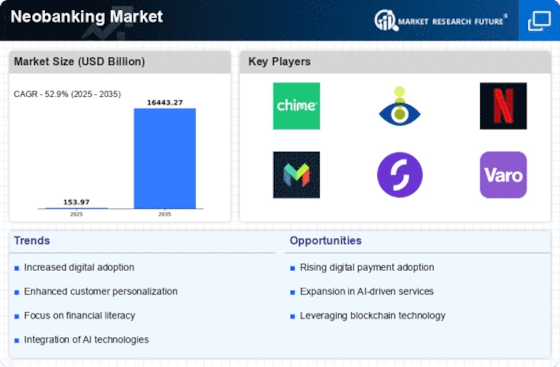
As per Market Research Future analysis, the Neobanking Market Size was estimated at 153.97 USD Billion in 2024. The Neobanking industry is projected to grow from 235.43 USD Billion in 2025 to 16443.27 USD Billion by 2035, exhibiting a compound annual growth rate (CAGR) of 52.9% during the forecast period 2025 - 2035

Key Market Trends & Highlights

The Neobanking Market is experiencing robust growth driven by technological advancements and evolving consumer preferences.

  • The North American region remains the largest market for neobanking, characterized by a strong demand for personalized banking solutions. In the Asia-Pacific region, neobanking is the fastest-growing segment, fueled by a surge in digital-first banking adoption. The business account segment leads in market size, while savings accounts are emerging as the fastest-growing category among consumers. Key market drivers include the rise of digital-first banking solutions and the growing demand for financial inclusion, which are reshaping the landscape.

Market Size & Forecast

2024 Market Size 153.97 (USD Billion)
2035 Market Size 16443.27 (USD Billion)
CAGR (2025 - 2035) 52.9%
Largest Regional Market Share in 2024 North America

Major Players

Chime (US), Revolut (GB), N26 (DE), Monzo (GB), Starling Bank (GB), Varo Bank (US), Ally Bank (US), Aspiration (US)

Market Trends

The neobanking market is currently experiencing a transformative phase characterized by rapid technological advancements and evolving consumer preferences. As digital banking solutions gain traction, traditional banking institutions are compelled to adapt or risk obsolescence. This shift is driven by a growing demand for seamless, user-friendly financial services that prioritize convenience and accessibility. Neobanks, which operate exclusively online without physical branches, are emerging as formidable competitors, offering innovative products tailored to the needs of tech-savvy consumers. The emphasis on personalized experiences and real-time financial management tools appears to resonate well with younger demographics, who increasingly favor digital interactions over traditional banking methods.

Moreover, regulatory frameworks are evolving to accommodate the rise of neobanking, fostering an environment conducive to innovation. This regulatory support, coupled with advancements in artificial intelligence and data analytics, enables neobanks to enhance their service offerings and improve customer engagement. As the neobank market continues to expand, it seems likely that partnerships between fintech companies and traditional banks will become more prevalent, allowing for a hybrid approach that leverages the strengths of both sectors. The future landscape of banking may be defined by a blend of digital and traditional services, creating a more inclusive financial ecosystem for consumers worldwide.

Increased Personalization

The neobanking market is witnessing a trend towards heightened personalization in financial services. Neobanks are leveraging data analytics to tailor offerings to individual customer preferences, enhancing user satisfaction and loyalty. This focus on customization allows consumers to receive targeted financial advice and product recommendations, fostering a more engaging banking experience.

Integration of Advanced Technologies

The integration of advanced technologies, such as artificial intelligence and machine learning, is reshaping the neobanking Market. These technologies enable neobanks to streamline operations, improve risk assessment, and enhance customer service through chatbots and automated processes. This trend not only increases efficiency but also provides customers with faster and more accurate responses.

Sustainability Initiatives

Sustainability initiatives are becoming increasingly prominent within the neo market. Many neobanks are adopting eco-friendly practices, such as paperless transactions and carbon offset programs, to appeal to environmentally conscious consumers. This trend reflects a broader societal shift towards sustainability, positioning neo banking as a responsible financial alternative.

Neobanking Market Market Drivers

Enhanced Security Features

Security concerns remain paramount in the Neobanking Market, prompting neobanks to invest heavily in advanced security features. With the rise of cyber threats, consumers are increasingly seeking banking solutions that offer robust protection for their financial data. Neobanks often utilize cutting-edge technologies such as biometric authentication and encryption protocols to safeguard user information. This emphasis on security not only builds consumer trust but also positions neobanks as viable alternatives to traditional banking institutions. As the market evolves, the integration of enhanced security measures may become a key differentiator for neobanks, potentially influencing consumer choices.

Cost Efficiency and Lower Fees

Cost efficiency emerges as a pivotal driver in the Neobanking Market, as neobanks typically operate with lower overhead costs compared to traditional banks. This operational model allows them to offer competitive pricing structures, including lower fees and attractive interest rates. Recent statistics reveal that neobanks can reduce transaction fees by up to 50%, appealing to cost-conscious consumers. As financial literacy increases, customers are becoming more discerning about banking fees, which may lead to a further shift towards neobanking solutions that prioritize affordability and transparency in their pricing strategies.

Regulatory Support and Innovation

Regulatory frameworks play a crucial role in shaping the Neobanking Market, as supportive policies can foster innovation and growth. Many regions are witnessing a shift towards more favorable regulations that encourage the establishment of neobanks. For instance, regulatory sandboxes allow fintech companies to test new products in a controlled environment, promoting experimentation and innovation. This regulatory support may lead to an influx of new entrants in the neobanking space, enhancing competition and driving further advancements in technology and service offerings. As regulations evolve, they could significantly impact the landscape of the neobanking market.

Growing Demand for Financial Inclusion

The Neobanking Market is increasingly driven by the demand for financial inclusion, particularly in underserved populations. Neobanks often target demographics that have been historically excluded from traditional banking services, such as low-income individuals and those without credit histories. By leveraging technology, neobanks can offer accessible financial products that cater to these groups, potentially transforming their financial landscapes. Recent studies indicate that nearly 1.7 billion adults remain unbanked, underscoring the opportunity for neobanks to bridge this gap. As awareness of financial inclusion grows, neobanks may play a pivotal role in expanding access to essential banking services.

Rise of Digital-First Banking Solutions

The Neobanking Market experiences a notable shift towards digital-first banking solutions, driven by consumer preferences for convenience and accessibility. As traditional banks face challenges in adapting to the digital landscape, neobanks capitalize on this gap by offering user-friendly interfaces and seamless online experiences. Recent data indicates that over 60% of consumers prefer managing their finances through mobile applications, highlighting the demand for innovative banking solutions. This trend suggests that neobanks are likely to capture a significant share of the market, as they provide services that align with the evolving expectations of tech-savvy customers.

Market Segment Insights

By Account Type: Business Account (Largest) vs. Savings Account (Fastest-Growing)

The neobanking market is characterized by a dynamic shift towards account types that meet the diverse needs of consumers. Business accounts have emerged as the largest segment, capturing significant attention from small and medium enterprises seeking digital-first solutions. Meanwhile, savings accounts are gaining traction, particularly among individual users who prefer accessible and flexible saving options. This has created a competitive landscape where each account type caters to different demographics.

Account Types: Business Account (Dominant) vs. Savings Account (Emerging)

Business accounts in the neobank market sector are known for their robust features tailored to meet the needs of companies, such as seamless integration with accounting software and cash flow management tools. They are favored by startups and entrepreneurs looking for efficient, cost-effective banking solutions. In contrast, savings accounts are rapidly emerging due to their appealing interest rates and user-friendly apps that simplify savings processes. These accounts attract a younger demographic who prioritize financial planning and digital banking convenience, thus representing a growing trend in the overall market.

By Application: Personal (Largest) vs. Enterprises (Fastest-Growing)

In the Neobanking Market, the market share distribution reveals 'Personal' accounts as the largest segment, catering to a broad customer base looking for convenient banking solutions. This segment capitalizes on the rapid adoption of digital banking by individuals, driven by convenience and user-friendly interfaces. 'Enterprises,' on the other hand, have emerged as the fastest-growing segment, reflecting an increasing trend of businesses seeking digital financial solutions to streamline operations and improve cash flow management.

Personal: Largest vs. Enterprises: Fastest-Growing

The 'Personal' segment in the Neobanking Market stands as a dominant force, offering tailored banking experiences that appeal to individual consumers. This segment thrives on the integration of innovative features like budgeting tools, instant loan approvals, and personalized financial insights, making banking more accessible. Conversely, the 'Enterprises' segment is categorized as the fastest-growing, driven by a surge in demand for digital solutions that enhance operational efficiency. Businesses are increasingly recognizing the benefits of market neo, such as lower fees and seamless integration with financial management systems, which significantly contributes to this growth. Together, these segments illustrate a dynamic shift towards digital banking solutions that cater to both individual and commercial needs.

Get more detailed insights about Neobanking Market Research Report – Forecast till 2035

Regional Insights

North America : Digital Banking Revolution

The North American neobanking market is driven by increasing consumer demand for digital banking solutions, with a significant shift towards mobile banking. The region holds the largest market share at approximately 45%, followed closely by Europe at 30%. Regulatory support, such as the Office of the Comptroller of the Currency's initiatives, has further catalyzed growth, allowing neobanks to operate with greater flexibility and innovation. Key players like Chime, Varo Bank, and Ally Bank dominate the landscape, offering a range of services that appeal to tech-savvy consumers. The competitive environment is characterized by rapid technological advancements and a focus on customer experience. As traditional banks adapt to this digital shift, neobanking is well-positioned to capture a growing segment of the market, particularly among younger demographics seeking convenience and lower fees.

Europe : Emerging Fintech Hub

Europe's neobanking market is characterized by robust regulatory frameworks that encourage innovation and competition. The region holds a market share of approximately 30%, making it the second-largest market globally. Key drivers include the European Union's PSD2 regulation, which promotes open banking, and a growing consumer preference for digital financial services. This regulatory environment is expected to further enhance market growth and consumer trust in neobanking solutions. Leading countries such as Germany, the UK, and France are at the forefront of this transformation, with players like Revolut segment analysis, N26, and Monzo leading the charge. The competitive landscape is vibrant, with numerous startups and established banks entering the neo market space. This dynamic environment fosters innovation, allowing consumers to benefit from a wide array of financial products tailored to their needs.

Asia-Pacific : Rapid Digital Adoption

The Asia-Pacific neobanking market is witnessing rapid growth, fueled by increasing smartphone penetration and a young, tech-savvy population. The region holds a market share of approximately 20%, with countries like India and China leading the charge. Regulatory initiatives aimed at promoting financial inclusion and digital banking are key growth drivers, as governments encourage the adoption of fintech solutions to reach underserved populations. Countries such as India, Australia, and Singapore are emerging as hotspots for neo banking, with local players and international entrants competing for market share. The competitive landscape is marked by innovation, with neobanks offering unique features such as AI-driven financial advice and personalized banking experiences. As traditional banks face pressure to adapt, the neobank market is well-positioned to capture a significant share of the growing digital banking market.

Middle East and Africa : Untapped Market Potential

The Middle East and Africa (MEA) neobanking market is in its nascent stages but shows significant potential for growth. The region holds a market share of approximately 5%, driven by increasing smartphone usage and a growing demand for digital financial services. Regulatory bodies are beginning to recognize the importance of fintech, with initiatives aimed at fostering innovation and improving financial inclusion across the region. Countries like South Africa, Nigeria, and the UAE are leading the way in neobanking adoption, with local startups emerging to meet the needs of a diverse consumer base. The competitive landscape is evolving, with both traditional banks and new entrants vying for market share. As the region continues to embrace digital transformation, neobanks are expected to play a crucial role in shaping the future of banking in MEA.

Key Players and Competitive Insights

The Neobanking Market is currently characterized by a dynamic competitive landscape, driven by rapid technological advancements and shifting consumer preferences towards digital financial solutions. Key players such as Chime (US), Revolut (GB), and N26 (DE) are at the forefront, each adopting distinct strategies to enhance their market positioning. Chime (US) focuses on user-friendly interfaces and fee-free banking, appealing to younger demographics seeking simplicity and transparency. Meanwhile, Revolut (GB) emphasizes a broad range of financial services, including cryptocurrency trading and international money transfers, positioning itself as a comprehensive financial platform. N26 (DE) leverages its European roots to expand aggressively across the continent, offering localized services that cater to diverse customer needs. Collectively, these strategies contribute to a competitive environment that is increasingly defined by innovation and customer-centricity.The business tactics employed by these neobanks reflect a keen understanding of market demands. For instance, localizing services to meet regional preferences and optimizing digital platforms for seamless user experiences are common practices. The competitive structure of the neobanking market appears moderately fragmented, with numerous players vying for market share. However, the influence of major players like Chime (US) and Revolut (GB) is substantial, as they set benchmarks for service offerings and customer engagement.
In August Chime (US) announced a partnership with a leading fintech firm to enhance its mobile app's functionality, integrating advanced budgeting tools and personalized financial advice. This strategic move is likely to bolster user engagement and retention, as it aligns with the growing consumer demand for tailored financial solutions. By enhancing its app capabilities, Chime (US) positions itself as a more valuable resource for its users, potentially increasing its market share in the competitive landscape.
In September Revolut (GB) launched a new feature allowing users to invest in fractional shares of stocks and ETFs, thereby democratizing access to investment opportunities. This initiative not only broadens its service portfolio but also attracts a younger audience interested in investing. The strategic importance of this move lies in its potential to enhance customer loyalty and diversify revenue streams, as users are likely to engage more with a platform that offers comprehensive financial services.
In October N26 (DE) expanded its operations into the Nordic countries, introducing tailored banking solutions that cater to local preferences. This expansion reflects N26's commitment to regional growth and its strategy of adapting services to meet specific market needs. By entering new markets, N26 (DE) not only increases its customer base but also strengthens its competitive position against established banks in those regions.
As of October the neobanking market is witnessing trends that emphasize digitalization, sustainability, and the integration of artificial intelligence. Strategic alliances among neobanks and technology firms are shaping the competitive landscape, fostering innovation and enhancing service delivery. Looking ahead, it appears that competitive differentiation will increasingly hinge on technological advancements and the ability to provide unique, value-added services rather than solely competing on price. This shift underscores the importance of innovation and supply chain reliability in maintaining a competitive edge.

Key Companies in the Neobanking Market include

Industry Developments

  • Q2 2024: Brazilian neobank Nubank launches in Mexico under the name Nu Nubank, one of the world’s largest digital banks, officially launched its neobanking services in Mexico under the brand 'Nu', expanding its Latin American footprint.
  • Q2 2024: UK neobank Monzo raises $430 million in new funding round Monzo, a leading UK-based neobank, secured $430 million in a funding round led by CapitalG, Alphabet’s independent growth fund, to fuel international expansion and product development.
  • Q2 2024: Revolut appoints Francesca Carlesi as UK CEO Revolut, the UK-based neobank, named Francesca Carlesi as its new UK CEO, strengthening its executive team as it pursues a UK banking license.
  • Q2 2024: German neobank N26 receives regulatory approval to offer investment products N26, a prominent German neobank, received regulatory approval from BaFin to launch investment products, marking a significant expansion of its financial services.
  • Q3 2024: Indian neobank Jupiter raises $100 million in Series C funding Jupiter, an Indian neobank, closed a $100 million Series C funding round led by Tiger Global, aiming to scale its digital banking platform and expand its user base.
  • Q3 2024: US neobank Chime partners with Visa to launch new credit builder card Chime, a major US neobank, announced a partnership with Visa to launch a new credit builder card, targeting customers seeking to improve their credit scores.
  • Q3 2024: Starling Bank acquires Fleet Mortgages for £50 million Starling Bank, a UK neobank, acquired Fleet Mortgages for £50 million, expanding its lending portfolio and entering the mortgage market.
  • Q4 2024: Australian neobank Up launches business banking services Up, an Australian neobank, launched a suite of business banking services, marking its entry into the SME banking segment.
  • Q4 2024: French neobank Qonto secures €150 million in Series D extension Qonto, a French neobank focused on SMEs, raised an additional €150 million in a Series D extension to accelerate European expansion.
  • Q1 2025: US neobank Varo Bank raises $75 million to boost product innovation Varo Bank, a US-based neobank, raised $75 million in new funding to support product innovation and customer acquisition.
  • Q1 2025: Revolut receives Lithuanian banking license renewal Revolut, the global neobank, received a renewal of its Lithuanian banking license, allowing it to continue offering banking services across the European Economic Area.
  • Q2 2025: Brazil’s C6 Bank partners with Google Pay for digital wallet integration C6 Bank, a leading Brazilian neobank, announced a partnership with Google Pay to integrate its digital wallet services, enhancing payment options for its customers.

Future Outlook

Neobanking Market Future Outlook

The Neobanking Market is projected to grow at a 52.9% CAGR from 2025 to 2035, driven by technological advancements, increased digital adoption, and evolving consumer preferences.

New opportunities lie in:

  • <p>Integration of AI-driven customer service solutions Development of personalized financial management tools Expansion into underserved markets with tailored offerings</p>

By 2035, the Neobanking Market is expected to be a dominant force in the global financial landscape.

Market Segmentation

Neobanking Market Application Outlook

  • Enterprises
  • Personal
  • Others

Neobanking Market Account Type Outlook

  • Business Account
  • Savings Account

Report Scope

MARKET SIZE 2024 153.97(USD Billion)
MARKET SIZE 2025 235.43(USD Billion)
MARKET SIZE 2035 16443.27(USD Billion)
COMPOUND ANNUAL GROWTH RATE (CAGR) 52.9% (2025 - 2035)
REPORT COVERAGE Revenue Forecast, Competitive Landscape, Growth Factors, and Trends
BASE YEAR 2024
Market Forecast Period 2025 - 2035
Historical Data 2019 - 2024
Market Forecast Units USD Billion
Key Companies Profiled Chime (US), Revolut (GB), N26 (DE), Monzo (GB), Starling Bank (GB), Varo Bank (US), Ally Bank (US), Aspiration (US)
Segments Covered Account Type, Region
Key Market Opportunities Integration of advanced artificial intelligence enhances customer experience in the Neobanking Market.
Key Market Dynamics Rising consumer demand for digital banking solutions drives competition and innovation in the neobanking sector.
Countries Covered North America, Europe, APAC, South America, MEA

FAQs

What is the current valuation of the Neobanking Market as of 2024?

The Neobanking Market was valued at 153.97 USD Billion in 2024.

What is the projected market valuation for the Neobanking Market in 2035?

The Neobanking Market is projected to reach a valuation of 16443.27 USD Billion by 2035.

What is the expected CAGR for the Neobanking Market during the forecast period 2025 - 2035?

The expected CAGR for the Neobanking Market during the forecast period 2025 - 2035 is 52.9%.

Which companies are considered key players in the Neobanking Market?

Key players in the Neobanking Market include Chime, Revolut, N26, Monzo, Starling Bank, Varo Bank, Ally Bank, and Aspiration.

What are the main segments of the Neobanking Market?

The main segments of the Neobanking Market include Account Type and Application.

What was the valuation of Business Accounts in the Neobanking Market in 2024?

The valuation of Business Accounts in the Neobanking Market was 30.0 USD Billion in 2024.

  1. SECTION I: EXECUTIVE SUMMARY AND KEY HIGHLIGHTS
    1. EXECUTIVE SUMMARY
      1. Market Overview
      2. Key Findings
      3. Market Segmentation
      4. Competitive Landscape
      5. Challenges and Opportunities
      6. Future Outlook 2
  2. SECTION II: SCOPING, METHODOLOGY AND MARKET STRUCTURE
    1. MARKET INTRODUCTION
      1. Definition
      2. Scope of the study
    2. RESEARCH METHODOLOGY
      1. Overview
      2. Data Mining
      3. Secondary Research
      4. Primary Research
      5. Forecasting Model
      6. Market Size Estimation
      7. Data Triangulation
      8. Validation 3
  3. SECTION III: QUALITATIVE ANALYSIS
    1. MARKET DYNAMICS
      1. Overview
      2. Drivers
      3. Restraints
      4. Opportunities
    2. MARKET FACTOR ANALYSIS
      1. Value chain Analysis
      2. Porter's Five Forces Analysis
      3. COVID-19 Impact Analysis
  4. SECTION IV: QUANTITATIVE ANALYSIS
    1. BFSI, BY Account Type (USD Billion)
      1. Business Account
      2. Savings Account
    2. BFSI, BY Application (USD Billion)
      1. Enterprises
      2. Personal
      3. Others
    3. BFSI, BY Region (USD Billion)
      1. North America
      2. Europe
      3. APAC
      4. South America
      5. MEA
  5. SECTION V: COMPETITIVE ANALYSIS
    1. Competitive Landscape
      1. Overview
      2. Competitive Analysis
      3. Market share Analysis
      4. Major Growth Strategy in the BFSI
      5. Competitive Benchmarking
      6. Leading Players in Terms of Number of Developments in the BFSI
      7. Key developments and growth strategies
      8. Major Players Financial Matrix
    2. Company Profiles
      1. Chime (US)
      2. Revolut (GB)
      3. N26 (DE)
      4. Monzo (GB)
      5. Starling Bank (GB)
      6. Varo Bank (US)
      7. Ally Bank (US)
      8. Aspiration (US)
    3. Appendix
      1. References
      2. Related Reports 6 LIST OF FIGURES
    4. MARKET SYNOPSIS
    5. NORTH AMERICA MARKET ANALYSIS
    6. US MARKET ANALYSIS BY ACCOUNT TYPE
    7. US MARKET ANALYSIS BY APPLICATION
    8. CANADA MARKET ANALYSIS BY ACCOUNT TYPE
    9. CANADA MARKET ANALYSIS BY APPLICATION
    10. EUROPE MARKET ANALYSIS
    11. GERMANY MARKET ANALYSIS BY ACCOUNT TYPE
    12. GERMANY MARKET ANALYSIS BY APPLICATION
    13. UK MARKET ANALYSIS BY ACCOUNT TYPE
    14. UK MARKET ANALYSIS BY APPLICATION
    15. FRANCE MARKET ANALYSIS BY ACCOUNT TYPE
    16. FRANCE MARKET ANALYSIS BY APPLICATION
    17. RUSSIA MARKET ANALYSIS BY ACCOUNT TYPE
    18. RUSSIA MARKET ANALYSIS BY APPLICATION
    19. ITALY MARKET ANALYSIS BY ACCOUNT TYPE
    20. ITALY MARKET ANALYSIS BY APPLICATION
    21. SPAIN MARKET ANALYSIS BY ACCOUNT TYPE
    22. SPAIN MARKET ANALYSIS BY APPLICATION
    23. REST OF EUROPE MARKET ANALYSIS BY ACCOUNT TYPE
    24. REST OF EUROPE MARKET ANALYSIS BY APPLICATION
    25. APAC MARKET ANALYSIS
    26. CHINA MARKET ANALYSIS BY ACCOUNT TYPE
    27. CHINA MARKET ANALYSIS BY APPLICATION
    28. INDIA MARKET ANALYSIS BY ACCOUNT TYPE
    29. INDIA MARKET ANALYSIS BY APPLICATION
    30. JAPAN MARKET ANALYSIS BY ACCOUNT TYPE
    31. JAPAN MARKET ANALYSIS BY APPLICATION
    32. SOUTH KOREA MARKET ANALYSIS BY ACCOUNT TYPE
    33. SOUTH KOREA MARKET ANALYSIS BY APPLICATION
    34. MALAYSIA MARKET ANALYSIS BY ACCOUNT TYPE
    35. MALAYSIA MARKET ANALYSIS BY APPLICATION
    36. THAILAND MARKET ANALYSIS BY ACCOUNT TYPE
    37. THAILAND MARKET ANALYSIS BY APPLICATION
    38. INDONESIA MARKET ANALYSIS BY ACCOUNT TYPE
    39. INDONESIA MARKET ANALYSIS BY APPLICATION
    40. REST OF APAC MARKET ANALYSIS BY ACCOUNT TYPE
    41. REST OF APAC MARKET ANALYSIS BY APPLICATION
    42. SOUTH AMERICA MARKET ANALYSIS
    43. BRAZIL MARKET ANALYSIS BY ACCOUNT TYPE
    44. BRAZIL MARKET ANALYSIS BY APPLICATION
    45. MEXICO MARKET ANALYSIS BY ACCOUNT TYPE
    46. MEXICO MARKET ANALYSIS BY APPLICATION
    47. ARGENTINA MARKET ANALYSIS BY ACCOUNT TYPE
    48. ARGENTINA MARKET ANALYSIS BY APPLICATION
    49. REST OF SOUTH AMERICA MARKET ANALYSIS BY ACCOUNT TYPE
    50. REST OF SOUTH AMERICA MARKET ANALYSIS BY APPLICATION
    51. MEA MARKET ANALYSIS
    52. GCC COUNTRIES MARKET ANALYSIS BY ACCOUNT TYPE
    53. GCC COUNTRIES MARKET ANALYSIS BY APPLICATION
    54. SOUTH AFRICA MARKET ANALYSIS BY ACCOUNT TYPE
    55. SOUTH AFRICA MARKET ANALYSIS BY APPLICATION
    56. REST OF MEA MARKET ANALYSIS BY ACCOUNT TYPE
    57. REST OF MEA MARKET ANALYSIS BY APPLICATION
    58. KEY BUYING CRITERIA OF BFSI
    59. RESEARCH PROCESS OF MRFR
    60. DRO ANALYSIS OF BFSI
    61. DRIVERS IMPACT ANALYSIS: BFSI
    62. RESTRAINTS IMPACT ANALYSIS: BFSI
    63. SUPPLY / VALUE CHAIN: BFSI
    64. BFSI, BY ACCOUNT TYPE, 2024 (% SHARE)
    65. BFSI, BY ACCOUNT TYPE, 2024 TO 2035 (USD Billion)
    66. BFSI, BY APPLICATION, 2024 (% SHARE)
    67. BFSI, BY APPLICATION, 2024 TO 2035 (USD Billion)
    68. BENCHMARKING OF MAJOR COMPETITORS 7 LIST OF TABLES
    69. LIST OF ASSUMPTIONS
    70. North America MARKET SIZE ESTIMATES; FORECAST
      1. BY ACCOUNT TYPE, 2025-2035 (USD Billion)
      2. BY APPLICATION, 2025-2035 (USD Billion)
    71. US MARKET SIZE ESTIMATES; FORECAST
      1. BY ACCOUNT TYPE, 2025-2035 (USD Billion)
      2. BY APPLICATION, 2025-2035 (USD Billion)
    72. Canada MARKET SIZE ESTIMATES; FORECAST
      1. BY ACCOUNT TYPE, 2025-2035 (USD Billion)
      2. BY APPLICATION, 2025-2035 (USD Billion)
    73. Europe MARKET SIZE ESTIMATES; FORECAST
      1. BY ACCOUNT TYPE, 2025-2035 (USD Billion)
      2. BY APPLICATION, 2025-2035 (USD Billion)
    74. Germany MARKET SIZE ESTIMATES; FORECAST
      1. BY ACCOUNT TYPE, 2025-2035 (USD Billion)
      2. BY APPLICATION, 2025-2035 (USD Billion)
    75. UK MARKET SIZE ESTIMATES; FORECAST
      1. BY ACCOUNT TYPE, 2025-2035 (USD Billion)
      2. BY APPLICATION, 2025-2035 (USD Billion)
    76. France MARKET SIZE ESTIMATES; FORECAST
      1. BY ACCOUNT TYPE, 2025-2035 (USD Billion)
      2. BY APPLICATION, 2025-2035 (USD Billion)
    77. Russia MARKET SIZE ESTIMATES; FORECAST
      1. BY ACCOUNT TYPE, 2025-2035 (USD Billion)
      2. BY APPLICATION, 2025-2035 (USD Billion)
    78. Italy MARKET SIZE ESTIMATES; FORECAST
      1. BY ACCOUNT TYPE, 2025-2035 (USD Billion)
      2. BY APPLICATION, 2025-2035 (USD Billion)
    79. Spain MARKET SIZE ESTIMATES; FORECAST
      1. BY ACCOUNT TYPE, 2025-2035 (USD Billion)
      2. BY APPLICATION, 2025-2035 (USD Billion)
    80. Rest of Europe MARKET SIZE ESTIMATES; FORECAST
      1. BY ACCOUNT TYPE, 2025-2035 (USD Billion)
      2. BY APPLICATION, 2025-2035 (USD Billion)
    81. APAC MARKET SIZE ESTIMATES; FORECAST
      1. BY ACCOUNT TYPE, 2025-2035 (USD Billion)
      2. BY APPLICATION, 2025-2035 (USD Billion)
    82. China MARKET SIZE ESTIMATES; FORECAST
      1. BY ACCOUNT TYPE, 2025-2035 (USD Billion)
      2. BY APPLICATION, 2025-2035 (USD Billion)
    83. India MARKET SIZE ESTIMATES; FORECAST
      1. BY ACCOUNT TYPE, 2025-2035 (USD Billion)
      2. BY APPLICATION, 2025-2035 (USD Billion)
    84. Japan MARKET SIZE ESTIMATES; FORECAST
      1. BY ACCOUNT TYPE, 2025-2035 (USD Billion)
      2. BY APPLICATION, 2025-2035 (USD Billion)
    85. South Korea MARKET SIZE ESTIMATES; FORECAST
      1. BY ACCOUNT TYPE, 2025-2035 (USD Billion)
      2. BY APPLICATION, 2025-2035 (USD Billion)
    86. Malaysia MARKET SIZE ESTIMATES; FORECAST
      1. BY ACCOUNT TYPE, 2025-2035 (USD Billion)
      2. BY APPLICATION, 2025-2035 (USD Billion)
    87. Thailand MARKET SIZE ESTIMATES; FORECAST
      1. BY ACCOUNT TYPE, 2025-2035 (USD Billion)
      2. BY APPLICATION, 2025-2035 (USD Billion)
    88. Indonesia MARKET SIZE ESTIMATES; FORECAST
      1. BY ACCOUNT TYPE, 2025-2035 (USD Billion)
      2. BY APPLICATION, 2025-2035 (USD Billion)
    89. Rest of APAC MARKET SIZE ESTIMATES; FORECAST
      1. BY ACCOUNT TYPE, 2025-2035 (USD Billion)
      2. BY APPLICATION, 2025-2035 (USD Billion)
    90. South America MARKET SIZE ESTIMATES; FORECAST
      1. BY ACCOUNT TYPE, 2025-2035 (USD Billion)
      2. BY APPLICATION, 2025-2035 (USD Billion)
    91. Brazil MARKET SIZE ESTIMATES; FORECAST
      1. BY ACCOUNT TYPE, 2025-2035 (USD Billion)
      2. BY APPLICATION, 2025-2035 (USD Billion)
    92. Mexico MARKET SIZE ESTIMATES; FORECAST
      1. BY ACCOUNT TYPE, 2025-2035 (USD Billion)
      2. BY APPLICATION, 2025-2035 (USD Billion)
    93. Argentina MARKET SIZE ESTIMATES; FORECAST
      1. BY ACCOUNT TYPE, 2025-2035 (USD Billion)
      2. BY APPLICATION, 2025-2035 (USD Billion)
    94. Rest of South America MARKET SIZE ESTIMATES; FORECAST
      1. BY ACCOUNT TYPE, 2025-2035 (USD Billion)
      2. BY APPLICATION, 2025-2035 (USD Billion)
    95. MEA MARKET SIZE ESTIMATES; FORECAST
      1. BY ACCOUNT TYPE, 2025-2035 (USD Billion)
      2. BY APPLICATION, 2025-2035 (USD Billion)
    96. GCC Countries MARKET SIZE ESTIMATES; FORECAST
      1. BY ACCOUNT TYPE, 2025-2035 (USD Billion)
      2. BY APPLICATION, 2025-2035 (USD Billion)
    97. South Africa MARKET SIZE ESTIMATES; FORECAST
      1. BY ACCOUNT TYPE, 2025-2035 (USD Billion)
      2. BY APPLICATION, 2025-2035 (USD Billion)
    98. Rest of MEA MARKET SIZE ESTIMATES; FORECAST
      1. BY ACCOUNT TYPE, 2025-2035 (USD Billion)
      2. BY APPLICATION, 2025-2035 (USD Billion)
    99. PRODUCT LAUNCH/PRODUCT DEVELOPMENT/APPROVAL
    100. ACQUISITION/PARTNERSHIP

Neobanking Market Segmentation

Neobanking Market Account Type Outlook (Revenue, USD Billion, 2020 - 2034)

  • Business Account
  • Savings Account

Neobanking Market Application Outlook (Revenue, USD Billion, 2020 - 2034)

  • Enterprises
  • Personal
  • Others

Neobanking Market Regional Outlook (Revenue, USD Billion, 2020 - 2034)

  • North America Outlook (USD Billion, 2020 - 2034)
    • Neobanking Market  by Account Type
      • Business Account
      • Savings Account
    • Neobanking Market  by Application
      • Enterprises
      • Personal
      • Others
    • US Outlook (USD Billion, 2020 - 2034)
    • Neobanking Market  by Account Type
      • Business Account
      • Savings Account
    • Neobanking Market  by Application
      • Enterprises
      • Personal
      • Others
    • Canada Outlook (USD Billion, 2020 - 2034)
    • Neobanking Market  by Account Type
      • Business Account
      • Savings Account
    • Neobanking Market  by Application
      • Enterprises
      • Personal
      • Others
  • Europe Outlook (USD Billion, 2020 - 2034)
    • Neobanking Market  by Account Type
      • Business Account
      • Savings Account
    • Neobanking Market  by Application
      • Enterprises
      • Personal
      • Others
    • Germany Outlook (USD Billion, 2020 - 2034)
    • Neobanking Market  by Account Type
      • Business Account
      • Savings Account
    • Neobanking Market  by Application
      • Enterprises
      • Personal
      • Others
    • France Outlook (USD Billion, 2020 - 2034)
    • Neobanking Market  by Account Type
      • Business Account
      • Savings Account
    • Neobanking Market  by Application
      • Enterprises
      • Personal
      • Others
    • UK Outlook (USD Billion, 2020 - 2034)
    • Neobanking Market  by Account Type
      • Business Account
      • Savings Account
    • Neobanking Market  by Application
      • Enterprises
      • Personal
      • Others
    • Italy Outlook (USD Billion, 2020 - 2034)
    • Neobanking Market  by Account Type
      • Business Account
      • Savings Account
    • Neobanking Market  by Application
      • Enterprises
      • Personal
      • Others
    • Spain Outlook (USD Billion, 2020 - 2034)
    • Neobanking Market  by Account Type
      • Business Account
      • Savings Account
    • Neobanking Market  by Application
      • Enterprises
      • Personal
      • Others
    • Rest Of Europe Outlook (USD Billion, 2020 - 2034)
    • Neobanking Market  by Account Type
      • Business Account
      • Savings Account
    • Neobanking Market  by Application
      • Enterprises
      • Personal
      • Others
  • Asia-Pacific Outlook (USD Billion, 2020 - 2034)
    • Neobanking Market  by Account Type
      • Business Account
      • Savings Account
    • Neobanking Market  by Application
      • Enterprises
      • Personal
      • Others
    • China Outlook (USD Billion, 2020 - 2034)
    • Neobanking Market  by Account Type
      • Business Account
      • Savings Account
    • Neobanking Market  by Application
      • Enterprises
      • Personal
      • Others
    • Japan Outlook (USD Billion, 2020 - 2034)
    • Neobanking Market  by Account Type
      • Business Account
      • Savings Account
    • Neobanking Market  by Application
      • Enterprises
      • Personal
      • Others
    • India Outlook (USD Billion, 2020 - 2034)
    • Neobanking Market  by Account Type
      • Business Account
      • Savings Account
    • Neobanking Market  by Application
      • Enterprises
      • Personal
      • Others
    • Australia Outlook (USD Billion, 2020 - 2034)
    • Neobanking Market  by Account Type
      • Business Account
      • Savings Account
    • Neobanking Market  by Application
      • Enterprises
      • Personal
      • Others
    • Rest of Asia-Pacific Outlook (USD Billion, 2020 - 2034)
    • Neobanking Market  by Account Type
      • Business Account
      • Savings Account
    • Neobanking Market  by Application
      • Enterprises
      • Personal
      • Others
  • Rest of the World Outlook (USD Billion, 2020 - 2034)
    • Neobanking Market  by Account Type
      • Business Account
      • Savings Account
    • Neobanking Market  by Application
      • Enterprises
      • Personal
      • Others
    • Middle East Outlook (USD Billion, 2020 - 2034)
    • Neobanking Market  by Account Type
      • Business Account
      • Savings Account
    • Neobanking Market  by Application
      • Enterprises
      • Personal
      • Others
    • Africa Outlook (USD Billion, 2020 - 2034)
    • Neobanking Market  by Account Type
      • Business Account
      • Savings Account
    • Neobanking Market  by Application
      • Enterprises
      • Personal
      • Others
    • Latin America Outlook (USD Billion, 2020 - 2034)
    • Neobanking Market  by Account Type
      • Business Account
      • Savings Account
    • Neobanking Market  by Application
      • Enterprises
      • Personal
      • Others


Infographic

Free Sample Request

Kindly complete the form below to receive a free sample of this Report

Get Free Sample

Customer Strories

Compare Licence

×
Features License Type
Single User Multiuser License Enterprise User
Price $4,950 $5,950 $7,250
Maximum User Access Limit 1 User Upto 10 Users Unrestricted Access Throughout the Organization
Free Customization
Direct Access to Analyst
Deliverable Format
Platform Access
Discount on Next Purchase 10% 15% 15%
Printable Versions