×
Request Free Sample ×

Kindly complete the form below to receive a free sample of this Report

* Please use a valid business email

Leading companies partner with us for data-driven Insights

clients tt-cursor
Hero Background
English
Chinese
French
Japanese
Korean
German
Spanish

Multi Ovens Market Trends

ID: MRFR/CG/8600-HCR
120 Pages
Sejal Akre
February 2026

Multi Ovens Market Size, Share, Industry Trend & Analysis Research Report Information by Product (Steam Generated and Boilerless), End-user (Hotels & Restaurants, Bakery Stores, Retail Outlets, Domestic & Institutional, and Commercial Kitchens) and Region (North America, Europe, Asia-Pacific, Middle East & Africa and South America) – Forecast till 2035

Share:
Download PDF ×

We do not share your information with anyone. However, we may send you emails based on your report interest from time to time. You may contact us at any time to opt-out.

Multi Ovens Market Infographic
Purchase Options

Market Trends

Key Emerging Trends in the Multi Ovens Market

The multi oven market, which is a specialized segment of the larger kitchenware industry, has been very dynamic to such an extent that it has generated very intense rivalry in recent years. As an essential factor of business operations in this area, market share positioning strategies, give a companies the possibility of being successful in this environment. These strategies involve activities like product differentiation, pricing, distribution and marketing with focus on positioning the product in such a way that it is seen by the customers as unique and of high quality.

The hottest strategy to help you claim the massake in Multi Ovens Market is through innovation the product differentiation. Companies look out to make improvements that are exclusive to their ovens and not offered by competitors. From all new technologies in cooking, smart-connectivity options, up to the unique design elements, these things remain the most important selling points for the people out there searching for something that performs more than just the basic tasks. These businesses can develop widely appealing products and be trailblazers through consistent innovations, competitive technology, and impressive design.

Marketsharealso involving thepricingstrategieswith inthe Baking Ovens Market. Some brands choose to use the premium pricing strategy that is aiming for the high-end segment, and ensuring the purity and newness of the product items. Instead, they may go for price war strategy where they hope to gain a huge fraction of consumers who are thrifty. Tactful balance between value and price affordability is essential in this cutthroat competitive market and companies must work on the interpretation of market dynamics to set a perfect pricing strategy for their potential customers.

Through the channels of distribution is another important factor in building a market share positioning strategist. Business needs to keep track of products at the response and point by using different channels, such as physical stores, online platforms and kitchen appliances specialization store. The quality and the effectiveness of distribution network play an equally important role as the products themselves because they help to increase the sales volumes, reaching bigger number of customers. Strategic alliance with retailers and e-commerce platforms may be a good solution that will enhance a company's visibility and boost sales and thus, improve a company's market position.

The marketing activities like building a brand identity as well as the effective promotional campaigns remain of utmost importance to obtain the success of marketing campaigns. A massive chunk of businesses which is an organization pays to create brand image and brand loyalty is through marketing and social media. Constructing the ads that mainly stress on the specific features of their multi ovens and featuring real stories of customers' satisfaction can establish a good image for the sales in the customers' minds.

Author
Sejal Akre
Senior Research Analyst

She has over 5 years of rich experience, in market research and consulting providing valuable market insights to client. Hands on expertise in management consulting, and extensive knowledge in domain including ICT, Automotive & Transportation and Aerospace & Defense. She is skilled in Go-to market strategy, industry analysis, market sizing, in depth company profiling, competitive intelligence & benchmarking and value chain amongst others.

Leave a Comment

FAQs

What is the current valuation of the Multi Ovens Market as of 2024?

<p>The overall market valuation of the Multi Ovens Market was 5200.0 USD Million in 2024.</p>

What is the projected market valuation for the Multi Ovens Market in 2035?

<p>The projected valuation for the Multi Ovens Market is expected to reach 10950.0 USD Million by 2035.</p>

What is the expected CAGR for the Multi Ovens Market during the forecast period 2025 - 2035?

<p>The expected CAGR for the Multi Ovens Market during the forecast period 2025 - 2035 is 7.4%.</p>

Which companies are considered key players in the Multi Ovens Market?

<p>Key players in the Multi Ovens Market include Whirlpool, Bosch, Samsung, LG Electronics, Electrolux, Panasonic, Miele, GE Appliances, and Frigidaire.</p>

What are the main applications of multi ovens and their market values?

<p>The main applications include Baking (1300.0 to 2700.0 USD Million), Roasting (1200.0 to 2500.0 USD Million), Grilling (1000.0 to 2100.0 USD Million), Steaming (900.0 to 1800.0 USD Million), and Broiling (800.0 to 1700.0 USD Million).</p>

How is the Multi Ovens Market segmented by end use?

The market is segmented by end use into Residential (2080.0 to 4500.0 USD Million), Commercial (1560.0 to 3500.0 USD Million), and Industrial (1560.0 to 3950.0 USD Million).

What types of products are included in the Multi Ovens Market?

Product types include Convection Ovens (1300.0 to 2700.0 USD Million), Microwave Ovens (1500.0 to 3200.0 USD Million), Toaster Ovens (800.0 to 1800.0 USD Million), and Combination Ovens (2600.0 to 4500.0 USD Million).

What energy sources are utilized in the Multi Ovens Market?

The market utilizes energy sources such as Electric (2600.0 to 5500.0 USD Million), Gas (1800.0 to 4000.0 USD Million), and Solar (800.0 to 1450.0 USD Million).

What features are driving the Multi Ovens Market?

Key features driving the market include Smart Technology (1040.0 to 2200.0 USD Million), Self-Cleaning (780.0 to 1600.0 USD Million), Multi-Functionality (1560.0 to 3500.0 USD Million), and Compact Design (1820.0 to 3650.0 USD Million).

How does the market performance of multi ovens compare across different applications?

Market performance varies, with Baking leading at 1300.0 to 2700.0 USD Million, followed by Roasting at 1200.0 to 2500.0 USD Million, indicating diverse consumer preferences.

Market Summary

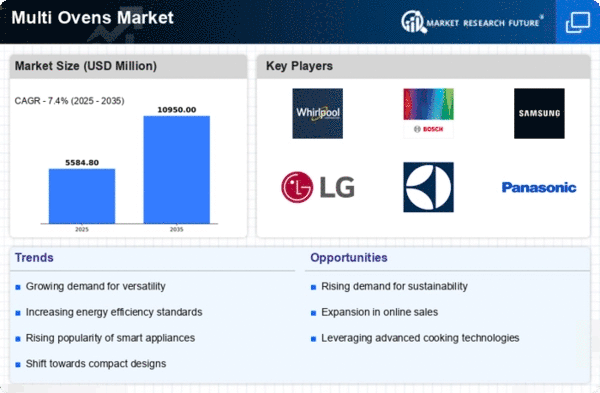
As per MRFR analysis, the Multi Ovens Market Size was estimated at 5200.0 USD Million in 2024. The Multi Ovens industry is projected to grow from 5540.0 in 2025 to 10950.0 by 2035, exhibiting a compound annual growth rate (CAGR) of 7.4% during the forecast period 2025 - 2035.

Key Market Trends & Highlights

The Multi Ovens Market is experiencing robust growth driven by technological advancements and evolving consumer preferences.

  • North America remains the largest market for multi ovens, reflecting a strong demand for versatile cooking solutions. The Asia-Pacific region is emerging as the fastest-growing market, fueled by increasing urbanization and changing lifestyles. The baking segment continues to dominate the market, while the grilling segment is witnessing rapid growth due to rising consumer interest in diverse cooking methods. Technological advancements and health consciousness are key drivers propelling the market forward, as consumers seek energy-efficient and multifunctional appliances.

Market Size & Forecast

2024 Market Size 5200.0 (USD Million)
2035 Market Size 10950.0 (USD Million)
CAGR (2025 - 2035) 7.4%
Largest Regional Market Share in 2024 North America

Major Players

<a href="https://www.whirlpool.com/">Whirlpool (US)</a>, Bosch (DE), Samsung (KR), LG Electronics (KR), <a href="https://www.electrolux.in/">Electrolux (SE)</a>, Panasonic (JP), Miele (DE), GE Appliances (US), Frigidaire (US)

Market Trends

The Multi Ovens Market is currently experiencing a notable transformation, driven by evolving consumer preferences and technological advancements. As households increasingly seek versatile cooking solutions, multi ovens are gaining traction for their ability to combine various cooking methods, such as baking, grilling, and steaming, into a single appliance. This trend reflects a broader shift towards convenience and efficiency in the kitchen, as consumers prioritize products that save time and space. Furthermore, the integration of smart technology into multi ovens is enhancing user experience, allowing for remote control and precise cooking settings, which aligns with the growing demand for connected home appliances. In addition to technological innovations, sustainability is becoming a pivotal factor influencing purchasing decisions within the Multi Ovens Market. Consumers are increasingly aware of their environmental impact and are gravitating towards energy-efficient models that reduce electricity consumption. Manufacturers are responding to this demand by developing eco-friendly products that not only meet performance expectations but also contribute to a more sustainable lifestyle. As the market continues to evolve, it appears that the combination of convenience, technology, and sustainability will shape the future landscape of multi ovens, making them an essential component of modern kitchens.

Technological Integration

The Multi Ovens Market is witnessing a surge in the incorporation of smart technology. This trend includes features such as app connectivity, voice control, and automated cooking programs, which enhance user convenience and precision. As consumers become more tech-savvy, the demand for appliances that integrate seamlessly with smart home ecosystems is likely to grow.

Focus on Energy Efficiency

There is a growing emphasis on energy-efficient appliances within the Multi Ovens Market. Consumers are increasingly seeking products that minimize energy consumption while maintaining high performance. This trend is prompting manufacturers to innovate and create models that not only meet energy standards but also appeal to environmentally conscious buyers.

Versatility in Cooking Methods

The versatility of multi ovens is a defining characteristic that is driving their popularity. These appliances offer multiple cooking functions, allowing users to bake, roast, steam, and grill with a single device. This multifunctionality caters to diverse culinary needs, making multi ovens an attractive option for modern households.

Multi Ovens Market Market Drivers

Market Growth Projections

The Global Multi Ovens Market Industry is poised for substantial growth, with projections indicating a market value of 18.2 USD Billion in 2024 and an anticipated increase to 37.5 USD Billion by 2035. This growth trajectory suggests a compound annual growth rate of 6.81% from 2025 to 2035. Such figures underscore the increasing consumer preference for multifunctional cooking appliances, driven by trends in health consciousness, technological advancements, and urbanization. The market's expansion reflects broader shifts in consumer behavior and preferences, positioning multi ovens as a key player in the kitchen appliance sector.

Health-Conscious Consumer Trends

Health consciousness among consumers significantly influences the Global Multi Ovens Market Industry. As individuals become more aware of nutrition and wellness, there is a shift towards cooking methods that promote healthier eating. Multi ovens, which often incorporate features such as air frying and steam cooking, cater to this demand by allowing users to prepare meals with less oil and fat. This trend is likely to bolster market growth, as consumers increasingly seek appliances that support their health goals. The industry's response to these trends may enhance its appeal, potentially contributing to a projected market value of 37.5 USD Billion by 2035.

Sustainability and Energy Efficiency

Sustainability concerns are increasingly shaping consumer choices within the Global Multi Ovens Market Industry. Eco-conscious consumers are gravitating towards energy-efficient appliances that minimize environmental impact. Multi ovens, which often utilize advanced heating technologies, can reduce energy consumption compared to traditional ovens. This shift towards sustainability not only aligns with global environmental goals but also resonates with consumers looking to lower their utility bills. As manufacturers respond to this demand by developing more energy-efficient models, the market is likely to see a positive impact on growth and consumer adoption.

Growing Urbanization and Space Constraints

Urbanization trends significantly affect the Global Multi Ovens Market Industry, as more individuals reside in urban areas where kitchen space is often limited. Multi ovens, designed to be compact and multifunctional, cater to the needs of urban dwellers who require efficient cooking solutions without sacrificing quality. This demographic shift drives demand for appliances that maximize functionality while minimizing space requirements. As urban populations continue to grow, the market for multi ovens is expected to expand, reflecting changing lifestyles and cooking habits.

Rising Demand for Versatile Cooking Solutions

The Global Multi Ovens Market Industry experiences a notable increase in demand for versatile cooking appliances. Consumers are increasingly seeking multifunctional devices that can perform various cooking methods, such as baking, grilling, and steaming. This trend is driven by the desire for convenience and efficiency in meal preparation. As of 2024, the market is valued at approximately 18.2 USD Billion, reflecting a growing preference for appliances that save time and space in kitchens. The versatility of multi ovens aligns with contemporary lifestyles, where consumers prioritize quick and healthy cooking options.

Technological Advancements in Cooking Appliances

Technological innovations play a crucial role in shaping the Global Multi Ovens Market Industry. The integration of smart technology, such as Wi-Fi connectivity and app-controlled cooking, enhances user experience and convenience. These advancements allow consumers to monitor and control their cooking processes remotely, appealing to tech-savvy individuals. As the market evolves, manufacturers are likely to invest in research and development to incorporate cutting-edge features, thereby attracting a broader customer base. This focus on innovation may contribute to a compound annual growth rate of 6.81% from 2025 to 2035, indicating a robust growth trajectory.

Market Segment Insights

By Application: Baking (Largest) vs. Roasting (Fastest-Growing)

<p>In the Multi Ovens Market, the application segment is primarily dominated by baking, which captures the largest share due to its widespread use across both residential kitchens and commercial establishments. Following closely are roasting and grilling applications, with steaming and broiling trailing behind. These foundational cooking methods contribute significantly to the overall market dynamics, attracting a wide array of consumers who seek convenience and efficiency in meal preparation. The growth trends within the application segment are driven by evolving consumer preferences for healthy cooking methods, particularly steaming and broiling. Companies are increasingly innovating their products to cater to these preferences, leading to more versatile multi ovens. Roasting has emerged as the fastest-growing segment, appealing to those seeking flavor and tenderness in their meals. Overall, the market dynamics reflect a shift towards multifunctional cooking solutions as consumers prioritize convenience and quality.</p>

<p>Baking (Dominant) vs. Steaming (Emerging)</p>

<p>Baking remains the dominant application for multi ovens, largely because it is integral to many culinary traditions and daily cooking practices. This method appeals to a wide consumer base, including home bakers and professionals. Its versatility allows for a range of baked goods from bread to pastries, driving consistent demand. In contrast, steaming is emerging as a favored choice among health-conscious consumers, who seek to preserve nutrients in food without the addition of fats. The rise in nutritious meal preparation techniques, combined with advancements in oven technology, has led to an increased adoption of steaming functions in multi ovens. This growing trend highlights the importance of innovation in meeting diverse culinary needs.</p>

By End Use: Residential (Largest) vs. Commercial (Fastest-Growing)

In the Multi Ovens Market, the residential segment dominates the landscape, accounting for the largest share. This segment is characterized by a growing preference for convenience and multifunctional appliances among consumers, which has led to increased adoption of multi ovens in households. On the other hand, the commercial segment is rapidly expanding, propelled by the surge in foodservice operations and the demand for efficiency in kitchen environments.

Residential (Dominant) vs. Commercial (Emerging)

The residential segment is defined by its focus on enhancing home cooking experiences, featuring compact designs and user-friendly technologies that appeal to everyday cooks. It caters to diverse culinary needs, from baking to air frying, aligning with the evolving consumer trend toward health-conscious cooking. Conversely, the commercial segment is emerging robustly, driven by the rising number of eateries and catering businesses that require high-capacity equipment. These ovens are tailored for heavy usage and efficiency, equipped with advanced functionalities to support diverse cooking methods required in professional settings.

By Product Type: Convection Ovens (Largest) vs. Combination Ovens (Fastest-Growing)

In the Multi Ovens Market, Convection Ovens stand out as the largest segment, commanding a significant portion of overall market share. Their popularity can be attributed to their versatility and ability to cook food evenly and efficiently, making them a preferred choice for both home cooks and professional chefs. Following closely are Microwave Ovens, Toaster Ovens, and Combination Ovens, each contributing to the diverse preferences in modern kitchens. Combination Ovens are recognized as the fastest-growing segment in this market. Their appeal stems from the increasing demand for multifunctional appliances that save space without compromising on performance. As consumers lean towards energy-efficient and time-saving cooking solutions, Combination Ovens are quickly becoming a staple in households, further fueled by trends in smaller living spaces and a focus on culinary convenience.

Convection Ovens: Dominant vs. Combination Ovens: Emerging

Convection Ovens have established themselves as the dominant force within the Multi Ovens Market, known for their ability to circulate hot air for even cooking, providing both culinary quality and efficiency. As energy-conscious consumers seek reliable and powerful cooking solutions, these ovens have become essential for a wide array of cooking styles. In contrast, Combination Ovens represent an emerging trend, captivating those who desire multifunctionality in their appliances. These ovens, which integrate the features of traditional convection and microwave cooking, are especially appealing for urban dwellers with limited kitchen space. The versatility of Combination Ovens aligns well with modern cooking habits, allowing for rapid meal preparation while preserving flavors and nutrients.

By Energy Source: Electric (Largest) vs. Gas (Fastest-Growing)

<p>The Multi Ovens Market showcases a diverse energy source landscape, with Electric ovens holding the largest market share. This dominance is largely attributed to their efficiency, ease of use, and the growing trend towards automation in cooking technologies. Gas ovens, while currently holding a smaller share, represent the fastest-growing segment as consumers increasingly appreciate their power and dynamic cooking capabilities. Solar ovens, while still niche, are gaining attention amidst the rise of sustainable living practices.</p>

<p>Electric (Dominant) vs. Gas (Emerging)</p>

<p>Electric ovens are recognized as the dominant choice in the Multi Ovens Market due to their technological advancements and user-friendly features, which appeal to both amateur and professional chefs. They offer consistent heating and improved energy efficiency, making them ideal for modern kitchens. On the other hand, Gas ovens are emerging steadily; they are known for their rapid heating and greater control over cooking temperatures, which cater to traditional cooking methods. Both segments are vital in shaping consumer preferences as they adapt to new culinary trends and demands.</p>

By Features: Smart Technology (Largest) vs. Self-Cleaning (Fastest-Growing)

In the Multi Ovens Market, the distribution of market share among different features highlights Smart Technology as the leading segment, reflecting its critical role in consumer preferences. This segment encompasses advanced connectivity options enabling users to control ovens remotely, which has given it a significant edge over traditional models. Self-Cleaning features, while currently smaller in market share, are rapidly gaining traction as consumers prioritize convenience and time-saving solutions in their kitchen appliances.

Features: Smart Technology (Dominant) vs. Self-Cleaning (Emerging)

Smart Technology in multi ovens serves as a dominant feature, offering capabilities such as remote operation, monitoring through mobile apps, and integration with smart home systems, thereby enhancing user experience. In contrast, the Self-Cleaning feature is emerging, capturing attention for its appeal to busy households seeking efficiency. This feature reduces the labor and time normally associated with maintaining cleanliness, thereby increasing the attractiveness of multi ovens. Consumers are likely to favor ovens that combine both Smart Technology and Self-Cleaning, indicating a trend towards multifunctional units that deliver on convenience and advanced capabilities.

Get more detailed insights about Multi Ovens Market Research Report - Global Forecast till 2035

Regional Insights

North America : Market Leader in Multi Ovens

North America is poised to maintain its leadership in the multi ovens market, holding a significant share of 2600.0 million. The growth is driven by rising consumer demand for energy-efficient appliances and innovative cooking technologies. Regulatory support for energy efficiency standards further propels market expansion, as consumers increasingly seek sustainable options. The trend towards smart home integration also boosts demand for advanced multi ovens, enhancing convenience and functionality. The competitive landscape in North America is robust, featuring key players such as Whirlpool, GE Appliances, and Frigidaire. These companies are investing heavily in R&D to introduce cutting-edge features that cater to evolving consumer preferences. The U.S. market is characterized by a strong focus on quality and performance, with brands competing on technology and design. As a result, North America is expected to continue leading The Multi Ovens well into 2025.

Europe : Emerging Market with Innovation

Europe's multi ovens market is projected to reach 1500.0 million, driven by a strong emphasis on sustainability and energy efficiency. Regulatory frameworks, such as the EU's Ecodesign Directive, encourage manufacturers to innovate and produce environmentally friendly appliances. The increasing consumer awareness regarding energy consumption and carbon footprints is also a significant driver of market growth. As a result, the demand for multi ovens that meet stringent energy standards is on the rise, reflecting a shift towards greener cooking solutions. Leading countries in this region include Germany, France, and the UK, where brands like Bosch and Miele dominate the market. The competitive landscape is marked by a focus on technological advancements, with companies investing in smart features and connectivity. The presence of established players and a growing number of startups contribute to a dynamic market environment. As European consumers prioritize quality and sustainability, the multi ovens market is expected to flourish.

Asia-Pacific : Rapid Growth in Emerging Markets

The Asia-Pacific region is witnessing rapid growth in the multi ovens market, projected to reach 800.0 million. This growth is fueled by increasing urbanization, rising disposable incomes, and changing consumer lifestyles that favor convenience in cooking. The demand for multi-functional appliances is on the rise, as consumers seek to optimize kitchen space and enhance cooking efficiency. Additionally, government initiatives promoting energy-efficient appliances are further driving market expansion in this region. Countries like China, Japan, and India are leading the charge in this market, with major players such as Samsung and LG Electronics making significant inroads. The competitive landscape is characterized by a mix of global and local brands, each vying for market share through innovative product offerings. As the region continues to develop, the multi ovens market is expected to see substantial growth, driven by evolving consumer preferences and technological advancements.

Middle East and Africa : Emerging Market with Potential

The Middle East and Africa region is gradually emerging in the multi ovens market, with a projected size of 300.0 million. The growth is primarily driven by increasing urbanization and a growing middle class that seeks modern kitchen appliances. Additionally, the rising trend of home cooking, especially post-pandemic, has led to a surge in demand for versatile cooking solutions. Regulatory initiatives aimed at promoting energy efficiency are also contributing to market growth, as consumers become more environmentally conscious. Leading countries in this region include South Africa and the UAE, where the presence of international brands is becoming more pronounced. Companies are focusing on introducing products that cater to local tastes and preferences, enhancing their competitive edge. The market is characterized by a mix of established players and new entrants, creating a dynamic environment ripe for growth. As consumer awareness increases, the multi ovens market in the Middle East and Africa is expected to expand significantly.

Key Players and Competitive Insights

The Multi Ovens Market is currently characterized by a dynamic competitive landscape, driven by innovation, consumer demand for multifunctionality, and sustainability initiatives. Major players such as Whirlpool (US), Bosch (DE), and Samsung (KR) are strategically positioning themselves through technological advancements and product diversification. For instance, Whirlpool (US) emphasizes energy-efficient models that cater to environmentally conscious consumers, while Bosch (DE) focuses on integrating smart technology into their appliances, enhancing user experience and connectivity. These strategies collectively foster a competitive environment that prioritizes innovation and consumer-centric solutions.In terms of business tactics, companies are increasingly localizing manufacturing to reduce lead times and optimize supply chains. The Multi Ovens Market appears moderately fragmented, with key players exerting considerable influence over market trends. This fragmentation allows for niche players to emerge, yet the collective strength of established brands like LG Electronics (KR) and Electrolux (SE) shapes the overall market dynamics, pushing for higher standards in product quality and technological integration.
In November Samsung (KR) announced the launch of its latest line of smart multi ovens, featuring AI-driven cooking assistance. This strategic move not only enhances the cooking experience but also positions Samsung as a leader in the integration of artificial intelligence within kitchen appliances. The introduction of such technology is likely to attract tech-savvy consumers, thereby expanding Samsung's market share in the competitive landscape.Similarly, in October 2025, Bosch (DE) unveiled a partnership with a leading smart home platform to enhance the connectivity of its multi ovens. This collaboration aims to provide users with seamless integration of their kitchen appliances into their smart home ecosystems. The strategic importance of this partnership lies in its potential to increase customer loyalty and drive sales through enhanced user engagement and convenience.
In December Electrolux (SE) launched a sustainability initiative aimed at reducing the carbon footprint of its multi ovens by 30% by 2030. This initiative reflects a growing trend among consumers who prioritize eco-friendly products. By committing to sustainability, Electrolux not only addresses consumer concerns but also positions itself favorably in a market increasingly driven by environmental considerations.
As of December the Multi Ovens Market is witnessing trends such as digitalization, sustainability, and the integration of AI technologies. Strategic alliances are becoming pivotal in shaping the competitive landscape, as companies collaborate to enhance product offerings and market reach. Looking ahead, competitive differentiation is likely to evolve from traditional price-based competition to a focus on innovation, technological advancements, and supply chain reliability. This shift underscores the importance of adaptability and forward-thinking strategies in maintaining a competitive edge.

Key Companies in the Multi Ovens Market include

Industry Developments

Future Outlook

Multi Ovens Market Future Outlook

The Multi Ovens Market is projected to grow at a 7.4% CAGR from 2025 to 2035, driven by technological advancements, increasing consumer demand for convenience, and energy efficiency.

New opportunities lie in:

  • <p>Expansion into smart kitchen appliances integration Development of energy-efficient multi ovens Targeting emerging markets with affordable models</p>

By 2035, the Multi Ovens Market is expected to achieve substantial growth and innovation.

Market Segmentation

Multi Ovens Market End Use Outlook

  • Residential
  • Commercial
  • Institutional
  • Industrial

Multi Ovens Market Features Outlook

  • Smart Technology
  • Self-Cleaning
  • Multi-Functionality
  • Energy Efficiency

Multi Ovens Market Application Outlook

  • Baking
  • Roasting
  • Grilling
  • Steaming
  • Broiling

Multi Ovens Market Product Type Outlook

  • Convection Ovens
  • Microwave Ovens
  • Toaster Ovens
  • Combination Ovens

Multi Ovens Market Energy Source Outlook

  • Electric
  • Gas
  • Solar
  • Induction

Report Scope

MARKET SIZE 2024 5200.0(USD Million)
MARKET SIZE 2025 5540.0(USD Million)
MARKET SIZE 2035 10950.0(USD Million)
COMPOUND ANNUAL GROWTH RATE (CAGR) 7.4% (2025 - 2035)
REPORT COVERAGE Revenue Forecast, Competitive Landscape, Growth Factors, and Trends
BASE YEAR 2024
Market Forecast Period 2025 - 2035
Historical Data 2019 - 2024
Market Forecast Units USD Million
Key Companies Profiled Whirlpool (US), Bosch (DE), Samsung (KR), LG Electronics (KR), Electrolux (SE), Panasonic (JP), Miele (DE), GE Appliances (US), Frigidaire (US)
Segments Covered Application, End Use, Product Type, Energy Source, Features
Key Market Opportunities Integration of smart technology enhances user experience in the Multi Ovens Market.
Key Market Dynamics Rising consumer preference for multifunctional appliances drives innovation and competition in the multi ovens market.
Countries Covered North America, Europe, APAC, South America, MEA

FAQs

What is the current valuation of the Multi Ovens Market as of 2024?

<p>The overall market valuation of the Multi Ovens Market was 5200.0 USD Million in 2024.</p>

What is the projected market valuation for the Multi Ovens Market in 2035?

<p>The projected valuation for the Multi Ovens Market is expected to reach 10950.0 USD Million by 2035.</p>

What is the expected CAGR for the Multi Ovens Market during the forecast period 2025 - 2035?

<p>The expected CAGR for the Multi Ovens Market during the forecast period 2025 - 2035 is 7.4%.</p>

Which companies are considered key players in the Multi Ovens Market?

<p>Key players in the Multi Ovens Market include Whirlpool, Bosch, Samsung, LG Electronics, Electrolux, Panasonic, Miele, GE Appliances, and Frigidaire.</p>

What are the main applications of multi ovens and their market values?

<p>The main applications include Baking (1300.0 to 2700.0 USD Million), Roasting (1200.0 to 2500.0 USD Million), Grilling (1000.0 to 2100.0 USD Million), Steaming (900.0 to 1800.0 USD Million), and Broiling (800.0 to 1700.0 USD Million).</p>

How is the Multi Ovens Market segmented by end use?

The market is segmented by end use into Residential (2080.0 to 4500.0 USD Million), Commercial (1560.0 to 3500.0 USD Million), and Industrial (1560.0 to 3950.0 USD Million).

What types of products are included in the Multi Ovens Market?

Product types include Convection Ovens (1300.0 to 2700.0 USD Million), Microwave Ovens (1500.0 to 3200.0 USD Million), Toaster Ovens (800.0 to 1800.0 USD Million), and Combination Ovens (2600.0 to 4500.0 USD Million).

What energy sources are utilized in the Multi Ovens Market?

The market utilizes energy sources such as Electric (2600.0 to 5500.0 USD Million), Gas (1800.0 to 4000.0 USD Million), and Solar (800.0 to 1450.0 USD Million).

What features are driving the Multi Ovens Market?

Key features driving the market include Smart Technology (1040.0 to 2200.0 USD Million), Self-Cleaning (780.0 to 1600.0 USD Million), Multi-Functionality (1560.0 to 3500.0 USD Million), and Compact Design (1820.0 to 3650.0 USD Million).

How does the market performance of multi ovens compare across different applications?

Market performance varies, with Baking leading at 1300.0 to 2700.0 USD Million, followed by Roasting at 1200.0 to 2500.0 USD Million, indicating diverse consumer preferences.

  1. SECTION I: EXECUTIVE SUMMARY AND KEY HIGHLIGHTS
    1. | 1.1 EXECUTIVE SUMMARY
    2. | | 1.1.1 Market Overview
    3. | | 1.1.2 Key Findings
    4. | | 1.1.3 Market Segmentation
    5. | | 1.1.4 Competitive Landscape
    6. | | 1.1.5 Challenges and Opportunities
    7. | | 1.1.6 Future Outlook
  2. SECTION II: SCOPING, METHODOLOGY AND MARKET STRUCTURE
    1. | 2.1 MARKET INTRODUCTION
    2. | | 2.1.1 Definition
    3. | | 2.1.2 Scope of the study
    4. | | | 2.1.2.1 Research Objective
    5. | | | 2.1.2.2 Assumption
    6. | | | 2.1.2.3 Limitations
    7. | 2.2 RESEARCH METHODOLOGY
    8. | | 2.2.1 Overview
    9. | | 2.2.2 Data Mining
    10. | | 2.2.3 Secondary Research
    11. | | 2.2.4 Primary Research
    12. | | | 2.2.4.1 Primary Interviews and Information Gathering Process
    13. | | | 2.2.4.2 Breakdown of Primary Respondents
    14. | | 2.2.5 Forecasting Model
    15. | | 2.2.6 Market Size Estimation
    16. | | | 2.2.6.1 Bottom-Up Approach
    17. | | | 2.2.6.2 Top-Down Approach
    18. | | 2.2.7 Data Triangulation
    19. | | 2.2.8 Validation
  3. SECTION III: QUALITATIVE ANALYSIS
    1. | 3.1 MARKET DYNAMICS
    2. | | 3.1.1 Overview
    3. | | 3.1.2 Drivers
    4. | | 3.1.3 Restraints
    5. | | 3.1.4 Opportunities
    6. | 3.2 MARKET FACTOR ANALYSIS
    7. | | 3.2.1 Value chain Analysis
    8. | | 3.2.2 Porter's Five Forces Analysis
    9. | | | 3.2.2.1 Bargaining Power of Suppliers
    10. | | | 3.2.2.2 Bargaining Power of Buyers
    11. | | | 3.2.2.3 Threat of New Entrants
    12. | | | 3.2.2.4 Threat of Substitutes
    13. | | | 3.2.2.5 Intensity of Rivalry
    14. | | 3.2.3 COVID-19 Impact Analysis
    15. | | | 3.2.3.1 Market Impact Analysis
    16. | | | 3.2.3.2 Regional Impact
    17. | | | 3.2.3.3 Opportunity and Threat Analysis
  4. SECTION IV: QUANTITATIVE ANALYSIS
    1. | 4.1 Consumer and Retail, BY Application (USD Million)
    2. | | 4.1.1 Baking
    3. | | 4.1.2 Roasting
    4. | | 4.1.3 Grilling
    5. | | 4.1.4 Steaming
    6. | | 4.1.5 Broiling
    7. | 4.2 Consumer and Retail, BY End Use (USD Million)
    8. | | 4.2.1 Residential
    9. | | 4.2.2 Commercial
    10. | | 4.2.3 Industrial
    11. | 4.3 Consumer and Retail, BY Product Type (USD Million)
    12. | | 4.3.1 Convection Ovens
    13. | | 4.3.2 Microwave Ovens
    14. | | 4.3.3 Toaster Ovens
    15. | | 4.3.4 Combination Ovens
    16. | 4.4 Consumer and Retail, BY Energy Source (USD Million)
    17. | | 4.4.1 Electric
    18. | | 4.4.2 Gas
    19. | | 4.4.3 Solar
    20. | 4.5 Consumer and Retail, BY Features (USD Million)
    21. | | 4.5.1 Smart Technology
    22. | | 4.5.2 Self-Cleaning
    23. | | 4.5.3 Multi-Functionality
    24. | | 4.5.4 Compact Design
    25. | 4.6 Consumer and Retail, BY Region (USD Million)
    26. | | 4.6.1 North America
    27. | | | 4.6.1.1 US
    28. | | | 4.6.1.2 Canada
    29. | | 4.6.2 Europe
    30. | | | 4.6.2.1 Germany
    31. | | | 4.6.2.2 UK
    32. | | | 4.6.2.3 France
    33. | | | 4.6.2.4 Russia
    34. | | | 4.6.2.5 Italy
    35. | | | 4.6.2.6 Spain
    36. | | | 4.6.2.7 Rest of Europe
    37. | | 4.6.3 APAC
    38. | | | 4.6.3.1 China
    39. | | | 4.6.3.2 India
    40. | | | 4.6.3.3 Japan
    41. | | | 4.6.3.4 South Korea
    42. | | | 4.6.3.5 Malaysia
    43. | | | 4.6.3.6 Thailand
    44. | | | 4.6.3.7 Indonesia
    45. | | | 4.6.3.8 Rest of APAC
    46. | | 4.6.4 South America
    47. | | | 4.6.4.1 Brazil
    48. | | | 4.6.4.2 Mexico
    49. | | | 4.6.4.3 Argentina
    50. | | | 4.6.4.4 Rest of South America
    51. | | 4.6.5 MEA
    52. | | | 4.6.5.1 GCC Countries
    53. | | | 4.6.5.2 South Africa
    54. | | | 4.6.5.3 Rest of MEA
  5. SECTION V: COMPETITIVE ANALYSIS
    1. | 5.1 Competitive Landscape
    2. | | 5.1.1 Overview
    3. | | 5.1.2 Competitive Analysis
    4. | | 5.1.3 Market share Analysis
    5. | | 5.1.4 Major Growth Strategy in the Consumer and Retail
    6. | | 5.1.5 Competitive Benchmarking
    7. | | 5.1.6 Leading Players in Terms of Number of Developments in the Consumer and Retail
    8. | | 5.1.7 Key developments and growth strategies
    9. | | | 5.1.7.1 New Product Launch/Service Deployment
    10. | | | 5.1.7.2 Merger & Acquisitions
    11. | | | 5.1.7.3 Joint Ventures
    12. | | 5.1.8 Major Players Financial Matrix
    13. | | | 5.1.8.1 Sales and Operating Income
    14. | | | 5.1.8.2 Major Players R&D Expenditure. 2023
    15. | 5.2 Company Profiles
    16. | | 5.2.1 Whirlpool (US)
    17. | | | 5.2.1.1 Financial Overview
    18. | | | 5.2.1.2 Products Offered
    19. | | | 5.2.1.3 Key Developments
    20. | | | 5.2.1.4 SWOT Analysis
    21. | | | 5.2.1.5 Key Strategies
    22. | | 5.2.2 Bosch (DE)
    23. | | | 5.2.2.1 Financial Overview
    24. | | | 5.2.2.2 Products Offered
    25. | | | 5.2.2.3 Key Developments
    26. | | | 5.2.2.4 SWOT Analysis
    27. | | | 5.2.2.5 Key Strategies
    28. | | 5.2.3 Samsung (KR)
    29. | | | 5.2.3.1 Financial Overview
    30. | | | 5.2.3.2 Products Offered
    31. | | | 5.2.3.3 Key Developments
    32. | | | 5.2.3.4 SWOT Analysis
    33. | | | 5.2.3.5 Key Strategies
    34. | | 5.2.4 LG Electronics (KR)
    35. | | | 5.2.4.1 Financial Overview
    36. | | | 5.2.4.2 Products Offered
    37. | | | 5.2.4.3 Key Developments
    38. | | | 5.2.4.4 SWOT Analysis
    39. | | | 5.2.4.5 Key Strategies
    40. | | 5.2.5 Electrolux (SE)
    41. | | | 5.2.5.1 Financial Overview
    42. | | | 5.2.5.2 Products Offered
    43. | | | 5.2.5.3 Key Developments
    44. | | | 5.2.5.4 SWOT Analysis
    45. | | | 5.2.5.5 Key Strategies
    46. | | 5.2.6 Panasonic (JP)
    47. | | | 5.2.6.1 Financial Overview
    48. | | | 5.2.6.2 Products Offered
    49. | | | 5.2.6.3 Key Developments
    50. | | | 5.2.6.4 SWOT Analysis
    51. | | | 5.2.6.5 Key Strategies
    52. | | 5.2.7 Miele (DE)
    53. | | | 5.2.7.1 Financial Overview
    54. | | | 5.2.7.2 Products Offered
    55. | | | 5.2.7.3 Key Developments
    56. | | | 5.2.7.4 SWOT Analysis
    57. | | | 5.2.7.5 Key Strategies
    58. | | 5.2.8 GE Appliances (US)
    59. | | | 5.2.8.1 Financial Overview
    60. | | | 5.2.8.2 Products Offered
    61. | | | 5.2.8.3 Key Developments
    62. | | | 5.2.8.4 SWOT Analysis
    63. | | | 5.2.8.5 Key Strategies
    64. | | 5.2.9 Frigidaire (US)
    65. | | | 5.2.9.1 Financial Overview
    66. | | | 5.2.9.2 Products Offered
    67. | | | 5.2.9.3 Key Developments
    68. | | | 5.2.9.4 SWOT Analysis
    69. | | | 5.2.9.5 Key Strategies
    70. | 5.3 Appendix
    71. | | 5.3.1 References
    72. | | 5.3.2 Related Reports
  6. LIST OF FIGURES
    1. | 6.1 MARKET SYNOPSIS
    2. | 6.2 NORTH AMERICA MARKET ANALYSIS
    3. | 6.3 US MARKET ANALYSIS BY APPLICATION
    4. | 6.4 US MARKET ANALYSIS BY END USE
    5. | 6.5 US MARKET ANALYSIS BY PRODUCT TYPE
    6. | 6.6 US MARKET ANALYSIS BY ENERGY SOURCE
    7. | 6.7 US MARKET ANALYSIS BY FEATURES
    8. | 6.8 CANADA MARKET ANALYSIS BY APPLICATION
    9. | 6.9 CANADA MARKET ANALYSIS BY END USE
    10. | 6.10 CANADA MARKET ANALYSIS BY PRODUCT TYPE
    11. | 6.11 CANADA MARKET ANALYSIS BY ENERGY SOURCE
    12. | 6.12 CANADA MARKET ANALYSIS BY FEATURES
    13. | 6.13 EUROPE MARKET ANALYSIS
    14. | 6.14 GERMANY MARKET ANALYSIS BY APPLICATION
    15. | 6.15 GERMANY MARKET ANALYSIS BY END USE
    16. | 6.16 GERMANY MARKET ANALYSIS BY PRODUCT TYPE
    17. | 6.17 GERMANY MARKET ANALYSIS BY ENERGY SOURCE
    18. | 6.18 GERMANY MARKET ANALYSIS BY FEATURES
    19. | 6.19 UK MARKET ANALYSIS BY APPLICATION
    20. | 6.20 UK MARKET ANALYSIS BY END USE
    21. | 6.21 UK MARKET ANALYSIS BY PRODUCT TYPE
    22. | 6.22 UK MARKET ANALYSIS BY ENERGY SOURCE
    23. | 6.23 UK MARKET ANALYSIS BY FEATURES
    24. | 6.24 FRANCE MARKET ANALYSIS BY APPLICATION
    25. | 6.25 FRANCE MARKET ANALYSIS BY END USE
    26. | 6.26 FRANCE MARKET ANALYSIS BY PRODUCT TYPE
    27. | 6.27 FRANCE MARKET ANALYSIS BY ENERGY SOURCE
    28. | 6.28 FRANCE MARKET ANALYSIS BY FEATURES
    29. | 6.29 RUSSIA MARKET ANALYSIS BY APPLICATION
    30. | 6.30 RUSSIA MARKET ANALYSIS BY END USE
    31. | 6.31 RUSSIA MARKET ANALYSIS BY PRODUCT TYPE
    32. | 6.32 RUSSIA MARKET ANALYSIS BY ENERGY SOURCE
    33. | 6.33 RUSSIA MARKET ANALYSIS BY FEATURES
    34. | 6.34 ITALY MARKET ANALYSIS BY APPLICATION
    35. | 6.35 ITALY MARKET ANALYSIS BY END USE
    36. | 6.36 ITALY MARKET ANALYSIS BY PRODUCT TYPE
    37. | 6.37 ITALY MARKET ANALYSIS BY ENERGY SOURCE
    38. | 6.38 ITALY MARKET ANALYSIS BY FEATURES
    39. | 6.39 SPAIN MARKET ANALYSIS BY APPLICATION
    40. | 6.40 SPAIN MARKET ANALYSIS BY END USE
    41. | 6.41 SPAIN MARKET ANALYSIS BY PRODUCT TYPE
    42. | 6.42 SPAIN MARKET ANALYSIS BY ENERGY SOURCE
    43. | 6.43 SPAIN MARKET ANALYSIS BY FEATURES
    44. | 6.44 REST OF EUROPE MARKET ANALYSIS BY APPLICATION
    45. | 6.45 REST OF EUROPE MARKET ANALYSIS BY END USE
    46. | 6.46 REST OF EUROPE MARKET ANALYSIS BY PRODUCT TYPE
    47. | 6.47 REST OF EUROPE MARKET ANALYSIS BY ENERGY SOURCE
    48. | 6.48 REST OF EUROPE MARKET ANALYSIS BY FEATURES
    49. | 6.49 APAC MARKET ANALYSIS
    50. | 6.50 CHINA MARKET ANALYSIS BY APPLICATION
    51. | 6.51 CHINA MARKET ANALYSIS BY END USE
    52. | 6.52 CHINA MARKET ANALYSIS BY PRODUCT TYPE
    53. | 6.53 CHINA MARKET ANALYSIS BY ENERGY SOURCE
    54. | 6.54 CHINA MARKET ANALYSIS BY FEATURES
    55. | 6.55 INDIA MARKET ANALYSIS BY APPLICATION
    56. | 6.56 INDIA MARKET ANALYSIS BY END USE
    57. | 6.57 INDIA MARKET ANALYSIS BY PRODUCT TYPE
    58. | 6.58 INDIA MARKET ANALYSIS BY ENERGY SOURCE
    59. | 6.59 INDIA MARKET ANALYSIS BY FEATURES
    60. | 6.60 JAPAN MARKET ANALYSIS BY APPLICATION
    61. | 6.61 JAPAN MARKET ANALYSIS BY END USE
    62. | 6.62 JAPAN MARKET ANALYSIS BY PRODUCT TYPE
    63. | 6.63 JAPAN MARKET ANALYSIS BY ENERGY SOURCE
    64. | 6.64 JAPAN MARKET ANALYSIS BY FEATURES
    65. | 6.65 SOUTH KOREA MARKET ANALYSIS BY APPLICATION
    66. | 6.66 SOUTH KOREA MARKET ANALYSIS BY END USE
    67. | 6.67 SOUTH KOREA MARKET ANALYSIS BY PRODUCT TYPE
    68. | 6.68 SOUTH KOREA MARKET ANALYSIS BY ENERGY SOURCE
    69. | 6.69 SOUTH KOREA MARKET ANALYSIS BY FEATURES
    70. | 6.70 MALAYSIA MARKET ANALYSIS BY APPLICATION
    71. | 6.71 MALAYSIA MARKET ANALYSIS BY END USE
    72. | 6.72 MALAYSIA MARKET ANALYSIS BY PRODUCT TYPE
    73. | 6.73 MALAYSIA MARKET ANALYSIS BY ENERGY SOURCE
    74. | 6.74 MALAYSIA MARKET ANALYSIS BY FEATURES
    75. | 6.75 THAILAND MARKET ANALYSIS BY APPLICATION
    76. | 6.76 THAILAND MARKET ANALYSIS BY END USE
    77. | 6.77 THAILAND MARKET ANALYSIS BY PRODUCT TYPE
    78. | 6.78 THAILAND MARKET ANALYSIS BY ENERGY SOURCE
    79. | 6.79 THAILAND MARKET ANALYSIS BY FEATURES
    80. | 6.80 INDONESIA MARKET ANALYSIS BY APPLICATION
    81. | 6.81 INDONESIA MARKET ANALYSIS BY END USE
    82. | 6.82 INDONESIA MARKET ANALYSIS BY PRODUCT TYPE
    83. | 6.83 INDONESIA MARKET ANALYSIS BY ENERGY SOURCE
    84. | 6.84 INDONESIA MARKET ANALYSIS BY FEATURES
    85. | 6.85 REST OF APAC MARKET ANALYSIS BY APPLICATION
    86. | 6.86 REST OF APAC MARKET ANALYSIS BY END USE
    87. | 6.87 REST OF APAC MARKET ANALYSIS BY PRODUCT TYPE
    88. | 6.88 REST OF APAC MARKET ANALYSIS BY ENERGY SOURCE
    89. | 6.89 REST OF APAC MARKET ANALYSIS BY FEATURES
    90. | 6.90 SOUTH AMERICA MARKET ANALYSIS
    91. | 6.91 BRAZIL MARKET ANALYSIS BY APPLICATION
    92. | 6.92 BRAZIL MARKET ANALYSIS BY END USE
    93. | 6.93 BRAZIL MARKET ANALYSIS BY PRODUCT TYPE
    94. | 6.94 BRAZIL MARKET ANALYSIS BY ENERGY SOURCE
    95. | 6.95 BRAZIL MARKET ANALYSIS BY FEATURES
    96. | 6.96 MEXICO MARKET ANALYSIS BY APPLICATION
    97. | 6.97 MEXICO MARKET ANALYSIS BY END USE
    98. | 6.98 MEXICO MARKET ANALYSIS BY PRODUCT TYPE
    99. | 6.99 MEXICO MARKET ANALYSIS BY ENERGY SOURCE
    100. | 6.100 MEXICO MARKET ANALYSIS BY FEATURES
    101. | 6.101 ARGENTINA MARKET ANALYSIS BY APPLICATION
    102. | 6.102 ARGENTINA MARKET ANALYSIS BY END USE
    103. | 6.103 ARGENTINA MARKET ANALYSIS BY PRODUCT TYPE
    104. | 6.104 ARGENTINA MARKET ANALYSIS BY ENERGY SOURCE
    105. | 6.105 ARGENTINA MARKET ANALYSIS BY FEATURES
    106. | 6.106 REST OF SOUTH AMERICA MARKET ANALYSIS BY APPLICATION
    107. | 6.107 REST OF SOUTH AMERICA MARKET ANALYSIS BY END USE
    108. | 6.108 REST OF SOUTH AMERICA MARKET ANALYSIS BY PRODUCT TYPE
    109. | 6.109 REST OF SOUTH AMERICA MARKET ANALYSIS BY ENERGY SOURCE
    110. | 6.110 REST OF SOUTH AMERICA MARKET ANALYSIS BY FEATURES
    111. | 6.111 MEA MARKET ANALYSIS
    112. | 6.112 GCC COUNTRIES MARKET ANALYSIS BY APPLICATION
    113. | 6.113 GCC COUNTRIES MARKET ANALYSIS BY END USE
    114. | 6.114 GCC COUNTRIES MARKET ANALYSIS BY PRODUCT TYPE
    115. | 6.115 GCC COUNTRIES MARKET ANALYSIS BY ENERGY SOURCE
    116. | 6.116 GCC COUNTRIES MARKET ANALYSIS BY FEATURES
    117. | 6.117 SOUTH AFRICA MARKET ANALYSIS BY APPLICATION
    118. | 6.118 SOUTH AFRICA MARKET ANALYSIS BY END USE
    119. | 6.119 SOUTH AFRICA MARKET ANALYSIS BY PRODUCT TYPE
    120. | 6.120 SOUTH AFRICA MARKET ANALYSIS BY ENERGY SOURCE
    121. | 6.121 SOUTH AFRICA MARKET ANALYSIS BY FEATURES
    122. | 6.122 REST OF MEA MARKET ANALYSIS BY APPLICATION
    123. | 6.123 REST OF MEA MARKET ANALYSIS BY END USE
    124. | 6.124 REST OF MEA MARKET ANALYSIS BY PRODUCT TYPE
    125. | 6.125 REST OF MEA MARKET ANALYSIS BY ENERGY SOURCE
    126. | 6.126 REST OF MEA MARKET ANALYSIS BY FEATURES
    127. | 6.127 KEY BUYING CRITERIA OF CONSUMER AND RETAIL
    128. | 6.128 RESEARCH PROCESS OF MRFR
    129. | 6.129 DRO ANALYSIS OF CONSUMER AND RETAIL
    130. | 6.130 DRIVERS IMPACT ANALYSIS: CONSUMER AND RETAIL
    131. | 6.131 RESTRAINTS IMPACT ANALYSIS: CONSUMER AND RETAIL
    132. | 6.132 SUPPLY / VALUE CHAIN: CONSUMER AND RETAIL
    133. | 6.133 CONSUMER AND RETAIL, BY APPLICATION, 2024 (% SHARE)
    134. | 6.134 CONSUMER AND RETAIL, BY APPLICATION, 2024 TO 2035 (USD Million)
    135. | 6.135 CONSUMER AND RETAIL, BY END USE, 2024 (% SHARE)
    136. | 6.136 CONSUMER AND RETAIL, BY END USE, 2024 TO 2035 (USD Million)
    137. | 6.137 CONSUMER AND RETAIL, BY PRODUCT TYPE, 2024 (% SHARE)
    138. | 6.138 CONSUMER AND RETAIL, BY PRODUCT TYPE, 2024 TO 2035 (USD Million)
    139. | 6.139 CONSUMER AND RETAIL, BY ENERGY SOURCE, 2024 (% SHARE)
    140. | 6.140 CONSUMER AND RETAIL, BY ENERGY SOURCE, 2024 TO 2035 (USD Million)
    141. | 6.141 CONSUMER AND RETAIL, BY FEATURES, 2024 (% SHARE)
    142. | 6.142 CONSUMER AND RETAIL, BY FEATURES, 2024 TO 2035 (USD Million)
    143. | 6.143 BENCHMARKING OF MAJOR COMPETITORS
  7. LIST OF TABLES
    1. | 7.1 LIST OF ASSUMPTIONS
    2. | | 7.1.1
    3. | 7.2 North America MARKET SIZE ESTIMATES; FORECAST
    4. | | 7.2.1 BY APPLICATION, 2025-2035 (USD Million)
    5. | | 7.2.2 BY END USE, 2025-2035 (USD Million)
    6. | | 7.2.3 BY PRODUCT TYPE, 2025-2035 (USD Million)
    7. | | 7.2.4 BY ENERGY SOURCE, 2025-2035 (USD Million)
    8. | | 7.2.5 BY FEATURES, 2025-2035 (USD Million)
    9. | 7.3 US MARKET SIZE ESTIMATES; FORECAST
    10. | | 7.3.1 BY APPLICATION, 2025-2035 (USD Million)
    11. | | 7.3.2 BY END USE, 2025-2035 (USD Million)
    12. | | 7.3.3 BY PRODUCT TYPE, 2025-2035 (USD Million)
    13. | | 7.3.4 BY ENERGY SOURCE, 2025-2035 (USD Million)
    14. | | 7.3.5 BY FEATURES, 2025-2035 (USD Million)
    15. | 7.4 Canada MARKET SIZE ESTIMATES; FORECAST
    16. | | 7.4.1 BY APPLICATION, 2025-2035 (USD Million)
    17. | | 7.4.2 BY END USE, 2025-2035 (USD Million)
    18. | | 7.4.3 BY PRODUCT TYPE, 2025-2035 (USD Million)
    19. | | 7.4.4 BY ENERGY SOURCE, 2025-2035 (USD Million)
    20. | | 7.4.5 BY FEATURES, 2025-2035 (USD Million)
    21. | 7.5 Europe MARKET SIZE ESTIMATES; FORECAST
    22. | | 7.5.1 BY APPLICATION, 2025-2035 (USD Million)
    23. | | 7.5.2 BY END USE, 2025-2035 (USD Million)
    24. | | 7.5.3 BY PRODUCT TYPE, 2025-2035 (USD Million)
    25. | | 7.5.4 BY ENERGY SOURCE, 2025-2035 (USD Million)
    26. | | 7.5.5 BY FEATURES, 2025-2035 (USD Million)
    27. | 7.6 Germany MARKET SIZE ESTIMATES; FORECAST
    28. | | 7.6.1 BY APPLICATION, 2025-2035 (USD Million)
    29. | | 7.6.2 BY END USE, 2025-2035 (USD Million)
    30. | | 7.6.3 BY PRODUCT TYPE, 2025-2035 (USD Million)
    31. | | 7.6.4 BY ENERGY SOURCE, 2025-2035 (USD Million)
    32. | | 7.6.5 BY FEATURES, 2025-2035 (USD Million)
    33. | 7.7 UK MARKET SIZE ESTIMATES; FORECAST
    34. | | 7.7.1 BY APPLICATION, 2025-2035 (USD Million)
    35. | | 7.7.2 BY END USE, 2025-2035 (USD Million)
    36. | | 7.7.3 BY PRODUCT TYPE, 2025-2035 (USD Million)
    37. | | 7.7.4 BY ENERGY SOURCE, 2025-2035 (USD Million)
    38. | | 7.7.5 BY FEATURES, 2025-2035 (USD Million)
    39. | 7.8 France MARKET SIZE ESTIMATES; FORECAST
    40. | | 7.8.1 BY APPLICATION, 2025-2035 (USD Million)
    41. | | 7.8.2 BY END USE, 2025-2035 (USD Million)
    42. | | 7.8.3 BY PRODUCT TYPE, 2025-2035 (USD Million)
    43. | | 7.8.4 BY ENERGY SOURCE, 2025-2035 (USD Million)
    44. | | 7.8.5 BY FEATURES, 2025-2035 (USD Million)
    45. | 7.9 Russia MARKET SIZE ESTIMATES; FORECAST
    46. | | 7.9.1 BY APPLICATION, 2025-2035 (USD Million)
    47. | | 7.9.2 BY END USE, 2025-2035 (USD Million)
    48. | | 7.9.3 BY PRODUCT TYPE, 2025-2035 (USD Million)
    49. | | 7.9.4 BY ENERGY SOURCE, 2025-2035 (USD Million)
    50. | | 7.9.5 BY FEATURES, 2025-2035 (USD Million)
    51. | 7.10 Italy MARKET SIZE ESTIMATES; FORECAST
    52. | | 7.10.1 BY APPLICATION, 2025-2035 (USD Million)
    53. | | 7.10.2 BY END USE, 2025-2035 (USD Million)
    54. | | 7.10.3 BY PRODUCT TYPE, 2025-2035 (USD Million)
    55. | | 7.10.4 BY ENERGY SOURCE, 2025-2035 (USD Million)
    56. | | 7.10.5 BY FEATURES, 2025-2035 (USD Million)
    57. | 7.11 Spain MARKET SIZE ESTIMATES; FORECAST
    58. | | 7.11.1 BY APPLICATION, 2025-2035 (USD Million)
    59. | | 7.11.2 BY END USE, 2025-2035 (USD Million)
    60. | | 7.11.3 BY PRODUCT TYPE, 2025-2035 (USD Million)
    61. | | 7.11.4 BY ENERGY SOURCE, 2025-2035 (USD Million)
    62. | | 7.11.5 BY FEATURES, 2025-2035 (USD Million)
    63. | 7.12 Rest of Europe MARKET SIZE ESTIMATES; FORECAST
    64. | | 7.12.1 BY APPLICATION, 2025-2035 (USD Million)
    65. | | 7.12.2 BY END USE, 2025-2035 (USD Million)
    66. | | 7.12.3 BY PRODUCT TYPE, 2025-2035 (USD Million)
    67. | | 7.12.4 BY ENERGY SOURCE, 2025-2035 (USD Million)
    68. | | 7.12.5 BY FEATURES, 2025-2035 (USD Million)
    69. | 7.13 APAC MARKET SIZE ESTIMATES; FORECAST
    70. | | 7.13.1 BY APPLICATION, 2025-2035 (USD Million)
    71. | | 7.13.2 BY END USE, 2025-2035 (USD Million)
    72. | | 7.13.3 BY PRODUCT TYPE, 2025-2035 (USD Million)
    73. | | 7.13.4 BY ENERGY SOURCE, 2025-2035 (USD Million)
    74. | | 7.13.5 BY FEATURES, 2025-2035 (USD Million)
    75. | 7.14 China MARKET SIZE ESTIMATES; FORECAST
    76. | | 7.14.1 BY APPLICATION, 2025-2035 (USD Million)
    77. | | 7.14.2 BY END USE, 2025-2035 (USD Million)
    78. | | 7.14.3 BY PRODUCT TYPE, 2025-2035 (USD Million)
    79. | | 7.14.4 BY ENERGY SOURCE, 2025-2035 (USD Million)
    80. | | 7.14.5 BY FEATURES, 2025-2035 (USD Million)
    81. | 7.15 India MARKET SIZE ESTIMATES; FORECAST
    82. | | 7.15.1 BY APPLICATION, 2025-2035 (USD Million)
    83. | | 7.15.2 BY END USE, 2025-2035 (USD Million)
    84. | | 7.15.3 BY PRODUCT TYPE, 2025-2035 (USD Million)
    85. | | 7.15.4 BY ENERGY SOURCE, 2025-2035 (USD Million)
    86. | | 7.15.5 BY FEATURES, 2025-2035 (USD Million)
    87. | 7.16 Japan MARKET SIZE ESTIMATES; FORECAST
    88. | | 7.16.1 BY APPLICATION, 2025-2035 (USD Million)
    89. | | 7.16.2 BY END USE, 2025-2035 (USD Million)
    90. | | 7.16.3 BY PRODUCT TYPE, 2025-2035 (USD Million)
    91. | | 7.16.4 BY ENERGY SOURCE, 2025-2035 (USD Million)
    92. | | 7.16.5 BY FEATURES, 2025-2035 (USD Million)
    93. | 7.17 South Korea MARKET SIZE ESTIMATES; FORECAST
    94. | | 7.17.1 BY APPLICATION, 2025-2035 (USD Million)
    95. | | 7.17.2 BY END USE, 2025-2035 (USD Million)
    96. | | 7.17.3 BY PRODUCT TYPE, 2025-2035 (USD Million)
    97. | | 7.17.4 BY ENERGY SOURCE, 2025-2035 (USD Million)
    98. | | 7.17.5 BY FEATURES, 2025-2035 (USD Million)
    99. | 7.18 Malaysia MARKET SIZE ESTIMATES; FORECAST
    100. | | 7.18.1 BY APPLICATION, 2025-2035 (USD Million)
    101. | | 7.18.2 BY END USE, 2025-2035 (USD Million)
    102. | | 7.18.3 BY PRODUCT TYPE, 2025-2035 (USD Million)
    103. | | 7.18.4 BY ENERGY SOURCE, 2025-2035 (USD Million)
    104. | | 7.18.5 BY FEATURES, 2025-2035 (USD Million)
    105. | 7.19 Thailand MARKET SIZE ESTIMATES; FORECAST
    106. | | 7.19.1 BY APPLICATION, 2025-2035 (USD Million)
    107. | | 7.19.2 BY END USE, 2025-2035 (USD Million)
    108. | | 7.19.3 BY PRODUCT TYPE, 2025-2035 (USD Million)
    109. | | 7.19.4 BY ENERGY SOURCE, 2025-2035 (USD Million)
    110. | | 7.19.5 BY FEATURES, 2025-2035 (USD Million)
    111. | 7.20 Indonesia MARKET SIZE ESTIMATES; FORECAST
    112. | | 7.20.1 BY APPLICATION, 2025-2035 (USD Million)
    113. | | 7.20.2 BY END USE, 2025-2035 (USD Million)
    114. | | 7.20.3 BY PRODUCT TYPE, 2025-2035 (USD Million)
    115. | | 7.20.4 BY ENERGY SOURCE, 2025-2035 (USD Million)
    116. | | 7.20.5 BY FEATURES, 2025-2035 (USD Million)
    117. | 7.21 Rest of APAC MARKET SIZE ESTIMATES; FORECAST
    118. | | 7.21.1 BY APPLICATION, 2025-2035 (USD Million)
    119. | | 7.21.2 BY END USE, 2025-2035 (USD Million)
    120. | | 7.21.3 BY PRODUCT TYPE, 2025-2035 (USD Million)
    121. | | 7.21.4 BY ENERGY SOURCE, 2025-2035 (USD Million)
    122. | | 7.21.5 BY FEATURES, 2025-2035 (USD Million)
    123. | 7.22 South America MARKET SIZE ESTIMATES; FORECAST
    124. | | 7.22.1 BY APPLICATION, 2025-2035 (USD Million)
    125. | | 7.22.2 BY END USE, 2025-2035 (USD Million)
    126. | | 7.22.3 BY PRODUCT TYPE, 2025-2035 (USD Million)
    127. | | 7.22.4 BY ENERGY SOURCE, 2025-2035 (USD Million)
    128. | | 7.22.5 BY FEATURES, 2025-2035 (USD Million)
    129. | 7.23 Brazil MARKET SIZE ESTIMATES; FORECAST
    130. | | 7.23.1 BY APPLICATION, 2025-2035 (USD Million)
    131. | | 7.23.2 BY END USE, 2025-2035 (USD Million)
    132. | | 7.23.3 BY PRODUCT TYPE, 2025-2035 (USD Million)
    133. | | 7.23.4 BY ENERGY SOURCE, 2025-2035 (USD Million)
    134. | | 7.23.5 BY FEATURES, 2025-2035 (USD Million)
    135. | 7.24 Mexico MARKET SIZE ESTIMATES; FORECAST
    136. | | 7.24.1 BY APPLICATION, 2025-2035 (USD Million)
    137. | | 7.24.2 BY END USE, 2025-2035 (USD Million)
    138. | | 7.24.3 BY PRODUCT TYPE, 2025-2035 (USD Million)
    139. | | 7.24.4 BY ENERGY SOURCE, 2025-2035 (USD Million)
    140. | | 7.24.5 BY FEATURES, 2025-2035 (USD Million)
    141. | 7.25 Argentina MARKET SIZE ESTIMATES; FORECAST
    142. | | 7.25.1 BY APPLICATION, 2025-2035 (USD Million)
    143. | | 7.25.2 BY END USE, 2025-2035 (USD Million)
    144. | | 7.25.3 BY PRODUCT TYPE, 2025-2035 (USD Million)
    145. | | 7.25.4 BY ENERGY SOURCE, 2025-2035 (USD Million)
    146. | | 7.25.5 BY FEATURES, 2025-2035 (USD Million)
    147. | 7.26 Rest of South America MARKET SIZE ESTIMATES; FORECAST
    148. | | 7.26.1 BY APPLICATION, 2025-2035 (USD Million)
    149. | | 7.26.2 BY END USE, 2025-2035 (USD Million)
    150. | | 7.26.3 BY PRODUCT TYPE, 2025-2035 (USD Million)
    151. | | 7.26.4 BY ENERGY SOURCE, 2025-2035 (USD Million)
    152. | | 7.26.5 BY FEATURES, 2025-2035 (USD Million)
    153. | 7.27 MEA MARKET SIZE ESTIMATES; FORECAST
    154. | | 7.27.1 BY APPLICATION, 2025-2035 (USD Million)
    155. | | 7.27.2 BY END USE, 2025-2035 (USD Million)
    156. | | 7.27.3 BY PRODUCT TYPE, 2025-2035 (USD Million)
    157. | | 7.27.4 BY ENERGY SOURCE, 2025-2035 (USD Million)
    158. | | 7.27.5 BY FEATURES, 2025-2035 (USD Million)
    159. | 7.28 GCC Countries MARKET SIZE ESTIMATES; FORECAST
    160. | | 7.28.1 BY APPLICATION, 2025-2035 (USD Million)
    161. | | 7.28.2 BY END USE, 2025-2035 (USD Million)
    162. | | 7.28.3 BY PRODUCT TYPE, 2025-2035 (USD Million)
    163. | | 7.28.4 BY ENERGY SOURCE, 2025-2035 (USD Million)
    164. | | 7.28.5 BY FEATURES, 2025-2035 (USD Million)
    165. | 7.29 South Africa MARKET SIZE ESTIMATES; FORECAST
    166. | | 7.29.1 BY APPLICATION, 2025-2035 (USD Million)
    167. | | 7.29.2 BY END USE, 2025-2035 (USD Million)
    168. | | 7.29.3 BY PRODUCT TYPE, 2025-2035 (USD Million)
    169. | | 7.29.4 BY ENERGY SOURCE, 2025-2035 (USD Million)
    170. | | 7.29.5 BY FEATURES, 2025-2035 (USD Million)
    171. | 7.30 Rest of MEA MARKET SIZE ESTIMATES; FORECAST
    172. | | 7.30.1 BY APPLICATION, 2025-2035 (USD Million)
    173. | | 7.30.2 BY END USE, 2025-2035 (USD Million)
    174. | | 7.30.3 BY PRODUCT TYPE, 2025-2035 (USD Million)
    175. | | 7.30.4 BY ENERGY SOURCE, 2025-2035 (USD Million)
    176. | | 7.30.5 BY FEATURES, 2025-2035 (USD Million)
    177. | 7.31 PRODUCT LAUNCH/PRODUCT DEVELOPMENT/APPROVAL
    178. | | 7.31.1
    179. | 7.32 ACQUISITION/PARTNERSHIP
    180. | | 7.32.1

Consumer and Retail Market Segmentation

Consumer and Retail By Application (USD Million, 2025-2035)

  • Baking
  • Roasting
  • Grilling
  • Steaming
  • Broiling

Consumer and Retail By End Use (USD Million, 2025-2035)

  • Residential
  • Commercial
  • Industrial

Consumer and Retail By Product Type (USD Million, 2025-2035)

  • Convection Ovens
  • Microwave Ovens
  • Toaster Ovens
  • Combination Ovens

Consumer and Retail By Energy Source (USD Million, 2025-2035)

  • Electric
  • Gas
  • Solar

Consumer and Retail By Features (USD Million, 2025-2035)

  • Smart Technology
  • Self-Cleaning
  • Multi-Functionality
  • Compact Design
Infographic

Free Sample Request

Kindly complete the form below to receive a free sample of this Report

Get Free Sample

Customer Strories

Compare Licence

×
Features License Type
Single User Multiuser License Enterprise User
Price $4,950 $5,950 $7,250
Maximum User Access Limit 1 User Upto 10 Users Unrestricted Access Throughout the Organization
Free Customization
Direct Access to Analyst
Deliverable Format
Platform Access
Discount on Next Purchase 10% 15% 15%
Printable Versions