Request Free Sample ×

Kindly complete the form below to receive a free sample of this Report

* Please use a valid business email

Leading companies partner with us for data-driven Insights

clients tt-cursor
Hero Background
English
Chinese
French
Japanese
Korean
German
Spanish

Mouth Ulcer Treatment Market Share

ID: MRFR/Pharma/4960-HCR
90 Pages
Rahul Gotadki
December 2024

Mouth Ulcer Treatment Market Research Report By Treatment Type (Topical Treatments, Oral Rinses, Systemic Medications, Home Remedies), By End User (Hospitals, Clinics, Home Care), By Formulation (Gels, Ointments, Tablets, Mouthwash), By Age Group (Children, Adults, Elderly) and By Regional (North America, Europe, South America, Asia Pacific, Middle East and Africa) - Growth & Industry Forecast 2025 To 2035

Share:
Download PDF ×

We do not share your information with anyone. However, we may send you emails based on your report interest from time to time. You may contact us at any time to opt-out.

Mouth Ulcer Treatment Market Infographic
Purchase Options

Market Share

Mouth Ulcer Treatment Market Share Analysis

Organizations are concentrating on expanding the options for treatment. This includes the development of various definitions such as mouthwashes, salves, gels, and pills. Diversification satisfies a range of consumer preferences by offering a selection of options for the efficient and convenient treatment of mouth ulcers. Makers are persuadingly breaking into new international business industries. This calls for collaborating with oral health specialists, customizing therapies to suit diverse cultural preferences, and making sure that cutting-edge mouth ulcer treatment choices are accessible in a number of places. Businesses are concentrating on over-the-counter (OTC) items because they understand how beneficial consumers require them. For patients looking for immediate assistance without a cure, non-solution mouth ulcer remedies are essentially available and can be purchased from pharmacies and retail establishments. In order to adopt computerized wellness patterns, organizations are working together on mouth ulcer medications with telehealth and telemedicine stages. In order to increase accessibility and prolong the duration of oral consideration administrations, virtual conversations, tele-dentistry, and portable programs collaborate with remote guidance from medical services professionals. Given how common oral ulcers are, organizations are looking into feasible projects. This entails collaborating with traders on value packs, estimate techniques, and other initiatives that lower the cost of mouth ulcer medications for customers. Owing to the concept of oral consideration, firms prioritize adherence to safe and secure policies and administrative consistency. Adhering to strict security and viability protocols ensures the consistent quality and safety of mouth ulcer medications, fostering confidence among consumers and healthcare professionals. Progress is essential, especially when designing new elements and features. Businesses are spending a tonne of money on research to find new information that will increase adherence, offer a better customer experience, and create cutting-edge synthetic materials with faster healing times. Current research focuses on advanced healing processes. In order to develop medications that lessen side effects and promote faster and more effective healing, organizations are investing resources in understanding the molecular and cell components of mouth ulcers. Choosing the right medication based on the severity, recurrence, and unique characteristics of mouth ulcers ensures that customers receive effective solutions that meet their unique needs.

Author
Rahul Gotadki
Research Manager

He holds an experience of about 9+ years in Market Research and Business Consulting, working under the spectrum of Life Sciences and Healthcare domains. Rahul conceptualizes and implements a scalable business strategy and provides strategic leadership to the clients. His expertise lies in market estimation, competitive intelligence, pipeline analysis, customer assessment, etc.

Leave a Comment

FAQs

What is the current valuation of the Mouth Ulcer Treatment Market?

<p>The Mouth Ulcer Treatment Market was valued at 4.219 USD Billion in 2024.</p>

What is the projected market size for the Mouth Ulcer Treatment Market by 2035?

<p>The market is projected to reach 5.625 USD Billion by 2035.</p>

What is the expected CAGR for the Mouth Ulcer Treatment Market during the forecast period 2025 - 2035?

<p>The expected CAGR for the Mouth Ulcer Treatment Market during 2025 - 2035 is 2.65%.</p>

Which segment is anticipated to have the highest valuation in the Mouth Ulcer Treatment Market?

<p>The Home Remedies segment is expected to grow from 1.219 USD Billion in 2024 to 1.925 USD Billion by 2035.</p>

How do topical treatments perform in the Mouth Ulcer Treatment Market?

<p>Topical Treatments increased from 1.2 USD Billion in 2024 to a projected 1.5 USD Billion by 2035.</p>

What are the key end-user segments in the Mouth Ulcer Treatment Market?

<p>The market segments include Hospitals, Clinics, and Home Care, with Hospitals projected to grow from 1.687 USD Billion in 2024 to 2.2 USD Billion by 2035.</p>

Which age group is expected to dominate the Mouth Ulcer Treatment Market?

<p>Adults are anticipated to dominate the market, growing from 2.5 USD Billion in 2024 to 3.2 USD Billion by 2035.</p>

What formulations are available in the Mouth Ulcer Treatment Market?

<p>Formulations include Gels, Ointments, Tablets, and Mouthwash, with Mouthwash expected to rise from 1.574 USD Billion in 2024 to 1.75 USD Billion by 2035.</p>

Who are the key players in the Mouth Ulcer Treatment Market?

<p>Key players include GlaxoSmithKline, Bristol-Myers Squibb, Johnson & Johnson, and Pfizer, among others.</p>

What trends are influencing the Mouth Ulcer Treatment Market?

<p>Trends indicate a growing preference for Home Remedies and topical treatments, reflecting changing consumer behaviors and preferences.</p>

Market Summary

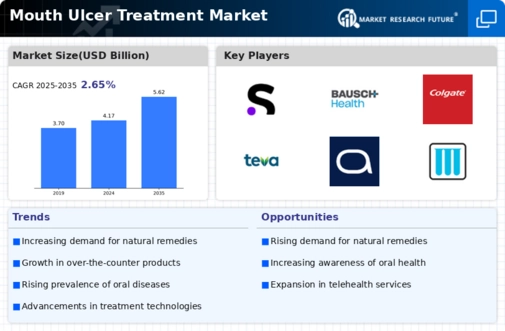
As per Market Research Future analysis, the Mouth Ulcer Treatment Market was estimated at 4.219 USD Billion in 2024. The Mouth Ulcer Treatment industry is projected to grow from 4.331 USD Billion in 2025 to 5.625 USD Billion by 2035, exhibiting a compound annual growth rate (CAGR) of 2.65% during the forecast period 2025 - 2035

Key Market Trends & Highlights

The Mouth Ulcer Treatment Market is experiencing a dynamic shift towards natural and personalized treatment options.

  • The market is witnessing a notable shift towards natural remedies, reflecting changing consumer preferences. Technological advancements in treatment methodologies are enhancing the efficacy of mouth ulcer therapies. Personalized healthcare approaches are gaining traction, catering to individual patient needs and preferences. The rising incidence of mouth ulcers and increased awareness of oral health are driving demand for both over-the-counter products and natural remedies.

Market Size & Forecast

2024 Market Size 4.219 (USD Billion)
2035 Market Size 5.625 (USD Billion)
CAGR (2025 - 2035) 2.65%
Largest Regional Market Share in 2024 North America

Major Players

GlaxoSmithKline (GB), <a href="https://news.bms.com/news/corporate-financial/2025/Bristol-Myers-Squibb-Builds-on-Eliquis-apixaban-Direct-to-Patient-Program-Announces-New-BMS-Patient-Connect-Platform-Offering-Sotyktu-deucravacitinib/default.aspx">Bristol-Myers Squibb</a> (US), Johnson &amp; Johnson (US), Pfizer (US), Mylan (US), Novartis (CH), Sanofi (FR), AstraZeneca (GB), Merck &amp; Co. (US)

Market Trends

The Mouth Ulcer Treatment Market is currently experiencing a notable evolution, driven by a combination of factors including increasing awareness of oral health and the rising prevalence of mouth ulcers among various demographics. This condition, often characterized by painful sores in the mouth, has prompted a surge in demand for effective treatment options. As consumers become more informed about available therapies, the market is witnessing a shift towards innovative solutions that not only alleviate symptoms but also address underlying causes. Furthermore, the growing inclination towards natural and homeopathic remedies is influencing product development, as manufacturers seek to cater to a more health-conscious audience. In addition to the rising demand for diverse treatment options, the Mouth Ulcer Treatment Market is also shaped by advancements in technology and research. New formulations and delivery methods are emerging, enhancing the efficacy and convenience of treatments. The integration of digital health solutions, such as mobile applications for tracking symptoms and treatment progress, is also gaining traction. This trend indicates a broader movement towards personalized healthcare, where patients are empowered to manage their conditions more effectively. Overall, the Mouth Ulcer Treatment Market appears poised for continued growth, driven by innovation and a deeper understanding of consumer needs.

Shift Towards Natural Remedies

There is a growing trend within the Mouth Ulcer Treatment Market towards natural and homeopathic solutions. Consumers are increasingly seeking alternatives to conventional medications, favoring products that are perceived as safer and more holistic. This shift is prompting manufacturers to explore and develop formulations that incorporate herbal ingredients and natural compounds.

Technological Advancements in Treatment

The Mouth Ulcer Treatment Market is witnessing significant technological advancements that enhance treatment efficacy. Innovations in drug delivery systems, such as gels and patches, are becoming more prevalent. These advancements not only improve patient compliance but also provide targeted relief, thereby addressing the discomfort associated with mouth ulcers more effectively.

Personalized Healthcare Approaches

The trend towards personalized healthcare is becoming more pronounced in the Mouth Ulcer Treatment Market. Patients are increasingly looking for tailored treatment plans that consider their unique health profiles and preferences. This shift is encouraging healthcare providers and manufacturers to offer customized solutions, thereby improving patient satisfaction and treatment outcomes.

Mouth Ulcer Treatment Market Market Drivers

Rising Incidence of Mouth Ulcers

The increasing prevalence of mouth ulcers is a primary driver for the Mouth Ulcer Treatment Market. Factors such as stress, dietary deficiencies, and certain medical conditions contribute to the rise in cases. Recent studies indicate that approximately 20% of the population experiences mouth ulcers at some point in their lives. This growing incidence necessitates effective treatment options, thereby propelling the demand for various therapeutic products. As awareness about oral health continues to expand, more individuals seek remedies, further stimulating market growth. The Mouth Ulcer Treatment Market is likely to see a surge in product development aimed at addressing this widespread issue, including over-the-counter medications and natural remedies.

Increased Awareness of Oral Health

There is a notable increase in awareness regarding oral health, which significantly impacts the Mouth Ulcer Treatment Market. Educational campaigns and health initiatives have led to a better understanding of the causes and treatments of mouth ulcers. As individuals become more informed about the implications of oral health on overall well-being, they are more inclined to seek treatment for mouth ulcers. This heightened awareness is reflected in the growing sales of mouth ulcer treatment products, which have seen a rise of approximately 15% in recent years. Consequently, the Mouth Ulcer Treatment Market is experiencing a shift towards more innovative and effective treatment solutions to meet the demands of a more health-conscious population.

Advancements in Pharmaceutical Research

The Mouth Ulcer Treatment Market is significantly influenced by advancements in pharmaceutical research. Ongoing studies and clinical trials are leading to the development of novel therapies that offer improved efficacy and safety profiles. For instance, the introduction of new topical agents and systemic treatments has expanded the range of options available for patients suffering from mouth ulcers. The market is projected to grow at a compound annual growth rate (CAGR) of around 6% over the next few years, driven by these innovations. As pharmaceutical companies invest in research and development, the Mouth Ulcer Treatment Market is poised for substantial growth, with an emphasis on creating targeted therapies that address the underlying causes of mouth ulcers.

Emergence of Natural and Herbal Remedies

The emergence of natural and herbal remedies is reshaping the Mouth Ulcer Treatment Market. As consumers become more health-conscious, there is a growing preference for treatments that are perceived as safe and effective without synthetic ingredients. Products containing natural ingredients such as aloe vera, chamomile, and licorice root are gaining popularity among consumers seeking alternative solutions. This trend is supported by a market analysis indicating that the natural remedies segment is expected to grow by approximately 8% in the coming years. The Mouth Ulcer Treatment Market is adapting to this shift by incorporating more natural options into their product lines, thereby appealing to a broader audience that values holistic health approaches.

Growing Demand for Over-the-Counter Products

The demand for over-the-counter (OTC) products is a significant driver in the Mouth Ulcer Treatment Market. Consumers increasingly prefer accessible and convenient treatment options that do not require a prescription. This trend is evident in the rising sales of topical gels, mouth rinses, and lozenges designed to alleviate the discomfort associated with mouth ulcers. The OTC segment has experienced a growth rate of approximately 10% annually, reflecting a shift in consumer behavior towards self-medication. As more individuals seek immediate relief from symptoms, the Mouth Ulcer Treatment Market is likely to expand its offerings in the OTC category, catering to the needs of a diverse consumer base.

Market Segment Insights

By Type: Topical Treatments (Largest) vs. Home Remedies (Fastest-Growing)

In the Mouth Ulcer Treatment Market, the distribution of market share is quite distinct, with topical treatments holding the largest stake due to their direct application and effectiveness. They are widely preferred by patients seeking immediate relief from discomfort. Meanwhile, oral rinses and systemic medications form a significant portion of the market as well, but they don&rsquo;t match the dominance of topical options. Home remedies, although historically sidelined, are gaining popularity as consumers increasingly look for natural alternatives, marking a shift in consumer preferences. The growth trends in this segment reveal a dual narrative: while topical treatments continue to dominate, home remedies are emerging rapidly, driven by a growing consumer shift toward natural and holistic health solutions. Increased awareness of product efficacy, ease of access, and a desire for cost-effective treatments are propelling home remedies into the spotlight. Meanwhile, the innovation in topical products continues to enhance their market share by providing better formulations, further solidifying their dominant position in the market.

Topical Treatments (Dominant) vs. Home Remedies (Emerging)

Topical treatments are a cornerstone of the Mouth Ulcer Treatment Market, renowned for their immediate relief and efficiency in managing pain and inflammation associated with mouth ulcers. These include gels, ointments, and creams that directly target ulcer sites. Their dominance is bolstered by ongoing advancements that improve their formulations, enhancing patient compliance and satisfaction. Conversely, home remedies, which encompass various traditional and natural approaches, have seen a surge in interest as consumers seek alternatives that resonate with their wellness philosophies. These remedies often attract health-conscious individuals looking for safe, accessible solutions to manage mouth ulcers. Despite being emerging, the rise of social media and health blogs has contributed significantly to their popularity, creating a robust market niche.

By End User: Hospitals (Largest) vs. Home Care (Fastest-Growing)

In the Mouth Ulcer Treatment Market, hospitals hold the largest market share among end-user segments, primarily due to the comprehensive care they provide and the availability of specialized treatment. Clinics follow as significant contributors, offering targeted treatments that cater to outpatient needs. Home care represents a growing segment, driven by the increasing preference of patients for convenience and self-management, especially in chronic conditions like mouth ulcers.

Hospitals (Dominant) vs. Home Care (Emerging)

The hospital segment in the Mouth Ulcer Treatment Market is characterized by advanced medical infrastructure and access to a range of treatment options, making it a dominant player in patient care for mouth ulcers. Hospitals typically have specialized departments that can provide thorough diagnosis and treatment plans for severe cases. In contrast, the home care segment is emerging rapidly as patients lean towards home treatments for comfort and convenience. This segment is driven by an expanding availability of over-the-counter treatments and digital health solutions, encouraging individuals to manage their conditions effectively from home.

By Formulation: Gels (Largest) vs. Ointments (Fastest-Growing)

In the Mouth Ulcer Treatment Market, Gels hold the largest share among the various formulation types, catering to the needs of consumers seeking effective pain relief and healing properties. These products are preferred for their ease of application and quick absorption, making them a popular choice among patients. Ointments, while growing rapidly, follow closely behind, appealing particularly to those who prefer a thicker consistency for prolonged contact with ulcerated areas.

Gels: Dominant vs. Ointments: Emerging

Gels have established themselves as the dominant formulation in the Mouth Ulcer Treatment Market due to their superior effectiveness and convenience. Patients often favor gels for their non-greasy texture, which allows for easy and comfortable application. On the other hand, ointments are emerging as an increasingly popular choice, particularly for individuals who need sustained relief. Ointments provide a thicker barrier that protects ulcers and can be particularly beneficial for patients who experience chronic mouth ulcers. As consumer preferences evolve, both these formulations are expected to coexist, catering to different patient needs and offering diverse therapeutic benefits.

By Age Group: Adults (Largest) vs. Children (Fastest-Growing)

The mouth ulcer treatment market is notably segmented by age demographics, with adults holding the largest share. They experience a higher prevalence of mouth ulcers due to factors such as stress, dietary choices, and underlying health conditions. In contrast, children represent the fastest-growing segment, driven by increasing awareness among parents and a rise in conditions like hand-foot-and-mouth disease that lead to oral ulcers. This demographic shift indicates a significant opportunity for targeted treatments and interventions. Growth trends for the mouth ulcer treatment market by age group point to a more focused approach in addressing the distinct needs of each segment. The adult population is influenced by chronic health conditions and lifestyle factors, which promote a steady demand for existing treatment options. Meanwhile, the growth in the child segment can be attributed to increased diagnostic rates and parents seeking immediate solutions for their children's discomfort, highlighting the necessity for pediatric-centric formulations and marketing strategies.

Adults: (Dominant) vs. Children (Emerging)

In the mouth ulcer treatment market, adults are positioned as the dominant segment due to higher prevalence rates and a variety of factors contributing to oral health issues, such as chronic stress and nutritional deficiencies. They are more likely to seek treatment, thus driving demand for advanced therapies. On the other hand, children are emerging as a significant segment, primarily because of the increase in conditions that lead to mouth ulcers, such as viral infections. This segment is characterized by a growing need for specialized treatments designed for younger patients, attracting considerable attention from pharmaceutical companies looking to develop kid-friendly formulations. As awareness continues to rise, the demand for effective treatments tailored to children's unique needs will likely expand.

Get more detailed insights about Mouth Ulcer Treatment Market Research Report – Forecast to 2035

Regional Insights

The Mouth Ulcer Treatment Market, valued at 4.11 USD Billion in 2023, demonstrates a diversified regional landscape with notable contributions from various regions. North America holds a majority share in this market, valued at 1.209 USD Billion in 2023, and is projected to reach 1.576 USD Billion by 2032, underlining its dominance due to high healthcare expenditure and awareness. 

Europe follows closely with a valuation of 0.967 USD Billion in 2023, forecasted to grow to 1.182 USD Billion, driven by an increasing patient population and advanced healthcare infrastructure.The APAC region, valued at 0.806 USD Billion in 2023, is also expected to expand to 1.024 USD Billion, highlighting the rising demand for effective mouth ulcer treatments due to increased incidence rates and growing healthcare access. 

South America and MEA, with valuations of 0.484 USD Billion and 0.645 USD Billion, respectively, in 2023, represent smaller markets but show potential for growth, thanks to improving healthcare systems and rising awareness about oral health. The market growth across these regions is propelled by effective treatment options and increasing recognition of the impact of mouth ulcers, presenting significant opportunities for stakeholders in the Mouth Ulcer Treatment Market industry.

Key Players and Competitive Insights

The Mouth Ulcer Treatment Market is characterized by a dynamic competitive landscape, driven by increasing awareness of oral health and the rising prevalence of mouth ulcers influenced by factors such as stress, nutritional deficiencies, and certain medical conditions. As the demand for effective treatment options grows, companies in this market are striving to innovate and enhance their product offerings to cater to diverse patient needs. 
The market is populated with a variety of players, ranging from pharmaceutical giants to specialized firms, each looking to establish a robust foothold. Competitive strategies include the development of novel therapies, investment in research and development, and strategic collaborations aimed at expanding distribution networks. This competitive environment highlights the importance of understanding market trends and consumer preferences in driving growth and positioning within the sector.
Sanofi has established a notable presence within the Mouth Ulcer Treatment Market, leveraging its extensive portfolio and expertise in various therapeutic areas. The company possesses a strong reputation for delivering reliable healthcare solutions, which translates into trust among healthcare professionals and patients alike. Sanofi benefits from a well-developed distribution network, allowing for effective reach and accessibility of its products across various regions. 
The firm is known for its commitment to research and innovation, continuously working on enhancing existing therapies and exploring new avenues for mouth ulcer treatment. Furthermore, its strong financial position enables Sanofi to invest significantly in marketing initiatives, raising awareness and educating consumers about the importance of addressing mouth ulcers promptly, consequently solidifying its position within this market.
Bausch Health Companies holds a significant stance in the Mouth Ulcer Treatment Market, differentiating itself through its specialized product offerings and focus on patient-centered care. The company is recognized for its dedication to delivering effective oral health solutions, which has earned it a loyal customer base. Bausch Health Companies emphasizes the importance of innovative formulations, aiming to provide treatments that alleviate pain and promote healing for individuals suffering from mouth ulcers. 
Its strategic investments in research and development have resulted in a continuous stream of product enhancements and new launch initiatives, allowing the company to stay ahead of emerging trends in the industry. Additionally, Bausch Health Companies promotes educational initiatives that aim to inform both patients and healthcare providers about the various treatment options available, thereby fostering a deeper understanding of mouth ulcer management and enhancing patient outcomes.

Key Companies in the Mouth Ulcer Treatment Market include

Industry Developments

  • Q2 2024: MouthWatch Unveils New HD Intraoral Camera at Las Vegas Dental Conference MouthWatch, a key player in oral health technology, launched its new HD intraoral camera designed to assist dentists in the diagnosis and treatment of mouth ulcers and other oral conditions. The product was introduced at a major dental conference in Las Vegas, aiming to improve clinical outcomes and patient care.

Future Outlook

Mouth Ulcer Treatment Market Future Outlook

The Mouth Ulcer Treatment Market is projected to grow at a 2.65% CAGR from 2025 to 2035, driven by increasing prevalence and innovative treatment options.

New opportunities lie in:

  • Development of targeted oral care products for specific demographics.
  • Expansion of <a href="https://www.marketresearchfuture.com/reports/telehealth-service-market-43509">telehealth services</a> for remote consultations and prescriptions.
  • Investment in research for novel therapeutic agents and delivery systems.

By 2035, the market is expected to achieve substantial growth, reflecting evolving consumer needs and treatment advancements.

Market Segmentation

Mouth Ulcer Treatment Market Type Outlook

  • Topical Treatments
  • Oral Rinses
  • Systemic Medications
  • Home Remedies

Mouth Ulcer Treatment Market End User Outlook

  • Hospitals
  • Clinics
  • Home Care

Mouth Ulcer Treatment Market Age Group Outlook

  • Children
  • Adults
  • Elderly

Mouth Ulcer Treatment Market Formulation Outlook

  • Gels
  • Ointments
  • Tablets
  • Mouthwash

Report Scope

MARKET SIZE 2024 4.219(USD Billion)
MARKET SIZE 2025 4.331(USD Billion)
MARKET SIZE 2035 5.625(USD Billion)
COMPOUND ANNUAL GROWTH RATE (CAGR) 2.65% (2025 - 2035)
REPORT COVERAGE Revenue Forecast, Competitive Landscape, Growth Factors, and Trends
BASE YEAR 2024
Market Forecast Period 2025 - 2035
Historical Data 2019 - 2024
Market Forecast Units USD Billion
Key Companies Profiled GlaxoSmithKline (GB), Bristol-Myers Squibb (US), Johnson & Johnson (US), Pfizer (US), Mylan (US), Novartis (CH), Sanofi (FR), AstraZeneca (GB), Merck & Co. (US)
Segments Covered Treatment Type, End User, Formulation, Age Group, Regional
Key Market Opportunities Emerging natural remedies and innovative formulations present growth opportunities in the Mouth Ulcer Treatment Market.
Key Market Dynamics Rising demand for innovative treatments drives competition and influences regulatory frameworks in the mouth ulcer treatment market.
Countries Covered North America, Europe, APAC, South America, MEA

FAQs

What is the current valuation of the Mouth Ulcer Treatment Market?

<p>The Mouth Ulcer Treatment Market was valued at 4.219 USD Billion in 2024.</p>

What is the projected market size for the Mouth Ulcer Treatment Market by 2035?

<p>The market is projected to reach 5.625 USD Billion by 2035.</p>

What is the expected CAGR for the Mouth Ulcer Treatment Market during the forecast period 2025 - 2035?

<p>The expected CAGR for the Mouth Ulcer Treatment Market during 2025 - 2035 is 2.65%.</p>

Which segment is anticipated to have the highest valuation in the Mouth Ulcer Treatment Market?

<p>The Home Remedies segment is expected to grow from 1.219 USD Billion in 2024 to 1.925 USD Billion by 2035.</p>

How do topical treatments perform in the Mouth Ulcer Treatment Market?

<p>Topical Treatments increased from 1.2 USD Billion in 2024 to a projected 1.5 USD Billion by 2035.</p>

What are the key end-user segments in the Mouth Ulcer Treatment Market?

<p>The market segments include Hospitals, Clinics, and Home Care, with Hospitals projected to grow from 1.687 USD Billion in 2024 to 2.2 USD Billion by 2035.</p>

Which age group is expected to dominate the Mouth Ulcer Treatment Market?

<p>Adults are anticipated to dominate the market, growing from 2.5 USD Billion in 2024 to 3.2 USD Billion by 2035.</p>

What formulations are available in the Mouth Ulcer Treatment Market?

<p>Formulations include Gels, Ointments, Tablets, and Mouthwash, with Mouthwash expected to rise from 1.574 USD Billion in 2024 to 1.75 USD Billion by 2035.</p>

Who are the key players in the Mouth Ulcer Treatment Market?

<p>Key players include GlaxoSmithKline, Bristol-Myers Squibb, Johnson & Johnson, and Pfizer, among others.</p>

What trends are influencing the Mouth Ulcer Treatment Market?

<p>Trends indicate a growing preference for Home Remedies and topical treatments, reflecting changing consumer behaviors and preferences.</p>

  1. SECTION I: EXECUTIVE SUMMARY AND KEY HIGHLIGHTS
    1. | 1.1 EXECUTIVE SUMMARY
    2. | | 1.1.1 Market Overview
    3. | | 1.1.2 Key Findings
    4. | | 1.1.3 Market Segmentation
    5. | | 1.1.4 Competitive Landscape
    6. | | 1.1.5 Challenges and Opportunities
    7. | | 1.1.6 Future Outlook
  2. SECTION II: SCOPING, METHODOLOGY AND MARKET STRUCTURE
    1. | 2.1 MARKET INTRODUCTION
    2. | | 2.1.1 Definition
    3. | | 2.1.2 Scope of the study
    4. | | | 2.1.2.1 Research Objective
    5. | | | 2.1.2.2 Assumption
    6. | | | 2.1.2.3 Limitations
    7. | 2.2 RESEARCH METHODOLOGY
    8. | | 2.2.1 Overview
    9. | | 2.2.2 Data Mining
    10. | | 2.2.3 Secondary Research
    11. | | 2.2.4 Primary Research
    12. | | | 2.2.4.1 Primary Interviews and Information Gathering Process
    13. | | | 2.2.4.2 Breakdown of Primary Respondents
    14. | | 2.2.5 Forecasting Model
    15. | | 2.2.6 Market Size Estimation
    16. | | | 2.2.6.1 Bottom-Up Approach
    17. | | | 2.2.6.2 Top-Down Approach
    18. | | 2.2.7 Data Triangulation
    19. | | 2.2.8 Validation
  3. SECTION III: QUALITATIVE ANALYSIS
    1. | 3.1 MARKET DYNAMICS
    2. | | 3.1.1 Overview
    3. | | 3.1.2 Drivers
    4. | | 3.1.3 Restraints
    5. | | 3.1.4 Opportunities
    6. | 3.2 MARKET FACTOR ANALYSIS
    7. | | 3.2.1 Value chain Analysis
    8. | | 3.2.2 Porter's Five Forces Analysis
    9. | | | 3.2.2.1 Bargaining Power of Suppliers
    10. | | | 3.2.2.2 Bargaining Power of Buyers
    11. | | | 3.2.2.3 Threat of New Entrants
    12. | | | 3.2.2.4 Threat of Substitutes
    13. | | | 3.2.2.5 Intensity of Rivalry
    14. | | 3.2.3 COVID-19 Impact Analysis
    15. | | | 3.2.3.1 Market Impact Analysis
    16. | | | 3.2.3.2 Regional Impact
    17. | | | 3.2.3.3 Opportunity and Threat Analysis
  4. SECTION IV: QUANTITATIVE ANALYSIS
    1. | 4.1 Healthcare, BY Type (USD Billion)
    2. | | 4.1.1 Topical Treatments
    3. | | 4.1.2 Oral Rinses
    4. | | 4.1.3 Systemic Medications
    5. | | 4.1.4 Home Remedies
    6. | 4.2 Healthcare, BY End User (USD Billion)
    7. | | 4.2.1 Hospitals
    8. | | 4.2.2 Clinics
    9. | | 4.2.3 Home Care
    10. | 4.3 Healthcare, BY Formulation (USD Billion)
    11. | | 4.3.1 Gels
    12. | | 4.3.2 Ointments
    13. | | 4.3.3 Tablets
    14. | | 4.3.4 Mouthwash
    15. | 4.4 Healthcare, BY Age Group (USD Billion)
    16. | | 4.4.1 Children
    17. | | 4.4.2 Adults
    18. | | 4.4.3 Elderly
    19. | 4.5 Healthcare, BY Region (USD Billion)
    20. | | 4.5.1 North America
    21. | | | 4.5.1.1 US
    22. | | | 4.5.1.2 Canada
    23. | | 4.5.2 Europe
    24. | | | 4.5.2.1 Germany
    25. | | | 4.5.2.2 UK
    26. | | | 4.5.2.3 France
    27. | | | 4.5.2.4 Russia
    28. | | | 4.5.2.5 Italy
    29. | | | 4.5.2.6 Spain
    30. | | | 4.5.2.7 Rest of Europe
    31. | | 4.5.3 APAC
    32. | | | 4.5.3.1 China
    33. | | | 4.5.3.2 India
    34. | | | 4.5.3.3 Japan
    35. | | | 4.5.3.4 South Korea
    36. | | | 4.5.3.5 Malaysia
    37. | | | 4.5.3.6 Thailand
    38. | | | 4.5.3.7 Indonesia
    39. | | | 4.5.3.8 Rest of APAC
    40. | | 4.5.4 South America
    41. | | | 4.5.4.1 Brazil
    42. | | | 4.5.4.2 Mexico
    43. | | | 4.5.4.3 Argentina
    44. | | | 4.5.4.4 Rest of South America
    45. | | 4.5.5 MEA
    46. | | | 4.5.5.1 GCC Countries
    47. | | | 4.5.5.2 South Africa
    48. | | | 4.5.5.3 Rest of MEA
  5. SECTION V: COMPETITIVE ANALYSIS
    1. | 5.1 Competitive Landscape
    2. | | 5.1.1 Overview
    3. | | 5.1.2 Competitive Analysis
    4. | | 5.1.3 Market share Analysis
    5. | | 5.1.4 Major Growth Strategy in the Healthcare
    6. | | 5.1.5 Competitive Benchmarking
    7. | | 5.1.6 Leading Players in Terms of Number of Developments in the Healthcare
    8. | | 5.1.7 Key developments and growth strategies
    9. | | | 5.1.7.1 New Product Launch/Service Deployment
    10. | | | 5.1.7.2 Merger & Acquisitions
    11. | | | 5.1.7.3 Joint Ventures
    12. | | 5.1.8 Major Players Financial Matrix
    13. | | | 5.1.8.1 Sales and Operating Income
    14. | | | 5.1.8.2 Major Players R&D Expenditure. 2023
    15. | 5.2 Company Profiles
    16. | | 5.2.1 GlaxoSmithKline (GB)
    17. | | | 5.2.1.1 Financial Overview
    18. | | | 5.2.1.2 Products Offered
    19. | | | 5.2.1.3 Key Developments
    20. | | | 5.2.1.4 SWOT Analysis
    21. | | | 5.2.1.5 Key Strategies
    22. | | 5.2.2 Bristol-Myers Squibb (US)
    23. | | | 5.2.2.1 Financial Overview
    24. | | | 5.2.2.2 Products Offered
    25. | | | 5.2.2.3 Key Developments
    26. | | | 5.2.2.4 SWOT Analysis
    27. | | | 5.2.2.5 Key Strategies
    28. | | 5.2.3 Johnson & Johnson (US)
    29. | | | 5.2.3.1 Financial Overview
    30. | | | 5.2.3.2 Products Offered
    31. | | | 5.2.3.3 Key Developments
    32. | | | 5.2.3.4 SWOT Analysis
    33. | | | 5.2.3.5 Key Strategies
    34. | | 5.2.4 Pfizer (US)
    35. | | | 5.2.4.1 Financial Overview
    36. | | | 5.2.4.2 Products Offered
    37. | | | 5.2.4.3 Key Developments
    38. | | | 5.2.4.4 SWOT Analysis
    39. | | | 5.2.4.5 Key Strategies
    40. | | 5.2.5 Mylan (US)
    41. | | | 5.2.5.1 Financial Overview
    42. | | | 5.2.5.2 Products Offered
    43. | | | 5.2.5.3 Key Developments
    44. | | | 5.2.5.4 SWOT Analysis
    45. | | | 5.2.5.5 Key Strategies
    46. | | 5.2.6 Novartis (CH)
    47. | | | 5.2.6.1 Financial Overview
    48. | | | 5.2.6.2 Products Offered
    49. | | | 5.2.6.3 Key Developments
    50. | | | 5.2.6.4 SWOT Analysis
    51. | | | 5.2.6.5 Key Strategies
    52. | | 5.2.7 Sanofi (FR)
    53. | | | 5.2.7.1 Financial Overview
    54. | | | 5.2.7.2 Products Offered
    55. | | | 5.2.7.3 Key Developments
    56. | | | 5.2.7.4 SWOT Analysis
    57. | | | 5.2.7.5 Key Strategies
    58. | | 5.2.8 AstraZeneca (GB)
    59. | | | 5.2.8.1 Financial Overview
    60. | | | 5.2.8.2 Products Offered
    61. | | | 5.2.8.3 Key Developments
    62. | | | 5.2.8.4 SWOT Analysis
    63. | | | 5.2.8.5 Key Strategies
    64. | | 5.2.9 Merck & Co. (US)
    65. | | | 5.2.9.1 Financial Overview
    66. | | | 5.2.9.2 Products Offered
    67. | | | 5.2.9.3 Key Developments
    68. | | | 5.2.9.4 SWOT Analysis
    69. | | | 5.2.9.5 Key Strategies
    70. | 5.3 Appendix
    71. | | 5.3.1 References
    72. | | 5.3.2 Related Reports
  6. LIST OF FIGURES
    1. | 6.1 MARKET SYNOPSIS
    2. | 6.2 NORTH AMERICA MARKET ANALYSIS
    3. | 6.3 US MARKET ANALYSIS BY TYPE
    4. | 6.4 US MARKET ANALYSIS BY END USER
    5. | 6.5 US MARKET ANALYSIS BY FORMULATION
    6. | 6.6 US MARKET ANALYSIS BY AGE GROUP
    7. | 6.7 CANADA MARKET ANALYSIS BY TYPE
    8. | 6.8 CANADA MARKET ANALYSIS BY END USER
    9. | 6.9 CANADA MARKET ANALYSIS BY FORMULATION
    10. | 6.10 CANADA MARKET ANALYSIS BY AGE GROUP
    11. | 6.11 EUROPE MARKET ANALYSIS
    12. | 6.12 GERMANY MARKET ANALYSIS BY TYPE
    13. | 6.13 GERMANY MARKET ANALYSIS BY END USER
    14. | 6.14 GERMANY MARKET ANALYSIS BY FORMULATION
    15. | 6.15 GERMANY MARKET ANALYSIS BY AGE GROUP
    16. | 6.16 UK MARKET ANALYSIS BY TYPE
    17. | 6.17 UK MARKET ANALYSIS BY END USER
    18. | 6.18 UK MARKET ANALYSIS BY FORMULATION
    19. | 6.19 UK MARKET ANALYSIS BY AGE GROUP
    20. | 6.20 FRANCE MARKET ANALYSIS BY TYPE
    21. | 6.21 FRANCE MARKET ANALYSIS BY END USER
    22. | 6.22 FRANCE MARKET ANALYSIS BY FORMULATION
    23. | 6.23 FRANCE MARKET ANALYSIS BY AGE GROUP
    24. | 6.24 RUSSIA MARKET ANALYSIS BY TYPE
    25. | 6.25 RUSSIA MARKET ANALYSIS BY END USER
    26. | 6.26 RUSSIA MARKET ANALYSIS BY FORMULATION
    27. | 6.27 RUSSIA MARKET ANALYSIS BY AGE GROUP
    28. | 6.28 ITALY MARKET ANALYSIS BY TYPE
    29. | 6.29 ITALY MARKET ANALYSIS BY END USER
    30. | 6.30 ITALY MARKET ANALYSIS BY FORMULATION
    31. | 6.31 ITALY MARKET ANALYSIS BY AGE GROUP
    32. | 6.32 SPAIN MARKET ANALYSIS BY TYPE
    33. | 6.33 SPAIN MARKET ANALYSIS BY END USER
    34. | 6.34 SPAIN MARKET ANALYSIS BY FORMULATION
    35. | 6.35 SPAIN MARKET ANALYSIS BY AGE GROUP
    36. | 6.36 REST OF EUROPE MARKET ANALYSIS BY TYPE
    37. | 6.37 REST OF EUROPE MARKET ANALYSIS BY END USER
    38. | 6.38 REST OF EUROPE MARKET ANALYSIS BY FORMULATION
    39. | 6.39 REST OF EUROPE MARKET ANALYSIS BY AGE GROUP
    40. | 6.40 APAC MARKET ANALYSIS
    41. | 6.41 CHINA MARKET ANALYSIS BY TYPE
    42. | 6.42 CHINA MARKET ANALYSIS BY END USER
    43. | 6.43 CHINA MARKET ANALYSIS BY FORMULATION
    44. | 6.44 CHINA MARKET ANALYSIS BY AGE GROUP
    45. | 6.45 INDIA MARKET ANALYSIS BY TYPE
    46. | 6.46 INDIA MARKET ANALYSIS BY END USER
    47. | 6.47 INDIA MARKET ANALYSIS BY FORMULATION
    48. | 6.48 INDIA MARKET ANALYSIS BY AGE GROUP
    49. | 6.49 JAPAN MARKET ANALYSIS BY TYPE
    50. | 6.50 JAPAN MARKET ANALYSIS BY END USER
    51. | 6.51 JAPAN MARKET ANALYSIS BY FORMULATION
    52. | 6.52 JAPAN MARKET ANALYSIS BY AGE GROUP
    53. | 6.53 SOUTH KOREA MARKET ANALYSIS BY TYPE
    54. | 6.54 SOUTH KOREA MARKET ANALYSIS BY END USER
    55. | 6.55 SOUTH KOREA MARKET ANALYSIS BY FORMULATION
    56. | 6.56 SOUTH KOREA MARKET ANALYSIS BY AGE GROUP
    57. | 6.57 MALAYSIA MARKET ANALYSIS BY TYPE
    58. | 6.58 MALAYSIA MARKET ANALYSIS BY END USER
    59. | 6.59 MALAYSIA MARKET ANALYSIS BY FORMULATION
    60. | 6.60 MALAYSIA MARKET ANALYSIS BY AGE GROUP
    61. | 6.61 THAILAND MARKET ANALYSIS BY TYPE
    62. | 6.62 THAILAND MARKET ANALYSIS BY END USER
    63. | 6.63 THAILAND MARKET ANALYSIS BY FORMULATION
    64. | 6.64 THAILAND MARKET ANALYSIS BY AGE GROUP
    65. | 6.65 INDONESIA MARKET ANALYSIS BY TYPE
    66. | 6.66 INDONESIA MARKET ANALYSIS BY END USER
    67. | 6.67 INDONESIA MARKET ANALYSIS BY FORMULATION
    68. | 6.68 INDONESIA MARKET ANALYSIS BY AGE GROUP
    69. | 6.69 REST OF APAC MARKET ANALYSIS BY TYPE
    70. | 6.70 REST OF APAC MARKET ANALYSIS BY END USER
    71. | 6.71 REST OF APAC MARKET ANALYSIS BY FORMULATION
    72. | 6.72 REST OF APAC MARKET ANALYSIS BY AGE GROUP
    73. | 6.73 SOUTH AMERICA MARKET ANALYSIS
    74. | 6.74 BRAZIL MARKET ANALYSIS BY TYPE
    75. | 6.75 BRAZIL MARKET ANALYSIS BY END USER
    76. | 6.76 BRAZIL MARKET ANALYSIS BY FORMULATION
    77. | 6.77 BRAZIL MARKET ANALYSIS BY AGE GROUP
    78. | 6.78 MEXICO MARKET ANALYSIS BY TYPE
    79. | 6.79 MEXICO MARKET ANALYSIS BY END USER
    80. | 6.80 MEXICO MARKET ANALYSIS BY FORMULATION
    81. | 6.81 MEXICO MARKET ANALYSIS BY AGE GROUP
    82. | 6.82 ARGENTINA MARKET ANALYSIS BY TYPE
    83. | 6.83 ARGENTINA MARKET ANALYSIS BY END USER
    84. | 6.84 ARGENTINA MARKET ANALYSIS BY FORMULATION
    85. | 6.85 ARGENTINA MARKET ANALYSIS BY AGE GROUP
    86. | 6.86 REST OF SOUTH AMERICA MARKET ANALYSIS BY TYPE
    87. | 6.87 REST OF SOUTH AMERICA MARKET ANALYSIS BY END USER
    88. | 6.88 REST OF SOUTH AMERICA MARKET ANALYSIS BY FORMULATION
    89. | 6.89 REST OF SOUTH AMERICA MARKET ANALYSIS BY AGE GROUP
    90. | 6.90 MEA MARKET ANALYSIS
    91. | 6.91 GCC COUNTRIES MARKET ANALYSIS BY TYPE
    92. | 6.92 GCC COUNTRIES MARKET ANALYSIS BY END USER
    93. | 6.93 GCC COUNTRIES MARKET ANALYSIS BY FORMULATION
    94. | 6.94 GCC COUNTRIES MARKET ANALYSIS BY AGE GROUP
    95. | 6.95 SOUTH AFRICA MARKET ANALYSIS BY TYPE
    96. | 6.96 SOUTH AFRICA MARKET ANALYSIS BY END USER
    97. | 6.97 SOUTH AFRICA MARKET ANALYSIS BY FORMULATION
    98. | 6.98 SOUTH AFRICA MARKET ANALYSIS BY AGE GROUP
    99. | 6.99 REST OF MEA MARKET ANALYSIS BY TYPE
    100. | 6.100 REST OF MEA MARKET ANALYSIS BY END USER
    101. | 6.101 REST OF MEA MARKET ANALYSIS BY FORMULATION
    102. | 6.102 REST OF MEA MARKET ANALYSIS BY AGE GROUP
    103. | 6.103 KEY BUYING CRITERIA OF HEALTHCARE
    104. | 6.104 RESEARCH PROCESS OF MRFR
    105. | 6.105 DRO ANALYSIS OF HEALTHCARE
    106. | 6.106 DRIVERS IMPACT ANALYSIS: HEALTHCARE
    107. | 6.107 RESTRAINTS IMPACT ANALYSIS: HEALTHCARE
    108. | 6.108 SUPPLY / VALUE CHAIN: HEALTHCARE
    109. | 6.109 HEALTHCARE, BY TYPE, 2024 (% SHARE)
    110. | 6.110 HEALTHCARE, BY TYPE, 2024 TO 2035 (USD Billion)
    111. | 6.111 HEALTHCARE, BY END USER, 2024 (% SHARE)
    112. | 6.112 HEALTHCARE, BY END USER, 2024 TO 2035 (USD Billion)
    113. | 6.113 HEALTHCARE, BY FORMULATION, 2024 (% SHARE)
    114. | 6.114 HEALTHCARE, BY FORMULATION, 2024 TO 2035 (USD Billion)
    115. | 6.115 HEALTHCARE, BY AGE GROUP, 2024 (% SHARE)
    116. | 6.116 HEALTHCARE, BY AGE GROUP, 2024 TO 2035 (USD Billion)
    117. | 6.117 BENCHMARKING OF MAJOR COMPETITORS
  7. LIST OF TABLES
    1. | 7.1 LIST OF ASSUMPTIONS
    2. | | 7.1.1
    3. | 7.2 North America MARKET SIZE ESTIMATES; FORECAST
    4. | | 7.2.1 BY TYPE, 2025-2035 (USD Billion)
    5. | | 7.2.2 BY END USER, 2025-2035 (USD Billion)
    6. | | 7.2.3 BY FORMULATION, 2025-2035 (USD Billion)
    7. | | 7.2.4 BY AGE GROUP, 2025-2035 (USD Billion)
    8. | 7.3 US MARKET SIZE ESTIMATES; FORECAST
    9. | | 7.3.1 BY TYPE, 2025-2035 (USD Billion)
    10. | | 7.3.2 BY END USER, 2025-2035 (USD Billion)
    11. | | 7.3.3 BY FORMULATION, 2025-2035 (USD Billion)
    12. | | 7.3.4 BY AGE GROUP, 2025-2035 (USD Billion)
    13. | 7.4 Canada MARKET SIZE ESTIMATES; FORECAST
    14. | | 7.4.1 BY TYPE, 2025-2035 (USD Billion)
    15. | | 7.4.2 BY END USER, 2025-2035 (USD Billion)
    16. | | 7.4.3 BY FORMULATION, 2025-2035 (USD Billion)
    17. | | 7.4.4 BY AGE GROUP, 2025-2035 (USD Billion)
    18. | 7.5 Europe MARKET SIZE ESTIMATES; FORECAST
    19. | | 7.5.1 BY TYPE, 2025-2035 (USD Billion)
    20. | | 7.5.2 BY END USER, 2025-2035 (USD Billion)
    21. | | 7.5.3 BY FORMULATION, 2025-2035 (USD Billion)
    22. | | 7.5.4 BY AGE GROUP, 2025-2035 (USD Billion)
    23. | 7.6 Germany MARKET SIZE ESTIMATES; FORECAST
    24. | | 7.6.1 BY TYPE, 2025-2035 (USD Billion)
    25. | | 7.6.2 BY END USER, 2025-2035 (USD Billion)
    26. | | 7.6.3 BY FORMULATION, 2025-2035 (USD Billion)
    27. | | 7.6.4 BY AGE GROUP, 2025-2035 (USD Billion)
    28. | 7.7 UK MARKET SIZE ESTIMATES; FORECAST
    29. | | 7.7.1 BY TYPE, 2025-2035 (USD Billion)
    30. | | 7.7.2 BY END USER, 2025-2035 (USD Billion)
    31. | | 7.7.3 BY FORMULATION, 2025-2035 (USD Billion)
    32. | | 7.7.4 BY AGE GROUP, 2025-2035 (USD Billion)
    33. | 7.8 France MARKET SIZE ESTIMATES; FORECAST
    34. | | 7.8.1 BY TYPE, 2025-2035 (USD Billion)
    35. | | 7.8.2 BY END USER, 2025-2035 (USD Billion)
    36. | | 7.8.3 BY FORMULATION, 2025-2035 (USD Billion)
    37. | | 7.8.4 BY AGE GROUP, 2025-2035 (USD Billion)
    38. | 7.9 Russia MARKET SIZE ESTIMATES; FORECAST
    39. | | 7.9.1 BY TYPE, 2025-2035 (USD Billion)
    40. | | 7.9.2 BY END USER, 2025-2035 (USD Billion)
    41. | | 7.9.3 BY FORMULATION, 2025-2035 (USD Billion)
    42. | | 7.9.4 BY AGE GROUP, 2025-2035 (USD Billion)
    43. | 7.10 Italy MARKET SIZE ESTIMATES; FORECAST
    44. | | 7.10.1 BY TYPE, 2025-2035 (USD Billion)
    45. | | 7.10.2 BY END USER, 2025-2035 (USD Billion)
    46. | | 7.10.3 BY FORMULATION, 2025-2035 (USD Billion)
    47. | | 7.10.4 BY AGE GROUP, 2025-2035 (USD Billion)
    48. | 7.11 Spain MARKET SIZE ESTIMATES; FORECAST
    49. | | 7.11.1 BY TYPE, 2025-2035 (USD Billion)
    50. | | 7.11.2 BY END USER, 2025-2035 (USD Billion)
    51. | | 7.11.3 BY FORMULATION, 2025-2035 (USD Billion)
    52. | | 7.11.4 BY AGE GROUP, 2025-2035 (USD Billion)
    53. | 7.12 Rest of Europe MARKET SIZE ESTIMATES; FORECAST
    54. | | 7.12.1 BY TYPE, 2025-2035 (USD Billion)
    55. | | 7.12.2 BY END USER, 2025-2035 (USD Billion)
    56. | | 7.12.3 BY FORMULATION, 2025-2035 (USD Billion)
    57. | | 7.12.4 BY AGE GROUP, 2025-2035 (USD Billion)
    58. | 7.13 APAC MARKET SIZE ESTIMATES; FORECAST
    59. | | 7.13.1 BY TYPE, 2025-2035 (USD Billion)
    60. | | 7.13.2 BY END USER, 2025-2035 (USD Billion)
    61. | | 7.13.3 BY FORMULATION, 2025-2035 (USD Billion)
    62. | | 7.13.4 BY AGE GROUP, 2025-2035 (USD Billion)
    63. | 7.14 China MARKET SIZE ESTIMATES; FORECAST
    64. | | 7.14.1 BY TYPE, 2025-2035 (USD Billion)
    65. | | 7.14.2 BY END USER, 2025-2035 (USD Billion)
    66. | | 7.14.3 BY FORMULATION, 2025-2035 (USD Billion)
    67. | | 7.14.4 BY AGE GROUP, 2025-2035 (USD Billion)
    68. | 7.15 India MARKET SIZE ESTIMATES; FORECAST
    69. | | 7.15.1 BY TYPE, 2025-2035 (USD Billion)
    70. | | 7.15.2 BY END USER, 2025-2035 (USD Billion)
    71. | | 7.15.3 BY FORMULATION, 2025-2035 (USD Billion)
    72. | | 7.15.4 BY AGE GROUP, 2025-2035 (USD Billion)
    73. | 7.16 Japan MARKET SIZE ESTIMATES; FORECAST
    74. | | 7.16.1 BY TYPE, 2025-2035 (USD Billion)
    75. | | 7.16.2 BY END USER, 2025-2035 (USD Billion)
    76. | | 7.16.3 BY FORMULATION, 2025-2035 (USD Billion)
    77. | | 7.16.4 BY AGE GROUP, 2025-2035 (USD Billion)
    78. | 7.17 South Korea MARKET SIZE ESTIMATES; FORECAST
    79. | | 7.17.1 BY TYPE, 2025-2035 (USD Billion)
    80. | | 7.17.2 BY END USER, 2025-2035 (USD Billion)
    81. | | 7.17.3 BY FORMULATION, 2025-2035 (USD Billion)
    82. | | 7.17.4 BY AGE GROUP, 2025-2035 (USD Billion)
    83. | 7.18 Malaysia MARKET SIZE ESTIMATES; FORECAST
    84. | | 7.18.1 BY TYPE, 2025-2035 (USD Billion)
    85. | | 7.18.2 BY END USER, 2025-2035 (USD Billion)
    86. | | 7.18.3 BY FORMULATION, 2025-2035 (USD Billion)
    87. | | 7.18.4 BY AGE GROUP, 2025-2035 (USD Billion)
    88. | 7.19 Thailand MARKET SIZE ESTIMATES; FORECAST
    89. | | 7.19.1 BY TYPE, 2025-2035 (USD Billion)
    90. | | 7.19.2 BY END USER, 2025-2035 (USD Billion)
    91. | | 7.19.3 BY FORMULATION, 2025-2035 (USD Billion)
    92. | | 7.19.4 BY AGE GROUP, 2025-2035 (USD Billion)
    93. | 7.20 Indonesia MARKET SIZE ESTIMATES; FORECAST
    94. | | 7.20.1 BY TYPE, 2025-2035 (USD Billion)
    95. | | 7.20.2 BY END USER, 2025-2035 (USD Billion)
    96. | | 7.20.3 BY FORMULATION, 2025-2035 (USD Billion)
    97. | | 7.20.4 BY AGE GROUP, 2025-2035 (USD Billion)
    98. | 7.21 Rest of APAC MARKET SIZE ESTIMATES; FORECAST
    99. | | 7.21.1 BY TYPE, 2025-2035 (USD Billion)
    100. | | 7.21.2 BY END USER, 2025-2035 (USD Billion)
    101. | | 7.21.3 BY FORMULATION, 2025-2035 (USD Billion)
    102. | | 7.21.4 BY AGE GROUP, 2025-2035 (USD Billion)
    103. | 7.22 South America MARKET SIZE ESTIMATES; FORECAST
    104. | | 7.22.1 BY TYPE, 2025-2035 (USD Billion)
    105. | | 7.22.2 BY END USER, 2025-2035 (USD Billion)
    106. | | 7.22.3 BY FORMULATION, 2025-2035 (USD Billion)
    107. | | 7.22.4 BY AGE GROUP, 2025-2035 (USD Billion)
    108. | 7.23 Brazil MARKET SIZE ESTIMATES; FORECAST
    109. | | 7.23.1 BY TYPE, 2025-2035 (USD Billion)
    110. | | 7.23.2 BY END USER, 2025-2035 (USD Billion)
    111. | | 7.23.3 BY FORMULATION, 2025-2035 (USD Billion)
    112. | | 7.23.4 BY AGE GROUP, 2025-2035 (USD Billion)
    113. | 7.24 Mexico MARKET SIZE ESTIMATES; FORECAST
    114. | | 7.24.1 BY TYPE, 2025-2035 (USD Billion)
    115. | | 7.24.2 BY END USER, 2025-2035 (USD Billion)
    116. | | 7.24.3 BY FORMULATION, 2025-2035 (USD Billion)
    117. | | 7.24.4 BY AGE GROUP, 2025-2035 (USD Billion)
    118. | 7.25 Argentina MARKET SIZE ESTIMATES; FORECAST
    119. | | 7.25.1 BY TYPE, 2025-2035 (USD Billion)
    120. | | 7.25.2 BY END USER, 2025-2035 (USD Billion)
    121. | | 7.25.3 BY FORMULATION, 2025-2035 (USD Billion)
    122. | | 7.25.4 BY AGE GROUP, 2025-2035 (USD Billion)
    123. | 7.26 Rest of South America MARKET SIZE ESTIMATES; FORECAST
    124. | | 7.26.1 BY TYPE, 2025-2035 (USD Billion)
    125. | | 7.26.2 BY END USER, 2025-2035 (USD Billion)
    126. | | 7.26.3 BY FORMULATION, 2025-2035 (USD Billion)
    127. | | 7.26.4 BY AGE GROUP, 2025-2035 (USD Billion)
    128. | 7.27 MEA MARKET SIZE ESTIMATES; FORECAST
    129. | | 7.27.1 BY TYPE, 2025-2035 (USD Billion)
    130. | | 7.27.2 BY END USER, 2025-2035 (USD Billion)
    131. | | 7.27.3 BY FORMULATION, 2025-2035 (USD Billion)
    132. | | 7.27.4 BY AGE GROUP, 2025-2035 (USD Billion)
    133. | 7.28 GCC Countries MARKET SIZE ESTIMATES; FORECAST
    134. | | 7.28.1 BY TYPE, 2025-2035 (USD Billion)
    135. | | 7.28.2 BY END USER, 2025-2035 (USD Billion)
    136. | | 7.28.3 BY FORMULATION, 2025-2035 (USD Billion)
    137. | | 7.28.4 BY AGE GROUP, 2025-2035 (USD Billion)
    138. | 7.29 South Africa MARKET SIZE ESTIMATES; FORECAST
    139. | | 7.29.1 BY TYPE, 2025-2035 (USD Billion)
    140. | | 7.29.2 BY END USER, 2025-2035 (USD Billion)
    141. | | 7.29.3 BY FORMULATION, 2025-2035 (USD Billion)
    142. | | 7.29.4 BY AGE GROUP, 2025-2035 (USD Billion)
    143. | 7.30 Rest of MEA MARKET SIZE ESTIMATES; FORECAST
    144. | | 7.30.1 BY TYPE, 2025-2035 (USD Billion)
    145. | | 7.30.2 BY END USER, 2025-2035 (USD Billion)
    146. | | 7.30.3 BY FORMULATION, 2025-2035 (USD Billion)
    147. | | 7.30.4 BY AGE GROUP, 2025-2035 (USD Billion)
    148. | 7.31 PRODUCT LAUNCH/PRODUCT DEVELOPMENT/APPROVAL
    149. | | 7.31.1
    150. | 7.32 ACQUISITION/PARTNERSHIP
    151. | | 7.32.1

Healthcare Market Segmentation

Healthcare By Type (USD Billion, 2025-2035)

  • Topical Treatments
  • Oral Rinses
  • Systemic Medications
  • Home Remedies

Healthcare By End User (USD Billion, 2025-2035)

  • Hospitals
  • Clinics
  • Home Care

Healthcare By Formulation (USD Billion, 2025-2035)

  • Gels
  • Ointments
  • Tablets
  • Mouthwash

Healthcare By Age Group (USD Billion, 2025-2035)

  • Children
  • Adults
  • Elderly
Infographic

Free Sample Request

Kindly complete the form below to receive a free sample of this Report

Get Free Sample

Customer Strories

Compare Licence

×
Features License Type
Single User Multiuser License Enterprise User
Price $4,950 $5,950 $7,250
Maximum User Access Limit 1 User Upto 10 Users Unrestricted Access Throughout the Organization
Free Customization
Direct Access to Analyst
Deliverable Format
Platform Access
Discount on Next Purchase 10% 15% 15%
Printable Versions