×
Request Free Sample ×

Kindly complete the form below to receive a free sample of this Report

* Please use a valid business email

Leading companies partner with us for data-driven Insights

clients tt-cursor
Hero Background
English
Chinese
French
Japanese
Korean
German
Spanish

Mobile VOIP Market Share

ID: MRFR/ICT/7168-HCR
140 Pages
Aarti Dhapte
February 2026

Mobile VOIP Market Research Report Information By Service Type (Voice, Video And Instant Messaging), By OS Type(Android, iOS, Windows And Others), By User Type (Enterprises And Individuals) And By Region (North America, Europe, Asia-Pacific, And Rest Of The World) –Market Forecast Till 2035

Share:
Download PDF ×

We do not share your information with anyone. However, we may send you emails based on your report interest from time to time. You may contact us at any time to opt-out.

Mobile VOIP Market Infographic
Purchase Options

Market Share

Mobile VOIP Market Share Analysis

As communication technologies advance and demand for flexible and affordable mobile phone services rises, the Mobile phone over Internet Protocol (VoIP) industry is showing notable trends. Mobile VoIP is becoming more popular. With the rise of smartphones and high-speed mobile internet networks, people are switching to mobile VoIP for voice conversations due to its reduced prices and better functionality. The sector is adapting to the shifting communication landscape and mobile VoIP's popularity.

The 5G technology integration drives Mobile VoIP industry developments. The enhanced data rates, lower latency, and expanded network capacity of 5G networks make mobile VoIP more smooth and dependable. Mobile VoIP is adapting to 5G, offering better voice conversations and new applications that take use of network performance. This development correlates with industry initiatives to optimize mobile VoIP services using 5G.

Mobile VoIP solutions are affected by UCaaS expansion. Companies are using UCaaS services that combine audio, texting, and collaboration. This trend is supported by mobile VoIP apps that integrate with UCaaS to give a complete mobile communication experience. The industry recognizes the necessity for cross-platform communication and collaboration technologies.

Mobile VoIP competition is changing due to the rise of OTT apps. OTT apps circumvent telecom networks to provide voice and messaging services. Mobile VoIP services, supplied via OTT applications, are popular because to their simplicity and affordability. The increased rivalry between traditional phone services and OTT-based mobile VoIP solutions drives service providers to innovate and improve their products.

Security and privacy are becoming more important in Mobile VoIP. Security is prioritized for mobile VoIP services since they handle sensitive voice data. Mobile VoIP apps employ encryption, secure authentication, and advanced security features to safeguard user privacy and voice conversations. This trend supports the industry's commitment to safe and private mobile VoIP.

Mobile VoIP solutions are being influenced by WebRTC technology. WebRTC allows real-time communication in web browsers without plugins. WebRTC is being used in mobile VoIP apps to enable browser-based voice calls. This trend underscores the industry's goal of seamless, accessible communication experiences using web standards for interoperability.

Mobile VoIP services are being improved using AI and ML. Voice recognition, transcription, and intelligent call routing make mobile VoIP more sophisticated and user-friendly. ML algorithms improve call quality and prediction features by analyzing use trends. The industry is using AI and ML to provide better, more tailored mobile VoIP services.


Author
Aarti Dhapte
AVP - Research

A consulting professional focused on helping businesses navigate complex markets through structured research and strategic insights. I partner with clients to solve high-impact business problems across market entry strategy, competitive intelligence, and opportunity assessment. Over the course of my experience, I have led and contributed to 100+ market research and consulting engagements, delivering insights across multiple industries and geographies, and supporting strategic decisions linked to $500M+ market opportunities. My core expertise lies in building robust market sizing, forecasting, and commercial models (top-down and bottom-up), alongside deep-dive competitive and industry analysis. I have played a key role in shaping go-to-market strategies, investment cases, and growth roadmaps, enabling clients to make confident, data-backed decisions in dynamic markets.

Leave a Comment

FAQs

What is the current valuation of the Mobile VOIP Market?

<p>The Mobile VOIP Market was valued at 31.3 USD Billion in 2024.</p>

What is the projected market size for the Mobile VOIP Market by 2035?

<p>The market is projected to reach 111.05 USD Billion by 2035.</p>

What is the expected CAGR for the Mobile VOIP Market during the forecast period?

<p>The expected CAGR for the Mobile VOIP Market from 2025 to 2035 is 12.2%.</p>

Which service type segments are leading in the Mobile VOIP Market?

<p>The leading service type segments include Voice at 54.0 USD Billion, Video at 36.0 USD Billion, and Instant Messaging at 21.05 USD Billion.</p>

How do user types impact the Mobile VOIP Market valuation?

<p>The market valuation indicates that Individuals contribute 66.05 USD Billion, while Enterprises account for 45.0 USD Billion.</p>

What operating systems are most popular in the Mobile VOIP Market?

<p>Android leads with 36.0 USD Billion, followed by iOS at 28.0 USD Billion, and Others at 29.05 USD Billion.</p>

Who are the key players in the Mobile VOIP Market?

<p>Key players include Skype, Vonage, RingCentral, WhatsApp, Viber, Google Voice, Zoom, Line, and WeChat.</p>

What trends are influencing the growth of the Mobile VOIP Market?

<p>Trends such as increased smartphone penetration and demand for cost-effective communication solutions appear to drive market growth.</p>

How does the Mobile VOIP Market compare across different user types?

<p>The market shows a notable disparity, with Individuals generating higher revenue than Enterprises.</p>

What factors could affect the future growth of the Mobile VOIP Market?

<p>Factors such as technological advancements and changing consumer preferences may significantly influence future growth.</p>

Market Summary

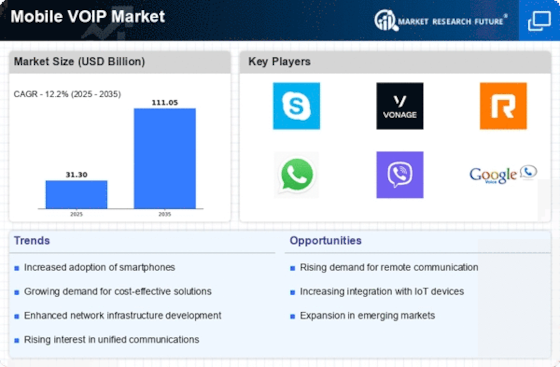
As per Market Research Future analysis, the Mobile VOIP Market Size was estimated at 31.3 USD Billion in 2024. The Mobile VOIP industry is projected to grow from 35.12 USD Billion in 2025 to 111.05 USD Billion by 2035, exhibiting a compound annual growth rate (CAGR) of 12.2% during the forecast period 2025 - 2035

Key Market Trends & Highlights

The Mobile VOIP Market is experiencing robust growth driven by technological advancements and changing communication preferences.

  • North America remains the largest market for Mobile VOIP Market, driven by high smartphone penetration and advanced internet infrastructure. The Asia-Pacific region is the fastest-growing market, fueled by increasing smartphone adoption and a burgeoning digital economy. Voice services continue to dominate the market, while video services are emerging as the fastest-growing segment due to rising demand for video conferencing solutions. Key market drivers include the rising demand for cost-effective communication solutions and advancements in internet infrastructure, which are shaping the Mobile VOIP Market landscape.

Market Size & Forecast

2024 Market Size 31.3 (USD Billion)
2035 Market Size 111.05 (USD Billion)
CAGR (2025 - 2035) 12.2%
Largest Regional Market Share in 2024 North America

Major Players

<a href="https://www.business-standard.com/companies/news/microsoft-to-retire-skype-in-may-2025-shifts-focus-to-microsoft-teams-125022801315_1.html">Skype</a> (US), Vonage (US), RingCentral (US), WhatsApp (US), Viber (CY), Google Voice (US), Zoom (US), Line (JP), <a href="https://explodingtopics.com/blog/messaging-apps-stats">WeChat</a> (CN)

Market Trends

The Mobile VOIP Market is currently experiencing a transformative phase, characterized by rapid technological advancements and shifting consumer preferences. As users increasingly seek cost-effective communication solutions, the demand for mobile voice over internet protocol services continues to rise. This trend is further fueled by the proliferation of smartphones and improved internet connectivity, which enable seamless communication across various platforms. Additionally, the integration of artificial intelligence and machine learning into mobile VOIP applications is enhancing user experience, making these services more intuitive and efficient. Moreover, the competitive landscape of the Mobile VOIP Market is evolving, with numerous players vying for market share. Companies are focusing on innovative features, such as enhanced security protocols and high-definition voice quality, to differentiate their offerings. The growing trend of remote work and The Mobile VOIP Market, as individuals and businesses alike seek reliable and flexible communication tools. As the Mobile VOIP Market continues to mature, it appears poised for sustained growth, driven by technological innovation and changing consumer behaviors.

Increased Adoption of Cloud-Based Solutions

The Mobile VOIP Market is witnessing a notable shift towards cloud-based services. This transition allows users to access communication tools from anywhere, enhancing flexibility and convenience. As businesses increasingly adopt remote work policies, the demand for cloud solutions is likely to grow, enabling seamless collaboration among teams.

Focus on Enhanced Security Features

With the rise in cyber threats, there is a growing emphasis on security within the Mobile VOIP Market. Providers are investing in advanced encryption technologies and secure authentication methods to protect user data. This trend indicates a heightened awareness of privacy concerns among consumers, driving demand for secure communication options.

Integration of AI and Machine Learning

The incorporation of artificial intelligence and machine learning into Mobile VOIP Market applications is becoming more prevalent. These technologies facilitate personalized user experiences, such as smart call routing and predictive analytics. As a result, the Mobile VOIP Market is likely to see increased user engagement and satisfaction.

Mobile VOIP Market Market Drivers

Integration of Value-Added Services

The Mobile VOIP Market is witnessing a trend towards the integration of value-added services that enhance user experience. Features such as video conferencing, messaging, and file sharing are increasingly being bundled with traditional voice services, providing users with a comprehensive communication platform. This integration not only improves user engagement but also encourages businesses to adopt Mobile VOIP Market solutions as part of their communication strategy. Data indicates that companies utilizing integrated communication platforms experience a 20% increase in productivity. As users seek more versatile and multifunctional communication tools, the Mobile VOIP Market is likely to expand, driven by the demand for these enhanced service offerings.

Advancements in Internet Infrastructure

The Mobile VOIP Market is poised for growth due to advancements in internet infrastructure. The proliferation of 4G and 5G networks has significantly improved the quality and reliability of internet connections, which are crucial for seamless VOIP communication. Enhanced bandwidth and reduced latency enable users to experience high-definition voice calls without interruptions. As of October 2025, it is estimated that over 60% of mobile users have access to 4G or 5G networks, facilitating the adoption of Mobile VOIP Market services. This technological evolution not only supports existing users but also attracts new customers who prioritize high-quality communication. The Mobile VOIP Market is thus likely to benefit from these infrastructural improvements, as they create a more conducive environment for VOIP applications to thrive.

Increased Focus on Security and Privacy

The Mobile VOIP Market is experiencing an increased focus on security and privacy, which is becoming a critical factor for users. With the rise in cyber threats and data breaches, consumers and businesses are prioritizing secure communication channels. Mobile VOIP Market providers are responding by implementing advanced encryption technologies and security protocols to protect user data. Recent surveys indicate that over 70% of users consider security features as a primary factor when choosing a VOIP service. This heightened awareness around security is likely to drive the adoption of Mobile VOIP Market solutions that offer robust protection against potential threats. As a result, the Mobile VOIP Market is expected to grow as providers enhance their security measures to meet user expectations.

Growing Trend of Remote Work and Digital Communication

The Mobile VOIP Market is significantly influenced by the growing trend of remote work and digital communication. As organizations increasingly adopt flexible work arrangements, the need for reliable communication tools has become paramount. Mobile VOIP Market services provide an effective solution for remote teams, enabling them to communicate seamlessly regardless of their physical location. Recent statistics suggest that approximately 30% of the workforce is now engaged in remote work, a trend that is expected to persist. This shift has led to a heightened demand for Mobile VOIP Market solutions that facilitate collaboration and connectivity among dispersed teams. Consequently, the Mobile VOIP Market is likely to see sustained growth as businesses invest in communication technologies that support their remote workforce.

Rising Demand for Cost-Effective Communication Solutions

The Mobile VOIP Market is experiencing a notable surge in demand for cost-effective communication solutions. As businesses and consumers alike seek to minimize communication expenses, Mobile VOIP Market services offer a compelling alternative to traditional telephony. The ability to make voice calls over the internet significantly reduces costs, particularly for long-distance and international calls. Recent data indicates that the Mobile VOIP Market segment is projected to grow at a compound annual growth rate of approximately 10% over the next five years. This trend is driven by the increasing number of smartphone users and the widespread availability of high-speed internet, which together enhance the accessibility and appeal of Mobile VOIP Market services. Consequently, the Mobile VOIP Market is likely to expand as more users recognize the financial benefits associated with these services.

Market Segment Insights

By Service Type: Voice (Largest) vs. Video (Fastest-Growing)

<p>In the Mobile VOIP market, the service type distribution showcases 'Voice' as the most substantial segment, maintaining a significant lead over 'Video' and 'Instant Messaging.' This dominance is primarily attributed to the longstanding reliance on voice communication, with users gravitating towards seamless audio quality and reliability. 'Video' services are quickly gaining traction as consumer preferences shift toward more interactive communication methods, driving their increased share in the market. As users become more accustomed to video calls on mobile devices, 'Instant Messaging' holds a smaller segment but plays an integral role in complementing voice and video services. The growth drivers for the Mobile VOIP market's service types center on technological advancements and changing user behaviors. The advancements in mobile network infrastructure, including 5G technology, are enhancing voice and video quality, fueling user adoption. Moreover, the rising demand for remote work solutions and virtual interactions accelerates the adoption of video and instant messaging services. As applications strive to integrate these functionalities into cohesive platforms, the competition among service types is expected to intensify, further broadening market opportunities and stimulating innovation.</p>

<p>Voice (Dominant) vs. Video (Emerging)</p>

<p>In the Mobile VOIP market, 'Voice' services remain dominant due to their established infrastructure and user familiarity. They provide a straightforward and reliable means of communication that meets fundamental user needs. Its widespread accessibility and cost-effectiveness reinforce the segment's market position. Meanwhile, 'Video' services, categorized as an emerging segment, are rapidly gaining an audience, particularly among younger demographics focused on enhanced engagement. Video has become essential for personal and professional interactions, driven by the rise of remote work. The integration of video capabilities within existing VOIP applications offers users a multi-functional platform, contributing to the segment's swift growth. Both segments cater to different user preferences, making their coexistence crucial in achieving a comprehensive Mobile VOIP experience.</p>

By OS Type: Android (Largest) vs. iOS (Fastest-Growing)

<p>The Mobile VoIP market's OS type segment reveals a significant distribution of market share among various operating systems. Android emerges as the largest player, commanding a substantial portion of the market due to its vast user base and wide-ranging device compatibility. iOS follows closely behind, gaining traction rapidly, particularly appealing to users who prioritize privacy and security features inherent to Apple’s ecosystem. Meanwhile, Windows and other OS types occupy a smaller share but remain relevant in niche markets.</p>

<p>OS Type: Android (Dominant) vs. iOS (Emerging)</p>

<p>Android's dominance in the Mobile VoIP market is attributed to its expansive reach across various demographics and regions, bolstered by its open-source nature that supports a plethora of applications. This versatility allows Android to cater to a wide audience, from budget-conscious users to tech-savvy individuals seeking advanced features. In contrast, iOS, while currently the fastest-growing segment, is characterized by a loyal user base that values high-quality performance and seamless integration with other Apple products. As developers increasingly focus on creating optimized VoIP applications for Apple's platform, iOS is set to capture a growing share of customers, driven by technological innovation and user engagement.</p>

By User Type: Enterprises (Largest) vs. Individuals (Fastest-Growing)

<p>In the Mobile VOIP Market, the user type segment is primarily dominated by enterprises, which hold a significant portion of the total market share. This dominance is attributed to the growing demand for efficient communication solutions in business operations. Enterprises leverage Mobile VOIP services to enhance collaboration, reduce costs, and improve overall productivity. On the other hand, the individual user segment is experiencing rapid growth, driven by increasing mobile penetration and the desire for cost-effective communication options among consumers.</p>

<p>User Type: Enterprises (Dominant) vs. Individuals (Emerging)</p>

<p>The enterprises segment in the Mobile VOIP Market is characterized by its robust infrastructure and strategic adoption of technology to facilitate seamless communication. Enterprises focus on integrating VOIP with existing systems while emphasizing scalability and security. Conversely, the individual segment is emerging rapidly, reflecting trends such as the shift toward remote work and increased smartphone usage. Individual users prioritize affordability and accessibility, thus gravitating towards services that offer flexible pricing and user-friendly interfaces. This contrast underscores the evolving landscape of mobile communication, where both segments play vital roles in shaping market dynamics.</p>

Get more detailed insights about Mobile VOIP Market Research Report - Global Forecast till 2035

Regional Insights

North America : Leading Innovation and Adoption

North America is the largest market for Mobile VOIP Market, holding approximately 45% of the global share. The region's growth is driven by high smartphone penetration, robust internet infrastructure, and increasing demand for cost-effective communication solutions. Regulatory support for digital communication technologies further catalyzes market expansion, with a focus on enhancing user privacy and data security. The United States leads the market, followed by Canada, with major players like Skype, Vonage, and WhatsApp dominating the landscape. The competitive environment is characterized by continuous innovation and partnerships, as companies strive to enhance user experience and expand their service offerings. The presence of tech giants ensures a dynamic market, fostering rapid advancements in Mobile VOIP Market technology.

Europe : Emerging Regulatory Frameworks

Europe is witnessing significant growth in the Mobile VOIP Market, accounting for approximately 30% of the global share. The region's expansion is fueled by stringent regulatory frameworks that promote fair competition and consumer protection. The European Union's Digital Single Market initiative aims to enhance connectivity and accessibility, driving demand for Mobile VOIP Market services across member states. Leading countries include Germany, the UK, and France, where companies like Viber and Skype are making substantial inroads. The competitive landscape is marked by a mix of established players and emerging startups, all vying for market share. The focus on compliance with GDPR and other regulations ensures that user data is protected, fostering consumer trust and encouraging adoption of Mobile VOIP Market solutions.

Asia-Pacific : Rapid Growth and Adoption

Asia-Pacific is rapidly emerging as a powerhouse in the Mobile VOIP Market, holding around 20% of the global share. The region's growth is driven by increasing smartphone adoption, affordable internet access, and a young, tech-savvy population. Countries like China and India are leading the charge, with favorable government policies promoting digital communication technologies and infrastructure development. China, with platforms like WeChat, and Japan, with Line, are at the forefront of this market. The competitive landscape is vibrant, with numerous local players and international companies vying for dominance. The region's unique cultural and social dynamics influence user preferences, leading to innovative service offerings tailored to local needs, further propelling market growth.

Middle East and Africa : Untapped Potential and Growth

The Middle East and Africa region is characterized by untapped potential in the Mobile VOIP Market, currently holding about 5% of the global share. The growth is driven by increasing mobile penetration, urbanization, and a rising demand for affordable communication solutions. Government initiatives aimed at improving digital infrastructure are also contributing to market expansion, creating a conducive environment for Mobile VOIP Market services. Leading countries include South Africa and the UAE, where local and international players are increasingly entering the market. The competitive landscape is evolving, with a mix of established brands and new entrants focusing on innovative solutions to cater to diverse consumer needs. As the region continues to develop, the Mobile VOIP Market is expected to grow significantly, driven by both demand and investment in technology.

Key Players and Competitive Insights

Leading market players are extensively spending in research and development in order to extend their product lines, which will help the mobile VOIP market grow even more. Market participants are also engaging in a number of strategic initiatives to grow their worldwide presence, with significant market developments including new product launches, contractual agreements, mergers and acquisitions, increased investments, and collaboration with other organizations. To expand and thrive in a more competitive and expanding market climate, the mobile VOIP market industry must provide cost-effective products. Producing locally to reduce operational costs is one of the primary business methods utilized by manufacturers in the mobile VOIP market industry to benefit clients and expand the market sector. In recent years, the mobile VOIP market industry has provided some of the most significant benefits to medical. Major players in the mobile VOIP market include 3cx Facebook Inc. Apple Inc. Google Inc. Microsoft Corporation Skype, StarSSIP Ltd, Talk 360, Vonage Holdings Corporation, TATA Communications Ltd, and others. Because of the severe competition in the supply of VoIP services, service providers can provide distinct goods and services. Microsoft Corporation is a worldwide technology company with its main office in Redmond, Washington. The Windows family of operating systems, the Microsoft Office package, and the Internet Explorer and Edge web browsers are among Microsoft's most well-known software offerings. The Xbox video gaming consoles and the Microsoft Surface range of touch screen personal PCs are its two main hardware offerings. Microsoft was the world's largest software company by revenue as of 2019; it was placed No. 21 in the Fortune 500 rankings of the largest American firms by total revenue in 2020. Together with Alphabet (Google), Amazon, Apple, and Meta, it is one of the Big Five American technological firms (Facebook). Jul-2021 Microsoft joined together with BT, a British multinational telecommunications holding company, to create the future of communications. By aligning their goals for communication, connectivity, security, and digital technology, both organizations are able to strengthen innovative transmission services that satisfy client requests and needs. Cisco Systems, Inc., abbreviated as Cisco, is a worldwide digital communications technology company headquartered in San Jose, California. Cisco designs, manufactures, and distributes networking hardware, software, telecom equipment, and other high-tech services and products. Cisco focuses on specialized technology areas such as the Internet of Things (IoT), domain security, videoconferencing, and energy management, with leading products such as Webex, OpenDNS, Jabber, Duo Security, and Jasper. Cisco is one of the world's top technological businesses, ranked 74 on the Fortune 100 and employing about 80,000 people.Jun-2021 Cisco Systems has bought Kenna Security, a software-as-a-service Vulnerability and Risk Intelligence platform. Combining Kenna's vulnerability management platform with Cisco's SecureX platform's market-leading detection and response capabilities would give clients the opportunity to discover and prioritize an organization's assets with a consolidated, contextual perspective. Additionally, orchestration would speed up and simplify response, as well as eliminate friction associated with compliance activities.

Key Companies in the Mobile VOIP Market include

Industry Developments

In February 2023, AWS (Amazon Web Service) Inc. and RingCentral, Inc. announced their Strategic Partnership to speed up the movement of business into the cloud and modernize staff and client associations.

Various companies have expanded their product portfolios and adopted a wider diversification of customers due to technological advancements across the world as well as an increase in demand for mobile VoIP. In May 2022, for example, Maxis unveiled something called Managed Voice that converged voice, data and video while opening up new services over broadband or IP channels.

Such is the case in November 2022, when Cisco was Appraised a Gartner Peer Insights™ Customers’ Choice 2022 for its Meeting Solutions on the Webex Suite.

This initiative has enabled VoIP studio’s clients with highly scalable VoIP communication solutions capable of accommodating seamless business expansion. For instance, in February 2022, DIDWW—A global telecom operator that offers first-class VoIP communications/SIP trucking services, partnered with VoIP Studio—a reputable company offering professional-grade cloud telephony systems.

For example, zoom launched Zoom Phone service in India in November 2022, which is a voice over internet protocol (VoIP) based utility enabling businesses to make phone calls using Zoom. Competitors such as Microsoft Teams or Cisco’s WebEx also offer similar services.

Nov-2021: Mitel partnership with RingCentral, a global provider of enterprise cloud communications solutions, including collaboration software, video conferencing facilities and contact center systems. Under this association, a simplified migratory path has been created by the company for its customer base towards the use of RingCentral’s Message Video Phone™ (MVP®) cloud communications platform.

July 2021: BT enters a partnership with Microsoft to pioneer future telecoms. The two companies, through this alliance, will align themselves to ensure that they are able to generate new delivery networks that meet most consumers’ expectations by adopting common positions concerning communication applications, networking, security and emerging technology.


Future Outlook

Mobile VOIP Market Future Outlook

The Mobile VOIP Market is projected to grow at a 12.2% CAGR from 2025 to 2035, driven by increasing smartphone penetration, enhanced internet connectivity, and demand for cost-effective communication solutions.

New opportunities lie in:

  • <p>Development of AI-driven customer support systems for enhanced user experience. Expansion into emerging markets with tailored pricing strategies. Partnerships with telecom providers to bundle VOIP services with mobile plans.</p>

By 2035, the Mobile VOIP Market is expected to be robust, reflecting substantial growth and innovation.

Market Segmentation

Mobile VOIP Market OS Type Outlook

  • Android
  • iOS
  • Windows
  • Others

Mobile VOIP Market User Type Outlook

  • Enterprises
  • Individuals

Mobile VOIP Market Service Type Outlook

  • Voice
  • Video
  • Instant Messaging

Report Scope

MARKET SIZE 2024 31.3(USD Billion)
MARKET SIZE 2025 35.12(USD Billion)
MARKET SIZE 2035 111.05(USD Billion)
COMPOUND ANNUAL GROWTH RATE (CAGR) 12.2% (2025 - 2035)
REPORT COVERAGE Revenue Forecast, Competitive Landscape, Growth Factors, and Trends
BASE YEAR 2024
Market Forecast Period 2025 - 2035
Historical Data 2019 - 2024
Market Forecast Units USD Billion
Key Companies Profiled Skype (US), Vonage (US), RingCentral (US), WhatsApp (US), Viber (CY), Google Voice (US), Zoom (US), Line (JP), WeChat (CN)
Segments Covered Service Type, OS Type, User Type, Region
Key Market Opportunities Integration of artificial intelligence enhances user experience in the Mobile VOIP Market.
Key Market Dynamics Rising consumer demand for cost-effective communication solutions drives innovation and competition in the Mobile Voice over Internet Protocol market.
Countries Covered North America, Europe, APAC, South America, MEA

FAQs

What is the current valuation of the Mobile VOIP Market?

<p>The Mobile VOIP Market was valued at 31.3 USD Billion in 2024.</p>

What is the projected market size for the Mobile VOIP Market by 2035?

<p>The market is projected to reach 111.05 USD Billion by 2035.</p>

What is the expected CAGR for the Mobile VOIP Market during the forecast period?

<p>The expected CAGR for the Mobile VOIP Market from 2025 to 2035 is 12.2%.</p>

Which service type segments are leading in the Mobile VOIP Market?

<p>The leading service type segments include Voice at 54.0 USD Billion, Video at 36.0 USD Billion, and Instant Messaging at 21.05 USD Billion.</p>

How do user types impact the Mobile VOIP Market valuation?

<p>The market valuation indicates that Individuals contribute 66.05 USD Billion, while Enterprises account for 45.0 USD Billion.</p>

What operating systems are most popular in the Mobile VOIP Market?

<p>Android leads with 36.0 USD Billion, followed by iOS at 28.0 USD Billion, and Others at 29.05 USD Billion.</p>

Who are the key players in the Mobile VOIP Market?

<p>Key players include Skype, Vonage, RingCentral, WhatsApp, Viber, Google Voice, Zoom, Line, and WeChat.</p>

What trends are influencing the growth of the Mobile VOIP Market?

<p>Trends such as increased smartphone penetration and demand for cost-effective communication solutions appear to drive market growth.</p>

How does the Mobile VOIP Market compare across different user types?

<p>The market shows a notable disparity, with Individuals generating higher revenue than Enterprises.</p>

What factors could affect the future growth of the Mobile VOIP Market?

<p>Factors such as technological advancements and changing consumer preferences may significantly influence future growth.</p>

  1. SECTION I: EXECUTIVE SUMMARY AND KEY HIGHLIGHTS
    1. | 1.1 EXECUTIVE SUMMARY
    2. | | 1.1.1 Market Overview
    3. | | 1.1.2 Key Findings
    4. | | 1.1.3 Market Segmentation
    5. | | 1.1.4 Competitive Landscape
    6. | | 1.1.5 Challenges and Opportunities
    7. | | 1.1.6 Future Outlook
  2. SECTION II: SCOPING, METHODOLOGY AND MARKET STRUCTURE
    1. | 2.1 MARKET INTRODUCTION
    2. | | 2.1.1 Definition
    3. | | 2.1.2 Scope of the study
    4. | | | 2.1.2.1 Research Objective
    5. | | | 2.1.2.2 Assumption
    6. | | | 2.1.2.3 Limitations
    7. | 2.2 RESEARCH METHODOLOGY
    8. | | 2.2.1 Overview
    9. | | 2.2.2 Data Mining
    10. | | 2.2.3 Secondary Research
    11. | | 2.2.4 Primary Research
    12. | | | 2.2.4.1 Primary Interviews and Information Gathering Process
    13. | | | 2.2.4.2 Breakdown of Primary Respondents
    14. | | 2.2.5 Forecasting Model
    15. | | 2.2.6 Market Size Estimation
    16. | | | 2.2.6.1 Bottom-Up Approach
    17. | | | 2.2.6.2 Top-Down Approach
    18. | | 2.2.7 Data Triangulation
    19. | | 2.2.8 Validation
  3. SECTION III: QUALITATIVE ANALYSIS
    1. | 3.1 MARKET DYNAMICS
    2. | | 3.1.1 Overview
    3. | | 3.1.2 Drivers
    4. | | 3.1.3 Restraints
    5. | | 3.1.4 Opportunities
    6. | 3.2 MARKET FACTOR ANALYSIS
    7. | | 3.2.1 Value chain Analysis
    8. | | 3.2.2 Porter's Five Forces Analysis
    9. | | | 3.2.2.1 Bargaining Power of Suppliers
    10. | | | 3.2.2.2 Bargaining Power of Buyers
    11. | | | 3.2.2.3 Threat of New Entrants
    12. | | | 3.2.2.4 Threat of Substitutes
    13. | | | 3.2.2.5 Intensity of Rivalry
    14. | | 3.2.3 COVID-19 Impact Analysis
    15. | | | 3.2.3.1 Market Impact Analysis
    16. | | | 3.2.3.2 Regional Impact
    17. | | | 3.2.3.3 Opportunity and Threat Analysis
  4. SECTION IV: QUANTITATIVE ANALYSIS
    1. | 4.1 Information and Communications Technology, BY Service Type (USD Billion)
    2. | | 4.1.1 Voice
    3. | | 4.1.2 Video
    4. | | 4.1.3 Instant Messaging
    5. | 4.2 Information and Communications Technology, BY OS Type (USD Billion)
    6. | | 4.2.1 Android
    7. | | 4.2.2 iOS
    8. | | 4.2.3 Windows
    9. | | 4.2.4 Others
    10. | 4.3 Information and Communications Technology, BY User Type (USD Billion)
    11. | | 4.3.1 Enterprises
    12. | | 4.3.2 Individuals
    13. | 4.4 Information and Communications Technology, BY Region (USD Billion)
    14. | | 4.4.1 North America
    15. | | | 4.4.1.1 US
    16. | | | 4.4.1.2 Canada
    17. | | 4.4.2 Europe
    18. | | | 4.4.2.1 Germany
    19. | | | 4.4.2.2 UK
    20. | | | 4.4.2.3 France
    21. | | | 4.4.2.4 Russia
    22. | | | 4.4.2.5 Italy
    23. | | | 4.4.2.6 Spain
    24. | | | 4.4.2.7 Rest of Europe
    25. | | 4.4.3 APAC
    26. | | | 4.4.3.1 China
    27. | | | 4.4.3.2 India
    28. | | | 4.4.3.3 Japan
    29. | | | 4.4.3.4 South Korea
    30. | | | 4.4.3.5 Malaysia
    31. | | | 4.4.3.6 Thailand
    32. | | | 4.4.3.7 Indonesia
    33. | | | 4.4.3.8 Rest of APAC
    34. | | 4.4.4 South America
    35. | | | 4.4.4.1 Brazil
    36. | | | 4.4.4.2 Mexico
    37. | | | 4.4.4.3 Argentina
    38. | | | 4.4.4.4 Rest of South America
    39. | | 4.4.5 MEA
    40. | | | 4.4.5.1 GCC Countries
    41. | | | 4.4.5.2 South Africa
    42. | | | 4.4.5.3 Rest of MEA
  5. SECTION V: COMPETITIVE ANALYSIS
    1. | 5.1 Competitive Landscape
    2. | | 5.1.1 Overview
    3. | | 5.1.2 Competitive Analysis
    4. | | 5.1.3 Market share Analysis
    5. | | 5.1.4 Major Growth Strategy in the Information and Communications Technology
    6. | | 5.1.5 Competitive Benchmarking
    7. | | 5.1.6 Leading Players in Terms of Number of Developments in the Information and Communications Technology
    8. | | 5.1.7 Key developments and growth strategies
    9. | | | 5.1.7.1 New Product Launch/Service Deployment
    10. | | | 5.1.7.2 Merger & Acquisitions
    11. | | | 5.1.7.3 Joint Ventures
    12. | | 5.1.8 Major Players Financial Matrix
    13. | | | 5.1.8.1 Sales and Operating Income
    14. | | | 5.1.8.2 Major Players R&D Expenditure. 2023
    15. | 5.2 Company Profiles
    16. | | 5.2.1 Skype (US)
    17. | | | 5.2.1.1 Financial Overview
    18. | | | 5.2.1.2 Products Offered
    19. | | | 5.2.1.3 Key Developments
    20. | | | 5.2.1.4 SWOT Analysis
    21. | | | 5.2.1.5 Key Strategies
    22. | | 5.2.2 Vonage (US)
    23. | | | 5.2.2.1 Financial Overview
    24. | | | 5.2.2.2 Products Offered
    25. | | | 5.2.2.3 Key Developments
    26. | | | 5.2.2.4 SWOT Analysis
    27. | | | 5.2.2.5 Key Strategies
    28. | | 5.2.3 RingCentral (US)
    29. | | | 5.2.3.1 Financial Overview
    30. | | | 5.2.3.2 Products Offered
    31. | | | 5.2.3.3 Key Developments
    32. | | | 5.2.3.4 SWOT Analysis
    33. | | | 5.2.3.5 Key Strategies
    34. | | 5.2.4 WhatsApp (US)
    35. | | | 5.2.4.1 Financial Overview
    36. | | | 5.2.4.2 Products Offered
    37. | | | 5.2.4.3 Key Developments
    38. | | | 5.2.4.4 SWOT Analysis
    39. | | | 5.2.4.5 Key Strategies
    40. | | 5.2.5 Viber (CY)
    41. | | | 5.2.5.1 Financial Overview
    42. | | | 5.2.5.2 Products Offered
    43. | | | 5.2.5.3 Key Developments
    44. | | | 5.2.5.4 SWOT Analysis
    45. | | | 5.2.5.5 Key Strategies
    46. | | 5.2.6 Google Voice (US)
    47. | | | 5.2.6.1 Financial Overview
    48. | | | 5.2.6.2 Products Offered
    49. | | | 5.2.6.3 Key Developments
    50. | | | 5.2.6.4 SWOT Analysis
    51. | | | 5.2.6.5 Key Strategies
    52. | | 5.2.7 Zoom (US)
    53. | | | 5.2.7.1 Financial Overview
    54. | | | 5.2.7.2 Products Offered
    55. | | | 5.2.7.3 Key Developments
    56. | | | 5.2.7.4 SWOT Analysis
    57. | | | 5.2.7.5 Key Strategies
    58. | | 5.2.8 Line (JP)
    59. | | | 5.2.8.1 Financial Overview
    60. | | | 5.2.8.2 Products Offered
    61. | | | 5.2.8.3 Key Developments
    62. | | | 5.2.8.4 SWOT Analysis
    63. | | | 5.2.8.5 Key Strategies
    64. | | 5.2.9 WeChat (CN)
    65. | | | 5.2.9.1 Financial Overview
    66. | | | 5.2.9.2 Products Offered
    67. | | | 5.2.9.3 Key Developments
    68. | | | 5.2.9.4 SWOT Analysis
    69. | | | 5.2.9.5 Key Strategies
    70. | 5.3 Appendix
    71. | | 5.3.1 References
    72. | | 5.3.2 Related Reports
  6. LIST OF FIGURES
    1. | 6.1 MARKET SYNOPSIS
    2. | 6.2 NORTH AMERICA MARKET ANALYSIS
    3. | 6.3 US MARKET ANALYSIS BY SERVICE TYPE
    4. | 6.4 US MARKET ANALYSIS BY OS TYPE
    5. | 6.5 US MARKET ANALYSIS BY USER TYPE
    6. | 6.6 CANADA MARKET ANALYSIS BY SERVICE TYPE
    7. | 6.7 CANADA MARKET ANALYSIS BY OS TYPE
    8. | 6.8 CANADA MARKET ANALYSIS BY USER TYPE
    9. | 6.9 EUROPE MARKET ANALYSIS
    10. | 6.10 GERMANY MARKET ANALYSIS BY SERVICE TYPE
    11. | 6.11 GERMANY MARKET ANALYSIS BY OS TYPE
    12. | 6.12 GERMANY MARKET ANALYSIS BY USER TYPE
    13. | 6.13 UK MARKET ANALYSIS BY SERVICE TYPE
    14. | 6.14 UK MARKET ANALYSIS BY OS TYPE
    15. | 6.15 UK MARKET ANALYSIS BY USER TYPE
    16. | 6.16 FRANCE MARKET ANALYSIS BY SERVICE TYPE
    17. | 6.17 FRANCE MARKET ANALYSIS BY OS TYPE
    18. | 6.18 FRANCE MARKET ANALYSIS BY USER TYPE
    19. | 6.19 RUSSIA MARKET ANALYSIS BY SERVICE TYPE
    20. | 6.20 RUSSIA MARKET ANALYSIS BY OS TYPE
    21. | 6.21 RUSSIA MARKET ANALYSIS BY USER TYPE
    22. | 6.22 ITALY MARKET ANALYSIS BY SERVICE TYPE
    23. | 6.23 ITALY MARKET ANALYSIS BY OS TYPE
    24. | 6.24 ITALY MARKET ANALYSIS BY USER TYPE
    25. | 6.25 SPAIN MARKET ANALYSIS BY SERVICE TYPE
    26. | 6.26 SPAIN MARKET ANALYSIS BY OS TYPE
    27. | 6.27 SPAIN MARKET ANALYSIS BY USER TYPE
    28. | 6.28 REST OF EUROPE MARKET ANALYSIS BY SERVICE TYPE
    29. | 6.29 REST OF EUROPE MARKET ANALYSIS BY OS TYPE
    30. | 6.30 REST OF EUROPE MARKET ANALYSIS BY USER TYPE
    31. | 6.31 APAC MARKET ANALYSIS
    32. | 6.32 CHINA MARKET ANALYSIS BY SERVICE TYPE
    33. | 6.33 CHINA MARKET ANALYSIS BY OS TYPE
    34. | 6.34 CHINA MARKET ANALYSIS BY USER TYPE
    35. | 6.35 INDIA MARKET ANALYSIS BY SERVICE TYPE
    36. | 6.36 INDIA MARKET ANALYSIS BY OS TYPE
    37. | 6.37 INDIA MARKET ANALYSIS BY USER TYPE
    38. | 6.38 JAPAN MARKET ANALYSIS BY SERVICE TYPE
    39. | 6.39 JAPAN MARKET ANALYSIS BY OS TYPE
    40. | 6.40 JAPAN MARKET ANALYSIS BY USER TYPE
    41. | 6.41 SOUTH KOREA MARKET ANALYSIS BY SERVICE TYPE
    42. | 6.42 SOUTH KOREA MARKET ANALYSIS BY OS TYPE
    43. | 6.43 SOUTH KOREA MARKET ANALYSIS BY USER TYPE
    44. | 6.44 MALAYSIA MARKET ANALYSIS BY SERVICE TYPE
    45. | 6.45 MALAYSIA MARKET ANALYSIS BY OS TYPE
    46. | 6.46 MALAYSIA MARKET ANALYSIS BY USER TYPE
    47. | 6.47 THAILAND MARKET ANALYSIS BY SERVICE TYPE
    48. | 6.48 THAILAND MARKET ANALYSIS BY OS TYPE
    49. | 6.49 THAILAND MARKET ANALYSIS BY USER TYPE
    50. | 6.50 INDONESIA MARKET ANALYSIS BY SERVICE TYPE
    51. | 6.51 INDONESIA MARKET ANALYSIS BY OS TYPE
    52. | 6.52 INDONESIA MARKET ANALYSIS BY USER TYPE
    53. | 6.53 REST OF APAC MARKET ANALYSIS BY SERVICE TYPE
    54. | 6.54 REST OF APAC MARKET ANALYSIS BY OS TYPE
    55. | 6.55 REST OF APAC MARKET ANALYSIS BY USER TYPE
    56. | 6.56 SOUTH AMERICA MARKET ANALYSIS
    57. | 6.57 BRAZIL MARKET ANALYSIS BY SERVICE TYPE
    58. | 6.58 BRAZIL MARKET ANALYSIS BY OS TYPE
    59. | 6.59 BRAZIL MARKET ANALYSIS BY USER TYPE
    60. | 6.60 MEXICO MARKET ANALYSIS BY SERVICE TYPE
    61. | 6.61 MEXICO MARKET ANALYSIS BY OS TYPE
    62. | 6.62 MEXICO MARKET ANALYSIS BY USER TYPE
    63. | 6.63 ARGENTINA MARKET ANALYSIS BY SERVICE TYPE
    64. | 6.64 ARGENTINA MARKET ANALYSIS BY OS TYPE
    65. | 6.65 ARGENTINA MARKET ANALYSIS BY USER TYPE
    66. | 6.66 REST OF SOUTH AMERICA MARKET ANALYSIS BY SERVICE TYPE
    67. | 6.67 REST OF SOUTH AMERICA MARKET ANALYSIS BY OS TYPE
    68. | 6.68 REST OF SOUTH AMERICA MARKET ANALYSIS BY USER TYPE
    69. | 6.69 MEA MARKET ANALYSIS
    70. | 6.70 GCC COUNTRIES MARKET ANALYSIS BY SERVICE TYPE
    71. | 6.71 GCC COUNTRIES MARKET ANALYSIS BY OS TYPE
    72. | 6.72 GCC COUNTRIES MARKET ANALYSIS BY USER TYPE
    73. | 6.73 SOUTH AFRICA MARKET ANALYSIS BY SERVICE TYPE
    74. | 6.74 SOUTH AFRICA MARKET ANALYSIS BY OS TYPE
    75. | 6.75 SOUTH AFRICA MARKET ANALYSIS BY USER TYPE
    76. | 6.76 REST OF MEA MARKET ANALYSIS BY SERVICE TYPE
    77. | 6.77 REST OF MEA MARKET ANALYSIS BY OS TYPE
    78. | 6.78 REST OF MEA MARKET ANALYSIS BY USER TYPE
    79. | 6.79 KEY BUYING CRITERIA OF INFORMATION AND COMMUNICATIONS TECHNOLOGY
    80. | 6.80 RESEARCH PROCESS OF MRFR
    81. | 6.81 DRO ANALYSIS OF INFORMATION AND COMMUNICATIONS TECHNOLOGY
    82. | 6.82 DRIVERS IMPACT ANALYSIS: INFORMATION AND COMMUNICATIONS TECHNOLOGY
    83. | 6.83 RESTRAINTS IMPACT ANALYSIS: INFORMATION AND COMMUNICATIONS TECHNOLOGY
    84. | 6.84 SUPPLY / VALUE CHAIN: INFORMATION AND COMMUNICATIONS TECHNOLOGY
    85. | 6.85 INFORMATION AND COMMUNICATIONS TECHNOLOGY, BY SERVICE TYPE, 2024 (% SHARE)
    86. | 6.86 INFORMATION AND COMMUNICATIONS TECHNOLOGY, BY SERVICE TYPE, 2024 TO 2035 (USD Billion)
    87. | 6.87 INFORMATION AND COMMUNICATIONS TECHNOLOGY, BY OS TYPE, 2024 (% SHARE)
    88. | 6.88 INFORMATION AND COMMUNICATIONS TECHNOLOGY, BY OS TYPE, 2024 TO 2035 (USD Billion)
    89. | 6.89 INFORMATION AND COMMUNICATIONS TECHNOLOGY, BY USER TYPE, 2024 (% SHARE)
    90. | 6.90 INFORMATION AND COMMUNICATIONS TECHNOLOGY, BY USER TYPE, 2024 TO 2035 (USD Billion)
    91. | 6.91 BENCHMARKING OF MAJOR COMPETITORS
  7. LIST OF TABLES
    1. | 7.1 LIST OF ASSUMPTIONS
    2. | | 7.1.1
    3. | 7.2 North America MARKET SIZE ESTIMATES; FORECAST
    4. | | 7.2.1 BY SERVICE TYPE, 2025-2035 (USD Billion)
    5. | | 7.2.2 BY OS TYPE, 2025-2035 (USD Billion)
    6. | | 7.2.3 BY USER TYPE, 2025-2035 (USD Billion)
    7. | 7.3 US MARKET SIZE ESTIMATES; FORECAST
    8. | | 7.3.1 BY SERVICE TYPE, 2025-2035 (USD Billion)
    9. | | 7.3.2 BY OS TYPE, 2025-2035 (USD Billion)
    10. | | 7.3.3 BY USER TYPE, 2025-2035 (USD Billion)
    11. | 7.4 Canada MARKET SIZE ESTIMATES; FORECAST
    12. | | 7.4.1 BY SERVICE TYPE, 2025-2035 (USD Billion)
    13. | | 7.4.2 BY OS TYPE, 2025-2035 (USD Billion)
    14. | | 7.4.3 BY USER TYPE, 2025-2035 (USD Billion)
    15. | 7.5 Europe MARKET SIZE ESTIMATES; FORECAST
    16. | | 7.5.1 BY SERVICE TYPE, 2025-2035 (USD Billion)
    17. | | 7.5.2 BY OS TYPE, 2025-2035 (USD Billion)
    18. | | 7.5.3 BY USER TYPE, 2025-2035 (USD Billion)
    19. | 7.6 Germany MARKET SIZE ESTIMATES; FORECAST
    20. | | 7.6.1 BY SERVICE TYPE, 2025-2035 (USD Billion)
    21. | | 7.6.2 BY OS TYPE, 2025-2035 (USD Billion)
    22. | | 7.6.3 BY USER TYPE, 2025-2035 (USD Billion)
    23. | 7.7 UK MARKET SIZE ESTIMATES; FORECAST
    24. | | 7.7.1 BY SERVICE TYPE, 2025-2035 (USD Billion)
    25. | | 7.7.2 BY OS TYPE, 2025-2035 (USD Billion)
    26. | | 7.7.3 BY USER TYPE, 2025-2035 (USD Billion)
    27. | 7.8 France MARKET SIZE ESTIMATES; FORECAST
    28. | | 7.8.1 BY SERVICE TYPE, 2025-2035 (USD Billion)
    29. | | 7.8.2 BY OS TYPE, 2025-2035 (USD Billion)
    30. | | 7.8.3 BY USER TYPE, 2025-2035 (USD Billion)
    31. | 7.9 Russia MARKET SIZE ESTIMATES; FORECAST
    32. | | 7.9.1 BY SERVICE TYPE, 2025-2035 (USD Billion)
    33. | | 7.9.2 BY OS TYPE, 2025-2035 (USD Billion)
    34. | | 7.9.3 BY USER TYPE, 2025-2035 (USD Billion)
    35. | 7.10 Italy MARKET SIZE ESTIMATES; FORECAST
    36. | | 7.10.1 BY SERVICE TYPE, 2025-2035 (USD Billion)
    37. | | 7.10.2 BY OS TYPE, 2025-2035 (USD Billion)
    38. | | 7.10.3 BY USER TYPE, 2025-2035 (USD Billion)
    39. | 7.11 Spain MARKET SIZE ESTIMATES; FORECAST
    40. | | 7.11.1 BY SERVICE TYPE, 2025-2035 (USD Billion)
    41. | | 7.11.2 BY OS TYPE, 2025-2035 (USD Billion)
    42. | | 7.11.3 BY USER TYPE, 2025-2035 (USD Billion)
    43. | 7.12 Rest of Europe MARKET SIZE ESTIMATES; FORECAST
    44. | | 7.12.1 BY SERVICE TYPE, 2025-2035 (USD Billion)
    45. | | 7.12.2 BY OS TYPE, 2025-2035 (USD Billion)
    46. | | 7.12.3 BY USER TYPE, 2025-2035 (USD Billion)
    47. | 7.13 APAC MARKET SIZE ESTIMATES; FORECAST
    48. | | 7.13.1 BY SERVICE TYPE, 2025-2035 (USD Billion)
    49. | | 7.13.2 BY OS TYPE, 2025-2035 (USD Billion)
    50. | | 7.13.3 BY USER TYPE, 2025-2035 (USD Billion)
    51. | 7.14 China MARKET SIZE ESTIMATES; FORECAST
    52. | | 7.14.1 BY SERVICE TYPE, 2025-2035 (USD Billion)
    53. | | 7.14.2 BY OS TYPE, 2025-2035 (USD Billion)
    54. | | 7.14.3 BY USER TYPE, 2025-2035 (USD Billion)
    55. | 7.15 India MARKET SIZE ESTIMATES; FORECAST
    56. | | 7.15.1 BY SERVICE TYPE, 2025-2035 (USD Billion)
    57. | | 7.15.2 BY OS TYPE, 2025-2035 (USD Billion)
    58. | | 7.15.3 BY USER TYPE, 2025-2035 (USD Billion)
    59. | 7.16 Japan MARKET SIZE ESTIMATES; FORECAST
    60. | | 7.16.1 BY SERVICE TYPE, 2025-2035 (USD Billion)
    61. | | 7.16.2 BY OS TYPE, 2025-2035 (USD Billion)
    62. | | 7.16.3 BY USER TYPE, 2025-2035 (USD Billion)
    63. | 7.17 South Korea MARKET SIZE ESTIMATES; FORECAST
    64. | | 7.17.1 BY SERVICE TYPE, 2025-2035 (USD Billion)
    65. | | 7.17.2 BY OS TYPE, 2025-2035 (USD Billion)
    66. | | 7.17.3 BY USER TYPE, 2025-2035 (USD Billion)
    67. | 7.18 Malaysia MARKET SIZE ESTIMATES; FORECAST
    68. | | 7.18.1 BY SERVICE TYPE, 2025-2035 (USD Billion)
    69. | | 7.18.2 BY OS TYPE, 2025-2035 (USD Billion)
    70. | | 7.18.3 BY USER TYPE, 2025-2035 (USD Billion)
    71. | 7.19 Thailand MARKET SIZE ESTIMATES; FORECAST
    72. | | 7.19.1 BY SERVICE TYPE, 2025-2035 (USD Billion)
    73. | | 7.19.2 BY OS TYPE, 2025-2035 (USD Billion)
    74. | | 7.19.3 BY USER TYPE, 2025-2035 (USD Billion)
    75. | 7.20 Indonesia MARKET SIZE ESTIMATES; FORECAST
    76. | | 7.20.1 BY SERVICE TYPE, 2025-2035 (USD Billion)
    77. | | 7.20.2 BY OS TYPE, 2025-2035 (USD Billion)
    78. | | 7.20.3 BY USER TYPE, 2025-2035 (USD Billion)
    79. | 7.21 Rest of APAC MARKET SIZE ESTIMATES; FORECAST
    80. | | 7.21.1 BY SERVICE TYPE, 2025-2035 (USD Billion)
    81. | | 7.21.2 BY OS TYPE, 2025-2035 (USD Billion)
    82. | | 7.21.3 BY USER TYPE, 2025-2035 (USD Billion)
    83. | 7.22 South America MARKET SIZE ESTIMATES; FORECAST
    84. | | 7.22.1 BY SERVICE TYPE, 2025-2035 (USD Billion)
    85. | | 7.22.2 BY OS TYPE, 2025-2035 (USD Billion)
    86. | | 7.22.3 BY USER TYPE, 2025-2035 (USD Billion)
    87. | 7.23 Brazil MARKET SIZE ESTIMATES; FORECAST
    88. | | 7.23.1 BY SERVICE TYPE, 2025-2035 (USD Billion)
    89. | | 7.23.2 BY OS TYPE, 2025-2035 (USD Billion)
    90. | | 7.23.3 BY USER TYPE, 2025-2035 (USD Billion)
    91. | 7.24 Mexico MARKET SIZE ESTIMATES; FORECAST
    92. | | 7.24.1 BY SERVICE TYPE, 2025-2035 (USD Billion)
    93. | | 7.24.2 BY OS TYPE, 2025-2035 (USD Billion)
    94. | | 7.24.3 BY USER TYPE, 2025-2035 (USD Billion)
    95. | 7.25 Argentina MARKET SIZE ESTIMATES; FORECAST
    96. | | 7.25.1 BY SERVICE TYPE, 2025-2035 (USD Billion)
    97. | | 7.25.2 BY OS TYPE, 2025-2035 (USD Billion)
    98. | | 7.25.3 BY USER TYPE, 2025-2035 (USD Billion)
    99. | 7.26 Rest of South America MARKET SIZE ESTIMATES; FORECAST
    100. | | 7.26.1 BY SERVICE TYPE, 2025-2035 (USD Billion)
    101. | | 7.26.2 BY OS TYPE, 2025-2035 (USD Billion)
    102. | | 7.26.3 BY USER TYPE, 2025-2035 (USD Billion)
    103. | 7.27 MEA MARKET SIZE ESTIMATES; FORECAST
    104. | | 7.27.1 BY SERVICE TYPE, 2025-2035 (USD Billion)
    105. | | 7.27.2 BY OS TYPE, 2025-2035 (USD Billion)
    106. | | 7.27.3 BY USER TYPE, 2025-2035 (USD Billion)
    107. | 7.28 GCC Countries MARKET SIZE ESTIMATES; FORECAST
    108. | | 7.28.1 BY SERVICE TYPE, 2025-2035 (USD Billion)
    109. | | 7.28.2 BY OS TYPE, 2025-2035 (USD Billion)
    110. | | 7.28.3 BY USER TYPE, 2025-2035 (USD Billion)
    111. | 7.29 South Africa MARKET SIZE ESTIMATES; FORECAST
    112. | | 7.29.1 BY SERVICE TYPE, 2025-2035 (USD Billion)
    113. | | 7.29.2 BY OS TYPE, 2025-2035 (USD Billion)
    114. | | 7.29.3 BY USER TYPE, 2025-2035 (USD Billion)
    115. | 7.30 Rest of MEA MARKET SIZE ESTIMATES; FORECAST
    116. | | 7.30.1 BY SERVICE TYPE, 2025-2035 (USD Billion)
    117. | | 7.30.2 BY OS TYPE, 2025-2035 (USD Billion)
    118. | | 7.30.3 BY USER TYPE, 2025-2035 (USD Billion)
    119. | 7.31 PRODUCT LAUNCH/PRODUCT DEVELOPMENT/APPROVAL
    120. | | 7.31.1
    121. | 7.32 ACQUISITION/PARTNERSHIP
    122. | | 7.32.1

Information and Communications Technology Market Segmentation

Information and Communications Technology By Service Type (USD Billion, 2025-2035)

  • Voice
  • Video
  • Instant Messaging

Information and Communications Technology By OS Type (USD Billion, 2025-2035)

  • Android
  • iOS
  • Windows
  • Others

Information and Communications Technology By User Type (USD Billion, 2025-2035)

  • Enterprises
  • Individuals
Infographic

Free Sample Request

Kindly complete the form below to receive a free sample of this Report

Get Free Sample

Customer Strories

Compare Licence

×
Features License Type
Single User Multiuser License Enterprise User
Price $4,950 $5,950 $7,250
Maximum User Access Limit 1 User Upto 10 Users Unrestricted Access Throughout the Organization
Free Customization
Direct Access to Analyst
Deliverable Format
Platform Access
Discount on Next Purchase 10% 15% 15%
Printable Versions