×
Hero Background
English
Chinese
French
Japanese
Korean
German
Spanish

Mobile Payment Technologies Market Analysis

ID: MRFR/ICT/5898-HCR
100 Pages
Ankit Gupta
October 2025

Mobile Payment Technologies Market Research Report Information By Vertical (Entertainment, BFSI, Retail, Media, E-commerce), By Solution (QR Code, POS, NFC, Mobile Wallet, Mobile Banking, Internet Payment), By Deployment (Hybrid, On-Cloud) - Forecast till 2035

Share:
Download PDF ×

We do not share your information with anyone. However, we may send you emails based on your report interest from time to time. You may contact us at any time to opt-out.

Mobile Payment Technologies Market Infographic
Purchase Options

Market Analysis

In-depth Analysis of Mobile Payment Technologies Market Industry Landscape

Mobile payment technologies market dynamics and growth are shaped by many key variables. Smartphone use worldwide is fueling mobile payment technology growth. Demand for mobile payment solutions rises as more people have smartphones. Digitalization and mobile payments also drive the industry.

The rising importance of payment security and convenience is another market aspect. Cyber risks and fraud are driving consumers and organizations to seek safe and efficient payment alternatives. Advanced security features in mobile payment technologies like biometric authentication and tokenization are favorably impacting the market.

Additionally, legislative changes shape the mobile payment technology industry. Data privacy, consumer protection, and interoperability laws affect mobile payment solution development and acceptance. These restrictions are crucial for mobile payment enterprises, and regulatory changes can drastically impact market dynamics.

Competitiveness and strategic collaborations affect mobile payment technology markets. Major players like IT, banks, and mobile network carriers boost competition and innovation. Strategic partnerships between industry players to improve products and increase market reach affect market growth.

Consumer tastes and behavior also shape the mobile payment technology industry. Mobile payment solutions have grown because to the worldwide COVID-19 epidemic and the need for smooth, contactless payments. To address customer demands for ease and flexibility in financial transactions, the industry develops new payment technologies.

Artificial intelligence, machine learning, and IoT integration into mobile payment systems also affects the industry. These technologies offer tailored and predictive payments, increasing consumer happiness. These advances in mobile payment systems are changing the industry and user uptake.

GDP growth, disposable income, and consumer buying patterns also affect mobile payment technology. As economies flourish and consumer purchasing power rises, need for efficient and secure payment systems drives market growth.


Author
Ankit Gupta
Senior Research Analyst

Ankit Gupta is an analyst in market research industry in ICT and SEMI industry. With post-graduation in "Telecom and Marketing Management" and graduation in "Electronics and Telecommunication" vertical he is well versed with recent development in ICT industry as a whole. Having worked on more than 150+ reports including consultation for fortune 500 companies such as Microsoft and Rio Tinto in identifying solutions with respect to business problems his opinions are inclined towards mixture of technical and managerial aspects.

Leave a Comment

FAQs

At what CAGR can the mobile payment technologies market expand?

The mobile payment technologies market can thrive at 45.05% CAGR by 2030.

What is the estimated valuation for the mobile payment technologies market?

The mobile payment technologies market can value at USD 9032 Bn by 2030.

What are the Key Market Drivers for the growth of the Mobile Payment Technologies Market?

The Mobile Payment Technologies Market is projected to grow at a significant rate due to various reasons.

Who are the key players of the mobile payment technologies market?

Google, First Data, Fiserv, and PayPal are some reputed names in the mobile payment technologies market.

What is the regional analysis of the mobile payment technologies market?

The Europe mobile payment technologies market can achieve lucrative valuation by the conclusion of assessment period.

Market Summary

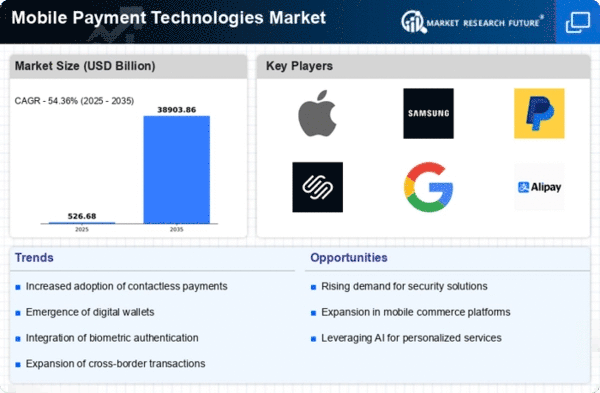
As per MRFR analysis, the Mobile Payment Technologies Market Size was estimated at 341.2 USD Billion in 2024. The Mobile Payment Technologies industry is projected to grow from 506.24 USD Billion in 2025 to 38903.86 USD Billion by 2035, exhibiting a compound annual growth rate (CAGR) of 54.36 during the forecast period 2025 - 2035.

Key Market Trends & Highlights

The Mobile Payment Technologies Market is experiencing robust growth driven by technological advancements and changing consumer behaviors.

  • The adoption of contactless payments is witnessing a notable increase, particularly in North America, where convenience is paramount.
  • Artificial intelligence integration is enhancing user experiences and security measures across various mobile payment platforms.
  • Digital wallets remain the largest segment, while QR code payments are emerging as the fastest-growing method in the Asia-Pacific region.
  • Rising smartphone penetration and evolving consumer preferences are key drivers propelling the market forward.

Market Size & Forecast

2024 Market Size 341.2 (USD Billion)
2035 Market Size 38903.86 (USD Billion)
CAGR (2025 - 2035) 54.36%
Largest Regional Market Share in 2024 North America

Major Players

<p>Apple (US), Google (US), Samsung (KR), PayPal (US), Square (US), Alipay (CN), WeChat Pay (CN), Visa (US), Mastercard (US)</p>

Market Trends

The Mobile Payment Technologies Market is currently experiencing a transformative phase, driven by advancements in technology and changing consumer preferences. The proliferation of smartphones and the increasing penetration of the internet have facilitated the adoption of mobile payment solutions across various demographics. As consumers seek convenience and efficiency in their transactions, businesses are compelled to adapt to these evolving demands. This shift is not merely a trend but appears to be a fundamental change in how financial transactions are conducted, suggesting a long-term impact on traditional payment methods. Moreover, the Mobile Payment Technologies Market is characterized by a diverse range of players, including financial institutions, technology companies, and startups. This competitive landscape fosters innovation, leading to the development of new features and services that enhance user experience. Security concerns remain a pivotal issue, prompting stakeholders to invest in robust security measures to build consumer trust. As the market continues to evolve, it is likely that regulatory frameworks will also adapt to ensure consumer protection and promote fair competition. Overall, the Mobile Payment Technologies Market is poised for sustained growth, reflecting broader trends in digitalization and consumer behavior.

Increased Adoption of Contactless Payments

The trend towards contactless payments is gaining momentum, as consumers increasingly prefer quick and seamless transaction experiences. This method allows users to make payments by simply tapping their devices, reducing the need for physical cash or cards. As merchants upgrade their point-of-sale systems to accommodate this technology, the convenience factor is likely to drive further adoption.

Integration of Artificial Intelligence

Artificial intelligence is becoming a crucial component in the Mobile Payment Technologies Market, enhancing user experience through personalized services and improved security measures. AI algorithms can analyze transaction patterns, detect fraudulent activities, and offer tailored recommendations, thereby fostering consumer trust and engagement.

Expansion of Digital Wallets

Digital wallets are witnessing significant growth as they offer a centralized platform for managing various payment methods. This trend indicates a shift towards more integrated financial solutions, where users can store loyalty cards, coupons, and payment information in one place. The convenience and efficiency of digital wallets are likely to attract a broader user base.

Mobile Payment Technologies Market Market Drivers

Technological Advancements

Technological advancements in mobile payment systems are pivotal in driving the Global Mobile Payment Technologies Market Industry. Innovations such as Near Field Communication (NFC), biometric authentication, and blockchain technology enhance the security and efficiency of mobile transactions. These advancements not only improve user experience but also address concerns related to fraud and data breaches. As technology continues to evolve, the integration of artificial intelligence and machine learning in payment systems is expected to further streamline processes and enhance personalization. This continuous innovation is likely to attract more users, thereby contributing to the market's anticipated compound annual growth rate of 59.5% from 2025 to 2035.

Evolving Consumer Preferences

Shifting consumer preferences towards digital transactions significantly influence the Global Mobile Payment Technologies Market Industry. Consumers increasingly favor contactless payment methods due to their convenience and speed. This trend is particularly pronounced among younger demographics, who are more inclined to adopt innovative payment solutions. For instance, the rise of e-wallets and peer-to-peer payment platforms reflects this shift. As consumers seek seamless and efficient transaction experiences, businesses are compelled to adapt, further driving the market's expansion. The anticipated growth trajectory suggests that by 2035, the market could reach an astonishing 57992.6 USD Billion, indicating a robust demand for mobile payment solutions.

Increased E-commerce Adoption

The rapid growth of e-commerce is a significant driver of the Global Mobile Payment Technologies Market Industry. As online shopping becomes increasingly prevalent, consumers are seeking convenient payment options that mobile technologies provide. The integration of mobile payment solutions into e-commerce platforms facilitates seamless transactions, enhancing the overall shopping experience. This trend is particularly evident in regions with high internet penetration and smartphone usage. The convenience of mobile payments is likely to encourage more consumers to engage in online shopping, further propelling the market's growth. The synergy between e-commerce and mobile payments is expected to contribute to the industry's robust expansion in the coming years.

Rising Smartphone Penetration

The increasing penetration of smartphones globally is a primary driver of the Global Mobile Payment Technologies Market Industry. As of 2024, the number of smartphone users is projected to reach approximately 6 billion, facilitating easier access to mobile payment applications. This trend is particularly evident in emerging markets, where mobile devices serve as the primary means of internet access. The convenience of mobile payments, coupled with the growing number of applications available, enhances user engagement and adoption rates. Consequently, this surge in smartphone usage is likely to propel the market's growth, contributing to the projected market value of 341.2 USD Billion in 2024.

Government Initiatives and Regulations

Government initiatives aimed at promoting digital payments play a crucial role in shaping the Global Mobile Payment Technologies Market Industry. Various countries are implementing policies to encourage cashless transactions, enhancing financial inclusion and economic efficiency. For example, initiatives such as India's Digital India program aim to increase the adoption of digital payment systems among the population. Regulatory frameworks are also evolving to support mobile payment innovations while ensuring consumer protection. These government efforts not only foster a conducive environment for market growth but also stimulate consumer confidence in mobile payment technologies, thereby contributing to the industry's projected growth.

Market Segment Insights

By Application: Retail Payments (Largest) vs. Peer-to-Peer Transfers (Fastest-Growing)

<p>The Mobile Payment Technologies Market reveals a diverse application landscape, with Retail Payments holding the largest market share due to its extensive use in physical stores and e-commerce platforms. Peer-to-Peer Transfers have emerged as a significant player, capitalizing on the convenience of moving funds between individuals quickly without needing a banking intermediary. Other applications, such as Bill Payments and In-App Payments, continue to grow but at a slower rate compared to the primary segments.</p>

<p>Payments: Retail Payments (Dominant) vs. Peer-to-Peer Transfers (Emerging)</p>

<p>Retail Payments dominate the mobile payment landscape, given their widespread adoption across various sectors, facilitating seamless transactions in both online and offline environments. In contrast, Peer-to-Peer Transfers are rapidly gaining traction, especially among younger demographics favoring quick and easy money transfers. As more consumers turn to digital payment solutions, these two segments exemplify the shift in spending habits. Retail Payments benefit from established infrastructure, while Peer-to-Peer applications thrive on innovation and user engagement, positioning themselves as a compelling alternative to traditional banking services.</p>

By Technology: Digital Wallets (Largest) vs. QR Code Payments (Fastest-Growing)

<p>The Mobile Payment Technologies Market is increasingly driven by various technology segments, with Digital Wallets leading in market share, primarily due to their widespread adoption and the integration of advanced features. Other notable technologies, including Near Field Communication (NFC) and Mobile Banking, hold significant shares but do not match the dominance of Digital Wallets. QR Code Payments are also gaining traction, appealing to consumers looking for contactless and quick payment options. This diverse landscape highlights the competitive nature of mobile payment technologies, as businesses strive to innovate and enhance customer experiences. The growth trends within the Mobile Payment Technologies segment are influenced by increasing smartphone penetration, enhanced internet connectivity, and changing consumer preferences towards convenience and security. Digital Wallets are expected to maintain their lead due to continuous developments and partnerships between fintech companies and traditional banks. Meanwhile, QR Code Payments are emerging as the fastest-growing segment, driven by their ease of use and adaptability across various platforms. As consumers become more tech-savvy and demand seamless payment experiences, the market is poised for significant transformation and expansion across these technology segments.</p>

<p>Digital Wallets (Dominant) vs. QR Code Payments (Emerging)</p>

<p>Digital Wallets have established themselves as the dominant force in the Mobile Payment Technologies Market, providing users with a convenient and secure means to transact. They integrate features such as loyalty programs, in-app purchases, and advanced encryption to enhance user experience and security. Companies like PayPal and Apple Pay have significantly contributed to the growth of Digital Wallets, fostering trust and reliability in mobile transactions. Meanwhile, QR Code Payments are labeled as an emerging technology due to their growing acceptance, particularly in retail and service environments. Their low implementation cost and the ability to facilitate contactless payments during the pandemic have driven rapid adoption. QR Code Payments appeal to both consumers and merchants due to their simplicity and effectiveness in enabling transactions without physical contact.</p>

By End User: Consumers (Largest) vs. Financial Institutions (Fastest-Growing)

<p>The mobile payment technologies market is significantly influenced by its end users, with Consumers representing the largest segment. This group has consistently driven adoption due to their demand for convenience and seamless transactions. Following closely are Financial Institutions, who are rapidly adapting to digital trends and have begun to invest heavily in mobile payment solutions to meet customer expectations and maintain competitive advantage. In terms of growth trends, the rise of e-commerce and the increasing smartphone penetration among consumers have led to a robust demand for mobile payment solutions. Financial Institutions are emerging as the fastest-growing segment, propelled by the need to innovate and digitize traditional banking processes. As both segments evolve, collaborations between tech providers and financial firms are anticipated to enhance service offerings, fostering further adoption within the market.</p>

<p>Financial Institutions: (Dominant) vs. Small and Medium Enterprises (Emerging)</p>

<p>In the mobile payment technologies market, Financial Institutions hold a dominant position due to their extensive resources and established customer trust. They leverage advanced security measures and seamless integration capabilities, which are crucial for gaining consumer confidence in mobile transactions. On the other hand, Small and Medium Enterprises (SMEs) are categorized as an emerging segment. SMEs are increasingly adopting mobile payment technologies to enhance customer experience and streamline their operations. With lower operational costs and payments processing fees, SMEs benefit from quick integration and flexibility that mobile payment solutions provide. As both segments evolve in response to market demands, particularly in terms of security and convenience, a competitive landscape is expected.</p>

Get more detailed insights about Mobile Payment Technologies Market Research Report – Forecast till 2035

Regional Insights

North America : Market Leader in Innovation

North America continues to lead the Mobile Payment Technologies Market, holding a significant share of 170.6M in 2024. The growth is driven by high smartphone penetration, increasing consumer preference for contactless payments, and supportive regulatory frameworks. The region's robust infrastructure and technological advancements further catalyze market expansion, with a growing emphasis on security and user experience. The United States is the primary contributor, with major players like Apple, Google, and PayPal dominating the landscape. The competitive environment is characterized by continuous innovation and partnerships, enhancing service offerings. As mobile payment adoption rises, the presence of established financial institutions and tech giants solidifies North America's position as a market leader.

Europe : Emerging Market with Potential

Europe's Mobile Payment Technologies Market is valued at 85.3M, reflecting a growing trend towards digital transactions. Factors such as increasing e-commerce activities, regulatory support for digital finance, and consumer demand for seamless payment solutions are driving this growth. The European Union's initiatives to enhance digital payment security and interoperability further bolster market dynamics. Leading countries like Germany, France, and the UK are at the forefront, with a competitive landscape featuring key players such as Visa and Mastercard. The presence of innovative fintech companies is reshaping the market, offering diverse solutions. As consumer trust in mobile payments increases, Europe is poised for significant growth in this sector.

Asia-Pacific : Rapid Growth and Adoption

The Asia-Pacific region, with a market size of 70.0M, is witnessing rapid growth in mobile payment technologies. This surge is fueled by the increasing smartphone adoption, a young population, and a shift towards cashless transactions. Countries like China and India are leading this transformation, supported by government initiatives promoting digital payments and financial inclusion. China, with platforms like Alipay and WeChat Pay, dominates the market, while India is experiencing a boom in digital wallets and UPI transactions. The competitive landscape is vibrant, with numerous startups and established players vying for market share. As the region embraces mobile payments, the potential for further growth remains substantial.

Middle East and Africa : Emerging Market with Challenges

The Middle East and Africa (MEA) region, valued at 15.3M, is gradually embracing mobile payment technologies, driven by increasing smartphone penetration and a young demographic. However, challenges such as inadequate infrastructure and regulatory hurdles hinder rapid adoption. Governments are recognizing the need for digital transformation, leading to initiatives aimed at enhancing financial inclusion and mobile payment accessibility. Countries like South Africa and Kenya are leading the charge, with mobile payment solutions gaining traction. The competitive landscape is evolving, with local and international players entering the market. As awareness and trust in mobile payments grow, the MEA region is poised for gradual yet significant advancements in this sector.

Key Players and Competitive Insights

The Mobile Payment Technologies Market is characterized by a rapidly evolving competitive landscape, driven by technological advancements and changing consumer preferences. Key players such as Apple (US), Google (US), and Alipay (CN) are at the forefront, each adopting distinct strategies to enhance their market positioning. Apple (US) continues to innovate with its Apple Pay platform, focusing on seamless integration with its ecosystem of devices, while Google (US) emphasizes its Google Pay service, leveraging its vast data analytics capabilities to personalize user experiences. Alipay (CN), on the other hand, is expanding its reach beyond China, targeting international markets through strategic partnerships, thereby reshaping the competitive dynamics in the mobile payment sector.

In terms of business tactics, companies are increasingly localizing their operations to better cater to regional markets. This includes optimizing supply chains and enhancing customer service capabilities. The market appears moderately fragmented, with a mix of established players and emerging fintech startups. The collective influence of these key players is significant, as they drive innovation and set industry standards, creating a competitive environment that encourages continuous improvement and adaptation.

In November 2025, Apple (US) announced a partnership with several major banks to enhance its Apple Pay service, allowing users to access exclusive offers and rewards. This strategic move not only strengthens Apple's position in the mobile payment space but also highlights its commitment to providing added value to consumers, potentially increasing user engagement and transaction volumes. Such partnerships may also serve to bolster customer loyalty, a critical factor in this competitive market.

In October 2025, Google (US) launched a new feature within Google Pay that utilizes AI to provide personalized financial advice to users. This initiative underscores Google's focus on integrating advanced technologies into its payment solutions, aiming to differentiate itself from competitors. By offering tailored financial insights, Google (US) seeks to enhance user experience and drive adoption, which could lead to increased market share in the mobile payment sector.

In December 2025, Alipay (CN) expanded its services to include cryptocurrency transactions, allowing users to buy and sell digital currencies directly through its platform. This strategic pivot not only positions Alipay (CN) as a forward-thinking player in the mobile payment landscape but also reflects the growing consumer interest in cryptocurrencies. By embracing this trend, Alipay (CN) may attract a new demographic of tech-savvy users, further solidifying its market presence.

As of December 2025, the competitive trends in the Mobile Payment Technologies Market are increasingly defined by digitalization, sustainability, and the integration of AI. Strategic alliances are becoming more prevalent, as companies recognize the value of collaboration in enhancing service offerings and expanding market reach. Looking ahead, competitive differentiation is likely to evolve, shifting from price-based competition to a focus on innovation, technology, and supply chain reliability. This transition suggests that companies that prioritize these aspects will be better positioned to thrive in an increasingly complex and dynamic market.

Key Companies in the Mobile Payment Technologies Market market include

Industry Developments

    • In the year 2018, the Bank of America announced its corporate cardholders for using apps for mobile payment by Google, Samsung, and Apple.
    • In 2019, Planeta Informatica and Visa announced to launch a new technology to enable the public transit operators. This new technology helps to improve the speed of contactless payments at a cheaper rate.
    • In April 2019, another key player called Orange announced its digital transformation and launched the "Orange Digital Centre" in Tunisia.

Future Outlook

Mobile Payment Technologies Market Future Outlook

<p>The Mobile Payment Technologies Market is projected to grow at a 54.36% CAGR from 2024 to 2035, driven by increased smartphone penetration, enhanced security features, and evolving consumer preferences.</p>

New opportunities lie in:

  • <p>Integration of AI-driven fraud detection systems</p>
  • <p>Expansion of mobile wallets in emerging markets</p>
  • <p>Development of contactless payment solutions for public transport</p>

<p>By 2035, the market is expected to be robust, driven by innovation and widespread adoption.</p>

Market Segmentation

Mobile Payment Technologies Market End User Outlook

  • Consumers
  • Small and Medium Enterprises
  • Large Enterprises
  • Financial Institutions
  • Government

Mobile Payment Technologies Market Technology Outlook

  • Near Field Communication
  • QR Code Payments
  • Mobile Banking
  • Digital Wallets
  • Biometric Authentication

Mobile Payment Technologies Market Application Outlook

  • Retail Payments
  • Peer-to-Peer Transfers
  • Bill Payments
  • Mobile Wallets
  • In-App Payments

Report Scope

MARKET SIZE 2024341.2(USD Billion)
MARKET SIZE 2025506.24(USD Billion)
MARKET SIZE 203538903.86(USD Billion)
COMPOUND ANNUAL GROWTH RATE (CAGR)54.36% (2024 - 2035)
REPORT COVERAGERevenue Forecast, Competitive Landscape, Growth Factors, and Trends
BASE YEAR2024
Market Forecast Period2025 - 2035
Historical Data2019 - 2024
Market Forecast UnitsUSD Billion
Key Companies ProfiledApple (US), Google (US), Samsung (KR), PayPal (US), Square (US), Alipay (CN), WeChat Pay (CN), Visa (US), Mastercard (US)
Segments CoveredApplication, Technology, End User
Key Market OpportunitiesIntegration of biometric authentication enhances security in the Mobile Payment Technologies Market.
Key Market DynamicsRising consumer demand for seamless transactions drives innovation and competition in mobile payment technologies.
Countries CoveredNorth America, Europe, APAC, South America, MEA

FAQs

At what CAGR can the mobile payment technologies market expand?

The mobile payment technologies market can thrive at 45.05% CAGR by 2030.

What is the estimated valuation for the mobile payment technologies market?

The mobile payment technologies market can value at USD 9032 Bn by 2030.

What are the Key Market Drivers for the growth of the Mobile Payment Technologies Market?

The Mobile Payment Technologies Market is projected to grow at a significant rate due to various reasons.

Who are the key players of the mobile payment technologies market?

Google, First Data, Fiserv, and PayPal are some reputed names in the mobile payment technologies market.

What is the regional analysis of the mobile payment technologies market?

The Europe mobile payment technologies market can achieve lucrative valuation by the conclusion of assessment period.

  1. Executive Summary
    1. Scope of the Report
    2. Market Definition
    3. Scope of the Study
    4. Research Objectives
    5. Markets Structure
  2. Research Methodology
    1. Market Dynamics
    2. Market Drivers
      1. Increasing
      2. Increasing
    3. Development in digital technology
    4. adoption rate of smartphones and internet on mobile
    5. investment by non-banking institutions in the payment system
    6. High Growth in E-commerce sector
    7. Market Restraints
      1. Lack of cross-border payment standards
      2. Development in 5G network
      3. Introducing artificial intelligence technology in digital
    8. Market Opportunities
    9. payments
    10. Market Challenges
      1. Increasing
    11. cyber-attacks
    12. Porter’s Five Forces Analysis
      1. Threat of New Entrants
      2. Bargaining
      3. Threat of Substitutes
      4. Bargaining Power of Suppliers
    13. Power of Buyers
    14. Segment Rivalry
    15. Government/Industry Norms and Regulations
    16. Mobile Payment Technologies Market by Solutions
    17. Introduction
    18. Point-of-sale solutions
      1. Market
      2. Market Estimates
      3. Near-field
      4. Sound waves-based
      5. Magnetic secure transmission (MST) payments
      6. Market Estimates & Forecast,
      7. Market Estimates & Forecast by
      8. Mobile wallets
    19. Estimates & Forecast, 2020–2027
    20. & Forecast by Region, 2020–2027
    21. communication (NFC) payments
    22. Forecast, 2020–2027
    23. Forecast by Region, 2020–2027
    24. payments
    25. Market Estimates & Forecast, 2020–2027
    26. Market Estimates & Forecast by Region, 2020–2027
    27. In-store Payments
    28. Region, 2020–2027
    29. Market Estimates & Forecast, 2020–2027
    30. Market Estimates & Forecast by Region, 2020–2027
    31. Quick response (QR) code payments
    32. & Forecast, 2020–2027
    33. & Forecast by Region, 2020–2027
    34. Remote Payments
      1. Market Estimates & Forecast, 2020–2027
      2. Direct carrier billing
    35. Market Estimates & Forecast by Region, 2020–2027
    36. Internet payments
    37. Region, 2020–2027
    38. Market Estimates & Forecast, 2020–2027
    39. Market Estimates & Forecast by Region, 2020–2027
    40. Mobile banking
    41. by Region, 2020–2027
  3. Market Estimates & Forecast,
  4. Market Estimates & Forecast
  5. Mobile Payment Technologies
    1. Market by Deployment
    2. Introduction
      1. Market Estimates & Forecast, 2020–2027
      2. Market Estimates & Forecast by Region, 2020–2027
    3. On-Premise
    4. On-cloud
      1. Market Estimates &
      2. Market Estimates & Forecast
    5. Forecast, 2020–2027
    6. by Region, 2020–2027
    7. Hybrid
      1. Market
    8. Market Estimates & Forecast, 2020–2027
    9. Estimates & Forecast by Region, 2020–2027
  6. Mobile
    1. Payment Technologies Market by Organization Size
    2. Introduction
    3. SMEs
      1. Market Estimates &
      2. Market Estimates & Forecast
    4. Forecast, 2020–2027
    5. by Region, 2020–2027
    6. Large Enterprises
      1. Market
    7. Market Estimates & Forecast, 2020–2027
    8. Estimates & Forecast by Region, 2020–2027
  7. Mobile
    1. Payment Technologies Market by Verticals
    2. Introduction
    3. BFSI
      1. Market Estimates &
      2. Market Estimates & Forecast
    4. Forecast, 2020–2027
    5. by Region, 2020–2027
    6. IT & Telecommunication
      1. Market Estimates & Forecast, 2020–2027
      2. Market Estimates &
      3. Market Estimates & Forecast
    7. Market Estimates & Forecast by Region, 2020–2027
    8. Retail & E-commerce
    9. Forecast, 2020–2027
    10. by Region, 2020–2027
    11. Media & Entertainment
      1. Market Estimates & Forecast, 2020–2027
      2. Market Estimates & Forecast, 2020–2027
      3. Market Estimates & Forecast by Region, 2020–2027
    12. Market Estimates & Forecast by Region, 2020–2027
    13. Others
  8. Mobile Payment Technologies Market by Region
    1. Introduction
    2. North America
    3. Market Estimates & Forecast by Country, 2020–2027
    4. Market Estimates & Forecast by Solutions, 2020–2027
    5. Market Estimates & Forecast by Deployment, 2020–2027
    6. Market Estimates & Forecast by Organization Size, 2020–2027
    7. Market Estimates & Forecast by Verticals, 2020–2027
    8. US
    9. Deployment, 2020–2027
    10. Forecast by Organization Size, 2020–2027
    11. Estimates & Forecast by Verticals, 2020–2027
    12. Verticals, 2020–2027
    13. Market Estimates & Forecast by Solutions, 2020–2027
    14. Market Estimates & Forecast by Deployment, 2020–2027
    15. Market Estimates & Forecast by Organization Size, 2020–2027
    16. Market Estimates & Forecast by Verticals, 2020–2027
    17. Europe
    18. Solutions, 2020–2027
    19. by Deployment, 2020–2027
    20. Forecast by Organization Size, 2020–2027
    21. Estimates & Forecast by Verticals, 2020–2027
    22. Verticals, 2020–2027
    23. Market Estimates & Forecast by Solutions, 2020–2027
    24. Market Estimates & Forecast by Deployment, 2020–2027
    25. Market Estimates & Forecast by Organization Size, 2020–2027
    26. Market Estimates & Forecast by Verticals, 2020–2027
    27. Italy
    28. Deployment, 2020–2027
    29. Forecast by Organization Size, 2020–2027
    30. Estimates & Forecast by Verticals, 2020–2027
    31. Verticals, 2020–2027
    32. Market Estimates & Forecast by Solutions, 2020–2027
    33. Market Estimates & Forecast by Deployment, 2020–2027
    34. Market Estimates & Forecast by Organization Size, 2020–2027
    35. Market Estimates & Forecast by Verticals, 2020–2027
    36. Spain
    37. by Deployment, 2020–2027
    38. & Forecast by Organization Size, 2020–2027
    39. Estimates & Forecast by Verticals, 2020–2027
    40. of Europe
    41. by Deployment, 2020–2027
    42. & Forecast by Organization Size, 2020–2027
    43. Estimates & Forecast by Verticals, 2020–2027
    44. Verticals, 2020–2027
    45. Market Estimates & Forecast by Solutions, 2020–2027
    46. Market Estimates & Forecast by Deployment, 2020–2027
    47. Market Estimates & Forecast by Organization Size, 2020–2027
    48. Market Estimates & Forecast by Verticals, 2020–2027
    49. India
    50. Deployment, 2020–2027
    51. Forecast by Organization Size, 2020–2027
    52. Estimates & Forecast by Verticals, 2020–2027
    53. Verticals, 2020–2027
    54. Market Estimates & Forecast by Solutions, 2020–2027
    55. Market Estimates & Forecast by Deployment, 2020–2027
    56. Market Estimates & Forecast by Organization Size, 2020–2027
    57. Market Estimates & Forecast by Verticals, 2020–2027
    58. Singapore
    59. by Solutions, 2020–2027
    60. Forecast by Deployment, 2020–2027
    61. & Forecast by Organization Size, 2020–2027
    62. Estimates & Forecast by Verticals, 2020–2027
    63. by Verticals, 2020–2027
    64. by Verticals, 2020–2027
    65. Market Estimates & Forecast by Country, 2020–2027
    66. Market Estimates & Forecast by Solutions, 2020–2027
    67. Market Estimates & Forecast by Deployment, 2020–2027
    68. Market Estimates & Forecast by Organization Size, 2020–2027
    69. Market Estimates & Forecast by Verticals, 2020–2027
    70. Middle East & Africa
    71. Forecast by Solutions, 2020–2027
    72. & Forecast by Deployment, 2020–2027
    73. Estimates & Forecast by Organization Size, 2020–2027
    74. Market Estimates & Forecast by Verticals, 2020–2027
    75. South America
    76. by Solutions, 2020–2027
    77. Forecast by Deployment, 2020–2027
    78. & Forecast by Organization Size, 2020–2027
    79. Estimates & Forecast by Verticals, 2020–2027
  9. Market Estimates & Forecast by Solutions,
  10. Market Estimates & Forecast by
  11. Market Estimates &
  12. Market
  13. Mexico
  14. Market Estimates & Forecast by Solutions, 2020–2027
  15. Market Estimates & Forecast by Deployment, 2020–2027
  16. Market Estimates & Forecast by Organization Size,
  17. Market Estimates & Forecast by
  18. Canada
  19. Market Estimates & Forecast by Country,
  20. Market Estimates & Forecast by
  21. Market Estimates & Forecast
  22. Market Estimates &
  23. Market
  24. Germany
  25. Market Estimates & Forecast by Solutions, 2020–2027
  26. Market Estimates & Forecast by Deployment, 2020–2027
  27. Market Estimates & Forecast by Organization Size,
  28. Market Estimates & Forecast by
  29. France
  30. Market Estimates & Forecast by Solutions,
  31. Market Estimates & Forecast by
  32. Market Estimates &
  33. Market
  34. Russia
  35. Market Estimates & Forecast by Solutions, 2020–2027
  36. Market Estimates & Forecast by Deployment, 2020–2027
  37. Market Estimates & Forecast by Organization Size,
  38. Market Estimates & Forecast by
  39. UK
  40. Market Estimates & Forecast by Solutions,
  41. Market Estimates & Forecast
  42. Market Estimates
  43. Market
  44. Rest
  45. Market Estimates & Forecast by Solutions,
  46. Market Estimates & Forecast
  47. Market Estimates
  48. Market
    1. Asia-Pacific
      1. Market Estimates & Forecast by Country, 2020–2027
      2. Market Estimates & Forecast by Solutions, 2020–2027
      3. Market Estimates & Forecast by Deployment, 2020–2027
      4. Market Estimates & Forecast by Organization Size,
      5. Market Estimates & Forecast by
      6. China
      7. Japan
      8. South Korea
      9. Australia
      10. Rest of Asia-Pacific
    2. Rest of the World
  49. Competitive
    1. Landscape
    2. Key Players Market Share Analysis, 2020/2020
    3. (%)
    4. Competitive Benchmarking
    5. Key
      1. Mergers & Acquisition
      2. Product Developments
      3. Business
      4. Partnerships & Collaborations
    6. Developments Analysis, 2020/2020
    7. Expansion
    8. Agreements
  50. Company Profiles
    1. Google
    2. Product/Business Segment Overview
    3. Updates
    4. Analysis
    5. Segment Overview
    6. Key Developments
    7. Key Strategy
    8. Overview
    9. Financial Updates
    10. SWOT Analysis
    11. First Data
    12. Product/Business Segment Overview
    13. Updates
    14. Analysis
    15. Segment Overview
    16. Key Developments
    17. Key Strategy
    18. Overview
    19. Financial Updates
    20. SWOT Analysis
    21. Wirecard
    22. Product/Business Segment Overview
    23. Updates
    24. Analysis
    25. Segment Overview
    26. Key Developments
    27. Key Strategy
    28. Company Overview
    29. Overview
    30. Financial Updates
    31. SWOT Analysis
    32. BlueSnap
    33. Product/Business Segment Overview
    34. Updates
    35. SWOT Analysis
    36. PayU
    37. Product/Business Segment Overview
    38. Updates
    39. SWOT Analysis
    40. Dwolla
    41. Product/Business Segment Overview
    42. Updates
    43. SWOT Analysis
    44. Stripe
    45. Product/Business Segment Overview
    46. Updates
    47. SWOT Analysis
    48. Six Payment services
    49. Product/Business Segment Overview
    50. Updates
    51. SWOT Analysis
    52. Conclusion/Recommendations
  51. Company Overview
  52. Financial
  53. Key Developments
  54. SWOT
  55. Key Strategy
    1. PayPal
      1. Company Overview
      2. Product/Business
      3. Financial Updates
      4. SWOT Analysis
    2. Fiserv
      1. Company
      2. Product/Business Segment Overview
      3. Key Developments
      4. Key Strategy
      5. Company Overview
      6. Financial
      7. Key Developments
      8. SWOT
      9. Key Strategy
    3. Worldpay
      1. Company Overview
      2. Product/Business
      3. Financial Updates
      4. SWOT Analysis
    4. Paytm
      1. Company
      2. Product/Business Segment Overview
      3. Key Developments
      4. Key Strategy
      5. Company Overview
      6. Financial
      7. Key Developments
      8. SWOT
      9. Key Strategy
    5. Novatti
      1. Company Overview
      2. Product/Business
      3. Financial Updates
      4. SWOT Analysis
    6. ACI worldwide
      1. Product/Business Segment Overview
      2. Financial Updates
      3. Key Developments
      4. SWOT Analysis
      5. Key Strategy
    7. Global payments
      1. Company
      2. Product/Business Segment Overview
      3. Key Developments
      4. Key Strategy
      5. Company Overview
      6. Financial
      7. Key Developments
      8. Key Strategy
      9. Company Overview
      10. Financial
      11. Key Developments
      12. Key Strategy
      13. Company Overview
      14. Financial
      15. Key Developments
      16. Key Strategy
      17. Company Overview
      18. Financial
      19. Key Developments
      20. Key Strategy
      21. Company Overview
      22. Financial
      23. Key Developments
      24. Key Strategy
  56. LIST OF TABLES
    1. Table 1
  57. Mobile Payment Technologies market, by Region, 2020–2027
  58. North America: Mobile Payment Technologies
  59. market, by Country, 2020–2027
    1. Table 3
  60. Europe: Mobile Payment Technologies market, by Country, 2020–2027
  61. Asia-Pacific: Mobile Payment Technologies
  62. market, by Country, 2020–2027
    1. Table 5
  63. Rest of the World: Mobile Payment Technologies market, by Region, 2020–2027
  64. North America: Mobile Payment Technologies
  65. Solutions Market, by Country, 2020–2027
    1. Table 7
  66. Europe: Mobile Payment Technologies Solutions Market, by Country, 2020–2027
  67. Asia-Pacific: Mobile Payment Technologies
  68. Solutions Market, by Country, 2020–2027
    1. Table 9
  69. Rest of the World: Mobile Payment Technologies Solutions Market, by Region,
  70. Global Mobile
  71. Payment Technologies Solutions Market, by Region, 2020–2027
    1. Table 11
    2. North America: Mobile Payment Technologies deployment Market,
    3. by Country, 2020–2027
  72. Europe:
  73. Mobile Payment Technologies deployment Market, by Country, 2020–2027
    1. Table
  74. Asia-Pacific: Mobile Payment Technologies
  75. deployment Market, by Country, 2020–2027
    1. Table 14
  76. Rest of the World: Mobile Payment Technologies deployment Market, by Country,
  77. Global Mobile
  78. Payment Technologies deployment Market, by Region, 2020–2027
    1. Table 16
    2. North America: Mobile Payment Technologies Verticals Market,
    3. by Country, 2020–2027
  79. Europe:
  80. Mobile Payment Technologies Verticals Market, by Country, 2020–2027
    1. Table
  81. Asia-Pacific: Mobile Payment Technologies
  82. Verticals Market, by Country, 2020–2027
    1. Table 19
  83. Rest of the World: Mobile Payment Technologies Verticals Market, by Country,
  84. LIST OF FIGURES
    1. FIGURE 1
    2. Global Mobile Payment Technologies market Segmentation
    3. FIGURE 2
    4. Forecast Methodology
  85. Porter’s
    1. Five Forces Analysis of Global Mobile Payment Technologies market
    2. FIGURE
  86. Value Chain/supply chain of Global Mobile Payment Technologies
    1. market
  87. Share of Global Mobile Payment Technologies
  88. market in 2020, by Country (in %)
  89. Global
    1. Mobile Payment Technologies market , 2020–2027
    2. FIGURE 7
    3. Sub-segments of Solutions
  90. Global Mobile Payment
  91. Technologies market Size, by Solutions, 2020
  92. Share
  93. of Global Mobile Payment Technologies market , by Solutions, 2020 to 2027
    1. FIGURE
  94. Global Mobile Payment Technologies market Size, by Deployment,
  95. Share of Global Mobile Payment Technologies
  96. market , by Deployment, 2020 to 2027
  97. Global Mobile
  98. Payment Technologies market Size, by Verticals, 2020
    1. FIGURE 13
  99. Share of Global Mobile Payment Technologies market , by Verticals, 2020 to

Mobile Payment Technologies Market Segmentation

Market Segmentation Overview

  • Detailed segmentation data will be available in the full report
  • Comprehensive analysis by multiple parameters
  • Regional and country-level breakdowns
  • Market size forecasts by segment
Infographic

Free Sample Request

Kindly complete the form below to receive a free sample of this Report

Get Free Sample

Customer Strories

Compare Licence

×
Features License Type
Single User Multiuser License Enterprise User
Price $4,950 $5,950 $7,250
Maximum User Access Limit 1 User Upto 10 Users Unrestricted Access Throughout the Organization
Free Customization
Direct Access to Analyst
Deliverable Format
Platform Access
Discount on Next Purchase 10% 15% 15%
Printable Versions