×
Request Free Sample ×

Kindly complete the form below to receive a free sample of this Report

* Please use a valid business email

Leading companies partner with us for data-driven Insights

clients tt-cursor
Hero Background

Mexico Off Highway Diesel Common Rail Injection System Market

ID: MRFR/AT/56155-HCR
200 Pages
Sejal Akre
February 2026

Mexico Off Highway Diesel Common Rail Injection System Market Research Report: By Application (Construction Equipment, Agricultural Equipment, Mining Equipment, Material Handling Equipment), By Fuel Type (Ultra Low Sulfur Diesel, Low Sulfur Diesel, Biodiesel, Conventional Diesel), By Engine Type (Internal Combustion Engine, Dual Fuel Engine, Multi-Fuel Engine) and By Power Output (Below 100 HP, 100-200 HP, 200-300 HP, Above 300 HP) - Forecast to 2035

Share:
Download PDF ×

We do not share your information with anyone. However, we may send you emails based on your report interest from time to time. You may contact us at any time to opt-out.

Mexico Off Highway Diesel Common Rail Injection System Market Infographic
Purchase Options

Mexico Off Highway Diesel Common Rail Injection System Market Summary

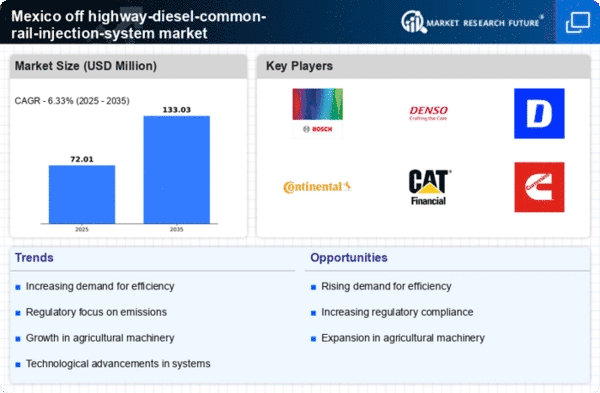
As per Market Research Future analysis, the Mexico Off Highway Diesel Common Rail Injection System Market size was estimated at 67.72 USD Million in 2024. The Off Highway-diesel-common-rail-injection-system market is projected to grow from 72.01 USD Million in 2025 to 133.03 USD Million by 2035, exhibiting a compound annual growth rate (CAGR) of 6.3% during the forecast period 2025 - 2035

Key Market Trends & Highlights

The Mexico off highway-diesel-common-rail-injection-system market is poised for growth driven by technological advancements and increasing demand from key sectors.

  • Technological advancements in diesel engines are enhancing fuel efficiency and performance in the off highway sector.
  • The agricultural segment represents the largest market share, driven by rising agricultural mechanization across Mexico.
  • Infrastructure development initiatives are contributing to the growth of the off highway-diesel-common-rail-injection-system market.
  • Rising agricultural mechanization and stringent environmental regulations are key drivers propelling market expansion.

Market Size & Forecast

2024 Market Size 67.72 (USD Million)
2035 Market Size 133.03 (USD Million)
CAGR (2025 - 2035) 6.33%

Major Players

Bosch (DE), Denso (JP), Delphi Technologies (GB), Continental (DE), Caterpillar (US), Cummins (US), Yanmar (JP), Weichai Power (CN), FPT Industrial (IT)

Our Impact
Enabled $4.3B Revenue Impact for Fortune 500 and Leading Multinationals
Partnering with 2000+ Global Organizations Each Year
30K+ Citations by Top-Tier Firms in the Industry

Mexico Off Highway Diesel Common Rail Injection System Market Trends

The Mexico Off Highway Diesel Common Rail Injection System Market is currently experiencing notable growth, driven by increasing demand for efficient fuel systems in various applications such as agriculture, construction, and mining. This market segment is characterized by advancements in technology, which enhance performance and reduce emissions. The integration of common rail systems allows for better fuel atomization, leading to improved combustion efficiency. As environmental regulations become more stringent, manufacturers are focusing on developing systems that comply with these standards while maintaining high performance. In Mexico, the off highway-diesel-common-rail-injection-system market is influenced by the country's robust agricultural sector and ongoing infrastructure projects. The government has been investing in modernization efforts, which further stimulates the demand for advanced diesel engines equipped with common rail injection systems. Additionally, the rising awareness of fuel efficiency and sustainability among operators is likely to drive the adoption of these systems. As the market evolves, it appears that innovation and regulatory compliance will play crucial roles in shaping future developments.

Technological Advancements

The off highway-diesel-common-rail-injection-system market is witnessing rapid technological advancements. Innovations in fuel injection technology are enhancing engine performance and efficiency. These developments are crucial for meeting the increasing demands for lower emissions and higher fuel economy.

Regulatory Compliance

Regulatory compliance is becoming increasingly important in the off highway-diesel-common-rail-injection-system market. Stricter environmental regulations are prompting manufacturers to develop systems that not only meet but exceed these standards, ensuring sustainability in operations.

Market Demand from Key Sectors

Key sectors such as agriculture and construction are driving demand in the off highway-diesel-common-rail-injection-system market. The need for reliable and efficient machinery in these industries is leading to a greater emphasis on advanced diesel technologies.

Mexico Off Highway Diesel Common Rail Injection System Market Drivers

Growth in Mining Activities

The mining sector in Mexico is a crucial driver for the off highway-diesel-common-rail-injection-system market. With the country being one of the largest producers of silver, copper, and gold, the demand for heavy machinery in mining operations is substantial. The mining industry has been expanding, with investments projected to reach $5 billion in 2025, which will likely increase the need for efficient diesel engines equipped with common rail injection systems. These systems provide the necessary power and efficiency for mining equipment, such as excavators and haul trucks, which operate in demanding environments. As mining activities continue to grow, the off highway-diesel-common-rail-injection-system market is expected to benefit significantly from this trend.

Rising Agricultural Mechanization

The off highway-diesel-common-rail-injection-system market in Mexico is experiencing growth due to the increasing mechanization of agriculture. As farmers seek to enhance productivity and efficiency, the demand for advanced machinery equipped with diesel common rail injection systems is rising. This trend is particularly evident in regions where agricultural output is critical for local economies. The Mexican government has been promoting agricultural modernization, which further stimulates the market. In 2023, the agricultural sector accounted for approximately 3% of Mexico's GDP, indicating a substantial market potential for off highway-diesel-common-rail-injection systems. The integration of these systems in tractors and harvesters is expected to improve fuel efficiency and reduce emissions, aligning with environmental goals. Thus, the mechanization trend is a significant driver for the off highway-diesel-common-rail-injection-system market in Mexico.

Infrastructure Development Initiatives

Infrastructure development initiatives in Mexico are significantly impacting the off highway-diesel-common-rail-injection-system market. The government has been investing heavily in transportation and construction projects, which require robust machinery powered by diesel engines. This investment is expected to reach $25 billion by 2025, creating a substantial demand for construction equipment that utilizes advanced injection systems. The off highway-diesel-common-rail-injection-system market benefits from this trend as construction vehicles and heavy machinery increasingly adopt these technologies to enhance performance and comply with emissions regulations. The ongoing projects, including highways, bridges, and urban development, are likely to sustain the demand for efficient and powerful diesel engines, thereby driving the market forward.

Environmental Regulations and Standards

The off highway-diesel-common-rail-injection-system market in Mexico is influenced by stringent environmental regulations aimed at reducing emissions from diesel engines. The government has implemented various standards that require manufacturers to adopt cleaner technologies. As a result, there is a growing need for advanced common rail injection systems that can meet these regulations while maintaining performance. The Mexican government aims to reduce greenhouse gas emissions by 30% by 2030, which necessitates the adoption of more efficient diesel technologies. This regulatory landscape is likely to drive innovation and investment in the off highway-diesel-common-rail-injection-system market, as companies strive to develop solutions that comply with these evolving standards.

Technological Innovations in Diesel Engines

Technological innovations in diesel engines are reshaping the off highway-diesel-common-rail-injection-system market in Mexico. Manufacturers are increasingly focusing on enhancing the performance and efficiency of diesel engines through advanced injection technologies. Innovations such as electronic control units and improved fuel atomization are becoming standard in new machinery. This trend is driven by the need for better fuel economy and lower emissions, aligning with both consumer preferences and regulatory requirements. The market for off highway-diesel-common-rail-injection systems is likely to expand as these technologies become more prevalent in construction, agriculture, and mining equipment. The continuous evolution of diesel engine technology suggests a promising future for the off highway-diesel-common-rail-injection-system market in Mexico.


Market Segment Insights

By Application: Construction Equipment (Largest) vs. Agricultural Equipment (Fastest-Growing)

Within the application segment of the Mexico off highway-diesel-common-rail-injection-system market, construction equipment holds the largest market share due to the rising infrastructure projects and urban development in the region. This segment has been the backbone of the market, leveraging advancements in diesel common rail systems to enhance efficiency and power output, thereby meeting the increasing demand from contractors and developers. On the other hand, agricultural equipment is recognized as the fastest-growing segment. The growth is driven by technological advancements and the need for modernized farming practices to improve productivity. The increasing adoption of mechanized equipment in agriculture, fueled by government incentives and a push towards modernization, is significantly driving demand for sophisticated diesel common rail systems in this application area.

Construction Equipment: Dominant vs. Agricultural Equipment: Emerging

Construction equipment dominates the application segment, characterized by heavy-duty machinery like excavators and bulldozers, which rely heavily on advanced diesel common rail injection systems for optimal performance and fuel efficiency. The market for construction equipment in the area is robust, propelled by ongoing infrastructure projects and investments that require reliable high-performance engines. In contrast, agricultural equipment is rapidly emerging, featuring innovative solutions such as tractors and harvesters that utilize diesel common rail technology to enhance efficiency and reduce emissions. As farmers seek to adopt more sustainable practices, the demand for modern agricultural machinery equipped with enhanced diesel systems continues to rise, positioning it as a key player in the evolving off highway-diesel-common-rail-injection-system market.

By Fuel Type: Ultra Low Sulfur Diesel (Largest) vs. Biodiesel (Fastest-Growing)

In the Mexico off highway-diesel-common-rail-injection-system market, the fuel type segment is characterized by distinct preferences among various types of diesel. Ultra Low Sulfur Diesel holds the largest market share, driven by stringent environmental regulations and growing awareness regarding emissions. Low Sulfur Diesel follows, benefiting from its wide availability and acceptance among consumers. Conventional Diesel remains a staple, although its market share is declining due to increasing shifts towards more sustainable solutions. The growth trends within this segment indicate a rapid ascent of Biodiesel, driven by favorable government policies and the rising demand for renewable energy sources. This trend reflects a global shift towards sustainability and the need for cleaner fuel alternatives. The transition to more environmentally friendly fuels is being aided by advances in technology and increased investments in biodiesel infrastructure, suggesting a robust future for this segment amidst ongoing environmental concerns.

Ultra Low Sulfur Diesel (Dominant) vs. Biodiesel (Emerging)

Ultra Low Sulfur Diesel stands as the dominant fuel type in the Mexico off highway-diesel-common-rail-injection-system market, owing to its adherence to stringent emission standards and environmental regulations. It offers better combustion efficiency and reduced pollutants compared to conventional options. Biodiesel, on the other hand, is emerging quickly due to its renewable nature and lower greenhouse gas emissions, appealing to environmentally conscious consumers and businesses. While Ultra Low Sulfur Diesel is widely accepted and utilized across the industry, Biodiesel is gaining traction, supported by technological advancements and favorable government incentives aimed at promoting cleaner fuels. This dynamic indicates a potential shift in market preferences as sustainability becomes a priority in fuel choices.

By Engine Type: Internal Combustion Engine (Largest) vs. Dual Fuel Engine (Fastest-Growing)

In the Mexico off highway-diesel-common-rail-injection-system market, Internal Combustion Engines hold a substantial market share due to their extensive use in various applications, securing their position as the dominant technology in the sector. Conversely, Dual Fuel Engines are emerging as a popular alternative, driven by increasing demand for more flexible fuel options and environmental considerations. The growth trends in this segment are primarily influenced by technological advancements and shifts in regulatory frameworks aimed at reducing emissions. The push for greener solutions has positioned Dual Fuel Engines as the fastest-growing segment, as they cater to both performance and sustainability needs. Market dynamics indicate that further innovations will continue to shape these engine types, fostering a competitive landscape.

Engine Type: Internal Combustion Engine (Dominant) vs. Dual Fuel Engine (Emerging)

The Internal Combustion Engine is characterized by its reliability and efficiency, which makes it a preferred choice in sectors such as agriculture and construction. It remains dominant in the market due to its established infrastructure and widespread adoption. On the other hand, the Dual Fuel Engine presents an emerging opportunity with its ability to run on alternative fuels, appealing to companies aiming to reduce their carbon footprint. This engine type is becoming increasingly relevant as it offers both operational flexibility and lower emissions, aligning with global trends toward sustainability and energy efficiency. As regulatory pressures mount, the Dual Fuel Engine could potentially capture a larger share of the market.

By Power Output: 200-300 HP (Largest) vs. Below 100 HP (Fastest-Growing)

The Mexico off highway-diesel-common-rail-injection-system market presents a diverse landscape with varying demand across different power output ranges. The 200-300 HP segment stands out as the largest, commanding a significant portion of the overall market share. This segment is favored for its balance of power and efficiency, making it popular among users requiring robust performance without excessive fuel consumption. In contrast, the below 100 HP segment is rapidly gaining traction, indicating a shift towards smaller, more efficient engines that offer lower operational costs and cater to specific niche applications. Future growth in the power output segment is expected to be influenced by advancements in technology and shifting market dynamics. The demand for fuel-efficient and environmentally friendly options drives interest in smaller engines, while larger power ranges continue to thrive due to their essential role in heavy-duty applications. Manufacturers are focusing on innovation to enhance performance, comply with stricter emissions regulations, and meet the evolving preferences of consumers seeking sustainable solutions. This dual trend of growth in both ends of the power spectrum highlights the market's adaptability to diverse needs and evolving technologies.

200-300 HP (Dominant) vs. Below 100 HP (Emerging)

The 200-300 HP segment dominates the Mexico off highway-diesel-common-rail-injection-system market due to its versatile application across different industries, including construction, agriculture, and mining. This segment caters to machines that require a balance between output and efficiency, making it ideal for large-scale operations. Many operators prefer this range for its capability to perform challenging tasks while maintaining relative fuel consumption. On the other hand, the below 100 HP segment is emerging rapidly, driven by increasing demand for compact and energy-efficient machinery for specialized tasks. These engines are gaining popularity in urban and rural settings where lightweight and maneuverable machines are essential. As regulations tighten and environmental concerns escalate, this market segment is expected to see innovations aimed at enhancing efficiency and reducing emissions.

Get more detailed insights about Mexico Off Highway Diesel Common Rail Injection System Market

Key Players and Competitive Insights

The off highway-diesel-common-rail-injection-system market in Mexico is characterized by a competitive landscape that is increasingly shaped by technological advancements and sustainability initiatives. Key players such as Bosch (DE), Cummins (US), and Denso (JP) are actively pursuing strategies that emphasize innovation and regional expansion. Bosch (DE), for instance, has been focusing on enhancing its product offerings through the integration of advanced digital technologies, which not only improves efficiency but also aligns with the growing demand for environmentally friendly solutions. Meanwhile, Cummins (US) has been investing in partnerships aimed at developing cleaner fuel technologies, thereby positioning itself as a leader in sustainable practices within the sector. Denso (JP) appears to be concentrating on optimizing its supply chain to enhance responsiveness to market demands, which is crucial in a moderately fragmented market where agility can provide a competitive edge.The business tactics employed by these companies reflect a broader trend towards localizing manufacturing and optimizing supply chains to mitigate risks and enhance operational efficiency. The market structure is moderately fragmented, with several players vying for market share, yet the collective influence of major companies like Bosch, Cummins, and Denso is significant. Their strategies not only drive competition but also set benchmarks for innovation and sustainability that smaller players may strive to emulate.

In August Bosch (DE) announced the launch of a new line of common rail injection systems designed specifically for off-highway applications, which are expected to reduce emissions by up to 30%. This strategic move underscores Bosch's commitment to sustainability and positions the company to capture a larger share of the market as regulatory pressures for cleaner technologies intensify. The introduction of these systems is likely to enhance Bosch's competitive positioning by appealing to environmentally conscious consumers and manufacturers.

In September Cummins (US) entered into a strategic partnership with a leading agricultural machinery manufacturer to co-develop advanced diesel engines that utilize its latest common rail injection technology. This collaboration is significant as it not only expands Cummins' reach into the agricultural sector but also reinforces its commitment to innovation in fuel efficiency and emissions reduction. Such partnerships are indicative of a trend where companies leverage synergies to enhance their technological capabilities and market presence.

In October Denso (JP) unveiled a new initiative aimed at integrating AI into its manufacturing processes, which is expected to streamline operations and reduce production costs by approximately 15%. This move highlights Denso's focus on digital transformation and its potential to enhance competitiveness through improved operational efficiency. The integration of AI technologies is likely to set a new standard in the industry, compelling other players to adopt similar innovations to remain relevant.

As of November the competitive trends in the off highway-diesel-common-rail-injection-system market are increasingly defined by digitalization, sustainability, and the integration of advanced technologies such as AI. Strategic alliances are becoming more prevalent, as companies recognize the value of collaboration in driving innovation and enhancing market responsiveness. Looking ahead, it is anticipated that competitive differentiation will evolve, shifting from traditional price-based competition to a focus on technological innovation, sustainability, and supply chain reliability. This transition may redefine the competitive landscape, compelling all players to adapt to the new norms of the market.

Key Companies in the Mexico Off Highway Diesel Common Rail Injection System Market include

Industry Developments

Recent developments in the Mexico Off Highway Diesel Common Rail Injection System Market have been influenced by advancements in technology and shifts in regulatory standards. Notably, Bosch and Denso have been active in enhancing their product offerings to meet the evolving emissions regulations imposed by the Mexican government, which aims to reduce air pollution and foster sustainability in the transportation sector. Current affairs point towards significant growth triggered by an increase in construction and agricultural activities, stimulating demand for efficient diesel engines equipped with common rail injection systems.

In terms of mergers and acquisitions, Tenneco announced its acquisition of Clean Air Solutions in June 2023, strengthening its position in the emissions control segment within Mexico's off-highway market. Furthermore, Hitachi has been expanding its partnership with Cummins to develop advanced injection technologies tailored for Mexican consumers. Over the past few years, investments in infrastructure and economic recovery post-COVID-19 have positively impacted the valuation of leading market players like Parker Hannifin and Continental, indicating a robust outlook for the sector in Mexico as companies ramp up production to meet the rising demand.

Future Outlook

Mexico Off Highway Diesel Common Rail Injection System Market Future Outlook

The Off Highway Diesel Common Rail Injection System Market in Mexico is projected to grow at a 6.33% CAGR from 2025 to 2035, driven by technological advancements and increasing demand for efficiency.

New opportunities lie in:

  • Development of advanced fuel injection technologies for improved efficiency.
  • Expansion into renewable diesel compatibility for diverse applications.
  • Implementation of predictive maintenance solutions to enhance operational uptime.

By 2035, the market is expected to achieve robust growth, driven by innovation and strategic investments.

Market Segmentation

Mexico Off Highway Diesel Common Rail Injection System Market Fuel Type Outlook

  • Ultra Low Sulfur Diesel
  • Low Sulfur Diesel
  • Biodiesel
  • Conventional Diesel

Mexico Off Highway Diesel Common Rail Injection System Market Application Outlook

  • Construction Equipment
  • Agricultural Equipment
  • Mining Equipment
  • Material Handling Equipment

Mexico Off Highway Diesel Common Rail Injection System Market Engine Type Outlook

  • Internal Combustion Engine
  • Dual Fuel Engine
  • Multi-Fuel Engine

Mexico Off Highway Diesel Common Rail Injection System Market Power Output Outlook

  • Below 100 HP
  • 100-200 HP
  • 200-300 HP
  • Above 300 HP

Report Scope

MARKET SIZE 2024 67.72(USD Million)
MARKET SIZE 2025 72.01(USD Million)
MARKET SIZE 2035 133.03(USD Million)
COMPOUND ANNUAL GROWTH RATE (CAGR) 6.33% (2025 - 2035)
REPORT COVERAGE Revenue Forecast, Competitive Landscape, Growth Factors, and Trends
BASE YEAR 2024
Market Forecast Period 2025 - 2035
Historical Data 2019 - 2024
Market Forecast Units USD Million
Key Companies Profiled Bosch (DE), Denso (JP), Delphi Technologies (GB), Continental (DE), Caterpillar (US), Cummins (US), Yanmar (JP), Weichai Power (CN), FPT Industrial (IT)
Segments Covered Application, Fuel Type, Engine Type, Power Output
Key Market Opportunities Adoption of advanced emission control technologies in the off highway-diesel-common-rail-injection-system market.
Key Market Dynamics Rising demand for fuel efficiency drives innovation in off highway-diesel-common-rail-injection-systems in Mexico.
Countries Covered Mexico
Leave a Comment

FAQs

What is the projected market size of the Mexico Off Highway Diesel Common Rail Injection System Market in 2024?

The projected market size in 2024 is 54.12 million USD.

What is the expected market size of the Mexico Off Highway Diesel Common Rail Injection System Market by 2035?

The expected market size by 2035 is 95.11 million USD.

What is the expected compound annual growth rate (CAGR) for the Mexico Off Highway Diesel Common Rail Injection System Market from 2025 to 2035?

The expected CAGR for this market from 2025 to 2035 is 5.259 percent.

Which application holds the largest market share in the Mexico Off Highway Diesel Common Rail Injection System Market?

The construction equipment application holds the largest market share, valued at 20.0 million USD in 2024.

What will the market value for agricultural equipment in the Mexico Off Highway Diesel Common Rail Injection System Market be in 2035?

The market value for agricultural equipment is projected to reach 25.0 million USD by 2035.

Who are the key players in the Mexico Off Highway Diesel Common Rail Injection System Market?

Key players include Bosch, Honeywell, Tenneco, Aisin Seiki, and Hitachi, among others.

How much is the mining equipment segment expected to contribute to the market in 2024?

The mining equipment segment is expected to contribute 10.0 million USD to the market in 2024.

What are the expected market values for material handling equipment in 2024 and 2035?

The market value for material handling equipment is 9.12 million USD in 2024 and anticipated to grow to 17.11 million USD by 2035.

What are the growth drivers for the Mexico Off Highway Diesel Common Rail Injection System Market?

Growth drivers include increasing demand for construction and agricultural equipment in the region.

What challenges might affect the Mexico Off Highway Diesel Common Rail Injection System Market?

Challenges may include fluctuations in fuel prices and regulatory changes impacting diesel engine technology.

Download Free Sample

Kindly complete the form below to receive a free sample of this Report

Compare Licence

×
Features License Type
Single User Multiuser License Enterprise User
Price $4,950 $5,950 $7,250
Maximum User Access Limit 1 User Upto 10 Users Unrestricted Access Throughout the Organization
Free Customization
Direct Access to Analyst
Deliverable Format
Platform Access
Discount on Next Purchase 10% 15% 15%
Printable Versions