×
Request Free Sample ×

Kindly complete the form below to receive a free sample of this Report

* Please use a valid business email

Leading companies partner with us for data-driven Insights

clients tt-cursor
Hero Background

Mexico Directional Drilling Market

ID: MRFR/EnP/46393-HCR
128 Pages
Snehal Singh
February 2026

Mexico Directional Drilling Market Research Report By Well type (Horizontal, Extended reach, Multilateral), By Tool Type (Logging-while drilling (LWD), Measurements-while drilling (MWD)), By Technology (Rotary Steerable Systems, Downhole Motors) and By Application (Onshore, Offshore)- Forecast to 2035

Share:
Download PDF ×

We do not share your information with anyone. However, we may send you emails based on your report interest from time to time. You may contact us at any time to opt-out.

Mexico Directional Drilling Market Infographic
Purchase Options

Mexico Directional Drilling Market Summary

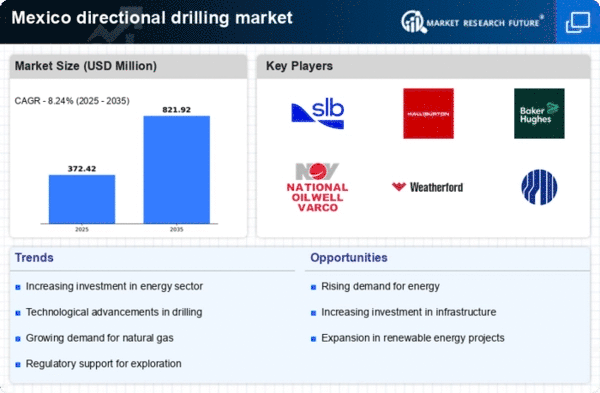
As per Market Research Future analysis, the Mexico directional drilling market size was estimated at 344.07 USD Million in 2024. The Mexico directional drilling market is projected to grow from 372.42 USD Million in 2025 to 821.92 USD Million by 2035, exhibiting a compound annual growth rate (CAGR) of 8.2% during the forecast period 2025 - 2035

Key Market Trends & Highlights

The Mexico directional drilling market is poised for growth driven by technological advancements and regulatory support.

  • Technological advancements in drilling equipment are enhancing operational efficiency and reducing costs.
  • The integration of directional drilling with renewable energy projects is emerging as a notable trend.
  • The oil and gas exploration segment remains the largest, while the natural gas segment is the fastest-growing in the market.
  • Increased oil and gas exploration and government policies favoring energy sector growth are key drivers of market expansion.

Market Size & Forecast

2024 Market Size 344.07 (USD Million)
2035 Market Size 821.92 (USD Million)
CAGR (2025 - 2035) 8.24%

Major Players

Schlumberger (US), Halliburton (US), Baker Hughes (US), National Oilwell Varco (US), Weatherford International (US), Nabors Industries (US), Precision Drilling (CA), Ensign Energy Services (CA), KCA Deutag (GB)

Our Impact
Enabled $4.3B Revenue Impact for Fortune 500 and Leading Multinationals
Partnering with 2000+ Global Organizations Each Year
30K+ Citations by Top-Tier Firms in the Industry

Mexico Directional Drilling Market Trends

The directional drilling market in Mexico is currently experiencing notable growth, driven by the increasing demand for efficient drilling techniques in the oil and gas sector. This method allows for precise drilling, minimizing environmental impact while maximizing resource extraction. The country's rich hydrocarbon reserves, particularly in the Gulf of Mexico, present significant opportunities for advancements in drilling technologies. As companies seek to enhance operational efficiency, the adoption of innovative tools and techniques is likely to rise, fostering a competitive landscape. Furthermore, regulatory frameworks are evolving to support sustainable practices, which may further stimulate market expansion. In addition, the directional drilling market is influenced by the rising emphasis on renewable energy sources. As Mexico transitions towards a more diversified energy portfolio, the integration of directional drilling techniques in geothermal and other renewable projects appears promising. This shift not only aligns with The directional drilling market for future growth. The interplay between traditional energy extraction and emerging technologies suggests a dynamic environment where adaptability and innovation will be crucial for stakeholders in the directional drilling sector.

Technological Advancements

The directional drilling market is witnessing rapid technological advancements that enhance drilling efficiency and accuracy. Innovations such as real-time data analytics and automated drilling systems are becoming increasingly prevalent. These technologies enable operators to make informed decisions quickly, reducing downtime and improving overall productivity.

Regulatory Support for Sustainable Practices

There is a growing trend towards regulatory support for sustainable practices within the directional drilling market. Mexican authorities are implementing policies that encourage environmentally responsible drilling methods. This regulatory framework not only promotes sustainability but also attracts investment in advanced drilling technologies.

Integration with Renewable Energy Projects

The directional drilling market is increasingly integrating with renewable energy projects, particularly in geothermal energy extraction. This trend reflects a broader shift towards diversifying energy sources in Mexico. By leveraging directional drilling techniques, companies can optimize resource extraction in renewable sectors, aligning with national energy goals.

Mexico Directional Drilling Market Drivers

Rising Demand for Natural Gas

The directional drilling market in Mexico is witnessing a rising demand for natural gas, which is reshaping the energy landscape. As the country aims to transition towards cleaner energy sources, natural gas is becoming a preferred option due to its lower emissions compared to coal and oil. In 2025, natural gas consumption is expected to increase by 20%, prompting energy companies to invest in directional drilling technologies that facilitate efficient extraction. This shift not only supports the country's energy goals but also enhances the market for directional drilling services. The industry's ability to adapt to changing energy demands indicates a promising outlook, as companies leverage advanced drilling techniques to tap into natural gas reserves effectively.

Increased Oil and Gas Exploration

The directional drilling market in Mexico is experiencing a surge due to increased oil and gas exploration activities. The government has been actively promoting exploration in untapped regions, which has led to a rise in demand for advanced drilling techniques. In 2025, the exploration budget allocated by the Mexican government is estimated to reach $2 billion, reflecting a 15% increase from the previous year. This investment is likely to enhance the capabilities of the directional drilling market, as companies seek to optimize resource extraction while minimizing environmental impact. The focus on deeper and more complex reservoirs necessitates the use of directional drilling technologies, which can navigate challenging geological formations. As a result, the industry is poised for growth, driven by the need for efficient and effective drilling solutions.

Infrastructure Development Initiatives

Infrastructure development initiatives in Mexico are significantly impacting the directional drilling market. The government has launched several projects aimed at improving transportation and energy infrastructure, which in turn drives the demand for directional drilling services. For instance, the construction of new pipelines and refineries requires precise drilling techniques to ensure safety and efficiency. In 2025, it is projected that infrastructure investments will exceed $10 billion, with a substantial portion allocated to energy projects. This influx of capital is likely to create opportunities for directional drilling companies to expand their operations and enhance their service offerings. The alignment of infrastructure development with energy needs suggests a robust growth trajectory for the directional drilling market, as companies adapt to meet the evolving demands of the sector.

Technological Innovations in Drilling Equipment

Technological innovations in drilling equipment are playing a crucial role in the directional drilling market. The introduction of advanced tools and techniques, such as rotary steerable systems and real-time data analytics, is enhancing drilling efficiency and accuracy. In Mexico, companies are increasingly adopting these innovations to reduce operational costs and improve safety standards. The market for drilling equipment is projected to grow by 12% annually, driven by the need for more sophisticated solutions. As the industry evolves, the integration of cutting-edge technologies is likely to redefine operational practices, making directional drilling more effective and reliable. This trend suggests that the directional drilling market will continue to expand as companies invest in modernizing their equipment and processes.

Government Policies Favoring Energy Sector Growth

Government policies favoring energy sector growth are significantly influencing the directional drilling market in Mexico. Recent reforms aimed at attracting foreign investment and enhancing competition have created a more favorable environment for drilling companies. In 2025, it is anticipated that regulatory changes will lead to a 25% increase in new drilling permits issued, facilitating greater exploration and production activities. These policies not only stimulate market growth but also encourage the adoption of innovative drilling techniques. The alignment of government objectives with industry needs suggests a robust future for the directional drilling market, as companies capitalize on the opportunities presented by a supportive regulatory framework.


Market Segment Insights

By Well Type: Horizontal (Largest) vs. Extended Reach (Fastest-Growing)

In the Mexico directional drilling market, the well type segment shows a dynamic distribution of market shares. Horizontal wells dominate the market, benefiting from their ability to maximize production while minimizing surface disruption. Extended reach wells, while currently smaller in share, are gaining attention due to their potential to access reserves located further from drilling sites, leading to innovative strategies and operational efficiencies. Growth trends indicate a shift toward more complex drilling solutions, particularly in the extended reach category, which is projected to experience the fastest growth. This is driven by the increasing demand for efficient resource extraction from challenging geological formations and the need to reach deeper reserves. Technological advancements and investment in drilling capabilities are also accelerating growth in both horizontal and extended reach wells.

Horizontal (Dominant) vs. Extended Reach (Emerging)

Horizontal wells are characterized by their ability to drill laterally through reservoirs, leading to increased contact with hydrocarbons and higher efficiency. They dominate the Mexico directional drilling market as they allow for the extraction of resources while reducing environmental impact and surface footprint. On the other hand, extended reach wells, although emerging, are defined by their capacity to reach targets situated at significant distances from the drilling site. This type of well utilizes advanced technologies to push boundaries in drilling depth and distance, making them ideal for tapping into hard-to-reach reservoirs. The rising complexities of drilling projects and the demand for operational flexibility position extended reach wells as a significant player, complementing the strengths of horizontal drilling.

By Tool Type: Measurements-while drilling (Largest) vs. Logging-while drilling (Fastest-Growing)

In the Mexico directional drilling market, the tool type segment is primarily dominated by Measurements-while drilling (MWD), which holds the largest market share due to its reliability and precision in providing real-time data. Logging-while drilling (LWD) also plays a significant role, with a growing presence as drillers seek to enhance accuracy during the drilling process. Both technologies are critical for successful operations, yet MWD currently leads in adoption rates and utilization across various drilling projects. Looking ahead, the growth trends for these tools are shaped by technological advancements and the increasing complexity of drilling operations. The push for efficient resource extraction motivates operators to adopt MWD for its real-time insight capabilities, while LWD is emerging rapidly as drillers aim for improved downhole data and reduced operational risks. The synergy of these tools continues to transform the efficiency of drilling, reinforcing their respective positions in the market.

Tool Type: MWD (Dominant) vs. LWD (Emerging)

Measurements-while drilling (MWD) has established itself as the dominant tool in the Mexico directional drilling market, primarily due to its exceptional ability to provide real-time data that enhances decision-making during drilling operations. Its robustness and dependability make it the preferred choice among operators, especially in challenging drilling environments. Meanwhile, Logging-while drilling (LWD) represents an emerging force, gaining traction as it enables additional insights into geological formations while drilling, thereby enhancing efficiency and safety. As the industry progresses, both tools are likely to coexist, although MWD is currently favored for its established market presence while LWD is being recognized for its innovative capabilities.

By Technology: Rotary Steerable Systems (Largest) vs. Downhole Motors (Fastest-Growing)

In the Mexico directional drilling market, the distribution of market share reveals that Rotary Steerable Systems (RSS) dominate due to their advanced capabilities in enhancing drilling efficiency and precision. The widespread adoption of RSS can be attributed to their ability to provide real-time adjustments and greater control over the drilling trajectory, leading to lower operational costs and reduced drilling times. On the other hand, Downhole Motors are emerging as the fastest-growing segment, driven by the increasing demand for high-performance drilling technologies. The introduction of more efficient and robust designs in downhole motors is fueling their growth, as operators seek to optimize drilling operations in challenging formations. Factors such as technological advancements, enhanced performance, and the need for cost-effective solutions are pivotal in promoting the adoption of downhole motors.

Technology: Rotary Steerable Systems (Dominant) vs. Downhole Motors (Emerging)

Rotary Steerable Systems (RSS) have established themselves as the dominant technology in the directional drilling landscape, offering significant advantages in terms of accuracy and operational efficiency. Their design facilitates continuous rotation while allowing for directional changes, making them ideal for complex drilling projects. Conversely, Downhole Motors, while currently an emerging technology, are rapidly gaining traction due to their simplicity and effectiveness in delivering high torque at the bit. This growing interest stems from their performance in various geological formations, with operators increasingly recognizing their potential to enhance drilling productivity. Both technologies play crucial roles in advancing the capabilities of directional drilling, but RSS leads in terms of market acceptance and operational integration.

By Application: Onshore (Largest) vs. Offshore (Fastest-Growing)

In the Mexico directional drilling market, the application segment is predominantly led by onshore activities, capturing a significant share of the total market. Onshore drilling benefits from established infrastructure and a favorable regulatory environment, making it the preferred choice among operators. In contrast, offshore drilling, while currently a smaller segment, is gaining traction due to advances in technology and increased investment in deepwater projects. Growth trends indicate a strong upward trajectory for offshore directional drilling, spurred by the need for oil and gas companies to explore untapped reserves in deeper waters. Factors such as improved drilling techniques, the rise in oil prices, and strategic collaborations are driving this segment's expansion. As companies adapt to changing market dynamics, offshore drilling is likely to see accelerated growth in the coming years.

Application: Onshore (Dominant) vs. Offshore (Emerging)

Onshore directional drilling remains the dominant application in the Mexico directional drilling market, primarily due to its operational efficiency and lower costs compared to offshore drilling. Operators have optimized their processes to minimize downtime and maximize output. However, offshore drilling presents a compelling case as an emerging segment, characterized by innovation and the pursuit of challenging reserves. As technology evolves, offshore projects are becoming more feasible, with advancements in subsea engineering and resource management. The competition between these segments illustrates the market's adaptability, as stakeholders seek to capitalize on both the established advantages of onshore drilling and the promising potential of offshore exploration.

Get more detailed insights about Mexico Directional Drilling Market

Key Players and Competitive Insights

The directional drilling market in Mexico is characterized by a competitive landscape that is increasingly shaped by technological advancements and strategic partnerships. Key players such as Schlumberger (US), Halliburton (US), and Baker Hughes (US) are actively pursuing innovation and digital transformation to enhance operational efficiency and service delivery. These companies are not only focusing on expanding their technological capabilities but are also engaging in strategic alliances to bolster their market presence. The collective strategies of these firms indicate a shift towards a more integrated approach, where collaboration and technology play pivotal roles in shaping competitive dynamics.
In terms of business tactics, companies are localizing manufacturing and optimizing supply chains to better serve the Mexican market. The competitive structure appears moderately fragmented, with several players vying for market share. However, the influence of major companies like National Oilwell Varco (US) and Weatherford International (US) remains substantial, as they leverage their extensive resources and expertise to maintain a competitive edge. This dynamic suggests that while competition is robust, the presence of established firms provides a stabilizing effect on market operations.
In October 2025, Schlumberger (US) announced a partnership with a local technology firm to develop advanced drilling solutions tailored for the Mexican oil fields. This strategic move is likely to enhance Schlumberger's service offerings and improve operational efficiencies, thereby solidifying its position in the market. The collaboration underscores the importance of local expertise in navigating the unique challenges of the region, which may lead to more effective drilling operations and reduced costs.
In September 2025, Halliburton (US) launched a new digital platform aimed at optimizing drilling performance through real-time data analytics. This initiative is indicative of Halliburton's commitment to integrating digital technologies into its operations, potentially leading to improved decision-making and enhanced productivity. The emphasis on data-driven solutions reflects a broader trend within the industry towards leveraging technology for competitive advantage.
In August 2025, Baker Hughes (US) expanded its service portfolio by introducing a suite of environmentally sustainable drilling technologies. This strategic initiative aligns with the growing emphasis on sustainability within the energy sector, suggesting that Baker Hughes is positioning itself as a leader in eco-friendly drilling practices. The move not only addresses regulatory pressures but also caters to the increasing demand for sustainable solutions from clients.
As of November 2025, the competitive trends in the directional drilling market are increasingly defined by digitalization, sustainability, and the integration of artificial intelligence. Strategic alliances are becoming more prevalent, as companies recognize the value of collaboration in enhancing their technological capabilities. Looking ahead, it appears that competitive differentiation will increasingly hinge on innovation and technology rather than price. Firms that prioritize supply chain reliability and invest in cutting-edge solutions are likely to emerge as leaders in this evolving landscape.

Key Companies in the Mexico Directional Drilling Market include

Industry Developments

Recent developments in the Mexico Directional Drilling Market have showcased an increasing demand for advanced drilling technologies, with essential players such as Baker Hughes, Halliburton, and Schlumberger actively enhancing their service offerings. 

In April 2023, Baker Hughes announced collaborations aimed at improving operational efficiency through digital solutions. Furthermore, the current push for energy reforms in Mexico has led to greater investment in the oil and gas sector, attracting companies like Ensign Energy Services and Nabors Industries, who are expanding their operations. Mergers and acquisitions have also been notable; for instance, in February 2023, Halliburton completed its acquisition of Pioneer Energy Services to bolster its market presence in Mexico, focusing on integrated drilling solutions.

The market valuation is benefitting from these expansions, with increasing valuations attributed to the rise in demand for energy projects and enhanced drilling techniques. 

Moreover, over the past two years, significant growth has been observed, reflecting a rebound after pandemic challenges, as companies like Precision Drilling and Weatherford continue to innovate and drive efficiency in their offerings within the region’s evolving energy landscape.

Future Outlook

Mexico Directional Drilling Market Future Outlook

The Directional Drilling Market in Mexico is projected to grow at an 8.24% CAGR from 2025 to 2035, driven by technological advancements and increasing energy demands.

New opportunities lie in:

  • Development of advanced telemetry systems for real-time data analysis.
  • Expansion of eco-friendly drilling fluids to meet regulatory standards.
  • Investment in training programs for skilled directional drilling personnel.

By 2035, the directional drilling market is expected to achieve robust growth and enhanced operational efficiencies.

Market Segmentation

Mexico Directional Drilling Market Tool Type Outlook

  • Logging-while drilling (LWD)
  • Measurements-while drilling (MWD)

Mexico Directional Drilling Market Well Type Outlook

  • Horizontal
  • Extended reach
  • Multilateral

Mexico Directional Drilling Market Technology Outlook

  • Rotary Steerable Systems
  • Downhole Motors

Mexico Directional Drilling Market Application Outlook

  • Onshore
  • Offshore

Report Scope

MARKET SIZE 2024 344.07(USD Million)
MARKET SIZE 2025 372.42(USD Million)
MARKET SIZE 2035 821.92(USD Million)
COMPOUND ANNUAL GROWTH RATE (CAGR) 8.24% (2025 - 2035)
REPORT COVERAGE Revenue Forecast, Competitive Landscape, Growth Factors, and Trends
BASE YEAR 2024
Market Forecast Period 2025 - 2035
Historical Data 2019 - 2024
Market Forecast Units USD Million
Key Companies Profiled Schlumberger (US), Halliburton (US), Baker Hughes (US), National Oilwell Varco (US), Weatherford International (US), Nabors Industries (US), Precision Drilling (CA), Ensign Energy Services (CA), KCA Deutag (GB)
Segments Covered Well Type, Tool Type, Technology, Application
Key Market Opportunities Adoption of advanced automation technologies enhances efficiency in the directional drilling market.
Key Market Dynamics Technological advancements and regulatory changes drive growth in the directional drilling market in Mexico.
Countries Covered Mexico
Leave a Comment

FAQs

What is the expected market size of the Mexico Directional Drilling Market in 2024?

The Mexico Directional Drilling Market is expected to be valued at 346.0 million USD in 2024.

How much is the Mexico Directional Drilling Market projected to be worth by 2035?

By 2035, the Mexico Directional Drilling Market is projected to reach a value of 1024.0 million USD.

What is the compound annual growth rate (CAGR) for the Mexico Directional Drilling Market from 2025 to 2035?

The market is expected to grow at a CAGR of 10.367% from 2025 to 2035.

Which company holds a significant share within the Mexico Directional Drilling Market?

Baker Hughes is one of the major players with a significant presence in the Mexico Directional Drilling Market.

What are the projected values for horizontal directional drilling by 2035?

Horizontal directional drilling is projected to be valued at 409.0 million USD by 2035.

What is the expected market size for extended reach drilling in 2024?

The expected market size for extended reach drilling in 2024 is 103.0 million USD.

How much is the market for multilateral directional drilling expected to grow by 2035?

The market for multilateral directional drilling is expected to grow to 308.0 million USD by 2035.

What challenges are currently faced by the Mexico Directional Drilling Market?

Challenges currently faced by the market include fluctuating oil prices and the need for advanced technology.

Which regions are primarily driving growth in the Mexico Directional Drilling Market?

The growth is primarily driven by regions with significant oil reserves and ongoing energy exploration.

What emerging trends are influencing the Mexico Directional Drilling Market?

Emerging trends include increased adoption of automation and technological advancements in drilling techniques.

Download Free Sample

Kindly complete the form below to receive a free sample of this Report

Compare Licence

×
Features License Type
Single User Multiuser License Enterprise User
Price $4,950 $5,950 $7,250
Maximum User Access Limit 1 User Upto 10 Users Unrestricted Access Throughout the Organization
Free Customization
Direct Access to Analyst
Deliverable Format
Platform Access
Discount on Next Purchase 10% 15% 15%
Printable Versions