×
Request Free Sample ×

Kindly complete the form below to receive a free sample of this Report

* Please use a valid business email

Leading companies partner with us for data-driven Insights

clients tt-cursor
Hero Background
English
Chinese
French
Japanese
Korean
German
Spanish

Medicated Wipes Market Size

ID: MRFR/HC/9890-CR
128 Pages
Garvit Vyas
March 2023

Medicated Wipes Market Research Report Information by Product (Dry and Wet), by Type of Packaging (Single Pack and Bundled Pack), by Application (Hemorrhoid Care, Feminine Care, Acne Treatment, Skin Disinfection & Anti-Allergy, and Others), by Distribution Channel (Pharmacies & Drugstores, Supermarkets & Hypermarkets, E-commerce, and Others), and By Region (North America, Europe, Asia-Pacific, and Rest of the World) - Forecast Till 2035.

Share:
Download PDF ×

We do not share your information with anyone. However, we may send you emails based on your report interest from time to time. You may contact us at any time to opt-out.

Medicated Wipes Market Infographic
Purchase Options

Medicated Wipes Size

Medicated Wipes Market Growth Projections and Opportunities

Medicated wipes are handy for soothing discomfort or irritation, and both adults and children use them. The global market for these wipes is expanding, thanks to more people worldwide dealing with acne and other skin issues. Additionally, there's a rising awareness about personal hygiene contributing to this growth. The use of biodegradable materials for making these wipes is also on the rise, which presents promising opportunities for the market in the future. However, worries about rashes and allergies could slow down the market's growth in the coming years.

Let's break down why medicated wipes are becoming increasingly popular. These wipes are designed to provide relief when you're feeling uncomfortable or irritated, making them useful for various situations. Both adults and children use them, reflecting their broad appeal and practicality for different age groups.

Now, why is the global market for medicated wipes growing? One significant reason is the increasing prevalence of skin issues like acne around the world. More people are dealing with these conditions, and as a result, there's a growing demand for products that can help alleviate discomfort and irritation. Medicated wipes fit the bill perfectly, contributing to the expansion of the market.

Another factor driving the growth is the rising awareness of personal hygiene. People are becoming more conscious of the importance of maintaining good hygiene practices. Using medicated wipes is seen as a convenient and effective way to address personal care needs, further fueling the market's development.

The use of biodegradable materials in making these wipes is a noteworthy trend that's gaining traction. Biodegradable materials break down naturally over time, causing less harm to the environment. This approach aligns with the increasing global focus on sustainability. As more people and companies prioritize eco-friendly options, the use of biodegradable materials in medicated wipes provides a promising avenue for future growth in the market.

However, it's essential to consider potential challenges. Despite the positive aspects, concerns related to rashes and allergies could pose obstacles to the market's growth in the forecast period. Some individuals might be sensitive to certain ingredients in these wipes, leading to skin reactions. Addressing these concerns and ensuring the safety of users will be crucial for sustaining the market's upward trajectory.

The medicated wipes are becoming increasingly popular globally due to their effectiveness in providing relief from discomfort and irritation. The market is expanding because of the growing prevalence of skin issues like acne, heightened awareness of personal hygiene, and the adoption of biodegradable materials for sustainable production. While there are promising opportunities for growth, it's essential to navigate challenges related to potential skin reactions to ensure the continued success of the market in the future.
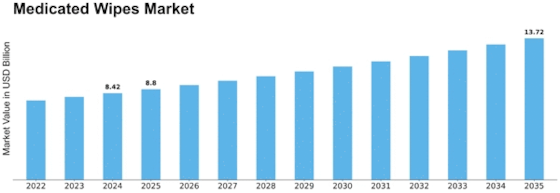

Medicated Wipes Market Size Graph
Author
Garvit Vyas
Analyst

Explore the profile of Garvit Vyas, one of our esteemed authors at Market Research Future, and access their expert research contributions in the field of market research and industry analysis

Leave a Comment

FAQs

What is the current valuation of the Medicated Wipes Market?

<p>As of 2024, the Medicated Wipes Market was valued at 8.42 USD Billion.</p>

What is the projected market size for the Medicated Wipes Market by 2035?

<p>The market is projected to reach 13.72 USD Billion by 2035.</p>

What is the expected CAGR for the Medicated Wipes Market during the forecast period?

<p>The expected CAGR for the Medicated Wipes Market from 2025 to 2035 is 4.54%.</p>

Which companies are the key players in the Medicated Wipes Market?

<p>Key players include Procter & Gamble, Kimberly-Clark, Johnson & Johnson, and Reckitt Benckiser Group.</p>

What are the main product segments in the Medicated Wipes Market?

<p>The main product segments are Dry Wipes, valued at 5.52 USD Billion, and Wet Wipes, valued at 8.2 USD Billion.</p>

How is the Medicated Wipes Market segmented by packaging type?

<p>The market is segmented into Single Packs, valued at 5.56 USD Billion, and Bundled Packs, valued at 8.16 USD Billion.</p>

What applications are driving the growth of the Medicated Wipes Market?

<p>Key applications include Skin Disinfection & Anti-Allergy, valued at 3.4 USD Billion, and Hemorrhoid Care, valued at 2.73 USD Billion.</p>

Which distribution channels are most effective for Medicated Wipes?

Pharmacies &amp; Drugstores, with a valuation of 4.12 USD Billion, and E-commerce, valued at 4.02 USD Billion, are leading distribution channels.

What trends are influencing the Medicated Wipes Market?

Trends indicate a growing demand for specialized applications, particularly in Feminine Care and Acne Treatment.

How does the Medicated Wipes Market compare to other personal care segments?

The Medicated Wipes Market shows robust growth potential, particularly in niche applications, compared to broader personal care segments.

Market Summary

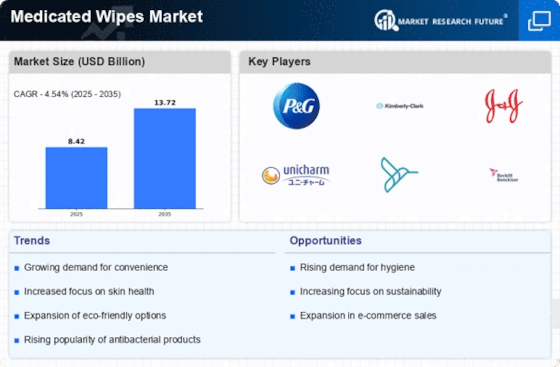
As per Market Research Future analysis, the Medicated Wipes Market Size was estimated at 8.42 USD Billion in 2024. The Medicated Wipes industry is projected to grow from 8.802 USD Billion in 2025 to 13.72 USD Billion by 2035, exhibiting a compound annual growth rate (CAGR) of 4.54% during the forecast period 2025 - 2035

Key Market Trends & Highlights

The Medicated Wipes Market is experiencing robust growth driven by health awareness and convenience.

  • The demand for antimicrobial products is rising, particularly in North America, which remains the largest market. Sustainability initiatives are influencing product development, especially in the Asia-Pacific region, the fastest-growing market. Convenience and portability are key factors driving consumer preferences, notably in the wet wipes segment, which is the largest. Increasing health awareness and the growing demand in healthcare facilities are major drivers propelling market expansion.

Market Size & Forecast

2024 Market Size 8.42 (USD Billion)
2035 Market Size 13.72 (USD Billion)
CAGR (2025 - 2035) 4.54%
Largest Regional Market Share in 2024 North America

Major Players

Procter &amp; Gamble (US), Kimberly-Clark (US), Johnson &amp; Johnson (US), Unicharm Corporation (JP), Edgewell Personal Care (US), Reckitt Benckiser Group (GB), Burt's Bees (US), Caldrea (US)

Market Trends

The Medicated Wipes Market is currently experiencing a notable evolution, driven by increasing consumer awareness regarding hygiene and health. This market segment appears to be expanding as individuals seek convenient solutions for maintaining cleanliness, particularly in personal care and healthcare settings. The rise in demand for products that offer antimicrobial properties suggests a shift towards wipes that not only cleanse but also provide additional health benefits. Furthermore, the growing trend of on-the-go lifestyles seems to be influencing purchasing behaviors, as consumers favor portable and easy-to-use options that fit seamlessly into their daily routines. In addition, the Medicated Wipes Market is likely to witness innovations in formulations and packaging. Manufacturers are exploring eco-friendly materials and sustainable practices, which may appeal to environmentally conscious consumers. This focus on sustainability, coupled with advancements in product efficacy, indicates a potential for growth in niche markets. As the landscape evolves, it is essential for stakeholders to remain attuned to changing consumer preferences and regulatory developments that could shape the future of this market.

Rising Demand for Antimicrobial Products

There is an increasing preference for wipes that offer antimicrobial properties, reflecting a broader consumer focus on health and hygiene. This trend suggests that consumers are not only looking for cleaning solutions but also for products that can help prevent the spread of germs.

Sustainability Initiatives

Manufacturers are increasingly adopting sustainable practices, including the use of biodegradable materials in wipe production. This shift indicates a growing awareness of environmental issues among consumers, who are more likely to support brands that prioritize eco-friendly solutions.

Convenience and Portability

The fast-paced lifestyle of consumers is driving demand for convenient and portable cleaning solutions. Medicated wipes that are easy to carry and use are becoming more popular, as they align with the needs of individuals seeking quick and effective hygiene options.

Medicated Wipes Market Market Drivers

Increasing Health Awareness

The Medicated Wipes Market is experiencing a surge in demand due to heightened health awareness among consumers. As individuals become more conscious of hygiene and infection control, the preference for products that offer antimicrobial properties has escalated. This trend is particularly evident in households and healthcare settings, where the need for effective cleaning solutions is paramount. According to recent data, the market for medicated wipes is projected to grow at a compound annual growth rate of approximately 6.5% over the next five years. This growth is driven by the increasing incidence of infectious diseases and the rising emphasis on personal hygiene, which positions medicated wipes as a convenient and effective solution for consumers seeking to maintain cleanliness and health.

Rising E-commerce Penetration

The Medicated Wipes Market is benefiting from the rapid expansion of e-commerce platforms. With the increasing reliance on online shopping, consumers are finding it more convenient to purchase medicated wipes from the comfort of their homes. This trend is particularly pronounced among younger demographics who prefer the ease of online transactions. E-commerce platforms often provide a wider range of products, competitive pricing, and the convenience of home delivery, which enhances consumer access to medicated wipes. Recent statistics indicate that online sales of personal care products, including medicated wipes, have seen a significant uptick, suggesting that this channel will continue to play a crucial role in the market's growth trajectory.

Growing Demand in Healthcare Facilities

The Medicated Wipes Market is witnessing a notable increase in demand from healthcare facilities. Hospitals, clinics, and nursing homes are increasingly adopting medicated wipes for their efficacy in maintaining hygiene and preventing cross-contamination. The convenience of using wipes in high-traffic areas, such as waiting rooms and patient care settings, is driving their adoption. Furthermore, regulatory bodies are emphasizing the importance of infection control measures, which further propels the demand for effective cleaning solutions. As healthcare facilities continue to prioritize patient safety and hygiene, the medicated wipes segment is expected to experience robust growth, contributing significantly to the overall market expansion.

Consumer Preference for Multi-functional Products

The Medicated Wipes Market is experiencing a shift towards multi-functional products that cater to diverse consumer needs. Consumers are increasingly seeking wipes that not only clean but also provide additional benefits, such as moisturizing or soothing properties. This trend is particularly relevant in the personal care segment, where consumers are looking for products that simplify their routines. The rise of multi-functional medicated wipes is likely to attract a wider audience, including parents looking for safe and effective options for their children. As manufacturers respond to this demand by developing innovative products, the market is poised for continued growth, reflecting changing consumer preferences and lifestyle choices.

Technological Advancements in Product Formulation

Innovations in product formulation are significantly influencing the Medicated Wipes Market. Manufacturers are increasingly investing in research and development to create wipes that not only clean but also provide therapeutic benefits. Enhanced formulations that include natural ingredients and advanced antimicrobial agents are becoming more prevalent. This shift is likely to attract a broader consumer base, including those with sensitive skin or specific health concerns. The introduction of biodegradable and eco-friendly wipes is also gaining traction, aligning with consumer preferences for sustainable products. As a result, the market is expected to witness a diversification of offerings, catering to various consumer needs and preferences, thereby driving overall growth.

Market Segment Insights

By Product: Wet (Largest) vs. Dry (Fastest-Growing)

<p>In the Medicated Wipes Market, the product segmentation reveals that wet medicated wipes account for the largest share, appealing to consumers seeking effective and convenient solutions for personal care, especially in disinfecting and sanitizing roles. The wet format's ability to deliver moisture and active ingredients directly onto surfaces makes it preferable among users, thus solidifying its market position as a staple product in various applications ranging from healthcare to personal hygiene. On the other hand, dry medicated wipes are emerging as the fastest-growing segment within this market. Although they currently hold a smaller portion of the market share compared to their wet counterparts, their popularity is surging due to factors such as convenience and versatility. Consumers are increasingly attracted to the potential for enhanced portability and longer shelf life that dry wipes offer, making them particularly popular among on-the-go users and parents for children's care needs.</p>

<p>Wet (Dominant) vs. Dry (Emerging)</p>

<p>Wet medicated wipes are characterized by their pre-moistened nature, which facilitates immediate use for disinfection and cleansing. They are widely adopted in various settings, including healthcare, personal care, and household cleaning, due to their effectiveness and ease of use. The dominance of wet wipes in the market stems from their ability to quickly deliver moisture and medications, making them indispensable for those seeking instant relief and cleanliness. In contrast, dry medicated wipes, while currently less dominant, are gaining traction as an emerging option for consumers looking for a more portable and versatile solution. They are often chosen for their longer shelf life and convenience, making them appealing to busy families and travelers.</p>

By Type of Packaging: Bundled Pack (Largest) vs. Single Pack (Fastest-Growing)

<p>In the Medicated Wipes Market, the 'Bundled Pack' type of packaging holds the largest market share. This segment appeals particularly to consumers seeking value and convenience, as bundled packs typically offer a greater quantity of wipes at a lower cost per unit compared to single packs. Additionally, bundled packs are often preferred by both retail and commercial users, including hospitals and clinics, due to their easy storage and prolonged usability. On the growth front, single packs are quickly becoming the fastest-growing segment within the medicated wipes market. The increase in individual consumer demand, particularly for on-the-go use, has driven sales of single packs. Moreover, the rise in personal hygiene awareness and changing lifestyles are fueling the preference for single-use products that promote convenience and hygiene, influencing overall market dynamics.</p>

<p>Packaging: Bundled Pack (Dominant) vs. Single Pack (Emerging)</p>

<p>The 'Bundled Pack' type of packaging stands out as a dominant force in the Medicated Wipes Market due to its appealing pricing and quantity advantages. It is particularly favored in environments that require bulk purchasing, like healthcare settings, where efficiency and cost-effectiveness are paramount. On the other hand, the 'Single Pack' format represents an emerging trend, catering to a growing segment of consumers looking for convenience in personal care and hygiene. The rise of urban lifestyles, where on-the-go accessibility is crucial, positions single packs as a strategic innovation. While bundled packs solidify established market preferences, single packs are capturing the interest of younger demographics and health-conscious individuals seeking portable solutions.</p>

By Application: Skin Disinfection & Anti-Allergy (Largest) vs. Acne Treatment (Fastest-Growing)

<p>The Medicated Wipes Market is characterized by diverse applications, with Skin Disinfection & Anti-Allergy accounting for the largest share. This segment benefits from a growing awareness of hygiene and increased incidence of skin infections, which drives demand. Hemorrhoid Care and Feminine Care also represent substantial portions of the market, targeting specific consumer needs. Although smaller in size, segments like Acne Treatment are gaining traction among the youth and hygiene-conscious populations, indicating a gradual shift towards these targeted applications. The growth trends in the Medicated Wipes Market are largely influenced by consumer preferences for convenience and efficacy in skincare solutions. The Acne Treatment segment, in particular, is projected to experience rapid growth as demand rises for effective solutions catering to skin issues among young adults. Innovations in formulations that are gentle yet effective are also propelling the market forward, enhancing product appeal and driving higher sales across all segments.</p>

<p>Skin Disinfection & Anti-Allergy (Dominant) vs. Acne Treatment (Emerging)</p>

<p>Skin Disinfection & Anti-Allergy wipes are leading the Medicated Wipes Market, primarily due to their effectiveness in preventing infections and managing allergies. These wipes are often infused with antiseptic properties, making them a preferred choice for consumers who prioritize hygiene and skin health. This segment benefits from growing health awareness among consumers, particularly in post-pandemic times, where cleanliness is paramount. On the other hand, the Acne Treatment segment is rapidly emerging as a trendsetter among the younger demographic. This growth is fueled by an increasing focus on skin health, with consumers actively seeking easy-to-use products that deliver quick results. As brands introduce more natural and organic formulations, the appeal of Acne Treatment wipes is set to broaden, capturing the interest of both new and existing customers.</p>

By Distribution Channel: Pharmacies & Drugstores (Largest) vs. E-commerce (Fastest-Growing)

<p>In the Medicated Wipes Market, the distribution channel landscape is predominantly occupied by Pharmacies & Drugstores, which command a significant market share due to their widespread availability and trust among consumers. Supermarkets & Hypermarkets follow closely, offering convenience and accessibility, while E-commerce has rapidly gained traction, especially post-pandemic, reshaping purchasing habits. Other distribution channels contribute to a smaller percentage, yet cater to niche markets and specific consumer needs.</p>

<p>Distribution Channels: Pharmacies & Drugstores (Dominant) vs. E-commerce (Emerging)</p>

<p>Pharmacies & Drugstores serve as the dominant force in the medicated wipes market, providing a reliable source for consumers seeking health-related products. Their established customer base and knowledgeable staff enhance consumer confidence. In contrast, E-commerce is emerging as a critical player, driven by the shift towards online shopping and increased consumer preference for the convenience of home delivery. This channel allows brands to reach broader audiences, including tech-savvy consumers who value quick access to a variety of products and health information. Thus, while Pharmacies & Drugstores anchor the market with their presence, E-commerce is poised for rapid growth, catering to evolving consumer behaviors.</p>

Get more detailed insights about Medicated Wipes Market Research Report—Global Forecast till 2035

Regional Insights

North America : Market Leader in Medicated Wipes Market

North America is the largest market for medicated wipes, holding approximately 45% of the global share. The growth is driven by increasing consumer awareness regarding hygiene and the rising prevalence of skin-related issues. Regulatory support from health organizations further boosts demand, as they promote the use of medicated products for personal care. The U.S. is the primary contributor, followed by Canada, which is experiencing a growing trend in the adoption of these products. The competitive landscape in North America is robust, featuring key players such as Procter & Gamble, Kimberly-Clark, and Johnson & Johnson. These companies leverage advanced technology and marketing strategies to maintain their market positions. The presence of established retail channels and e-commerce platforms facilitates easy access to medicated wipes, further enhancing market growth. The region's focus on innovation and product development continues to attract investments, ensuring sustained growth in the sector.

Europe : Emerging Market with Growth Potential

Europe is witnessing a significant increase in the demand for medicated wipes, holding around 30% of the global market share. The growth is fueled by heightened awareness of hygiene and the increasing incidence of allergies and skin conditions. Regulatory bodies in the region are also promoting the use of safe and effective personal care products, which is a catalyst for market expansion. Countries like Germany and the UK are leading this growth, with a strong focus on sustainability and eco-friendly products. The competitive landscape in Europe is characterized by a mix of local and international players, including Reckitt Benckiser and Unicharm Corporation. These companies are focusing on product innovation and sustainability to meet consumer demands. The presence of stringent regulations regarding product safety and efficacy ensures that only high-quality products are available in the market. This competitive environment encourages continuous improvement and adaptation to consumer preferences, driving further growth in the medicated wipes sector.

Asia-Pacific : Rapid Growth in Emerging Markets

Asia-Pacific is rapidly emerging as a significant player in the medicated wipes market, accounting for approximately 20% of the global share. The region's growth is driven by increasing urbanization, rising disposable incomes, and a growing awareness of hygiene practices. Countries like China and India are at the forefront, with a rising demand for personal care products. Regulatory frameworks are evolving to support the introduction of innovative and safe products, further propelling market growth. The competitive landscape in Asia-Pacific is diverse, with both local and international brands vying for market share. Key players such as Unicharm Corporation and Edgewell Personal Care are expanding their presence through strategic partnerships and product launches. The region's unique consumer preferences and cultural factors influence product development, leading to a variety of offerings tailored to local markets. This dynamic environment fosters innovation and competition, driving the medicated wipes market forward.

Middle East and Africa : Untapped Potential in Wipes Market

The Middle East and Africa region is gradually emerging in the medicated wipes market, holding about 5% of the global share. The growth is primarily driven by increasing health awareness and the rising prevalence of skin conditions. Regulatory bodies are beginning to implement guidelines that promote the use of safe and effective personal care products, which is expected to catalyze market growth. Countries like South Africa and the UAE are leading this trend, with a growing demand for hygiene products. The competitive landscape in this region is still developing, with a mix of local and international players. Companies are focusing on expanding their product lines and improving distribution channels to meet the rising demand. The presence of key players is limited compared to other regions, but the potential for growth is significant. As consumer awareness increases and regulations become more favorable, the medicated wipes market in the Middle East and Africa is poised for expansion.

Key Players and Competitive Insights

Major market players are spending a lot of money on R&D to increase their product lines, which will help the market of medicated wipes grow even more. Market participants are also taking a range of strategic initiatives to grow their worldwide footprint, including new product launches, contractual agreements, mergers and acquisitions, increased investments, and collaboration with other organizations. Competitors in the medicated wipes industry must offer cost-effective items to expand and survive in an increasingly competitive and rising market environment.
Diamond Wipes International Inc. (Diamond Wipes) is a leading company in the US. The company manufactures makeup remover, face cleanser, body wash, nail polish remover, baby wipes, feminine hygiene, butt wipes, OTC antibacterial, and medicated antiseptic. Moreover, the company serves more than 50 beauty and personal care brands.
In November Diamond Wipes International, acquired Ode to Clean (US), the world's first cleaning wipes made with 100% plant-based ingredients.

Key Companies in the Medicated Wipes Market include

Industry Developments

Future Outlook

Medicated Wipes Market Future Outlook

The Medicated Wipes Market is projected to grow at a 4.54% CAGR from 2025 to 2035, driven by increasing consumer awareness and demand for hygiene products.

New opportunities lie in:

  • <p>Expansion into eco-friendly product lines Development of targeted medicated formulations for specific skin conditions Partnerships with healthcare providers for bulk supply contracts</p>

By 2035, the market is expected to solidify its position as a key player in personal care.

Market Segmentation

Medicated Wipes Market Product Outlook

  • Dry
  • Wet

Medicated Wipes Market Application Outlook

  • Hemorrhoid Care
  • Feminine Care
  • Acne Treatment
  • Skin Disinfection & Anti-Allergy
  • Others

Medicated Wipes Market Type of Packaging Outlook

  • Single Pack
  • Bundled Pack

Medicated Wipes Market Distribution Channel Outlook

  • Pharmacies & Drugstores
  • Supermarkets & Hypermarkets
  • E-commerce
  • Others

Report Scope

MARKET SIZE 2024 8.42(USD Billion)
MARKET SIZE 2025 8.802(USD Billion)
MARKET SIZE 2035 13.72(USD Billion)
COMPOUND ANNUAL GROWTH RATE (CAGR) 4.54% (2025 - 2035)
REPORT COVERAGE Revenue Forecast, Competitive Landscape, Growth Factors, and Trends
BASE YEAR 2024
Market Forecast Period 2025 - 2035
Historical Data 2019 - 2024
Market Forecast Units USD Billion
Key Companies Profiled Procter & Gamble (US), Kimberly-Clark (US), Johnson & Johnson (US), Unicharm Corporation (JP), Edgewell Personal Care (US), Reckitt Benckiser Group (GB), Burt's Bees (US), Caldrea (US)
Segments Covered Product, Type of Packaging, Application, Distribution Channel, Region
Key Market Opportunities Growing demand for eco-friendly and antimicrobial formulations in the Medicated Wipes Market presents significant opportunities.
Key Market Dynamics Rising consumer demand for convenience drives innovation and competition in the medicated wipes market.
Countries Covered North America, Europe, APAC, South America, MEA

FAQs

What is the current valuation of the Medicated Wipes Market?

<p>As of 2024, the Medicated Wipes Market was valued at 8.42 USD Billion.</p>

What is the projected market size for the Medicated Wipes Market by 2035?

<p>The market is projected to reach 13.72 USD Billion by 2035.</p>

What is the expected CAGR for the Medicated Wipes Market during the forecast period?

<p>The expected CAGR for the Medicated Wipes Market from 2025 to 2035 is 4.54%.</p>

Which companies are the key players in the Medicated Wipes Market?

<p>Key players include Procter & Gamble, Kimberly-Clark, Johnson & Johnson, and Reckitt Benckiser Group.</p>

What are the main product segments in the Medicated Wipes Market?

<p>The main product segments are Dry Wipes, valued at 5.52 USD Billion, and Wet Wipes, valued at 8.2 USD Billion.</p>

How is the Medicated Wipes Market segmented by packaging type?

<p>The market is segmented into Single Packs, valued at 5.56 USD Billion, and Bundled Packs, valued at 8.16 USD Billion.</p>

What applications are driving the growth of the Medicated Wipes Market?

<p>Key applications include Skin Disinfection & Anti-Allergy, valued at 3.4 USD Billion, and Hemorrhoid Care, valued at 2.73 USD Billion.</p>

Which distribution channels are most effective for Medicated Wipes?

Pharmacies &amp; Drugstores, with a valuation of 4.12 USD Billion, and E-commerce, valued at 4.02 USD Billion, are leading distribution channels.

What trends are influencing the Medicated Wipes Market?

Trends indicate a growing demand for specialized applications, particularly in Feminine Care and Acne Treatment.

How does the Medicated Wipes Market compare to other personal care segments?

The Medicated Wipes Market shows robust growth potential, particularly in niche applications, compared to broader personal care segments.

  1. SECTION I: EXECUTIVE SUMMARY AND KEY HIGHLIGHTS
    1. | 1.1 EXECUTIVE SUMMARY
    2. | | 1.1.1 Market Overview
    3. | | 1.1.2 Key Findings
    4. | | 1.1.3 Market Segmentation
    5. | | 1.1.4 Competitive Landscape
    6. | | 1.1.5 Challenges and Opportunities
    7. | | 1.1.6 Future Outlook
  2. SECTION II: SCOPING, METHODOLOGY AND MARKET STRUCTURE
    1. | 2.1 MARKET INTRODUCTION
    2. | | 2.1.1 Definition
    3. | | 2.1.2 Scope of the study
    4. | | | 2.1.2.1 Research Objective
    5. | | | 2.1.2.2 Assumption
    6. | | | 2.1.2.3 Limitations
    7. | 2.2 RESEARCH METHODOLOGY
    8. | | 2.2.1 Overview
    9. | | 2.2.2 Data Mining
    10. | | 2.2.3 Secondary Research
    11. | | 2.2.4 Primary Research
    12. | | | 2.2.4.1 Primary Interviews and Information Gathering Process
    13. | | | 2.2.4.2 Breakdown of Primary Respondents
    14. | | 2.2.5 Forecasting Model
    15. | | 2.2.6 Market Size Estimation
    16. | | | 2.2.6.1 Bottom-Up Approach
    17. | | | 2.2.6.2 Top-Down Approach
    18. | | 2.2.7 Data Triangulation
    19. | | 2.2.8 Validation
  3. SECTION III: QUALITATIVE ANALYSIS
    1. | 3.1 MARKET DYNAMICS
    2. | | 3.1.1 Overview
    3. | | 3.1.2 Drivers
    4. | | 3.1.3 Restraints
    5. | | 3.1.4 Opportunities
    6. | 3.2 MARKET FACTOR ANALYSIS
    7. | | 3.2.1 Value chain Analysis
    8. | | 3.2.2 Porter's Five Forces Analysis
    9. | | | 3.2.2.1 Bargaining Power of Suppliers
    10. | | | 3.2.2.2 Bargaining Power of Buyers
    11. | | | 3.2.2.3 Threat of New Entrants
    12. | | | 3.2.2.4 Threat of Substitutes
    13. | | | 3.2.2.5 Intensity of Rivalry
    14. | | 3.2.3 COVID-19 Impact Analysis
    15. | | | 3.2.3.1 Market Impact Analysis
    16. | | | 3.2.3.2 Regional Impact
    17. | | | 3.2.3.3 Opportunity and Threat Analysis
  4. SECTION IV: QUANTITATIVE ANALYSIS
    1. | 4.1 Healthcare, BY Product (USD Billion)
    2. | | 4.1.1 Dry
    3. | | 4.1.2 Wet
    4. | 4.2 Healthcare, BY Type of Packaging (USD Billion)
    5. | | 4.2.1 Single Pack
    6. | | 4.2.2 Bundled Pack
    7. | 4.3 Healthcare, BY Application (USD Billion)
    8. | | 4.3.1 Hemorrhoid Care
    9. | | 4.3.2 Feminine Care
    10. | | 4.3.3 Acne Treatment
    11. | | 4.3.4 Skin Disinfection & Anti-Allergy
    12. | | 4.3.5 Others
    13. | 4.4 Healthcare, BY Distribution Channel (USD Billion)
    14. | | 4.4.1 Pharmacies & Drugstores
    15. | | 4.4.2 Supermarkets & Hypermarkets
    16. | | 4.4.3 E-commerce
    17. | | 4.4.4 Others
    18. | 4.5 Healthcare, BY Region (USD Billion)
    19. | | 4.5.1 North America
    20. | | | 4.5.1.1 US
    21. | | | 4.5.1.2 Canada
    22. | | 4.5.2 Europe
    23. | | | 4.5.2.1 Germany
    24. | | | 4.5.2.2 UK
    25. | | | 4.5.2.3 France
    26. | | | 4.5.2.4 Russia
    27. | | | 4.5.2.5 Italy
    28. | | | 4.5.2.6 Spain
    29. | | | 4.5.2.7 Rest of Europe
    30. | | 4.5.3 APAC
    31. | | | 4.5.3.1 China
    32. | | | 4.5.3.2 India
    33. | | | 4.5.3.3 Japan
    34. | | | 4.5.3.4 South Korea
    35. | | | 4.5.3.5 Malaysia
    36. | | | 4.5.3.6 Thailand
    37. | | | 4.5.3.7 Indonesia
    38. | | | 4.5.3.8 Rest of APAC
    39. | | 4.5.4 South America
    40. | | | 4.5.4.1 Brazil
    41. | | | 4.5.4.2 Mexico
    42. | | | 4.5.4.3 Argentina
    43. | | | 4.5.4.4 Rest of South America
    44. | | 4.5.5 MEA
    45. | | | 4.5.5.1 GCC Countries
    46. | | | 4.5.5.2 South Africa
    47. | | | 4.5.5.3 Rest of MEA
  5. SECTION V: COMPETITIVE ANALYSIS
    1. | 5.1 Competitive Landscape
    2. | | 5.1.1 Overview
    3. | | 5.1.2 Competitive Analysis
    4. | | 5.1.3 Market share Analysis
    5. | | 5.1.4 Major Growth Strategy in the Healthcare
    6. | | 5.1.5 Competitive Benchmarking
    7. | | 5.1.6 Leading Players in Terms of Number of Developments in the Healthcare
    8. | | 5.1.7 Key developments and growth strategies
    9. | | | 5.1.7.1 New Product Launch/Service Deployment
    10. | | | 5.1.7.2 Merger & Acquisitions
    11. | | | 5.1.7.3 Joint Ventures
    12. | | 5.1.8 Major Players Financial Matrix
    13. | | | 5.1.8.1 Sales and Operating Income
    14. | | | 5.1.8.2 Major Players R&D Expenditure. 2023
    15. | 5.2 Company Profiles
    16. | | 5.2.1 Procter & Gamble (US)
    17. | | | 5.2.1.1 Financial Overview
    18. | | | 5.2.1.2 Products Offered
    19. | | | 5.2.1.3 Key Developments
    20. | | | 5.2.1.4 SWOT Analysis
    21. | | | 5.2.1.5 Key Strategies
    22. | | 5.2.2 Kimberly-Clark (US)
    23. | | | 5.2.2.1 Financial Overview
    24. | | | 5.2.2.2 Products Offered
    25. | | | 5.2.2.3 Key Developments
    26. | | | 5.2.2.4 SWOT Analysis
    27. | | | 5.2.2.5 Key Strategies
    28. | | 5.2.3 Johnson & Johnson (US)
    29. | | | 5.2.3.1 Financial Overview
    30. | | | 5.2.3.2 Products Offered
    31. | | | 5.2.3.3 Key Developments
    32. | | | 5.2.3.4 SWOT Analysis
    33. | | | 5.2.3.5 Key Strategies
    34. | | 5.2.4 Unicharm Corporation (JP)
    35. | | | 5.2.4.1 Financial Overview
    36. | | | 5.2.4.2 Products Offered
    37. | | | 5.2.4.3 Key Developments
    38. | | | 5.2.4.4 SWOT Analysis
    39. | | | 5.2.4.5 Key Strategies
    40. | | 5.2.5 Edgewell Personal Care (US)
    41. | | | 5.2.5.1 Financial Overview
    42. | | | 5.2.5.2 Products Offered
    43. | | | 5.2.5.3 Key Developments
    44. | | | 5.2.5.4 SWOT Analysis
    45. | | | 5.2.5.5 Key Strategies
    46. | | 5.2.6 Reckitt Benckiser Group (GB)
    47. | | | 5.2.6.1 Financial Overview
    48. | | | 5.2.6.2 Products Offered
    49. | | | 5.2.6.3 Key Developments
    50. | | | 5.2.6.4 SWOT Analysis
    51. | | | 5.2.6.5 Key Strategies
    52. | | 5.2.7 Burt's Bees (US)
    53. | | | 5.2.7.1 Financial Overview
    54. | | | 5.2.7.2 Products Offered
    55. | | | 5.2.7.3 Key Developments
    56. | | | 5.2.7.4 SWOT Analysis
    57. | | | 5.2.7.5 Key Strategies
    58. | | 5.2.8 Caldrea (US)
    59. | | | 5.2.8.1 Financial Overview
    60. | | | 5.2.8.2 Products Offered
    61. | | | 5.2.8.3 Key Developments
    62. | | | 5.2.8.4 SWOT Analysis
    63. | | | 5.2.8.5 Key Strategies
    64. | 5.3 Appendix
    65. | | 5.3.1 References
    66. | | 5.3.2 Related Reports
  6. LIST OF FIGURES
    1. | 6.1 MARKET SYNOPSIS
    2. | 6.2 NORTH AMERICA MARKET ANALYSIS
    3. | 6.3 US MARKET ANALYSIS BY PRODUCT
    4. | 6.4 US MARKET ANALYSIS BY TYPE OF PACKAGING
    5. | 6.5 US MARKET ANALYSIS BY APPLICATION
    6. | 6.6 US MARKET ANALYSIS BY DISTRIBUTION CHANNEL
    7. | 6.7 CANADA MARKET ANALYSIS BY PRODUCT
    8. | 6.8 CANADA MARKET ANALYSIS BY TYPE OF PACKAGING
    9. | 6.9 CANADA MARKET ANALYSIS BY APPLICATION
    10. | 6.10 CANADA MARKET ANALYSIS BY DISTRIBUTION CHANNEL
    11. | 6.11 EUROPE MARKET ANALYSIS
    12. | 6.12 GERMANY MARKET ANALYSIS BY PRODUCT
    13. | 6.13 GERMANY MARKET ANALYSIS BY TYPE OF PACKAGING
    14. | 6.14 GERMANY MARKET ANALYSIS BY APPLICATION
    15. | 6.15 GERMANY MARKET ANALYSIS BY DISTRIBUTION CHANNEL
    16. | 6.16 UK MARKET ANALYSIS BY PRODUCT
    17. | 6.17 UK MARKET ANALYSIS BY TYPE OF PACKAGING
    18. | 6.18 UK MARKET ANALYSIS BY APPLICATION
    19. | 6.19 UK MARKET ANALYSIS BY DISTRIBUTION CHANNEL
    20. | 6.20 FRANCE MARKET ANALYSIS BY PRODUCT
    21. | 6.21 FRANCE MARKET ANALYSIS BY TYPE OF PACKAGING
    22. | 6.22 FRANCE MARKET ANALYSIS BY APPLICATION
    23. | 6.23 FRANCE MARKET ANALYSIS BY DISTRIBUTION CHANNEL
    24. | 6.24 RUSSIA MARKET ANALYSIS BY PRODUCT
    25. | 6.25 RUSSIA MARKET ANALYSIS BY TYPE OF PACKAGING
    26. | 6.26 RUSSIA MARKET ANALYSIS BY APPLICATION
    27. | 6.27 RUSSIA MARKET ANALYSIS BY DISTRIBUTION CHANNEL
    28. | 6.28 ITALY MARKET ANALYSIS BY PRODUCT
    29. | 6.29 ITALY MARKET ANALYSIS BY TYPE OF PACKAGING
    30. | 6.30 ITALY MARKET ANALYSIS BY APPLICATION
    31. | 6.31 ITALY MARKET ANALYSIS BY DISTRIBUTION CHANNEL
    32. | 6.32 SPAIN MARKET ANALYSIS BY PRODUCT
    33. | 6.33 SPAIN MARKET ANALYSIS BY TYPE OF PACKAGING
    34. | 6.34 SPAIN MARKET ANALYSIS BY APPLICATION
    35. | 6.35 SPAIN MARKET ANALYSIS BY DISTRIBUTION CHANNEL
    36. | 6.36 REST OF EUROPE MARKET ANALYSIS BY PRODUCT
    37. | 6.37 REST OF EUROPE MARKET ANALYSIS BY TYPE OF PACKAGING
    38. | 6.38 REST OF EUROPE MARKET ANALYSIS BY APPLICATION
    39. | 6.39 REST OF EUROPE MARKET ANALYSIS BY DISTRIBUTION CHANNEL
    40. | 6.40 APAC MARKET ANALYSIS
    41. | 6.41 CHINA MARKET ANALYSIS BY PRODUCT
    42. | 6.42 CHINA MARKET ANALYSIS BY TYPE OF PACKAGING
    43. | 6.43 CHINA MARKET ANALYSIS BY APPLICATION
    44. | 6.44 CHINA MARKET ANALYSIS BY DISTRIBUTION CHANNEL
    45. | 6.45 INDIA MARKET ANALYSIS BY PRODUCT
    46. | 6.46 INDIA MARKET ANALYSIS BY TYPE OF PACKAGING
    47. | 6.47 INDIA MARKET ANALYSIS BY APPLICATION
    48. | 6.48 INDIA MARKET ANALYSIS BY DISTRIBUTION CHANNEL
    49. | 6.49 JAPAN MARKET ANALYSIS BY PRODUCT
    50. | 6.50 JAPAN MARKET ANALYSIS BY TYPE OF PACKAGING
    51. | 6.51 JAPAN MARKET ANALYSIS BY APPLICATION
    52. | 6.52 JAPAN MARKET ANALYSIS BY DISTRIBUTION CHANNEL
    53. | 6.53 SOUTH KOREA MARKET ANALYSIS BY PRODUCT
    54. | 6.54 SOUTH KOREA MARKET ANALYSIS BY TYPE OF PACKAGING
    55. | 6.55 SOUTH KOREA MARKET ANALYSIS BY APPLICATION
    56. | 6.56 SOUTH KOREA MARKET ANALYSIS BY DISTRIBUTION CHANNEL
    57. | 6.57 MALAYSIA MARKET ANALYSIS BY PRODUCT
    58. | 6.58 MALAYSIA MARKET ANALYSIS BY TYPE OF PACKAGING
    59. | 6.59 MALAYSIA MARKET ANALYSIS BY APPLICATION
    60. | 6.60 MALAYSIA MARKET ANALYSIS BY DISTRIBUTION CHANNEL
    61. | 6.61 THAILAND MARKET ANALYSIS BY PRODUCT
    62. | 6.62 THAILAND MARKET ANALYSIS BY TYPE OF PACKAGING
    63. | 6.63 THAILAND MARKET ANALYSIS BY APPLICATION
    64. | 6.64 THAILAND MARKET ANALYSIS BY DISTRIBUTION CHANNEL
    65. | 6.65 INDONESIA MARKET ANALYSIS BY PRODUCT
    66. | 6.66 INDONESIA MARKET ANALYSIS BY TYPE OF PACKAGING
    67. | 6.67 INDONESIA MARKET ANALYSIS BY APPLICATION
    68. | 6.68 INDONESIA MARKET ANALYSIS BY DISTRIBUTION CHANNEL
    69. | 6.69 REST OF APAC MARKET ANALYSIS BY PRODUCT
    70. | 6.70 REST OF APAC MARKET ANALYSIS BY TYPE OF PACKAGING
    71. | 6.71 REST OF APAC MARKET ANALYSIS BY APPLICATION
    72. | 6.72 REST OF APAC MARKET ANALYSIS BY DISTRIBUTION CHANNEL
    73. | 6.73 SOUTH AMERICA MARKET ANALYSIS
    74. | 6.74 BRAZIL MARKET ANALYSIS BY PRODUCT
    75. | 6.75 BRAZIL MARKET ANALYSIS BY TYPE OF PACKAGING
    76. | 6.76 BRAZIL MARKET ANALYSIS BY APPLICATION
    77. | 6.77 BRAZIL MARKET ANALYSIS BY DISTRIBUTION CHANNEL
    78. | 6.78 MEXICO MARKET ANALYSIS BY PRODUCT
    79. | 6.79 MEXICO MARKET ANALYSIS BY TYPE OF PACKAGING
    80. | 6.80 MEXICO MARKET ANALYSIS BY APPLICATION
    81. | 6.81 MEXICO MARKET ANALYSIS BY DISTRIBUTION CHANNEL
    82. | 6.82 ARGENTINA MARKET ANALYSIS BY PRODUCT
    83. | 6.83 ARGENTINA MARKET ANALYSIS BY TYPE OF PACKAGING
    84. | 6.84 ARGENTINA MARKET ANALYSIS BY APPLICATION
    85. | 6.85 ARGENTINA MARKET ANALYSIS BY DISTRIBUTION CHANNEL
    86. | 6.86 REST OF SOUTH AMERICA MARKET ANALYSIS BY PRODUCT
    87. | 6.87 REST OF SOUTH AMERICA MARKET ANALYSIS BY TYPE OF PACKAGING
    88. | 6.88 REST OF SOUTH AMERICA MARKET ANALYSIS BY APPLICATION
    89. | 6.89 REST OF SOUTH AMERICA MARKET ANALYSIS BY DISTRIBUTION CHANNEL
    90. | 6.90 MEA MARKET ANALYSIS
    91. | 6.91 GCC COUNTRIES MARKET ANALYSIS BY PRODUCT
    92. | 6.92 GCC COUNTRIES MARKET ANALYSIS BY TYPE OF PACKAGING
    93. | 6.93 GCC COUNTRIES MARKET ANALYSIS BY APPLICATION
    94. | 6.94 GCC COUNTRIES MARKET ANALYSIS BY DISTRIBUTION CHANNEL
    95. | 6.95 SOUTH AFRICA MARKET ANALYSIS BY PRODUCT
    96. | 6.96 SOUTH AFRICA MARKET ANALYSIS BY TYPE OF PACKAGING
    97. | 6.97 SOUTH AFRICA MARKET ANALYSIS BY APPLICATION
    98. | 6.98 SOUTH AFRICA MARKET ANALYSIS BY DISTRIBUTION CHANNEL
    99. | 6.99 REST OF MEA MARKET ANALYSIS BY PRODUCT
    100. | 6.100 REST OF MEA MARKET ANALYSIS BY TYPE OF PACKAGING
    101. | 6.101 REST OF MEA MARKET ANALYSIS BY APPLICATION
    102. | 6.102 REST OF MEA MARKET ANALYSIS BY DISTRIBUTION CHANNEL
    103. | 6.103 KEY BUYING CRITERIA OF HEALTHCARE
    104. | 6.104 RESEARCH PROCESS OF MRFR
    105. | 6.105 DRO ANALYSIS OF HEALTHCARE
    106. | 6.106 DRIVERS IMPACT ANALYSIS: HEALTHCARE
    107. | 6.107 RESTRAINTS IMPACT ANALYSIS: HEALTHCARE
    108. | 6.108 SUPPLY / VALUE CHAIN: HEALTHCARE
    109. | 6.109 HEALTHCARE, BY PRODUCT, 2024 (% SHARE)
    110. | 6.110 HEALTHCARE, BY PRODUCT, 2024 TO 2035 (USD Billion)
    111. | 6.111 HEALTHCARE, BY TYPE OF PACKAGING, 2024 (% SHARE)
    112. | 6.112 HEALTHCARE, BY TYPE OF PACKAGING, 2024 TO 2035 (USD Billion)
    113. | 6.113 HEALTHCARE, BY APPLICATION, 2024 (% SHARE)
    114. | 6.114 HEALTHCARE, BY APPLICATION, 2024 TO 2035 (USD Billion)
    115. | 6.115 HEALTHCARE, BY DISTRIBUTION CHANNEL, 2024 (% SHARE)
    116. | 6.116 HEALTHCARE, BY DISTRIBUTION CHANNEL, 2024 TO 2035 (USD Billion)
    117. | 6.117 BENCHMARKING OF MAJOR COMPETITORS
  7. LIST OF TABLES
    1. | 7.1 LIST OF ASSUMPTIONS
    2. | | 7.1.1
    3. | 7.2 North America MARKET SIZE ESTIMATES; FORECAST
    4. | | 7.2.1 BY PRODUCT, 2025-2035 (USD Billion)
    5. | | 7.2.2 BY TYPE OF PACKAGING, 2025-2035 (USD Billion)
    6. | | 7.2.3 BY APPLICATION, 2025-2035 (USD Billion)
    7. | | 7.2.4 BY DISTRIBUTION CHANNEL, 2025-2035 (USD Billion)
    8. | 7.3 US MARKET SIZE ESTIMATES; FORECAST
    9. | | 7.3.1 BY PRODUCT, 2025-2035 (USD Billion)
    10. | | 7.3.2 BY TYPE OF PACKAGING, 2025-2035 (USD Billion)
    11. | | 7.3.3 BY APPLICATION, 2025-2035 (USD Billion)
    12. | | 7.3.4 BY DISTRIBUTION CHANNEL, 2025-2035 (USD Billion)
    13. | 7.4 Canada MARKET SIZE ESTIMATES; FORECAST
    14. | | 7.4.1 BY PRODUCT, 2025-2035 (USD Billion)
    15. | | 7.4.2 BY TYPE OF PACKAGING, 2025-2035 (USD Billion)
    16. | | 7.4.3 BY APPLICATION, 2025-2035 (USD Billion)
    17. | | 7.4.4 BY DISTRIBUTION CHANNEL, 2025-2035 (USD Billion)
    18. | 7.5 Europe MARKET SIZE ESTIMATES; FORECAST
    19. | | 7.5.1 BY PRODUCT, 2025-2035 (USD Billion)
    20. | | 7.5.2 BY TYPE OF PACKAGING, 2025-2035 (USD Billion)
    21. | | 7.5.3 BY APPLICATION, 2025-2035 (USD Billion)
    22. | | 7.5.4 BY DISTRIBUTION CHANNEL, 2025-2035 (USD Billion)
    23. | 7.6 Germany MARKET SIZE ESTIMATES; FORECAST
    24. | | 7.6.1 BY PRODUCT, 2025-2035 (USD Billion)
    25. | | 7.6.2 BY TYPE OF PACKAGING, 2025-2035 (USD Billion)
    26. | | 7.6.3 BY APPLICATION, 2025-2035 (USD Billion)
    27. | | 7.6.4 BY DISTRIBUTION CHANNEL, 2025-2035 (USD Billion)
    28. | 7.7 UK MARKET SIZE ESTIMATES; FORECAST
    29. | | 7.7.1 BY PRODUCT, 2025-2035 (USD Billion)
    30. | | 7.7.2 BY TYPE OF PACKAGING, 2025-2035 (USD Billion)
    31. | | 7.7.3 BY APPLICATION, 2025-2035 (USD Billion)
    32. | | 7.7.4 BY DISTRIBUTION CHANNEL, 2025-2035 (USD Billion)
    33. | 7.8 France MARKET SIZE ESTIMATES; FORECAST
    34. | | 7.8.1 BY PRODUCT, 2025-2035 (USD Billion)
    35. | | 7.8.2 BY TYPE OF PACKAGING, 2025-2035 (USD Billion)
    36. | | 7.8.3 BY APPLICATION, 2025-2035 (USD Billion)
    37. | | 7.8.4 BY DISTRIBUTION CHANNEL, 2025-2035 (USD Billion)
    38. | 7.9 Russia MARKET SIZE ESTIMATES; FORECAST
    39. | | 7.9.1 BY PRODUCT, 2025-2035 (USD Billion)
    40. | | 7.9.2 BY TYPE OF PACKAGING, 2025-2035 (USD Billion)
    41. | | 7.9.3 BY APPLICATION, 2025-2035 (USD Billion)
    42. | | 7.9.4 BY DISTRIBUTION CHANNEL, 2025-2035 (USD Billion)
    43. | 7.10 Italy MARKET SIZE ESTIMATES; FORECAST
    44. | | 7.10.1 BY PRODUCT, 2025-2035 (USD Billion)
    45. | | 7.10.2 BY TYPE OF PACKAGING, 2025-2035 (USD Billion)
    46. | | 7.10.3 BY APPLICATION, 2025-2035 (USD Billion)
    47. | | 7.10.4 BY DISTRIBUTION CHANNEL, 2025-2035 (USD Billion)
    48. | 7.11 Spain MARKET SIZE ESTIMATES; FORECAST
    49. | | 7.11.1 BY PRODUCT, 2025-2035 (USD Billion)
    50. | | 7.11.2 BY TYPE OF PACKAGING, 2025-2035 (USD Billion)
    51. | | 7.11.3 BY APPLICATION, 2025-2035 (USD Billion)
    52. | | 7.11.4 BY DISTRIBUTION CHANNEL, 2025-2035 (USD Billion)
    53. | 7.12 Rest of Europe MARKET SIZE ESTIMATES; FORECAST
    54. | | 7.12.1 BY PRODUCT, 2025-2035 (USD Billion)
    55. | | 7.12.2 BY TYPE OF PACKAGING, 2025-2035 (USD Billion)
    56. | | 7.12.3 BY APPLICATION, 2025-2035 (USD Billion)
    57. | | 7.12.4 BY DISTRIBUTION CHANNEL, 2025-2035 (USD Billion)
    58. | 7.13 APAC MARKET SIZE ESTIMATES; FORECAST
    59. | | 7.13.1 BY PRODUCT, 2025-2035 (USD Billion)
    60. | | 7.13.2 BY TYPE OF PACKAGING, 2025-2035 (USD Billion)
    61. | | 7.13.3 BY APPLICATION, 2025-2035 (USD Billion)
    62. | | 7.13.4 BY DISTRIBUTION CHANNEL, 2025-2035 (USD Billion)
    63. | 7.14 China MARKET SIZE ESTIMATES; FORECAST
    64. | | 7.14.1 BY PRODUCT, 2025-2035 (USD Billion)
    65. | | 7.14.2 BY TYPE OF PACKAGING, 2025-2035 (USD Billion)
    66. | | 7.14.3 BY APPLICATION, 2025-2035 (USD Billion)
    67. | | 7.14.4 BY DISTRIBUTION CHANNEL, 2025-2035 (USD Billion)
    68. | 7.15 India MARKET SIZE ESTIMATES; FORECAST
    69. | | 7.15.1 BY PRODUCT, 2025-2035 (USD Billion)
    70. | | 7.15.2 BY TYPE OF PACKAGING, 2025-2035 (USD Billion)
    71. | | 7.15.3 BY APPLICATION, 2025-2035 (USD Billion)
    72. | | 7.15.4 BY DISTRIBUTION CHANNEL, 2025-2035 (USD Billion)
    73. | 7.16 Japan MARKET SIZE ESTIMATES; FORECAST
    74. | | 7.16.1 BY PRODUCT, 2025-2035 (USD Billion)
    75. | | 7.16.2 BY TYPE OF PACKAGING, 2025-2035 (USD Billion)
    76. | | 7.16.3 BY APPLICATION, 2025-2035 (USD Billion)
    77. | | 7.16.4 BY DISTRIBUTION CHANNEL, 2025-2035 (USD Billion)
    78. | 7.17 South Korea MARKET SIZE ESTIMATES; FORECAST
    79. | | 7.17.1 BY PRODUCT, 2025-2035 (USD Billion)
    80. | | 7.17.2 BY TYPE OF PACKAGING, 2025-2035 (USD Billion)
    81. | | 7.17.3 BY APPLICATION, 2025-2035 (USD Billion)
    82. | | 7.17.4 BY DISTRIBUTION CHANNEL, 2025-2035 (USD Billion)
    83. | 7.18 Malaysia MARKET SIZE ESTIMATES; FORECAST
    84. | | 7.18.1 BY PRODUCT, 2025-2035 (USD Billion)
    85. | | 7.18.2 BY TYPE OF PACKAGING, 2025-2035 (USD Billion)
    86. | | 7.18.3 BY APPLICATION, 2025-2035 (USD Billion)
    87. | | 7.18.4 BY DISTRIBUTION CHANNEL, 2025-2035 (USD Billion)
    88. | 7.19 Thailand MARKET SIZE ESTIMATES; FORECAST
    89. | | 7.19.1 BY PRODUCT, 2025-2035 (USD Billion)
    90. | | 7.19.2 BY TYPE OF PACKAGING, 2025-2035 (USD Billion)
    91. | | 7.19.3 BY APPLICATION, 2025-2035 (USD Billion)
    92. | | 7.19.4 BY DISTRIBUTION CHANNEL, 2025-2035 (USD Billion)
    93. | 7.20 Indonesia MARKET SIZE ESTIMATES; FORECAST
    94. | | 7.20.1 BY PRODUCT, 2025-2035 (USD Billion)
    95. | | 7.20.2 BY TYPE OF PACKAGING, 2025-2035 (USD Billion)
    96. | | 7.20.3 BY APPLICATION, 2025-2035 (USD Billion)
    97. | | 7.20.4 BY DISTRIBUTION CHANNEL, 2025-2035 (USD Billion)
    98. | 7.21 Rest of APAC MARKET SIZE ESTIMATES; FORECAST
    99. | | 7.21.1 BY PRODUCT, 2025-2035 (USD Billion)
    100. | | 7.21.2 BY TYPE OF PACKAGING, 2025-2035 (USD Billion)
    101. | | 7.21.3 BY APPLICATION, 2025-2035 (USD Billion)
    102. | | 7.21.4 BY DISTRIBUTION CHANNEL, 2025-2035 (USD Billion)
    103. | 7.22 South America MARKET SIZE ESTIMATES; FORECAST
    104. | | 7.22.1 BY PRODUCT, 2025-2035 (USD Billion)
    105. | | 7.22.2 BY TYPE OF PACKAGING, 2025-2035 (USD Billion)
    106. | | 7.22.3 BY APPLICATION, 2025-2035 (USD Billion)
    107. | | 7.22.4 BY DISTRIBUTION CHANNEL, 2025-2035 (USD Billion)
    108. | 7.23 Brazil MARKET SIZE ESTIMATES; FORECAST
    109. | | 7.23.1 BY PRODUCT, 2025-2035 (USD Billion)
    110. | | 7.23.2 BY TYPE OF PACKAGING, 2025-2035 (USD Billion)
    111. | | 7.23.3 BY APPLICATION, 2025-2035 (USD Billion)
    112. | | 7.23.4 BY DISTRIBUTION CHANNEL, 2025-2035 (USD Billion)
    113. | 7.24 Mexico MARKET SIZE ESTIMATES; FORECAST
    114. | | 7.24.1 BY PRODUCT, 2025-2035 (USD Billion)
    115. | | 7.24.2 BY TYPE OF PACKAGING, 2025-2035 (USD Billion)
    116. | | 7.24.3 BY APPLICATION, 2025-2035 (USD Billion)
    117. | | 7.24.4 BY DISTRIBUTION CHANNEL, 2025-2035 (USD Billion)
    118. | 7.25 Argentina MARKET SIZE ESTIMATES; FORECAST
    119. | | 7.25.1 BY PRODUCT, 2025-2035 (USD Billion)
    120. | | 7.25.2 BY TYPE OF PACKAGING, 2025-2035 (USD Billion)
    121. | | 7.25.3 BY APPLICATION, 2025-2035 (USD Billion)
    122. | | 7.25.4 BY DISTRIBUTION CHANNEL, 2025-2035 (USD Billion)
    123. | 7.26 Rest of South America MARKET SIZE ESTIMATES; FORECAST
    124. | | 7.26.1 BY PRODUCT, 2025-2035 (USD Billion)
    125. | | 7.26.2 BY TYPE OF PACKAGING, 2025-2035 (USD Billion)
    126. | | 7.26.3 BY APPLICATION, 2025-2035 (USD Billion)
    127. | | 7.26.4 BY DISTRIBUTION CHANNEL, 2025-2035 (USD Billion)
    128. | 7.27 MEA MARKET SIZE ESTIMATES; FORECAST
    129. | | 7.27.1 BY PRODUCT, 2025-2035 (USD Billion)
    130. | | 7.27.2 BY TYPE OF PACKAGING, 2025-2035 (USD Billion)
    131. | | 7.27.3 BY APPLICATION, 2025-2035 (USD Billion)
    132. | | 7.27.4 BY DISTRIBUTION CHANNEL, 2025-2035 (USD Billion)
    133. | 7.28 GCC Countries MARKET SIZE ESTIMATES; FORECAST
    134. | | 7.28.1 BY PRODUCT, 2025-2035 (USD Billion)
    135. | | 7.28.2 BY TYPE OF PACKAGING, 2025-2035 (USD Billion)
    136. | | 7.28.3 BY APPLICATION, 2025-2035 (USD Billion)
    137. | | 7.28.4 BY DISTRIBUTION CHANNEL, 2025-2035 (USD Billion)
    138. | 7.29 South Africa MARKET SIZE ESTIMATES; FORECAST
    139. | | 7.29.1 BY PRODUCT, 2025-2035 (USD Billion)
    140. | | 7.29.2 BY TYPE OF PACKAGING, 2025-2035 (USD Billion)
    141. | | 7.29.3 BY APPLICATION, 2025-2035 (USD Billion)
    142. | | 7.29.4 BY DISTRIBUTION CHANNEL, 2025-2035 (USD Billion)
    143. | 7.30 Rest of MEA MARKET SIZE ESTIMATES; FORECAST
    144. | | 7.30.1 BY PRODUCT, 2025-2035 (USD Billion)
    145. | | 7.30.2 BY TYPE OF PACKAGING, 2025-2035 (USD Billion)
    146. | | 7.30.3 BY APPLICATION, 2025-2035 (USD Billion)
    147. | | 7.30.4 BY DISTRIBUTION CHANNEL, 2025-2035 (USD Billion)
    148. | 7.31 PRODUCT LAUNCH/PRODUCT DEVELOPMENT/APPROVAL
    149. | | 7.31.1
    150. | 7.32 ACQUISITION/PARTNERSHIP
    151. | | 7.32.1

Healthcare Market Segmentation

Healthcare By Product (USD Billion, 2025-2035)

  • Dry
  • Wet

Healthcare By Type of Packaging (USD Billion, 2025-2035)

  • Single Pack
  • Bundled Pack

Healthcare By Application (USD Billion, 2025-2035)

  • Hemorrhoid Care
  • Feminine Care
  • Acne Treatment
  • Skin Disinfection & Anti-Allergy
  • Others

Healthcare By Distribution Channel (USD Billion, 2025-2035)

  • Pharmacies & Drugstores
  • Supermarkets & Hypermarkets
  • E-commerce
  • Others
Infographic

Free Sample Request

Kindly complete the form below to receive a free sample of this Report

Get Free Sample

Customer Strories

Compare Licence

×
Features License Type
Single User Multiuser License Enterprise User
Price $4,950 $5,950 $7,250
Maximum User Access Limit 1 User Upto 10 Users Unrestricted Access Throughout the Organization
Free Customization
Direct Access to Analyst
Deliverable Format
Platform Access
Discount on Next Purchase 10% 15% 15%
Printable Versions