×
Request Free Sample ×

Kindly complete the form below to receive a free sample of this Report

* Please use a valid business email

Leading companies partner with us for data-driven Insights

clients tt-cursor
Hero Background

MEA Drone Defense System Market

ID: MRFR/AD/54875-HCR
128 Pages
Sejal Akre
February 2026

MEA Drone Defense System Market Size, Share, Industry Trend & Analysis Research Report By Application (Identification & Detection Systems, Countermeasure Systems), By End User (Military & Defense, Commercial, Homeland Security), and By Regional (GCC Countries, South Africa, Rest of MEA) - Forecast to 2035.

Share:
Download PDF ×

We do not share your information with anyone. However, we may send you emails based on your report interest from time to time. You may contact us at any time to opt-out.

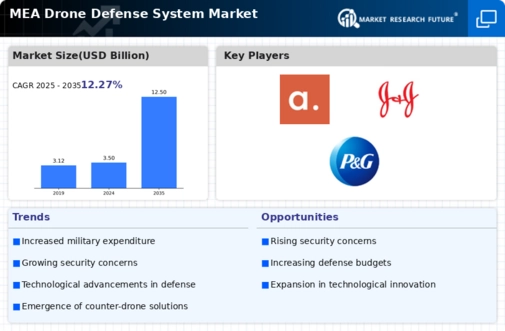
MEA Drone Defense System Market Infographic
Purchase Options

MEA Drone Defense System Market Summary

As per analysis, the (MEA) Drone Defense System Market is projected to grow from USD 0.373 Billion in 2025 to USD 0.718 Billion by 2035, exhibiting a compound annual growth rate (CAGR) of 6.81% during the forecast period (2025 - 2035).

Key Market Trends & Highlights

The MEA Drone Defense System Market is poised for substantial growth driven by technological advancements and rising security concerns.

  • The GCC region emerges as the largest market for drone defense systems, reflecting heightened military expenditure.
  • South Africa is recognized as the fastest-growing region, indicating a surge in demand for advanced defense technologies.
  • Surveillance systems dominate the market, while countermeasures are rapidly gaining traction as a vital segment.
  • Rising security concerns and government initiatives are key drivers propelling the market forward.

Market Size & Forecast

2024 Market Size 0.348 (USD Billion)
2035 Market Size 0.718 (USD Billion)
CAGR (2025 - 2035) 6.81%

Major Players

Northrop Grumman (US), Raytheon Technologies (US), Thales Group (FR), Leonardo (IT), BAE Systems (GB), Israel Aerospace Industries (IL), General Atomics (US), Saab (SE), Rafael Advanced Defense Systems (IL)

Our Impact
Enabled $4.3B Revenue Impact for Fortune 500 and Leading Multinationals
Partnering with 2000+ Global Organizations Each Year
30K+ Citations by Top-Tier Firms in the Industry

MEA Drone Defense System Market Trends

The MEA Drone Defense System Market is currently experiencing a notable evolution, driven by the increasing need for security and surveillance across various sectors. Countries within the Middle East and Africa are investing significantly in advanced technologies to counteract the rising threats posed by unauthorized drone activities. This market appears to be influenced by a combination of geopolitical tensions, urbanization, and the proliferation of drone usage for both commercial and recreational purposes. As a result, governments and private entities are prioritizing the development and deployment of sophisticated defense systems to safeguard critical infrastructure and ensure public safety. Moreover, the MEA region is characterized by a diverse landscape of regulatory frameworks and technological capabilities. This complexity may lead to varying adoption rates of drone defense systems across different countries. While some nations are rapidly advancing their defense capabilities, others may lag due to budget constraints or lack of technical expertise. The ongoing collaboration between local and international defense firms suggests a potential for innovation and knowledge transfer, which could further enhance the effectiveness of drone defense solutions in the region. As the market continues to mature, stakeholders must remain vigilant to emerging threats and adapt their strategies accordingly.

Increased Investment in Defense Technologies

Countries in the MEA region are allocating more resources towards advanced defense technologies, particularly in response to the growing threat of drone incursions. This trend indicates a shift in focus towards enhancing national security capabilities, with governments recognizing the necessity of robust drone defense systems to protect critical assets.

Regulatory Developments and Compliance

The MEA Drone Defense System Market is witnessing evolving regulatory frameworks aimed at managing drone operations and ensuring public safety. These developments may create a more structured environment for the deployment of defense systems, as governments seek to balance innovation with security concerns.

Collaboration Between Public and Private Sectors

There is a noticeable trend of collaboration between government entities and private sector firms in the MEA region. This partnership could facilitate the development of cutting-edge drone defense technologies, as both parties leverage their respective strengths to address the unique challenges posed by drone threats.

MEA Drone Defense System Market Drivers

Rising Security Concerns

The MEA Drone Defense System Market is experiencing a surge in demand due to escalating security concerns across the region. Countries in the Middle East and Africa are increasingly facing threats from unauthorized drone activities, which could potentially compromise national security. As a result, governments are prioritizing investments in advanced drone defense systems to safeguard critical infrastructure and public safety. For instance, nations like Saudi Arabia and the UAE have allocated substantial budgets for enhancing their aerial defense capabilities. This trend indicates a growing recognition of the need for robust drone defense solutions, thereby driving market growth in the MEA region.

Technological Advancements

Technological advancements play a pivotal role in shaping the MEA Drone Defense System Market. Innovations in radar systems, artificial intelligence, and machine learning are enhancing the effectiveness of drone detection and neutralization systems. The integration of these technologies allows for real-time monitoring and response to potential threats. For example, the introduction of advanced jamming systems and kinetic interceptors has significantly improved the capabilities of defense forces in the region. As these technologies continue to evolve, they are likely to attract further investments, thereby propelling the growth of the MEA drone defense market.

Growing Commercial Drone Usage

The growing commercial drone usage in the MEA region is a double-edged sword that impacts the Drone Defense System Market. While commercial drones offer numerous benefits across various sectors, they also pose security risks that necessitate effective defense mechanisms. As industries such as agriculture, logistics, and surveillance increasingly adopt drone technology, the potential for misuse or accidents rises. Consequently, governments and private entities are compelled to invest in drone defense systems to mitigate these risks. This duality of opportunity and threat is likely to stimulate demand for advanced defense solutions in the MEA market.

Increased Military Expenditure

Increased military expenditure across the MEA region significantly influences the Drone Defense System Market. Countries such as Israel and Saudi Arabia are among the top spenders on defense, with a focus on modernizing their military capabilities. The allocation of funds towards drone defense systems is seen as a strategic move to counter emerging threats. According to recent reports, military budgets in the MEA region are projected to grow, with a notable portion earmarked for advanced defense technologies. This trend suggests a sustained commitment to enhancing aerial defense capabilities, thereby driving market growth.

Government Initiatives and Policies

Government initiatives and policies are crucial drivers of the MEA Drone Defense System Market. Many governments in the region are formulating comprehensive strategies to address the challenges posed by drone threats. For instance, the UAE has established a national drone strategy that emphasizes the development of a secure airspace. Additionally, countries like Egypt and Qatar are implementing regulations to govern drone usage, which indirectly boosts the demand for defense systems. These proactive measures indicate a commitment to enhancing national security, thus fostering a conducive environment for the growth of the drone defense market.


Market Segment Insights

By Application: Surveillance (Largest) vs. Countermeasures (Fastest-Growing)

The MEA Drone Defense System Market is diversified with applications spanning Surveillance, Countermeasures, Detection, Tracking, and Neutralization. Among these, Surveillance holds the largest market share due to the increasing demand for security and monitoring solutions across various sectors. Countermeasures, on the other hand, are gaining traction as they provide essential defensive capabilities against potential threats posed by malicious drones, positioning themselves as a critical segment of the market.

Surveillance (Dominant) vs. Countermeasures (Emerging)

Surveillance applications dominate the MEA Drone Defense System Market by offering crucial capabilities for monitoring airspace and protecting sensitive areas. This segment benefits from heightened security concerns and the need for situational awareness in both civilian and military domains. Meanwhile, Countermeasures are an emerging focus, driven by escalating drone-related threats and the necessity for effective responses. This segment encompasses various technologies designed to neutralize intruding drones, making it increasingly vital to national and commercial security strategies, thus contributing to its rapid growth.

By Technology: Laser Systems (Largest) vs. Cyber Systems (Fastest-Growing)

In the MEA Drone Defense System Market, Laser Systems hold the largest market share, driven by their precision targeting capabilities and operational efficiency. They have gained significant traction among defense forces due to their ability to neutralize aerial threats with minimal collateral damage. Following closely, Cyber Systems are the fastest-growing segment, as the increasing reliance on unmanned aerial vehicles (UAVs) necessitates robust cyber capabilities to protect against hacking and unauthorized access.

Technology: Laser Systems (Dominant) vs. Cyber Systems (Emerging)

Laser Systems are deemed dominant in the MEA Drone Defense System Market, offering high accuracy and cost-effectiveness in eliminating aerial threats. Their adaptability enables forces to execute swift responses in combat scenarios, positioning them as the preferred choice for defense establishments. In contrast, Cyber Systems are emerging as vital components of drone defense, focusing on countering electronic warfare and safeguarding drone operations from cyber threats. As UAV technology advances, the demand for sophisticated cyber solutions and strategies intensifies, making Cyber Systems increasingly central to comprehensive defense strategies.

By End Use: Military (Largest) vs. Commercial (Fastest-Growing)

The MEA Drone Defense System Market exhibits a diverse distribution across various end-use segments. The military sector holds the most substantial share, driven by increasing defense budgets and the need for advanced technology in combat operations. Meanwhile, the commercial sector is rapidly gaining traction, owing to the growing adoption of drones for logistics, agriculture, and infrastructure monitoring, positioning it as a crucial player in the market landscape.

Military (Dominant) vs. Commercial (Emerging)

The military segment is characterized by its reliance on cutting-edge technology and significant investments from defense forces across the MEA region. This segment's dominance stems from the escalating security challenges faced by nations, prompting the procurement of advanced drone defense systems to counter potential threats. On the other hand, the commercial segment, though emerging, is becoming increasingly critical as enterprises leverage drone capabilities for operational efficiency and surveillance. Industries such as logistics and agriculture are driving demand, leading to innovative solutions and partnerships that further enhance the commercial landscape within the drone defense sector.

Get more detailed insights about MEA Drone Defense System Market

Regional Insights

South Africa : Strategic Partnerships and Local Innovation

With a market share of 9.5%, South Africa is witnessing a gradual increase in demand for drone defense systems, driven by local security challenges and international collaborations. The government is actively promoting defense modernization through policies that encourage local manufacturing and innovation. This has led to a growing interest in drone technology among defense contractors and startups, enhancing the overall market landscape.

Rest of MEA : Varied Market Dynamics and Growth

The Rest of MEA accounts for a market share of 7.8%, characterized by diverse demand across different countries. Key growth drivers include regional conflicts and the need for enhanced surveillance capabilities. Government initiatives are increasingly focusing on integrating drone technology into national defense strategies. However, market growth is uneven, influenced by varying levels of investment and regulatory support across countries.

Key Players and Competitive Insights

The Drone Defense System Market is currently characterized by a dynamic competitive landscape, driven by increasing security concerns and the proliferation of unmanned aerial vehicles (UAVs). Key players such as Northrop Grumman (US), Raytheon Technologies (US), and Israel Aerospace Industries (IL) are actively shaping the market through strategic innovations and partnerships. Northrop Grumman (US) focuses on enhancing its technological capabilities, particularly in AI and machine learning, to improve threat detection and response times. Meanwhile, Raytheon Technologies (US) emphasizes regional expansion and collaboration with local defense contractors to strengthen its foothold in the Middle East and Africa. Israel Aerospace Industries (IL) is leveraging its expertise in drone technology to develop integrated defense solutions, thereby enhancing its competitive positioning in the market.

The business tactics employed by these companies include localizing manufacturing and optimizing supply chains to meet regional demands effectively. The market structure appears moderately fragmented, with several players vying for market share. However, the collective influence of major companies is significant, as they drive innovation and set industry standards, thereby shaping the competitive environment.

In December 2025, Northrop Grumman (US) announced a partnership with a leading Middle Eastern defense firm to co-develop advanced drone defense systems tailored for urban environments. This strategic move is likely to enhance Northrop Grumman's market presence and enable it to address specific regional security challenges more effectively. The collaboration underscores the importance of localized solutions in a market that increasingly demands adaptability to unique operational contexts.

In November 2025, Raytheon Technologies (US) unveiled a new drone detection and neutralization system designed to counter emerging threats from commercial UAVs. This innovation is expected to bolster Raytheon's product portfolio and position the company as a leader in counter-drone technology. The introduction of this system reflects a broader trend towards integrating advanced technologies to enhance defense capabilities in response to evolving threats.

In October 2025, Israel Aerospace Industries (IL) launched a new suite of drone defense solutions aimed at protecting critical infrastructure. This initiative is indicative of the company's commitment to addressing the growing need for robust security measures in the region. By focusing on infrastructure protection, Israel Aerospace Industries is likely to capture a significant share of the market, as governments prioritize safeguarding vital assets against drone incursions.

As of January 2026, current competitive trends in the Drone Defense System Market include a pronounced shift towards digitalization, sustainability, and the integration of AI technologies. Strategic alliances are increasingly shaping the landscape, as companies recognize the value of collaboration in enhancing their technological capabilities. Looking ahead, competitive differentiation is expected to evolve, with a greater emphasis on innovation and technology rather than price-based competition. The reliability of supply chains will also play a crucial role in determining market success, as companies strive to deliver cutting-edge solutions that meet the demands of an ever-changing security environment.

Key Companies in the MEA Drone Defense System Market include

Industry Developments

In recent months, the MEA Drone Defense System Market has been significantly influenced by various developments. Notably, BAE Systems and Israel Aerospace Industries have expanded their collaborations to enhance counter-drone technologies in the region. In July 2023, Northrop Grumman announced new contracts aimed at integrating advanced drone capabilities within MEA defense frameworks, showcasing the increasing demand for sophisticated aerial defense solutions. Growth in market valuation has been bolstered by rising geopolitical tensions, prompting countries within the Middle East and Africa to invest heavily in drone defense systems, with estimates indicating a market growth of around 15% by 2025.

During the past two years, Lockheed Martin secured contracts in UAE for drone interceptors, while Raytheon Technologies unveiled new radar systems tailored for drone detection. Despite the competitive landscape, mergers and acquisitions remain limited, with notable exceptions. In August 2023, Thales Group and Airbus announced a partnership focusing on unmanned aerial vehicle (UAV) integration in training operations. This dynamic environment highlights ongoing advancements and investments geared towards enhancing the security landscape against drone threats throughout the MEA region.


Future Outlook

MEA Drone Defense System Market Future Outlook

The MEA Drone Defense System Market is projected to grow at a 6.81% CAGR from 2025 to 2035, driven by increasing security concerns and technological advancements.

New opportunities lie in:

  • Development of integrated AI-driven threat detection systems.
  • Expansion of mobile drone defense units for rapid deployment.
  • Partnerships with local governments for customized defense solutions.

By 2035, the market is expected to be robust, reflecting substantial growth and innovation.

Market Segmentation

MEA Drone Defense System Market End Use Outlook

  • Military
  • Commercial
  • Government
  • Critical Infrastructure
  • Public Safety

MEA Drone Defense System Market Technology Outlook

  • Laser Systems
  • Electromagnetic Systems
  • Kinetic Systems
  • Cyber Systems
  • Acoustic Systems

MEA Drone Defense System Market Application Outlook

  • Surveillance
  • Countermeasures
  • Detection
  • Tracking
  • Neutralization

Report Scope

MARKET SIZE 20240.348(USD Billion)
MARKET SIZE 20250.373(USD Billion)
MARKET SIZE 20350.718(USD Billion)
COMPOUND ANNUAL GROWTH RATE (CAGR)6.81% (2024 - 2035)
REPORT COVERAGERevenue Forecast, Competitive Landscape, Growth Factors, and Trends
BASE YEAR2024
Market Forecast Period2025 - 2035
Historical Data2019 - 2024
Market Forecast UnitsUSD Billion
Key Companies ProfiledNorthrop Grumman (US), Raytheon Technologies (US), Thales Group (FR), Leonardo (IT), BAE Systems (GB), Israel Aerospace Industries (IL), General Atomics (US), Saab (SE), Rafael Advanced Defense Systems (IL)
Segments CoveredApplication, Technology, End Use
Key Market OpportunitiesGrowing demand for advanced surveillance and counter-drone technologies in the MEA Drone Defense System Market.
Key Market DynamicsRising geopolitical tensions in the Middle East and Africa drive demand for advanced drone defense systems.
Countries CoveredGCC Countries, South Africa, Rest of MEA
Leave a Comment

FAQs

What is the projected market valuation of the MEA Drone Defense System Market by 2035?

The projected market valuation for the MEA Drone Defense System Market is expected to reach 0.718 USD Billion by 2035.

What was the market valuation of the MEA Drone Defense System Market in 2024?

The overall market valuation was 0.348 USD Billion in 2024.

What is the expected CAGR for the MEA Drone Defense System Market during the forecast period 2025 - 2035?

The expected CAGR for the MEA Drone Defense System Market during the forecast period 2025 - 2035 is 6.81%.

Which companies are considered key players in the MEA Drone Defense System Market?

Key players in the market include Northrop Grumman, Raytheon Technologies, Thales Group, Leonardo, BAE Systems, Israel Aerospace Industries, General Atomics, Saab, and Rafael Advanced Defense Systems.

What are the main applications of the MEA Drone Defense System Market?

The main applications include Surveillance, Countermeasures, Detection, Tracking, and Neutralization.

How much is the Surveillance segment projected to grow by 2035?

The Surveillance segment is projected to grow from 0.087 USD Billion in 2024 to 0.175 USD Billion by 2035.

What technologies are utilized in the MEA Drone Defense System Market?

Technologies utilized include Laser Systems, Electromagnetic Systems, Kinetic Systems, Cyber Systems, and Acoustic Systems.

What is the projected growth for the Kinetic Systems segment by 2035?

The Kinetic Systems segment is expected to grow from 0.1 USD Billion in 2024 to 0.2 USD Billion by 2035.

Which end-use sectors are driving the MEA Drone Defense System Market?

The end-use sectors driving the market include Military, Commercial, Government, Critical Infrastructure, and Public Safety.

What is the projected valuation for the Military segment by 2035?

The Military segment is projected to grow from 0.12 USD Billion in 2024 to 0.25 USD Billion by 2035.

Download Free Sample

Kindly complete the form below to receive a free sample of this Report

Compare Licence

×
Features License Type
Single User Multiuser License Enterprise User
Price $4,950 $5,950 $7,250
Maximum User Access Limit 1 User Upto 10 Users Unrestricted Access Throughout the Organization
Free Customization
Direct Access to Analyst
Deliverable Format
Platform Access
Discount on Next Purchase 10% 15% 15%
Printable Versions