×
Request Free Sample ×

Kindly complete the form below to receive a free sample of this Report

* Please use a valid business email

Leading companies partner with us for data-driven Insights

clients tt-cursor
Hero Background

Malaysia Battlefield Management System Market

ID: MRFR/AD/56326-HCR
200 Pages
Garvit Vyas
February 2026

Malaysia Battlefield Management System Market Size, Share, Industry Trend & Analysis Research Report: By Type (Commander Systems, Dismounted Soldier Systems, Communication Network Systems, Other Systems) andBy Application (Army, Air Force, Navy)- Forecast to 2035

Share:
Download PDF ×

We do not share your information with anyone. However, we may send you emails based on your report interest from time to time. You may contact us at any time to opt-out.

Malaysia Battlefield Management System Market Infographic
Purchase Options

Malaysia Battlefield Management System Market Summary

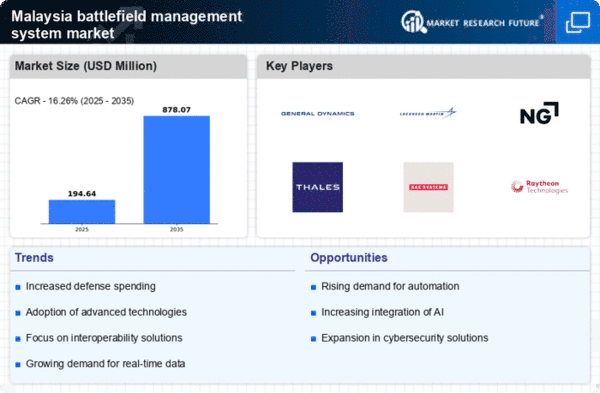
As per Market Research Future analysis, the Malaysia battlefield management system market size was estimated at 167.42 USD Million in 2024. The Malaysia battlefield management-system market is projected to grow from 194.64 USD Million in 2025 to 878.07 USD Million by 2035, exhibiting a compound annual growth rate (CAGR) of 16.2% during the forecast period 2025 - 2035

Key Market Trends & Highlights

The Malaysia battlefield management system market is poised for growth driven by technological advancements and rising defense spending.

  • Technological advancements are reshaping the battlefield management-system landscape, enhancing operational efficiency.
  • The largest segment in the market is the command and control systems, while the fastest-growing segment is the training and simulation systems.
  • Increased defense spending reflects a commitment to modernizing military capabilities, particularly in the Asia-Pacific region.
  • Rising security concerns and the integration of advanced technologies are key drivers propelling market expansion.

Market Size & Forecast

2024 Market Size 167.42 (USD Million)
2035 Market Size 878.07 (USD Million)
CAGR (2025 - 2035) 16.26%

Major Players

General Dynamics (US), Lockheed Martin (US), Northrop Grumman (US), Thales Group (FR), BAE Systems (GB), Raytheon Technologies (US), Leonardo (IT), Elbit Systems (IL)

Our Impact
Enabled $4.3B Revenue Impact for Fortune 500 and Leading Multinationals
Partnering with 2000+ Global Organizations Each Year
30K+ Citations by Top-Tier Firms in the Industry

Malaysia Battlefield Management System Market Trends

The battlefield management system market is currently experiencing a notable evolution, driven by advancements in technology and the increasing need for efficient military operations. In Malaysia, the focus on enhancing defense capabilities has led to a growing interest in integrated systems that facilitate real-time data sharing and situational awareness. The government appears committed to modernizing its armed forces, which may result in increased investments in sophisticated battlefield management solutions. This trend is likely to be influenced by regional security dynamics and the necessity for improved operational readiness. Moreover, the integration of artificial intelligence and machine learning into battlefield management systems is becoming more prevalent. These technologies seem to offer enhanced decision-making capabilities, allowing military personnel to respond swiftly to changing scenarios. As Malaysia continues to prioritize defense modernization, the battlefield management-system market is expected to expand, potentially attracting both domestic and international players. The emphasis on interoperability among various defense platforms may also shape the future landscape of this market, fostering collaboration and innovation in military operations.

Technological Advancements

The battlefield management-system market is witnessing rapid technological advancements, particularly in the areas of artificial intelligence and data analytics. These innovations are likely to enhance decision-making processes and improve operational efficiency for military forces.

Increased Defense Spending

There appears to be a trend of increased defense spending in Malaysia, which may lead to greater investments in advanced battlefield management systems. This focus on modernization is expected to drive demand for integrated solutions that enhance situational awareness.

Focus on Interoperability

The emphasis on interoperability among various military platforms is becoming increasingly important. This trend suggests that battlefield management systems will need to be compatible with existing technologies, facilitating seamless communication and coordination during operations.

Malaysia Battlefield Management System Market Drivers

Rising Security Concerns

The battlefield management system market in Malaysia is experiencing growth due to escalating security concerns. The government is increasingly focused on enhancing national defense capabilities in response to regional tensions. This has led to a rise in defense budgets, with allocations for advanced technologies. In 2025, Malaysia's defense expenditure is projected to reach approximately $4.5 billion, reflecting a 5% increase from the previous year. This financial commitment indicates a strong intent to invest in sophisticated battlefield management systems that can improve situational awareness and operational efficiency. As threats evolve, the demand for integrated systems that provide real-time data and analytics is likely to surge, driving the market forward.

Focus on Cybersecurity Measures

The battlefield management-system market is increasingly influenced by the need for robust cybersecurity measures. As military operations become more reliant on digital systems, the threat of cyberattacks poses significant risks. In Malaysia, the government has recognized this challenge, allocating approximately $200 million for cybersecurity enhancements in defense systems. This investment is expected to bolster the resilience of battlefield management systems against potential cyber threats. The emphasis on cybersecurity is likely to drive innovation within the market, as manufacturers develop solutions that prioritize data protection and system integrity. Consequently, the battlefield management-system market may witness a shift towards more secure and resilient technologies.

Collaborative Defense Initiatives

Collaborative defense initiatives among ASEAN nations are shaping the battlefield management-system market in Malaysia. Joint exercises and information-sharing agreements are becoming more prevalent, fostering interoperability among regional forces. This collaboration is expected to drive demand for systems that can seamlessly integrate with those of neighboring countries. As Malaysia participates in these initiatives, the need for compatible battlefield management systems becomes critical. The market is projected to grow by 15% annually as defense forces seek solutions that facilitate joint operations and enhance collective security. This trend indicates a shift towards systems that not only serve national interests but also support regional stability through enhanced cooperation.

Integration of Advanced Technologies

The battlefield management-system market is significantly influenced by the integration of advanced technologies such as artificial intelligence (AI) and machine learning (ML). These technologies enhance decision-making processes and operational effectiveness. In Malaysia, the adoption of AI-driven systems is expected to increase by 30% over the next five years, as military forces seek to leverage data analytics for strategic advantages. The incorporation of these technologies into battlefield management systems allows for improved data processing and predictive capabilities, which are essential for modern warfare. Consequently, the market is likely to see a shift towards systems that not only manage battlefield information but also provide actionable insights, thereby enhancing overall military readiness.

Growing Demand for Training and Simulation

The battlefield management-system market in Malaysia is witnessing a growing demand for training and simulation solutions. As military forces seek to enhance operational readiness, the need for realistic training environments becomes paramount. Investments in simulation technologies are projected to increase by 20% over the next few years, as they provide cost-effective training alternatives. These systems allow personnel to practice decision-making and tactical maneuvers in a controlled setting, thereby improving overall effectiveness. The integration of battlefield management systems with training solutions is likely to create a comprehensive approach to military preparedness, further driving market growth. This trend indicates a recognition of the importance of continuous training in maintaining a capable defense force.


Market Segment Insights

By Type: Commander Systems (Largest) vs. Dismounted Soldier Systems (Fastest-Growing)

The Malaysia battlefield management system market reflects a diverse distribution among various segment values. Commander Systems hold the largest share, driven by increasing demand for command and control capabilities on the field. Meanwhile, Dismounted Soldier Systems are beginning to carve out a significant portion of the market, appealing to modernization efforts and enhancing soldier capabilities in challenging environments. Growth trends indicate a robust expansion for these systems, particularly in the realm of Dismounted Soldier Systems, which are becoming critical for enhancing the operational effectiveness of individual soldiers. The integration of advanced technologies and battlefield communications is driving this segment's emergence. Additionally, investments in research, development, and integration of innovative systems are propelling the market's overall growth, emphasizing the need for operational superiority.

Commander Systems (Dominant) vs. Dismounted Soldier Systems (Emerging)

Commander Systems represent the dominant force in the market, characterized by their capability to streamline operations, enhance decision-making, and coordinate various military assets effectively. Their advanced features, including real-time data integration and strategic planning tools, cement their crucial role in battlefield management. On the other hand, Dismounted Soldier Systems are an emerging segment focused on individual soldier enhancements, incorporating wearables and mobile technology to improve situational awareness and communication on the ground. This segment is quickly gaining traction due to increased military emphasis on soldier-centric approaches, driving innovation in personal gear and system integration.

By Application: Army (Largest) vs. Air Force (Fastest-Growing)

The Malaysia battlefield management system market is primarily segmented into three key applications: Army, Air Force, and Navy. Among these, the Army leads with the largest market share, reflecting the nation’s ongoing commitment to enhancing ground operations through advanced management systems. In contrast, the Air Force is emerging rapidly, capturing a growing share of the market as investment in aerial capabilities to support intelligence and combat operations increases. Growth trends in the segment reveal a robust trajectory for both the Army and Air Force applications. The continued emphasis on modernizing military operations is driven by strategic initiatives focusing on technological innovation. The increasing need for integrated systems that enhance situational awareness and operational efficiency in combat scenarios is further catalyzing investments in battlefield management solutions, particularly within the Air Force sector.

Army: Dominant vs. Air Force: Emerging

The Army segment of the Malaysia battlefield management-system market is characterized by its extensive adoption of ground force management technologies. This dominance is attributed to significant investments in defense capabilities and the integration of advanced communication and information systems that support various military operations. Conversely, the Air Force segment, while currently smaller, is rapidly evolving and is projected to gain prominence due to the increasing reliance on aerial surveillance and combat capabilities. The demand for real-time data and enhanced coordination in air operations positions the Air Force as an emerging leader, driving innovation and competitiveness in military technology.

Get more detailed insights about Malaysia Battlefield Management System Market

Key Players and Competitive Insights

The battlefield management-system market is characterized by a dynamic competitive landscape, driven by technological advancements and increasing defense budgets across various nations. Key players such as General Dynamics (US), Lockheed Martin (US), and Thales Group (FR) are strategically positioned to leverage innovation and partnerships to enhance their offerings. General Dynamics (US) focuses on integrating advanced data analytics and AI into its systems, while Lockheed Martin (US) emphasizes regional expansion and collaboration with local defense contractors. Thales Group (FR) is actively pursuing digital transformation initiatives, which collectively shape a competitive environment that is increasingly reliant on cutting-edge technology and strategic alliances.In terms of business tactics, companies are localizing manufacturing to reduce costs and enhance supply chain efficiency. The market appears moderately fragmented, with several key players exerting influence through strategic partnerships and technological innovations. This structure allows for a diverse range of solutions, catering to the specific needs of various military operations, while also fostering competition among established and emerging players.

In October Lockheed Martin (US) announced a partnership with a Malaysian defense firm to co-develop a new battlefield management system tailored for regional requirements. This collaboration is significant as it not only strengthens Lockheed Martin's foothold in the Malaysian market but also enhances its ability to deliver customized solutions that meet local operational demands. Such partnerships are likely to become more prevalent as companies seek to align their offerings with the unique needs of different regions.

In September Thales Group (FR) unveiled a new suite of integrated battlefield management solutions designed to enhance situational awareness and decision-making capabilities for military commanders. This launch underscores Thales' commitment to innovation and its strategic focus on digital transformation, which is essential for maintaining a competitive edge in a rapidly evolving market. The introduction of these advanced systems may significantly influence operational effectiveness in the field.

In August General Dynamics (US) secured a contract worth $150 million to supply advanced battlefield management systems to the Malaysian Armed Forces. This contract not only highlights the company's robust capabilities but also reflects the growing demand for sophisticated military solutions in the region. The financial implications of such contracts are substantial, potentially leading to increased investment in R&D and further advancements in technology.

As of November current trends in the battlefield management-system market include a strong emphasis on digitalization, AI integration, and sustainability. Strategic alliances are increasingly shaping the competitive landscape, as companies recognize the need for collaboration to drive innovation. Moving forward, competitive differentiation is likely to evolve from traditional price-based competition to a focus on technological advancements, supply chain reliability, and the ability to deliver tailored solutions that meet the specific needs of military operations.

Key Companies in the Malaysia Battlefield Management System Market include

Industry Developments

In terms of mergers and acquisitions, there have been no recent publicly confirmed transactions specifically involving companies within this market since the last reported activity in June 2023. Nevertheless, market valuation is showing an upward trajectory, driven by the Malaysian government’s commitment to bolstering national security through technology investments. This is evidenced by the allocation of a substantial defense budget aimed at fostering the integration of advanced systems provided by Elbit Systems, Rafael Advanced Defense Systems, and Raytheon Technologies, among others.

Over the past few years, Malaysia has actively sought to improve its defense infrastructure, with significant contracts awarded for logistics and battlefield management systems in late 2022. As the regional security landscape evolves, the demand for innovative and efficient battlefield management solutions continues to grow, shaping a dynamic and competitive market environment in Malaysia.

Future Outlook

Malaysia Battlefield Management System Market Future Outlook

The Battlefield Management System Market in Malaysia is projected to grow at a 16.26% CAGR from 2025 to 2035, driven by technological advancements and increasing defense budgets.

New opportunities lie in:

  • Integration of AI-driven analytics for real-time decision-making
  • Development of mobile battlefield management applications
  • Partnerships with local defense contractors for customized solutions

By 2035, the market is expected to achieve substantial growth and innovation.

Market Segmentation

Malaysia Battlefield Management System Market Type Outlook

  • Commander Systems
  • Dismounted Soldier Systems
  • Communication Network Systems
  • Other Systems

Malaysia Battlefield Management System Market Application Outlook

  • Army
  • Air Force
  • Navy

Report Scope

MARKET SIZE 2024 167.42(USD Million)
MARKET SIZE 2025 194.64(USD Million)
MARKET SIZE 2035 878.07(USD Million)
COMPOUND ANNUAL GROWTH RATE (CAGR) 16.26% (2025 - 2035)
REPORT COVERAGE Revenue Forecast, Competitive Landscape, Growth Factors, and Trends
BASE YEAR 2024
Market Forecast Period 2025 - 2035
Historical Data 2019 - 2024
Market Forecast Units USD Million
Key Companies Profiled General Dynamics (US), Lockheed Martin (US), Northrop Grumman (US), Thales Group (FR), BAE Systems (GB), Raytheon Technologies (US), Leonardo (IT), Elbit Systems (IL)
Segments Covered Type, Application
Key Market Opportunities Integration of artificial intelligence and machine learning enhances decision-making in the battlefield management-system market.
Key Market Dynamics Technological advancements drive competitive dynamics in the battlefield management-system market, enhancing operational efficiency and decision-making.
Countries Covered Malaysia
Leave a Comment

FAQs

What is the expected market size of the Malaysia Battlefield Management System Market in 2024?

The expected market size of the Malaysia Battlefield Management System Market in 2024 is valued at 99.79 USD Million.

What is the projected market value by 2035 for the Malaysia Battlefield Management System Market?

By 2035, the projected market value for the Malaysia Battlefield Management System Market is expected to reach 329.43 USD Million.

What is the anticipated compound annual growth rate (CAGR) for the Malaysia Battlefield Management System Market from 2025 to 2035?

The anticipated CAGR for the Malaysia Battlefield Management System Market from 2025 to 2035 is 11.468%.

Which type segment is expected to have the largest market size in 2035 within the Malaysia Battlefield Management System Market?

The Commander Systems segment is expected to have the largest market size, valued at 85.37 USD Million in 2035.

What is the market size for Communication Network Systems in 2024 within this market?

The market size for Communication Network Systems in 2024 is valued at 30.0 USD Million.

Who are the key players operating in the Malaysia Battlefield Management System Market?

Key players in the Malaysia Battlefield Management System Market include Lockheed Martin, Thales Group, and General Dynamics, among others.

What is the expected market size for Dismounted Soldier Systems by 2035?

The expected market size for Dismounted Soldier Systems by 2035 is projected to be 67.62 USD Million.

How has the overall competitive landscape evolved in the Malaysia Battlefield Management System Market?

The competitive landscape has evolved with major players intensifying their focus on innovative technologies and strategic partnerships.

What are potential growth drivers for the Malaysia Battlefield Management System Market?

Potential growth drivers include increasing defense budgets and the rising demand for advanced battlefield technologies.

What challenges are faced by the Malaysia Battlefield Management System Market?

Challenges include budget constraints and the need for continuous technological advancements to meet defense requirements.

Download Free Sample

Kindly complete the form below to receive a free sample of this Report

Compare Licence

×
Features License Type
Single User Multiuser License Enterprise User
Price $4,950 $5,950 $7,250
Maximum User Access Limit 1 User Upto 10 Users Unrestricted Access Throughout the Organization
Free Customization
Direct Access to Analyst
Deliverable Format
Platform Access
Discount on Next Purchase 10% 15% 15%
Printable Versions