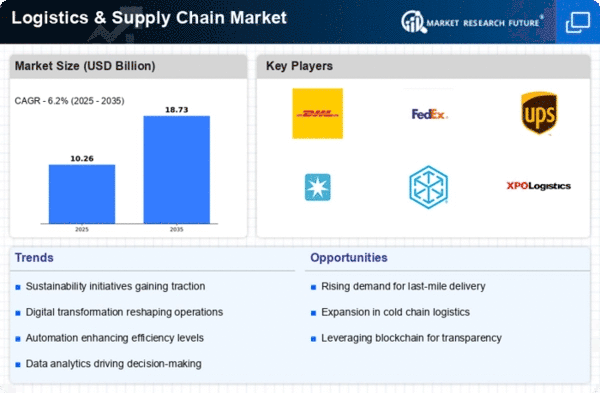
North America : Logistics Powerhouse
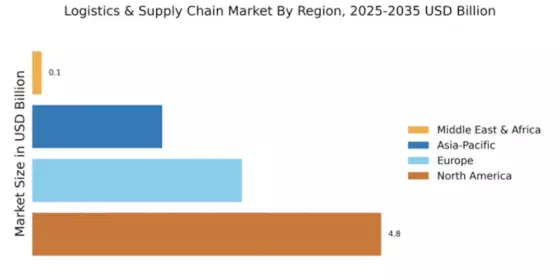
North America continues to dominate the Logistics & Supply Chain Market, holding a significant market share of 4.83 in 2024. Key growth drivers include advancements in technology, increased e-commerce demand, and a robust regulatory framework that supports infrastructure development. The region's strategic location and extensive transportation networks further enhance its logistics capabilities, making it a critical hub for global trade.
The competitive landscape is characterized by major players such as FedEx, UPS, and DHL, which are investing heavily in technology and sustainability initiatives. The U.S. leads the market, followed by Canada and Mexico, with a focus on improving supply chain efficiency. The presence of these key players ensures a dynamic market environment, fostering innovation and responsiveness to consumer needs.
Europe : Diverse and Competitive Market
Europe's Logistics & Supply Chain Market is valued at 2.9, driven by increasing cross-border trade and regulatory support for digitalization. The European Union's initiatives to enhance transport infrastructure and sustainability are pivotal in shaping market dynamics. The region is witnessing a shift towards green logistics, with regulations promoting eco-friendly practices, which are expected to further boost market growth.
Leading countries include Germany, France, and the UK, where major players like DHL and DB Schenker are expanding their operations. The competitive landscape is marked by a mix of established firms and emerging startups, all vying for market share. The focus on innovation and customer-centric solutions is reshaping the logistics landscape, making Europe a key player in the global supply chain.
Asia-Pacific : Emerging Market Potential
The Asia-Pacific region, with a market size of 1.8, is experiencing rapid growth in the Logistics & Supply Chain sector, driven by urbanization, rising consumer demand, and advancements in technology. Countries like China and India are at the forefront, with significant investments in infrastructure and logistics capabilities. Regulatory support for trade facilitation is also enhancing market dynamics, making the region a focal point for global supply chains.
China leads the market, followed by Japan and India, with key players such as Nippon Express and Kuehne + Nagel expanding their presence. The competitive landscape is evolving, with a mix of local and international firms striving to capture market share. The emphasis on digital transformation and efficiency is reshaping logistics operations, positioning Asia-Pacific as a vital player in the global market.
Middle East and Africa : Emerging Logistics Hub
The Middle East and Africa region, with a market size of 0.13, presents emerging opportunities in the Logistics & Supply Chain sector. Key growth drivers include increasing trade activities, investments in infrastructure, and a growing focus on e-commerce. Regulatory frameworks are evolving to support logistics development, enhancing the region's attractiveness for global players. The strategic location of the Middle East as a trade corridor further boosts its logistics potential.
Leading countries include the UAE and South Africa, where companies are investing in logistics capabilities to meet rising demand. The competitive landscape is characterized by both local and international players, with a focus on innovation and service quality. As the region continues to develop, it is poised to become a significant player in The Logistics & Supply Chain.