×
Request Free Sample ×

Kindly complete the form below to receive a free sample of this Report

* Please use a valid business email

Leading companies partner with us for data-driven Insights

clients tt-cursor
Hero Background
English
Chinese
French
Japanese
Korean
German
Spanish

Liquid Soap Market Share

ID: MRFR/CG/7934-HCR
128 Pages
Pradeep Nandi
February 2026

Liquid Soap Market Size, Share, Industry Trend & Analysis Research Report Information By Product Type (Bath & Body Soaps, Dish Wash Soaps, Laundry Soaps, and Others (Surface Cleaners and Car Wash Soaps)), By Application (Household and Commercial), By Distribution Channel (Supermarkets/Hypermarkets, Convenience Stores, Online Sales Channel, and Others (Pharmacies and Department Stores)) And By Region (North America, Europe, Asia-Pacific, And Rest Of The World) – Forecast Till 2035

Share:
Download PDF ×

We do not share your information with anyone. However, we may send you emails based on your report interest from time to time. You may contact us at any time to opt-out.

Liquid Soap Market Infographic
Purchase Options

Market Share

Liquid Soap Market Share Analysis

The competitive environment in liquid soap is cutthroat, making it almost an arms race where companies employ strategic positioning tactics to carve out a niche and take a sizeable share of the market. The approaches of companies in this hothouse environment are focused around product innovation, where they repeatedly introduce new formulations and different types to keep up with consumers 'changing tastes. It also involves the development of liquid soaps in natural and organic formulations, antibacterial formulations and products containment skincare benefits. Thus, companies compete on the cutting edge of innovation, with the intention of becoming out in front as suppliers of brand name and shaded liquid soaps to suit the different preferences or hygienic requirements of consumers. Brand differentiation is especially vital in the battle for market share in the separate frozen soup industry. In the commercial world, firms concentrate on cultivating robust brand trademarks synonymous with trustworthiness, reliability, and cleanliness. Good branding recipe We all enjoy good packaging, especially when accompanied by a catchy logo and attention-grabbing ad campaigns. All these letters L help forge consumer brand loyalty. In a chock-full market, a logo makes the difference between two similar products; a good one not only promotes the company but is a psychological factor in the consumer's selection of the product. Adding strategic alliances and cooperative arrangements are elements of the implementation of market share positioning. Customization and individualization strategies are ways of meeting consumers 'different needs and preferences, which helps position the market share. Catering to a variety of preferences with different scents, formulations, and packages to choose from, companies have a wider market in consumer tastes. Ability to personalize, such as offering a variety of fragrances or letting consumers design their own packaging, values the consumer experience and offers him a reason to be loyal to the product. A flexible design that can meet individual preferences therefore puts companies in a good position in a market where personalization is becoming more in favor. The market share positioning strategies revealed that eco-friendly initiatives and sustainable practices were becoming popular. Due to the increasing awareness of consumers, more companies switch to eco-conscious packaging to even the point of switching to sustainable sourcing in the hope of making a profit and increasing customer interaction. Brands of liquid soap emphasizing recyclable materials meant less thrown away plastic, while environmentally friendly manufacturing processes placed their own spirit of environmentalism in the position of a social choice. This made for a growing choice for environmentally aware consumers. In the age of the Internet, online sales and e-commerce optimization are integral steps in market share strategies.
Author
Pradeep Nandi
Senior Research Analyst

I have a bachelor's degree in mechanical engineering and an MBA. I have more than two years of expertise in the retail, food, and beverage, chemical, and material industries, and hence have developed a sound cross-domain expertise. A firm believer in lifelong learning and sharing of knowledge. Having a proclivity for hatching ideas and trying to absorb as much information as possible in a short amount of time. Introducing corporates to the data and insight, which enables them to move from probability to possibility, has been my key areas of interest. 

Leave a Comment

FAQs

What is the projected market valuation of The Global Liquid Soap by 2035?

<p>The Global Liquid Soap is projected to reach a valuation of 51.0 USD Billion by 2035.</p>

What was the market valuation of The Global Liquid Soap in 2024?

<p>In 2024, The Global Liquid Soap was valued at 23.49 USD Billion.</p>

What is the expected CAGR for The Global Liquid Soap during the forecast period 2025 - 2035?

<p>The expected CAGR for The Global Liquid Soap during the forecast period 2025 - 2035 is 7.3%.</p>

Which segment of liquid soap had the highest valuation in 2024?

<p>In 2024, the Laundry Soaps segment had the highest valuation at 7.0 USD Billion.</p>

What are the key distribution channels for liquid soap?

<p>Key distribution channels for liquid soap include Supermarkets/Hypermarkets, Convenience Stores, and Online Sales Channels.</p>

Which company is a leading player in The Global Liquid Soap?

Procter &amp; Gamble is one of the leading players in The Global Liquid Soap.

What was the valuation of the Dish Wash Soaps segment in 2024?

The Dish Wash Soaps segment was valued at 6.0 USD Billion in 2024.

How does the Household application segment compare to the Commercial segment in terms of market size?

The Household application segment was valued at 14.09 USD Billion, significantly higher than the Commercial segment, which was valued at 9.4 USD Billion in 2024.

What is the projected growth for the Others segment, which includes surface cleaners and car wash soaps, by 2035?

The Others segment is projected to grow from 5.49 USD Billion in 2024 to 12.0 USD Billion by 2035.

What is the expected market trend for Online Sales Channels in The Global Liquid Soap?

The Online Sales Channel is expected to grow from 6.0 USD Billion in 2024 to 15.0 USD Billion by 2035.

Market Summary

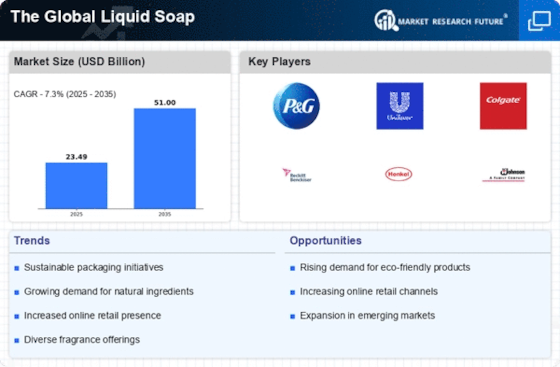
As per Market Research Future analysis, The Global Liquid Soap Market Size was estimated at 23.49 USD Billion in 2024. The liquid soap industry is projected to grow from 25.21 USD Billion in 2025 to 51.0 USD Billion by 2035, exhibiting a compound annual growth rate (CAGR) of 7.3% during the forecast period 2025 - 2035

Key Market Trends & Highlights

The Global Liquid Soap Market is experiencing a dynamic shift towards sustainability and health-conscious products.

  • North America remains the largest market for liquid soap, driven by increasing consumer awareness of hygiene and sustainability. The Asia-Pacific region is emerging as the fastest-growing market, fueled by rising disposable incomes and urbanization. Bath and body soaps dominate the market, while dish wash soaps are witnessing the fastest growth due to changing consumer preferences. Key market drivers include a strong focus on sustainability and health and wellness trends, which are shaping product development and consumer choices.

Market Size & Forecast

2024 Market Size 23.49 (USD Billion)
2035 Market Size 51.0 (USD Billion)
CAGR (2025 - 2035) 7.3%
Largest Regional Market Share in 2024 North America

Major Players

Procter &amp; Gamble (US), <a href="https://www.unilever.com/">Unilever (GB)</a>, Colgate-Palmolive (US), <a href="https://www.reckitt.com/">Reckitt Benckiser (GB)</a>, Henkel (DE), SC Johnson (US), Caldrea (US), Ecover (BE), Seventh Generation (US), Method Products (US)

Market Trends

The Global Liquid Soap Market is currently experiencing a dynamic evolution, driven by a confluence of consumer preferences and environmental considerations. As awareness regarding hygiene and cleanliness continues to rise, the demand for liquid soap products has surged. This market is characterized by a diverse range of offerings, including antibacterial, moisturizing, and organic formulations, catering to various consumer needs. Additionally, the shift towards sustainable packaging and eco-friendly ingredients is becoming increasingly prominent, as consumers seek products that align with their values. Companies are responding by innovating their product lines and adopting greener practices, which may enhance their competitive edge in this sector.

Moreover, the global liquid soap market appears to be influenced by changing lifestyles and the growing trend of personal care. With an increasing number of consumers prioritizing health and wellness, liquid soap is often perceived as a more effective and convenient option compared to traditional bar soaps. This trend is further supported by the rise of e-commerce platforms, which facilitate easier access to a wide array of products within the liquid hand soap market. As the market continues to expand, brands are likely to focus on enhancing user experience and product efficacy, supported by innovative liquid soap marketing strategy approaches that resonate with a broader audience.

Sustainability Focus

The emphasis on sustainability is becoming a defining characteristic of The Global Liquid Soap Market. Consumers are increasingly inclined towards products that utilize eco-friendly ingredients and sustainable packaging. This trend suggests that companies may need to adapt their practices to meet the growing demand for environmentally responsible options.

Health and Wellness Trends

The rising awareness of health and wellness is significantly impacting consumer choices within The Global Liquid Soap Market. Liquid soap is often viewed as a more hygienic alternative to traditional soap, which may drive its popularity. This trend indicates a potential shift in marketing strategies to highlight health benefits.

E-commerce Growth

The expansion of e-commerce platforms is reshaping the purchasing landscape for liquid soap. Consumers are increasingly turning to online shopping for convenience and variety. This trend suggests that brands may need to enhance their digital presence and optimize online sales strategies to capture this growing market segment.

Liquid Soap Market Market Drivers

E-commerce Growth

The rapid expansion of e-commerce platforms is significantly influencing The Global Liquid Soap Industry. As consumers increasingly turn to online shopping for convenience, the availability of liquid soaps through various digital channels is on the rise. Recent statistics reveal that online sales of personal care products, including liquid soaps, have surged by over 30% in the past year. This shift not only provides consumers with a wider selection but also allows brands to reach a global audience without the constraints of traditional retail. The ease of access to product information and customer reviews further enhances consumer confidence in purchasing liquid soaps online. As e-commerce continues to evolve, it is expected to play a pivotal role in shaping the distribution strategies within The Global Liquid Soap Industry.

Sustainability Focus

The increasing emphasis on sustainability is a pivotal driver for The Global Liquid Soap Industry. Consumers are becoming more environmentally conscious, leading to a surge in demand for eco-friendly products. This trend is reflected in the growing popularity of liquid soaps made from natural ingredients and biodegradable packaging. According to recent data, the market for sustainable personal care products is projected to grow at a compound annual growth rate of 8.5% over the next five years. Companies are responding by reformulating their products to meet these expectations, which not only enhances brand loyalty but also attracts a broader customer base. As a result, The Global Liquid Soap Industry is likely to witness a significant shift towards sustainable practices, influencing product development and marketing strategies.

Emerging Market Dynamics

The soap market share in India is being reshaped by evolving consumer preferences and demographic shifts. With over 700 companies operating in India's soap industry and market capitalization reaching $17 billion, the country has become a crucial battleground for global and domestic brands. The soap market share in India is particularly influenced by the expanding middle class, urbanization trends, and government-led sanitation initiatives like Swachh Bharat Abhiyan. Companies competing for soap market share in India are increasingly focusing on herbal formulations, premium positioning, and rural market penetration to capture the diverse consumer base across urban and rural demographics.

Health and Wellness Trends

The rising awareness of health and hygiene is a crucial driver for The Global Liquid Soap Industry. With an increasing focus on personal hygiene, consumers are opting for liquid soaps that offer antibacterial properties and skin-friendly formulations. Market data indicates that the demand for liquid soaps with added health benefits is on the rise, with a notable increase in sales of products containing natural antibacterial agents. This trend is particularly pronounced in regions where health education campaigns have been implemented, leading to a greater understanding of the importance of hand hygiene. Consequently, manufacturers are innovating their product lines to include health-oriented features, thereby enhancing their competitive edge in The Global Liquid Soap Industry.

Innovative Product Development

Innovation in product development is a key driver for The Global Liquid Soap Industry. Companies are increasingly investing in research and development to create unique formulations that cater to diverse consumer preferences. This includes the introduction of liquid soaps with specialized features such as moisturizing properties, organic ingredients, and customizable scents. Market analysis suggests that the segment of premium liquid soaps is experiencing robust growth, driven by consumers willing to pay a premium for high-quality products. Furthermore, the incorporation of advanced technologies in production processes is enabling manufacturers to enhance product efficacy and sustainability. As a result, The Global Liquid Soap Industry is likely to see a continuous influx of innovative products that meet evolving consumer demands.

Regulatory Compliance and Safety Standards

Regulatory compliance and adherence to safety standards are increasingly becoming essential drivers for The Global Liquid Soap Industry. Governments and regulatory bodies are implementing stringent guidelines to ensure the safety and efficacy of personal care products, including liquid soaps. This has led manufacturers to invest in quality assurance processes and certifications to meet these regulations. Data indicates that products compliant with safety standards are more likely to gain consumer trust, thereby enhancing brand reputation. Additionally, the focus on transparency in ingredient sourcing and product labeling is becoming more pronounced, as consumers demand to know what they are using on their skin. Consequently, The Global Liquid Soap Industry is witnessing a shift towards greater accountability and quality assurance, which is likely to shape future market dynamics.

Market Segment Insights

By Type: Bath & Body Soaps (Largest) vs. Dish Wash Soaps (Fastest-Growing)

The Global Liquid Soap exhibits a diverse distribution among its various segments. Bath &amp; Body Soaps represent the largest segment due to their widespread usage and established consumer preference. This segment benefits from strong brand loyalty and a variety of product offerings targeted at personal care. Meanwhile, Dish Wash Soaps are gaining attention, showcasing significant growth driven by increased demand for convenience and hygiene in household cleaning products. This shift is steering consumer attention towards high-performance solutions in dish washing. In recent years, the growth trajectory for Dish Wash Soaps has been particularly evident, reflecting a broader trend towards sanitization and cleanliness, especially post-pandemic. As consumers become increasingly health-conscious, the demand for liquid soaps with antibacterial properties has surged. Additionally, innovations in formulations and packaging are propelling the growth of this segment, catering to the evolving preferences of the modern consumer.

Bath &amp; Body Soaps (Dominant) vs. Dish Wash Soaps (Emerging)

Bath &amp; Body Soaps remain the dominant segment within The Global Liquid Soap, characterized by a broad array of products catering to skincare and personal hygiene. This dominance is attributed to the ongoing demand for premium and organic soap options, which appeal to conscious consumers. In contrast, Dish Wash Soaps, while emerging, are rapidly capturing market share owing to the increasing emphasis on environmental sustainability and convenience. Manufacturers are innovating by developing eco-friendly formulations and effective cleaning agents that resonate with consumers' desire for responsible cleaning products. Both segments showcase unique attributes and respond to distinct consumer needs, with Bath &amp; Body Soaps leading in brand loyalty and Dish Wash Soaps emerging as essential household staples.

By Application: Household (Largest) vs. Commercial (Fastest-Growing)

In The Global Liquid Soap, the application segment is prominently divided into Household and Commercial usages. The Household segment holds the largest share, driven by increasing consumer emphasis on hygiene and cleanliness. This segment benefits from the widespread adoption of liquid soap in daily personal care routines across various demographics. Conversely, the Commercial segment is positioned as the fastest-growing segment, fueled by heightened awareness of hygiene in public spaces such as restaurants, hospitals, and commercial establishments. The demand for bulk liquid soap packaging and eco-friendly products contributes significantly to this segment's expansion, as businesses seek to align with health standards and consumer preferences for sustainability.

Household (Dominant) vs. Commercial (Emerging)

The Household application of liquid soap is a dominant force in the market, characterized by a diverse range of products that cater to various consumer needs, including moisturizing, antibacterial, and scented options. Households increasingly prioritize hygiene, leading to regular purchases and brand loyalty among well-established products. In contrast, the Commercial segment is emerging rapidly, driven by businesses adopting liquid soap as a staple for public sanitation. This segment includes bulk purchases for facilities and an increasing focus on eco-friendly options that comply with regulations. Both segments reflect evolving consumer preferences and increasing health consciousness, though they cater to different market dynamics.

By Distribution Channel: Supermarkets/Hypermarkets (Largest) vs. Online Sales Channel (Fastest-Growing)

In The Global Liquid Soap, the distribution of sales across various channels reveals significant insights into consumer preferences. Supermarkets and hypermarkets are leading the pack, accounting for the largest share of sales. Their wide reach, convenience, and ability to offer a variety of liquid soap products make them the preferred choice among consumers. In contrast, convenience stores and other channels, including pharmacies and department stores, hold smaller market shares, as they primarily cater to immediate purchase needs. As consumer behavior evolves, online sales channels are emerging as the fastest-growing segment within this market. The impact of digitalization has shifted shopping towards e-commerce platforms, enabling consumers to purchase liquid soap products from the comfort of their homes. Factors such as the rise of online shopping convenience and the growing popularity of direct-to-consumer models are driving this segment's growth. Brands are increasingly investing in online marketing strategies to enhance their visibility and capture this expanding market segment.

Supermarkets/Hypermarkets (Dominant) vs. Convenience Stores (Emerging)

Supermarkets and hypermarkets dominate The Global Liquid Soap by providing an expansive array of products that appeal to consumers seeking variety and quality. These large retail formats are strategically located in urban and suburban areas, allowing them to attract a significant number of shoppers looking for household essentials, including liquid soap. Their competitive pricing and promotional offers enhance their appeal, solidifying their dominant position. On the other hand, convenience stores, while still emerging compared to supermarkets, serve a niche market by focusing on immediate needs. They provide quick access to liquid soap and other personal care items, catering to consumers who prioritize convenience and around-the-clock shopping options. As such, the presence of both channel types reflects the diverse purchasing behaviors of liquid soap consumers.

By Distribution Channel: Online Retail (Largest) vs. Supermarkets (Fastest-Growing)

In the liquid soap market, the distribution channels exhibit a varied landscape, with online retail emerging as the largest segment. Consumers increasingly prefer the convenience of purchasing liquid soaps through online platforms, which has significantly expanded the market’s reach. Supermarkets, while holding a substantial share, are witnessing swift adoption rates, reflecting a growing trend among consumers to buy liquid soaps during regular grocery shopping trips. This duality highlights the shifting preferences whereby convenience and accessibility are becoming essential in consumer decisions. The growth trends in this segment are primarily driven by changing consumer behavior and the rise of e-commerce. Online retail is harnessing technological advancements, offering personalized shopping experiences, which enhances customer engagement. Meanwhile, supermarkets are capitalizing on the increased foot traffic and impulse buys as shoppers combine necessities with liquid soap purchases. Additionally, promotions and visibility of liquid soap products in supermarkets further fuel their growth, making this channel a competitive player in the market.

Online Retail: Dominant vs. Supermarkets: Emerging

Online retail is establishing itself as a dominant channel in the liquid soap market, thanks to the increasing trend of e-commerce and consumer preference for online shopping. This segment attracts a tech-savvy demographic that values convenience, product variety, and the ability to compare prices easily. Brands are investing in enhancing their online presence to cater to this growing demand. In contrast, supermarkets serve as an emerging channel that capitalizes on in-store displays and cross-promotional strategies which encourage impulse purchases. They hold a strong advantage as they cater to consumers seeking immediate access to liquid soaps while they shop for groceries. The dual appeal of both channels showcases evolving consumer trends and market dynamics.

By Consumer Demographics: Age Group (Largest) vs. Lifestyle (Fastest-Growing)

In the liquid soap market, the consumer demographics play a vital role in driving purchasing decisions. Among the age groups, millennials and Gen Z are currently the largest segments, comprising a significant share of overall consumers. These demographics are increasingly leaning towards liquid soaps that reflect their personal values, such as sustainability and ethical sourcing. Additionally, the lifestyle segment is experiencing rapid growth, particularly among health-conscious consumers seeking out products that promote wellness and hygiene. This demographic is drawn to liquid soaps with natural ingredients and added benefits such as moisturizing properties. The growth trends in the consumer demographics highlight changing attitudes towards personal care products. Younger consumers are not only focused on functionality but also on the ingredients used in their liquid soaps. As the awareness of health and environmental issues rises, there is a distinct shift towards products that align with these values. The fastest-growing segment, which comprises lifestyle-oriented consumers, is expected to continue to expand as companies innovate to stay ahead of trends and cater to this market's evolving preferences.

Age Group: Millennials (Dominant) vs. Lifestyle: Health-Conscious Consumers (Emerging)

Millennials are currently the dominant age group in the liquid soap market, possessing a strong inclination towards brands that resonate with their lifestyle and social values. This demographic favors liquid soap products that demonstrate eco-friendliness, cruelty-free practices, and premium quality. On the other hand, health-conscious consumers are emerging as a significant segment within the lifestyle category, valuing liquid soaps with organic or natural ingredients that promote overall wellness. They actively seek products that are free from harmful chemicals, align with their health goals, and enhance their personal hygiene routines. As these segments evolve, brands that focus on transparency and ingredient quality are likely to gain a loyal following among both millennials and health-conscious consumers.

Get more detailed insights about Liquid Soap Market Research Report - Global Forecast till 2035

Regional Insights

By region, the study provides the market insights into North America, Europe, Asia-Pacific and Rest of the World. The North American liquid soap market area will dominate this market. The onset of the coronavirus pandemic has raised consumer awareness of hygienic and health conditions, which has fueled safety trends in public spaces such as offices and residences. One of the significant advancements in this field that is driving the growth of the liquid soap market is this.

Further, the major countries studied in the market report are the US, Canada, German, France, the UK, Italy, Spain, China, Japan, India, Australia, South Korea, and Brazil.

Figure 2:  LIQUID SOAP MARKET SHARE BY REGION 2022 (USD Billion)

Source Secondary Research, Primary Research, Market Research Future Database and Analyst Review

Europe liquid soap market accounts for the second-largest market share because developed nations can be found in the area. The European populace is eager to preserve personal hygiene and, as a result, is willing to spend more money to do so in terms of hygiene goods. Additionally, regional players are being encouraged to produce sustainable products and are promoting their use in the region thanks to government initiatives like the European eco-label and organic product certification. This is helping to increase product demand.

Further, the German liquid soap market held the largest market share, and the UK liquid soap market was the fastest growing market in the European region.

The Asia-Pacific Liquid Soap Market is expected to grow at the fastest CAGR from 2023 to 2032 due to a number of circumstances. These include the presence of nations with large populations, a thriving hotel and resort industry, and rising concern for cleanliness. Additionally, as household income levels have increased, more premium goods like liquid soaps are being sold, which has increased market growth in the area. Moreover, China’s liquid soap market held the largest market share, and the Indian liquid soap market was the fastest growing market in the Asia-Pacific region.

Key Players and Competitive Insights

Leading market players are investing heavily in research and development in order to expand their product lines, which will help the liquid soap market grow even more. Market participants are also undertaking a variety of strategic activities to expand their footprint, with important market developments including new product launches, contractual agreements, mergers and acquisitions, higher investments, and collaboration with other organizations. To expand and survive in a more competitive and rising market climate, liquid soap industry must offer cost-effective items.
Manufacturing locally to minimize operational costs is one of the key business tactics used by manufacturers in the liquid soap industry to benefit clients and increase the market sector. In recent years, the liquid soap industry has offered some of the most significant advantages to medicine. Major players in the liquid soap market are attempting to increase market demand by investing in research and development operations includes Procter & Gamble (U.S.), Henkel AG & Co.
KGaA (Germany), Colgate-Palmolive Company (U.S.), Unilever (U.K.), Reckitt Benckiser Group plc (U.K.), Kimberly-Clark Worldwide, Inc. (U.S.), The 3M Company (U.S.), Lion Corporation (Japan), Kao Corporation (Japan) and Johnson & Johnson Services, Inc. (U.S.).
The Procter & Gamble Co. is a worldwide American manufacturing firm with its headquarters in Ohio, United States. It was established in 1837. The business originally produced soap and candles, but it has since expanded its expertise to include a variety of consumer items for diverse needs, including those related to baby care, hair care, fabric care, grooming, home care, and oral care, among others. They sell the goods under some of their best-known international brands, including, among others, Ariel, Tide, Pampers, Gillette, Head & Shoulders, and Safeguard.
Manufacturer of goods for health, hygiene, and home care, Reckitt Benckiser Group plc is a well-known international business. The company began operating in the industrial chemical sector, and the Reckitt Benckiser Group was established in 1999 as a result of several developments and mergers involving Reckitt & Coleman plc and Benckiser N.V. Dettol, Durex, Nutramigen, Nurofen, Strepsils, Lysol, and Harpic are just a few of the many names the corporation has created to market its goods.
In September under the Dettol brand, the Dettol liquid hand wash was introduced by Reckitt Benckiser Group plc.
The corporation could improve its product portfolio thanks to the launch.

Key Companies in the Liquid Soap Market include

Industry Developments

  • Q2 2024: Henkel launches new Dial Eco-Smart Amenity Dispenser for liquid soaps Henkel introduced the 'Eco-Smart Amenity Dispenser,' an easy-to-set-up unit for liquid soaps featuring 100% recyclable refill bottles, targeting hospitality and commercial sectors.
  • Q2 2024: NDTV-Dettol Banega Swasth India campaign celebrates 10th anniversary The NDTV-Dettol Banega Swasth India campaign marked its 10th year, continuing to promote hygiene and liquid soap usage across India through public health initiatives and educational outreach.

Future Outlook

Liquid Soap Market Future Outlook

The Global Liquid Soap Market is projected to grow at a 7.3% CAGR from 2025 to 2035, driven by increasing hygiene awareness, eco-friendly formulations, and rising demand in emerging markets.

New opportunities lie in:

  • <p>Expansion of e-commerce platforms for liquid soap sales. Development of biodegradable packaging solutions. Introduction of customizable liquid soap products for niche markets.</p>

By 2035, the market is expected to achieve robust growth, reflecting evolving consumer preferences and sustainability trends.

Market Segmentation

Liquid Soap Market Type Outlook

  • Bath & Body Soaps
  • Dish Wash Soaps
  • Laundry Soaps
  • Others (Surface Cleaners and Car Wash Soaps)

Liquid Soap Market Application Outlook

  • Household
  • Commercial

Liquid Soap Market Distribution Channel Outlook

  • Supermarkets/Hypermarkets
  • Convenience Stores
  • Online Sales Channel
  • Others (Pharmacies and Department Stores)

Report Scope

MARKET SIZE 2024 23.49(USD Billion)
MARKET SIZE 2025 25.21(USD Billion)
MARKET SIZE 2035 51.0(USD Billion)
COMPOUND ANNUAL GROWTH RATE (CAGR) 7.3% (2025 - 2035)
REPORT COVERAGE Revenue Forecast, Competitive Landscape, Growth Factors, and Trends
BASE YEAR 2024
Market Forecast Period 2025 - 2035
Historical Data 2019 - 2024
Market Forecast Units USD Billion
Key Companies Profiled Procter & Gamble (US), Unilever (GB), Colgate-Palmolive (US), Reckitt Benckiser (GB), Henkel (DE), SC Johnson (US), Caldrea (US), Ecover (BE), Seventh Generation (US), Method Products (US)
Segments Covered Product Type, Application, Distribution Channel, Region
Key Market Opportunities Growing demand for eco-friendly formulations in The Global Liquid Soap presents significant opportunities.
Key Market Dynamics Rising consumer preference for eco-friendly formulations drives innovation and competition in the liquid soap market.
Countries Covered North America, Europe, APAC, South America, MEA

FAQs

What is the projected market valuation of The Global Liquid Soap by 2035?

<p>The Global Liquid Soap is projected to reach a valuation of 51.0 USD Billion by 2035.</p>

What was the market valuation of The Global Liquid Soap in 2024?

<p>In 2024, The Global Liquid Soap was valued at 23.49 USD Billion.</p>

What is the expected CAGR for The Global Liquid Soap during the forecast period 2025 - 2035?

<p>The expected CAGR for The Global Liquid Soap during the forecast period 2025 - 2035 is 7.3%.</p>

Which segment of liquid soap had the highest valuation in 2024?

<p>In 2024, the Laundry Soaps segment had the highest valuation at 7.0 USD Billion.</p>

What are the key distribution channels for liquid soap?

<p>Key distribution channels for liquid soap include Supermarkets/Hypermarkets, Convenience Stores, and Online Sales Channels.</p>

Which company is a leading player in The Global Liquid Soap?

Procter &amp; Gamble is one of the leading players in The Global Liquid Soap.

What was the valuation of the Dish Wash Soaps segment in 2024?

The Dish Wash Soaps segment was valued at 6.0 USD Billion in 2024.

How does the Household application segment compare to the Commercial segment in terms of market size?

The Household application segment was valued at 14.09 USD Billion, significantly higher than the Commercial segment, which was valued at 9.4 USD Billion in 2024.

What is the projected growth for the Others segment, which includes surface cleaners and car wash soaps, by 2035?

The Others segment is projected to grow from 5.49 USD Billion in 2024 to 12.0 USD Billion by 2035.

What is the expected market trend for Online Sales Channels in The Global Liquid Soap?

The Online Sales Channel is expected to grow from 6.0 USD Billion in 2024 to 15.0 USD Billion by 2035.

  1. SECTION I: EXECUTIVE SUMMARY AND KEY HIGHLIGHTS |
    1. EXECUTIVE SUMMARY | |
      1. Market Overview | |
      2. Key Findings | |
      3. Market Segmentation | |
      4. Competitive Landscape | |
      5. Challenges and Opportunities | |
      6. Future Outlook 2
  2. SECTION II: SCOPING, METHODOLOGY AND MARKET STRUCTURE |
    1. MARKET INTRODUCTION | |
      1. Definition | |
      2. Scope of the study | | |
    2. RESEARCH METHODOLOGY | |
      1. Overview | |
      2. Data Mining | |
      3. Secondary Research | |
      4. Primary Research | | |
      5. Forecasting Model | |
      6. Market Size Estimation | | |
      7. Data Triangulation | |
      8. Validation 3
  3. SECTION III: QUALITATIVE ANALYSIS |
    1. MARKET DYNAMICS | |
      1. Overview | |
      2. Drivers | |
      3. Restraints | |
      4. Opportunities |
    2. MARKET FACTOR ANALYSIS | |
      1. Value chain Analysis | |
      2. Porter's Five Forces Analysis | | |
      3. COVID-19 Impact Analysis | | |
  4. SECTION IV: QUANTITATIVE ANALYSIS |
    1. Consumer and Retail, BY Type (USD Billion) | |
      1. Bath & Body Soaps | |
      2. Dish Wash Soaps | |
      3. Laundry Soaps | |
      4. Others (Surface Cleaners and Car Wash Soaps) |
    2. Consumer and Retail, BY Application (USD Billion) | |
      1. Household | |
      2. Commercial |
    3. Consumer and Retail, BY Distribution Channel (USD Billion) | |
      1. Supermarkets/Hypermarkets | |
      2. Convenience Stores | |
      3. Online Sales Channel | |
      4. Others (Pharmacies and Department Stores) |
    4. Consumer and Retail, BY Region (USD Billion) | |
      1. North America | | |
      2. Europe | | |
      3. APAC | | |
      4. South America | | |
      5. MEA | | |
  5. SECTION V: COMPETITIVE ANALYSIS |
    1. Competitive Landscape | |
      1. Overview | |
      2. Competitive Analysis | |
      3. Market share Analysis | |
      4. Major Growth Strategy in the Consumer and Retail | |
      5. Competitive Benchmarking | |
      6. Leading Players in Terms of Number of Developments in the Consumer and Retail | |
      7. Key developments and growth strategies | | |
      8. Major Players Financial Matrix | | |
    2. Company Profiles | |
      1. Procter & Gamble (US) | | |
      2. Unilever (GB) | | |
      3. Colgate-Palmolive (US) | | |
      4. Reckitt Benckiser (GB) | | |
      5. Henkel (DE) | | |
      6. SC Johnson (US) | | |
      7. Caldrea (US) | | |
      8. Ecover (BE) | | |
      9. Seventh Generation (US) | | |
      10. Method Products (US) | | |
    3. Appendix | |
      1. References | |
      2. Related Reports 6 LIST OF FIGURES |
    4. MARKET SYNOPSIS |
    5. NORTH AMERICA MARKET ANALYSIS |
    6. US MARKET ANALYSIS BY TYPE |
    7. US MARKET ANALYSIS BY APPLICATION |
    8. US MARKET ANALYSIS BY DISTRIBUTION CHANNEL |
    9. CANADA MARKET ANALYSIS BY TYPE |
    10. CANADA MARKET ANALYSIS BY APPLICATION |
    11. CANADA MARKET ANALYSIS BY DISTRIBUTION CHANNEL |
    12. EUROPE MARKET ANALYSIS |
    13. GERMANY MARKET ANALYSIS BY TYPE |
    14. GERMANY MARKET ANALYSIS BY APPLICATION |
    15. GERMANY MARKET ANALYSIS BY DISTRIBUTION CHANNEL |
    16. UK MARKET ANALYSIS BY TYPE |
    17. UK MARKET ANALYSIS BY APPLICATION |
    18. UK MARKET ANALYSIS BY DISTRIBUTION CHANNEL |
    19. FRANCE MARKET ANALYSIS BY TYPE |
    20. FRANCE MARKET ANALYSIS BY APPLICATION |
    21. FRANCE MARKET ANALYSIS BY DISTRIBUTION CHANNEL |
    22. RUSSIA MARKET ANALYSIS BY TYPE |
    23. RUSSIA MARKET ANALYSIS BY APPLICATION |
    24. RUSSIA MARKET ANALYSIS BY DISTRIBUTION CHANNEL |
    25. ITALY MARKET ANALYSIS BY TYPE |
    26. ITALY MARKET ANALYSIS BY APPLICATION |
    27. ITALY MARKET ANALYSIS BY DISTRIBUTION CHANNEL |
    28. SPAIN MARKET ANALYSIS BY TYPE |
    29. SPAIN MARKET ANALYSIS BY APPLICATION |
    30. SPAIN MARKET ANALYSIS BY DISTRIBUTION CHANNEL |
    31. REST OF EUROPE MARKET ANALYSIS BY TYPE |
    32. REST OF EUROPE MARKET ANALYSIS BY APPLICATION |
    33. REST OF EUROPE MARKET ANALYSIS BY DISTRIBUTION CHANNEL |
    34. APAC MARKET ANALYSIS |
    35. CHINA MARKET ANALYSIS BY TYPE |
    36. CHINA MARKET ANALYSIS BY APPLICATION |
    37. CHINA MARKET ANALYSIS BY DISTRIBUTION CHANNEL |
    38. INDIA MARKET ANALYSIS BY TYPE |
    39. INDIA MARKET ANALYSIS BY APPLICATION |
    40. INDIA MARKET ANALYSIS BY DISTRIBUTION CHANNEL |
    41. JAPAN MARKET ANALYSIS BY TYPE |
    42. JAPAN MARKET ANALYSIS BY APPLICATION |
    43. JAPAN MARKET ANALYSIS BY DISTRIBUTION CHANNEL |
    44. SOUTH KOREA MARKET ANALYSIS BY TYPE |
    45. SOUTH KOREA MARKET ANALYSIS BY APPLICATION |
    46. SOUTH KOREA MARKET ANALYSIS BY DISTRIBUTION CHANNEL |
    47. MALAYSIA MARKET ANALYSIS BY TYPE |
    48. MALAYSIA MARKET ANALYSIS BY APPLICATION |
    49. MALAYSIA MARKET ANALYSIS BY DISTRIBUTION CHANNEL |
    50. THAILAND MARKET ANALYSIS BY TYPE |
    51. THAILAND MARKET ANALYSIS BY APPLICATION |
    52. THAILAND MARKET ANALYSIS BY DISTRIBUTION CHANNEL |
    53. INDONESIA MARKET ANALYSIS BY TYPE |
    54. INDONESIA MARKET ANALYSIS BY APPLICATION |
    55. INDONESIA MARKET ANALYSIS BY DISTRIBUTION CHANNEL |
    56. REST OF APAC MARKET ANALYSIS BY TYPE |
    57. REST OF APAC MARKET ANALYSIS BY APPLICATION |
    58. REST OF APAC MARKET ANALYSIS BY DISTRIBUTION CHANNEL |
    59. SOUTH AMERICA MARKET ANALYSIS |
    60. BRAZIL MARKET ANALYSIS BY TYPE |
    61. BRAZIL MARKET ANALYSIS BY APPLICATION |
    62. BRAZIL MARKET ANALYSIS BY DISTRIBUTION CHANNEL |
    63. MEXICO MARKET ANALYSIS BY TYPE |
    64. MEXICO MARKET ANALYSIS BY APPLICATION |
    65. MEXICO MARKET ANALYSIS BY DISTRIBUTION CHANNEL |
    66. ARGENTINA MARKET ANALYSIS BY TYPE |
    67. ARGENTINA MARKET ANALYSIS BY APPLICATION |
    68. ARGENTINA MARKET ANALYSIS BY DISTRIBUTION CHANNEL |
    69. REST OF SOUTH AMERICA MARKET ANALYSIS BY TYPE |
    70. REST OF SOUTH AMERICA MARKET ANALYSIS BY APPLICATION |
    71. REST OF SOUTH AMERICA MARKET ANALYSIS BY DISTRIBUTION CHANNEL |
    72. MEA MARKET ANALYSIS |
    73. GCC COUNTRIES MARKET ANALYSIS BY TYPE |
    74. GCC COUNTRIES MARKET ANALYSIS BY APPLICATION |
    75. GCC COUNTRIES MARKET ANALYSIS BY DISTRIBUTION CHANNEL |
    76. SOUTH AFRICA MARKET ANALYSIS BY TYPE |
    77. SOUTH AFRICA MARKET ANALYSIS BY APPLICATION |
    78. SOUTH AFRICA MARKET ANALYSIS BY DISTRIBUTION CHANNEL |
    79. REST OF MEA MARKET ANALYSIS BY TYPE |
    80. REST OF MEA MARKET ANALYSIS BY APPLICATION |
    81. REST OF MEA MARKET ANALYSIS BY DISTRIBUTION CHANNEL |
    82. KEY BUYING CRITERIA OF CONSUMER AND RETAIL |
    83. RESEARCH PROCESS OF MRFR |
    84. DRO ANALYSIS OF CONSUMER AND RETAIL |
    85. DRIVERS IMPACT ANALYSIS: CONSUMER AND RETAIL |
    86. RESTRAINTS IMPACT ANALYSIS: CONSUMER AND RETAIL |
    87. SUPPLY / VALUE CHAIN: CONSUMER AND RETAIL |
    88. CONSUMER AND RETAIL, BY TYPE, 2024 (% SHARE) |
    89. CONSUMER AND RETAIL, BY TYPE, 2024 TO 2035 (USD Billion) |
    90. CONSUMER AND RETAIL, BY APPLICATION, 2024 (% SHARE) |
    91. CONSUMER AND RETAIL, BY APPLICATION, 2024 TO 2035 (USD Billion) |
    92. CONSUMER AND RETAIL, BY DISTRIBUTION CHANNEL, 2024 (% SHARE) |
    93. CONSUMER AND RETAIL, BY DISTRIBUTION CHANNEL, 2024 TO 2035 (USD Billion) |
    94. BENCHMARKING OF MAJOR COMPETITORS 7 LIST OF TABLES |
    95. LIST OF ASSUMPTIONS | |
      1. |
    96. North America MARKET SIZE ESTIMATES; FORECAST | |
      1. BY TYPE, 2025-2035 (USD Billion) | |
      2. BY APPLICATION, 2025-2035 (USD Billion) | |
      3. BY DISTRIBUTION CHANNEL, 2025-2035 (USD Billion) |
    97. US MARKET SIZE ESTIMATES; FORECAST | |
      1. BY TYPE, 2025-2035 (USD Billion) | |
      2. BY APPLICATION, 2025-2035 (USD Billion) | |
      3. BY DISTRIBUTION CHANNEL, 2025-2035 (USD Billion) |
    98. Canada MARKET SIZE ESTIMATES; FORECAST | |
      1. BY TYPE, 2025-2035 (USD Billion) | |
      2. BY APPLICATION, 2025-2035 (USD Billion) | |
      3. BY DISTRIBUTION CHANNEL, 2025-2035 (USD Billion) |
    99. Europe MARKET SIZE ESTIMATES; FORECAST | |
      1. BY TYPE, 2025-2035 (USD Billion) | |
      2. BY APPLICATION, 2025-2035 (USD Billion) | |
      3. BY DISTRIBUTION CHANNEL, 2025-2035 (USD Billion) |
    100. Germany MARKET SIZE ESTIMATES; FORECAST | |
      1. BY TYPE, 2025-2035 (USD Billion) | |
      2. BY APPLICATION, 2025-2035 (USD Billion) | |
      3. BY DISTRIBUTION CHANNEL, 2025-2035 (USD Billion) |
    101. UK MARKET SIZE ESTIMATES; FORECAST | |
      1. BY TYPE, 2025-2035 (USD Billion) | |
      2. BY APPLICATION, 2025-2035 (USD Billion) | |
      3. BY DISTRIBUTION CHANNEL, 2025-2035 (USD Billion) |
    102. France MARKET SIZE ESTIMATES; FORECAST | |
      1. BY TYPE, 2025-2035 (USD Billion) | |
      2. BY APPLICATION, 2025-2035 (USD Billion) | |
      3. BY DISTRIBUTION CHANNEL, 2025-2035 (USD Billion) |
    103. Russia MARKET SIZE ESTIMATES; FORECAST | |
      1. BY TYPE, 2025-2035 (USD Billion) | |
      2. BY APPLICATION, 2025-2035 (USD Billion) | |
      3. BY DISTRIBUTION CHANNEL, 2025-2035 (USD Billion) |
    104. Italy MARKET SIZE ESTIMATES; FORECAST | |
      1. BY TYPE, 2025-2035 (USD Billion) | |
      2. BY APPLICATION, 2025-2035 (USD Billion) | |
      3. BY DISTRIBUTION CHANNEL, 2025-2035 (USD Billion) |
    105. Spain MARKET SIZE ESTIMATES; FORECAST | |
      1. BY TYPE, 2025-2035 (USD Billion) | |
      2. BY APPLICATION, 2025-2035 (USD Billion) | |
      3. BY DISTRIBUTION CHANNEL, 2025-2035 (USD Billion) |
    106. Rest of Europe MARKET SIZE ESTIMATES; FORECAST | |
      1. BY TYPE, 2025-2035 (USD Billion) | |
      2. BY APPLICATION, 2025-2035 (USD Billion) | |
      3. BY DISTRIBUTION CHANNEL, 2025-2035 (USD Billion) |
    107. APAC MARKET SIZE ESTIMATES; FORECAST | |
      1. BY TYPE, 2025-2035 (USD Billion) | |
      2. BY APPLICATION, 2025-2035 (USD Billion) | |
      3. BY DISTRIBUTION CHANNEL, 2025-2035 (USD Billion) |
    108. China MARKET SIZE ESTIMATES; FORECAST | |
      1. BY TYPE, 2025-2035 (USD Billion) | |
      2. BY APPLICATION, 2025-2035 (USD Billion) | |
      3. BY DISTRIBUTION CHANNEL, 2025-2035 (USD Billion) |
    109. India MARKET SIZE ESTIMATES; FORECAST | |
      1. BY TYPE, 2025-2035 (USD Billion) | |
      2. BY APPLICATION, 2025-2035 (USD Billion) | |
      3. BY DISTRIBUTION CHANNEL, 2025-2035 (USD Billion) |
    110. Japan MARKET SIZE ESTIMATES; FORECAST | |
      1. BY TYPE, 2025-2035 (USD Billion) | |
      2. BY APPLICATION, 2025-2035 (USD Billion) | |
      3. BY DISTRIBUTION CHANNEL, 2025-2035 (USD Billion) |
    111. South Korea MARKET SIZE ESTIMATES; FORECAST | |
      1. BY TYPE, 2025-2035 (USD Billion) | |
      2. BY APPLICATION, 2025-2035 (USD Billion) | |
      3. BY DISTRIBUTION CHANNEL, 2025-2035 (USD Billion) |
    112. Malaysia MARKET SIZE ESTIMATES; FORECAST | |
      1. BY TYPE, 2025-2035 (USD Billion) | |
      2. BY APPLICATION, 2025-2035 (USD Billion) | |
      3. BY DISTRIBUTION CHANNEL, 2025-2035 (USD Billion) |
    113. Thailand MARKET SIZE ESTIMATES; FORECAST | |
      1. BY TYPE, 2025-2035 (USD Billion) | |
      2. BY APPLICATION, 2025-2035 (USD Billion) | |
      3. BY DISTRIBUTION CHANNEL, 2025-2035 (USD Billion) |
    114. Indonesia MARKET SIZE ESTIMATES; FORECAST | |
      1. BY TYPE, 2025-2035 (USD Billion) | |
      2. BY APPLICATION, 2025-2035 (USD Billion) | |
      3. BY DISTRIBUTION CHANNEL, 2025-2035 (USD Billion) |
    115. Rest of APAC MARKET SIZE ESTIMATES; FORECAST | |
      1. BY TYPE, 2025-2035 (USD Billion) | |
      2. BY APPLICATION, 2025-2035 (USD Billion) | |
      3. BY DISTRIBUTION CHANNEL, 2025-2035 (USD Billion) |
    116. South America MARKET SIZE ESTIMATES; FORECAST | |
      1. BY TYPE, 2025-2035 (USD Billion) | |
      2. BY APPLICATION, 2025-2035 (USD Billion) | |
      3. BY DISTRIBUTION CHANNEL, 2025-2035 (USD Billion) |
    117. Brazil MARKET SIZE ESTIMATES; FORECAST | |
      1. BY TYPE, 2025-2035 (USD Billion) | |
      2. BY APPLICATION, 2025-2035 (USD Billion) | |
      3. BY DISTRIBUTION CHANNEL, 2025-2035 (USD Billion) |
    118. Mexico MARKET SIZE ESTIMATES; FORECAST | |
      1. BY TYPE, 2025-2035 (USD Billion) | |
      2. BY APPLICATION, 2025-2035 (USD Billion) | |
      3. BY DISTRIBUTION CHANNEL, 2025-2035 (USD Billion) |
    119. Argentina MARKET SIZE ESTIMATES; FORECAST | |
      1. BY TYPE, 2025-2035 (USD Billion) | |
      2. BY APPLICATION, 2025-2035 (USD Billion) | |
      3. BY DISTRIBUTION CHANNEL, 2025-2035 (USD Billion) |
    120. Rest of South America MARKET SIZE ESTIMATES; FORECAST | |
      1. BY TYPE, 2025-2035 (USD Billion) | |
      2. BY APPLICATION, 2025-2035 (USD Billion) | |
      3. BY DISTRIBUTION CHANNEL, 2025-2035 (USD Billion) |
    121. MEA MARKET SIZE ESTIMATES; FORECAST | |
      1. BY TYPE, 2025-2035 (USD Billion) | |
      2. BY APPLICATION, 2025-2035 (USD Billion) | |
      3. BY DISTRIBUTION CHANNEL, 2025-2035 (USD Billion) |
    122. GCC Countries MARKET SIZE ESTIMATES; FORECAST | |
      1. BY TYPE, 2025-2035 (USD Billion) | |
      2. BY APPLICATION, 2025-2035 (USD Billion) | |
      3. BY DISTRIBUTION CHANNEL, 2025-2035 (USD Billion) |
    123. South Africa MARKET SIZE ESTIMATES; FORECAST | |
      1. BY TYPE, 2025-2035 (USD Billion) | |
      2. BY APPLICATION, 2025-2035 (USD Billion) | |
      3. BY DISTRIBUTION CHANNEL, 2025-2035 (USD Billion) |
    124. Rest of MEA MARKET SIZE ESTIMATES; FORECAST | |
      1. BY TYPE, 2025-2035 (USD Billion) | |
      2. BY APPLICATION, 2025-2035 (USD Billion) | |
      3. BY DISTRIBUTION CHANNEL, 2025-2035 (USD Billion) |
    125. PRODUCT LAUNCH/PRODUCT DEVELOPMENT/APPROVAL | |
      1. |
    126. ACQUISITION/PARTNERSHIP | |

Consumer and Retail Market Segmentation

Consumer and Retail By Type (USD Billion, 2025-2035)

  • Bath & Body Soaps
  • Dish Wash Soaps
  • Laundry Soaps
  • Others (Surface Cleaners and Car Wash Soaps)

Consumer and Retail By Application (USD Billion, 2025-2035)

  • Household
  • Commercial

Consumer and Retail By Distribution Channel (USD Billion, 2025-2035)

  • Supermarkets/Hypermarkets
  • Convenience Stores
  • Online Sales Channel
  • Others (Pharmacies and Department Stores)
Infographic

Free Sample Request

Kindly complete the form below to receive a free sample of this Report

Get Free Sample

Customer Strories

Compare Licence

×
Features License Type
Single User Multiuser License Enterprise User
Price $4,950 $5,950 $7,250
Maximum User Access Limit 1 User Upto 10 Users Unrestricted Access Throughout the Organization
Free Customization
Direct Access to Analyst
Deliverable Format
Platform Access
Discount on Next Purchase 10% 15% 15%
Printable Versions