×
Request Free Sample ×

Kindly complete the form below to receive a free sample of this Report

* Please use a valid business email

Leading companies partner with us for data-driven Insights

clients tt-cursor
Hero Background

Linoleic Acid Market

ID: MRFR/CnM/22023-HCR
100 Pages
Priya Nagrale
February 2026

Linoleic Acid Market Research Report By Application (Food and Beverages, Dietary Supplements, Pharmaceuticals, Cosmetics and Personal Care, Industrial), By Source (Plant-Based Oils (Soybean, Sunflower, Corn, Safflower), Animal-Based Oils (Fish, Butter), Synthetic Production), By Concentration (50%, 50-70%, 70-90%, >90%), By Purity (Pharmaceutical Grade, Food Grade, Industrial Grade) and By Regional (North America, Europe, South America, Asia Pacific, Middle East and Africa) - Forecast to 2035

Share:
Download PDF ×

We do not share your information with anyone. However, we may send you emails based on your report interest from time to time. You may contact us at any time to opt-out.

Linoleic Acid Market Infographic
Purchase Options

Linoleic Acid Market Summary

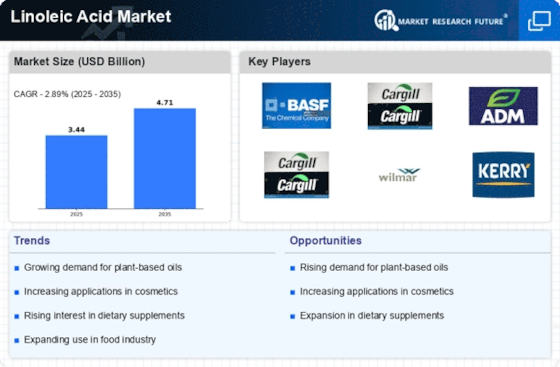
As per Market Research Future analysis, the Linoleic Acid Market Size was estimated at 3.442 USD Billion in 2024. The Linoleic Acid industry is projected to grow from 3.542 USD Billion in 2025 to 4.71 USD Billion by 2035, exhibiting a compound annual growth rate (CAGR) of 2.89% during the forecast period 2025 - 2035

Key Market Trends & Highlights

The Linoleic Acid Market is experiencing robust growth driven by health trends and sustainability efforts.

  • Health consciousness is rising, leading to increased demand for linoleic acid in food and beverages.
  • Sustainability in production practices is becoming a focal point for manufacturers in the linoleic acid market.
  • North America remains the largest market, while Asia-Pacific is emerging as the fastest-growing region.
  • The expansion of the cosmetic industry and rising awareness of omega fatty acids are key drivers propelling market growth.

Market Size & Forecast

2024 Market Size 3.442 (USD Billion)
2035 Market Size 4.71 (USD Billion)
CAGR (2025 - 2035) 2.89%

Major Players

BASF SE (DE), Cargill, Incorporated (US), Archer Daniels Midland Company (US), Cargill, Incorporated (US), Wilmar International Limited (SG), Kerry Group plc (IE), Nutrien Ltd. (CA), Cargill, Incorporated (US)

Our Impact
Enabled $4.3B Revenue Impact for Fortune 500 and Leading Multinationals
Partnering with 2000+ Global Organizations Each Year
30K+ Citations by Top-Tier Firms in the Industry

Linoleic Acid Market Trends

The Linoleic Acid Market is currently experiencing a notable transformation, driven by increasing consumer awareness regarding health and nutrition. This fatty acid, primarily found in vegetable oils, is recognized for its potential benefits in promoting heart health and reducing inflammation. As a result, there is a growing demand for linoleic acid in various sectors, including food and beverages, cosmetics, and dietary supplements. Manufacturers are increasingly focusing on sourcing high-quality raw materials to meet the rising expectations of health-conscious consumers. Furthermore, the trend towards plant-based diets appears to be influencing the market positively, as linoleic acid is predominantly derived from plant sources. In addition to health trends, the Linoleic Acid Market is also witnessing advancements in production technologies. Innovations in extraction and processing methods are likely to enhance the efficiency and sustainability of linoleic acid production. This could lead to a more stable supply chain and potentially lower costs for manufacturers. Moreover, regulatory frameworks surrounding food safety and labeling are evolving, which may impact how linoleic acid is marketed and utilized in various applications. Overall, the Linoleic Acid Market seems poised for growth, driven by both consumer preferences and technological advancements.

Rising Health Consciousness

There is an observable increase in consumer awareness regarding the health benefits associated with linoleic acid. This trend is prompting manufacturers to incorporate linoleic acid into various products, particularly in the food and beverage sector, where it is valued for its potential to support heart health.

Sustainability in Production

The Linoleic Acid Market is likely to benefit from advancements in sustainable production practices. Innovations in extraction and processing methods may enhance the environmental footprint of linoleic acid production, appealing to eco-conscious consumers and businesses alike.

Regulatory Developments

Evolving regulatory frameworks concerning food safety and labeling are influencing the Linoleic Acid Market. These changes may affect how linoleic acid is marketed and utilized, necessitating adaptations from manufacturers to comply with new standards.

Linoleic Acid Market Drivers

Expansion of the Cosmetic Industry

The Linoleic Acid Market is also benefiting from the expansion of the cosmetic and personal care sector. Linoleic acid is recognized for its skin-nourishing properties, making it a sought-after ingredient in various skincare formulations. Its ability to maintain skin barrier function and provide hydration has led to its incorporation in moisturizers, serums, and anti-aging products. The cosmetic industry is projected to grow at a steady pace, with a focus on natural and organic ingredients. This trend aligns with the increasing consumer preference for products that are both effective and derived from natural sources. As the demand for clean beauty products rises, the linoleic acid market is likely to see enhanced growth opportunities, as manufacturers strive to formulate products that cater to this evolving consumer landscape.

Rising Awareness of Omega Fatty Acids

The Linoleic Acid Market is witnessing a heightened awareness regarding the benefits of omega fatty acids, particularly omega-6 fatty acids like linoleic acid. This awareness is largely fueled by educational campaigns and health organizations advocating for balanced diets that include essential fatty acids. Linoleic acid is essential for various bodily functions, including cell membrane integrity and hormone production. As consumers become more informed about the role of omega fatty acids in overall health, the demand for linoleic acid-rich products is expected to rise. Market data suggests that the consumption of omega-6 fatty acids is on the rise, with projections indicating a potential increase in demand for linoleic acid in dietary supplements and fortified foods. This trend may significantly impact the linoleic acid market, as manufacturers adapt their offerings to align with consumer preferences.

Increasing Demand for Functional Foods

The Linoleic Acid Market is experiencing a notable surge in demand for functional foods, which are perceived to offer health benefits beyond basic nutrition. This trend is largely driven by consumers' growing awareness of the importance of dietary fats, particularly polyunsaturated fatty acids like linoleic acid. Research indicates that linoleic acid plays a crucial role in maintaining cardiovascular health and reducing inflammation. As a result, food manufacturers are increasingly incorporating linoleic acid into their products, such as oils, spreads, and snacks. The market for functional foods is projected to grow significantly, with estimates suggesting a compound annual growth rate of over 8% in the coming years. This increasing demand is likely to bolster the linoleic acid market, as manufacturers seek to meet consumer preferences for healthier food options.

Growing Applications in Pharmaceuticals

The Linoleic Acid Market is expanding due to its growing applications in the pharmaceutical sector. Linoleic acid is recognized for its therapeutic properties, particularly in formulations aimed at treating various health conditions, including cardiovascular diseases and skin disorders. The pharmaceutical industry is increasingly incorporating linoleic acid into drug formulations and supplements, capitalizing on its health benefits. Market analysis indicates that the demand for linoleic acid in pharmaceuticals is expected to rise, driven by the increasing prevalence of chronic diseases and the need for effective treatment options. As pharmaceutical companies continue to explore the potential of linoleic acid, this trend is likely to contribute to the overall growth of the linoleic acid market, providing new avenues for innovation and product development.

Technological Advancements in Extraction Methods

The Linoleic Acid Market is poised for growth due to technological advancements in extraction methods. Innovations in extraction techniques, such as cold pressing and supercritical fluid extraction, have improved the efficiency and yield of linoleic acid from various sources, including vegetable oils and seeds. These advancements not only enhance the quality of the extracted linoleic acid but also reduce production costs, making it more accessible to manufacturers. As the demand for high-quality linoleic acid continues to rise, these technological improvements are likely to play a pivotal role in shaping the market landscape. Furthermore, the ability to produce linoleic acid sustainably and efficiently aligns with the increasing consumer demand for ethically sourced ingredients, potentially driving further growth in the linoleic acid market.


Market Segment Insights

By Application: Food and Beverages (Largest) vs. Dietary Supplements (Fastest-Growing)

The Linoleic Acid Market sees a varied distribution of applications, with Food and Beverages leading in market share. This segment benefits from the rising consumer demand for healthier options, as linoleic acid is recognized for its essential fatty acid properties. Beyond this, sectors like Pharmaceuticals and Cosmetics also contribute significantly, showcasing the versatility of linoleic acid in various formulations. On the other hand, the Dietary Supplements segment has emerged as the fastest-growing application. Increasing awareness about health benefits and dietary requirements has surged the demand for linoleic acid supplements. This trend is bolstered by growing consumer preferences for natural and organic products, fueling innovation in formulation and presentation across this segment.

Food and Beverages: Dominant vs. Dietary Supplements: Emerging

The Food and Beverages segment remains dominant due to the longstanding incorporation of linoleic acid in various food products. It serves as a functional ingredient improving nutritional profiles while catering to health-conscious consumers. In contrast, the Dietary Supplements segment is emerging rapidly as a significant player. It reflects a shift towards personalized nutrition and preventative health measures, appealing to a growing demographic focused on wellness. Both segments are interconnected as they respond to the evolving consumer landscape, where health, nutrition, and wellness take precedence. Their dynamic relationship shapes market trends and influences new product developments.

By Source: Plant-Based Oils (Largest) vs. Animal-Based Oils (Fastest-Growing)

The linoleic acid market is predominantly driven by plant-based oils, which currently hold the largest share in the overall source segment. This category benefits from increasing consumer preferences for natural and plant-derived products, supported by a rising demand in health-conscious diets. In contrast, animal-based oils, while smaller in market share, are experiencing rapid growth as they find niche applications in the food industry and personal care products, leveraging unique properties that appeal to specific consumer segments.

Plant-Based Oils (Dominant) vs. Animal-Based Oils (Emerging)

Plant-based oils are at the forefront of the linoleic acid market due to their widespread acceptance and versatility across various applications such as cooking, cosmetics, and dietary supplements. These oils are celebrated for their health benefits, making them the preferred choice among a growing number of consumers. On the other hand, animal-based oils are seen as an emerging player in this market; they are increasingly recognized for their potential to offer distinctive flavors and nutritional profiles that cater to gourmet and specialized culinary trends. As consumers seek diversity in food sources and health products, animal-based oils are carving out a solid market position.

By Concentration: 50% (Largest) vs. 70-90% (Fastest-Growing)

The concentration segment of the Linoleic Acid Market exhibits a diverse distribution among its values, notably highlighting the dominance of the 50% concentration segment, which leads the market due to its widespread application in various industries. The 70-90% concentration range follows closely behind, representing a rapidly growing portion of the market as demand for higher purity levels increases. Together, these segments form a significant portion of the market, reflecting both established preferences and emerging trends in linoleic acid formulations.

50% (Dominant) vs. 70-90% (Emerging)

The 50% concentration segment is characterized by its versatility and extensive usage across multiple applications, including food, cosmetics, and pharmaceuticals, highlighting its established position within the Linoleic Acid Market. In contrast, the 70-90% concentration segment is emerging rapidly, fueled by the growing demand for higher-quality products that meet specific industry standards. This shift towards higher purity concentrations is driven by consumer preferences for clean-label products and formulations that prioritize quality, thereby enhancing the appeal of the 70-90% concentration range in competitive markets.

By Purity: Pharmaceutical Grade (Largest) vs. Industrial Grade (Fastest-Growing)

In the Linoleic Acid Market, the purity segment is divided into three main categories: Pharmaceutical Grade, Food Grade, and Industrial Grade. Among these, Pharmaceutical Grade holds the largest market share due to its significant application in various health-related products. The Food Grade segment follows, attributed to the increasing consumer preference for natural ingredients in food and dietary supplements. Meanwhile, the Industrial Grade, although smaller in market share, is rapidly gaining traction as industries leverage linoleic acid for its beneficial properties in manufacturing processes.

Industrial Grade (Emerging) vs. Food Grade (Dominant)

The Industrial Grade linoleic acid is emerging as a significant player in the market, driven by its application in various industrial processes like paint and coatings, adhesives, and lubricants. This segment is expanding its footprint due to the growing demand for bio-based and sustainable materials. On the other hand, the Food Grade linoleic acid remains a dominant choice in the market, primarily fueled by rising health consciousness and the demand for functional foods. This segment is characterized by stringent quality standards and regulatory approvals, ensuring safety and efficacy in food applications, thus reinforcing its robust market position.

Get more detailed insights about Linoleic Acid Market

Regional Insights

North America : Market Leader in Innovation

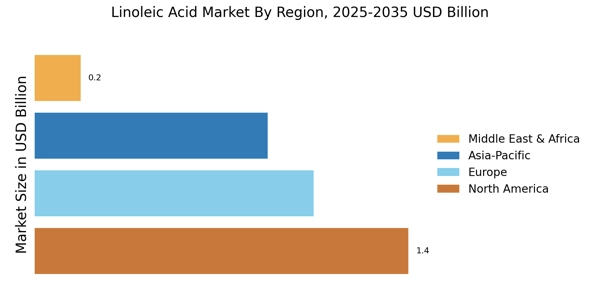
North America is the largest market for linoleic acid, holding approximately 40% of the global share. The region benefits from advanced agricultural practices, a strong demand for health-conscious products, and supportive regulatory frameworks. The increasing use of linoleic acid in food, cosmetics, and pharmaceuticals drives growth, with a notable rise in consumer awareness regarding health benefits. The United States is the primary contributor, with key players like Cargill and Archer Daniels Midland leading the market. The competitive landscape is characterized by innovation and sustainability initiatives, as companies invest in research and development to enhance product offerings. The presence of major corporations ensures a robust supply chain and market stability.

Europe : Regulatory Frameworks Drive Growth

Europe is the second-largest market for linoleic acid, accounting for around 30% of the global share. The region's growth is propelled by stringent regulations promoting sustainable agricultural practices and the increasing demand for natural ingredients in food and cosmetics. The European Union's Green Deal and Farm to Fork Strategy are pivotal in shaping market dynamics, encouraging the use of linoleic acid in various applications. Leading countries include Germany, France, and the Netherlands, where companies like BASF and Kerry Group are prominent. The competitive landscape is marked by a focus on innovation and sustainability, with firms investing in eco-friendly production methods. The presence of regulatory bodies ensures compliance and fosters a market environment conducive to growth.

Asia-Pacific : Emerging Market Potential

Asia-Pacific is witnessing rapid growth in the linoleic acid market, holding approximately 25% of the global share. The region's demand is driven by increasing health awareness, rising disposable incomes, and a growing food processing industry. Countries like China and India are leading this growth, supported by favorable government policies promoting agricultural development and food safety standards. China is the largest market in the region, with significant contributions from local players and multinational corporations. The competitive landscape is evolving, with companies focusing on product diversification and strategic partnerships to enhance market presence. The increasing trend towards natural and organic products further fuels demand for linoleic acid in various sectors.

Middle East and Africa : Untapped Market Opportunities

The Middle East and Africa region is gradually emerging in the linoleic acid market, holding about 5% of the global share. The growth is primarily driven by increasing urbanization, rising health consciousness, and a burgeoning food and beverage sector. Countries like South Africa and Nigeria are showing promising trends, with government initiatives aimed at boosting agricultural productivity and food security. The competitive landscape is still developing, with local and international players exploring opportunities in this untapped market. The presence of key players is limited, but there is a growing interest in sustainable practices and natural ingredients, which could enhance market dynamics in the coming years.

Linoleic Acid Market Regional Image

Key Players and Competitive Insights

Major players in the Linoleic Acid Market industry are constantly engaging in research and development activities to launch innovative products and expand their market share. These players are also focusing on strategic partnerships and collaborations to strengthen their position in the market. The Linoleic Acid Market industry is characterized by intense competition, with leading Linoleic Acid Market players adopting various strategies to gain a competitive edge. These strategies include product innovation, strategic acquisitions, and geographical expansion. The Linoleic Acid Market development is expected to be driven by factors such as increasing demand for healthy and nutritious food products, rising disposable income, and growing awareness about the health benefits of linoleic acid.Archer Daniels Midland Company is a global leader in the production and distribution of agricultural commodities, including linoleic acid. The company has a wide network of production facilities and distribution channels, which enables it to meet the demands of customers worldwide. Archer Daniels Midland Company is also actively involved in research and development activities to develop new and innovative linoleic acid products.Cargill Incorporated is another major player in the Linoleic Acid Market industry. The company has a global presence and offers a wide range of linoleic acid products for various applications. Cargill Incorporated is also committed to sustainability and has implemented several initiatives to reduce its environmental impact. The company is also investing in renewable energy sources to power its operations.

Key Companies in the Linoleic Acid Market include

Industry Developments

The Linoleic Acid Market is anticipated to reach a valuation of USD 4.58 billion by 2034, expanding at a CAGR of 2.89% from 2025 to 2034. The rising consumption of processed foods, increasing health consciousness, and growing demand for nutritional supplements are driving market growth. Additionally, the expanding pharmaceutical industry and advancements in drug delivery systems are expected to contribute to market expansion. Recent developments include the launch of new products such as conjugated linoleic acid (CLA) supplements and the development of innovative applications in the cosmetic and personal care industries.

Key players are focusing on strategic partnerships, acquisitions, and collaborations to strengthen their market position.

Future Outlook

Linoleic Acid Market Future Outlook

The Linoleic Acid Market is projected to grow at a 2.89% CAGR from 2025 to 2035, driven by rising health awareness, demand in food applications, and expanding cosmetic uses.

New opportunities lie in:

  • Developing high-purity linoleic acid for pharmaceutical applications. Expanding product lines to include organic linoleic acid variants. Investing in sustainable sourcing practices to enhance brand value.

By 2035, the Linoleic Acid Market is expected to solidify its growth trajectory and expand its global footprint.

Market Segmentation

Linoleic Acid Market Purity Outlook

  • Pharmaceutical Grade
  • Food Grade
  • Industrial Grade

Linoleic Acid Market Source Outlook

  • Plant-Based Oils
  • Animal-Based Oils
  • Synthetic Production

Linoleic Acid Market Application Outlook

  • Food and Beverages
  • Dietary Supplements
  • Pharmaceuticals
  • Cosmetics and Personal Care
  • Industrial

Linoleic Acid Market Concentration Outlook

  • 50%
  • 50-70%
  • 70-90%
  • >90%

Report Scope

MARKET SIZE 2024 3.442(USD Billion)
MARKET SIZE 2025 3.542(USD Billion)
MARKET SIZE 2035 4.71(USD Billion)
COMPOUND ANNUAL GROWTH RATE (CAGR) 2.89% (2025 - 2035)
REPORT COVERAGE Revenue Forecast, Competitive Landscape, Growth Factors, and Trends
BASE YEAR 2024
Market Forecast Period 2025 - 2035
Historical Data 2019 - 2024
Market Forecast Units USD Billion
Key Companies Profiled BASF SE (DE), Cargill, Incorporated (US), Archer Daniels Midland Company (US), Cargill, Incorporated (US), Wilmar International Limited (SG), Kerry Group plc (IE), Nutrien Ltd. (CA), Cargill, Incorporated (US)
Segments Covered Application, Source, Concentration, Purity, Regional
Key Market Opportunities Growing demand for plant-based oils enhances opportunities in the Linoleic Acid Market.
Key Market Dynamics Rising demand for plant-based oils drives competition and innovation in the linoleic acid market.
Countries Covered North America, Europe, APAC, South America, MEA
Leave a Comment

FAQs

What is the projected market valuation of the Linoleic Acid Market for 2035?

The projected market valuation for the Linoleic Acid Market in 2035 is 4.71 USD Billion.

What was the overall market valuation of the Linoleic Acid Market in 2024?

The overall market valuation of the Linoleic Acid Market in 2024 was 3.442 USD Billion.

What is the expected CAGR for the Linoleic Acid Market during the forecast period 2025 - 2035?

The expected CAGR for the Linoleic Acid Market during the forecast period 2025 - 2035 is 2.89%.

Which companies are considered key players in the Linoleic Acid Market?

Key players in the Linoleic Acid Market include BASF SE, Cargill, Incorporated, Archer Daniels Midland Company, Wilmar International Limited, Kerry Group plc, and Nutrien Ltd.

What are the projected valuations for the Food and Beverages segment by 2035?

The projected valuation for the Food and Beverages segment of the Linoleic Acid Market is expected to reach 2.0 USD Billion by 2035.

How does the projected valuation for Dietary Supplements change from 2024 to 2035?

The projected valuation for Dietary Supplements is anticipated to increase from 0.8 USD Billion in 2024 to 1.1 USD Billion by 2035.

What is the expected growth in the Industrial segment of the Linoleic Acid Market by 2035?

The Industrial segment is projected to grow from 0.142 USD Billion in 2024 to 0.212 USD Billion by 2035.

What are the projected valuations for different sources of Linoleic Acid by 2035?

By 2035, the projected valuations for sources of Linoleic Acid are 2.1 USD Billion for Plant-Based Oils, 1.1 USD Billion for Animal-Based Oils, and 1.5 USD Billion for Synthetic Production.

What is the anticipated market performance for Pharmaceutical Grade Linoleic Acid by 2035?

The anticipated market performance for Pharmaceutical Grade Linoleic Acid is expected to reach 0.95 USD Billion by 2035.

How does the concentration of Linoleic Acid impact its market valuation by 2035?

The concentration of Linoleic Acid is projected to show significant growth, with the >90% concentration category expected to reach 1.35 USD Billion by 2035.

Download Free Sample

Kindly complete the form below to receive a free sample of this Report

Compare Licence

×
Features License Type
Single User Multiuser License Enterprise User
Price $4,950 $5,950 $7,250
Maximum User Access Limit 1 User Upto 10 Users Unrestricted Access Throughout the Organization
Free Customization
Direct Access to Analyst
Deliverable Format
Platform Access
Discount on Next Purchase 10% 15% 15%
Printable Versions