×
Request Free Sample ×

Kindly complete the form below to receive a free sample of this Report

* Please use a valid business email

Leading companies partner with us for data-driven Insights

clients tt-cursor
Hero Background

Limestone Powders Market

ID: MRFR/PCM/38307-CR
139 Pages
Chitranshi Jaiswal
December 2024

Limestone Powders Market Research Report Information by Type (High-Content Calcium Carbonate Limestone Powder, And Low-Content Calcium Carbonate Limestone Powder), by Process (Wet Grinding, And Dry Grinding), by Application (Construction, Rubber, Textile, Agriculture, Paint & Coatings, Chemical Manufacturing, And Others), and by Region (North America, Europe, Asia-Pacific, Middle East & Africa, and South America) –Market Forecast Till 2035

Share:
Download PDF ×

We do not share your information with anyone. However, we may send you emails based on your report interest from time to time. You may contact us at any time to opt-out.

Limestone Powders Market Infographic
Purchase Options

Limestone Powders Market Summary

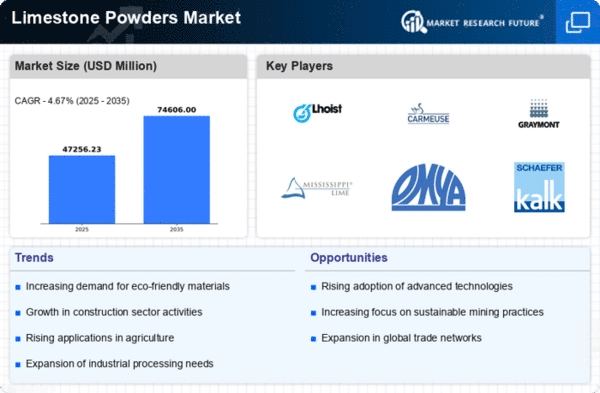
As per MRFR analysis, the Limestone Powders Market Size was estimated at 45147.83 USD Million in 2024. The Limestone Powders industry is projected to grow from 47257.15 in 2025 to 74606.0 by 2035, exhibiting a compound annual growth rate (CAGR) of 4.67 during the forecast period 2025 - 2035.

Key Market Trends & Highlights

The Limestone Powders Market is experiencing robust growth driven by diverse applications and sustainable practices.

  • The market is witnessing a notable shift towards sustainable practices in production, particularly in North America.
  • Expansion in construction applications continues to dominate the market, with cement production being the largest segment.
  • Technological innovations in processing are enhancing efficiency and product quality, especially in the Asia-Pacific region.
  • Rising demand in the construction sector and environmental regulations favoring limestone use are key drivers propelling market growth.

Market Size & Forecast

2024 Market Size 45147.83 (USD Million)
2035 Market Size 74606.0 (USD Million)
CAGR (2025 - 2035) 4.67%

Major Players

Lhoist (BE), Carmeuse (BE), Graymont (CA), Mississippi Lime Company (US), Omya AG (CH), Schaefer Kalk (DE), Cemex (MX), Martin Marietta Materials (US), Tarmac (GB)

Our Impact
Enabled $4.3B Revenue Impact for Fortune 500 and Leading Multinationals
Partnering with 2000+ Global Organizations Each Year
30K+ Citations by Top-Tier Firms in the Industry

Limestone Powders Market Trends

The Limestone Powders Market is currently experiencing a dynamic phase characterized by evolving applications and increasing demand across various industries. This market is influenced by the growing need for high-quality limestone powders in construction, agriculture, and manufacturing sectors. The versatility of limestone powders, which can be utilized as fillers, soil conditioners, and in the production of cement, contributes to its rising popularity. Furthermore, the environmental benefits associated with limestone, such as its role in carbon capture and reduction of greenhouse gas emissions, are becoming more recognized, potentially driving further interest in its use. In addition, the Limestone Powders Market appears to be shaped by technological advancements that enhance processing techniques and product quality. Innovations in extraction and milling processes may lead to more efficient production methods, thereby improving the overall supply chain. As sustainability becomes a focal point for many industries, the demand for eco-friendly materials, including limestone powders, is likely to increase. This trend suggests a promising future for the market, as stakeholders seek to align with environmental goals while meeting the needs of diverse applications.

Sustainable Practices in Production

The Limestone Powders Market is witnessing a shift towards sustainable production methods. Companies are increasingly adopting eco-friendly practices to minimize environmental impact. This trend includes the use of renewable energy sources in manufacturing processes and the implementation of waste reduction strategies. Such initiatives not only enhance corporate responsibility but also appeal to environmentally conscious consumers.

Expansion in Construction Applications

There is a notable expansion in the use of limestone powders within the construction sector. As infrastructure development continues to grow, the demand for high-quality materials is rising. Limestone powders are being utilized in various applications, including concrete production and as a filler in asphalt. This trend indicates a robust future for the market as construction activities increase globally.

Technological Innovations in Processing

Technological advancements are playing a crucial role in the Limestone Powders Market. Innovations in processing techniques are enhancing product quality and efficiency. Improved milling and extraction methods are likely to lead to higher purity levels and better performance characteristics. This trend suggests that companies investing in technology may gain a competitive edge in the market.

Limestone Powders Market Drivers

Market Growth Projections

The Global Limestone Powders Market Industry is projected to witness a compound annual growth rate (CAGR) of 4.58% from 2025 to 2035. This growth trajectory reflects the increasing applications of limestone powders across various industries, including construction, agriculture, and manufacturing. The market is expected to evolve significantly, driven by factors such as rising urbanization, environmental regulations, and technological advancements. As the demand for limestone powders continues to expand, the market is likely to reach substantial valuations, indicating a promising outlook for stakeholders involved in the Global Limestone Powders Market Industry.

Growth in Agriculture Sector

The Global Limestone Powders Market Industry is significantly influenced by the agricultural sector, where limestone powder is utilized to improve soil quality and enhance crop yields. The increasing focus on sustainable farming practices and soil health is driving the demand for agricultural limestone. As farmers seek to optimize their land productivity, the application of limestone powder is becoming more prevalent. This trend is expected to contribute to the market's growth, particularly as the agricultural sector continues to evolve. The integration of limestone in agricultural practices underscores its versatility and importance in promoting sustainable agriculture, thereby supporting the Global Limestone Powders Market Industry.

Rising Demand in Construction Sector

The Global Limestone Powders Market Industry experiences a robust demand driven by the construction sector. Limestone powder serves as a key ingredient in cement production, which is essential for infrastructure development. With global construction spending projected to reach approximately 45.1 USD Billion in 2024, the demand for limestone powders is anticipated to surge. This growth is further fueled by urbanization trends, particularly in emerging economies, where infrastructure projects are on the rise. As a result, the construction industry's expansion is likely to bolster the limestone powders market, indicating a strong correlation between construction activities and limestone powder consumption.

Increasing Use in Paints and Coatings

The Global Limestone Powders Market Industry is experiencing a notable uptick in demand from the paints and coatings sector. Limestone powder is widely used as a filler and pigment in various paint formulations, contributing to improved texture and durability. As the global paints and coatings market expands, projected to reach 73.9 USD Billion by 2035, the demand for limestone powders is expected to rise correspondingly. This trend highlights the importance of limestone in enhancing the performance characteristics of paints and coatings, suggesting a strong growth potential for the Global Limestone Powders Market Industry in alignment with the broader trends in the coatings market.

Technological Advancements in Production

Technological advancements in the production of limestone powders are poised to enhance the efficiency and quality of the Global Limestone Powders Market Industry. Innovations in processing techniques, such as fine grinding and classification, allow for the production of high-quality limestone powders that meet diverse industrial requirements. These advancements not only improve product performance but also reduce production costs, making limestone powders more competitive in various applications. As industries increasingly seek high-performance materials, the role of technology in optimizing limestone powder production is likely to drive market growth, indicating a positive trajectory for the Global Limestone Powders Market Industry.

Environmental Regulations Favoring Limestone Use

The Global Limestone Powders Market Industry benefits from stringent environmental regulations that promote the use of limestone powders as a sustainable alternative in various applications. Limestone is often utilized in flue gas desulfurization processes, which help reduce sulfur dioxide emissions from industrial sources. As governments worldwide implement stricter environmental policies, the demand for limestone powders is expected to increase. This trend aligns with global efforts to achieve sustainability goals, thereby enhancing the market's growth potential. The adoption of limestone in eco-friendly applications positions the Global Limestone Powders Market Industry favorably in the context of environmental stewardship.


Market Segment Insights

By Application: Construction (Largest) vs. Agriculture (Fastest-Growing)

The Limestone Powders Market showcases a diverse application landscape, with construction as the dominant force. A substantial share of the market is attributed to this segment, driven by its essential role in the production of cement and concrete. Agriculture follows, utilizing limestone powders for soil enhancement and crop production, contributing considerably to the overall demand. Other noteworthy applications include industrial uses such as fillers, environmental applications focusing on waste treatment, and chemical processes requiring high-quality limestone products.

Construction: Dominant vs. Agriculture: Emerging

The construction application of limestone powder is characterized by its extensive use in cement and concrete manufacturing, making it the cornerstone of the industry. Its roles in infrastructure development and housing projects emphasize its dominant market position. On the other hand, the agricultural segment is emerging rapidly, driven by the increasing awareness of sustainable practices and the need for soil improvement technologies. Agriculture utilizes limestone powders to neutralize soil acidity and provide essential nutrients, reflecting a significant shift towards enhancing crop yields and sustainable farming methods.

By End Use: Cement Production (Largest) vs. Glass Manufacturing (Fastest-Growing)

In the Limestone Powders Market, the distribution of market share among various end-use applications is indicative of significant trends. Cement Production holds the largest market share as it remains a fundamental component in construction materials, largely dominating the sector. In comparison, Glass Manufacturing is emerging as a rapidly growing segment, spurred by increased demand in various industrial applications, including consumer goods and electronics. As the construction industry continues to expand, Cement Production maintains its role as the backbone of infrastructure development. Meanwhile, the Glass Manufacturing sector is benefiting from innovations in technology and the growing preference for eco-friendly glass products. This duality in growth highlights the shifting dynamics, with Cement Production remaining stable while Glass Manufacturing surges ahead as a key player.

Cement Production (Dominant) vs. Paints and Coatings (Emerging)

In the Limestone Powders Market, Cement Production stands out as the dominant force due to its irreplaceable role in the construction sector, making it a staple in buildings and infrastructure projects. It provides essential properties such as strength and durability, contributing to its sustained demand. On the other hand, Paints and Coatings are emerging as a significant segment driven by increased aesthetic and protective applications in various industries. This growth is fueled by trends toward high-performance, low-VOC, and environmentally friendly products. As these sectors evolve, the relationship between Cement Production's stability and the Paints and Coatings market's dynamism will shape the future landscape of limestone use in industrial applications.

By Product Type: Calcium Carbonate (Largest) vs. Quicklime (Fastest-Growing)

Calcium Carbonate holds the largest market share in the Limestone Powders Market, primarily due to its extensive applications in industries such as construction, agriculture, and food. This segment benefits from its versatility and widespread acceptance, making it a preferred choice among manufacturers. Quicklime, on the other hand, is rapidly gaining traction as a preferred material in various industrial processes, showcasing a significant uptick in demand due to its critical role in steel production and water treatment. The market dynamics indicate that while Calcium Carbonate remains the dominant player, Quicklime is poised for substantial growth. This rise can be attributed to factors such as increased infrastructure investments and a growing emphasis on sustainability that drives the need for eco-friendly construction materials. Moreover, advancements in processing technology are enhancing the efficiency and application scope of Quicklime, positioning it strongly in the market.

Calcium Carbonate (Dominant) vs. Hydrated Lime (Emerging)

Calcium Carbonate is recognized as the dominant force in the Limestone Powders Market, favored for its adaptability in multiple sectors. Its applications range from industrial uses in paper and plastics to agricultural enhancements, highlighting its crucial role in enhancing material properties. In contrast, Hydrated Lime is an emerging segment, gaining traction for its utility in environmental applications, particularly in the treatment of wastewater and air pollution management. With increasing regulatory pressures on environmental health, Hydrated Lime is expected to see accelerated demand, driven by its effectiveness as a flocculant in water purification processes. This segment is progressively being recognized for its sustainable benefits, carving out a significant niche in a market that increasingly prioritizes eco-friendly solutions.

By Grade: High Purity (Largest) vs. Specialty Grade (Fastest-Growing)

In the Limestone Powders Market, the Grade segment showcases a clear distribution of market share, with High Purity grade leading the way due to its extensive application in industries such as pharmaceuticals and food processing. Medium Purity and Standard Grade follow closely as essential choices for various construction and industrial applications. Low Purity and Specialty Grade tend to occupy niche markets, with Specialty Grade increasingly gaining attention from specialized industries due to its unique properties and tailored applications.

High Purity (Dominant) vs. Specialty Grade (Emerging)

High Purity limestone powders are characterized by their exceptional quality and minimal impurities, making them the preferred choice for high-end applications, including pharmaceuticals and food. In contrast, Specialty Grade limestone powders are tailored for specific applications, including agriculture and environmental solutions, emerging rapidly as a popular option. The demand for Specialty Grade is driven by the need for customized solutions in industrial processes and sustainable practices. As regulations tighten and industries seek more efficient materials, the traction for both High Purity and Specialty Grade will continue to shape the market dynamics.

Get more detailed insights about Limestone Powders Market

Regional Insights

North America : Stable Market with Growth Potential

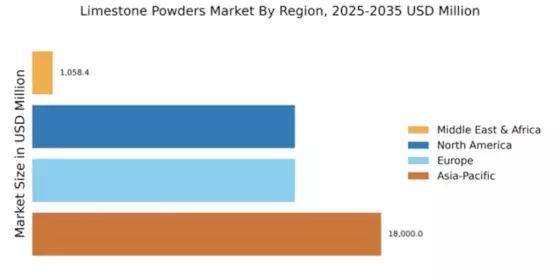
The North American limestone powders market is poised for steady growth, driven by increasing demand in construction and agriculture sectors. With a market size of $13,544.7 million, the region benefits from robust infrastructure projects and a focus on sustainable practices. Regulatory support for environmentally friendly materials further enhances market prospects, making it a key player in the global landscape. Leading countries such as the US and Canada dominate the market, with key players like Graymont and Martin Marietta Materials driving innovation and competition. The presence of established companies ensures a competitive landscape, while ongoing investments in technology and sustainability initiatives are expected to bolster market growth. The region's strategic focus on quality and compliance with regulations positions it favorably for future expansion.

Europe : Diverse Market with Regulatory Support

Europe's limestone powders market, valued at $13,544.7 million, is characterized by diverse applications across industries such as construction, agriculture, and environmental management. The region's growth is fueled by stringent regulations promoting sustainable practices and the use of eco-friendly materials. As a result, demand for limestone powders is expected to rise, supported by government initiatives aimed at reducing carbon footprints. Countries like Germany, France, and the UK are leading the market, with key players such as Lhoist and Schaefer Kalk contributing to innovation and market share. The competitive landscape is marked by collaborations and partnerships aimed at enhancing product offerings. Regulatory frameworks, including the EU's Green Deal, further drive the adoption of limestone powders, ensuring a sustainable future for the industry.

Asia-Pacific : Emerging Powerhouse in Limestone Market

The Asia-Pacific region is the largest market for limestone powders, with a market size of $18,000 million. This growth is driven by rapid industrialization, urbanization, and increasing construction activities across countries like China and India. The demand for limestone powders is further supported by government initiatives focusing on infrastructure development and environmental sustainability, making it a key player in the global market. China leads the region, followed by India and Japan, with major companies like Omya AG and Carmeuse establishing a strong presence. The competitive landscape is characterized by a mix of local and international players, fostering innovation and product diversification. As the region continues to invest in infrastructure and sustainable practices, the limestone powders market is expected to expand significantly, catering to diverse industrial needs.

Middle East and Africa : Resource-Rich Frontier for Limestone

The Middle East and Africa limestone powders market, valued at $1,058.43 million, is emerging as a resource-rich frontier. The growth is driven by increasing demand in construction and agriculture, supported by government initiatives aimed at infrastructure development. The region's strategic location and abundant natural resources position it favorably for market expansion, despite challenges such as regulatory hurdles and economic fluctuations. Leading countries like South Africa and the UAE are at the forefront, with key players such as Cemex and Tarmac making significant contributions. The competitive landscape is evolving, with local companies gaining traction alongside established international firms. As the region focuses on sustainable development and infrastructure projects, the limestone powders market is expected to witness substantial growth in the coming years.

Limestone Powders Market Regional Image

Key Players and Competitive Insights

The Limestone Powders Market is characterized by a competitive landscape that is increasingly shaped by innovation, sustainability, and strategic partnerships. Key players such as Lhoist (BE), Carmeuse (BE), and Graymont (CA) are actively pursuing growth strategies that emphasize regional expansion and technological advancements. Lhoist (BE), for instance, has focused on enhancing its product portfolio through sustainable practices, which aligns with the growing demand for environmentally friendly materials. Carmeuse (BE) has been investing in digital transformation initiatives to optimize its operations, thereby improving efficiency and reducing costs. These strategies collectively contribute to a dynamic competitive environment where companies are not only vying for market share but also striving to meet evolving customer expectations.The business tactics employed by these companies reflect a moderately fragmented market structure, where local manufacturing and supply chain optimization play crucial roles. Companies are increasingly localizing their production to reduce transportation costs and enhance responsiveness to regional demands. This approach not only strengthens their market position but also fosters closer relationships with customers. The collective influence of key players, including Mississippi Lime Company (US) and Omya AG (CH), further intensifies competition, as they seek to leverage their operational strengths to capture a larger share of the market.

In November Mississippi Lime Company (US) announced a strategic partnership with a leading construction firm to supply high-quality limestone powders for sustainable building materials. This collaboration is significant as it positions Mississippi Lime Company (US) at the forefront of the green construction movement, potentially increasing its market share in a sector that is rapidly gaining traction. The partnership underscores the importance of aligning product offerings with sustainability trends, which are becoming increasingly critical in the construction industry.

In October Omya AG (CH) launched a new line of limestone powders specifically designed for the agricultural sector, aimed at improving soil quality and crop yield. This strategic move not only diversifies Omya AG's product range but also taps into the growing demand for sustainable agricultural practices. By focusing on innovation in product development, Omya AG (CH) is likely to enhance its competitive edge and attract a broader customer base.

In September Graymont (CA) expanded its operations by acquiring a regional limestone producer, thereby increasing its production capacity and market reach. This acquisition is indicative of Graymont's commitment to strengthening its position in the Limestone Powders Market. By integrating the acquired company’s resources and expertise, Graymont (CA) is expected to enhance its operational efficiency and better serve its customers, which is crucial in a market that is becoming increasingly competitive.

As of December the Limestone Powders Market is witnessing trends that emphasize digitalization, sustainability, and the integration of advanced technologies such as AI. Strategic alliances are becoming more prevalent, as companies recognize the need to collaborate to enhance their competitive positioning. The shift from price-based competition to a focus on innovation and supply chain reliability is evident, suggesting that future differentiation will hinge on the ability to adapt to changing market dynamics and customer preferences.

Key Companies in the Limestone Powders Market include

Industry Developments

  • In September 2023, Graymont has acquired Compact Energy, a significant lime processing facility strategically situated in Banting, in the state of Selangor, Malaysia — near Port Klang, the country’s main container port. The facility has state-of-the-art, modern, fuel-efficient vertical lime kilns, and lime hydration and ancillary equipment, and is well situated to supply both domestic and export markets. This latest addition to Graymont’s Malaysian plant network will bring an additional 390,000 tonnes of annual quicklime production capacity and 70,000 tonnes of hydrated lime production capacity, boosting Graymont’s annual production capacity in the country to more than 600,000 tonnes of quicklime and 170,000 tonnes of hydrated lime. The acquisition of the Banting plant reinforces Graymont’s commitment to continue providing high-quality lime and limestone solutions to customers in essential industries across Malaysia and throughout the Asia Pacific region.
  • In May 2023, Graymont has completed the acquisition of the Gridland limestone quarry located in Ipoh, Perak, from GCCP Resources Ltd. The quarry is located in an area renowned for high quality limestone. This acquisition reinforces Graymont’s commitment to Perak and to continuing to provide essential lime and limestone solutions to its customers in essential industries across Malaysia.
  • In September 2022, SINGLETON Birch have been acquired by Mississippi Lime Company (MLC), one of the US’s oldest independent suppliers of lime products, for an undisclosed sum. The acquisition, which will power the next phase of Singleton Birch’s growth, is part of MLC’s strategy to drive growth, innovation, and sustainability through geographic expansion and new products and technologies that proactively address customers’ changing needs.

Future Outlook

Limestone Powders Market Future Outlook

The Limestone Powders Market is projected to grow at a 4.67% CAGR from 2025 to 2035, driven by increasing demand in construction, agriculture, and environmental applications.

New opportunities lie in:

  • Expansion into eco-friendly limestone powder production methods.
  • Development of customized limestone powder blends for specific industrial applications.
  • Investment in advanced logistics solutions for efficient distribution channels.

By 2035, the Limestone Powders Market is expected to achieve robust growth, reflecting evolving industry needs.

Market Segmentation

Limestone Powders Market Grade Outlook

  • High Purity
  • Medium Purity
  • Low Purity
  • Specialty Grade
  • Standard Grade

Limestone Powders Market End Use Outlook

  • Cement Production
  • Glass Manufacturing
  • Paints and Coatings
  • Plastics
  • Rubber

Limestone Powders Market Application Outlook

  • Construction
  • Agriculture
  • Industrial
  • Environmental
  • Chemical

Limestone Powders Market Product Type Outlook

  • Calcium Carbonate
  • Quicklime
  • Hydrated Lime
  • Limestone Flour
  • Limestone Granules

Report Scope

MARKET SIZE 202445147.83(USD Million)
MARKET SIZE 202547257.15(USD Million)
MARKET SIZE 203574606.0(USD Million)
COMPOUND ANNUAL GROWTH RATE (CAGR)4.67% (2025 - 2035)
REPORT COVERAGERevenue Forecast, Competitive Landscape, Growth Factors, and Trends
BASE YEAR2024
Market Forecast Period2025 - 2035
Historical Data2019 - 2024
Market Forecast UnitsUSD Million
Key Companies ProfiledLhoist (BE), Carmeuse (BE), Graymont (CA), Mississippi Lime Company (US), Omya AG (CH), Schaefer Kalk (DE), Cemex (MX), Martin Marietta Materials (US), Tarmac (GB)
Segments CoveredApplication, End Use, Product Type, Grade
Key Market OpportunitiesGrowing demand for eco-friendly construction materials drives innovation in the Limestone Powders Market.
Key Market DynamicsRising demand for eco-friendly construction materials drives innovation in limestone powder applications and production techniques.
Countries CoveredNorth America, Europe, APAC, South America, MEA
Leave a Comment

FAQs

What is the growth rate of the Limestone Powders Market?

Limestone Powders Market is expected to grow with a CAGR of 4.67% in the period 2025-2035

Which region held the largest market share in the Limestone Powders Market?

Asia Pacific had the largest share of the global market.

Who are the key players in the Limestone Powders Market?

The key players in the market are Aravali Group, R. K. Phosphates Pvt. Ltd, Graymont Limited, United States Lime & Minerals, Inc, Nordkalk, Mississippi Lime Company, Greer Lime Company, Linwood Mining & Minerals Corporation, Srinath Enterprises, And Carmeuse.

Which Application led the Limestone Powders Market?

The construction category dominated the market in 2024.

Which Process had the largest market share in the Limestone Powders Market?

Dry grinding segment had the largest revenue share of the global market.

Download Free Sample

Kindly complete the form below to receive a free sample of this Report

Compare Licence

×
Features License Type
Single User Multiuser License Enterprise User
Price $4,950 $5,950 $7,250
Maximum User Access Limit 1 User Upto 10 Users Unrestricted Access Throughout the Organization
Free Customization
Direct Access to Analyst
Deliverable Format
Platform Access
Discount on Next Purchase 10% 15% 15%
Printable Versions