×
Request Free Sample ×

Kindly complete the form below to receive a free sample of this Report

* Please use a valid business email

Leading companies partner with us for data-driven Insights

clients tt-cursor
Hero Background

Lawful Interception Market

ID: MRFR/ICT/8118-CR
128 Pages
Aarti Dhapte
December 2024

Lawful Interception Market Size, Share and Research Report: By Component (Solution and Services) and Network (Fixed network and Mobile network), by Mediation Device (Routers, Switches, Gateway, Handover interface, Intercept access point (IAP) and Management server), by Type of Interception (Active interception, Passive interception and Hybrid interception), by End-Users (Law enforcement agencies and Government) and By Region (North America, Europe, Asia-Pacific, Middle East and Africa, South America) –Market Forecast Till 2035

Share:
Download PDF ×

We do not share your information with anyone. However, we may send you emails based on your report interest from time to time. You may contact us at any time to opt-out.

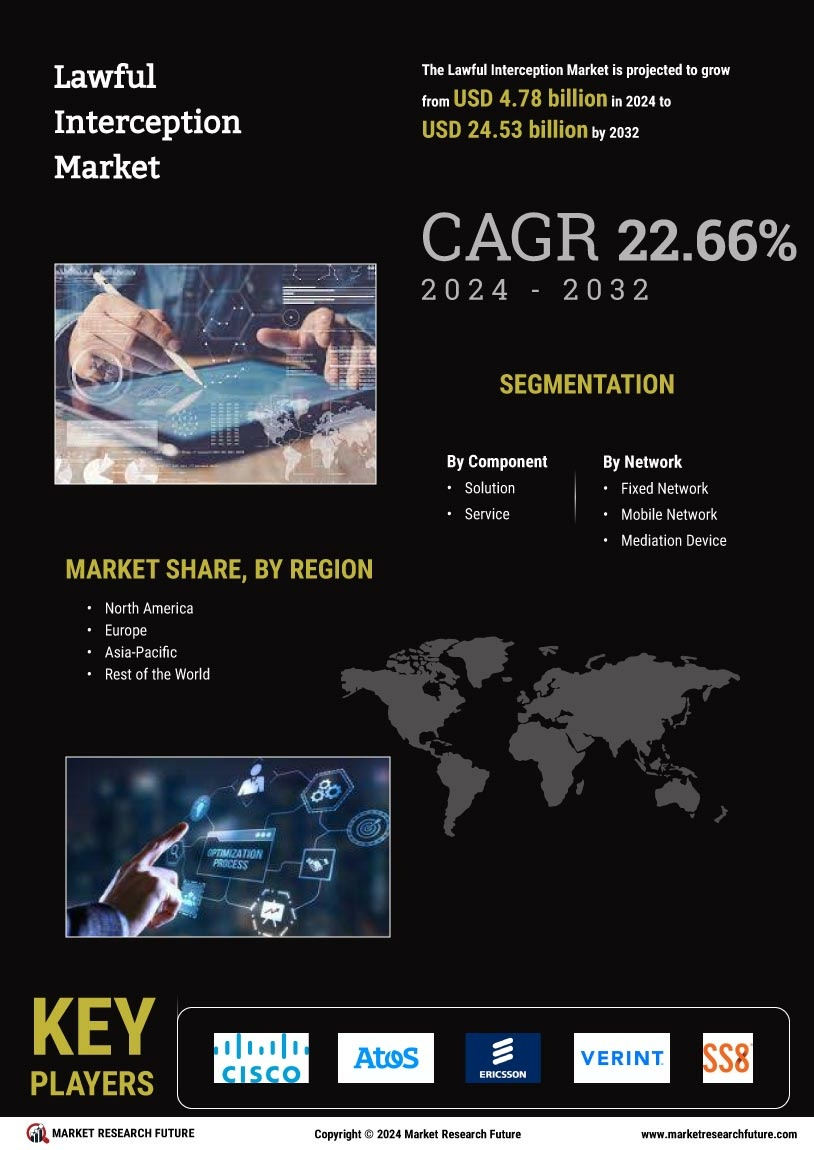
Lawful Interception Market Infographic
Purchase Options

Lawful Interception Market Summary

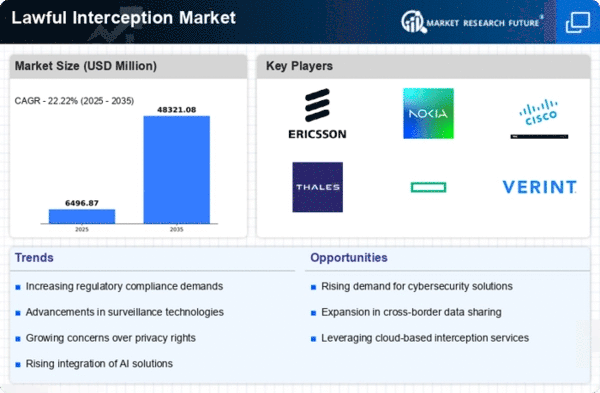
As per MRFR analysis, the Lawful Interception Market Size was estimated at 5315.72 USD Million in 2024. The Lawful Interception industry is projected to grow from 6496.89 in 2025 to 48321.08 by 2035, exhibiting a compound annual growth rate (CAGR) of 22.22 during the forecast period 2025 - 2035.

Key Market Trends & Highlights

The Lawful Interception Market is experiencing robust growth driven by technological advancements and regulatory compliance.

  • North America remains the largest market for lawful interception solutions, driven by stringent regulatory frameworks.
  • The Asia-Pacific region is emerging as the fastest-growing market, fueled by increasing investments in cybersecurity infrastructure.
  • The telecommunications segment continues to dominate the market, while the cybersecurity segment is witnessing rapid growth due to rising digital threats.
  • Technological advancements and growing demand for data privacy are key drivers propelling the lawful interception market forward.

Market Size & Forecast

2024 Market Size 5315.72 (USD Million)
2035 Market Size 48321.08 (USD Million)
CAGR (2025 - 2035) 22.22%

Major Players

Ericsson (SE), Nokia (FI), Cisco Systems (US), Thales Group (FR), Hewlett Packard Enterprise (US), Verint Systems (US), Amdocs (IL), Bae Systems (GB), ZTE Corporation (CN)

Our Impact
Enabled $4.3B Revenue Impact for Fortune 500 and Leading Multinationals
Partnering with 2000+ Global Organizations Each Year
30K+ Citations by Top-Tier Firms in the Industry

Lawful Interception Market Trends

The Lawful Interception Market is currently experiencing a notable evolution, driven by the increasing demand for security and surveillance across various sectors. Governments and law enforcement agencies are actively seeking advanced technologies to monitor communications and ensure public safety. This trend is further fueled by the growing concerns regarding cyber threats and criminal activities, prompting a shift towards more sophisticated interception solutions. As a result, the market is witnessing a surge in investments aimed at enhancing capabilities and compliance with legal frameworks. 

Moreover, the integration of artificial intelligence and machine learning into lawful interception systems appears to be a pivotal development. These technologies enable more efficient data analysis and real-time monitoring, which could significantly improve the effectiveness of surveillance operations. Additionally, the rising adoption of cloud-based solutions is likely to transform the landscape, offering scalable and flexible options for organizations. Overall, the Lawful Interception Market is poised for continued growth, reflecting the ongoing need for robust security measures in an increasingly digital world. The growing adoption of interception software across telecom operators and government agencies is a key factor driving the expansion of the lawful interception market globally. The demand for lawful interception software is increasing rapidly as service providers seek scalable, compliant, and analytics-driven solutions to meet evolving regulatory requirements. The application area of lawful interception continues to expand across telecommunications, cybersecurity, and national security domains, driving demand for advanced interception technologies.

Technological Advancements

The Lawful Interception Market is witnessing rapid technological advancements, particularly in the areas of artificial intelligence and machine learning. These innovations are enhancing the capabilities of interception systems, allowing for more efficient data processing and analysis. As a result, law enforcement agencies are better equipped to monitor communications and respond to potential threats.

Regulatory Compliance

Regulatory compliance is becoming increasingly critical within the Lawful Interception Market. Governments are establishing stricter guidelines and frameworks to ensure that interception practices align with legal standards. This trend emphasizes the need for companies to develop solutions that not only meet operational requirements but also adhere to privacy and ethical considerations.

Increased Collaboration

There is a noticeable trend towards increased collaboration between technology providers and government agencies in the Lawful Interception Market. This partnership approach aims to create more effective interception solutions that address the evolving challenges of security and surveillance. Such collaborations may lead to the establishment of best practices and shared resources, ultimately enhancing the overall efficacy of lawful interception.

Lawful Interception Market Drivers

Rising Demand for Public Safety

The Global Lawful Interception Market Industry is increasingly driven by the rising demand for public safety and crime prevention. Law enforcement agencies are under pressure to enhance their capabilities to respond to criminal activities effectively. This has led to a surge in investments in lawful interception technologies that enable timely access to critical information. For example, countries facing high crime rates are prioritizing the acquisition of interception tools to bolster their security infrastructure. This focus on public safety is likely to fuel market growth, with expectations of a significant increase in market size from 5.32 USD Billion in 2024 to 48.5 USD Billion by 2035.

Increasing Cybersecurity Concerns

The Global Lawful Interception Market Industry is experiencing heightened demand due to escalating cybersecurity threats. Governments and law enforcement agencies are increasingly investing in lawful interception technologies to combat cybercrime and terrorism. For instance, the rise in sophisticated hacking incidents has prompted regulatory bodies to enforce stringent compliance measures. This trend is reflected in the projected market growth from 5.32 USD Billion in 2024 to an anticipated 48.5 USD Billion by 2035, indicating a robust CAGR of 22.25% from 2025 to 2035. Such investments are essential for maintaining national security and public safety.

Regulatory Compliance Requirements

The Global Lawful Interception Market Industry is significantly influenced by stringent regulatory frameworks mandating lawful interception capabilities. Governments worldwide are implementing laws that require telecommunications and internet service providers to facilitate lawful interception for security agencies. For example, the European Union's ePrivacy Directive necessitates compliance from service providers, thereby driving demand for interception solutions. This regulatory landscape compels organizations to invest in advanced technologies to ensure compliance, contributing to the market's growth trajectory. As a result, the industry is poised for substantial expansion, aligning with the projected market valuation increase from 5.32 USD Billion in 2024 to 48.5 USD Billion by 2035.

Technological Advancements in Communication

The Global Lawful Interception Market Industry is propelled by rapid technological advancements in communication systems. The proliferation of mobile devices, VoIP, and encrypted messaging applications has necessitated the development of sophisticated interception solutions. As communication technologies evolve, so do the methods employed by law enforcement agencies to monitor and intercept communications legally. For instance, the integration of artificial intelligence and machine learning in interception technologies enhances the efficiency and effectiveness of surveillance operations. This trend is expected to contribute to the market's growth, with projections indicating a rise from 5.32 USD Billion in 2024 to 48.5 USD Billion by 2035.

Global Collaboration on Security Initiatives

The Global Lawful Interception Market Industry is benefiting from increased global collaboration on security initiatives. International partnerships among nations to combat transnational crime and terrorism are fostering the exchange of intelligence and best practices in lawful interception. For instance, joint operations and information-sharing agreements among countries enhance the effectiveness of interception efforts. This collaborative approach not only strengthens national security but also drives demand for advanced interception technologies. As countries invest in these solutions, the market is expected to experience substantial growth, aligning with the projected increase from 5.32 USD Billion in 2024 to 48.5 USD Billion by 2035.

Market Segment Insights

By Application: Telecommunications (Largest) vs. Cybersecurity (Fastest-Growing)

The Lawful Interception Market is significantly influenced by various application segments, with Telecommunications holding the largest share. This segment is characterized by its vast network infrastructures and requisite compliance with regulatory frameworks, making it a key player in the lawful interception landscape. Following closely is the Public Safety sector, which underscores the demand for secure communication channels and data monitoring as critical to national security. Other sectors like Government Agencies and Intelligence Services also contribute to the market, although their shares are comparatively smaller compared to Telecommunications. In recent years, the Cybersecurity segment has emerged as the fastest-growing area within the lawful interception landscape. The growing incidences of cyber threats and data breaches have amplified the necessity for advanced interception technologies. As organizations increasingly prioritize data protection and compliance with privacy regulations, the impetus for innovation in cybersecurity solutions fosters growth. The rising reliance on digital communication further contributes to the expansion of lawful interception capabilities across all sectors, driven by technological advancements and regulatory obligations.

Telecommunications (Dominant) vs. Cybersecurity (Emerging)

Telecommunications stands as the dominant application segment within the Lawful Interception Market, predominantly due to its extensive infrastructure and rigorous adherence to compliance measures, which facilitate a structured approach to lawful data acquisition. This segment encompasses major telecom providers who must navigate a complex regulatory environment, ensuring that they can comply with interception mandates while maintaining network integrity. In contrast, the Cybersecurity segment is emerging as a critical force, leveraging advanced technology to protect sensitive data against extensive cyber threats. With the rise of digital communications, the need for robust interception capabilities has never been greater. Organizations are increasingly investing in innovative cybersecurity solutions to incorporate lawful interception features, fostering rapid growth in this segment as companies seek to balance security, compliance, and usability.

By End Use: Law Enforcement (Largest) vs. Military (Fastest-Growing)

In the Lawful Interception Market, the distribution of market share among various end-use segments reveals that Law Enforcement remains the largest user, leveraging interception technologies primarily for crime prevention and investigation. Military applications, primarily focusing on national security and intelligence operations, are garnering increased attention due to the rising demand for advanced surveillance capabilities. The Private Sector, including corporate compliance and cybersecurity applications, alongside Telecom Operators and Internet Service Providers, contribute significantly to the market, although they trail behind Law Enforcement in terms of share.

Law Enforcement (Dominant) vs. Military (Emerging)

Law Enforcement is characterized by its established use of lawful interception technologies to monitor communications for criminal activities, making it a dominant segment in the market. This segment benefits from stringent regulations and government support, ensuring a continuous demand for advanced interception solutions. Military applications, on the other hand, represent an emerging sector particularly due to the increasing threats from cyber warfare and terrorism. As defense budgets expand and governments seek enhanced intelligence capabilities, the military's adoption of lawful interception technologies is expected to accelerate, highlighting a significant shift in focus towards national security and defense.

By Technology: Deep Packet Inspection (Largest) vs. Real-Time Monitoring (Fastest-Growing)

In the Lawful Interception Market, the technology segment is dominated by Deep Packet Inspection (DPI), which controls a significant portion of the market share due to its effectiveness in analyzing data packets as they traverse networks. On the other hand, Real-Time Monitoring is emerging rapidly, catering to the increasing demand for immediate surveillance capabilities in various sectors, including telecom and internet service providers. Other technologies such as Packet Filtering, Data Retention, and Network Analysis contribute to the overall market, but they play a less dominant role compared to the leading technologies.

Technology: Deep Packet Inspection (Dominant) vs. Real-Time Monitoring (Emerging)

Deep Packet Inspection (DPI) stands out in the Lawful Interception Market as a dominant technology due to its ability to analyze data packets for identifying security threats and ensuring lawful compliance. It enables law enforcement and government agencies to effectively intercept and analyze communications over networks. In contrast, Real-Time Monitoring is recognized as an emerging technology gaining traction as it offers the capability to oversee communications in real-time, responding swiftly to threats. As the demand for immediate data access grows amidst stringent regulatory requirements, Real-Time Monitoring is adapting rapidly to meet the needs of various industries, making it a significant player in the market.

By Deployment Type: On-Premises (Largest) vs. Cloud-Based (Fastest-Growing)

The Lawful Interception Market is notably segmented by deployment types, comprising On-Premises, Cloud-Based, and Hybrid solutions. Currently, On-Premises solutions dominate the market, holding the largest share due to their long-standing presence and trust among telecommunications providers. Cloud-Based solutions have experienced substantial growth, appealing to organizations seeking scalability, flexibility, and cost-effectiveness. Hybrid deployment options offer a balance between the two, catering to businesses with diverse needs and compliance requirements.

Deployment Type: On-Premises (Dominant) vs. Cloud-Based (Emerging)

On-Premises solutions remain the dominant deployment type in the Lawful Interception Market, favored for their high level of security and control. These systems are often implemented by larger telecommunications firms who require extensive customization and robust data handling capabilities. Conversely, Cloud-Based deployments are emerging strongly in the market thanks to advancements in cloud technology, allowing for quicker deployment and reduced operational costs. These solutions attract smaller companies and those looking to modernize their interception capabilities without significant upfront investment. Organizations are increasingly drawn to hybrid models which combine elements of both to enhance flexibility and scalability, catering to a wider array of operational demands.

By Component: Hardware (Largest) vs. Services (Fastest-Growing)

The Lawful Interception Market is characterized by a diverse distribution among its core components: Hardware, Software, and Services. Hardware holds the largest share, driven by the fundamental role that physical devices play in lawful interception processes. Software follows, contributing significantly as well, enabling the necessary analytical functionalities for data processing and monitoring. Lastly, the Services segment, though currently smaller, is rapidly expanding as organizations increasingly outsource their interception needs to specialized providers, highlighting a shift towards a more service-oriented market structure.

Software (Dominant) vs. Services (Emerging)

In the Lawful Interception Market, Software stands out as the dominant component, offering critical functionalities that enable effective data collection and analysis. Its capabilities facilitate seamless integration with existing systems, allowing law enforcement agencies and telecom operators to comply with legal interception mandates efficiently. Conversely, the Services segment is emerging as a key player, fueled by the increasing demand for expertise in deploying and maintaining lawful interception solutions. This trend is bolstered by the need for scalable and flexible service offerings, ensuring that organizations can adapt to changing regulations and technological advancements in the field.

Get more detailed insights about Lawful Interception Market

Regional Insights

North America : Market Leader in Lawful Interception

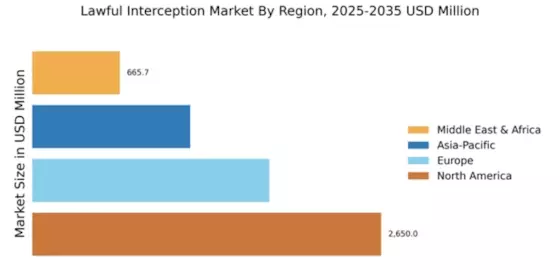
North America continues to lead the lawful interception market, holding a significant share of 2650.0 million. The growth is driven by stringent regulatory requirements and increasing demand for security solutions among telecom operators and government agencies. The region's focus on advanced technologies and cybersecurity measures further propels market expansion, with a notable rise in investments from key players. The competitive landscape is characterized by major players such as Cisco Systems, Ericsson, and Thales Group, which are actively innovating to meet regulatory demands. The U.S. and Canada are at the forefront, leveraging their technological advancements and robust infrastructure. The presence of these key players ensures a dynamic market environment, fostering continuous growth and adaptation to emerging threats.

Europe : Regulatory Framework Driving Growth

Europe's lawful interception market is projected to reach 1800.0 million, driven by comprehensive regulatory frameworks and increasing demand for data security. The General Data Protection Regulation (GDPR) and other national laws are pivotal in shaping market dynamics, ensuring that service providers comply with stringent interception requirements. This regulatory environment fosters innovation and investment in lawful interception technologies across the region. Leading countries such as Germany, the UK, and France are at the forefront of this market, with significant contributions from key players like Nokia and Thales Group. The competitive landscape is marked by collaborations between telecom operators and technology providers, enhancing the capabilities of lawful interception solutions. As the market evolves, the focus on privacy and compliance will continue to shape strategic initiatives in Europe.

Asia-Pacific : Emerging Market with Growth Potential

The Asia-Pacific lawful interception market is estimated at 1200.0 million, reflecting a growing recognition of the need for robust security measures. The region's rapid digital transformation and increasing internet penetration are key drivers of market growth. Governments are implementing stricter regulations to enhance cybersecurity, which is expected to further boost demand for lawful interception solutions in the coming years. Countries like China, India, and Japan are leading the charge, with significant investments from local and international players. Companies such as ZTE Corporation and Cisco Systems are actively participating in this evolving market. The competitive landscape is characterized by a mix of established firms and emerging startups, all vying to capture market share in this dynamic environment.

Middle East and Africa : Growing Demand Amid Challenges

The lawful interception market in the Middle East and Africa is valued at 665.72 million, driven by increasing security concerns and regulatory pressures. Governments in the region are prioritizing cybersecurity, leading to a rise in demand for lawful interception technologies. The market is also influenced by geopolitical factors, necessitating enhanced surveillance capabilities to address security threats effectively. Leading countries such as the UAE and South Africa are making strides in adopting lawful interception solutions, with key players like Bae Systems and Thales Group actively involved. The competitive landscape is evolving, with a focus on partnerships and collaborations to enhance technological capabilities. As the region navigates its unique challenges, the lawful interception market is poised for growth, driven by both regulatory and security demands.

Lawful Interception Market Regional Image

Key Players and Competitive Insights

The Lawful Interception Market is characterized by a dynamic competitive landscape, driven by the increasing demand for security and surveillance solutions across various sectors. Key players such as Ericsson (SE), Nokia (FI), and Cisco Systems (US) are at the forefront, each adopting distinct strategies to enhance their market positioning. Ericsson (SE) focuses on innovation and technological advancements, particularly in 5G networks, which are pivotal for lawful interception capabilities. Meanwhile, Nokia (FI) emphasizes partnerships with governmental agencies to tailor solutions that meet specific regulatory requirements, thereby strengthening its foothold in the market. Cisco Systems (US) leverages its extensive cybersecurity portfolio to integrate lawful interception seamlessly into broader security frameworks, indicating a trend towards comprehensive security solutions that encompass interception capabilities. The business tactics employed by these companies reflect a concerted effort to optimize operations and enhance service delivery. Localizing manufacturing and optimizing supply chains are prevalent strategies aimed at reducing costs and improving responsiveness to market demands. The competitive structure of the market appears moderately fragmented, with several players vying for dominance, yet the collective influence of major companies like Thales Group (FR) and Verint Systems (US) cannot be overlooked, as they contribute significantly to shaping market dynamics. In November 2025, Thales Group (FR) announced a strategic partnership with a leading telecommunications provider to develop advanced lawful interception solutions tailored for emerging markets. This collaboration is expected to enhance Thales's capabilities in delivering customized solutions that comply with local regulations, thereby expanding its market reach. The strategic importance of this partnership lies in its potential to position Thales as a key player in regions where regulatory compliance is paramount, thus driving growth in previously untapped markets. In October 2025, Verint Systems (US) launched a new AI-driven analytics platform designed to enhance lawful interception processes. This platform aims to streamline data collection and analysis, providing law enforcement agencies with more efficient tools for surveillance. The introduction of AI into lawful interception processes signifies a shift towards more sophisticated and automated solutions, which could redefine operational efficiencies in the sector. In December 2025, Cisco Systems (US) unveiled a comprehensive update to its lawful interception framework, integrating advanced encryption technologies to ensure data security during interception processes. This move not only enhances the security of intercepted data but also aligns with growing concerns regarding privacy and data protection. The strategic importance of this update lies in its potential to bolster Cisco's reputation as a leader in secure communications, thereby attracting clients who prioritize data integrity. As of December 2025, the competitive trends in the Lawful Interception Market are increasingly defined by digitalization, sustainability, and the integration of AI technologies. Strategic alliances among key players are shaping the landscape, fostering innovation and enhancing service offerings. The evolution of competitive differentiation appears to be shifting from price-based competition towards a focus on technological innovation, reliability of supply chains, and the ability to deliver tailored solutions that meet regulatory demands. This trend suggests that companies that prioritize innovation and adaptability will likely emerge as leaders in the market.

Key Companies in the Lawful Interception Market include

Industry Developments

  • Q2 2024: SS8 Networks Appoints New CEO to Drive Lawful Interception Market Expansion SS8 Networks, a leading provider of lawful interception solutions, announced the appointment of Dr. Keith Bhatia as CEO, aiming to accelerate product innovation and global expansion in the lawful interception sector.
  • Q2 2024: Bae Systems Wins Major Lawful Interception Market Contract with European Government BAE Systems secured a multi-year contract to provide advanced lawful interception and data analysis solutions to a European national security agency, strengthening its position in the government surveillance technology market.
  • Q3 2024: Verint Launches Next-Generation Lawful Interception Market Platform for 5G Networks Verint Systems introduced a new lawful interception platform designed specifically for 5G network environments, offering enhanced scalability and real-time monitoring capabilities for telecom operators and law enforcement agencies.
  • Q2 2024: Cisco Announces Strategic Partnership with Israeli Firm for Lawful Interception Market Solutions Cisco entered into a strategic partnership with an Israeli cybersecurity company to co-develop advanced lawful interception and network monitoring solutions targeting telecom and government clients.
  • Q1 2025: Thales Acquires Lawful Interception Market Startup to Bolster Cybersecurity Portfolio Thales completed the acquisition of a European lawful interception technology startup, integrating its solutions into Thales' broader cybersecurity offerings for government and critical infrastructure clients.
  • Q2 2025: Nokia Secures Lawful Interception Market Solution Deal with Major Asian Telecom Operator Nokia announced a contract win to deploy its lawful interception platform for a leading Asian telecom operator, supporting compliance with new regional regulatory mandates.
  • Q1 2024: Utimaco Opens New Lawful Interception Market R&D Facility in Germany Utimaco, a global provider of cybersecurity and compliance solutions, inaugurated a new research and development center in Aachen, Germany, focused on advancing lawful interception technologies.
  • Q3 2024: SS8 Networks Launches Cloud-Based Lawful Interception Market Service for CSPs SS8 Networks unveiled a new cloud-based lawful interception service aimed at communications service providers (CSPs), enabling rapid deployment and compliance with evolving global regulations.
  • Q2 2025: Aqsacom Partners with Ericsson to Deliver Integrated Lawful Interception Market Solutions Aqsacom announced a partnership with Ericsson to jointly deliver integrated lawful interception and mediation solutions for telecom operators in Europe and the Middle East.
  • Q1 2025: Verint Secures Lawful Interception Market Contract with Latin American Government Verint Systems was awarded a government contract to provide lawful interception and data analytics solutions to a national law enforcement agency in Latin America.
  • Q4 2024: Atos Launches AI-Driven Lawful Interception Market Platform for Global Markets Atos introduced a new AI-powered lawful interception platform designed to enhance real-time threat detection and compliance for telecom and government clients worldwide.
  • Q3 2025: BAE Systems Expands Lawful Interception Market Operations with New Facility in UAE BAE Systems opened a new regional operations center in the United Arab Emirates to support the delivery and maintenance of lawful interception solutions for Middle Eastern government clients.

Future Outlook

Lawful Interception Market Future Outlook

The Lawful Interception Market is projected to grow at a 22.22% CAGR from 2025 to 2035, driven by increasing regulatory requirements and advancements in technology.

New opportunities lie in:

  • Development of AI-driven analytics tools for real-time data processing. Expansion into emerging markets with tailored compliance solutions. Partnerships with telecom providers for integrated interception services.

By 2035, the market is expected to be robust, reflecting substantial growth and innovation.

Market Segmentation

Lawful Interception Market End Use Outlook

  • Law Enforcement
  • Military
  • Private Sector
  • Telecom Operators
  • Internet Service Providers

Lawful Interception Market Component Outlook

  • Hardware
  • Software
  • Services

Lawful Interception Market Technology Outlook

  • Packet Filtering
  • Deep Packet Inspection
  • Data Retention
  • Real-Time Monitoring
  • Network Analysis

Lawful Interception Market Application Outlook

  • Telecommunications
  • Public Safety
  • Government Agencies
  • Intelligence Services
  • Cybersecurity

Lawful Interception Market Deployment Type Outlook

  • On-Premises
  • Cloud-Based
  • Hybrid

Report Scope

MARKET SIZE 2024 5315.72(USD Million)
MARKET SIZE 2025 6496.89(USD Million)
MARKET SIZE 2035 48321.08(USD Million)
COMPOUND ANNUAL GROWTH RATE (CAGR) 22.22% (2025 - 2035)
REPORT COVERAGE Revenue Forecast, Competitive Landscape, Growth Factors, and Trends
BASE YEAR 2024
Market Forecast Period 2025 - 2035
Historical Data 2019 - 2024
Market Forecast Units USD Million
Key Companies Profiled Ericsson (SE), Nokia (FI), Cisco Systems (US), Thales Group (FR), Hewlett Packard Enterprise (US), Verint Systems (US), Amdocs (IL), Bae Systems (GB), ZTE Corporation (CN)
Segments Covered Application, End Use, Technology, Deployment Type, Component
Key Market Opportunities Integration of artificial intelligence in Lawful Interception Market enhances data analysis and operational efficiency.
Key Market Dynamics Rising regulatory scrutiny and technological advancements drive innovation and competition in the Lawful Interception Market.
Countries Covered North America, Europe, APAC, South America, MEA

Market Highlights

Author
Aarti Dhapte
Team Lead - Research

She holds an experience of about 6+ years in Market Research and Business Consulting, working under the spectrum of Information Communication Technology, Telecommunications and Semiconductor domains. Aarti conceptualizes and implements a scalable business strategy and provides strategic leadership to the clients. Her expertise lies in market estimation, competitive intelligence, pipeline analysis, customer assessment, etc.

Leave a Comment

FAQs

How much is the Lawful Interception Market?

The Lawful Interception Market size is expected to be valued at USD 4,452.78 Million in 2023.

What is the growth rate of the Lawful Interception Market?

The global market is projected to grow at a CAGR of 22.2% during the forecast period, 2024-2032.

Which region held the largest market share in the Lawful Interception Market?

North America had the largest share of the global market.

Who are the key players in the Lawful Interception Market?

The key players in the market are Atos SE, BAE Systems plc, Cisco Systems, Inc., Elbit Systems Ltd., SS8 Networks, Inc., Telefonaktiebolaget LM Ericsson, Verint Systems Inc., Utimaco GMBH and Others.

Which Component led the Lawful Interception Market?

The Solution segment dominated the market in 2023.

Download Free Sample

Kindly complete the form below to receive a free sample of this Report

Compare Licence

×
Features License Type
Single User Multiuser License Enterprise User
Price $4,950 $5,950 $7,250
Maximum User Access Limit 1 User Upto 10 Users Unrestricted Access Throughout the Organization
Free Customization
Direct Access to Analyst
Deliverable Format
Platform Access
Discount on Next Purchase 10% 15% 15%
Printable Versions