Request Free Sample ×

Kindly complete the form below to receive a free sample of this Report

* Please use a valid business email

Leading companies partner with us for data-driven Insights

clients tt-cursor
Hero Background
English
Chinese
French
Japanese
Korean
German
Spanish

Laboratory Informatics Market Size

ID: MRFR/HC/6634-HCR
200 Pages
Nidhi Mandole
December 2024

Laboratory Informatics Market Research Report: Size, Share, Trend Analysis By Types (LIMS, ELN, SDMS, CDS, Analytics Software), By Deployment Type (On-Premise, Cloud-Based, Hybrid), By End Users (Pharmaceuticals, Biotechnology, Clinical Laboratories, Academic Research, Environmental Testing), By Applications (Drug Discovery, Quality Control, Clinical Research, Environmental Testing, Food Beverage Testing) and By Regional (North America, Europe, South America, Asia Pacific, Middle East and Africa) - Growth Outlook & Industry Forecast 2025 To 2035

Share:
Download PDF ×

We do not share your information with anyone. However, we may send you emails based on your report interest from time to time. You may contact us at any time to opt-out.

Laboratory Informatics Market Infographic
Purchase Options

Laboratory Informatics Size

Laboratory Informatics Market Growth Projections and Opportunities

The need for laboratories to seamlessly integrate data is driving laboratory informatics demand. Businesses want new ways to streamline data administration, analysis, and reporting as research and development methods become more difficult. Cloud-hosted laboratory informatics solutions are growing increasingly popular as organizations seek flexibility, scalability, and cost-effectiveness. Cloud systems allow laboratories to safely store and retrieve data, making collaboration simpler and reducing the pressure on on-site equipment. Laboratory employers must meet strict regulatory requirements. GLP and GMP regulations are pushing the development of laboratory informatics solutions that assure data accuracy, traceability, and industry standards. The industry needs AI and enhanced data analytics in laboratory informatics systems. Labs employ these technologies to analyze massive datasets, improve decision-making, and speed scientific discovery. Automation is crucial to lab operations. Laboratory informatics solutions are being developed to automate repetitious tasks, reduce human errors, and boost productivity. Since laboratories are trying to enhance efficiency and operations, this breakthrough is important. Research and development globalization is driving laboratory informatics market growth. Academics and companies worldwide need informatics tools to exchange data in real time and cooperate. This is because partnerships and collaborations are expanding globally. Personalized medicine and genomics are driving the demand for better laboratory informatics solutions. These technologies help organize and analyze massive genetic data, facilitate precision medicine research, and provide tailored treatments. Recently, more biobanks and biorepositories have been developed to store and manage biological material. Biobanks need laboratory informatics tools to monitor, categorize, and ensure sample integrity. User experience is crucial to laboratory informatics system installation. Friendly, straightforward interfaces are in demand. These interfaces should be easy for lab personnel with varying technological knowledge. This will boost industry adoption. Given the expanding use of digitalization in lab operations, strict cybersecurity measures are essential. Laboratory informatics systems are being secured with advanced security techniques to safeguard sensitive data, comply with data privacy laws, and prevent cyberattacks.

Laboratory Informatics Market Size Graph
Author
Author Profile
Nidhi Mandole
Senior Research Analyst

She is an extremely curious individual currently working in Healthcare and Medical Devices Domain. Nidhi is comfortably versed in data centric research backed by healthcare educational background. She leverages extensive data mining and analytics tools such as Primary and Secondary Research, Statistical Analysis, Machine Learning, Data Modelling. Her key role also involves Technical Sales Support, Client Interaction and Project management within the Healthcare team. Lastly, she showcases extensive affinity towards learning new skills and remain fascinated in implementing them.

Leave a Comment

FAQs

What is the current valuation of the Laboratory Informatics Market?

<p>As of 2024, the Laboratory Informatics Market was valued at 4.65 USD Billion.</p>

What is the projected market size for the Laboratory Informatics Market by 2035?

<p>The market is projected to reach 8.7 USD Billion by 2035.</p>

What is the expected CAGR for the Laboratory Informatics Market during the forecast period?

<p>The expected CAGR for the Laboratory Informatics Market from 2025 to 2035 is 5.86%.</p>

Which companies are considered key players in the Laboratory Informatics Market?

<p>Key players include Thermo Fisher Scientific, Abbott Laboratories, PerkinElmer, and Agilent Technologies, among others.</p>

What are the main segments of the Laboratory Informatics Market?

<p>The main segments include Laboratory Information Management Systems (LIMS), Electronic Lab Notebooks (ELN), and Scientific Data Management Systems (SDMS), among others.</p>

How did the Laboratory Information Management System (LIMS) segment perform in 2024?

<p>In 2024, the LIMS segment was valued at 1.4 USD Billion and is expected to grow to 2.5 USD Billion by 2035.</p>

What is the valuation of the Cloud-Based deployment type in the Laboratory Informatics Market?

<p>The Cloud-Based deployment type was valued at 2.1 USD Billion in 2024 and is projected to reach 3.5 USD Billion by 2035.</p>

Which end-user segment is expected to see the highest growth in the Laboratory Informatics Market?

<p>The Pharmaceuticals segment, valued at 1.5 USD Billion in 2024, is projected to grow to 2.8 USD Billion by 2035.</p>

What applications are driving growth in the Laboratory Informatics Market?

<p>Applications such as Clinical Research and Drug Discovery are driving growth, with Clinical Research expected to grow from 1.3 USD Billion in 2024 to 2.4 USD Billion by 2035.</p>

What is the projected growth for the Environmental Testing application in the Laboratory Informatics Market?

<p>The Environmental Testing application is expected to grow from 0.7 USD Billion in 2024 to 1.3 USD Billion by 2035.</p>

Market Summary

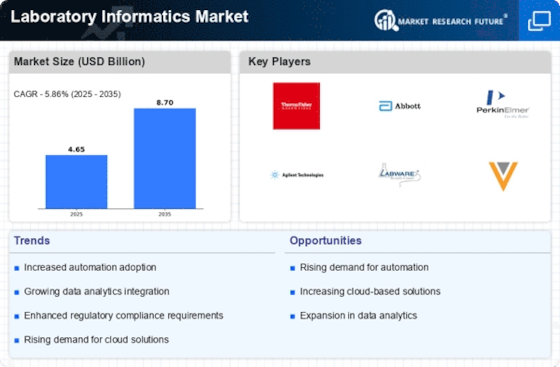
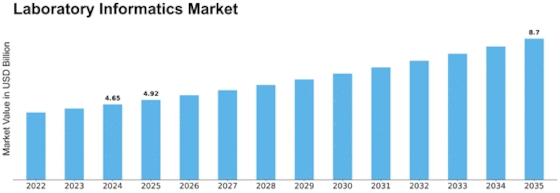
As per MRFR analysis, the Laboratory Informatics Market size was valued at USD 4.65 Billion in 2024. The market is projected to grow from USD 4.922 Billion in 2025 to USD 8.7 Billion by 2035, exhibiting a CAGR of 5.8% during the forecast period 2025-2035. North America dominated the Laboratory Informatics Market with the largest revenue share of 45% in 2024.

Key Market Trends & Highlights

The Laboratory Informatics Market is experiencing robust growth driven by technological advancements and evolving user needs.

  • The market is witnessing increased adoption of cloud solutions, particularly in North America, which remains the largest market. Integration of artificial intelligence is becoming a pivotal trend, enhancing data analysis capabilities across various laboratory settings. User-centric design is gaining traction, especially in the Electronic Lab Notebook segment, which is the fastest-growing in the market. Rising demand for data management solutions and regulatory compliance are key drivers propelling growth in both Laboratory Information Management Systems and cloud-based solutions.

Market Size & Forecast

2024 Market Size 4.65 (USD Billion)
2035 Market Size 8.7 (USD Billion)
CAGR (2025 - 2035) 5.86%
Largest Regional Market Share in 2024 North America

Major Players

<a href="https://www.thermofisher.com/in/en/home/digital-solutions/lab-informatics.html">Thermo Fisher Scientific</a> (US), Abbott Laboratories (US), PerkinElmer (US), Agilent Technologies (US), LabWare (US), Veeva Systems (US), IDBS (GB), Waters Corporation (US), Siemens Healthineers (DE), Roche Diagnostics (CH)

Market Trends

The Laboratory Informatics Market is currently experiencing a transformative phase, driven by advancements in technology and the increasing need for efficient data management solutions. Organizations are increasingly adopting laboratory informatics systems to streamline operations, enhance data integrity, and facilitate regulatory compliance.

This shift is largely influenced by the growing emphasis on automation and digitalization within laboratories, which allows for improved collaboration and data sharing among researchers and scientists. Furthermore, the integration of artificial intelligence and machine learning into laboratory informatics solutions is expected to enhance data analysis capabilities, thereby supporting more informed decision-making processes.

In addition, the Laboratory Informatics Market is witnessing a rise in demand for cloud-based solutions, which offer flexibility and scalability to organizations of varying laboratory sizes. These solutions enable laboratories to access data remotely, thus fostering a more agile research environment.

As the market evolves, it appears that the focus will increasingly shift towards user-friendly interfaces and customizable solutions that cater to specific laboratory needs. Overall, the Laboratory Informatics Market is poised for continued growth, driven by technological innovations and the ongoing quest for operational excellence in laboratory settings.

Increased Adoption of Cloud Solutions

The trend towards cloud-based laboratory informatics solutions is gaining momentum, as organizations seek to enhance flexibility and scalability. These solutions allow for remote access to data, facilitating collaboration and improving operational efficiency.

Integration of Artificial Intelligence

The incorporation of artificial intelligence into lab informatics systems is becoming more prevalent. This integration enhances data analysis capabilities, enabling laboratories to derive insights more effectively and support informed decision-making.

Focus on User-Centric Design

There is a growing emphasis on developing user-friendly interfaces within lab informatics solutions. Customizable features that cater to specific laboratory requirements are increasingly prioritized, ensuring that systems are accessible and efficient for all users.

Laboratory Informatics Market Market Drivers

Integration of Advanced Analytical Tools

The integration of advanced analytical tools is significantly shaping the Laboratory Informatics Market. Laboratories are increasingly adopting sophisticated analytical techniques to derive insights from complex datasets. This trend is driven by the need for enhanced accuracy and efficiency in research and development processes.
 
The market for analytical tools, including data visualization and statistical analysis software, is anticipated to expand by approximately 15% in the coming years. Such tools enable laboratories to make informed decisions based on real-time data analysis, thereby improving research outcomes. As a result, vendors in the Laboratory Informatics Market are focusing on creating solutions that seamlessly integrate these advanced analytical capabilities, allowing laboratories to harness the full potential of their data.

Regulatory Compliance and Quality Assurance

Regulatory compliance remains a pivotal driver in the Laboratory Informatics Market. Laboratories are subject to stringent regulations that govern their operations, particularly in sectors such as pharmaceuticals and biotechnology. The need to adhere to these regulations necessitates the implementation of informatics solutions that ensure data accuracy, traceability, and security.
 
As regulatory bodies continue to evolve their standards, laboratories are compelled to invest in informatics systems that facilitate compliance. This has resulted in a projected increase in the market for compliance-driven laboratory informatics solutions, which is expected to grow by around 10% annually. Consequently, the Laboratory Informatics Market is witnessing a shift towards solutions that not only streamline operations but also enhance quality assurance processes.

Rising Demand for Data Management Solutions

The Laboratory Informatics Market is experiencing a notable surge in demand for advanced data management solutions. Laboratories are increasingly tasked with handling vast amounts of data generated from various experiments and analyses. This has led to a growing need for software that can efficiently manage, store, and analyze this data.
 
According to recent estimates, the data management segment is projected to grow at a compound annual growth rate of approximately 12% over the next five years. This trend indicates that laboratories are prioritizing data integrity and accessibility, which are critical for compliance and operational efficiency. As a result, vendors in the Laboratory Informatics Market are focusing on developing robust data management tools that cater to the specific needs of laboratories, thereby enhancing their overall productivity.

Increased Investment in Research and Development

Investment in research and development is a critical driver of growth in the Laboratory Informatics Market. As organizations strive to innovate and develop new products, the demand for informatics solutions that support R&D activities is on the rise. This trend is particularly evident in sectors such as pharmaceuticals, where the need for efficient data management and analysis is paramount.
 
Recent data suggests that R&D spending in these sectors is expected to increase by approximately 8% annually. This growing investment is likely to propel the demand for laboratory informatics solutions that enhance research capabilities and streamline workflows. Consequently, the Laboratory Informatics Market is witnessing a surge in the development of specialized informatics tools tailored to meet the unique needs of R&D environments.

Growing Emphasis on Collaboration and Connectivity

Collaboration and connectivity are becoming increasingly vital in the Laboratory Informatics Market. As laboratories often operate in multidisciplinary environments, the need for seamless communication and data sharing among teams is paramount. This has led to the development of informatics solutions that facilitate collaborative workflows and enhance connectivity between different laboratory systems.
 
The market for collaborative laboratory informatics solutions is projected to grow at a rate of around 11% over the next few years. By fostering collaboration, laboratories can improve efficiency and innovation, ultimately leading to better research outcomes. Consequently, vendors are prioritizing the development of platforms that support collaborative features, thereby addressing the evolving needs of the Laboratory Informatics Market.

Market Segment Insights

By Type: Laboratory Information Management System (LIMS) (Largest) vs. Electronic Lab Notebooks (ELN) (Fastest-Growing)

In the Laboratory Informatics Market, the distribution among various types of informatics systems reveals a diverse landscape. The Laboratory Information Management System (LIMS) stands out as the largest segment due to its extensive adoption across laboratories for managing samples, associated data, and laboratory workflows. Following closely is the Electronic Lab Notebook (ELN) segment, which is rapidly gaining traction among research institutions and pharmaceutical companies, thanks to its ability to streamline documentation and enhance collaboration.

Laboratory System: LIMS (Dominant) vs. ELN (Emerging)

The Laboratory Information Management System (LIMS) has established itself as the dominant player in the laboratory informatics segment, enabling organizations to efficiently track samples, manage data, and ensure regulatory compliance. Its features encompass sample tracking, quality assurance, and data management capabilities. In contrast, the Electronic Lab Notebook (ELN), while currently seen as an emerging technology, is quickly becoming essential due to its digital documentation capabilities that enhance experiment reproducibility and collaboration among researchers. The ELN's integration with other systems, including LIMS and lab informatics software, is driving its adoption and positioning it as a vital tool for modern laboratories.

By Deployment Type: Cloud-Based (Largest) vs. On-Premise (Fastest-Growing)

The deployment type landscape in the laboratory informatics market displays a dynamic shift toward Cloud-Based solutions, which hold the largest market share due to their scalability, flexibility, and cost-effectiveness. On-Premise systems, while traditionally dominant, are now challenged as laboratories migrate toward more agile and collaborative environments that cloud solutions foster. Hybrid deployments, combining the best of both worlds, also play a significant role, appealing to those seeking a balance between control and flexibility. The growth trends indicate a notable acceleration in Cloud-Based deployments, driven by the demand for remote access and real-time data sharing among research teams. The rapid adoption of cutting-edge technologies and increasing regulatory requirements are compelling organizations to embrace more adaptive solutions. On-Premise systems, although slower in growth, remain relevant for institutions prioritizing data security and compliance, while Hybrid models are emerging to address varied laboratory needs, blending conventional and modern approaches.

Cloud-Based (Dominant) vs. On-Premise (Emerging)

Cloud-Based laboratory informatics solutions are paving the way for innovation in data management, offering unparalleled access, collaboration, and reduced IT overhead. This deployment type allows laboratories to leverage advanced analytics and big data capabilities, enhancing decision-making processes and improving operational efficiency. In contrast, On-Premise solutions are characterized by their security and control, catering to laboratories with strict compliance and regulatory requirements. These systems, though facing challenges from agile Cloud options, are still favored by organizations that prioritize data sovereignty. Hybrid models are carving a niche, providing a flexible approach that combines the strengths of both Cloud and On-Premise systems, thus appealing to a broader range of laboratory environments.

By End User: Pharmaceuticals (Largest) vs. Biotechnology (Fastest-Growing)

In the Laboratory Informatics Market, the Pharmaceuticals segment holds the largest share, driven by a high demand for advanced data management and analytical solutions. This sector benefits from substantial investments in research and development, leading to an increased need for informatics tools that streamline laboratory workflows and data integration. Conversely, the Biotechnology segment is the fastest-growing, fueled by the rise of <a href="https://www.marketresearchfuture.com/reports/biologics-market-1339">biologics</a> and personalized medicine, which requires specialized informatics solutions to handle complex biological data.

Pharmaceuticals (Dominant) vs. Biotechnology (Emerging)

The Pharmaceuticals segment dominates the market share due to its established infrastructure and consistent investment in technology. Companies in this segment utilize laboratory informatics to enhance <a title="drug development" href="https://www.marketresearchfuture.com/reports/drug-development-market-66529" target="_blank" rel="noopener">drug development</a> processes, manage clinical data, and ensure regulatory compliance. On the other hand, the Biotechnology segment is emerging as a key player, characterized by its innovative approaches to data analysis and integration. As research in genomics and proteomics expands, biotechnology firms increasingly rely on specialized informatics solutions to accelerate product development and bring therapies to market efficiently. This dynamic presents significant opportunities for growth and collaboration.

By Application: Drug Discovery (Largest) vs. Quality Control (Fastest-Growing)

In the Laboratory Informatics Market, the application segments exhibit a diverse distribution of market shares. Drug Discovery is the largest segment, driven by an increasing need for efficient drug development processes, robust data management, and integration of advanced technologies. Quality Control follows closely as industries prioritize the reliability and consistency of product quality, leading to a significant investment in informatics solutions. Other notable segments include Clinical Research, Environmental Testing, and Food and Beverage Testing, each contributing to the overall dynamics of the market. Looking towards growth trends, the Laboratory Informatics Market is experiencing a transformative phase. The Drug Discovery segment continues to see substantial investments as pharmaceutical organizations seek to enhance R&amp;D capabilities. Quality Control, on the other hand, is emerging rapidly as new regulations necessitate meticulous compliance and data traceability. These trends are underpinned by technological advancements and a growing demand for integrative solutions that streamline laboratory operations.

Drug Discovery: Dominant vs. Quality Control: Emerging

The Drug Discovery segment stands as a dominant force in the market share, exemplifying the critical role of data-driven insights in the pharmaceutical industry. This segment is characterized by sophisticated lab informatics software solutions that accelerate research and development processes, enabling scientists to analyze vast datasets efficiently. Despite its dominant position, Quality Control is emerging as a key player, particularly in sectors where regulatory compliance is paramount. The growth of Quality Control solutions is fueled by an increasing demand for transparency and accuracy in manufactured goods, alongside the emergence of innovative technologies such as AI and machine learning that enhance data quality and analysis. Both segments highlight evolving laboratory market demands, with Drug Discovery paving the way in pharmaceutical innovation and Quality Control ensuring product integrity across various industries.

Get more detailed insights about Laboratory Informatics Market Research Report-Forecast to 2035

Regional Insights

North America dominated the global Laboratory Informatics Market in 2024, reaching a market size of USD 2.1 billion. This strong performance can be attributed to advanced technological adoption and robust Research and Development activities in the region. Europe follows with a valuation of 1.3 USD Billion in 2024, rising to 2.6 USD Billion in 2035.

This laboratory market is driven by stringent regulations in the pharmaceutical and healthcare sectors that fuel demand for efficient laboratory informatics solutions.Asia Pacific, valued at 0.8 USD Billion in 2024, is expected to grow to 1.5 USD Billion by 2035, reflecting an increasing investment in automation and digitization of laboratories. South America and the Middle East and Africa, while smaller markets at valuations of 0.3 USD Billion and 0.1 USD Billion respectively in 2024, show potential for growth as local industries modernize their laboratory processes.

The overall Laboratory Informatics Market data points towards a positive trend, with steady growth fueled by technological advancements and an increasing emphasis on data management and compliance across all regions.

Key Players and Competitive Insights

The Laboratory Informatics Market is characterized by rapid advancements in technology, increasing demand for sophisticated data management solutions, and a growing emphasis on regulatory compliance and quality control across the life sciences sector. As organizations strive for greater efficiency and heightened analytical capabilities, the competitive landscape has become increasingly dynamic. Notably, key players are focusing on innovation, investment in research and development, and strategic partnerships to enhance their market position.
 
The lab informatics market is particularly driven by the implementation of automation and standardization of laboratory processes, which has paved the way for integrated informatics solutions that facilitate data sharing and collaboration among various stakeholders.Veeva Systems stands out in the Laboratory Informatics Market due to its specialized cloud-based applications tailored for the life sciences industry. The company leverages its strong presence in regulatory compliance and quality management to attract a diverse clientele. Veeva Systems excels in offering robust solutions that support data integrity and real-time tracking, which enhances laboratory efficiency.
 
The firm is recognized for its adaptive technology that integrates seamlessly with existing systems and processes in laboratories. Veeva’s commitment to innovation, combined with a strong focus on customer support and training, empowers organizations to optimize their informatics strategies and adapt to rapidly evolving compliance requirements, thereby reinforcing its competitive edge in the lab informatics market. Thermo Fisher Scientific plays a significant role in the Laboratory Informatics Market through its extensive range of products and services designed to support laboratory workflows and data management.
 
The company provides comprehensive laboratory informatics solutions, including data analysis software, laboratory information management systems (LIMS), and electronic lab notebooks essential for modern scientific research, driving the electronic lab notebook market. Thermo Fisher Scientific's strength lies in its ability to offer integrated solutions that enhance research efficiency and increase data reproducibility. The company has made strategic acquisitions to broaden its product portfolio, which further solidifies its market presence.
 
Additionally, Thermo Fisher’s commitment to innovation ensures that it provides state-of-the-art technology suited for a variety of applications in pharmaceuticals, biotechnology, and academic research institutions globally.
Through these competitive strategies, Thermo Fisher Scientific continues to maintain a strong foothold in the market by addressing evolving needs in laboratory informatics.

Key Companies in the Laboratory Informatics Market include

Industry Developments

The Laboratory Informatics Market has encountered significant developments recently, marked by a noticeable shift towards digital transformation in laboratory environments. Companies like Veeva Systems and Thermo Fisher Scientific are capitalizing on the trend towards cloud-based solutions, enhancing collaboration and data management in laboratories.

In April 2025, Siemens announced the acquisition of Dotmatics from Insight Partners in order to broaden its AI-powered laboratory informatics portfolio.LabKey released version 24.3 in July 2024, which includes improved Server SDMS, Sample Manager, and Biologics LIMS capabilities. 

In July 2024, Xybion Corporation collaborated with Envol Biomedical to implement Pristima LIMS to enhance the integrity of non-clinical research and development data and to ensure regulatory compliance. In May 2024, LabVantage acquired SEIN Infotech in South Korea, thereby improving its environmental compliance and EHS management solutions in the Asia Pacific region.

Future Outlook

Laboratory Informatics Market Future Outlook

The Laboratory Informatics Market is projected to grow at a 5.86% CAGR from 2025 to 2035, driven by advancements in data management, regulatory compliance, and automation technologies.

New opportunities lie in:

  • <p>Integration of AI-driven analytics platforms for enhanced data insights. Development of cloud-based laboratory management systems for remote access. Expansion of mobile laboratory informatics solutions for field research applications.</p>

By 2035, the Laboratory Informatics Market is expected to be robust, reflecting substantial growth and innovation.

Market Segmentation

Laboratory Informatics Market Type Outlook

  • Laboratory Information Management System (LIMS)
  • Electronic Lab Notebooks (ELN)
  • Scientific Data Management System (SDMS)
  • Chromatography Data System (CDS)
  • Analytics Software

Laboratory Informatics Market End User Outlook

  • Pharmaceuticals
  • Biotechnology
  • Clinical Laboratories
  • Academic Research
  • Environmental Testing

Laboratory Informatics Market Application Outlook

  • Drug Discovery
  • Quality Control
  • Clinical Research
  • Environmental Testing
  • Food and Beverage Testing

Laboratory Informatics Market Deployment Type Outlook

  • On-Premise
  • Cloud-Based
  • Hybrid

Report Scope

MARKET SIZE 2024 4.65(USD Billion)
MARKET SIZE 2025 4.922(USD Billion)
MARKET SIZE 2035 8.7(USD Billion)
COMPOUND ANNUAL GROWTH RATE (CAGR) 5.86% (2025 - 2035)
REPORT COVERAGE Revenue Forecast, Competitive Landscape, Growth Factors, and Trends
BASE YEAR 2024
Market Forecast Period 2025 - 2035
Historical Data 2019 - 2024
Market Forecast Units USD Billion
Key Companies Profiled Thermo Fisher Scientific (US), Abbott Laboratories (US), PerkinElmer (US), Agilent Technologies (US), LabWare (US), Veeva Systems (US), IDBS (GB), Waters Corporation (US), Siemens Healthineers (DE), Roche Diagnostics (CH)
Segments Covered Types, Deployment Type, End Users, Applications, Regional
Key Market Opportunities Integration of artificial intelligence in Laboratory Informatics Market enhances data analysis and operational efficiency.
Key Market Dynamics Rising demand for data integration solutions drives innovation and competition in the Laboratory Informatics Market.
Countries Covered North America, Europe, APAC, South America, MEA

FAQs

What is the current valuation of the Laboratory Informatics Market?

<p>As of 2024, the Laboratory Informatics Market was valued at 4.65 USD Billion.</p>

What is the projected market size for the Laboratory Informatics Market by 2035?

<p>The market is projected to reach 8.7 USD Billion by 2035.</p>

What is the expected CAGR for the Laboratory Informatics Market during the forecast period?

<p>The expected CAGR for the Laboratory Informatics Market from 2025 to 2035 is 5.86%.</p>

Which companies are considered key players in the Laboratory Informatics Market?

<p>Key players include Thermo Fisher Scientific, Abbott Laboratories, PerkinElmer, and Agilent Technologies, among others.</p>

What are the main segments of the Laboratory Informatics Market?

<p>The main segments include Laboratory Information Management Systems (LIMS), Electronic Lab Notebooks (ELN), and Scientific Data Management Systems (SDMS), among others.</p>

How did the Laboratory Information Management System (LIMS) segment perform in 2024?

<p>In 2024, the LIMS segment was valued at 1.4 USD Billion and is expected to grow to 2.5 USD Billion by 2035.</p>

What is the valuation of the Cloud-Based deployment type in the Laboratory Informatics Market?

<p>The Cloud-Based deployment type was valued at 2.1 USD Billion in 2024 and is projected to reach 3.5 USD Billion by 2035.</p>

Which end-user segment is expected to see the highest growth in the Laboratory Informatics Market?

<p>The Pharmaceuticals segment, valued at 1.5 USD Billion in 2024, is projected to grow to 2.8 USD Billion by 2035.</p>

What applications are driving growth in the Laboratory Informatics Market?

<p>Applications such as Clinical Research and Drug Discovery are driving growth, with Clinical Research expected to grow from 1.3 USD Billion in 2024 to 2.4 USD Billion by 2035.</p>

What is the projected growth for the Environmental Testing application in the Laboratory Informatics Market?

<p>The Environmental Testing application is expected to grow from 0.7 USD Billion in 2024 to 1.3 USD Billion by 2035.</p>

  1. SECTION I: EXECUTIVE SUMMARY AND KEY HIGHLIGHTS
    1. | 1.1 EXECUTIVE SUMMARY
    2. | | 1.1.1 Market Overview
    3. | | 1.1.2 Key Findings
    4. | | 1.1.3 Market Segmentation
    5. | | 1.1.4 Competitive Landscape
    6. | | 1.1.5 Challenges and Opportunities
    7. | | 1.1.6 Future Outlook
  2. SECTION II: SCOPING, METHODOLOGY AND MARKET STRUCTURE
    1. | 2.1 MARKET INTRODUCTION
    2. | | 2.1.1 Definition
    3. | | 2.1.2 Scope of the study
    4. | | | 2.1.2.1 Research Objective
    5. | | | 2.1.2.2 Assumption
    6. | | | 2.1.2.3 Limitations
    7. | 2.2 RESEARCH METHODOLOGY
    8. | | 2.2.1 Overview
    9. | | 2.2.2 Data Mining
    10. | | 2.2.3 Secondary Research
    11. | | 2.2.4 Primary Research
    12. | | | 2.2.4.1 Primary Interviews and Information Gathering Process
    13. | | | 2.2.4.2 Breakdown of Primary Respondents
    14. | | 2.2.5 Forecasting Model
    15. | | 2.2.6 Market Size Estimation
    16. | | | 2.2.6.1 Bottom-Up Approach
    17. | | | 2.2.6.2 Top-Down Approach
    18. | | 2.2.7 Data Triangulation
    19. | | 2.2.8 Validation
  3. SECTION III: QUALITATIVE ANALYSIS
    1. | 3.1 MARKET DYNAMICS
    2. | | 3.1.1 Overview
    3. | | 3.1.2 Drivers
    4. | | 3.1.3 Restraints
    5. | | 3.1.4 Opportunities
    6. | 3.2 MARKET FACTOR ANALYSIS
    7. | | 3.2.1 Value chain Analysis
    8. | | 3.2.2 Porter's Five Forces Analysis
    9. | | | 3.2.2.1 Bargaining Power of Suppliers
    10. | | | 3.2.2.2 Bargaining Power of Buyers
    11. | | | 3.2.2.3 Threat of New Entrants
    12. | | | 3.2.2.4 Threat of Substitutes
    13. | | | 3.2.2.5 Intensity of Rivalry
    14. | | 3.2.3 COVID-19 Impact Analysis
    15. | | | 3.2.3.1 Market Impact Analysis
    16. | | | 3.2.3.2 Regional Impact
    17. | | | 3.2.3.3 Opportunity and Threat Analysis
  4. SECTION IV: QUANTITATIVE ANALYSIS
    1. | 4.1 Healthcare, BY Type (USD Billion)
    2. | | 4.1.1 Laboratory Information Management System (LIMS)
    3. | | 4.1.2 Electronic Lab Notebooks (ELN)
    4. | | 4.1.3 Scientific Data Management System (SDMS)
    5. | | 4.1.4 Chromatography Data System (CDS)
    6. | | 4.1.5 Analytics Software
    7. | 4.2 Healthcare, BY Deployment Type (USD Billion)
    8. | | 4.2.1 On-Premise
    9. | | 4.2.2 Cloud-Based
    10. | | 4.2.3 Hybrid
    11. | 4.3 Healthcare, BY End User (USD Billion)
    12. | | 4.3.1 Pharmaceuticals
    13. | | 4.3.2 Biotechnology
    14. | | 4.3.3 Clinical Laboratories
    15. | | 4.3.4 Academic Research
    16. | | 4.3.5 Environmental Testing
    17. | 4.4 Healthcare, BY Application (USD Billion)
    18. | | 4.4.1 Drug Discovery
    19. | | 4.4.2 Quality Control
    20. | | 4.4.3 Clinical Research
    21. | | 4.4.4 Environmental Testing
    22. | | 4.4.5 Food and Beverage Testing
    23. | 4.5 Healthcare, BY Region (USD Billion)
    24. | | 4.5.1 North America
    25. | | | 4.5.1.1 US
    26. | | | 4.5.1.2 Canada
    27. | | 4.5.2 Europe
    28. | | | 4.5.2.1 Germany
    29. | | | 4.5.2.2 UK
    30. | | | 4.5.2.3 France
    31. | | | 4.5.2.4 Russia
    32. | | | 4.5.2.5 Italy
    33. | | | 4.5.2.6 Spain
    34. | | | 4.5.2.7 Rest of Europe
    35. | | 4.5.3 APAC
    36. | | | 4.5.3.1 China
    37. | | | 4.5.3.2 India
    38. | | | 4.5.3.3 Japan
    39. | | | 4.5.3.4 South Korea
    40. | | | 4.5.3.5 Malaysia
    41. | | | 4.5.3.6 Thailand
    42. | | | 4.5.3.7 Indonesia
    43. | | | 4.5.3.8 Rest of APAC
    44. | | 4.5.4 South America
    45. | | | 4.5.4.1 Brazil
    46. | | | 4.5.4.2 Mexico
    47. | | | 4.5.4.3 Argentina
    48. | | | 4.5.4.4 Rest of South America
    49. | | 4.5.5 MEA
    50. | | | 4.5.5.1 GCC Countries
    51. | | | 4.5.5.2 South Africa
    52. | | | 4.5.5.3 Rest of MEA
  5. SECTION V: COMPETITIVE ANALYSIS
    1. | 5.1 Competitive Landscape
    2. | | 5.1.1 Overview
    3. | | 5.1.2 Competitive Analysis
    4. | | 5.1.3 Market share Analysis
    5. | | 5.1.4 Major Growth Strategy in the Healthcare
    6. | | 5.1.5 Competitive Benchmarking
    7. | | 5.1.6 Leading Players in Terms of Number of Developments in the Healthcare
    8. | | 5.1.7 Key developments and growth strategies
    9. | | | 5.1.7.1 New Product Launch/Service Deployment
    10. | | | 5.1.7.2 Merger & Acquisitions
    11. | | | 5.1.7.3 Joint Ventures
    12. | | 5.1.8 Major Players Financial Matrix
    13. | | | 5.1.8.1 Sales and Operating Income
    14. | | | 5.1.8.2 Major Players R&D Expenditure. 2023
    15. | 5.2 Company Profiles
    16. | | 5.2.1 Thermo Fisher Scientific (US)
    17. | | | 5.2.1.1 Financial Overview
    18. | | | 5.2.1.2 Products Offered
    19. | | | 5.2.1.3 Key Developments
    20. | | | 5.2.1.4 SWOT Analysis
    21. | | | 5.2.1.5 Key Strategies
    22. | | 5.2.2 Abbott Laboratories (US)
    23. | | | 5.2.2.1 Financial Overview
    24. | | | 5.2.2.2 Products Offered
    25. | | | 5.2.2.3 Key Developments
    26. | | | 5.2.2.4 SWOT Analysis
    27. | | | 5.2.2.5 Key Strategies
    28. | | 5.2.3 PerkinElmer (US)
    29. | | | 5.2.3.1 Financial Overview
    30. | | | 5.2.3.2 Products Offered
    31. | | | 5.2.3.3 Key Developments
    32. | | | 5.2.3.4 SWOT Analysis
    33. | | | 5.2.3.5 Key Strategies
    34. | | 5.2.4 Agilent Technologies (US)
    35. | | | 5.2.4.1 Financial Overview
    36. | | | 5.2.4.2 Products Offered
    37. | | | 5.2.4.3 Key Developments
    38. | | | 5.2.4.4 SWOT Analysis
    39. | | | 5.2.4.5 Key Strategies
    40. | | 5.2.5 LabWare (US)
    41. | | | 5.2.5.1 Financial Overview
    42. | | | 5.2.5.2 Products Offered
    43. | | | 5.2.5.3 Key Developments
    44. | | | 5.2.5.4 SWOT Analysis
    45. | | | 5.2.5.5 Key Strategies
    46. | | 5.2.6 Veeva Systems (US)
    47. | | | 5.2.6.1 Financial Overview
    48. | | | 5.2.6.2 Products Offered
    49. | | | 5.2.6.3 Key Developments
    50. | | | 5.2.6.4 SWOT Analysis
    51. | | | 5.2.6.5 Key Strategies
    52. | | 5.2.7 IDBS (GB)
    53. | | | 5.2.7.1 Financial Overview
    54. | | | 5.2.7.2 Products Offered
    55. | | | 5.2.7.3 Key Developments
    56. | | | 5.2.7.4 SWOT Analysis
    57. | | | 5.2.7.5 Key Strategies
    58. | | 5.2.8 Waters Corporation (US)
    59. | | | 5.2.8.1 Financial Overview
    60. | | | 5.2.8.2 Products Offered
    61. | | | 5.2.8.3 Key Developments
    62. | | | 5.2.8.4 SWOT Analysis
    63. | | | 5.2.8.5 Key Strategies
    64. | | 5.2.9 Siemens Healthineers (DE)
    65. | | | 5.2.9.1 Financial Overview
    66. | | | 5.2.9.2 Products Offered
    67. | | | 5.2.9.3 Key Developments
    68. | | | 5.2.9.4 SWOT Analysis
    69. | | | 5.2.9.5 Key Strategies
    70. | | 5.2.10 Roche Diagnostics (CH)
    71. | | | 5.2.10.1 Financial Overview
    72. | | | 5.2.10.2 Products Offered
    73. | | | 5.2.10.3 Key Developments
    74. | | | 5.2.10.4 SWOT Analysis
    75. | | | 5.2.10.5 Key Strategies
    76. | 5.3 Appendix
    77. | | 5.3.1 References
    78. | | 5.3.2 Related Reports
  6. LIST OF FIGURES
    1. | 6.1 MARKET SYNOPSIS
    2. | 6.2 NORTH AMERICA MARKET ANALYSIS
    3. | 6.3 US MARKET ANALYSIS BY TYPE
    4. | 6.4 US MARKET ANALYSIS BY DEPLOYMENT TYPE
    5. | 6.5 US MARKET ANALYSIS BY END USER
    6. | 6.6 US MARKET ANALYSIS BY APPLICATION
    7. | 6.7 CANADA MARKET ANALYSIS BY TYPE
    8. | 6.8 CANADA MARKET ANALYSIS BY DEPLOYMENT TYPE
    9. | 6.9 CANADA MARKET ANALYSIS BY END USER
    10. | 6.10 CANADA MARKET ANALYSIS BY APPLICATION
    11. | 6.11 EUROPE MARKET ANALYSIS
    12. | 6.12 GERMANY MARKET ANALYSIS BY TYPE
    13. | 6.13 GERMANY MARKET ANALYSIS BY DEPLOYMENT TYPE
    14. | 6.14 GERMANY MARKET ANALYSIS BY END USER
    15. | 6.15 GERMANY MARKET ANALYSIS BY APPLICATION
    16. | 6.16 UK MARKET ANALYSIS BY TYPE
    17. | 6.17 UK MARKET ANALYSIS BY DEPLOYMENT TYPE
    18. | 6.18 UK MARKET ANALYSIS BY END USER
    19. | 6.19 UK MARKET ANALYSIS BY APPLICATION
    20. | 6.20 FRANCE MARKET ANALYSIS BY TYPE
    21. | 6.21 FRANCE MARKET ANALYSIS BY DEPLOYMENT TYPE
    22. | 6.22 FRANCE MARKET ANALYSIS BY END USER
    23. | 6.23 FRANCE MARKET ANALYSIS BY APPLICATION
    24. | 6.24 RUSSIA MARKET ANALYSIS BY TYPE
    25. | 6.25 RUSSIA MARKET ANALYSIS BY DEPLOYMENT TYPE
    26. | 6.26 RUSSIA MARKET ANALYSIS BY END USER
    27. | 6.27 RUSSIA MARKET ANALYSIS BY APPLICATION
    28. | 6.28 ITALY MARKET ANALYSIS BY TYPE
    29. | 6.29 ITALY MARKET ANALYSIS BY DEPLOYMENT TYPE
    30. | 6.30 ITALY MARKET ANALYSIS BY END USER
    31. | 6.31 ITALY MARKET ANALYSIS BY APPLICATION
    32. | 6.32 SPAIN MARKET ANALYSIS BY TYPE
    33. | 6.33 SPAIN MARKET ANALYSIS BY DEPLOYMENT TYPE
    34. | 6.34 SPAIN MARKET ANALYSIS BY END USER
    35. | 6.35 SPAIN MARKET ANALYSIS BY APPLICATION
    36. | 6.36 REST OF EUROPE MARKET ANALYSIS BY TYPE
    37. | 6.37 REST OF EUROPE MARKET ANALYSIS BY DEPLOYMENT TYPE
    38. | 6.38 REST OF EUROPE MARKET ANALYSIS BY END USER
    39. | 6.39 REST OF EUROPE MARKET ANALYSIS BY APPLICATION
    40. | 6.40 APAC MARKET ANALYSIS
    41. | 6.41 CHINA MARKET ANALYSIS BY TYPE
    42. | 6.42 CHINA MARKET ANALYSIS BY DEPLOYMENT TYPE
    43. | 6.43 CHINA MARKET ANALYSIS BY END USER
    44. | 6.44 CHINA MARKET ANALYSIS BY APPLICATION
    45. | 6.45 INDIA MARKET ANALYSIS BY TYPE
    46. | 6.46 INDIA MARKET ANALYSIS BY DEPLOYMENT TYPE
    47. | 6.47 INDIA MARKET ANALYSIS BY END USER
    48. | 6.48 INDIA MARKET ANALYSIS BY APPLICATION
    49. | 6.49 JAPAN MARKET ANALYSIS BY TYPE
    50. | 6.50 JAPAN MARKET ANALYSIS BY DEPLOYMENT TYPE
    51. | 6.51 JAPAN MARKET ANALYSIS BY END USER
    52. | 6.52 JAPAN MARKET ANALYSIS BY APPLICATION
    53. | 6.53 SOUTH KOREA MARKET ANALYSIS BY TYPE
    54. | 6.54 SOUTH KOREA MARKET ANALYSIS BY DEPLOYMENT TYPE
    55. | 6.55 SOUTH KOREA MARKET ANALYSIS BY END USER
    56. | 6.56 SOUTH KOREA MARKET ANALYSIS BY APPLICATION
    57. | 6.57 MALAYSIA MARKET ANALYSIS BY TYPE
    58. | 6.58 MALAYSIA MARKET ANALYSIS BY DEPLOYMENT TYPE
    59. | 6.59 MALAYSIA MARKET ANALYSIS BY END USER
    60. | 6.60 MALAYSIA MARKET ANALYSIS BY APPLICATION
    61. | 6.61 THAILAND MARKET ANALYSIS BY TYPE
    62. | 6.62 THAILAND MARKET ANALYSIS BY DEPLOYMENT TYPE
    63. | 6.63 THAILAND MARKET ANALYSIS BY END USER
    64. | 6.64 THAILAND MARKET ANALYSIS BY APPLICATION
    65. | 6.65 INDONESIA MARKET ANALYSIS BY TYPE
    66. | 6.66 INDONESIA MARKET ANALYSIS BY DEPLOYMENT TYPE
    67. | 6.67 INDONESIA MARKET ANALYSIS BY END USER
    68. | 6.68 INDONESIA MARKET ANALYSIS BY APPLICATION
    69. | 6.69 REST OF APAC MARKET ANALYSIS BY TYPE
    70. | 6.70 REST OF APAC MARKET ANALYSIS BY DEPLOYMENT TYPE
    71. | 6.71 REST OF APAC MARKET ANALYSIS BY END USER
    72. | 6.72 REST OF APAC MARKET ANALYSIS BY APPLICATION
    73. | 6.73 SOUTH AMERICA MARKET ANALYSIS
    74. | 6.74 BRAZIL MARKET ANALYSIS BY TYPE
    75. | 6.75 BRAZIL MARKET ANALYSIS BY DEPLOYMENT TYPE
    76. | 6.76 BRAZIL MARKET ANALYSIS BY END USER
    77. | 6.77 BRAZIL MARKET ANALYSIS BY APPLICATION
    78. | 6.78 MEXICO MARKET ANALYSIS BY TYPE
    79. | 6.79 MEXICO MARKET ANALYSIS BY DEPLOYMENT TYPE
    80. | 6.80 MEXICO MARKET ANALYSIS BY END USER
    81. | 6.81 MEXICO MARKET ANALYSIS BY APPLICATION
    82. | 6.82 ARGENTINA MARKET ANALYSIS BY TYPE
    83. | 6.83 ARGENTINA MARKET ANALYSIS BY DEPLOYMENT TYPE
    84. | 6.84 ARGENTINA MARKET ANALYSIS BY END USER
    85. | 6.85 ARGENTINA MARKET ANALYSIS BY APPLICATION
    86. | 6.86 REST OF SOUTH AMERICA MARKET ANALYSIS BY TYPE
    87. | 6.87 REST OF SOUTH AMERICA MARKET ANALYSIS BY DEPLOYMENT TYPE
    88. | 6.88 REST OF SOUTH AMERICA MARKET ANALYSIS BY END USER
    89. | 6.89 REST OF SOUTH AMERICA MARKET ANALYSIS BY APPLICATION
    90. | 6.90 MEA MARKET ANALYSIS
    91. | 6.91 GCC COUNTRIES MARKET ANALYSIS BY TYPE
    92. | 6.92 GCC COUNTRIES MARKET ANALYSIS BY DEPLOYMENT TYPE
    93. | 6.93 GCC COUNTRIES MARKET ANALYSIS BY END USER
    94. | 6.94 GCC COUNTRIES MARKET ANALYSIS BY APPLICATION
    95. | 6.95 SOUTH AFRICA MARKET ANALYSIS BY TYPE
    96. | 6.96 SOUTH AFRICA MARKET ANALYSIS BY DEPLOYMENT TYPE
    97. | 6.97 SOUTH AFRICA MARKET ANALYSIS BY END USER
    98. | 6.98 SOUTH AFRICA MARKET ANALYSIS BY APPLICATION
    99. | 6.99 REST OF MEA MARKET ANALYSIS BY TYPE
    100. | 6.100 REST OF MEA MARKET ANALYSIS BY DEPLOYMENT TYPE
    101. | 6.101 REST OF MEA MARKET ANALYSIS BY END USER
    102. | 6.102 REST OF MEA MARKET ANALYSIS BY APPLICATION
    103. | 6.103 KEY BUYING CRITERIA OF HEALTHCARE
    104. | 6.104 RESEARCH PROCESS OF MRFR
    105. | 6.105 DRO ANALYSIS OF HEALTHCARE
    106. | 6.106 DRIVERS IMPACT ANALYSIS: HEALTHCARE
    107. | 6.107 RESTRAINTS IMPACT ANALYSIS: HEALTHCARE
    108. | 6.108 SUPPLY / VALUE CHAIN: HEALTHCARE
    109. | 6.109 HEALTHCARE, BY TYPE, 2024 (% SHARE)
    110. | 6.110 HEALTHCARE, BY TYPE, 2024 TO 2035 (USD Billion)
    111. | 6.111 HEALTHCARE, BY DEPLOYMENT TYPE, 2024 (% SHARE)
    112. | 6.112 HEALTHCARE, BY DEPLOYMENT TYPE, 2024 TO 2035 (USD Billion)
    113. | 6.113 HEALTHCARE, BY END USER, 2024 (% SHARE)
    114. | 6.114 HEALTHCARE, BY END USER, 2024 TO 2035 (USD Billion)
    115. | 6.115 HEALTHCARE, BY APPLICATION, 2024 (% SHARE)
    116. | 6.116 HEALTHCARE, BY APPLICATION, 2024 TO 2035 (USD Billion)
    117. | 6.117 BENCHMARKING OF MAJOR COMPETITORS
  7. LIST OF TABLES
    1. | 7.1 LIST OF ASSUMPTIONS
    2. | | 7.1.1
    3. | 7.2 North America MARKET SIZE ESTIMATES; FORECAST
    4. | | 7.2.1 BY TYPE, 2025-2035 (USD Billion)
    5. | | 7.2.2 BY DEPLOYMENT TYPE, 2025-2035 (USD Billion)
    6. | | 7.2.3 BY END USER, 2025-2035 (USD Billion)
    7. | | 7.2.4 BY APPLICATION, 2025-2035 (USD Billion)
    8. | 7.3 US MARKET SIZE ESTIMATES; FORECAST
    9. | | 7.3.1 BY TYPE, 2025-2035 (USD Billion)
    10. | | 7.3.2 BY DEPLOYMENT TYPE, 2025-2035 (USD Billion)
    11. | | 7.3.3 BY END USER, 2025-2035 (USD Billion)
    12. | | 7.3.4 BY APPLICATION, 2025-2035 (USD Billion)
    13. | 7.4 Canada MARKET SIZE ESTIMATES; FORECAST
    14. | | 7.4.1 BY TYPE, 2025-2035 (USD Billion)
    15. | | 7.4.2 BY DEPLOYMENT TYPE, 2025-2035 (USD Billion)
    16. | | 7.4.3 BY END USER, 2025-2035 (USD Billion)
    17. | | 7.4.4 BY APPLICATION, 2025-2035 (USD Billion)
    18. | 7.5 Europe MARKET SIZE ESTIMATES; FORECAST
    19. | | 7.5.1 BY TYPE, 2025-2035 (USD Billion)
    20. | | 7.5.2 BY DEPLOYMENT TYPE, 2025-2035 (USD Billion)
    21. | | 7.5.3 BY END USER, 2025-2035 (USD Billion)
    22. | | 7.5.4 BY APPLICATION, 2025-2035 (USD Billion)
    23. | 7.6 Germany MARKET SIZE ESTIMATES; FORECAST
    24. | | 7.6.1 BY TYPE, 2025-2035 (USD Billion)
    25. | | 7.6.2 BY DEPLOYMENT TYPE, 2025-2035 (USD Billion)
    26. | | 7.6.3 BY END USER, 2025-2035 (USD Billion)
    27. | | 7.6.4 BY APPLICATION, 2025-2035 (USD Billion)
    28. | 7.7 UK MARKET SIZE ESTIMATES; FORECAST
    29. | | 7.7.1 BY TYPE, 2025-2035 (USD Billion)
    30. | | 7.7.2 BY DEPLOYMENT TYPE, 2025-2035 (USD Billion)
    31. | | 7.7.3 BY END USER, 2025-2035 (USD Billion)
    32. | | 7.7.4 BY APPLICATION, 2025-2035 (USD Billion)
    33. | 7.8 France MARKET SIZE ESTIMATES; FORECAST
    34. | | 7.8.1 BY TYPE, 2025-2035 (USD Billion)
    35. | | 7.8.2 BY DEPLOYMENT TYPE, 2025-2035 (USD Billion)
    36. | | 7.8.3 BY END USER, 2025-2035 (USD Billion)
    37. | | 7.8.4 BY APPLICATION, 2025-2035 (USD Billion)
    38. | 7.9 Russia MARKET SIZE ESTIMATES; FORECAST
    39. | | 7.9.1 BY TYPE, 2025-2035 (USD Billion)
    40. | | 7.9.2 BY DEPLOYMENT TYPE, 2025-2035 (USD Billion)
    41. | | 7.9.3 BY END USER, 2025-2035 (USD Billion)
    42. | | 7.9.4 BY APPLICATION, 2025-2035 (USD Billion)
    43. | 7.10 Italy MARKET SIZE ESTIMATES; FORECAST
    44. | | 7.10.1 BY TYPE, 2025-2035 (USD Billion)
    45. | | 7.10.2 BY DEPLOYMENT TYPE, 2025-2035 (USD Billion)
    46. | | 7.10.3 BY END USER, 2025-2035 (USD Billion)
    47. | | 7.10.4 BY APPLICATION, 2025-2035 (USD Billion)
    48. | 7.11 Spain MARKET SIZE ESTIMATES; FORECAST
    49. | | 7.11.1 BY TYPE, 2025-2035 (USD Billion)
    50. | | 7.11.2 BY DEPLOYMENT TYPE, 2025-2035 (USD Billion)
    51. | | 7.11.3 BY END USER, 2025-2035 (USD Billion)
    52. | | 7.11.4 BY APPLICATION, 2025-2035 (USD Billion)
    53. | 7.12 Rest of Europe MARKET SIZE ESTIMATES; FORECAST
    54. | | 7.12.1 BY TYPE, 2025-2035 (USD Billion)
    55. | | 7.12.2 BY DEPLOYMENT TYPE, 2025-2035 (USD Billion)
    56. | | 7.12.3 BY END USER, 2025-2035 (USD Billion)
    57. | | 7.12.4 BY APPLICATION, 2025-2035 (USD Billion)
    58. | 7.13 APAC MARKET SIZE ESTIMATES; FORECAST
    59. | | 7.13.1 BY TYPE, 2025-2035 (USD Billion)
    60. | | 7.13.2 BY DEPLOYMENT TYPE, 2025-2035 (USD Billion)
    61. | | 7.13.3 BY END USER, 2025-2035 (USD Billion)
    62. | | 7.13.4 BY APPLICATION, 2025-2035 (USD Billion)
    63. | 7.14 China MARKET SIZE ESTIMATES; FORECAST
    64. | | 7.14.1 BY TYPE, 2025-2035 (USD Billion)
    65. | | 7.14.2 BY DEPLOYMENT TYPE, 2025-2035 (USD Billion)
    66. | | 7.14.3 BY END USER, 2025-2035 (USD Billion)
    67. | | 7.14.4 BY APPLICATION, 2025-2035 (USD Billion)
    68. | 7.15 India MARKET SIZE ESTIMATES; FORECAST
    69. | | 7.15.1 BY TYPE, 2025-2035 (USD Billion)
    70. | | 7.15.2 BY DEPLOYMENT TYPE, 2025-2035 (USD Billion)
    71. | | 7.15.3 BY END USER, 2025-2035 (USD Billion)
    72. | | 7.15.4 BY APPLICATION, 2025-2035 (USD Billion)
    73. | 7.16 Japan MARKET SIZE ESTIMATES; FORECAST
    74. | | 7.16.1 BY TYPE, 2025-2035 (USD Billion)
    75. | | 7.16.2 BY DEPLOYMENT TYPE, 2025-2035 (USD Billion)
    76. | | 7.16.3 BY END USER, 2025-2035 (USD Billion)
    77. | | 7.16.4 BY APPLICATION, 2025-2035 (USD Billion)
    78. | 7.17 South Korea MARKET SIZE ESTIMATES; FORECAST
    79. | | 7.17.1 BY TYPE, 2025-2035 (USD Billion)
    80. | | 7.17.2 BY DEPLOYMENT TYPE, 2025-2035 (USD Billion)
    81. | | 7.17.3 BY END USER, 2025-2035 (USD Billion)
    82. | | 7.17.4 BY APPLICATION, 2025-2035 (USD Billion)
    83. | 7.18 Malaysia MARKET SIZE ESTIMATES; FORECAST
    84. | | 7.18.1 BY TYPE, 2025-2035 (USD Billion)
    85. | | 7.18.2 BY DEPLOYMENT TYPE, 2025-2035 (USD Billion)
    86. | | 7.18.3 BY END USER, 2025-2035 (USD Billion)
    87. | | 7.18.4 BY APPLICATION, 2025-2035 (USD Billion)
    88. | 7.19 Thailand MARKET SIZE ESTIMATES; FORECAST
    89. | | 7.19.1 BY TYPE, 2025-2035 (USD Billion)
    90. | | 7.19.2 BY DEPLOYMENT TYPE, 2025-2035 (USD Billion)
    91. | | 7.19.3 BY END USER, 2025-2035 (USD Billion)
    92. | | 7.19.4 BY APPLICATION, 2025-2035 (USD Billion)
    93. | 7.20 Indonesia MARKET SIZE ESTIMATES; FORECAST
    94. | | 7.20.1 BY TYPE, 2025-2035 (USD Billion)
    95. | | 7.20.2 BY DEPLOYMENT TYPE, 2025-2035 (USD Billion)
    96. | | 7.20.3 BY END USER, 2025-2035 (USD Billion)
    97. | | 7.20.4 BY APPLICATION, 2025-2035 (USD Billion)
    98. | 7.21 Rest of APAC MARKET SIZE ESTIMATES; FORECAST
    99. | | 7.21.1 BY TYPE, 2025-2035 (USD Billion)
    100. | | 7.21.2 BY DEPLOYMENT TYPE, 2025-2035 (USD Billion)
    101. | | 7.21.3 BY END USER, 2025-2035 (USD Billion)
    102. | | 7.21.4 BY APPLICATION, 2025-2035 (USD Billion)
    103. | 7.22 South America MARKET SIZE ESTIMATES; FORECAST
    104. | | 7.22.1 BY TYPE, 2025-2035 (USD Billion)
    105. | | 7.22.2 BY DEPLOYMENT TYPE, 2025-2035 (USD Billion)
    106. | | 7.22.3 BY END USER, 2025-2035 (USD Billion)
    107. | | 7.22.4 BY APPLICATION, 2025-2035 (USD Billion)
    108. | 7.23 Brazil MARKET SIZE ESTIMATES; FORECAST
    109. | | 7.23.1 BY TYPE, 2025-2035 (USD Billion)
    110. | | 7.23.2 BY DEPLOYMENT TYPE, 2025-2035 (USD Billion)
    111. | | 7.23.3 BY END USER, 2025-2035 (USD Billion)
    112. | | 7.23.4 BY APPLICATION, 2025-2035 (USD Billion)
    113. | 7.24 Mexico MARKET SIZE ESTIMATES; FORECAST
    114. | | 7.24.1 BY TYPE, 2025-2035 (USD Billion)
    115. | | 7.24.2 BY DEPLOYMENT TYPE, 2025-2035 (USD Billion)
    116. | | 7.24.3 BY END USER, 2025-2035 (USD Billion)
    117. | | 7.24.4 BY APPLICATION, 2025-2035 (USD Billion)
    118. | 7.25 Argentina MARKET SIZE ESTIMATES; FORECAST
    119. | | 7.25.1 BY TYPE, 2025-2035 (USD Billion)
    120. | | 7.25.2 BY DEPLOYMENT TYPE, 2025-2035 (USD Billion)
    121. | | 7.25.3 BY END USER, 2025-2035 (USD Billion)
    122. | | 7.25.4 BY APPLICATION, 2025-2035 (USD Billion)
    123. | 7.26 Rest of South America MARKET SIZE ESTIMATES; FORECAST
    124. | | 7.26.1 BY TYPE, 2025-2035 (USD Billion)
    125. | | 7.26.2 BY DEPLOYMENT TYPE, 2025-2035 (USD Billion)
    126. | | 7.26.3 BY END USER, 2025-2035 (USD Billion)
    127. | | 7.26.4 BY APPLICATION, 2025-2035 (USD Billion)
    128. | 7.27 MEA MARKET SIZE ESTIMATES; FORECAST
    129. | | 7.27.1 BY TYPE, 2025-2035 (USD Billion)
    130. | | 7.27.2 BY DEPLOYMENT TYPE, 2025-2035 (USD Billion)
    131. | | 7.27.3 BY END USER, 2025-2035 (USD Billion)
    132. | | 7.27.4 BY APPLICATION, 2025-2035 (USD Billion)
    133. | 7.28 GCC Countries MARKET SIZE ESTIMATES; FORECAST
    134. | | 7.28.1 BY TYPE, 2025-2035 (USD Billion)
    135. | | 7.28.2 BY DEPLOYMENT TYPE, 2025-2035 (USD Billion)
    136. | | 7.28.3 BY END USER, 2025-2035 (USD Billion)
    137. | | 7.28.4 BY APPLICATION, 2025-2035 (USD Billion)
    138. | 7.29 South Africa MARKET SIZE ESTIMATES; FORECAST
    139. | | 7.29.1 BY TYPE, 2025-2035 (USD Billion)
    140. | | 7.29.2 BY DEPLOYMENT TYPE, 2025-2035 (USD Billion)
    141. | | 7.29.3 BY END USER, 2025-2035 (USD Billion)
    142. | | 7.29.4 BY APPLICATION, 2025-2035 (USD Billion)
    143. | 7.30 Rest of MEA MARKET SIZE ESTIMATES; FORECAST
    144. | | 7.30.1 BY TYPE, 2025-2035 (USD Billion)
    145. | | 7.30.2 BY DEPLOYMENT TYPE, 2025-2035 (USD Billion)
    146. | | 7.30.3 BY END USER, 2025-2035 (USD Billion)
    147. | | 7.30.4 BY APPLICATION, 2025-2035 (USD Billion)
    148. | 7.31 PRODUCT LAUNCH/PRODUCT DEVELOPMENT/APPROVAL
    149. | | 7.31.1
    150. | 7.32 ACQUISITION/PARTNERSHIP
    151. | | 7.32.1

Healthcare Market Segmentation

Healthcare By Type (USD Billion, 2025-2035)

  • Laboratory Information Management System (LIMS)
  • Electronic Lab Notebooks (ELN)
  • Scientific Data Management System (SDMS)
  • Chromatography Data System (CDS)
  • Analytics Software

Healthcare By Deployment Type (USD Billion, 2025-2035)

  • On-Premise
  • Cloud-Based
  • Hybrid

Healthcare By End User (USD Billion, 2025-2035)

  • Pharmaceuticals
  • Biotechnology
  • Clinical Laboratories
  • Academic Research
  • Environmental Testing

Healthcare By Application (USD Billion, 2025-2035)

  • Drug Discovery
  • Quality Control
  • Clinical Research
  • Environmental Testing
  • Food and Beverage Testing
Infographic

Free Sample Request

Kindly complete the form below to receive a free sample of this Report

Get Free Sample

Customer Strories

Compare Licence

×
Features License Type
Single User Multiuser License Enterprise User
Price $4,950 $5,950 $7,250
Maximum User Access Limit 1 User Upto 10 Users Unrestricted Access Throughout the Organization
Free Customization
Direct Access to Analyst
Deliverable Format
Platform Access
Discount on Next Purchase 10% 15% 15%
Printable Versions