×
Request Free Sample ×

Kindly complete the form below to receive a free sample of this Report

* Please use a valid business email

Leading companies partner with us for data-driven Insights

clients tt-cursor
Hero Background

Japan Video Processing Platform Market

ID: MRFR/ICT/60811-HCR
200 Pages
Aarti Dhapte
February 2026

Japan Video Processing Platform Market Size, Share and Research Report: By Component (Hardware, Platform, Services), By Application (Video Upload and Ingestion, Dynamic Ad Insertion, Video Transcoding and Processing, Video Hosting, Content Rendering), By Content Type (Real-Time/Live, On-Demand), By End User (TV Broadcasters, Network Operators, Content Providers) and By Verticals (BFSI, Manufacturing, IT and Telecommunications, Retail and Consumer Goods, Media and Entertainment)- Industry Forecast to 2035

Share:
Download PDF ×

We do not share your information with anyone. However, we may send you emails based on your report interest from time to time. You may contact us at any time to opt-out.

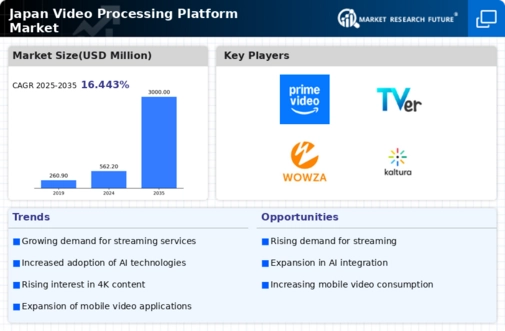
Japan Video Processing Platform Market Infographic
Purchase Options

Japan Video Processing Platform Market Summary

As per analysis, the Japan video processing platform market is projected to grow from USD 0.422 Billion in 2025 to USD 1.79 Billion by 2035, exhibiting a compound annual growth rate (CAGR) of 15.51% during the forecast period (2025 - 2035).

Key Market Trends & Highlights

The Japan video processing platform market is experiencing robust growth driven by technological advancements and evolving consumer demands.

  • The video editing segment remains the largest, reflecting a strong demand for high-quality content creation.
  • Live streaming is the fastest-growing segment, propelled by the increasing popularity of real-time content sharing.
  • The media and entertainment sector dominates the market, while the education sector is rapidly expanding due to the rise of e-learning.
  • Key market drivers include the growing demand for video content and advancements in technology, which are shaping the industry's future.

Market Size & Forecast

2024 Market Size 0.366 (USD Billion)
2035 Market Size 1.79 (USD Billion)
CAGR (2025 - 2035) 15.51%

Major Players

Adobe (JP), NVIDIA (JP), Sony (JP), Panasonic (JP), Hitachi (JP), NEC (JP), CyberLink (JP), Avid Technology (JP), Blackmagic Design (JP)

Our Impact
Enabled $4.3B Revenue Impact for Fortune 500 and Leading Multinationals
Partnering with 2000+ Global Organizations Each Year
30K+ Citations by Top-Tier Firms in the Industry

Japan Video Processing Platform Market Trends

The japan video processing platform market is currently experiencing a dynamic evolution, driven by advancements in technology and increasing consumer demand for high-quality video content. As the digital landscape continues to expand, various sectors, including entertainment, education, and corporate communications, are increasingly relying on sophisticated video processing solutions. This shift is indicative of a broader trend towards enhanced user engagement and the necessity for seamless content delivery. Furthermore, the proliferation of mobile devices and high-speed internet access in Japan has catalyzed the growth of video streaming services, thereby intensifying competition among platform providers. In addition, the rise of artificial intelligence and machine learning technologies is reshaping the capabilities of video processing platforms. These innovations enable more efficient content creation, editing, and distribution processes, which are essential for meeting the evolving expectations of consumers. As a result, companies within the japan video processing platform market are likely to invest heavily in research and development to stay ahead of the curve. The interplay between technological advancements and consumer preferences suggests a promising outlook for the market, as stakeholders adapt to the changing landscape and explore new opportunities for growth.

Increased Adoption of Cloud-Based Solutions

The trend towards cloud-based video processing solutions is gaining traction within the japan video processing platform market. This shift allows for greater scalability, flexibility, and cost-effectiveness, enabling businesses to manage their video content more efficiently. As organizations seek to streamline operations and reduce infrastructure costs, cloud solutions are becoming increasingly appealing.

Integration of AI and Machine Learning

The integration of artificial intelligence and machine learning technologies is transforming the capabilities of video processing platforms in Japan. These technologies facilitate advanced features such as automated editing, content analysis, and personalized recommendations, enhancing user experience and engagement. As a result, companies are likely to prioritize AI-driven innovations to remain competitive.

Focus on Enhanced User Experience

There is a growing emphasis on enhancing user experience within the japan video processing platform market. Companies are investing in user-friendly interfaces, improved accessibility, and interactive features to attract and retain customers. This focus on user experience is crucial for fostering loyalty and ensuring sustained growth in a competitive environment.

Japan Video Processing Platform Market Drivers

Advancements in Technology

Technological advancements play a crucial role in the evolution of the Japan video processing platform market. Innovations in video encoding, compression, and streaming technologies are enabling platforms to deliver higher quality video with reduced latency. For instance, the adoption of 4K and 8K video formats is becoming more prevalent, necessitating robust processing capabilities. Furthermore, the integration of artificial intelligence and machine learning algorithms is enhancing video analytics and personalization features, allowing for more tailored user experiences. As technology continues to advance, it is expected that the Japan video processing platform market will witness increased competition among providers striving to offer cutting-edge solutions that meet the demands of both consumers and businesses.

Growing Demand for Video Content

The Japan video processing platform market is experiencing a notable surge in demand for video content across various sectors. With the proliferation of digital platforms and social media, businesses are increasingly leveraging video as a primary medium for communication and marketing. According to recent statistics, the consumption of online video content in Japan has risen significantly, with over 80% of internet users engaging with video content regularly. This trend is driving the need for advanced video processing solutions that can enhance content quality and delivery. As a result, companies are investing in video processing platforms to meet the growing expectations of consumers for high-quality, engaging video experiences. This demand is likely to continue to shape the landscape of the Japan video processing platform market in the coming years.

Rise of E-Learning and Remote Work

The shift towards e-learning and remote work has significantly impacted the Japan video processing platform market. Educational institutions and businesses are increasingly utilizing video as a tool for training and communication, leading to a heightened demand for reliable video processing solutions. Reports indicate that the e-learning market in Japan is projected to grow substantially, with video content being a key component of this growth. As organizations seek to enhance their online training programs and virtual meetings, the need for high-quality video processing platforms becomes paramount. This trend is likely to persist, further driving the adoption of video processing technologies in various sectors, including education and corporate training.

Regulatory Support for Digital Media

The Japan video processing platform market benefits from supportive regulatory frameworks that promote the growth of digital media. The government has implemented policies aimed at fostering innovation and investment in the technology sector, particularly in media and entertainment. Initiatives such as the Digital Agency's efforts to enhance digital infrastructure and promote content creation are indicative of this support. Additionally, regulations that encourage the use of local content and protect intellectual property rights are likely to bolster the market. As these policies continue to evolve, they may create a more favorable environment for video processing platforms, facilitating their expansion and adoption across various industries in Japan.

Increased Investment in Media and Entertainment

Investment in the media and entertainment sector is a significant driver of the Japan video processing platform market. With the rise of streaming services and digital content consumption, companies are allocating substantial resources to enhance their video offerings. The Japanese entertainment industry has seen a marked increase in funding for content production and distribution, which in turn fuels the demand for advanced video processing solutions. As streaming platforms compete for viewer attention, the need for high-quality video processing capabilities becomes essential. This influx of investment is expected to stimulate innovation and growth within the Japan video processing platform market, creating opportunities for both established players and new entrants.


Market Segment Insights

By Application: Video Editing (Largest) vs. Live Streaming (Fastest-Growing)

In the Japan video processing platform market, the application segment showcases a diverse distribution among four primary values: Video Editing, Live Streaming, Content Creation, and Video Conferencing. Video Editing stands as the largest application, driven by the demand for high-quality content production in both professional and amateur circles. It holds a significant share, reflecting its essential role in media production. In contrast, Live Streaming has emerged rapidly, gaining traction due to the increasing popularity of real-time content sharing, especially in gaming and events, establishing itself as a critical player within the market.

Video Editing (Dominant) vs. Live Streaming (Emerging)

Video Editing is the dominant force in Japan's video processing platform market, favored by a range of users from professional filmmakers to hobbyists seeking to create polished content. This segment benefits from advanced editing tools and the growing trend of video consumption on social media platforms. On the other hand, Live Streaming represents an emerging market force characterized by its rapid growth, fueled by the rise of platforms facilitating instant broadcasting. The demand for interactive experiences and real-time audience engagement drives this segment, making it increasingly vital for brands and creators looking to connect with audiences more dynamically.

By End Use: Media and Entertainment (Largest) vs. Education (Fastest-Growing)

In the Japan video processing platform market, the end-use segment is dominated by Media and Entertainment, capturing a substantial market share. This segment encompasses various applications, including content creation, streaming services, and digital broadcasting, which continue to surge in popularity. Following closely, Education is emerging as a significant component, especially as institutions increasingly adopt digital platforms for remote learning and hybrid models, thereby expanding the usage of video processing technologies. The growth trends within these segments are driven primarily by technological advancements and changing consumer behaviors. The Media and Entertainment sector benefits from enhanced video quality and interactive features that attract a broader audience. On the other hand, the Education segment is benefitting from a rapidly increasing acceptance of online learning platforms, accelerated by recent global events, and the need for more innovative educational tools. This environment fosters substantial opportunities for video processing solutions tailored to each sector's unique requirements.

Media and Entertainment: Dominant vs. Education: Emerging

The Media and Entertainment segment in the Japan video processing platform market is characterized by its vast array of applications, including video streaming, film production, and gaming. This segment's dominance is driven by the increasing consumption of digital content and the necessity for high-quality video delivery across platforms. Businesses are investing in advanced video processing technologies to enhance user engagement and deliver rich content experiences. Conversely, the Education segment is positioned as an emerging player, gaining traction as more educational institutions adopt video-based teaching methods. The shift towards online learning has triggered the demand for robust video processing tools that facilitate the creation and distribution of educational content. This segment emphasizes user-friendly interfaces and interactive features, making video processing platforms essential in creating engaging and effective learning environments.

By Deployment Type: Cloud-Based (Largest) vs. On-Premises (Fastest-Growing)

In the Japan video processing platform market, the deployment type segment showcases a diverse landscape where Cloud-Based solutions dominate the market share. Businesses prefer the flexibility and scalability offered by cloud services, leading to a significant preference for this model. On the other hand, On-Premises solutions have gained traction, especially within industries requiring strict data security and compliance measures. As a result, both deployment types are carving out substantial niches in the market.

Cloud-Based (Dominant) vs. On-Premises (Emerging)

Cloud-Based solutions are leading the pack in the Japan video processing platform market due to their inherent advantages in scalability, cost-effectiveness, and ease of integration with other digital services. Many content creators and media companies are gravitating towards this model, valuing remote accessibility and collaborative capabilities. Meanwhile, On-Premises deployments are rapidly evolving to meet the demands of sectors that prioritize data privacy and control. While they are currently perceived as emerging solutions, advancements in technology and a growing number of companies adopting hybrid models showcase their evolving significance in the market.

By Technology: Artificial Intelligence (Largest) vs. Real-Time Processing (Fastest-Growing)

In the Japan video processing platform market, Artificial Intelligence (AI) holds the largest market share, significantly influencing content creation and delivery efficiencies. AI technologies enable advanced video analytics, personalized content recommendations, and automated editing processes, establishing themselves as vital to modern video processing. Following closely, Real-Time Processing is witnessing a surge in adoption, driven by increasing demand for live streaming and real-time interaction capabilities in various sectors, including entertainment and education.

Technology: AI (Dominant) vs. Real-Time Processing (Emerging)

Artificial Intelligence (AI) stands as the dominant force in the Japan video processing platform market, providing extensive capabilities ranging from automated content analysis to audience engagement optimization. This technology enhances user experiences through personalization and targeted content delivery. In contrast, Real-Time Processing is emerging rapidly, catering to the real-time demands of users for live broadcasts and instant content interactions. As audiences expect instantaneous experiences, the market is shifting towards platforms that can deliver high-speed video processing. Both technologies are crucial, but AI remains the cornerstone of the current market developments.

By User Type: Professional (Largest) vs. Enterprise (Fastest-Growing)

In the Japan video processing platform market, the user type segment exhibits a diverse array of preferences. The majority of the market is captured by Professional users, who leverage robust video processing capabilities for content creation and editing. Following closely are Amateur users, representing a significant portion of the market as they embrace user-friendly technologies for personal projects. The Enterprise segment, while smaller, is rapidly gaining traction as businesses recognize the value of advanced video processing solutions in enhancing operational efficiency and engaging audiences effectively. Growth trends in this segment are influenced by several factors. The professional segment benefits from growing demand for high-quality video content across various industries, including entertainment and education. In contrast, the Enterprise segment is driven by the increased focus on digital transformation, as organizations adopt video technologies for marketing, training, and communication purposes. The rise of remote work and online engagement further enhances the appeal of video processing solutions for enterprises, positioning them as a key growth area in the market.

Professional (Dominant) vs. Amateur (Emerging)

The Professional segment in the Japan video processing platform market stands as the dominant force, characterized by users who require advanced editing and processing capabilities to produce high-quality content for professional use. This group consists of filmmakers, video producers, and corporate entities that demand precision and feature-rich tools to enhance their visual storytelling. Conversely, the Amateur segment represents a rapidly emerging demographic that increasingly seeks accessible and intuitive video processing solutions for personal and creative projects. This group is often motivated by the rising popularity of social media platforms, where video content is a preferred format. As technology advances, both segments are evolving; professionals are leaning towards cutting-edge features, while amateurs are benefiting from simplified user interfaces that democratize video creation.

Get more detailed insights about Japan Video Processing Platform Market

Key Players and Competitive Insights

The competitive dynamics within the video processing platform market in Japan are characterized by a blend of innovation, strategic partnerships, and a focus on digital transformation. Key players such as Adobe (USA), NVIDIA (USA), and Sony (Japan) are at the forefront, each adopting distinct strategies that collectively shape the market landscape. Adobe (USA) emphasizes cloud-based solutions, enhancing user accessibility and collaboration, while NVIDIA (USA) focuses on leveraging its GPU technology to drive advancements in AI and machine learning for video processing. Sony (Japan), with its strong heritage in media and entertainment, is concentrating on integrating its hardware and software capabilities to deliver comprehensive solutions for content creators.

The market structure appears moderately fragmented, with several players vying for market share. Companies are increasingly localizing manufacturing and optimizing supply chains to enhance operational efficiency. This localized approach not only reduces costs but also allows for quicker response times to market demands. The collective influence of these key players fosters a competitive environment where innovation and technological advancements are paramount, driving the market forward.

In December 2025, Adobe (USA) announced the launch of its latest video editing software, which incorporates advanced AI features designed to streamline the editing process. This strategic move is significant as it positions Adobe to capture a larger share of the growing demand for user-friendly video editing tools, particularly among content creators and marketers. The integration of AI is likely to enhance user experience and efficiency, thereby reinforcing Adobe's competitive edge in the market.

In November 2025, NVIDIA (USA) unveiled a new suite of tools aimed at enhancing real-time video processing capabilities for live streaming applications. This initiative is crucial as it aligns with the increasing trend of live content consumption, particularly in gaming and eSports. By focusing on real-time processing, NVIDIA is not only addressing current market needs but also setting the stage for future innovations in video technology.

In October 2025, Sony (Japan) entered into a strategic partnership with a leading telecommunications provider to enhance its video streaming services. This collaboration is indicative of Sony's commitment to expanding its digital footprint and improving service delivery. By leveraging the telecommunications provider's infrastructure, Sony aims to offer superior streaming quality and reliability, which could significantly enhance user satisfaction and loyalty.

As of January 2026, the competitive trends in the video processing platform market are increasingly defined by digitalization, sustainability, and AI integration. Strategic alliances are becoming more prevalent, as companies recognize the value of collaboration in driving innovation and enhancing service offerings. Looking ahead, competitive differentiation is likely to evolve from traditional price-based competition to a focus on technological innovation, supply chain reliability, and the ability to deliver superior user experiences. This shift underscores the importance of adaptability and forward-thinking strategies in navigating the complexities of the market.

Key Companies in the Japan Video Processing Platform Market include

Industry Developments

The Japan Video Processing Platform Market has seen significant advancements and developments recently. NTT Communications has focused on enhancing its cloud-based video processing solutions, aiming to leverage artificial intelligence to improve processing efficiency.

In August 2025, NTT DOCOMO entered a multiyear collaboration with the NBA to livestream games and original programming in Japan, including dedicated commentary and exclusive content supported through the Lemino platform. In April 2025, Paramount+ signed a distribution agreement with Japan’s Lemino platform, broadening its availability on a domestic streaming hub operated by a leading Japanese mobile provider. In ‑March‑2025, WWWave Corporation officially launched its anime OTT platform OceanVeil, including a strategic agreement with Ascendent Animation to offer English‑dubbed anime titles to international audiences.

The market valuation of companies like NVIDIA Corporation and Panasonic Corporation has grown significantly, with increasing investments in Research and Development. Additionally, Blackmagic Design's recent initiatives in providing professional video processing solutions have been well-received, emphasizing the rapidly evolving landscape of the video processing market in Japan over the last two years.

Future Outlook

Japan Video Processing Platform Market Future Outlook

The Japan video processing platform market is projected to grow at a 15.51% CAGR from 2025 to 2035, driven by increasing demand for high-quality video content and technological advancements.

New opportunities lie in:

  • Development of AI-driven video editing tools for enhanced user experience.
  • Expansion of cloud-based video processing services for scalability.
  • Integration of real-time analytics for targeted advertising solutions.

By 2035, the market is expected to be robust, reflecting substantial growth and innovation.

Market Segmentation

Japan Video Processing Platform Market End Use Outlook

  • Media and Entertainment
  • Education
  • Corporate
  • Healthcare

Japan Video Processing Platform Market User Type Outlook

  • Professional
  • Amateur
  • Enterprise

Japan Video Processing Platform Market Technology Outlook

  • Artificial Intelligence
  • Machine Learning
  • Real-Time Processing

Japan Video Processing Platform Market Application Outlook

  • Video Editing
  • Live Streaming
  • Content Creation
  • Video Conferencing

Japan Video Processing Platform Market Deployment Type Outlook

  • Cloud-Based
  • On-Premises
  • Hybrid

Report Scope

MARKET SIZE 20240.366(USD Billion)
MARKET SIZE 20250.422(USD Billion)
MARKET SIZE 20351.79(USD Billion)
COMPOUND ANNUAL GROWTH RATE (CAGR)15.51% (2024 - 2035)
REPORT COVERAGERevenue Forecast, Competitive Landscape, Growth Factors, and Trends
BASE YEAR2024
Market Forecast Period2025 - 2035
Historical Data2019 - 2024
Market Forecast UnitsUSD Billion
Key Companies ProfiledAdobe (JP), NVIDIA (JP), Sony (JP), Panasonic (JP), Hitachi (JP), NEC (JP), CyberLink (JP), Avid Technology (JP), Blackmagic Design (JP)
Segments CoveredApplication, End Use, Deployment Type, Technology, User Type
Key Market OpportunitiesIntegration of artificial intelligence in video processing enhances efficiency and user experience in the japan video processing platform market.
Key Market DynamicsRising demand for high-definition content drives innovation in Japan's video processing platform market.
Countries CoveredJapan
Leave a Comment

FAQs

What is the current valuation of the Japan video processing platform market?

As of 2024, the market valuation was 0.366 USD Billion.

What is the projected market size for the Japan video processing platform market by 2035?

The market is projected to reach 1.79 USD Billion by 2035.

What is the expected CAGR for the Japan video processing platform market during the forecast period 2025 - 2035?

The expected CAGR for the market during this period is 15.51%.

Which application segments are driving growth in the Japan video processing platform market?

Key application segments include Video Editing, Live Streaming, Content Creation, and Video Conferencing, with Live Streaming projected to grow from 0.1 to 0.6 USD Billion.

What are the primary end-use sectors for video processing platforms in Japan?

The primary end-use sectors include Media and Entertainment, Education, Corporate, and Healthcare, with Media and Entertainment expected to grow from 0.15 to 0.75 USD Billion.

How does the deployment type affect the market valuation in Japan?

The market is segmented by deployment type, with Cloud-Based solutions projected to grow from 0.146 to 0.73 USD Billion.

What technological advancements are influencing the Japan video processing platform market?

Technologies such as Artificial Intelligence, Machine Learning, and Real-Time Processing are key, with Real-Time Processing expected to grow from 0.166 to 0.69 USD Billion.

Who are the key players in the Japan video processing platform market?

Key players include Adobe, NVIDIA, Sony, Panasonic, Hitachi, NEC, CyberLink, Avid Technology, and Blackmagic Design.

What user types are contributing to the growth of the Japan video processing platform market?

The market is segmented by user type, with Professional users projected to grow from 0.146 to 0.73 USD Billion.

What trends are emerging in the Japan video processing platform market?

Emerging trends include increased adoption of cloud-based solutions and advancements in AI and machine learning technologies.

Download Free Sample

Kindly complete the form below to receive a free sample of this Report

Compare Licence

×
Features License Type
Single User Multiuser License Enterprise User
Price $4,950 $5,950 $7,250
Maximum User Access Limit 1 User Upto 10 Users Unrestricted Access Throughout the Organization
Free Customization
Direct Access to Analyst
Deliverable Format
Platform Access
Discount on Next Purchase 10% 15% 15%
Printable Versions