×
Request Free Sample ×

Kindly complete the form below to receive a free sample of this Report

* Please use a valid business email

Leading companies partner with us for data-driven Insights

clients tt-cursor
Hero Background

Japan Thermal Camera Market

ID: MRFR/SEM/55877-HCR
200 Pages
Garvit Vyas
February 2026

Japan Thermal Camera Market Size, Share and Research Report By Type (Cooled IR Detector, Uncooled IR Detector), By Mobility (Handheld Fixed, Handheld Mounted) and By Application (Building Inspection, Fault Detection, Law Enforcement, Medical, Industrial Process, Astronomy, Meteorology, Others)- Industry Forecast Till 2035

Share:
Download PDF ×

We do not share your information with anyone. However, we may send you emails based on your report interest from time to time. You may contact us at any time to opt-out.

Japan Thermal Camera Market Infographic
Purchase Options

Japan Thermal Camera Market Summary

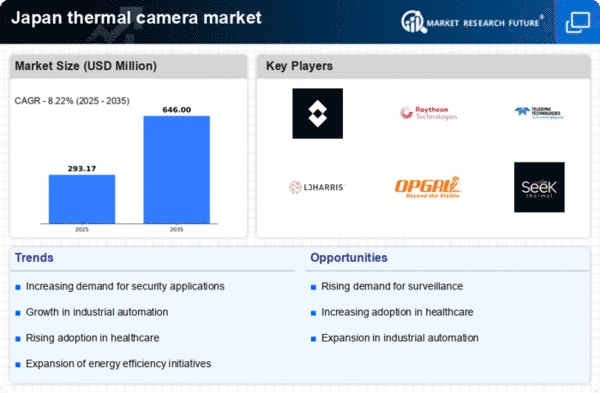
As per Market Research Future analysis, the Japan thermal camera market Size was estimated at 270.9 USD Million in 2024. The Japan thermal camera market is projected to grow from 293.17 USD Million in 2025 to 646.0 USD Million by 2035, exhibiting a compound annual growth rate (CAGR) of 8.2% during the forecast period 2025 - 2035

Key Market Trends & Highlights

The Japan thermal camera market is experiencing robust growth driven by technological advancements and increasing demand across various sectors.

  • Technological advancements are enhancing the capabilities and applications of thermal cameras in Japan.
  • The security segment remains the largest, while the healthcare segment is emerging as the fastest-growing area for thermal camera adoption.
  • Government initiatives are promoting the integration of thermal cameras in public safety and energy efficiency measures.
  • Rising industrial applications and enhanced safety regulations are key drivers propelling market growth.

Market Size & Forecast

2024 Market Size 270.9 (USD Million)
2035 Market Size 646.0 (USD Million)
CAGR (2025 - 2035) 8.22%

Major Players

FLIR Systems (US), Raytheon Technologies (US), Teledyne Technologies (US), L3Harris Technologies (US), Opgal Optronic Industries (IL), Seek Thermal (US), Dali Technology (CN), Hikvision (CN), Bosch Security Systems (DE)

Our Impact
Enabled $4.3B Revenue Impact for Fortune 500 and Leading Multinationals
Partnering with 2000+ Global Organizations Each Year
30K+ Citations by Top-Tier Firms in the Industry

Japan Thermal Camera Market Trends

The thermal camera market in Japan is currently experiencing notable growth, driven by advancements in technology and increasing applications across various sectors. The demand for these devices is rising in industries such as construction, manufacturing, and healthcare, where they are utilized for monitoring temperature variations and enhancing safety protocols. Furthermore, the integration of thermal imaging in security systems is becoming more prevalent, as organizations seek to bolster their surveillance capabilities. This trend is likely to continue as businesses recognize the value of thermal cameras in improving operational efficiency and ensuring safety. In addition, the Japanese government is actively promoting the adoption of innovative technologies, which may further stimulate the thermal camera market. Initiatives aimed at enhancing public safety and disaster management are encouraging the use of thermal imaging for early detection of fires and other hazards. As awareness of the benefits of thermal cameras grows, it appears that the market will expand, attracting new players and fostering competition. Overall, the thermal camera market in Japan is poised for significant development, with various factors contributing to its upward trajectory.

Technological Advancements

Recent innovations in sensor technology and image processing are enhancing the capabilities of thermal cameras. These advancements allow for improved image clarity and accuracy, making devices more effective in various applications. As technology continues to evolve, the thermal camera market is likely to benefit from the introduction of more sophisticated features.

Increased Demand in Security

The rising need for enhanced security measures is driving the adoption of thermal cameras in surveillance systems. Organizations are increasingly utilizing these devices for perimeter security and monitoring critical infrastructure. This trend suggests a growing recognition of the importance of thermal imaging in safeguarding assets.

Government Initiatives

The Japanese government is promoting the use of thermal cameras for public safety and disaster management. Initiatives aimed at improving emergency response capabilities are likely to encourage the integration of thermal imaging technology in various sectors. This support may lead to increased investment and growth within the thermal camera market.

Japan Thermal Camera Market Drivers

Enhanced Safety Regulations

In Japan, stringent safety regulations across various sectors are driving the demand for thermal cameras. The thermal camera market is significantly influenced by the need for compliance with safety standards in industries such as construction, manufacturing, and transportation. For example, the construction sector is mandated to implement safety measures that include monitoring heat levels to prevent fire hazards. This regulatory environment is expected to propel the thermal camera market, as companies invest in technology to ensure compliance and enhance workplace safety. Furthermore, the increasing focus on occupational health and safety is likely to lead to a rise in the adoption of thermal cameras for monitoring worker safety in hazardous environments. As a result, the thermal camera market is positioned to benefit from these evolving regulatory frameworks.

Growing Adoption in Healthcare

The healthcare sector in Japan is increasingly leveraging thermal cameras for various applications, including patient monitoring and diagnostics. The thermal camera market is witnessing a shift as hospitals and clinics adopt this technology for non-invasive temperature measurement, particularly in fever detection and monitoring of patients with infectious diseases. The market for thermal cameras in healthcare is expected to grow at a CAGR of around 15% over the next few years. This growth is attributed to the rising emphasis on patient safety and the need for efficient diagnostic tools. Additionally, the integration of thermal imaging with telemedicine solutions is likely to further enhance its adoption, as healthcare providers seek innovative ways to deliver care. Consequently, the thermal camera market is becoming increasingly vital in supporting healthcare advancements in Japan.

Rising Industrial Applications

The thermal camera market in Japan is experiencing a notable surge due to increasing industrial applications. Industries such as manufacturing, automotive, and energy are increasingly adopting thermal imaging technology for predictive maintenance, quality control, and process optimization. For instance, the manufacturing sector is projected to account for approximately 30% of the thermal camera market by 2026. This trend is driven by the need for enhanced operational efficiency and reduced downtime, as thermal cameras facilitate early detection of equipment failures. Furthermore, the integration of thermal cameras in automation processes is likely to bolster their demand, as industries seek to improve productivity and safety. The thermal camera market is thus poised for growth as more sectors recognize the value of thermal imaging in enhancing operational capabilities.

Technological Integration with IoT

The integration of thermal cameras with Internet of Things (IoT) technology is emerging as a key driver for the thermal camera market in Japan. This convergence allows for real-time data collection and analysis, enhancing the functionality of thermal cameras in various applications. The thermal camera market is likely to see a significant increase in demand as businesses adopt smart solutions for monitoring and surveillance. For instance, the ability to connect thermal cameras to IoT platforms enables remote monitoring and alerts, which can improve response times in critical situations. This technological advancement is expected to attract investments, with the market projected to grow by approximately 20% by 2027. As industries increasingly recognize the benefits of IoT integration, the thermal camera market is set to expand its reach and capabilities.

Increased Focus on Energy Efficiency

Japan's commitment to energy efficiency and sustainability is driving the thermal camera market forward. The thermal camera market is benefiting from initiatives aimed at reducing energy consumption in buildings and industrial processes. Thermal cameras are utilized for energy audits, helping identify heat loss and inefficiencies in insulation. This application is particularly relevant as Japan aims to achieve its energy conservation targets. The market for thermal cameras in energy efficiency applications is anticipated to grow at a CAGR of around 12% over the next five years. Additionally, the increasing awareness of environmental issues is prompting businesses to invest in technologies that promote sustainability. Consequently, the thermal camera market is likely to see a rise in demand as organizations seek to enhance their energy management strategies.


Market Segment Insights

By Type: Cooled IR Detector (Largest) vs. Uncooled IR Detector (Fastest-Growing)

In the Japan thermal camera market, the segment distribution shows that Cooled IR Detectors hold the largest share, attributed to their high sensitivity and precise imaging capabilities. These detectors are primarily used in industrial and military applications, which makes them a crucial segment. On the other hand, Uncooled IR Detectors are gaining momentum, thanks to advancements in technology that allow for more accessible and cost-effective solutions, leading to wider adoption. The growth trends in this segment are driven by the increasing demand for thermal imaging across various sectors, including surveillance, medical, and automotive. The Uncooled IR Detectors are emerging as a fast-growing alternative due to their lower operational costs and ease of integration into various devices. As industries seek efficient thermal imaging solutions, the demand for both segments is anticipated to rise, with Uncooled IR Detectors expected to capture a significant portion of the market soon.

Detector Type: Cooled IR (Dominant) vs. Uncooled IR (Emerging)

Cooled IR Detectors are characterized by their exceptional performance in detecting minute temperature variations, making them invaluable in defense and high-end industrial applications. Despite their higher cost, their reliability and imaging quality support their dominant position in the market. Conversely, Uncooled IR Detectors are emerging rapidly due to their affordability and compact design, making them ideal for consumer electronics and budget-sensitive applications. These detectors operate without the need for cooling mechanisms, which simplifies their implementation in various devices. As technological advancements continue, the performance gap between these two types may narrow, allowing Uncooled IR Detectors to capture larger market shares in the future.

By Mobility: Handheld Fixed (Largest) vs. Handheld Mounted (Fastest-Growing)

In the mobility segment of the Japan thermal camera market, the distribution between handheld fixed and handheld mounted types shows a clear preference for handheld fixed devices, which command a significant market share due to their usability and reliability in various applications. Handheld mounted thermal cameras, while less prevalent, are gaining traction as technological advancements enhance their functionality, making them more appealing to consumers seeking versatility in thermal imaging. The growth trends in this segment indicate a rising demand for handheld mounted devices, fueled by increasing applications in sectors like security and surveillance, as well as in industrial inspections. Factors such as advancements in camera technology, user-friendliness, and the expansion of the construction and maintenance industries contribute to the accelerated adoption of handheld mounted thermal cameras, positioning them as a fast-growing category in this market.

Handheld Fixed (Dominant) vs. Handheld Mounted (Emerging)

Handheld fixed thermal cameras in the Japan thermal camera market are characterized by their robust design and ease of use, making them the preferred choice for various applications from firefighting to electrical inspections. These devices are known for their high-resolution imaging and reliability, allowing users to conduct efficient assessments without compromising accuracy. On the other hand, handheld mounted thermal cameras are emerging as a flexible alternative, appealing to users that require mobility alongside efficient thermal imaging capabilities. They are increasingly integrated with other technologies for enhanced functionality and are particularly popular in applications requiring real-time data analysis.

By Application: Building Inspection (Largest) vs. Medical (Fastest-Growing)

The market share distribution among the application segments reveals that Building Inspection holds the largest share in the Japan thermal camera market, driven by the ongoing construction boom and a focus on energy-efficient buildings. The Fault Detection and Law Enforcement segments also contribute significantly, showcasing robust demand for thermal imaging in identifying anomalies and enhancing safety protocols. Conversely, the Medical segment is emerging rapidly, owing to increasing applications in diagnostics and patient monitoring, making it a vital area of growth. Growth trends in the respective segments highlight a transformative shift towards advanced thermal imaging technology. Factors such as heightened awareness regarding building safety standards and an uptick in infrastructure projects propel the Building Inspection sector. Medical applications, particularly in telemedicine and non-invasive diagnostics, are on an upward trajectory, further supported by technological innovations. As regulations evolve, sectors like Industrial Process and Meteorology are also poised for expansion, indicating a dynamic landscape ahead.

Building Inspection (Dominant) vs. Medical (Emerging)

Building Inspection stands out as the dominant application segment in the Japan thermal camera market, primarily attributed to its critical role in quality assurance and energy management in construction. The ability of thermal cameras to detect heat loss and moisture infiltration ensures compliance with building regulations, making them indispensable for inspectors. Meanwhile, the Medical segment is rapidly emerging, driven by trends in telehealth and the need for efficient patient monitoring systems. Thermal cameras enable non-invasive assessments, particularly in detecting fevers or monitoring blood flow. As healthcare demands evolve, the adoption of thermal imaging in medical arenas is expected to surge, driven by technological advancements and the necessity for effective diagnostic tools.

Get more detailed insights about Japan Thermal Camera Market

Key Players and Competitive Insights

The thermal camera market in Japan is characterized by a dynamic competitive landscape, driven by technological advancements and increasing demand across various sectors, including security, automotive, and industrial applications. Key players such as FLIR Systems (US), Raytheon Technologies (US), and Hikvision (CN) are strategically positioned to leverage innovation and regional expansion. FLIR Systems (US) focuses on enhancing its product portfolio through continuous innovation, while Raytheon Technologies (US) emphasizes defense applications, indicating a strong alignment with governmental contracts and security needs. Hikvision (CN), on the other hand, is expanding its market presence through aggressive pricing strategies and localized manufacturing, which collectively shape a competitive environment that is both fragmented and concentrated, with a few dominant players influencing market trends.In terms of business tactics, companies are increasingly localizing manufacturing to reduce costs and enhance supply chain efficiency. This approach appears to be a response to the growing need for rapid delivery and customization in the thermal camera market. The competitive structure is moderately fragmented, with several players vying for market share, yet a few key companies hold substantial influence over pricing and technology standards. This duality creates a complex landscape where innovation and operational efficiency are paramount.

In October FLIR Systems (US) announced the launch of a new line of thermal cameras designed specifically for the automotive sector, aimed at enhancing safety features in vehicles. This strategic move not only diversifies their product offerings but also positions them to capitalize on the growing trend of smart vehicle technology. The integration of thermal imaging in automotive applications is likely to enhance vehicle safety and performance, thereby expanding FLIR's market reach.

In September Raytheon Technologies (US) secured a multi-million dollar contract with the Japanese government to supply advanced thermal imaging systems for border security. This contract underscores the company's strong foothold in defense and security sectors, suggesting that government partnerships will continue to be a critical component of their growth strategy. Such contracts not only provide financial stability but also enhance Raytheon's reputation as a leader in high-tech security solutions.

In August Hikvision (CN) launched a new series of thermal cameras with AI capabilities, aimed at improving surveillance and monitoring in urban environments. This development reflects a broader trend towards the integration of artificial intelligence in security technologies, which may enhance operational efficiency and effectiveness. Hikvision's focus on AI-driven solutions indicates a strategic pivot towards meeting the evolving demands of smart city initiatives, potentially setting new standards in the market.

As of November current trends in the thermal camera market are increasingly defined by digitalization, sustainability, and the integration of AI technologies. Strategic alliances among key players are shaping the competitive landscape, fostering innovation and collaboration. The shift from price-based competition to a focus on technological advancement and supply chain reliability is evident, suggesting that companies will need to differentiate themselves through innovation and quality rather than solely on cost. This evolution may lead to a more sustainable and technologically advanced market, where the ability to adapt to changing consumer demands will be crucial for long-term success.

Key Companies in the Japan Thermal Camera Market include

Industry Developments

Recent developments in the Japan Thermal Camera Market indicate significant advancements and competition among key players such as FLIR Systems, Canon, and Hikvision. As of October 2023, Japan's strong focus on technology and security solutions has led to increased investment and demand for thermal imaging applications in various sectors, including public safety and infrastructure. Companies like Seek Thermal and Infratech are capitalizing on this trend by expanding their product portfolios to meet growing needs. 

In terms of mergers and acquisitions, notable activity occurred in September 2023, when NEC Corporation announced its acquisition of a leading thermal imaging technology firm to enhance its capabilities in surveillance applications. Additionally, with Nippon Avionics also enhancing its thermal camera offerings during 2022, the competition has intensified. The Ministry of Economy, Trade and Industry of Japan highlights the role of thermal cameras in energy conservation and disaster management. Overall, the market shows robust growth, driven by advancements in technology and strategic collaborations among major players.

Future Outlook

Japan Thermal Camera Market Future Outlook

The thermal camera market in Japan is projected to grow at an 8.22% CAGR from 2025 to 2035, driven by advancements in technology, increased demand in security, and industrial applications.

New opportunities lie in:

  • Development of AI-integrated thermal imaging solutions for predictive maintenance.
  • Expansion into agricultural monitoring systems for crop health assessment.
  • Partnerships with security firms for enhanced surveillance applications.

By 2035, the thermal camera market is expected to achieve substantial growth and innovation.

Market Segmentation

Japan Thermal Camera Market Type Outlook

  • Cooled IR Detector
  • Uncooled IR Detector

Japan Thermal Camera Market Mobility Outlook

  • Handheld Fixed
  • Handheld Mounted

Japan Thermal Camera Market Application Outlook

  • Building Inspection
  • Fault Detection
  • Law Enforcement
  • Medical
  • Industrial Process
  • Astronomy
  • Meteorology
  • Others

Report Scope

MARKET SIZE 2024 270.9(USD Million)
MARKET SIZE 2025 293.17(USD Million)
MARKET SIZE 2035 646.0(USD Million)
COMPOUND ANNUAL GROWTH RATE (CAGR) 8.22% (2025 - 2035)
REPORT COVERAGE Revenue Forecast, Competitive Landscape, Growth Factors, and Trends
BASE YEAR 2024
Market Forecast Period 2025 - 2035
Historical Data 2019 - 2024
Market Forecast Units USD Million
Key Companies Profiled FLIR Systems (US), Raytheon Technologies (US), Teledyne Technologies (US), L3Harris Technologies (US), Opgal Optronic Industries (IL), Seek Thermal (US), Dali Technology (CN), Hikvision (CN), Bosch Security Systems (DE)
Segments Covered Type, Mobility, Application
Key Market Opportunities Growing demand for advanced surveillance and safety solutions drives innovation in the thermal camera market.
Key Market Dynamics Rising demand for advanced thermal imaging in security and surveillance applications drives innovation in the thermal camera market.
Countries Covered Japan
Leave a Comment

FAQs

What is the expected market size of the Japan Thermal Camera Market in 2024?

The Japan Thermal Camera Market is expected to be valued at approximately 270.9 million USD in 2024.

What will the market value of the Japan Thermal Camera Market be by 2035?

By 2035, the Japan Thermal Camera Market is projected to reach around 531.7 million USD.

What is the anticipated CAGR for the Japan Thermal Camera Market from 2025 to 2035?

The Japan Thermal Camera Market is expected to grow at a CAGR of 6.322% from 2025 to 2035.

Which segment of the Japan Thermal Camera Market is expected to dominate by 2035?

The Uncooled IR Detector segment is projected to lead the market, valued at approximately 321.7 million USD by 2035.

What is the forecasted market value for Cooled IR Detectors in 2035?

The Cooled IR Detector segment is estimated to reach around 210.0 million USD by 2035.

Who are the key players in the Japan Thermal Camera Market?

Major players include FLIR Systems, Axis Communications, Canon, and Hikvision among others.

What are the primary applications driving the demand for thermal cameras in Japan?

Key applications include security surveillance, industrial inspections, and military applications.

How is the current economic climate affecting the Japan Thermal Camera Market?

The ongoing economic developments enhance demand for thermal cameras in various sectors, promoting market growth.

What are the growth opportunities for the Thermal Camera Market in Japan?

Opportunities lie in expanding applications in IoT integration and increasing use in smart city projects.

What challenges does the Japan Thermal Camera Market face?

Challenges may include competition from alternative technologies and high initial investment costs.

Download Free Sample

Kindly complete the form below to receive a free sample of this Report

Compare Licence

×
Features License Type
Single User Multiuser License Enterprise User
Price $4,950 $5,950 $7,250
Maximum User Access Limit 1 User Upto 10 Users Unrestricted Access Throughout the Organization
Free Customization
Direct Access to Analyst
Deliverable Format
Platform Access
Discount on Next Purchase 10% 15% 15%
Printable Versions