×
Request Free Sample ×

Kindly complete the form below to receive a free sample of this Report

* Please use a valid business email

Leading companies partner with us for data-driven Insights

clients tt-cursor
Hero Background

Japan Telecom Tower Power System Market

ID: MRFR/ICT/61258-HCR
200 Pages
Aarti Dhapte
February 2026

Japan Telecom Tower Power System Market Size, Share and Trends Analysis Report By Type (On-grid, Off-Grid), By Power Source (Diesel Diesel-Solar, Diesel-Battery, Diesel-Wind, Others), and By Component (Rectifiers, Batteries, Controllers, Inverters, Power Distribution Units, Generator, Others)- Forecast to 2035

Share:
Download PDF ×

We do not share your information with anyone. However, we may send you emails based on your report interest from time to time. You may contact us at any time to opt-out.

Japan Telecom Tower Power System Market Infographic
Purchase Options

Japan Telecom Tower Power System Market Summary

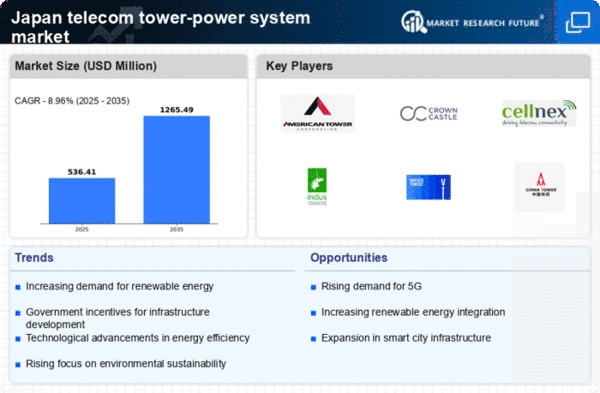
As per Market Research Future analysis, the Japan Telecom Tower Power System Market size was estimated at 492.3 USD Million in 2024. The Telecom Tower-power-system market is projected to grow from 536.41 USD Million in 2025 to 1265.49 USD Million by 2035, exhibiting a compound annual growth rate (CAGR) of 8.9% during the forecast period 2025 - 2035

Key Market Trends & Highlights

The Japan telecom tower-power-system market is experiencing a transformative shift towards sustainability and technological integration.

  • The market is witnessing a notable shift towards renewable energy sources, driven by environmental concerns.
  • Integration of smart technologies is enhancing operational efficiency and reducing costs in telecom tower power systems.
  • Regulatory support for energy efficiency is fostering innovation and investment in the sector.
  • Rising demand for mobile connectivity and expansion of 5G networks are key drivers propelling market growth.

Market Size & Forecast

2024 Market Size 492.3 (USD Million)
2035 Market Size 1265.49 (USD Million)
CAGR (2025 - 2035) 8.96%

Major Players

American Tower Corporation (US), Crown Castle International Corp (US), Cellnex Telecom (ES), Indus Towers Limited (IN), Vantage Towers AG (DE), China Tower Corporation Limited (CN), SBM Offshore (NL), Telesites S.A.B. de C.V. (MX)

Our Impact
Enabled $4.3B Revenue Impact for Fortune 500 and Leading Multinationals
Partnering with 2000+ Global Organizations Each Year
30K+ Citations by Top-Tier Firms in the Industry

Japan Telecom Tower Power System Market Trends

The Japan Telecom Tower Power System Market in Japan is currently experiencing a transformative phase, driven by the increasing demand for reliable and efficient energy solutions. As the nation continues to expand its telecommunications infrastructure, the need for robust power systems becomes paramount. This market is characterized by a shift towards renewable energy sources, which aligns with Japan's commitment to sustainability and reducing carbon emissions. The integration of advanced technologies, such as energy storage systems and smart grid solutions, is also gaining traction, enhancing the overall efficiency of telecom operations. Moreover, the regulatory environment in Japan is evolving, with government initiatives aimed at promoting energy efficiency and supporting the deployment of innovative power solutions. This creates a conducive atmosphere for investment and development within the telecom tower-power-system market. Stakeholders are increasingly focusing on optimizing energy consumption and minimizing operational costs, which could lead to a more competitive landscape. As the market matures, collaboration between telecom operators and energy providers is likely to intensify, fostering innovation and driving growth in the sector.

Shift Towards Renewable Energy

The telecom tower-power-system market is witnessing a notable transition towards renewable energy sources. This trend is largely influenced by Japan's commitment to sustainability and reducing reliance on fossil fuels. Operators are increasingly investing in solar and wind energy solutions to power their infrastructure, which not only lowers operational costs but also aligns with environmental goals.

Integration of Smart Technologies

The adoption of smart technologies within the telecom tower-power-system market is becoming more prevalent. Innovations such as energy management systems and IoT-enabled devices are enhancing operational efficiency. These technologies allow for real-time monitoring and optimization of energy usage, which can lead to significant cost savings and improved service reliability.

Regulatory Support for Energy Efficiency

The regulatory landscape in Japan is evolving to support energy efficiency initiatives within the telecom tower-power-system market. Government policies are increasingly encouraging the adoption of advanced power solutions and promoting investments in energy-efficient technologies. This regulatory support is likely to stimulate growth and innovation in the sector.

Japan Telecom Tower Power System Market Drivers

Expansion of 5G Networks

The rollout of 5G networks in Japan is a critical factor influencing the telecom tower-power-system market. With the government and private sector investing heavily in 5G infrastructure, the demand for telecom towers is set to increase significantly. It is estimated that by 2026, Japan will require an additional 30,000 telecom towers to support 5G services. This expansion necessitates advanced power systems capable of handling higher energy loads and ensuring reliability. Consequently, the telecom tower-power-system market is poised for growth as operators seek to establish a robust 5G network across the country.

Increased Focus on Energy Efficiency

The growing emphasis on energy efficiency within the telecom sector is a significant driver for the telecom tower-power-system market. Japanese telecom companies are under pressure to reduce their carbon footprint and operational costs. As a result, many are investing in energy-efficient power systems that can lower energy consumption by up to 40%. This shift not only aligns with global sustainability goals but also enhances the overall performance of telecom networks. The telecom tower-power-system market is thus expected to expand as companies prioritize energy-efficient solutions to meet regulatory standards and consumer expectations.

Rising Demand for Mobile Connectivity

The increasing reliance on mobile connectivity in Japan is a primary driver for the telecom tower-power-system market. With a population that is highly engaged in digital communication, the demand for robust mobile networks continues to surge. As of 2025, mobile data traffic in Japan is projected to grow by approximately 30% annually, necessitating the expansion of telecom infrastructure. This growth compels telecom operators to invest in advanced power systems to ensure uninterrupted service. The telecom tower-power-system market is thus positioned to benefit from this trend, as operators seek to enhance their network capabilities to meet consumer expectations.

Technological Advancements in Power Systems

Technological advancements in power systems are reshaping the telecom tower-power-system market. Innovations such as energy-efficient power supplies and smart grid technologies are becoming increasingly prevalent. These advancements not only reduce operational costs but also enhance the reliability of power systems. In Japan, the adoption of such technologies is expected to increase by 25% over the next five years, driven by the need for sustainable energy solutions. As telecom operators seek to modernize their infrastructure, the demand for advanced power systems will likely rise, further propelling market growth.

Government Initiatives for Infrastructure Development

Japanese government initiatives aimed at enhancing telecommunications infrastructure significantly influence the telecom tower-power-system market. The government has allocated substantial funding, estimated at ¥500 billion, to improve network coverage in rural areas. This initiative is expected to increase the number of telecom towers, thereby driving demand for efficient power systems. Furthermore, the government's commitment to digital transformation aligns with the need for reliable power solutions, as more towers require advanced energy management systems. Consequently, the telecom tower-power-system market is likely to experience growth as these initiatives unfold.


Market Segment Insights

By Type: On-grid (Largest) vs. Off-grid (Fastest-Growing)

In the Japan telecom tower-power-system market, the On-grid segment holds the largest market share, primarily due to the increased reliance on stable power sources for telecom operations. This segment benefits from reliable infrastructure and grid connectivity, making it a preferred choice for many telecom operators. In contrast, the Off-grid segment, although smaller, is rapidly gaining traction as more companies seek energy independence and sustainability solutions away from traditional power grids. The rising demand for renewable energy sources is also contributing to the growth of this segment. The Off-grid segment is characterized by its innovative approach to meeting energy needs through renewable technology such as solar and wind power. As energy security becomes a priority, this segment is expected to witness significant investments and advancements. Factors driving growth include regulatory support for green energy initiatives and a growing awareness of environmental issues among consumers and businesses. Consequently, while On-grid remains dominant, Off-grid is poised to be the future of energy solutions in telecommunications.

On-grid (Dominant) vs. Off-grid (Emerging)

The On-grid segment is recognized for its dominance in the Japan telecom tower-power-system market due to its robust infrastructure and stable energy supply from national grids. It is preferred by telecom operators who prioritize reliability and efficiency in their operations. Conversely, the Off-grid segment is considered emerging and is gaining popularity among companies looking for flexible and sustainable energy solutions. This segment utilizes alternative energy sources, such as solar and wind, to operate independently from the grid. Its growth is driven by technological advancements and a shift towards green energy, making it an attractive option for new telecom projects aimed at reducing carbon footprints.

By Power Source: Diesel-Solar (Largest) vs. Diesel-Battery (Fastest-Growing)

In the Japan telecom tower-power-system market, Diesel-Solar constitutes the largest share due to its established infrastructure and reliability. This segment benefits from the integration of renewable energy resources, appealing to operators focused on sustainability. Conversely, Diesel-Battery is rapidly gaining traction as the fastest-growing segment, owing to its efficiency in providing backup power and reducing operational costs. The growth trends in this segment are largely driven by advancements in battery technology and the increasing demand for sustainable power solutions. Stakeholders are investing in hybrid systems that combine diesel with solar and battery technologies to ensure high availability and reliability. Moreover, regulatory incentives and commitment towards reducing carbon footprints are propelling the adoption of these innovative power sources.

Diesel-Solar (Dominant) vs. Diesel-Battery (Emerging)

Diesel-Solar stands out as the dominant segment in the Japan telecom tower-power-system market, characterized by its robustness and proven performance in various environmental conditions. This segment leverages solar panels to supplement diesel generators, enhancing operational efficiency while minimizing emissions. On the other hand, Diesel-Battery is emerging as a competitive force, offering responsive power solutions with lower operational costs. With enhanced energy storage capabilities, this segment supports tower operations during outages and peak demand periods, appealing to telecom operators seeking reliability and performance. The combination of these two segments showcases the market's shift towards more sustainable and efficient power sourcing, reflecting the broader trends in energy procurement.

By Component: Rectifiers (Largest) vs. Batteries (Fastest-Growing)

The component segment of the Japan telecom tower-power-system market is characterized by distinct shares held by different technologies. Among these, rectifiers dominate the landscape, providing essential conversion of AC to DC power. Meanwhile, batteries are experiencing rapid growth as telecommunications infrastructure evolves, necessitating efficient and reliable energy storage solutions. Drivers of growth in this segment include the increasing demand for uninterrupted power supply and the push towards renewable energy solutions that integrate seamlessly with existing infrastructure. Innovations in battery technology, especially in energy density and charging speed, position batteries as a critical component in future telecom installations, thereby further propelling their market growth.

Rectifiers (Dominant) vs. Batteries (Emerging)

Rectifiers play a dominant role in the Japan telecom tower-power-system market, serving as the backbone for converting alternating current to direct current, which is crucial for high-efficiency operations. Their reliability and efficiency make them indispensable for telecom towers, ensuring consistent power delivery. On the other hand, batteries are emerging as vital components, driven by advancements in technology that enhance energy storage capabilities. Their role is increasingly significant as networks demand backup power to maintain operations during outages. The evolution of battery systems, particularly in terms of lifecycle and environmental sustainability, positions them as not only emerging but essential players in supporting an efficient power distribution system.

Get more detailed insights about Japan Telecom Tower Power System Market

Key Players and Competitive Insights

The telecom tower-power-system market in Japan is characterized by a competitive landscape that is increasingly shaped by technological advancements and strategic partnerships. Key players such as American Tower Corporation (US), Crown Castle International Corp (US), and China Tower Corporation Limited (CN) are actively pursuing growth through innovation and regional expansion. American Tower Corporation (US) has focused on enhancing its infrastructure capabilities, while Crown Castle International Corp (US) emphasizes digital transformation to optimize its service offerings. Meanwhile, China Tower Corporation Limited (CN) is leveraging its extensive network to strengthen its market position, indicating a trend towards consolidation and collaboration among major players.In terms of business tactics, companies are increasingly localizing manufacturing and optimizing supply chains to enhance operational efficiency. The market appears moderately fragmented, with a mix of established players and emerging companies vying for market share. The collective influence of these key players is significant, as they drive technological advancements and set industry standards, thereby shaping the competitive structure of the market.

In October American Tower Corporation (US) announced a strategic partnership with a leading Japanese telecommunications provider to enhance its tower infrastructure across urban areas. This collaboration is expected to improve service delivery and expand coverage, reflecting the company's commitment to innovation and customer-centric solutions. Such partnerships are likely to bolster American Tower's competitive edge in a rapidly evolving market.

In September Crown Castle International Corp (US) launched a new initiative aimed at integrating AI technologies into its tower management systems. This move is anticipated to streamline operations and reduce maintenance costs, thereby enhancing overall efficiency. The integration of AI signifies a broader trend towards digitalization within the industry, positioning Crown Castle as a forward-thinking leader in the telecom tower-power-system market.

In August China Tower Corporation Limited (CN) completed the acquisition of several smaller tower operators in Japan, significantly expanding its footprint in the region. This acquisition not only increases its market share but also enhances its ability to offer comprehensive solutions to clients. The strategic importance of this move lies in its potential to create synergies and improve service delivery across a larger network, thereby reinforcing China Tower's competitive position.

As of November the telecom tower-power-system market is witnessing trends such as digitalization, sustainability, and AI integration, which are redefining competitive dynamics. Strategic alliances are becoming increasingly vital, as companies seek to leverage shared resources and expertise. Looking ahead, competitive differentiation is likely to evolve from traditional price-based competition to a focus on innovation, technology, and supply chain reliability, underscoring the importance of adaptability in a rapidly changing market.

Key Companies in the Japan Telecom Tower Power System Market include

Industry Developments

In recent months, the Japan Telecom Tower Power System Market has undergone notable developments, particularly with companies like Rakuten Mobile, KDDI Corporation, and NTT Docomo investing heavily in infrastructure to enhance network reliability amid increasing data demands. In September 2023, SoftBank Group announced a collaboration with Mitsubishi Electric to upgrade its telecommunications tower systems, aiming to improve energy efficiency. 

Meanwhile, in August 2023, Fujitsu unveiled new energy solutions targeting reduced operational costs for telecommunication companies, including Nippon Wireless Systems and Power Japan. There have been significant mergers and acquisitions as well; in June 2023, KDDI Corporation acquired a majority stake in Japan Communications to expand its network offerings. 

The growth in market valuation following these developments has led to heightened competition among carriers and service providers, with American Tower Corporation and NTT Group also ensuring their positions as key players in expanding the telecommunications infrastructure. Over the last two to three years, Japan's telecom market has seen a shift towards sustainable energy practices, particularly as the government has set targets for carbon neutrality by 2050, incentivizing firms to combine technology advancements with sustainable development strategies.

Future Outlook

Japan Telecom Tower Power System Market Future Outlook

The Telecom Tower Power System Market in Japan is projected to grow at 8.96% CAGR from 2025 to 2035, driven by increasing demand for connectivity and renewable energy solutions.

New opportunities lie in:

  • Development of hybrid power systems integrating solar and wind energy.
  • Implementation of advanced energy management software for efficiency.
  • Expansion of maintenance services for aging infrastructure and new installations.

By 2035, the market is expected to achieve robust growth, driven by innovation and strategic investments.

Market Segmentation

Japan Telecom Tower Power System Market Type Outlook

  • On-grid
  • Off-grid

Japan Telecom Tower Power System Market Component Outlook

  • Rectifiers
  • Batteries
  • Controllers
  • Inverters
  • Power Distribution Unit
  • Generators
  • Others

Japan Telecom Tower Power System Market Power Source Outlook

  • Diesel-Solar
  • Diesel-Battery
  • Diesel-Wind
  • Others

Report Scope

MARKET SIZE 2024 492.3(USD Million)
MARKET SIZE 2025 536.41(USD Million)
MARKET SIZE 2035 1265.49(USD Million)
COMPOUND ANNUAL GROWTH RATE (CAGR) 8.96% (2025 - 2035)
REPORT COVERAGE Revenue Forecast, Competitive Landscape, Growth Factors, and Trends
BASE YEAR 2024
Market Forecast Period 2025 - 2035
Historical Data 2019 - 2024
Market Forecast Units USD Million
Key Companies Profiled American Tower Corporation (US), Crown Castle International Corp (US), Cellnex Telecom (ES), Indus Towers Limited (IN), Vantage Towers AG (DE), China Tower Corporation Limited (CN), SBM Offshore (NL), Telesites S.A.B. de C.V. (MX)
Segments Covered Type, Power Source, Component
Key Market Opportunities Integration of renewable energy sources in telecom tower-power-system market enhances sustainability and reduces operational costs.
Key Market Dynamics Rising demand for energy-efficient solutions drives innovation in the telecom tower-power-system market.
Countries Covered Japan
Leave a Comment

FAQs

What is the projected market size of the Japan Telecom Tower Power System Market in 2024?

The projected market size of the Japan Telecom Tower Power System Market in 2024 is expected to be valued at 492.3 million USD.

What will be the estimated market value of the Japan Telecom Tower Power System Market by 2035?

By 2035, the Japan Telecom Tower Power System Market is expected to reach an estimated value of 1278.0 million USD.

What is the expected compound annual growth rate of the Japan Telecom Tower Power System Market from 2025 to 2035?

The expected compound annual growth rate for the Japan Telecom Tower Power System Market from 2025 to 2035 is 9.06%.

Which type of telecom tower power system is projected to have a market value of 657.0 million USD by 2035?

The on-grid telecom tower power system is projected to have a market value of 657.0 million USD by 2035.

What is the estimated market value for the off-grid telecom tower power system in 2024?

The estimated market value for the off-grid telecom tower power system in 2024 is 246.0 million USD.

Who are the key players in the Japan Telecom Tower Power System Market?

Key players in the market include Rakuten Mobile, Nippon Telegraph and Telephone Corporation, Fujitsu, and SoftBank Group, among others.

Will the off-grid telecom tower power system market grow, and if so, to what value by 2035?

Yes, the off-grid telecom tower power system market is expected to grow to a value of 621.0 million USD by 2035.

What market value does the on-grid telecom tower power system hold in 2024?

The on-grid telecom tower power system holds a market value of 246.3 million USD in 2024.

What are the growth drivers for the Japan Telecom Tower Power System Market?

Growth drivers include increasing demand for telecom services, advancements in technology, and expansion in rural connectivity.

How does the competitive landscape look in the Japan Telecom Tower Power System Market?

The competitive landscape is robust with numerous key players vying for market share, leveraging technology and innovation.

Download Free Sample

Kindly complete the form below to receive a free sample of this Report

Compare Licence

×
Features License Type
Single User Multiuser License Enterprise User
Price $4,950 $5,950 $7,250
Maximum User Access Limit 1 User Upto 10 Users Unrestricted Access Throughout the Organization
Free Customization
Direct Access to Analyst
Deliverable Format
Platform Access
Discount on Next Purchase 10% 15% 15%
Printable Versions