×
Request Free Sample ×

Kindly complete the form below to receive a free sample of this Report

* Please use a valid business email

Leading companies partner with us for data-driven Insights

clients tt-cursor
Hero Background

Japan Swollen Knee Treatment Market

ID: MRFR/HC/55031-HCR
200 Pages
Garvit Vyas
February 2026

Japan Swollen Knee Treatment Market Research Report: Size, Share, Trend Analysis By Types (Medications, Surgery) and By End Users (Hospitals, Clinics) - Growth Outlook & Industry Forecast 2025 To 2035

Share:
Download PDF ×

We do not share your information with anyone. However, we may send you emails based on your report interest from time to time. You may contact us at any time to opt-out.

Japan Swollen Knee Treatment Market Infographic
Purchase Options

Japan Swollen Knee Treatment Market Summary

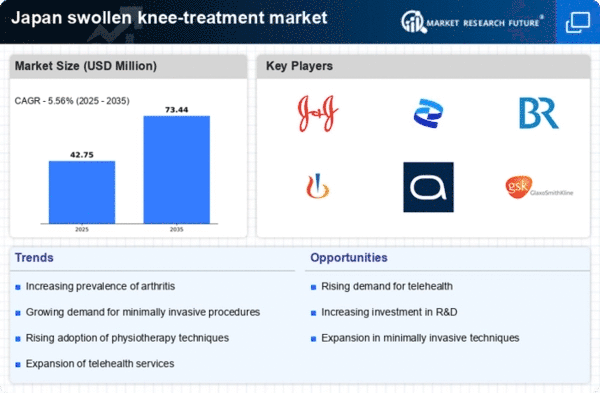
As per Market Research Future analysis, the Japan Swollen Knee Treatment Market size was estimated at 40.5 USD Million in 2024. The Swollen Knee-treatment market is projected to grow from 42.75 USD Million in 2025 to 73.44 USD Million by 2035, exhibiting a compound annual growth rate (CAGR) of 5.5% during the forecast period 2025 - 2035

Key Market Trends & Highlights

The Japan swollen knee-treatment market is experiencing a shift towards non-surgical solutions driven by demographic changes and healthcare advancements.

  • The demand for non-surgical treatments is rising as patients seek less invasive options for knee disorders.
  • Technological advancements in treatment methods are enhancing patient outcomes and satisfaction in the market.
  • Preventive care and rehabilitation are becoming focal points, reflecting a broader trend towards holistic health management.
  • The aging population and increased incidence of knee disorders are major drivers propelling market growth.

Market Size & Forecast

2024 Market Size 40.5 (USD Million)
2035 Market Size 73.44 (USD Million)
CAGR (2025 - 2035) 5.56%

Major Players

Johnson & Johnson (US), Pfizer (US), Bayer (DE), Novartis (CH), AbbVie (US), GlaxoSmithKline (GB), Sanofi (FR), Merck & Co. (US), Amgen (US)

Our Impact
Enabled $4.3B Revenue Impact for Fortune 500 and Leading Multinationals
Partnering with 2000+ Global Organizations Each Year
30K+ Citations by Top-Tier Firms in the Industry

Japan Swollen Knee Treatment Market Trends

The Japan Swollen Knee Treatment Market in Japan is currently experiencing notable developments, driven by an increasing awareness of knee health and the rising prevalence of knee-related ailments among the population. This market appears to be influenced by various factors, including an aging demographic that is more susceptible to conditions such as osteoarthritis and other inflammatory disorders. As a result, there is a growing demand for effective treatment options, which may include both conservative and surgical interventions. Furthermore, advancements in medical technology and rehabilitation practices are likely enhancing the efficacy of treatments available, thereby attracting more patients seeking relief from knee discomfort. In addition, the healthcare system in Japan is adapting to meet the needs of individuals suffering from swollen knees. The integration of innovative therapies, such as regenerative medicine and minimally invasive procedures, is gaining traction. This shift may reflect a broader trend towards personalized medicine, where treatment plans are tailored to individual patient needs. Moreover, The emphasis on preventive care and early intervention could lead to improved outcomes for patients, thereby fostering a more robust market environment. Overall, The swollen knee-treatment market is expected to grow due to demographic shifts, technological advancements, and evolving patient expectations.

Rising Demand for Non-Surgical Treatments

There is an increasing preference for non-invasive treatment options in the swollen knee-treatment market. Patients appear to favor therapies such as physical therapy, corticosteroid injections, and hyaluronic acid injections, which may provide relief without the need for surgery. This trend suggests a shift towards conservative management of knee conditions, reflecting a broader desire for less invasive approaches.

Technological Advancements in Treatment

Innovations in medical technology are playing a crucial role in the swollen knee-treatment market. The introduction of advanced imaging techniques and minimally invasive surgical options seems to enhance diagnostic accuracy and treatment effectiveness. These advancements may lead to quicker recovery times and improved patient satisfaction, thereby influencing treatment choices.

Focus on Preventive Care and Rehabilitation

The emphasis on preventive care and rehabilitation is becoming more pronounced in the swollen knee-treatment market. Healthcare providers appear to be prioritizing early intervention strategies and patient education to manage knee health proactively. This trend may contribute to better long-term outcomes and reduce the overall burden of knee-related disorders.

Japan Swollen Knee Treatment Market Drivers

Rising Healthcare Expenditure

Japan's healthcare expenditure has been on an upward trajectory, which positively influences the swollen knee-treatment market. In recent years, the country has allocated a substantial portion of its GDP to healthcare, with spending reaching approximately 10% in 2025. This increase in funding allows for better access to advanced treatment options, including physical therapy, medications, and surgical interventions for knee disorders. As patients become more willing to invest in their health, the swollen knee-treatment market is likely to benefit from this trend. Additionally, the government's initiatives to improve healthcare infrastructure may further enhance the availability of treatment services, thereby driving market growth.

Growing Awareness of Knee Health

There is a notable increase in public awareness regarding knee health in Japan, which serves as a significant driver for the swollen knee-treatment market. Educational campaigns and health programs have been implemented to inform the population about the importance of early diagnosis and treatment of knee disorders. This heightened awareness appears to encourage individuals experiencing knee pain to seek medical advice sooner, leading to earlier interventions. Consequently, this trend may result in a higher demand for various treatment modalities, including physiotherapy and medication, thereby positively impacting the swollen knee-treatment market. The proactive approach to knee health is likely to foster a culture of preventive care, further stimulating market growth.

Advancements in Rehabilitation Techniques

Innovations in rehabilitation techniques are emerging as a key driver for the swollen knee-treatment market. In Japan, the integration of technology in rehabilitation, such as virtual reality and robotic-assisted therapy, is gaining traction. These advancements not only enhance patient engagement but also improve recovery outcomes for individuals with knee disorders. As healthcare providers adopt these modern rehabilitation methods, the swollen knee-treatment market is expected to experience growth. Moreover, the increasing collaboration between technology firms and healthcare institutions may lead to the development of more effective treatment protocols, further solidifying the market's expansion in the coming years.

Increased Focus on Sports and Physical Activity

The rising interest in sports and physical activity among the Japanese population is influencing the swollen knee-treatment market. As more individuals engage in recreational and competitive sports, the incidence of knee injuries is likely to rise. This trend is particularly evident among younger demographics, who are increasingly participating in various athletic activities. Consequently, there is a growing demand for effective treatment options for sports-related knee injuries, which is expected to drive the swollen knee-treatment market. Additionally, sports organizations and healthcare providers are collaborating to promote injury prevention strategies, further contributing to the market's growth by addressing knee health proactively.

Aging Population and Increased Incidence of Knee Disorders

The aging population in Japan is a critical driver for the swollen knee-treatment market. As individuals age, the prevalence of knee disorders, including osteoarthritis and rheumatoid arthritis, tends to increase. According to recent statistics, approximately 30% of the elderly population in Japan experiences some form of knee pain, which significantly contributes to the demand for effective treatment options. This demographic shift is likely to propel the swollen knee-treatment market, as healthcare providers focus on developing tailored therapies to address the unique needs of older patients. Furthermore, the growing awareness of knee health among the elderly is expected to enhance the market landscape, leading to increased consultations and treatment uptake.


Market Segment Insights

By Type: Medications (Largest) vs. Patient-controlled analgesia (PCA) pumps (Fastest-Growing)

In the Japan swollen knee-treatment market, the segment distribution reveals that medications hold the largest share, dominating the treatment approaches for swelling. This is primarily due to their wide acceptance and ease of availability in clinical settings. On the other hand, patient-controlled analgesia (PCA) pumps are emerging as a significant component, capturing the interest of healthcare professionals and patients alike as they provide direct control over pain management. Growth trends within this segment indicate a shift towards less invasive and more patient-centric treatment options. Medications remain a staple, but the increasing adoption of PCA pumps reflects a changing landscape where patients seek greater autonomy in their treatment. Additionally, nerve blocks and surgeries, while critical, are gradually being supplemented by innovative solutions like liposomal bupivacaine, driving overall growth and diversification in the market.

Medications (Dominant) vs. Patient-controlled analgesia (PCA) pumps (Emerging)

In the Japan swollen knee-treatment market, medications are currently the dominant segment due to their established usage and effectiveness in alleviating pain and inflammation related to swelling. They encompass a variety of drugs ranging from NSAIDs to corticosteroids, appealing to both patients and clinicians for their reliability. Conversely, patient-controlled analgesia (PCA) pumps represent an emerging segment, providing enhanced pain management with user-directed options that can significantly improve patient comfort during recovery. This shift highlights a growing interest in personalized medicine, encouraging an integrative approach where patients feel empowered in managing their treatment options.

By End-User: Hospitals (Largest) vs. Clinics (Fastest-Growing)

In the Japan swollen knee-treatment market, hospitals are the predominant end-users, capturing the largest share of the market due to their extensive resources and specialized facilities. Clinics follow as significant players, providing accessible treatment options for patients. Ambulatory Surgery Centers and Others constitute a smaller portion of the market, catering to niche patient segments with specific needs. This distribution reflects the varying levels of specialization and patient preferences in accessing treatment. The growth trends within this segment indicate a robust expansion for clinics as they adapt to increasing patient demands for minimally invasive procedures. Hospitals continue to innovate in technology and patient care, ensuring their central role in treatment. The increasing prevalence of knee-related issues, coupled with an aging population, underscores the necessity for diverse treatment platforms, leading to a competitive environment across all end-user categories.

Hospitals (Dominant) vs. Clinics (Emerging)

Hospitals serve as the dominant force in the Japan swollen knee-treatment market, offering comprehensive resources, advanced technologies, and expertise that attract a wide range of patients requiring treatment. Their established reputation serves as a major draw for individuals seeking guaranteed care and specialized treatment pathways. Conversely, clinics are emerging swiftly as vital participants in the market by focusing on patient-centric care, offering convenience and lower costs. They tend to provide targeted treatments and are adapting quickly to technological advances, ensuring they remain competitive and capable of meeting rising patient demands while also alleviating the burden on hospitals.

Get more detailed insights about Japan Swollen Knee Treatment Market

Key Players and Competitive Insights

The swollen knee-treatment market in Japan has a dynamic competitive landscape marked by innovation, strategic partnerships, and regional expansion. Key players such as Johnson & Johnson (US), Pfizer (US), and AbbVie (US) are actively shaping the market through their focused operational strategies. Johnson & Johnson (US) emphasizes innovation in its product offerings, particularly in minimally invasive surgical techniques, which appear to resonate well with the growing demand for effective and less invasive treatment options. Meanwhile, Pfizer (US) is leveraging its extensive research capabilities to enhance its portfolio of anti-inflammatory medications, indicating a strong commitment to addressing the underlying causes of knee swelling. AbbVie (US), on the other hand, is pursuing strategic partnerships with local healthcare providers to improve patient access to its therapies, thereby enhancing its market presence.In terms of business tactics, companies are increasingly localizing manufacturing to reduce costs and improve supply chain efficiency. This approach not only mitigates risks associated with global supply chain disruptions but also aligns with the growing consumer preference for locally produced goods. The market structure appears moderately fragmented, with several players competing for market share, yet the collective influence of major companies like Bayer (DE) and Novartis (CH) remains significant, as they continue to invest in research and development to maintain their competitive edge.

In October Bayer (DE) announced a collaboration with a leading Japanese university to develop a new class of biologic therapies aimed at treating knee osteoarthritis. This strategic move is likely to enhance Bayer's research capabilities and accelerate the development of innovative treatments tailored to the specific needs of the Japanese population. Such collaborations may not only bolster Bayer's product pipeline but also strengthen its position in the market by aligning with local healthcare trends.

In September Novartis (CH) launched a digital health platform designed to support patients with knee-related conditions. This platform integrates telemedicine and personalized treatment plans, reflecting a growing trend towards digitalization in healthcare. By investing in digital health solutions, Novartis (CH) appears to be positioning itself as a forward-thinking leader in the market, potentially improving patient outcomes and engagement.

As of November the competitive trends in the swollen knee-treatment market are increasingly defined by digitalization, sustainability, and the integration of artificial intelligence (AI) in treatment protocols. Strategic alliances among companies are shaping the landscape, fostering innovation and enhancing product offerings. The shift from price-based competition to a focus on technological advancements and supply chain reliability is evident, suggesting that future competitive differentiation will hinge on the ability to innovate and adapt to evolving market demands.

Key Companies in the Japan Swollen Knee Treatment Market include

Industry Developments

Significant developments have been observed in the Japan Swollen Knee Treatment Market, particularly with companies like Mitsubishi Tanabe Pharma, Astellas Pharma, and Pfizer actively enhancing their product portfolios in response to the growing incidence of knee-related ailments. In September 2023, Bayer introduced advancements in their drug formulations aimed at treating knee conditions effectively. Furthermore, there has been an upsurge in collaborations among major players, including Johnson and Johnson and Stryker, aimed at consolidating their market presence. 

On the acquisition front, it was noted in October 2022 that medtech giant Medtronic acquired a notable orthopedic device maker to expand its offerings in knee treatments. Additionally, the overall market valuation for the Japan Swollen Knee Treatment Market sector has seen a positive lift, attributed to increased investments in Research and Development and the aging population. In December 2022, Takeda Pharmaceutical launched a targeted initiative that significantly impacted patient care standards for knee treatment. Lastly, ongoing regulatory support from the Ministry of Health, Labor and Welfare in Japan continues to facilitate innovations and advancements within this market segment.

Future Outlook

Japan Swollen Knee Treatment Market Future Outlook

The Swollen Knee Treatment Market in Japan is projected to grow at a 5.56% CAGR from 2025 to 2035, driven by increasing prevalence of knee disorders and advancements in treatment technologies.

New opportunities lie in:

  • Development of telehealth platforms for remote consultations and follow-ups.
  • Investment in regenerative medicine techniques for knee treatment.
  • Expansion of personalized treatment plans using AI-driven analytics.

By 2035, the market is expected to achieve substantial growth, reflecting evolving treatment methodologies and patient needs.

Market Segmentation

Japan Swollen Knee Treatment Market Type Outlook

  • Medications
  • Patient-controlled analgesia (PCA) pumps
  • Nerve blocks
  • Liposomal bupivacaine
  • Surgery

Japan Swollen Knee Treatment Market End-User Outlook

  • Hospitals
  • Clinics
  • Ambulatory Surgery Centers
  • Others

Report Scope

MARKET SIZE 2024 40.5(USD Million)
MARKET SIZE 2025 42.75(USD Million)
MARKET SIZE 2035 73.44(USD Million)
COMPOUND ANNUAL GROWTH RATE (CAGR) 5.56% (2025 - 2035)
REPORT COVERAGE Revenue Forecast, Competitive Landscape, Growth Factors, and Trends
BASE YEAR 2024
Market Forecast Period 2025 - 2035
Historical Data 2019 - 2024
Market Forecast Units USD Million
Key Companies Profiled Johnson & Johnson (US), Pfizer (US), Bayer (DE), Novartis (CH), AbbVie (US), GlaxoSmithKline (GB), Sanofi (FR), Merck & Co. (US), Amgen (US)
Segments Covered Type, End-User
Key Market Opportunities Integration of advanced imaging technologies enhances diagnosis and treatment options in the swollen knee-treatment market.
Key Market Dynamics Rising demand for innovative therapies drives competition in the swollen knee-treatment market.
Countries Covered Japan
Leave a Comment

FAQs

What is the expected market size of the Japan Swollen Knee Treatment Market in 2024?

The Japan Swollen Knee Treatment Market is expected to be valued at 40.5 million USD in 2024.

What is the expected market size of the Japan Swollen Knee Treatment Market by 2035?

By 2035, the market is anticipated to reach a value of 120.15 million USD.

What is the projected compound annual growth rate (CAGR) for the Japan Swollen Knee Treatment Market from 2025 to 2035?

The market is expected to witness a CAGR of 10.391% during the period from 2025 to 2035.

Which segment of the Japan Swollen Knee Treatment Market is expected to generate more revenue in 2024, medications or surgery?

In 2024, the surgery segment is projected to generate more revenue with a value of 22.5 million USD, compared to medications at 18.0 million USD.

What will be the market value of the surgery segment in the Japan Swollen Knee Treatment Market by 2035?

By 2035, the surgery segment is expected to grow to 66.15 million USD.

Which key players are dominating the Japan Swollen Knee Treatment Market?

Major players in the market include Mitsubishi Tanabe Pharma, Astellas Pharma, Pfizer, and Smith & Nephew among others.

What will be the market value of the medications segment in the Japan Swollen Knee Treatment Market by 2035?

The medications segment is projected to reach a market value of 54.0 million USD by 2035.

How does the Japan Swollen Knee Treatment Market reflect current healthcare trends?

The market is adapting to current healthcare trends by focusing on innovative treatments and technology-driven solutions.

What are some growth drivers for the Japan Swollen Knee Treatment Market?

The market growth is driven by an aging population, increasing prevalence of knee disorders, and improved healthcare facilities.

What challenges does the Japan Swollen Knee Treatment Market face?

Challenges include high treatment costs and competition among leading pharmaceutical companies.

Download Free Sample

Kindly complete the form below to receive a free sample of this Report

Compare Licence

×
Features License Type
Single User Multiuser License Enterprise User
Price $4,950 $5,950 $7,250
Maximum User Access Limit 1 User Upto 10 Users Unrestricted Access Throughout the Organization
Free Customization
Direct Access to Analyst
Deliverable Format
Platform Access
Discount on Next Purchase 10% 15% 15%
Printable Versions