×
Request Free Sample ×

Kindly complete the form below to receive a free sample of this Report

* Please use a valid business email

Leading companies partner with us for data-driven Insights

clients tt-cursor
Hero Background

Japan Software Defined Infrastructure Market

ID: MRFR/ICT/61522-HCR
200 Pages
Aarti Dhapte
February 2026

Japan Software-Defined Infrastructure Market Size, Share and Trends Analysis Report By Type (Compute, Storage, Network), By Deployment Model (On-Premises, Cloud-Based, Hybrid), By Technology (Virtualization, Containers, Infrastructure Automation, Orchestration) and By End User (IT Telecommunications, BFSI, Healthcare, Retail, Government)- Forecast to 2035

Share:
Download PDF ×

We do not share your information with anyone. However, we may send you emails based on your report interest from time to time. You may contact us at any time to opt-out.

Japan Software Defined Infrastructure Market Infographic
Purchase Options

Japan Software Defined Infrastructure Market Summary

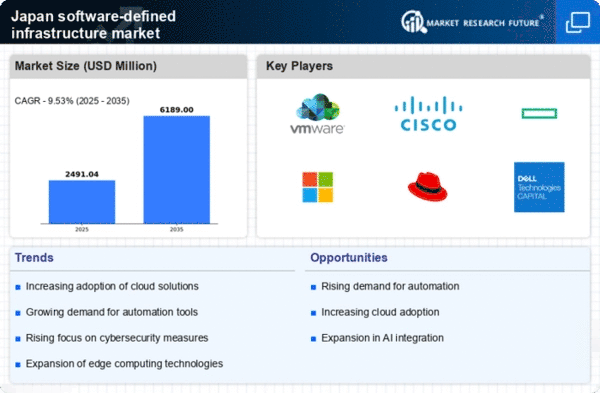
As per Market Research Future analysis, the Japan Software Defined Infrastructure Market size was estimated at 2274.3 USD Million in 2024. The Software Defined-infrastructure market is projected to grow from 2491.04 USD Million in 2025 to 6189.0 USD Million by 2035, exhibiting a compound annual growth rate (CAGR) of 9.5% during the forecast period 2025 - 2035

Key Market Trends & Highlights

The Japan software defined-infrastructure market is experiencing robust growth driven by technological advancements and evolving business needs.

  • The market is witnessing increased adoption of cloud solutions, particularly in the enterprise segment, which remains the largest.
  • Automation and orchestration are becoming focal points, with the fastest-growing segment being telecommunications.
  • Enhanced security measures are being prioritized as organizations recognize the growing importance of data security.
  • Key market drivers include rising demand for scalability and the integration of AI and machine learning to optimize infrastructure.

Market Size & Forecast

2024 Market Size 2274.3 (USD Million)
2035 Market Size 6189.0 (USD Million)
CAGR (2025 - 2035) 9.53%

Major Players

VMware (US), Cisco (US), Hewlett Packard Enterprise (US), Microsoft (US), Red Hat (US), Dell Technologies (US), IBM (US), Nutanix (US), Oracle (US)

Our Impact
Enabled $4.3B Revenue Impact for Fortune 500 and Leading Multinationals
Partnering with 2000+ Global Organizations Each Year
30K+ Citations by Top-Tier Firms in the Industry

Japan Software Defined Infrastructure Market Trends

The Japan Software Defined Infrastructure Market in Japan is currently experiencing a transformative phase, driven by the increasing demand for flexible and scalable IT solutions. Organizations are increasingly adopting software defined technologies to enhance operational efficiency and reduce costs. This shift is largely influenced by the need for businesses to adapt to rapidly changing market conditions and customer expectations. As a result, companies are investing in advanced infrastructure solutions that allow for greater automation and resource optimization. Furthermore, the integration of artificial intelligence and machine learning into these systems is expected to further enhance their capabilities, providing organizations with valuable insights and predictive analytics. In addition, the Japanese government is actively promoting digital transformation initiatives, which are likely to bolster the software defined-infrastructure market. Policies aimed at fostering innovation and supporting technology adoption are creating a conducive environment for growth. The emphasis on cybersecurity and data protection is also shaping the landscape, as organizations seek to secure their infrastructure against emerging threats. Overall, the software defined-infrastructure market in Japan appears poised for substantial growth, driven by technological advancements and supportive government policies.

Increased Adoption of Cloud Solutions

Organizations in Japan are increasingly embracing cloud-based solutions as part of their software defined-infrastructure strategies. This trend is driven by the need for scalability, flexibility, and cost-effectiveness. Companies are migrating their workloads to the cloud to enhance operational efficiency and improve service delivery.

Focus on Automation and Orchestration

There is a growing emphasis on automation and orchestration within the software defined-infrastructure market. Businesses are leveraging these technologies to streamline operations, reduce manual intervention, and improve resource management. This trend is expected to enhance overall productivity and responsiveness.

Enhanced Security Measures

As cyber threats continue to evolve, organizations are prioritizing security within their software defined-infrastructure frameworks. The implementation of advanced security protocols and compliance measures is becoming essential to protect sensitive data and maintain customer trust.

Japan Software Defined Infrastructure Market Drivers

Focus on Cost Efficiency

Cost efficiency remains a driving force in the software defined-infrastructure market in Japan. Organizations are increasingly seeking ways to reduce operational costs while maintaining high performance levels. The shift towards software defined infrastructure allows for more efficient resource utilization, which can lead to substantial cost savings. Data indicates that companies adopting these solutions have reported up to 30% reductions in IT operational expenses. This focus on cost efficiency is particularly relevant in industries facing tight margins, such as retail and manufacturing. As businesses continue to prioritize financial sustainability, the demand for cost-effective infrastructure solutions is expected to bolster the software defined-infrastructure market.

Rising Demand for Scalability

The software defined-infrastructure market in Japan is experiencing a notable surge in demand for scalability solutions. As organizations increasingly seek to adapt to fluctuating workloads, the ability to scale resources dynamically becomes paramount. This trend is particularly evident in sectors such as finance and telecommunications, where operational efficiency is critical. According to recent data, approximately 65% of enterprises in Japan are prioritizing scalable infrastructure to enhance their agility. This shift not only facilitates cost management but also supports the rapid deployment of applications, thereby driving growth in the software defined-infrastructure market. The emphasis on scalability is likely to continue as businesses strive to remain competitive in a fast-evolving digital landscape.

Government Initiatives and Support

Government initiatives aimed at promoting digital transformation are playing a crucial role in the software defined-infrastructure market in Japan. The Japanese government has launched various programs to encourage the adoption of advanced technologies, including software defined infrastructure. For example, initiatives that provide financial incentives for technology upgrades have led to increased investments in infrastructure modernization. Reports suggest that public sector spending on IT infrastructure is projected to rise by 20% over the next few years, further stimulating the software defined-infrastructure market. This supportive environment is likely to foster innovation and drive the adoption of cutting-edge solutions across various industries.

Growing Importance of Data Security

The growing importance of data security is a critical driver in the software defined-infrastructure market in Japan. With increasing cyber threats and data breaches, organizations are prioritizing secure infrastructure solutions to protect sensitive information. The implementation of software defined infrastructure allows for enhanced security protocols and better compliance with regulations. Recent surveys indicate that approximately 70% of Japanese enterprises consider data security a top priority in their IT strategy. This heightened focus on security is likely to drive investments in software defined infrastructure, as businesses seek to mitigate risks and ensure the integrity of their data.

Integration of AI and Machine Learning

The integration of artificial intelligence (AI) and machine learning (ML) technologies is significantly influencing the software defined-infrastructure market in Japan. Organizations are increasingly leveraging these technologies to optimize resource allocation and improve operational efficiency. For instance, AI-driven analytics can predict infrastructure needs, allowing for proactive scaling and management. Recent studies indicate that around 58% of Japanese companies are investing in AI and ML capabilities to enhance their infrastructure management. This trend not only streamlines operations but also reduces downtime, thereby enhancing service delivery. As AI and ML continue to evolve, their impact on the software defined-infrastructure market is expected to grow, potentially reshaping how businesses approach infrastructure management.


Market Segment Insights

By Type: Compute (Largest) vs. Storage (Fastest-Growing)

The Japan software defined-infrastructure market showcases a dynamic distribution of value among its core segments: Compute, Storage, and Network. Compute holds the largest market share primarily due to its critical role in processing and handling workloads efficiently, establishing itself as a leader. Meanwhile, Storage is rapidly gaining traction, reflecting a growing demand for data management solutions as enterprises increasingly prioritize data availability and accessibility. Growth trends indicate a robust expansion of the Storage segment, propelled by the increasing volume of data created and stored in organizations. This demand is driven by the digital transformation initiatives across various sectors, emphasizing the need for scalable and flexible storage solutions. Concurrently, Compute maintains its position through ongoing innovation, including advancements in virtualization and cloud computing capabilities, ensuring its relevance in an evolving market landscape.

Compute (Dominant) vs. Storage (Emerging)

In the Japan software defined-infrastructure market, Compute is recognized as the dominant segment due to its foundational importance in IT infrastructure. It underpins essential computing tasks, enabling organizations to optimize their performance and resource utilization. Compute solutions often incorporate cutting-edge technologies like virtualization and orchestration, catering to businesses that require agility and efficiency in their operations. Conversely, Storage is emerging as a critical segment, favored for its role in addressing the burgeoning requirements for data storage and management. Innovations like software-defined storage solutions offer organizations the flexibility to manage data more effectively. As organizations transition to cloud-based environments, Storage is becoming increasingly vital, reflecting a significant shift toward data-driven decision-making strategies.

By Deployment Model: Cloud-Based (Largest) vs. Hybrid (Fastest-Growing)

In the Japan software defined-infrastructure market, the deployment model segment is predominantly characterized by the strong presence of cloud-based solutions, which command the largest share. On-premises solutions continue to play a vital role but are gradually losing ground as businesses shift towards more flexible and scalable options. Hybrid models are also emerging as significant alternatives, catering to organizations looking to leverage both cloud and on-premises resources for optimized performance. The growth trend within the deployment model segment is largely driven by the increasing demand for scalability, flexibility, and cost-effectiveness. The cloud-based deployment model is favored for its ability to deliver resources and applications on-demand, promoting efficiency and reducing operational costs. Meanwhile, the hybrid model is gaining traction as organizations seek to combine the reliability of on-premises infrastructure with the agility of cloud services, making it the fastest-growing option in this segment.

On-Premises: Dominant vs. Hybrid: Emerging

On-premises solutions are currently the dominant force within the Japan software defined-infrastructure market, providing businesses with a controlled environment where data security and compliance are prioritized. These solutions attract industries with stringent regulatory needs, ensuring data is housed within their own facilities. Conversely, hybrid solutions are emerging rapidly, as they offer the flexibility of integrating cloud capabilities with existing on-premises resources. This appeal is particularly strong among businesses seeking to start a gradual transition into the cloud environment. The hybrid model enables organizations to optimize workloads and can significantly enhance their innovation potential while maintaining control over critical infrastructure.

By Technology: Containers (Largest) vs. Virtualization (Fastest-Growing)

In the Japan software defined-infrastructure market, Containers are emerging as the largest segment, reflecting the increasing demand for agile and efficient application deployment. This segment is gaining traction among enterprises looking to optimize their workloads and improve scalability. Conversely, Virtualization, while still significant, is being outpaced by the rapid adoption of container technology, signifying a shift in infrastructure management strategies. Growth trends in this sector are driven by the need for enhanced operational efficiency and flexibility in IT environments. As organizations increasingly embrace cloud-based solutions, the demand for Infrastructure Automation and Orchestration is intensifying. The movement towards DevOps practices and microservices architecture is also bolstering the popularity of Containers, making them pivotal in shaping the future of the Japan software defined-infrastructure market.

Technology: Containers (Dominant) vs. Virtualization (Emerging)

Containers are redefining how applications are developed and deployed within the Japan software defined-infrastructure market, showcasing their dominance through widespread adoption across industries. Their lightweight nature allows for rapid deployment and seamless integration with CI/CD pipelines. On the other hand, Virtualization remains relevant as an emerging segment, providing essential features for resource efficiency and isolation. While it serves traditional applications effectively, its growth is challenged by the agile capabilities offered by Containers. This shift indicates a broader trend towards cloud-native technologies that prioritize speed and flexibility, ultimately shaping the infrastructure landscape in Japan.

By End User: IT Telecommunications (Largest) vs. BFSI (Fastest-Growing)

In the Japan software defined-infrastructure market, the distribution of market share among end user segments reveals a significant presence of IT Telecommunications, which holds the largest share in 2024. It is followed closely by BFSI, which, while smaller in market share, is rapidly growing due to increased digital transformation initiatives. Other segments such as Healthcare, Retail, and Government maintain notable shares, reflecting a diverse interest across industries in leveraging software-defined technologies. Growth trends in the end user segment indicate a strong push towards digitalization across various sectors, particularly in BFSI, where the demand for secure, scalable solutions is escalating. The rapid adoption of cloud-based services and the need for enhanced IT infrastructure to support remote work are primary drivers. Healthcare is also witnessing growth due to increased investments in technology for patient management and operational efficiency, while Retail and Government are adapting to modern infrastructure needs to improve service delivery.

IT Telecommunications (Dominant) vs. BFSI (Emerging)

IT Telecommunications is the dominant segment in the Japan software defined-infrastructure market, characterized by its robust infrastructure and ability to support a wide range of applications, including cloud computing, data analytics, and network optimization. This segment enjoys a leading position due to its early adoption of advanced technology solutions, ensuring high reliability and performance for communication services. In contrast, BFSI is emerging rapidly, driven by the urgent need for cybersecurity, compliance, and seamless customer experiences. Financial institutions are turning to software-defined technologies to enhance service delivery and innovate their offerings. As BFSI continues to evolve, its growth is expected to challenge the dominance of IT Telecommunications, presenting unique opportunities and competitive dynamics in the marketplace.

Get more detailed insights about Japan Software Defined Infrastructure Market

Key Players and Competitive Insights

The software defined-infrastructure market in Japan is characterized by a dynamic competitive landscape, driven by rapid technological advancements and increasing demand for flexible IT solutions. Major players such as VMware (US), Cisco (US), and Hewlett Packard Enterprise (US) are strategically positioned to leverage innovation and partnerships to enhance their market presence. VMware (US) focuses on cloud infrastructure and digital workspace solutions, while Cisco (US) emphasizes network security and automation. Hewlett Packard Enterprise (US) is concentrating on hybrid cloud solutions, which collectively shape a competitive environment that is increasingly reliant on technological integration and customer-centric approaches.Key business tactics within this market include localizing manufacturing and optimizing supply chains to enhance operational efficiency. The competitive structure appears moderately fragmented, with several key players exerting influence over market dynamics. This fragmentation allows for a diverse range of offerings, catering to various customer needs while fostering innovation through competition.

In October VMware (US) announced a strategic partnership with a leading Japanese telecommunications provider to enhance its cloud services. This collaboration aims to integrate advanced AI capabilities into their offerings, thereby improving service delivery and customer experience. The strategic importance of this partnership lies in its potential to expand VMware's footprint in the Japanese market, aligning with local demand for sophisticated cloud solutions.

In September Cisco (US) launched a new initiative focused on enhancing cybersecurity measures within software defined-infrastructure. This initiative includes the introduction of advanced threat detection tools designed to protect data across hybrid environments. The significance of this move is underscored by the growing concerns around data security, positioning Cisco as a leader in safeguarding digital assets in an increasingly complex threat landscape.

In August Hewlett Packard Enterprise (US) unveiled its latest hybrid cloud platform, which integrates edge computing capabilities. This development is particularly relevant as it addresses the rising demand for real-time data processing and analytics. The strategic importance of this launch is evident in its alignment with market trends favoring edge computing, thereby enhancing HPE's competitive edge in delivering comprehensive infrastructure solutions.

As of November current competitive trends in the software defined-infrastructure market are heavily influenced by digitalization, sustainability initiatives, and the integration of AI technologies. Strategic alliances are increasingly shaping the landscape, enabling companies to pool resources and expertise to drive innovation. Looking ahead, competitive differentiation is likely to evolve from traditional price-based competition towards a focus on technological innovation, reliability in supply chains, and the ability to deliver tailored solutions that meet the specific needs of customers.

Key Companies in the Japan Software Defined Infrastructure Market include

Industry Developments

Fujitsu and Oracle established a strategic partnership in April 2024 to provide Japan with sovereign cloud and AI capabilities. Fujitsu will integrate over 100 OCI services, including generative AI, into its Uvance Hybrid IT portfolio by deploying Oracle's Alloy platform within its local data centers. This partnership allows government and enterprise clients in Japan to capitalize on cloud infrastructure with improved operational governance and data sovereignty.Juniper Networks expanded its partnership with Japan's National Institute of Informatics (NII) in September 2022 by enhancing its SINET6 academic network to 400G connectivity, which accommodates 70 PoPs. 

Juniper's MX Routers, ACX Cloud Metro Routers, NFV technologies, and DDoS protection were implemented as part of the initiative, which enhanced high-performance networking and virtualization in the research and education sectors.Microsoft announced a historic US $2.9 billion investment in April 2024 to expand its AI and cloud data center infrastructure in Japan over a two-year period. This investment is the largest of its kind in the country to date.

This entails the installation of AI semiconductors in two existing data centers, the establishment of an AI and robotics research facility in Tokyo, and the training of three million Japanese workers in AI skills, all while enhancing national cybersecurity.

Furthermore, in October 2024, JATCO, a significant automotive parts manufacturer in Japan, implemented Juniper's AI-native networking platform (enabled by Mist AI, AP43/AP63 access points) to upgrade its Wi-Fi infrastructure. The deployment of SDI allowed for proactive defect resolution, improved user connectivity, reduced costs, and increased productivity throughout its facilities, thereby illustrating the effectiveness of SDI deployment in manufacturing operations.

Future Outlook

Japan Software Defined Infrastructure Market Future Outlook

The Software Defined Infrastructure Market in Japan is projected to grow at a 9.53% CAGR from 2025 to 2035, driven by cloud adoption, automation, and demand for scalability.

New opportunities lie in:

  • Development of AI-driven resource management tools
  • Expansion of hybrid cloud solutions for enterprises
  • Integration of edge computing with existing infrastructure

By 2035, the market is expected to achieve substantial growth and innovation.

Market Segmentation

Japan Software Defined Infrastructure Market Type Outlook

  • Compute
  • Storage
  • Network

Japan Software Defined Infrastructure Market End User Outlook

  • IT Telecommunications
  • BFSI
  • Healthcare
  • Retail
  • Government

Japan Software Defined Infrastructure Market Technology Outlook

  • Virtualization
  • Containers
  • Infrastructure Automation
  • Orchestration

Japan Software Defined Infrastructure Market Deployment Model Outlook

  • On-Premises
  • Cloud-Based
  • Hybrid

Report Scope

MARKET SIZE 2024 2274.3(USD Million)
MARKET SIZE 2025 2491.04(USD Million)
MARKET SIZE 2035 6189.0(USD Million)
COMPOUND ANNUAL GROWTH RATE (CAGR) 9.53% (2025 - 2035)
REPORT COVERAGE Revenue Forecast, Competitive Landscape, Growth Factors, and Trends
BASE YEAR 2024
Market Forecast Period 2025 - 2035
Historical Data 2019 - 2024
Market Forecast Units USD Million
Key Companies Profiled VMware (US), Cisco (US), Hewlett Packard Enterprise (US), Microsoft (US), Red Hat (US), Dell Technologies (US), IBM (US), Nutanix (US), Oracle (US)
Segments Covered Type, Deployment Model, Technology, End User
Key Market Opportunities Integration of artificial intelligence in software defined-infrastructure market enhances operational efficiency and resource management.
Key Market Dynamics Rising demand for automation drives innovation in software defined-infrastructure, enhancing operational efficiency and scalability.
Countries Covered Japan
Leave a Comment

FAQs

What is the expected market size of the Japan Software-Defined Infrastructure Market in 2024?

In 2024, the Japan Software-Defined Infrastructure Market is expected to be valued at 2.43 billion USD.

What is the projected market value of the Japan Software-Defined Infrastructure Market by 2035?

By 2035, the market is projected to reach a value of 5.72 billion USD.

What is the expected compound annual growth rate (CAGR) for the Japan Software-Defined Infrastructure Market from 2025 to 2035?

The expected CAGR for the market from 2025 to 2035 is 8.104 percent.

Which segment is expected to dominate the Japan Software-Defined Infrastructure Market?

The Compute segment is anticipated to be the largest, valued at 2.01 billion USD by 2035.

What is the forecasted market size for the Storage segment in the Japan Software-Defined Infrastructure Market by 2035?

The Storage segment is expected to reach a market size of 1.75 billion USD by 2035.

How much is the Network segment valued in 2024 for the Japan Software-Defined Infrastructure Market?

In 2024, the Network segment is valued at 0.84 billion USD.

Who are the key players in the Japan Software-Defined Infrastructure Market?

Major players include Hewlett Packard Enterprise, Fujitsu, Nutanix, and Dell Technologies.

What challenges are faced by the Japan Software-Defined Infrastructure Market?

The market faces challenges such as rapid technological changes and the need for skilled workforce.

What opportunities exist within the Japan Software-Defined Infrastructure Market?

There are significant opportunities in increasing adoption of cloud services and digital transformation.

How are current global scenarios impacting the Japan Software-Defined Infrastructure Market?

Current global scenarios impact the market by influencing supply chain dynamics and investment trends.

Download Free Sample

Kindly complete the form below to receive a free sample of this Report

Compare Licence

×
Features License Type
Single User Multiuser License Enterprise User
Price $4,950 $5,950 $7,250
Maximum User Access Limit 1 User Upto 10 Users Unrestricted Access Throughout the Organization
Free Customization
Direct Access to Analyst
Deliverable Format
Platform Access
Discount on Next Purchase 10% 15% 15%
Printable Versions