×
Request Free Sample ×

Kindly complete the form below to receive a free sample of this Report

* Please use a valid business email

Leading companies partner with us for data-driven Insights

clients tt-cursor
Hero Background

Japan Smart Highways Market

ID: MRFR/ICT/61534-HCR
200 Pages
Aarti Dhapte
February 2026

Japan Smart Highways Market Size, Share and Research Report: By Technology (Intelligent Transportation Management System, Intelligent Traffic Management System) and By Deployment (On-Premises, Cloud-based)-Forecast to 2035

Share:
Download PDF ×

We do not share your information with anyone. However, we may send you emails based on your report interest from time to time. You may contact us at any time to opt-out.

Japan Smart Highways Market Infographic
Purchase Options

Japan Smart Highways Market Summary

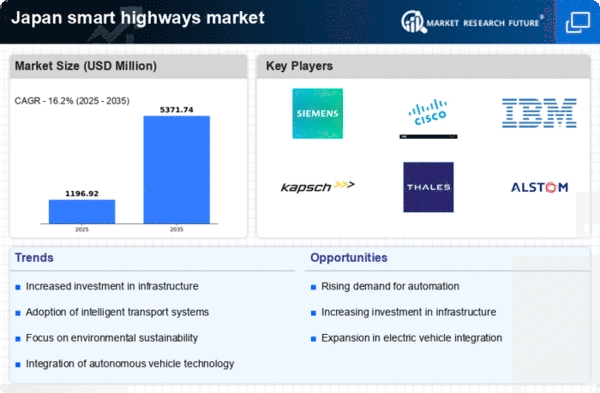
As per Market Research Future analysis, the Japan smart highways market size was estimated at 1030.05 USD Million in 2024. The Japan smart highways market is projected to grow from 1196.92 USD Million in 2025 to 5371.74 USD Million by 2035, exhibiting a compound annual growth rate (CAGR) of 16% during the forecast period 2025 - 2035

Key Market Trends & Highlights

The Japan smart highways market is poised for substantial growth driven by technological advancements and sustainability initiatives.

  • The integration of Intelligent Transportation Systems is transforming traffic management and enhancing road safety.
  • Sustainability initiatives are gaining traction, reflecting a growing commitment to environmentally friendly infrastructure.
  • Collaboration between public and private sectors is fostering innovation and accelerating project implementation.
  • Government investment in infrastructure and rising urbanization are key drivers propelling market expansion.

Market Size & Forecast

2024 Market Size 1030.05 (USD Million)
2035 Market Size 5371.74 (USD Million)
CAGR (2025 - 2035) 16.2%

Major Players

Siemens (DE), Cisco Systems (US), IBM (US), Kapsch TrafficCom (AT), Thales Group (FR), Alstom (FR), Honeywell (US), Cubic Corporation (US)

Our Impact
Enabled $4.3B Revenue Impact for Fortune 500 and Leading Multinationals
Partnering with 2000+ Global Organizations Each Year
30K+ Citations by Top-Tier Firms in the Industry

Japan Smart Highways Market Trends

The smart highways market is currently experiencing a transformative phase. This transformation is driven by advancements in technology and an increasing demand for efficient transportation solutions. In Japan, the integration of intelligent transportation systems (ITS) is becoming more prevalent, enhancing road safety and optimizing traffic flow. The government is actively investing in infrastructure improvements, which include the implementation of smart traffic signals, real-time monitoring systems, and vehicle-to-infrastructure communication. These developments not only aim to reduce congestion but also to minimize environmental impact, aligning with Japan's commitment to sustainability. Moreover, the rise of electric and autonomous vehicles is likely to further influence the smart highways market. As these vehicles become more common, the need for compatible infrastructure will grow. This shift may lead to innovative solutions such as dynamic lane management and adaptive traffic control systems. Collaboration between public and private sectors is essential for fostering an environment conducive to these advancements. Overall, the smart highways market is poised for significant growth, reflecting Japan's dedication to enhancing its transportation network and improving the quality of life for its citizens.

Integration of Intelligent Transportation Systems

The adoption of intelligent transportation systems is a key trend within the smart highways market. These systems facilitate real-time data collection and analysis, enabling better traffic management and improved safety measures. Japan's focus on ITS is evident in its ongoing projects aimed at enhancing road infrastructure and reducing travel times.

Sustainability Initiatives

Sustainability is becoming increasingly important in the smart highways market. Japan is prioritizing eco-friendly solutions, such as electric vehicle charging stations and energy-efficient traffic management systems. These initiatives not only support environmental goals but also promote the use of cleaner transportation options.

Collaboration Between Sectors

The collaboration between government entities and private companies is a notable trend in the smart highways market. This partnership is crucial for developing innovative technologies and infrastructure improvements. By working together, stakeholders can effectively address challenges and enhance the overall efficiency of transportation systems.

Japan Smart Highways Market Drivers

Public Awareness and Demand for Safety

Public awareness regarding road safety is a significant driver of the smart highways market in Japan. As traffic accidents continue to pose a serious concern, there is a growing demand for solutions that enhance safety on the roads. The introduction of smart technologies, such as automated traffic enforcement and real-time hazard detection systems, is seen as a proactive approach to mitigating risks. Surveys indicate that over 70% of the population supports the implementation of smart highway technologies to improve safety. This heightened awareness is likely to encourage government and private sector investments in the smart highways market, as stakeholders recognize the potential benefits of reducing accidents and enhancing overall road safety.

Government Investment in Infrastructure

The Japanese government has been actively investing in infrastructure development, particularly in the smart highways market. This investment is driven by the need to enhance transportation efficiency and safety. In recent years, the government allocated approximately $10 billion to upgrade existing roadways and implement smart technologies. These initiatives aim to reduce traffic congestion and improve overall road safety. The smart highways market in Japan is expected to benefit significantly from this influx of funding, as it facilitates the integration of advanced technologies such as vehicle-to-infrastructure communication and real-time traffic management systems. As a result, the market is projected to grow at a CAGR of 15% over the next five years, indicating a robust demand for innovative solutions in the transportation sector.

Environmental Regulations and Compliance

Japan's stringent environmental regulations are influencing the smart highways market. The government has set ambitious targets to reduce greenhouse gas emissions, which necessitates the adoption of sustainable transportation solutions. Smart highways can play a crucial role in achieving these targets by promoting eco-friendly driving behaviors and reducing congestion. For instance, the implementation of smart traffic management systems can lead to a reduction in vehicle emissions by up to 30%. As companies and municipalities strive to comply with these regulations, the demand for smart highway technologies is expected to rise. This regulatory environment creates a favorable landscape for innovation and investment in the smart highways market.

Rising Urbanization and Population Density

Japan's rapid urbanization and increasing population density are pivotal drivers of the smart highways market. With urban areas becoming more congested, the demand for efficient transportation solutions has surged. Approximately 91% of Japan's population resides in urban areas, leading to heightened traffic volumes and the need for smarter infrastructure. The smart highways market is poised to address these challenges by implementing technologies that optimize traffic flow and enhance safety. For instance, smart traffic signals and adaptive traffic management systems can significantly reduce travel times and emissions. This urbanization trend suggests a growing market potential, as stakeholders seek to invest in solutions that can alleviate the pressures of urban transport.

Technological Advancements in Connectivity

Technological advancements in connectivity are transforming the smart highways market in Japan. The proliferation of 5G technology is particularly noteworthy, as it enables faster and more reliable communication between vehicles and infrastructure. This connectivity facilitates the implementation of intelligent transportation systems that can monitor traffic conditions in real-time and provide drivers with critical information. The smart highways market is likely to see increased adoption of connected vehicle technologies, which can enhance safety and efficiency. As of 2025, it is estimated that over 50% of vehicles on Japanese roads will be equipped with connected technologies, further driving the demand for smart highway solutions that leverage these advancements.


Market Segment Insights

By Technology: Intelligent Transportation Management Systems (Largest) vs. Intelligent Traffic Management Systems (Fastest-Growing)

The Japan smart highways market exhibits a strong distribution in segment values, primarily dominated by Intelligent Transportation Management Systems. This segment holds the largest market share, significantly outweighing other technological advancements in the sector. In contrast, Intelligent Traffic Management Systems, while currently smaller in market share, have been rapidly gaining traction due to increasing urban traffic congestion and a rising focus on smart infrastructure. Recent trends indicate robust growth in the adoption of Intelligent Traffic Management Systems. The accelerating integration of advanced technologies such as AI and IoT within traffic management is a key driver for its expansion. Moreover, government initiatives encouraging smart city development are propelling the demand for both segment values. Consequently, these segments are expected to evolve further, adapting to emerging smart highway requirements.

Technology: Intelligent Transportation Management Systems (Dominant) vs. Intelligent Traffic Management Systems (Emerging)

Intelligent Transportation Management Systems are characterized by their comprehensive approach to traffic control and transport logistics, integrating various technologies to ensure efficient roadway use and traffic flow. This segment has established itself as the dominant force in the Japan smart highways market due to its capability to enhance transportation efficiency and safety. Meanwhile, Intelligent Traffic Management Systems are emerging as a critical player, focusing on real-time traffic data analysis and adaptive signal control. Their growth is fueled by advancements in sensor technologies and real-time data management, making them an attractive option for urban planners seeking solutions to escalating traffic issues.

By Deployment: Cloud-based (Largest) vs. On-Premises (Fastest-Growing)

In the Japan smart highways market, the deployment segment has witnessed a significant distribution between Cloud-based and On-Premises solutions. Currently, Cloud-based deployments hold the largest share, driven by their scalability and ease of integration with existing infrastructure. On-Premises solutions, while not as prevalent, are rapidly gaining traction among organizations seeking enhanced security and control over their data. This dynamic presents a diverse landscape within the deployment segment. Growth trends in the deployment segment are heavily influenced by technological advancements and changing consumer preferences. The shift towards smart city initiatives has bolstered the adoption of Cloud-based solutions, as they allow for seamless updates and remote management. Conversely, the increasing need for data security is propelling the growth of On-Premises deployments, making them an appealing choice for government and transportation agencies in Japan.

Deployment: Cloud-based (Dominant) vs. On-Premises (Emerging)

Cloud-based deployments dominate the segment in the Japan smart highways market due to their flexibility, cost-effectiveness, and ease of access. These solutions enable real-time data processing and analytics, essential for managing the growing complexity of transportation networks. On the other hand, On-Premises deployments are emerging as a preferred choice for organizations requiring stringent data security and compliance with regulations. These setups allow for greater control over IT resources and data governance, although they typically involve higher upfront costs and maintenance. As the market evolves, both deployment types will play crucial roles, catering to varying needs of stakeholders in the smart highways ecosystem.

Get more detailed insights about Japan Smart Highways Market

Key Players and Competitive Insights

The smart highways market in Japan is characterized by a dynamic competitive landscape. This landscape is driven by technological advancements and an increasing demand for efficient transportation solutions. Key players such as Siemens (DE), Cisco Systems (US), and IBM (US) are at the forefront, each adopting distinct strategies to enhance their market presence. Siemens (DE) focuses on innovation through the development of intelligent traffic management systems, while Cisco Systems (US) emphasizes digital transformation by integrating IoT solutions into highway infrastructure. IBM (US) leverages its expertise in data analytics to optimize traffic flow and enhance safety measures, collectively shaping a competitive environment that prioritizes technological integration and operational efficiency.The market structure appears moderately fragmented, with several players vying for dominance. Key business tactics include localizing manufacturing to reduce costs and enhance supply chain optimization. This approach not only fosters regional partnerships but also aligns with the growing trend of sustainability in infrastructure development. The collective influence of these major players is significant, as they drive innovation and set benchmarks for operational excellence within the market.

In October Siemens (DE) announced a partnership with a leading Japanese automotive manufacturer to develop smart traffic solutions that utilize AI for real-time traffic management. This strategic move is likely to enhance Siemens' position in the market by integrating advanced technologies into existing infrastructure, thereby improving traffic efficiency and safety. The collaboration underscores the importance of partnerships in driving innovation and meeting the evolving demands of urban mobility.

In September Cisco Systems (US) launched a new suite of IoT-enabled traffic management solutions aimed at enhancing connectivity across urban roadways. This initiative is significant as it aligns with the increasing emphasis on digitalization within the smart highways market. By providing real-time data analytics and connectivity, Cisco is positioning itself as a leader in the integration of smart technologies into transportation systems, potentially reshaping how cities manage traffic flow.

In August IBM (US) unveiled a new AI-driven platform designed to analyze traffic patterns and predict congestion in real-time. This development is crucial as it not only enhances the safety and efficiency of highway systems but also demonstrates IBM's commitment to leveraging cutting-edge technology to address contemporary transportation challenges. The platform's predictive capabilities may significantly influence traffic management strategies across Japan, setting a new standard for operational excellence.

As of November current trends in the smart highways market are heavily influenced by digitalization, sustainability, and AI integration. Strategic alliances among key players are shaping the competitive landscape, fostering innovation and collaboration. The shift from price-based competition to a focus on technological advancement and supply chain reliability is evident. Moving forward, competitive differentiation will likely hinge on the ability to innovate and adapt to emerging technologies, ensuring that companies remain at the forefront of this rapidly evolving market.

Key Companies in the Japan Smart Highways Market include

Industry Developments

Recent developments in the Japan Smart Highways Market have ramped up significantly, with investment from major companies such as Nippon Telegraph and Telephone Corporation, Kandenko, and Hitachi focusing on infrastructure modernization and intelligent traffic systems. In October 2023, Kawasaki Heavy Industries and Obayashi Corporation launched a collaborative project aimed at developing next-generation smart transportation solutions, enhancing safety and mobility.

Current affairs indicate a rising demand for sustainable and efficient transport systems, with the Japanese government pushing for smart highway initiatives as part of its broader smart city strategy. In terms of mergers and acquisitions, in September 2023, Sumitomo Electric Industries acquired a stake in a technology startup specializing in smart traffic management systems, signaling aggressive growth strategies among key players.

The consolidation within the market is likely to spur innovation, improve service delivery, and ultimately enhance user experiences. Moreover, the overall market valuation is expected to rise as companies like Fujitsu and Mitsubishi Electric invest extensively in Research and Development, aiming to pioneer advanced technologies and services. This combination of partnerships and investments reflects a vigorous pursuit of enhanced infrastructure and smart solutions in Japan's evolving transportation landscape.

Future Outlook

Japan Smart Highways Market Future Outlook

The Smart Highways Market in Japan is poised for growth at a 16.2% CAGR from 2025 to 2035, driven by technological advancements and increasing urbanization.

New opportunities lie in:

  • Integration of AI-driven traffic management systems
  • Development of smart tolling solutions for efficiency
  • Expansion of electric vehicle charging infrastructure along highways

By 2035, the smart highways market is expected to achieve substantial growth and innovation.

Market Segmentation

Japan Smart Highways Market Deployment Outlook

  • On-Premises
  • Cloud-based

Japan Smart Highways Market Technology Outlook

  • Intelligent Transportation Management Systems
  • Intelligent Traffic Management Systems

Report Scope

MARKET SIZE 2024 1030.05(USD Million)
MARKET SIZE 2025 1196.92(USD Million)
MARKET SIZE 2035 5371.74(USD Million)
COMPOUND ANNUAL GROWTH RATE (CAGR) 16.2% (2025 - 2035)
REPORT COVERAGE Revenue Forecast, Competitive Landscape, Growth Factors, and Trends
BASE YEAR 2024
Market Forecast Period 2025 - 2035
Historical Data 2019 - 2024
Market Forecast Units USD Million
Key Companies Profiled Siemens (DE), Cisco Systems (US), IBM (US), Kapsch TrafficCom (AT), Thales Group (FR), Alstom (FR), Honeywell (US), Cubic Corporation (US)
Segments Covered Technology, Deployment
Key Market Opportunities Integration of advanced traffic management systems enhances efficiency in the smart highways market.
Key Market Dynamics Technological advancements drive smart highways adoption, enhancing traffic management and safety in Japan's urban areas.
Countries Covered Japan
Leave a Comment

FAQs

What is the expected market size of the Japan Smart Highways Market in 2024?

The Japan Smart Highways Market is expected to be valued at 1.5 billion USD in 2024.

What will the Japan Smart Highways Market be valued at by 2035?

By 2035, the Japan Smart Highways Market is projected to reach a value of 10.0 billion USD.

What is the expected compound annual growth rate (CAGR) for the Japan Smart Highways Market from 2025 to 2035?

The market is expected to grow at a CAGR of 18.823% from 2025 to 2035.

Which segment of the Japan Smart Highways Market is expected to have the largest market value in 2035?

The Intelligent Transportation Management System segment is projected to be valued at 6.0 billion USD in 2035.

What is the expected market value for the Intelligent Traffic Management System segment in 2024?

The Intelligent Traffic Management System segment is expected to be valued at 0.6 billion USD in 2024.

Who are the key players in the Japan Smart Highways Market?

Major players include Nippon Telegraph and Telephone Corporation, Fujitsu, and Mitsubishi Electric among others.

What was the market value for the Intelligent Transportation Management System in 2024?

The market for Intelligent Transportation Management System is valued at 0.9 billion USD in 2024.

What are the main challenges faced by the Japan Smart Highways Market?

Challenges include technology implementation and integration complexities within existing infrastructure.

How is the Japan Smart Highways Market expected to grow regionally?

The market is expected to see significant growth driven by advancements in transportation technologies and infrastructure investments.

What are the emerging trends in the Japan Smart Highways Market?

Emerging trends include increased automation and the integration of artificial intelligence in traffic management systems.

Download Free Sample

Kindly complete the form below to receive a free sample of this Report

Compare Licence

×
Features License Type
Single User Multiuser License Enterprise User
Price $4,950 $5,950 $7,250
Maximum User Access Limit 1 User Upto 10 Users Unrestricted Access Throughout the Organization
Free Customization
Direct Access to Analyst
Deliverable Format
Platform Access
Discount on Next Purchase 10% 15% 15%
Printable Versions